Papua-New Guinea's
pp. 50-53 · Read in the full issue
New Tea Industry Is Getting Into Its Stride
By a Staff Writer
The first commercially-grown tea from the Mt. Hagen area of the Western Highlands of Papua-New Guinea will be processed soon in a new tea factory at Banz, to be officially opened by the Australian Minister for Territories, Mr.
C. E. Barnes, on July 7. The tea will probably reach the international market in 1967.
THE tea is being grown by Kurumul Plantations Pty. Ltd., a sub sidiary of F. W. Williams Holdings Ltd., of Sydney.
This company is one of a number of Australian interests which have begun producing tea in the Western Highlands since the Australian Government alienated land for this purpose a couple of years ago.
Most of the plantations are in the
Wahgi Valley at an average altitude of 5,000 ft. They should be in full production in six to eight years.
By the mid-1970’5, these and a few other big Australian plantations, together with numerous smaller ones run by native growers, are expected to be producing something like 4,000 tons of processed tea a year.
High Altitude Tea
This figure is based on an annual yield of 1,000 lb of manufactured tea per acre. But the yield could be considerably higher than that.
World experience has demonstrated that the greater the altitude, the better the quality. So everyone has high hopes that the quality of Western Highlands tea will be out standing.
If these hopes are realised, the tea industry should become one of P-NG’s biggest money-earners, as “quality” teas now fetch from 4/to 6/- a lb on the London market.
On these figures, the annual pro duction by the mid-seventies should be worth from £1,792,000 to £2,688,000 sterling, or more than any other P-NG industry except coconuts and perhaps coffee and cocoa.
The only problem at present seriously worrying the tea people is transport.
Its importance has been highlighted in recent weeks by the closure of
the 340-mile Lae-Mt. Hagen road through wet weather and landslides at the Daulo and Kassam Passes.
The closure has meant that fertiliser and equipment needed for the tea plantations has either been held up at Lae, or has had to be flown up.
This has caused some tea-men to think gloomily about what could happen to their tea if the road is not made landslide-proof by the time their plantations come into produc tion in a big way.
The fact is that tea deteriorates in quality the longer it is stored, particularly in a humid climate. So it is essential to have reliable transport to get it to market.
At least one of the tea interests has based all its costing on the use of air transport. But most apparently have not; and it seems certain that before long these people will either be urging the Administration to im prove the Lae-Mt. Hagen road, or to build a new one on a much shorter route from Mt. Hagen to Madang.
A Mt. Hagen-Madang road would mean that the tea people, and every one else in the Mt. Hagen area, would have the fine harbour at Madang through which to ship their cargoes.
The total area of land considered suitable for tea-growing in the Western Highlands is estimated at 26,000 acres. So this region should
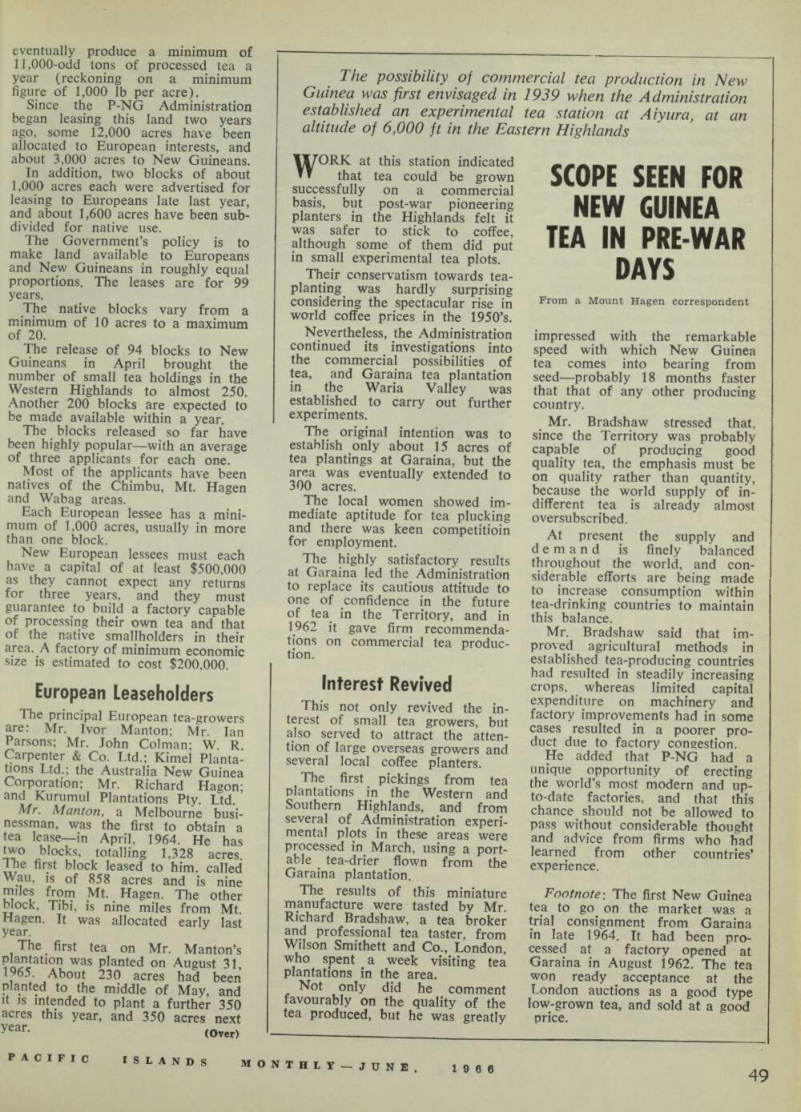
An employee inspects a tea plant for planting out at the nursery of Mr.
Ivor Manton near Mt. Hagen. Mr.
Manton was the first European to obtain a tea lease from the Admi nistration. This was in April, 1964.
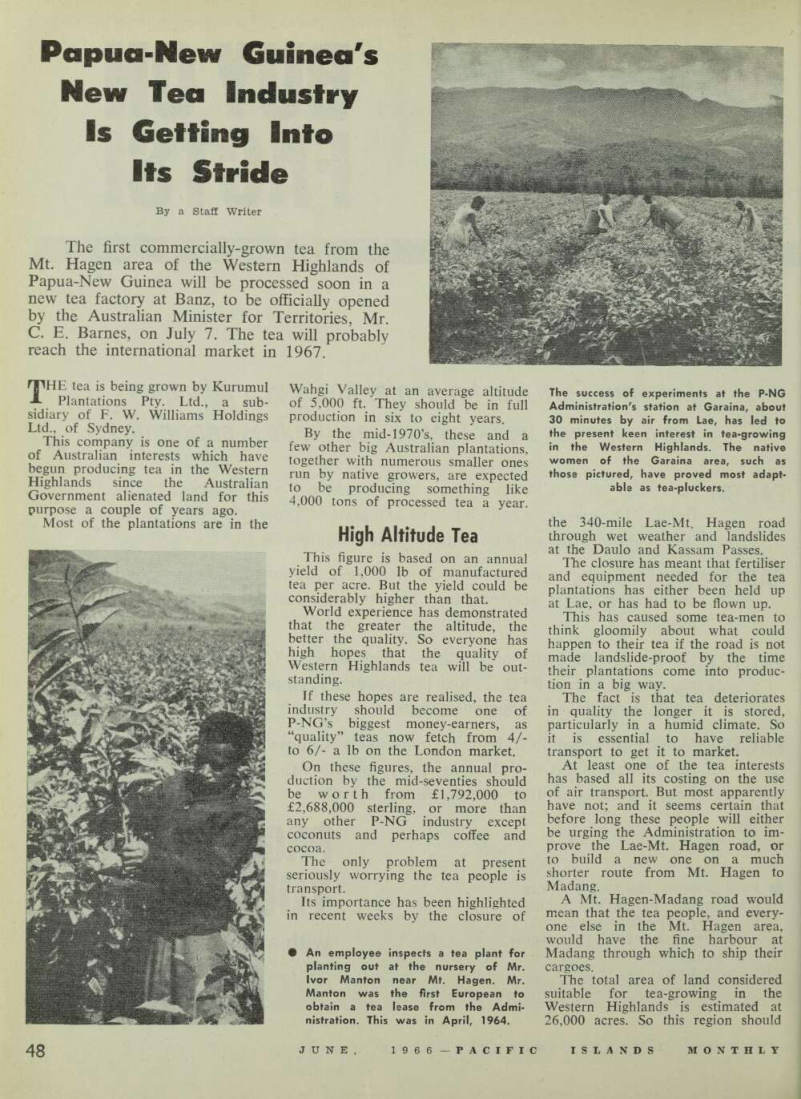
The success of experiments at the P-NG Administration's station at Garaina, about 30 minutes by air from Lae, has led to the present keen interest in tea-growing in the Western Highlands. The native women of the Garaina area, such as those pictured, have proved most adapt able as tea-pluckers.
eventually produce a minimum of 11,000-odd tons of processed tea a year (reckoning on a minimum figure of 1,000 lb per acre).
Since the P-NG Administration began leasing this land two years ago, some 12,000 acres have been allocated to European interests, and about 3,000 acres to New Guineans.
In addition, two blocks of about 1,000 acres each were advertised for leasing to Europeans late last year, and about 1,600 acres have been sub divided for native use.
The Government’s policy is to make land available to Europeans and New Guineans in roughly equal proportions. The leases are for 99 years.
The native blocks vary from a minimum of 10 acres to a maximum of 20.
The release of 94 blocks to New Guineans in April brought the number of small tea holdings in the Western Highlands to almost 250.
Another 200 blocks are expected to be made available within a year.
The blocks released so far have been highly popular—with an average of three applicants for each one.
Most of the applicants have been natives of the Chimbu, Mt. Hagen and Wabag areas.
Each European lessee has a mini mum of 1,000 acres, usually in more than one block.
New European lessees must each have a capital of at least $500,000 as they cannot expect any returns for three years, and they must guarantee to build a factory capable of processing their own tea and that of the native smallholders in their area. A factory of minimum economic size is estimated to cost $200,000.
European leaseholders
The principal European tea-growers are: Mr. Ivor Manton; Mr. lan Parsons; Mr. lohn Colman; W. R Carpenter & Co. Ltd.; Kimel Planta tions Ltd.; the Australia New Guinea Corporation; Mr. Richard Hagon; and Kurumul Plantations Pty. Ltd.
Mr. Manton, a Melbourne busi nessman, was the first to obtain a tea lease—in April, 1964. He has two blocks, totalling 1,328 acres The first block leased to him. called Wau, is of 858 acres and is nine miles from Mt. Hagen. The other block, Tibi, is nine miles from Mt.
Hagen. It was allocated early last year.
The first tea on Mr. Manton’s Pj. a jl tatlon was planted on August 31, 1965. About 230 acres had been planted to the middle of May, and it is intended to plant a further 350 acres this year, and 350 acres next year * (Over)
Plucking is expected to begin in May or June next year, Mr. Manton plans to build a factory to cope with 1,000 acres of bearing tea. Work on this will begin next January, and it is hoped to have it in production by June.
A force of 147 workers from Tari in the Southern Highlands is at present engaged on Mr. Manton’s property. This will be increased to 1,000 workers when in full produc tion.
The labour quarters have been de scribed as the best in the territory, with hot and cold showers and Asian type toilets.
Mr. Parsons’ plantation, called Nunga, is 27 miles east of Mt, Hagen.
Part of it is at present devoted to coffee.
Nunga’s first tea was planted early in 1963. One hundred acres have now been planted, and there should be 150 acres by the end of this year.
Mr. Parsons has had about 30 acres in bearing for the past six months, but this tea has not been plucked because no factory facilities are available.
A co-operative factory is to be built in the area in the near future — for other European and native plant ings as well as Nunga tea.
Mr. Parsons expects that 150 acres of tea will require 100 units of labour; and that the yield from five year-old tea will be 1,500 lb of made tea an acre.
Mr. Colman, a former patrol officer, and now a well-known planter and trader, has a property about 10 miles east of Mt. Hagen.
Called Madan Tea Estate, it covers 455 acres.
At present Mr. Colman has 25 acres of one-year-old tea established on his Madan Tea Estate, and nursery potential of about 60 acres.
He intends to plant 60 to 80 acres a year with final total of 300 acres by 1970.
W. R. Carpenter & Co. Ltd. have three blocks totalling 5,327 acres.
The nearest to Mt. Hagen is 45 miles by road. Roads are now being
built to shorten this distance con siderably.
The Carpenter tea interests are the largest in the Western Highlands, and the company expects to spend up to $2 million on its plantations by 1974.
The company’s first seed was planted soon after it acquired its leases two years ago, but planting did not begin in earnest until November, 1964.
By the end of this year, about 1,000 of the company’s 5,327 acres will be under tea. The first tea to be processed should be plucked in the early part of 1968.
At present, there are about 450 native and a dozen European employees on the three properties, and at the end of eight years, there could be as many as 3,500 natives and a few more Europeans.
“We will not be putting up a factory until we have good quality tea to put through it,” a company spokesman told me.
“We are not interested in growing filler tea or low-grade tea. We think it is essential for the wellbeing of
the New Guinea tea industry—and we trust everyone else will feel the same way—that New Guinea tea should n 0? acc ' u " e ? through going on to the market too
soon -
Pos6r For Administration
Asked about problems facing the tea industry, the spokesman said that t h e Administration would have to f ace up quickly to the matter of transportation between Mt. Hagen an( j t h e coast. . The road t 0 Lae is again out of act ; onj an( j ;t j s an open question * * reliaWe h “A road to Madan, would certainly be much shorter, Kimel Plantations Ltd's property is two blocks totalling 1,250 acres.
Both of these are between Mt. Hagen and Banz. Kimel Plantation, itself, is a large estate owned by Koitaki Para Rubber Estates Ltd. Until recently it was devoted to coffee, pie other property, about nine miles away, is the Tremearne Tea and
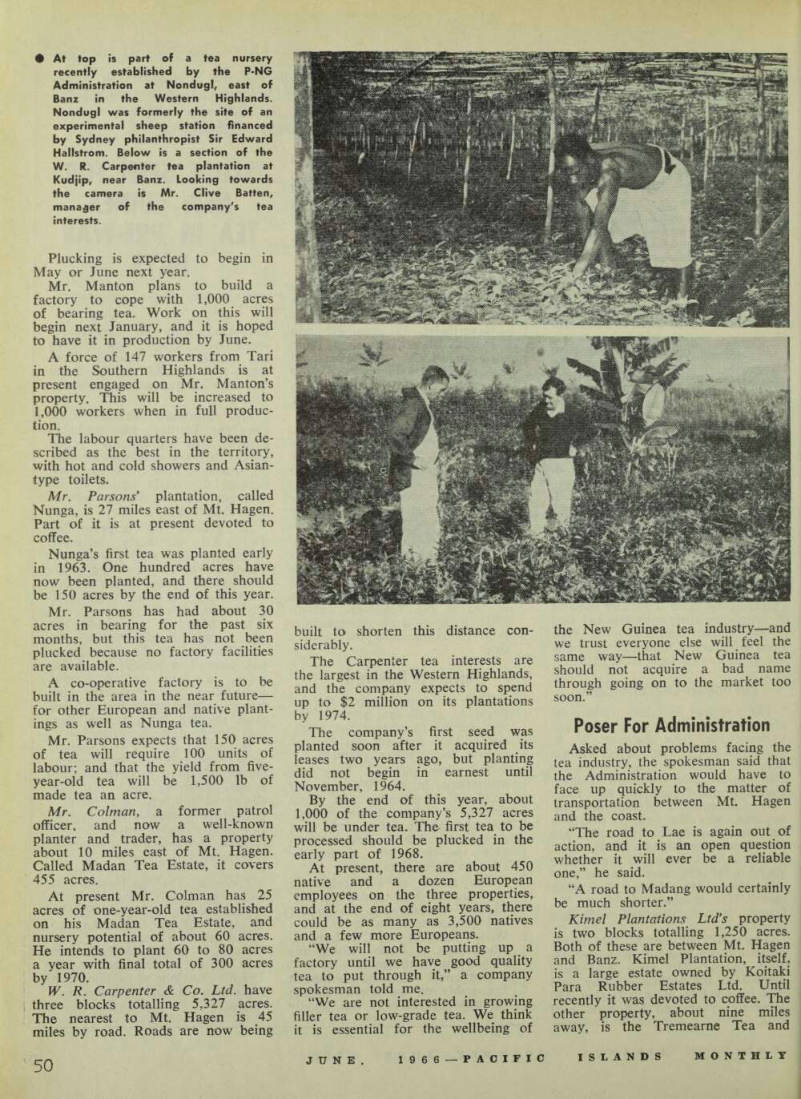
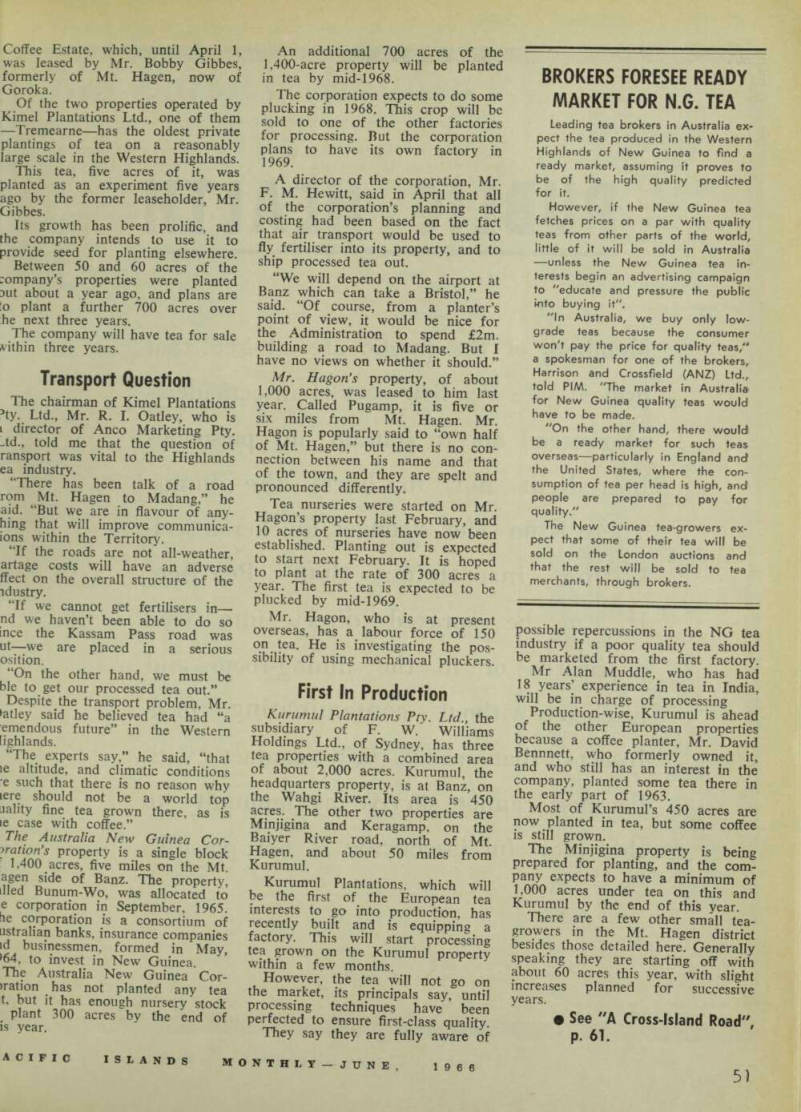
At top is part of a tea nursery recently established by the P-NG Administration at Nondugl, east of Banz in the Western Highlands.
Nondugl was formerly the site of an experimental sheep station financed by Sydney philanthropist Sir Edward Hallstrom. Below is a section of the W. R. Carpenter tea plantation at Kudjip, near Banz. Looking towards the camera is Mr. Clive Batten, manager of the company's tea interests.
Coffee Estate, which, until April 1, was leased by Mr. Bobby Gibbes, formerly of Mt. Hagen, now of Goroka.
Of the two properties operated by Kimel Plantations Ltd., one of them —Tremearne—has the oldest private plantings of tea on a reasonably large scale in the Western Highlands, This tea, five acres of it, was planted as an experiment five years ago by the former leaseholder, Mr.
Gibbes.
Its growth has been prolific, and the company intends to use it to provide seed for planting elsewhere.
Between 50 and 60 acres of the :ompany’s properties were planted 3ut about a year ago, and plans are to plant a further 700 acres over he next three years.
The company will have tea for sale vithin three years.
Transport Question
The chairman of Kimel Plantations 3 ty. Ltd., Mr. R. I. Oatley, who is i director of Anco Marketing Pty. -td., told me that the question of ransport was vital to the Highlands ea industry.
“There has been talk of a road rom Mt. Hagen to Madang,” he aid, “But we are in flavour of any hing that will improve communica ions within the Territory.
“If the roads are not all-weather, artage costs will have an adverse ffect on the overall structure of the idustry.
“If we cannot get fertilisers in— nd we haven’t been able to do so ince the Kassam Pass road was ut —we are placed in a serious osition.
“On the other hand, we must be ble to get our processed tea out.”
Despite the transport problem, Mr. ►atley said he believed tea had “a emendous future” in the Western [ighlands.
“The experts say,” he said, “that ic altitude, and climatic conditions e such that there is no reason why lere should not be a world top uality fine tea grown there, as is ic case with coffee.”
The Australia New Guinea Cor iration’s property is a single block 1,400 acres, five miles on the Mt. agen side of Banz. The property, illed Bunum-Wo, was allocated to e corporation in September, 1965. tie corporation is a consortium of ustralian banks, insurance companies id businessmen, formed in May, *64, to invest in New Guinea.
The Australia New Guinea Cor iration has not planted any tea t, but it has enough nursery stock plant 300 acres by the end of is year.
An additional 700 acres of the 1,400-acre property will be planted in tea by mid-1968.
The corporation expects to do some plucking in 1968. This crop will be sold to one of the other factories for processing. But the corporation plans to have its own factory in 1969.
A director of the corporation, Mr.
F. M. Hewitt, said in April that all of the corporation’s planning and costing had been based on the fact that air transport would be used to fly fertiliser into its property, and to ship processed tea out.
“We will depend on the airport at Banz which can take a Bristol,” he said. “Of course, from a planter’s point of view, it would be nice for the Administration to spend £2m. building a road to Madang. But I have no views on whether it should.”
Mr. Hagon’s property, of about 1,000 acres, was leased to him last year. Called Pugamp, it is five or six miles from Mt. Hagen. Mr.
Hagon is popularly said to “own half of Mt. Hagen,” but there is no con nection between his name and that of the town, and they are spelt and pronounced differently.
Tea nurseries were started on Mr.
Hagon’s property last February, and 10 acres of nurseries have now been established. Planting out is expected to start next February. It is hoped to plant at the rate of 300 acres a year. The first tea is expected to be plucked by mid-1969.
Mr. Hagon, who is at present overseas, has a labour force of 150 on tea. He is investigating the pos sibility of using mechanical pluckers.
First In Production
Kurumul Plantations Pty. Ltd., the subsidiary of F. W. Williams Holdings Ltd., of Sydney, has three tea properties with a combined area of about 2,000 acres. Kurumul, the headquarters property, is at Banz, on the Wahgi River. Its area is 450 acres. The other two properties are Minjigina and Keragamp, on the Baiyer River road, north of Mt.
Hagen, and about 50 miles from Kurumul.
Kurumul Plantations, which will be the first of the European tea interests to go into production, has recently built and is equipping a factory. This will start processing tea grown on the Kurumul property within a few months.
However, the tea will not go on the market, its principals say, until processing techniques have been perfected to ensure first-class quality.
They say they are fully aware of
possible repercussions in the NG tea industry if a poor quality tea should be marketed from the first factory.
Mr Alan Muddle, who has had 18 years’ experience in tea in India, will be in charge of processing Production-wise, Kurumul is ahead of the other European properties because a coffee planter, Mr. David Bennnett, who formerly owned it, and who still has an interest in the company, planted some tea there in the early part of 1963.
Most of Kurumul’s 450 acres are now planted in tea, but some coffee is still grown.
The Minjigina property is being prepared for planting, and the com pany expects to have a minimum of 1,000 acres under tea on this and Kurumul by the end of this year.
There are a few other small tea growers in the Mt. Hagen district besides those detailed here. Generally speaking they are starting off with about 60 acres this year, with slight increases planned for successive years.
See "A Cross-Island Road" p. 61.