Territories TALK-TALK
pp. 43-47 · Read in the full issue
Memories Of New Guinea Clubland Of
The Days B4
With Tola la
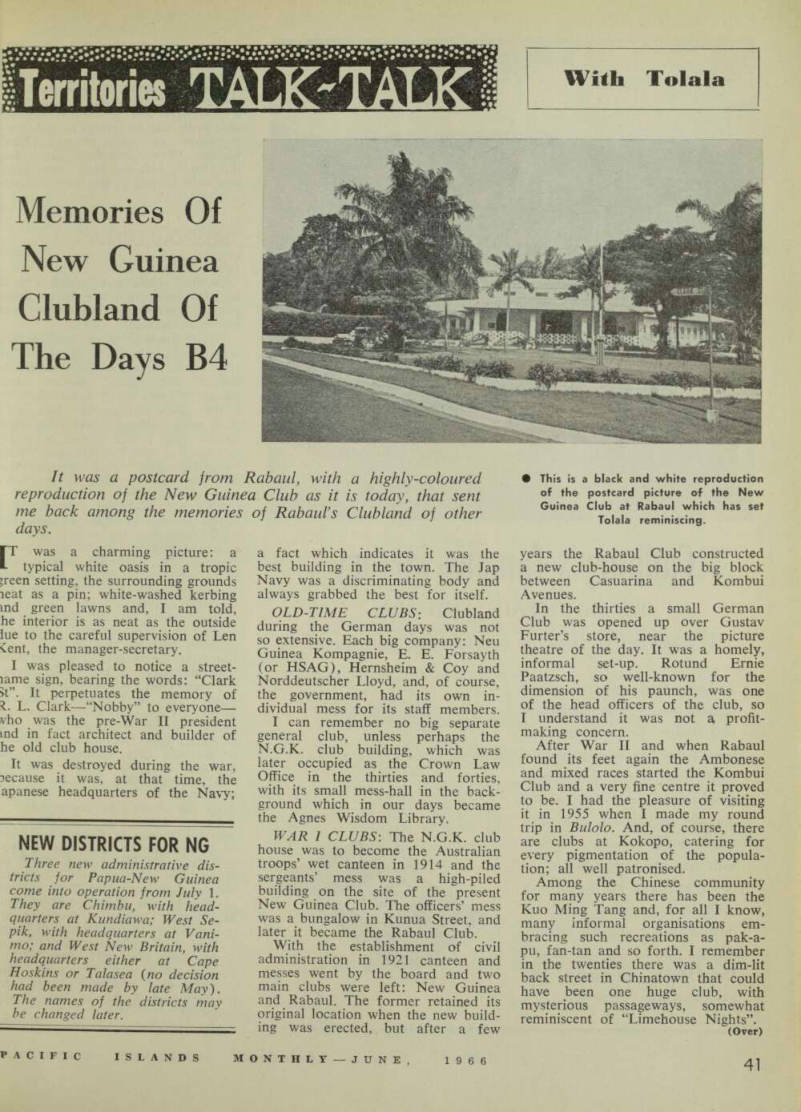
It was a postcard from Rabaul, with a highly-coloured reproduction of the New Guinea Club as it is today, that sent me back among the memories of RabauVs Clubland of other days.
[T was a charming picture: a typical white oasis in a tropic ;reen setting, the surrounding grounds leat as a pin; white-washed kerbing md green lawns and, I am told, he interior is as neat as the outside iue to the careful supervision of Len Cent, the manager-secretary.
I was pleased to notice a streetlame sign, bearing the words: “Clark >t”. It perpetuates the memory of L L. Clark—“Nobby” to everyone— vho was the pre-War II president md in fact architect and builder of he old club house.
It was destroyed during the war, because it was, at that time, the apanese headquarters of the Navy
a fact which indicates it was the best building in the town. The Jap Navy was a discriminating body and always grabbed the best for itself.
OLD-TIME CLUBS • Clubland during the German days was not so extensive. Each big company Neu Guinea Kompagnie, E. E. Forsayth (or HSAG), Hernsheim & Coy and Norddeutscher Lloyd, and, of course, the government, had its own individual mess for its staff members.
I can remember no big separate general club, unless perhaps the N.G.K. club building, which was late . r occupied as the Crown Law Office in the thirties and forties, with Rs small mess-hall in the background which in our days became the Agnes Wisdom Library. tj7 a n 7 rTnr , , house was to become the Australian troops wet canteen in 1914 and the sergeants mess was a high-piled building on file site of the present New Guinea Club. The officers mess was a bungalow in Kunua Street, and * at « r R became the Rabaul Club.
With the establishment of civil administration m 1921 canteen and messes went by the board and two mam clubs were left: New Guinea and Rabaul. The former retained its original location when the new buildmg was erected, but after a few
years the Rabaul Club constructed a new club-house on the big block between Casuarina and Kombui Avenues.
In tbe thirties a small German Club was °P ened U P over Gustav Furter ’ s store, near the picture * heatre of the day. It was a homely, informal set-up. Rotund Ernie Paatzsch, so well-known for the dimension of his paunch, was one th( r head officers of the club, so understand it was not a, profit making concern, After . War 11 and when Rabaul f°und its feet again the Ambonese and mixeid races started the Kombui Club and a very fine centre it proved *° . be - I bad , the P leasu T e of visiting ltm 1955 when I made my round trip in Bulolo. And, of course, there every the a \\ we h patronised.
Among the Chinese community f or ma ny years there has been the Kuo Ming Tang and, for all I know many informal organisations em bracing such recreations as pak-a pUj fan-tan and so forth. I remember j n the twenties there was a dim-lit back street in Chinatown that could haV e been one huge club, with mysterious passageways, somewhat reminiscent of “Limehouse Nights”. (Over)
This is a black and white reproduction of the postcard picture of the New Guinea Club at Rabaul which has set Tolala reminiscing.
But now all this has changed There are many clubs of various types, I expect all doing a good job. I don’t even pretend to know the extent of club activity in post war Rabaul. But, I do feel assured that both the anticipation and par ticipation of the pre-war New Guinea Club Christmas party for the local kiddies have not been surpassed by any of the more modern festivities.
Those Old Copra
Catchers
A short while ago I read, with a certain regret, that the Burns Philp passenger service to New Guinea was to be abandoned.
Every pre-War II resident of NG will retain pleasant memories of trips made in one of the chequered funnel BP liners, either inter island or from or to Australia.
BP seven-lettered-“M” vessels have been calling at NG ports long before War I and it was only the introduction of the German NDL steamships line which stopped the BP ships from calling in the Ger man colony.
The old Moresby was the last vessel to call at Rabaul when the NDL took over the run. It was the same Moresby which, after the oc cupation by Australian troops, was the first to call at Rabaul and renew trade relations with the one-time German colony.
From then on BP ships ran a more or less regular schedule between Sydney and New Guinea, Itineraries “were subject to alteration without notice” in the earlier years.
I remember joining Matunga at Faisi (BSI) in 1915 for a trip to Sydney. Capt. Donaldson was the master; Brush was supercargo and at Faisi Willy Dupain went aboard, as he was being transferred from manager at Faisi to take over the newly-re-established business of BP in Rabaul. He was the first manager since the Australian occupation.
From Faisi we travelled to Samarai, thence to Rabaul and then back through the Solomons to Syd ney. Poor old Matunga. A couple of years later she was to be captured by the German raider Wolf and all passengers and crew were interned in Europe. Donaldson wrote an in teresting little book on the incident.
That was really my first trip on a BP liner. In 1911 and 1912 I had travelled in NDL vessels. The German ships had two classes, and the fare from Sydney to Rabaul was about £l2.
Old residents of New Guinea
have a tender spot for those old BP copra catchers in which they travelled from the salt-mines of New Guinea to the pleasure-grounds of Australia, filled with ardent ex pectation of the joys ahead, care free and irresponsible; and then — the other side of the coin—the return to the salt-mines from the pleasure grounds: depressed, restrained, re pentant, stone motherless broke!
Yet you knew you’d do it all over again in three years’ time!
There was something comforting about the small smoke-rooms of those old-time liners: Melusia , Marsina, Morinda and others, dim-lit, smoke beclouded with members of a huge wandering clan gathered together from all parts of the territory doing some systematic drinking, while pro bably at a table in the corner four more sedate personalities would be playing bridge.
I recall one such scene when the skipper made one of the bridge four and every now and then a gust of wind would edge in through the doorway and disarrange dummy’s cards.
The skipper, an enthusiastic player, stood this irritation for some time, then beckoned the steward: “My compliments to Mr. Smith on the bridge and ask him to ease her off a couple of points”. Dummy’s cards afterwards lay undisturbed. The slight variation in the course had done the trick.
Sydney To Rabaul : The
most interesting trip I remember at the moment is one in 1923 when I went up to Rabaul in Mataram, I think it was, and there was a gaggle of Parliamentarians aboard under the leadership of Senator Crawford, of Queensland.
It was the first official party of politicians to visit Australia’s mandated territory. It was the first of many to follow down the years— and they’re still going.
One of the members was bluff tough, rough (but likeable) Senator Grant, an old Labour warhorse conspicuous sartorially for his red bandanna handkerchief tied around his neck and his firemen braces which kept his heavy dark blue serge trousers from falling down. There were a couple of Senators from Tasmania—Bennie and Benn (?) could be—but the most energetic member of the party was a tyro who later became Australia’s Prime Minister for six days in 1946, but at that time—l923—had only been Federal Member for Capricornia for a year.
His name was Francis Forde and he was as keen as mustard to find
all there was to be found out about New Guinea. He was always to be seen jotting down notes in his little black book and quizzing anyone who had a knowledge of the place.
Another interesting party travel ling on the same ship was the Papal Delegate in Sydney, Archbishop Cat taneo, accompanied by two Sydney priests, Fathers King and Clune. The Archbishop was on his way to New Guinea for the purpose of installing Bishop Vesters at Vunapope and Bishop Wolff at Alexishaven.
I was happy to meet Father Clune again. He had been the RC padre
of the 19th and 20th Bns. AIF in France and had been no base wallah.
He had collected an MC for his good work in the line.
Going Round The Traps:
But better than the trips to and from Sydney were the “business” trips, taken by executive officers around the group. A sort of “going round the traps” to see that all was well.
“It keeps the outports staff on their toes,” as one executive explained to me one day, when there was no need for any explanation, though I suppose he felt a bit guilty as he
made it a regular practice to take one on first Melusia, then Montoro, Mataram and finally Macdhui.
And what a pleasant trip it was: calling possibly at Kavieng, then Lombrum, Western Islands, on to Seleo Island for the Aitape coast, possibly at Awar, then on to Madang, Witu and back to Rabaul.
A 10 days’ period of relaxation, when stuffed shirts became unihibited and let their hair down; seeing new faces, making new friends, eating other foods and as for the personal servants who accompanied these stuf fed shirts, they enjoyed every moment of the adventure from the time they were told to pack for a trip “along sitima” to when the vessel came alongside the Rabaul wharf on the return trip.
Those lads had much to prepare for the trip; not only were they valets, but “wash-boys” as well and there existed a lively rivalry among this general factotum crowd to see that their own particular “master” (I am talking of the primitive twenties and thirties when the term was used) was better groomed than others.
White duck or drill suits were the popular wear in those years; whiter than white, well starched and ex pertly ironed.
We Have No Time : And
now? ... It would seem that there will not be much chance for a leisurely “going round the traps” not by the good BP steamers, any way. . . . We have not the time! . . .
How is it that 30 or 40 years ago we had so much more time than we have today? Chief executives, de partmental heads at one time could do their inspections by leisurely steamers; now their “skedules” are so tight they must hop from here to there and over yonder by aeroplane.
In many a case the time saved in travelling is spent lying in bed with an ulcer.
One of these fine days we’ll put this speed fiend where it belongs and live a leisurely life once again—as it was originally intended we should do.