A Jolly Good Show
pp. 17-18 · Read in the full issue
A Prince, A Baron And A Jolly Good Show
From New Guinea Correspondents
Regal and vice-regal visitors made May a VIP month in New Guinea, The Goroka Show helped colour the festivities.
ROYALTY was represented by 17-year-old Prince Charles, Prince of Wales and heir to the British Throne, who made an eight days’ visit to Anglican Mission stations with an annual party of boys from Geelong Grammar School, Victoria.
The young prince has been spend ing two terms at the school, as part of a getting-to-know-the-world policy instituted by his father, Prince Philip. Only one other royal visitor has been to New Guinea—Prince Philip.
Lord Casey, accompanied by Lady
Casey, was in the territory for 12 days—making his first official visit since becoming Australian Governor- General.
Prince Charles’ visit was strictly unofficial, and instructions went out that at all costs he was to be protected from the vulgar gaze.
Since he and Lord Casey were in the territory together the protocol experts had a nightmare seeing to it that the two did not end up in any of the same places together.
For this reason the prince did not attend the spectacular Goroka Show, which was officially opened by Lord
Casey and which was attended by other Geelong boys.
Prince Charles’ visit also proposed a protocol problem for the Admini
wonderedB'' rmofficfal was
unofficial when it involved royalty.
He finally settled it by informally inviting the whole Geelons nartv tn Government House for showers refreshments, and he also saw Prince Charles off on his way back to Aus tralia.
Th ’ a xt - Press fnnnd *pl!L nd r£J e "[ Guil l ea Y- lslt on ? Sch ° ol ’ a ctmg harl a tv! 1 ?' Ct frOI S the Pa ace ’
S
o^fo'the 0 Martyrs’* °l5 P mTs
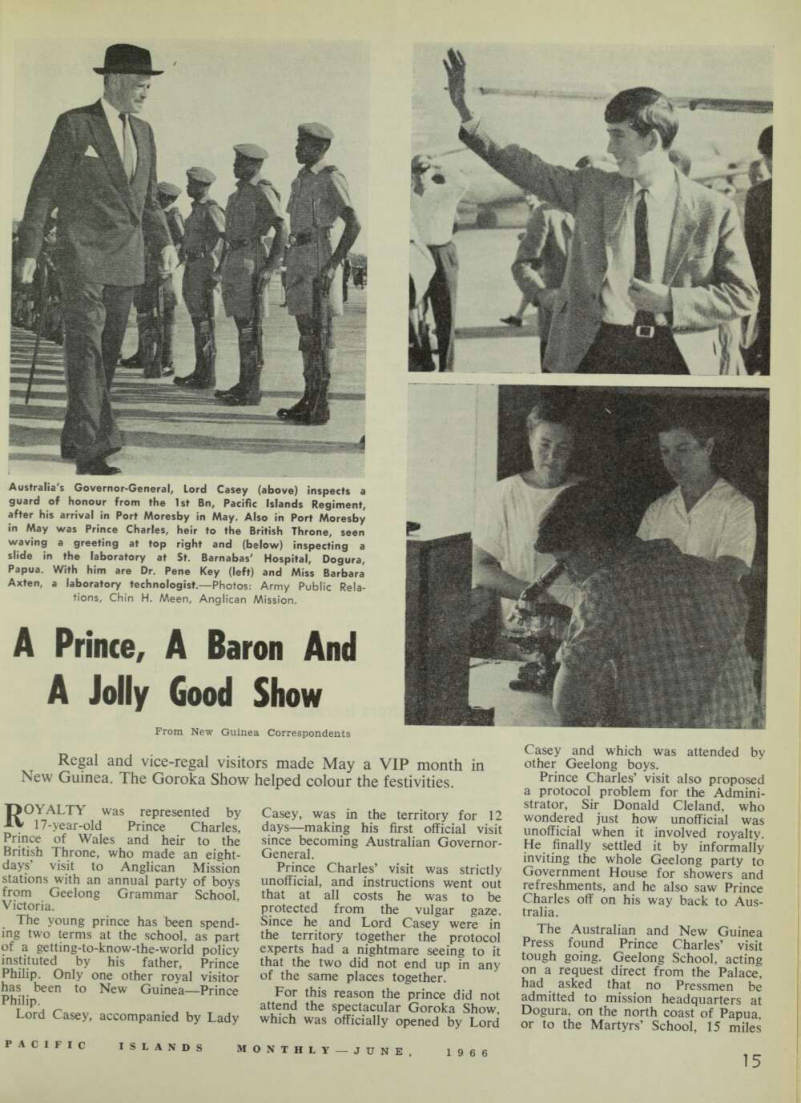
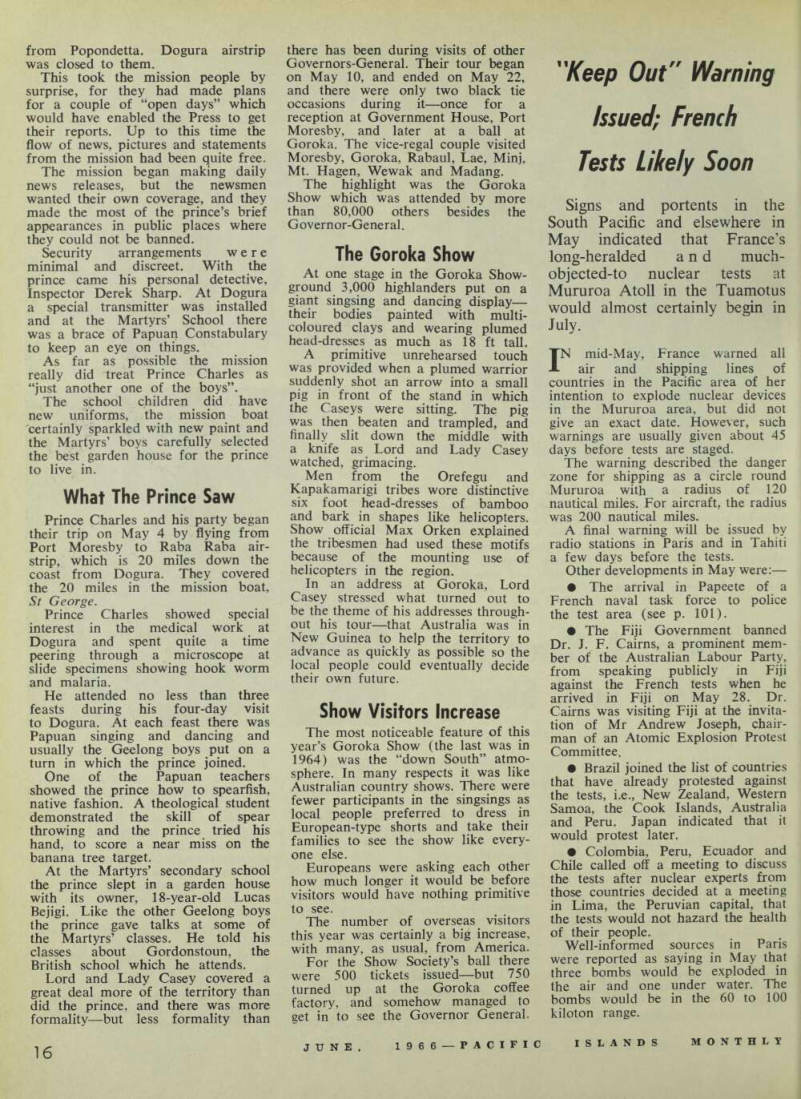
Australia's Governor-General, Lord Casey (above) inspects a guard of honour from the Ist Bn, Pacific Islands Regiment, after his arrival in Port Moresby in May. Also in Port Moresby in May was Prince Charles, heir to the British Throne, seen waving a greeting at top right and (below) inspecting a slide in the laboratory at St. Barnabas' Hospital, Dogura, Papua. With him are Dr. Pene Key (left) and Miss Barbara Axten, a laboratory technologist.— Photos: Army Public Rela tions, Chin H. Meen, Anglican Mission.
from Popondetta. Dogura airstrip was closed to them.
This took the mission people by surprise, for they had made plans for a couple of “open days” which would have enabled the Press to get their reports. Up to this time the flow of news, pictures and statements from the mission had been quite free.
The mission began making daily news releases, but the newsmen wanted their own coverage, and they made the most of the prince’s brief appearances in public places where they could not be banned.
Security arrangements were minimal and discreet. With the prince came his personal detective, Inspector Derek Sharp. At Dogura a special transmitter was installed and at the Martyrs’ School there was a brace of Papuan Constabulary to keep an eye on things.
As far as possible the mission really did treat Prince Charles as “just another one of the boys”.
The school children did have new uniforms, the mission boat certainly sparkled with new paint and the Martyrs’ boys carefully selected the best garden house for the prince to live in.
What The Prince Saw
Prince Charles and his party began their trip on May 4 by flying from Port Moresby to Raba Raba air strip, which is 20 miles down the coast from Dogura. They covered the 20 miles in the mission boat, St George.
Prince Charles showed special interest in the medical work at Dogura and spent quite a time peering through a microscope at slide specimens showing hook worm and malaria.
He attended no less than three feasts during his four-day visit to Dogura. At each feast there was Papuan singing and dancing and usually the Geelong boys put on a turn in which the prince joined.
One of the Papuan teachers showed the prince how to spearfish, native fashion. A theological student demonstrated the skill of spear throwing and the prince tried his hand, to score a near miss on the banana tree target.
At the Martyrs’ secondary school the prince slept in a garden house with its owner, 18-year-old Lucas Bejigi. Like the other Geelong boys the prince gave talks at some of the Martyrs’ classes. He told his classes about Gordonstoun, the British school which he attends.
Lord and Lady Casey covered a great deal more of the territory than did the prince, and there was more formality—but less formality than
there has been during visits of other Governors-General. Their tour began on May 10, and ended on May 22, and there were only two black tie occasions during it—once for a reception at Government House, Port Moresby, and later at a ball at Goroka. The vice-regal couple visited Moresby, Goroka, Rabaul, Lae, Minj, Mt. Hagen, Wewak and Madang.
The highlight was the Goroka Show which was attended by more than 80,000 others besides the Governor-General.
The Goroka Show
At one stage in the Goroka Show ground 3,000 highlanders put on a giant singsing and dancing display— their bodies painted with multi coloured clays and wearing plumed head-dresses as much as 18 ft tall.
A primitive unrehearsed touch was provided when a plumed warrior suddenly shot an arrow into a small pig in front of the stand in which the Caseys were sitting. The pig was then beaten and trampled, and finally slit down the middle with a knife as Lord and Lady Casey watched, grimacing.
Men from the Orefegu and Kapakamarigi tribes wore distinctive six foot head-dresses of bamboo and bark in shapes like helicopters.
Show official Max Orken explained the tribesmen had used these motifs because of the mounting use of helicopters in the region.
In an address at Goroka, Lord Casey stressed what turned out to be the theme of his addresses through out his tour —that Australia was in New Guinea to help the territory to advance as quickly as possible so the local people could eventually decide their own future.
Show Visitors Increase
The most noticeable feature of this year’s Goroka Show (the last was in 1964) was the “down South” atmo sphere. In many respects it was like Australian country shows. There were fewer participants in the singsings as local people preferred to dress in European-type shorts and take their families to see the show like every one else.
Europeans were asking each other how much longer it would be before visitors would have nothing primitive to see.
The number of overseas visitors this year was certainly a big increase, with many, as usual, from America.
For the Show Society’s ball there were 500 tickets issued—but 750 turned up at the Goroka coffee factory, and somehow managed to get in to see the Governor General.