Fiji Needs Less
pp. 15-155 · Read in the full issue
Talk And More Help From Australia
By Judy Tudor
Shorn of all its wishful-thinking, the recently announced Australian plan to aid less-developed countries by granting tariff concessions on certain goods means nothing to South Paci fic Islands territories. Cynics would be justified in regarding it as another symptom of Australia’s myopia, in which it chooses to see itself as “part of Asia” and to forget that, even more traditionally, it is also part of the Pacific.
THE concessions came into effect in April and apply to more than 130 countries ( PIM , May, p. 13). In the South Pacific the territories to which the concessions apply are the British Solomons, Cook Islands, Fiji, Gilbert and Ellice Islands, New Hebrides, Niue, Pitcairn, Papua-New Guinea, the Tokelaus, Tonga and Western Samoa.
None of the “h a n d-m ad e traditional, cottage industries” of carved and inlaid ivory-ware, stone ware, decorated leather, pottery, lacquerware, beaten, chased, ena melled, inlaid or moulded metalware, on which tariff is to be removed, has any significance at all in relation to these Pacific Islands, but every signifi cance in relation to Asia.
Almost the only item on the list that will be of benefit to the Pacific is woodwork, carved or otherwise.
This probably is of some signific ance to the workers in raintree-wood in Fiji, although oddly enough, this is not a “traditional cottage industry” but one that has come into promin ence only recently when it was found that the fashionable monkey-pod ware of Hawaii was nothing more nor less than raintree-wood worked into fancy bowls and trays.
Fight For A Share
As the Philippines also turns out this ware and is regarded as one of the “less developed countries” under the new concessions, Fiji would have to fight for a share of this market in Australia.
Following a close examination of £e Australian concessions, the Fiji jovernment made representations to to have included additional terns, some of which could be re
garded as traditional Pacific Islands handicrafts.
Mr. R. M. Major, Fiji represent ative in Australia, visited Canberra in this connection in mid-May and
also to try to get some ruling on the vaguely worded Customs and Excise Notice that outlined the con ditions under which concessions were to be made.
It appears, however, that neither the Australian Department of Trade nor the Customs Department is quite
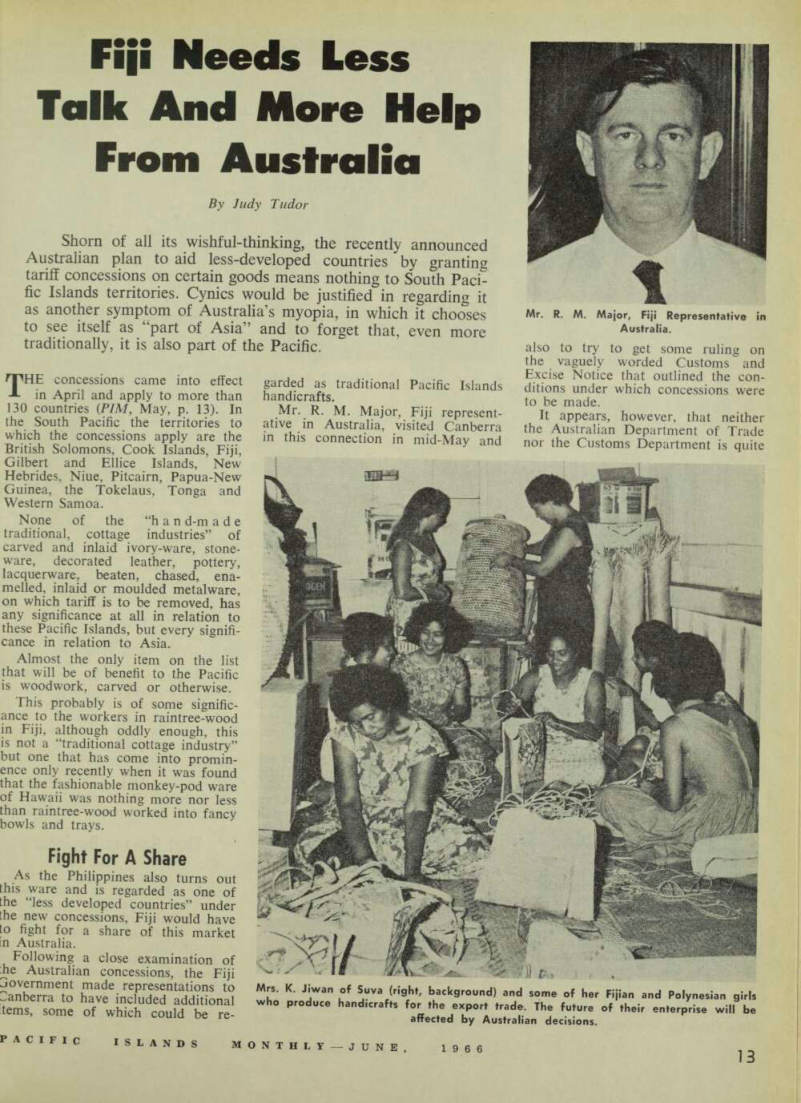
Mr. R. M. Major, Fiji Representative in Australia.
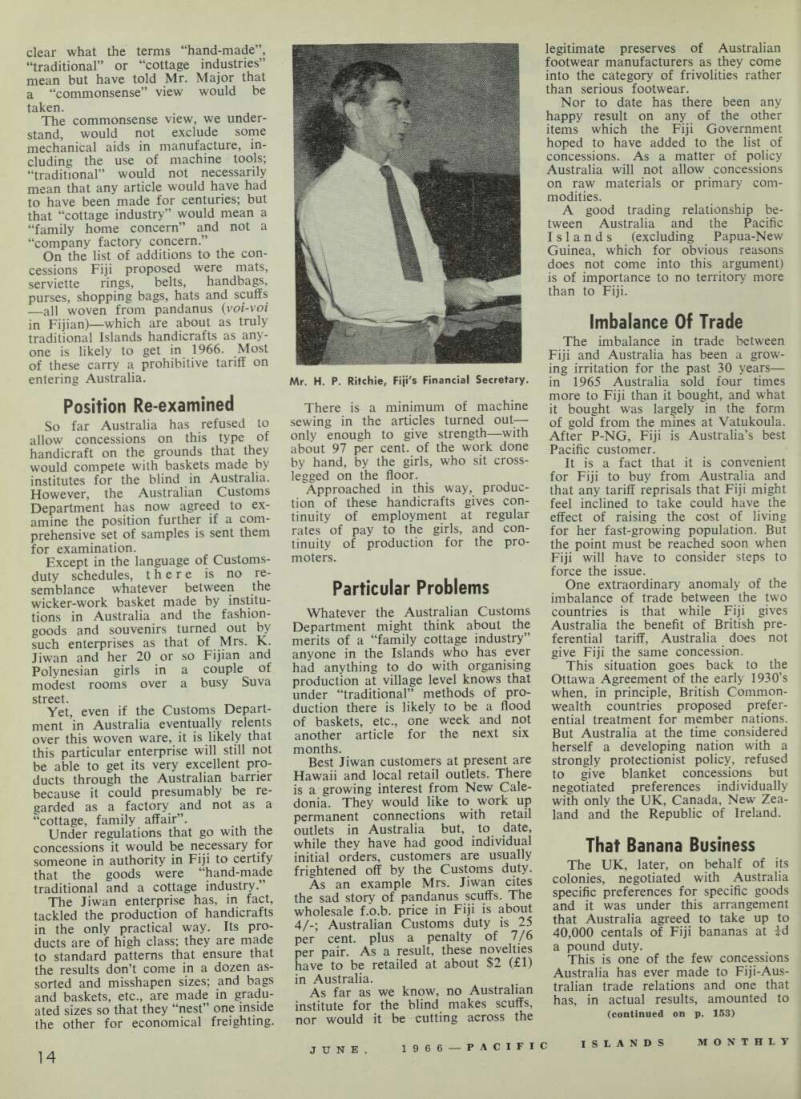
Mrs. K. Jiwan of Suva (right, background) and some of her Fijian and Polynesian girls who produce handicrafts for the export trade. The future of their enterprise will be affected by Australian decisions.
clear what the terms “hand-made”, “traditional” or “cottage industries” mean but have told Mr. Major that a “commonsense” view would be taken.
The commonsense view, we under stand, would not exclude some mechanical aids in manufacture, in cluding the use of machine tools; “traditional” would not necessarily mean that any article would have had to have been made for centuries; but that “cottage industry” would mean a “family home concern” and not a “company factory concern.”
On the list of additions to the con cessions Fiji proposed were mats, serviette rings, belts, handbags, purses, shopping bags, hats and scuffs —all woven from pandanus ( voi-voi in Fijian)—which are about as truly traditional Islands handicrafts as any one is likely to get in 1966. Most of these carry a prohibitive tariff on entering Australia.
Position Re-examined
So far Australia has refused to allow concessions on this type of handicraft on the grounds that they would compete with baskets made by institutes for the blind in Australia.
However, the Australian Customs Department has now agreed to ex amine the position further if a com prehensive set of samples is sent them for examination.
Except in the language of Customs duty schedules, there is no re semblance whatever between the wicker-work basket made by institu tions in Australia and the fashion goods and souvenirs turned out by such enterprises as that of Mrs. K.
Jiwan and her 20 or so Fijian and Polynesian girls in a couple of modest rooms over a busy Suva street.
Yet, even if the Customs Depart ment in Australia eventually relents over this woven ware, it is likely that this particular enterprise will still not be able to get its very excellent pro ducts through the Australian barrier because it could presumably be re garded as a factory and not as a “cottage, family affair”.
Under regulations that go with the concessions it would be necessary for someone in authority in Fiji to certify that the goods were “hand-made traditional and a cottage industry.”
The Jiwan enterprise has, in fact, tackled the production of handicrafts in the only practical way. Its pro ducts are of high class; they are made to standard patterns that ensure that the results don’t come in a dozen as sorted and misshapen sizes; and bags and baskets, etc., are made in gradu ated sizes so that they “nest” one inside the other for economical freighting.
There is a minimum of machine sewing in the articles turned out; — only enough to give strength—with about 97 per cent, of the work done by hand, by the girls, who sit cross legged on the floor.
Approached in this way, produc tion of these handicrafts gives con tinuity of employment at regular rates of pay to the girls, and con tinuity of production for the pro moters.
Particular Problems
Whatever the Australian Customs Department might think about the merits of a “family cottage industry” anyone in the Islands who has ever had anything to do with organising production at village level knows that under “traditional” methods of pro duction there is likely to be a flood of baskets, etc., one week and not another article for the next six months.
Best Jiwan customers at present are Hawaii and local retail outlets. There is a growing interest from New Cale donia. They would like to work up permanent connections with retail outlets in Australia but, to date, while they have had good individual initial orders, customers are usually frightened off by the Customs duty.
As an example Mrs. Jiwan cites the sad story of pandanus scuffs. The wholesale f.o.b. price in Fiji is about 4/-; Australian Customs duty is 25 per cent, plus a penalty of 7/6 per pair. As a result, these novelties have to be retailed at about S 2 (£1) in Australia.
As far as we know, no Australian institute for the blind makes scuffs, nor would it be cutting across the
legitimate preserves of Australian footwear manufacturers as they come into the category of frivolities rather than serious footwear.
Nor to date has there been any happy result on any of the other items which the Fiji Government hoped to have added to the list of concessions. As a matter of policy Australia will not allow concessions on raw materials or primary com modities.
A good trading relationship be tween Australia and the Pacific Islands (excluding Papua-New Guinea, which for obvious reasons does not come into this argument) is of importance to no territory more than to Fiji.
imbalance Of Trade
The imbalance in trade between Fiji and Australia has been a grow ing irritation for the past 30 years— in 1965 Australia sold four times more to Fiji than it bought, and what it bought was largely in the form of gold from the mines at Vatukoula.
After P-NG, Fiji is Australia’s best Pacific customer.
It is a fact that it is convenient for Fiji to buy from Australia and that any tariff reprisals that Fiji might feel inclined to take could have the effect of raising the cost of living for her fast-growing population. But the point must be reached soon when Fiji will have to consider steps to force the issue.
One extraordinary anomaly of the imbalance of trade between the two countries is that while Fiji gives Australia the benefit of British pre ferential tariff, Australia does not give Fiji the same concession.
This situation goes back to the Ottawa Agreement of the early 1930’s when, in principle, British Common wealth countries proposed prefer ential treatment for member nations.
But Australia at the time considered herself a developing nation with a strongly protectionist policy, refused to give blanket concessions but negotiated preferences individually with only the UK, Canada, New Zea land and the Republic of Ireland.
That Banana Business
The UK, later, on behalf of its colonies, negotiated with Australia specific preferences for specific goods and it was under this arrangement that Australia agreed to take up to 40,000 centals of Fiji bananas at id a pound duty.
This is one of the few concessions Australia has ever made to Fiji-Aus tralian trade relations and one that has, in actual results, amounted to
(continued on p. 153)
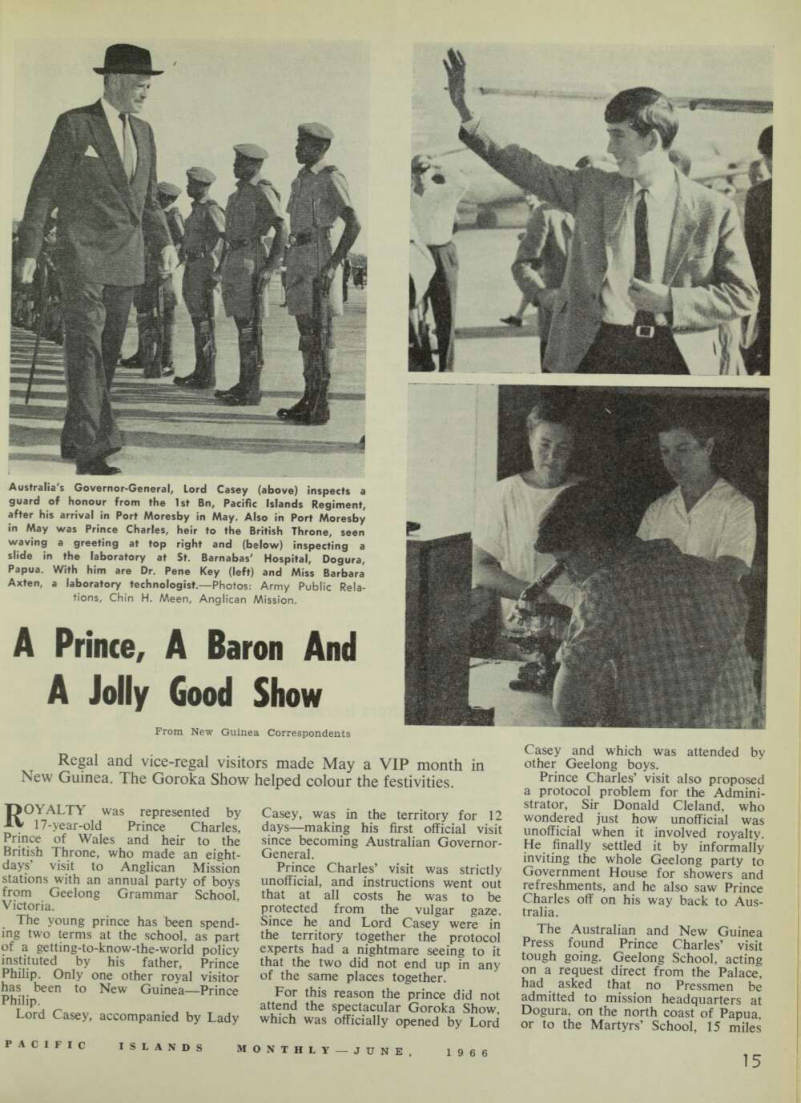
Mr. H. P. Ritchie, Fiji's Financial Secretary,
othing. No Fiji bananas enter Aus ralia, nor are they ever likely to. It eems that the same sort of position ould now develop over the alleged oncessions in relation to handicrafts.
Concessions on tariffs were made ven more difficult after the war fhen GATT came into being and, in ffect, froze tariffs internationally. It i necessary these days not only to egotiate concessions with an in ividual country but also with the iternational body.
Nor is it only in relation to trade tiat Fiji has had Australian dis ppointments in the last 12 months.
In 1965 the Governor of Fiji, Sir )erek Jakeway, paid an official visit d Australia and was given every ncouragement to hope that Australia rould help Fiji in any material way ossible.
Subsequently Fiji specifically asked Lustralia if it could help in (1) Financing the proposed develop ment Bank of Fiji; (2) Reconstructing and sealing the Nadi-Suva road; (3) School building; (4) Providing a men’s surgical ward at the Colonial War Memorial Hospital in Suva; and (5) Establishing a publishing section for the Education De partment.
Promises—And Reality
Presumably the Governor’s recep on by Australian officialdom dur ig his 1965 visit was such that this id could be asked for with some ope of success but to date the only fficial reaction is the notification that □ch help does not come within the :ope of ASPTAP and therefore be ranted. (See PIM, April, p. 61, which ets out the aims of the Australian outh Pacific Technical Assistance ’lan). Assistance from this organisa ion—which was hailed initially as tie South Seas Colombo Plan—is mited to technical aid, not cash, as tie April story shows.
At an even more recent date, Fiji sked for a Government-to-Govern icnt loan from Australia as part of he financing of the Colony’s Fifth De elopment Plan which commences tiis year and is designed to end in 970. This fifth plan will be financed lainly, as usual, by Fiji itself, the JK, the World Bank and one of the
United Nations funds. This will not cover all that is projected and Aus tralia was asked if it would loan Fiji £F500,000 per annum during the currency of the plan to cover the gap, (For plan details, see p. 139).
So far the Department of Trade is sympathetic to this. It is obvious that a great deal of the development money will find its way back into Australian trade channels, and any in crease in the standard of living of the Fiji people has traditionally meant bigger dividends for Australian traders and manufacturers.
The Australian Treasury is still considering it; but the official reply that has come from the Department of External Affairs says, in effect, that Fiji is not Australia’s re sponsibility and that such a loan would not come within the frame work of ASPTAP.
It is understandable that Australia is diffident about giving money to any Pacific territory other than P-NG but Fiji, in this latter instance, was not asking for gifts but a loan, on which interest would be paid.
What Australia Gives
Australia rightly prides itself on the amount of aid it has given to other countries in the post-war years.
It has recently announced that aid expenditure in 1965-66 will amount to $A121,500,000, of which about two-thirds will go to Papua-New Guinea; about one-quarter to the Colombo Plan and other Asian aid; and the rest will be split between de fence aid to Malaysia and India and donations to UN agencies, World Bank, etc.
How much good will result from the amount of Australian aid to Asia is still among the imponderables.
Against Asian requirements it can never amount to more than a drop in the bucket.
But there is no doubt at all about the great deal of good Australia could do closer at home in the Pacific, where there is a great fund of goodwill towards the Common wealth and a ready acceptance of her position of leadership.
In the ultimate analysis—because of her trade position, because of Australian investment in the Colony and for a dozen other reasons—Fiji must be Australia’s business.
Perhaps Fiji’s Financial Secretary, Mr. H. P. Ritchie, when he visits Canberra at the end of July, will be able to persuade someone that even the extension of duty concessions to voi-voi scuffs would be a step in the right direction in maintaining good relations.