Flightless Cagou
p. 89 · Read in the full issue
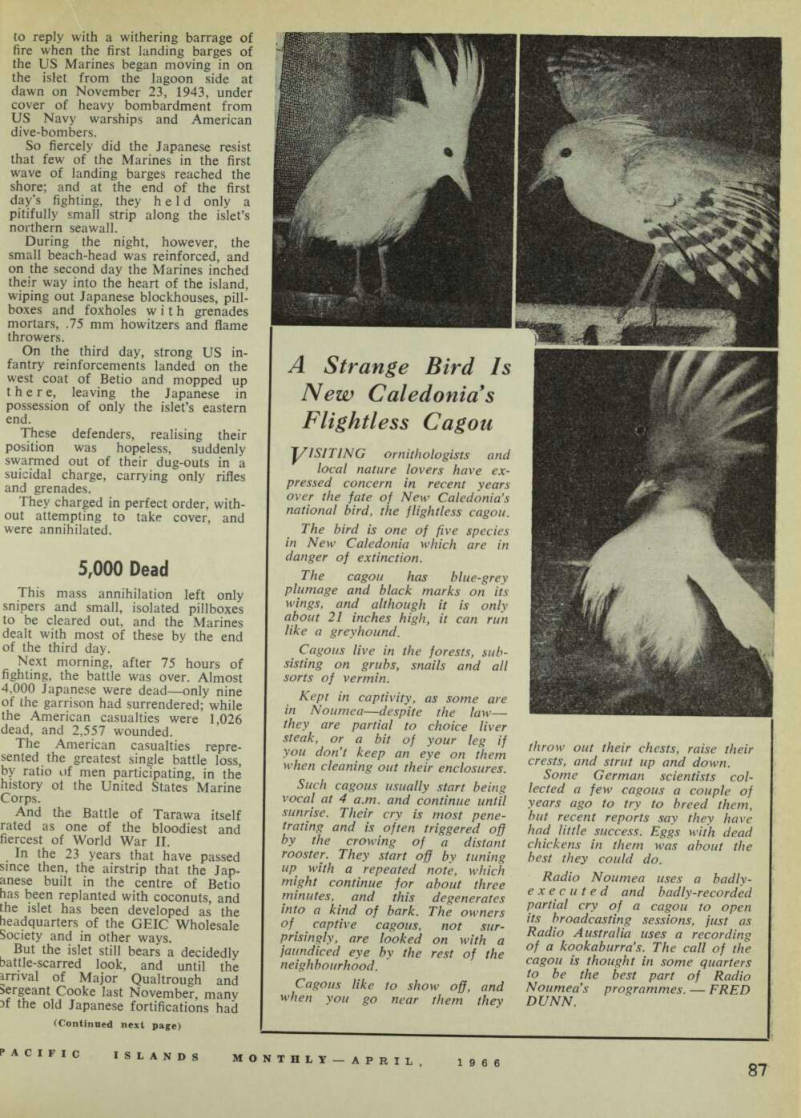
A Strange Bird Is New Caledonia’s Flightless Cagou
J/ISITING ornithologists and local nature lovers have ex pressed concern in recent years over the fate of New Caledonia’s national bird, the flightless cagou.
The bird is one of five species in New Caledonia which are in danger of extinction.
The cagou has blue-grey plumage and black marks on its wings, and although it is only about 21 inches high, it can run like a greyhound.
Cagous live in the forests, sub sisting on grubs, snails and all sorts of vermin.
Kept in captivity, as some are in Noumea—despite the law— they are partial to choice liver steak, or a bit of your leg if you don’t keep an eye on them when cleaning out their enclosures.
Such cagous usually start being vocal at 4 a.m. and continue until sunrise. Their cry is most pene trating and is often triggered off by the crowing of a distant rooster. They start off by tuning up with a repeated note, which might continue for about three minutes, and this degenerates into a kind of bark. The owners of captive cagous, not sur prisingly, are looked on with a jaundiced eye by the rest of the neighbourhood.
Cagous like to show off, and when you go near them they
throw out their chests, raise their crests, and strut up and down.
Some German scientists col lected a few cagous a couple of years ago to try to breed them, but recent reports say they have had little success. Eggs with dead chickens in them was about the best they could do.
Radio Noumea uses a badly executed and badly-recorded partial cry of a cagou to open its broadcasting sessions, just as Radio Australia uses a recording of a kookaburra's. The call of the cagou is thought in some quarters to be the best part of Radio
Noumea's programmes.