U.K. Army Disposal Experts
pp. 87-90 · Read in the full issue

Add A Footnote To The
Bloody Battle Of Tarawa
From a Tarawa Correspondent Twenty-three years after the United States Marines routed the Japanese in the famous Battle of Tarawa, two British Army men have cleared away dangerous debris from the battle field and dumped it in the sea.
THE two men, Major H. P.
Qualtrough and Sergeant H. E. (Joe) Cook, of the Royal Engineers, arrived in Tarawa, Gilbert and Ellice Islands Colony at the end of last November. For the next three months, with a labour gang of 12 civilians and 16 prisoners, they systematically
searched the tiny islet of Betio for explosives.
By the time they left Tarawa on March 8, they and their assistants had located and dumped about 92 tons of explosives over the weather reef at Betio—the explosives ranging from American 100 lb bombs and Japanese eight-inch shells to small arms am munition.
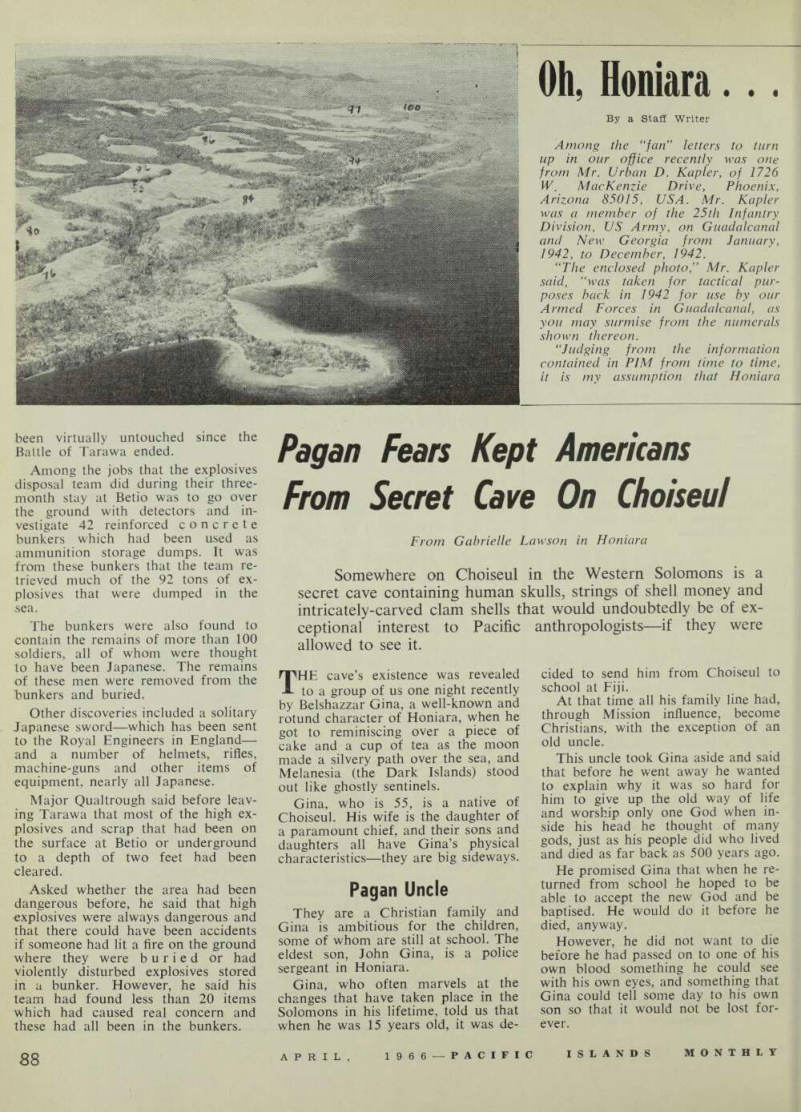
This enormous amount of material came from an area scarcely bigger than a market garden, for Betio Islet, which is on the south-west corner of Tarawa, is only 800 to 1,200 yards wide by 2i miles long.
Guns From Singapore
The Japanese occupied Betio early in 1942, and set about immediately to fortify it and convert it into a bomber base.
With 400 Koreans doing most of the work, they cut down palm trees in the islet’s centre and laid out an airstrip; and on all sides of this, they dug a labyrinth of caves, tunnels, fox holes and bunkers in which their supplies and ammunition were stored and in which their men lived and kept watch for the enemy.
There were about 500 fortified places altogether. They were fantastic
ally strong and difficult to attack— the foxholes, for example, being arranged like the spokes of a wheel, so that grenades had to be poked into each spoke to blast away the men inside, one by one.
The islet’s armament included 8-in Vickers guns brought from Singa pore, which were put in four twin emplacements on the island. These gave the Japanese a wide and effective range of fire.
Several pairs of 5-inch guns were dug into the coral sands, and there were numerous 3-inch guns which could be used effectively against an enemy travelling either by sea or in the air.
The gun emplacements were well protected and well-camouflaged. And the 4,000 troops who manned them also had radio direction finders, searchlights and range finders to aid them against an enemy.
In addition, they were protected by a ring of barbed wire on the islet’s fringing reef, then a barricade of coral blocks; then a submerged moat gouged out of the coral so that tanks could not pass over it; then more blocks and more barbed wire.
The only error the Japanese made in fortifying Betio was that they reckoned on an enemy attacking them from the ocean side of the islet rather than the lagoon side. The greater part of their artillery and blockhouses were therefore placed to meet a seaward attack.
Even so, the Japanese were able
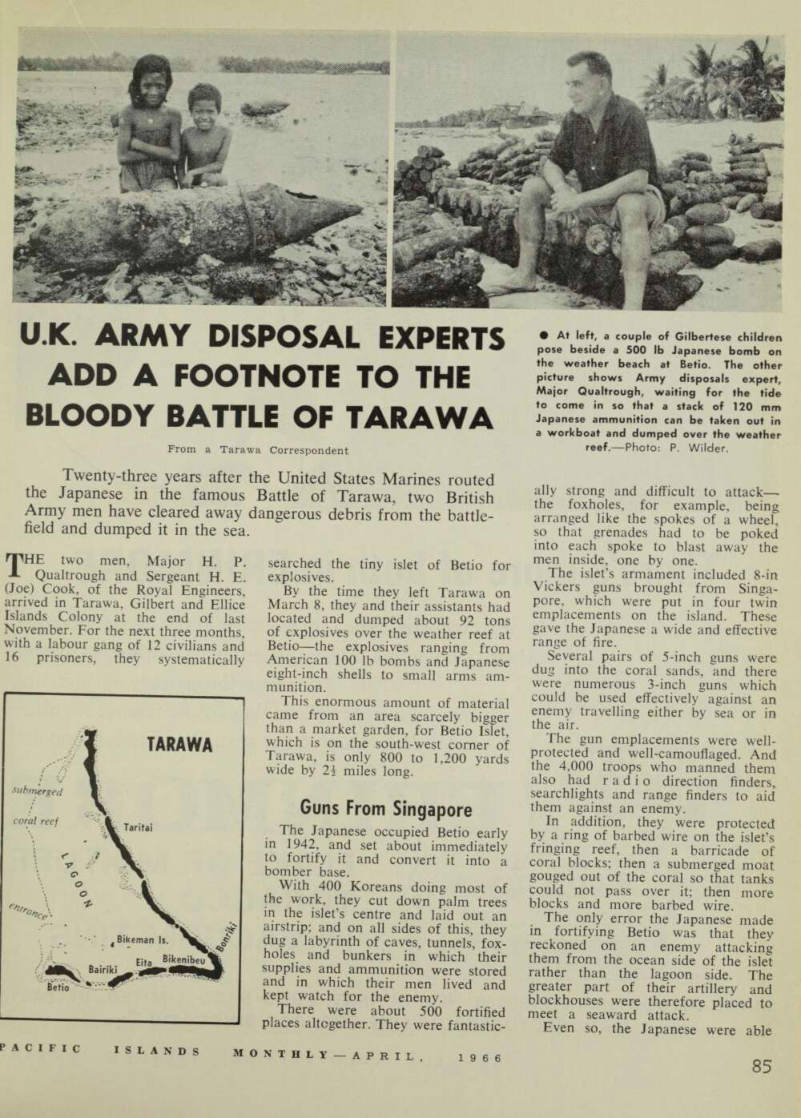
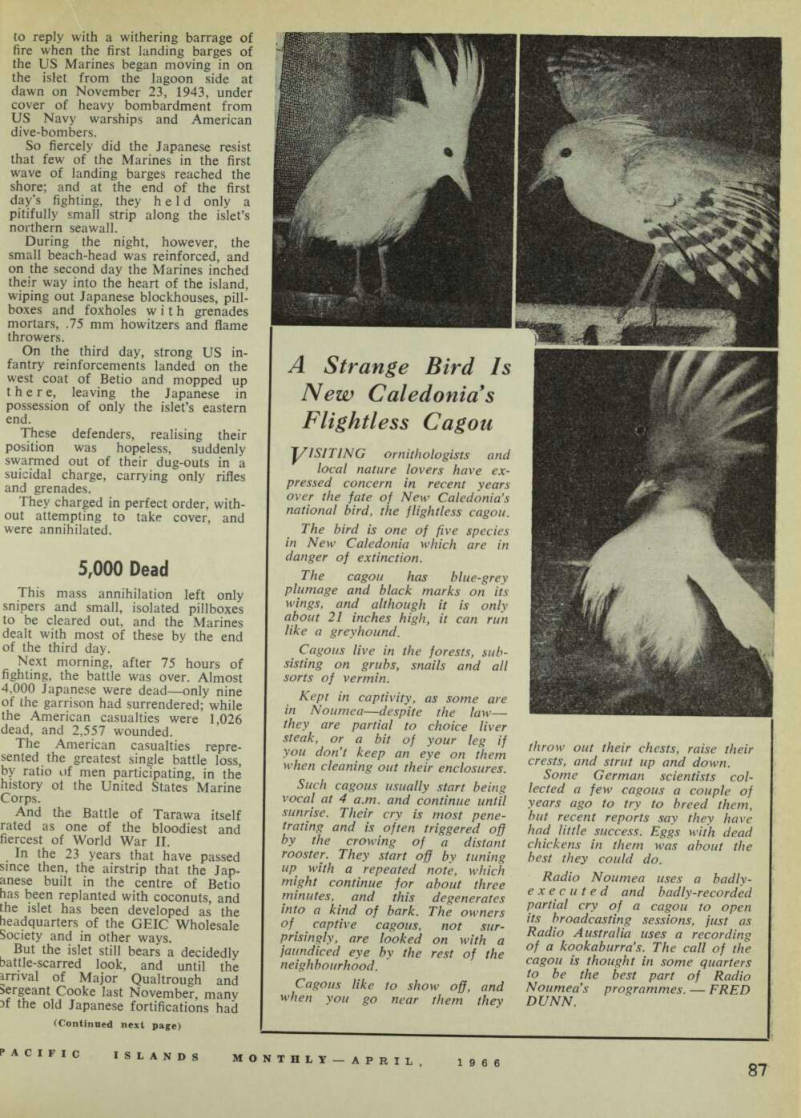
At left, a couple of Gilbertese children pose beside a 500 lb Japanese bomb on the weather beach at Betio. The other picture shows Army disposals expert, Major Qualtrough, waiting for the tide to come in so that a stack of 120 mm Japanese ammunition can be taken out in a workboat and dumped over the weather reef. Photo: P. Wilder.
to reply with a withering barrage of fire when the first landing barges of the US Marines began moving in on the islet from the lagoon side at dawn on November 23, 1943, under cover of heavy bombardment from US Navy warships and American dive-bombers.
So fiercely did the Japanese resist that few of the Marines in the first wave of landing barges reached the shore; and at the end of the first day's fighting, they held only a pitifully small strip along the islet’s northern seawall.
During the night, however, the small beach-head was reinforced, and on the second day the Marines inched their way into the heart of the island, wiping out Japanese blockhouses, pill boxes and foxholes with grenades mortars, .75 mm howitzers and flame throwers.
On the third day, strong US in fantry reinforcements landed on the west coat of Betio and mopped up there, leaving the Japanese in possession of only the islet’s eastern end.
These defenders, realising their position was hopeless, suddenly swarmed out of their dug-outs in a suicidal charge, carrying only rifles and grenades.
They charged in perfect order, with out attempting to take cover, and were annihilated.
5,000 Dead
This mass annihilation left only snipers and small, isolated pillboxes to be cleared out, and the Marines dealt with most of these by the end of the third day.
Next morning, after 75 hours of fighting, the battle was over. Almost 4,000 Japanese were dead—only nine of the garrison had surrendered; while the American casualties were 1,026 dead, and 2,557 wounded.
The American casualties repre sented the greatest single battle loss, by ratio of men participating, in the history of the United States Marine Corps.
And the Battle of Tarawa itself rated as one of the bloodiest and fiercest of World War 11.
In the 23 years that have passed since then, the airstrip that the Jap anese built in the centre of Betio has been replanted with coconuts, and the islet has been developed as the headquarters of the GEIC Wholesale Society and in other ways.
But the islet still bears a decidedly battle-scarred look, and until the arrival of Major Qualtrough and sergeant Cooke last November, many af the old Japanese fortifications had
(Continued next page)
been virtually untouched since the Battle of Tarawa ended.
Among the jobs that the explosives disposal team did during their three month stay at Betio was to go over the ground with detectors and in vestigate 42 reinforced concrete bunkers which had been used as ammunition storage dumps. It was from these bunkers that the team re trieved much of the 92 tons of ex plosives that were dumped in the sea.
The bunkers were also found to contain the remains of more than 100 soldiers, all of whom were thought to have been Japanese. The remains of these men were removed from the bunkers and buried.
Other discoveries included a solitary Japanese sword—which has been sent to the Royal Engineers in England— and a number of helmets, rifles, machine-guns and other items of equipment, nearly all Japanese.
Major Qualtrough said before leav ing Tarawa that most of the high ex plosives and scrap that had been on the surface at Betio or underground to a depth of two feet had been cleared.
Asked whether the area had been dangerous before, he said that high explosives were always dangerous and that there could have been accidents if someone had lit a fire on the ground where they were buried or had violently disturbed explosives stored in a bunker. However, he said his team had found less than 20 items which had caused real concern and these had all been in the bunkers.