Territories TALK-TALK
pp. 51-55 · Read in the full issue
New Guinea: The Land Of Musical Chairs
With Tolala
Some time ago mention was made in the Territory news papers of the contemplated transfer of the district headquarters of Bougainville from Sohano to Kieta. By now, let us hope it is under way. r ’
SPHERE’S no doubt about New Guinea being a land of musical chairs changing capital sites almost at the drop of the hat. In the colony’s earlier days they started off with the capital at Kerawara (in the Duke of Yorks), then Finschhafen, Friedrichshafen (Madang), Herbert shoehe (Kokopo), Rabaul and finally Lae, shortly before the Japs came in.
Kieta was the original headquarters for the Buka-Bouganville district, which was opened somewhere around 1909. At that time there were few plantations developed on the island of Bougainville.
Emma Kolbe had land at Kessa (Buka), Tinputz, Raua, Mabiri in Bougainville and owned the outlying island groups of Nissan, Carterets,
Mortlocks and Tasmans and smaller islands in Karola Harbour (Buka).
German Land Laws: The
purchasers of islands, according to the old German land laws, were re qmred to provide adequate coconuts and land for any native residents on the island, and in some instances the purchaser found he had no arable land after the native reserve had been excised, and was therefore only en titled to the trading rights above high-water mark.
All of the Kolbe plantation land in Buka and Bougainville (except Tin putz) had been acquired in Queen Emma’s early days, but had not been developed.
Land laws which became operative at the turn of the century required owners, other than the Neu Guinea Kompagnie, to develop at least 10 per cent, of the total area within 20 years.
This explains why several of the big German companies had con tractors at work planting up land in Buka and Bougainville in 1920 when the Exproboard came along and gobbled up the estates. (over)
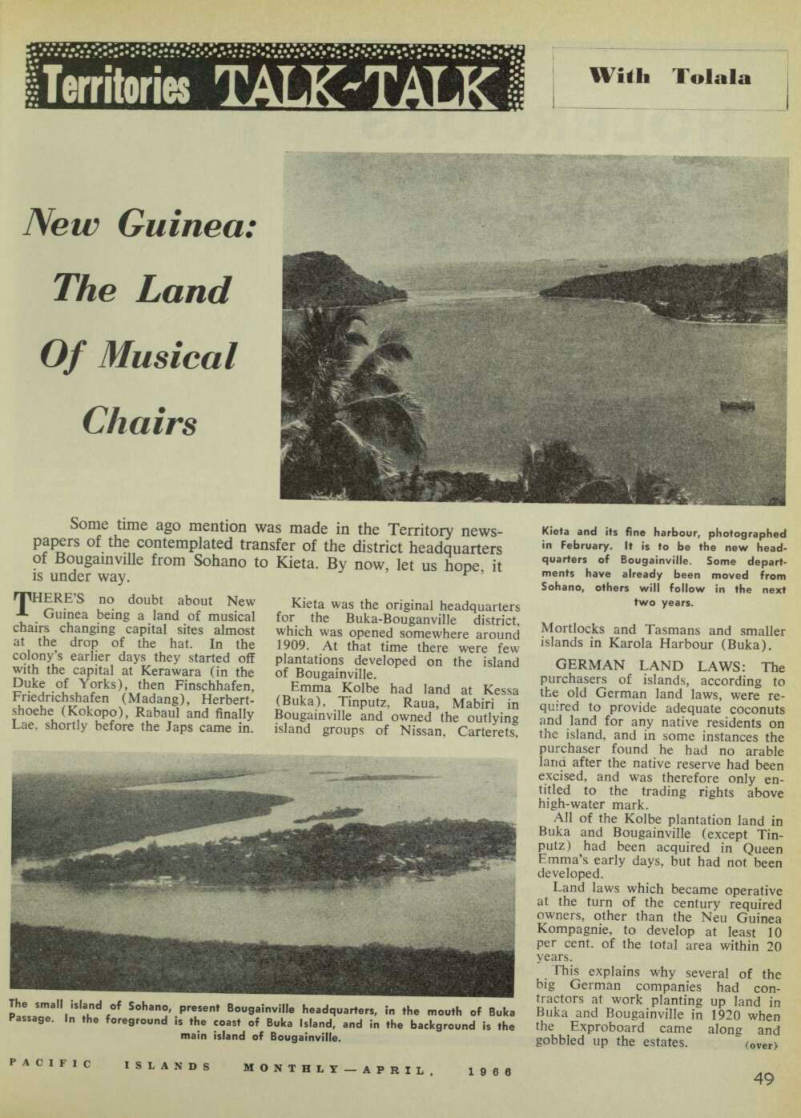
The small island of Sohano, present Bougainville headquarters, in the mouth of Buka Passage. In the foreground is the coast of Buka Island, and in the background is the main island of Bougainville.
Kieta and its fine Harbour, photographed in February. It is to be the new head quarters of Bougainville. Some depart ments have already been moved from Sohano, others will follow in the next two years.
Just before World War I Kieta was indeed a busy port. The Choiseul Plantations Ltd. plantations had left the launching pad in 1913 and all their supplies from Sydney came through the BSIP in the hold of the old Mindini, discharged at Faisi and transferred to schooner there for Bougainville, and all Customs work went through Kieta.
In the early thirties a few vocal locals of Buka Passage (where Sohano is located) started a move to have the district headquarters sited on Sohano Island.
There had been an increase in the European population in that area; more business, greater prestige and it would save the long, tedious trip down the coast to Kieta.
In these speed days, with air travel, it matters less where the headquarters are located . . . Gone are the days when your time is spent beating up against a South-easter in a cutter or, even worse, rolling on an oily sea, no wind, with flapping sails and creaking boom. And a lone optimistic lad, sitting in the bows, whistling to the wind gods who never come . . .
So now, about 30 years later, the transfer is back to Kieta with its natural harbour and its hill-sides (so handy for underground tunnels in a nuclear war!).
Kieta township had its charms in
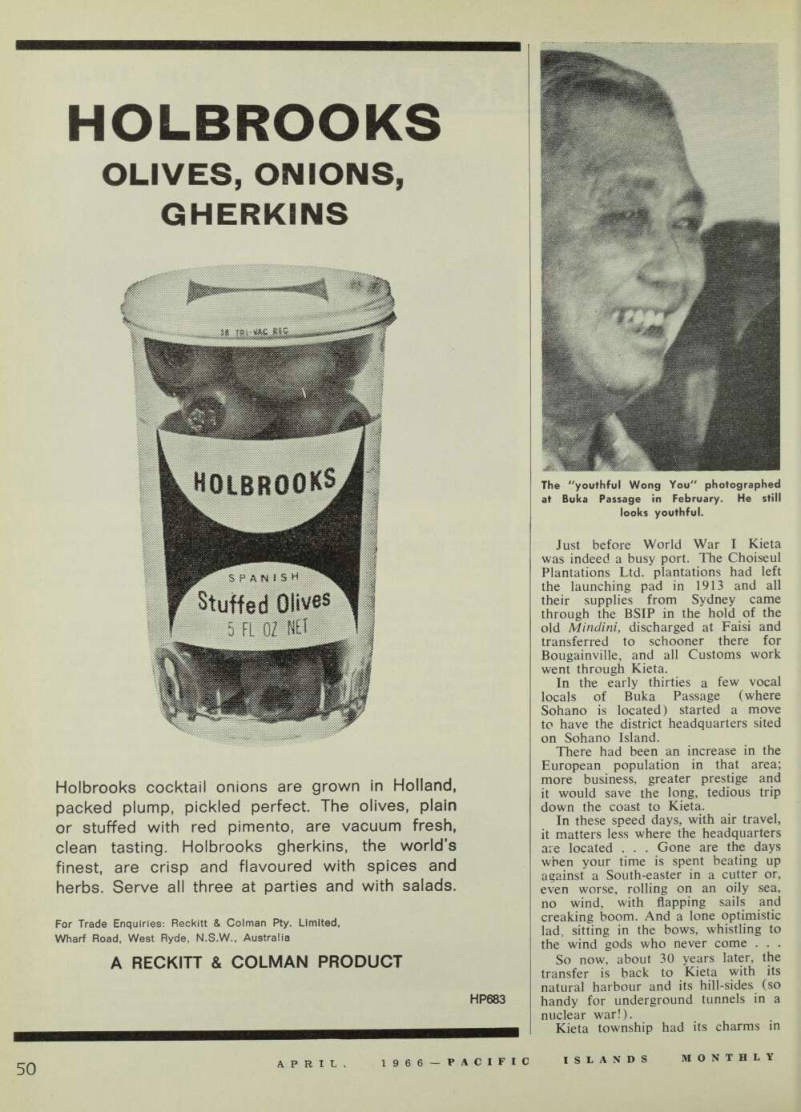
The "youthful Wong You" photographed at Buka Passage in February. He still looks youthful.
1912 when I first knew it. I must tell you about them one of these days: of Peter Hansen and Louis Somer; of Clas and Dreger in the H, and Co. store, and the youthful Wong You.
In another 30 years’ time the HQ will be shifted to the middle of the mountainous Crown Prince Range, where the local people would have established a flourishing tin- or copper-mining area; carefully await ing the time of their independence before disclosing the locality of this underground asset. (“Why should the palefaces reap all our mineral profits?”) . .FOOTNOTE: It gave me much pleasure to read Stuart Inder’s story on Kieta in the March PIM, which I received after the above was written; good to see the optimism following Conzinc Riotinto’s investi gations for copper.
These remarks about the next capital site when independence is attained, may not be so far from the mark after all! They were based on an old geological assay which had been made when a German scientific expedition went through from Arawa on the east coast to Empress Augusta Bay on the west.
Bougainville will come good one of these days.
Long Time No See
It was only in February I was writing of the pleasure that came my way when old-time NG residents dropped in; had a noggin (or some times a cuppa) and a good old yarn about who and who and where they were . . . Came then a few days ago a welcome trio led first by a man, sun-tanned, broken-nosed and dead pan expression. He called me by name and we shook hands; I waved him to a seat and hunted the halls of my memory. And then the penny dropped . . . Ted Bishton! More sun tanned than ever he had been in New Guinea (it looked like the tan of Surfers Paradise). Then followed his charming wife, with Mrs. Harry Dodd, and the party was on.
True, not long before their visit they had been to the Queensland Gold Coast, where they were sur prised at the number of old Terri torians who were moving into that area from other parts of Australia.
The colony was growing so exten sively that suggestions had been made to form an off-shoot of the NG Women’s Club. Perhaps the name ‘ Paradise” has a certain influence somewhere!
For many years “Bish” was one of the members of the Rabaul Amal-
gamated Wireless of Australia staff, before it became Overseas Tele communications, There was Jimmy Twycross, Jack Allan, W. R. B.
Thomas, “Tommy” Thompson and “Bish”. He alone remains.
The AWA personnel were really a species apart in the sociological classi fication of Territorial cliques. They were neither official nor non-official.
With them rested the secrets—often the destiny of the country; but their lips were sealed. After hours of “greasing”, in the hope of breaking down his resistance and eager to obtain information about something —latest form of the favourite of the second race, or perhaps the guts of a forthcoming regulation about min ing—the AWA man would smile tolerantly and murmur: “I really couldn’t say”. And you would know that the only thing to do was to put the cork in the whisky bottle and go to bed.
They had certain privileges these knights of the air waves: they were permitted to have interests outside their job. Several of them obtained valuable plantation properties when the Exproboard estates went up for tender.
I met a number of them a few days before Christmas, 1920. We were all quarantined in a house at Namanula, Rabaul. Measles had
broken out in Rabaul and everyone leaving the town had to spend the usual 14 days’ isolation to become a “clean skin”.
Quarantine was anything but monotonous in that house with those companions—a happy crowd of key punchers about to spring off to all parts of the Territory. Unfortunately I was transferred to another bungalow after a few days and . . . well, I blotted my copy-book by breaking quarantine. But that is another story.
“Bish” was in Kieta in 1921 when I arrived there on Exproboard busi ness. And the other day we spoke of the crowd there at the time: There was the Kiap, Harry Cardew, who was later to become the Terri tory’s first Protector of Natives and later Commissioner for Native Affairs. He was the father of Dick Cardew, one of the heroes of the “Z” Force in World War 11.
There was Medical Officer Calov and I do believe it was the interest ing work he met up with there that influenced him into becoming one of the foremost tropical diagnosticians in Sydney—if not in Australia. Then there was Mrs. Muriel Peterson, staying with the Cardews on a visit from Faisi, where she had been stay ing with Clare Scott. As a result of Muriel’s visit to Kieta in 1921 her hubby, Charlie, joined the Expro board staff, managed Massawa for several years, successfully tendered for Guntershoehe plantation, where he had a tragic death. . . .
Where are we getting to? We started off with Ted Bishton and now we’re burbling on about Charlie Peterson!
So Long, "Richie"
Undoubtedly one of New Guinea’s best-known personalities was Albert Richards. (I doubt if half his closest friends knew his first name; everyone knew him as “Richie”).
He has died in hospital at Rabaul after over 45 years of active service to the Territory.
I knew “Richie” from his first days in the Territory. In January, 1921, he was among the Expro board’s potential planters when, aboard the Wunatali, we sailed out of Kokopo for Buka and Bougain ville to “take over” the German plantations.
Also among the crowd was Alan Willis, who later became chief plantation inspector for Steamships in Papua, and who died in August, 1962. Alan took up duties on Raua and “Richie” started off at Arawa and was appointed liaison officer with
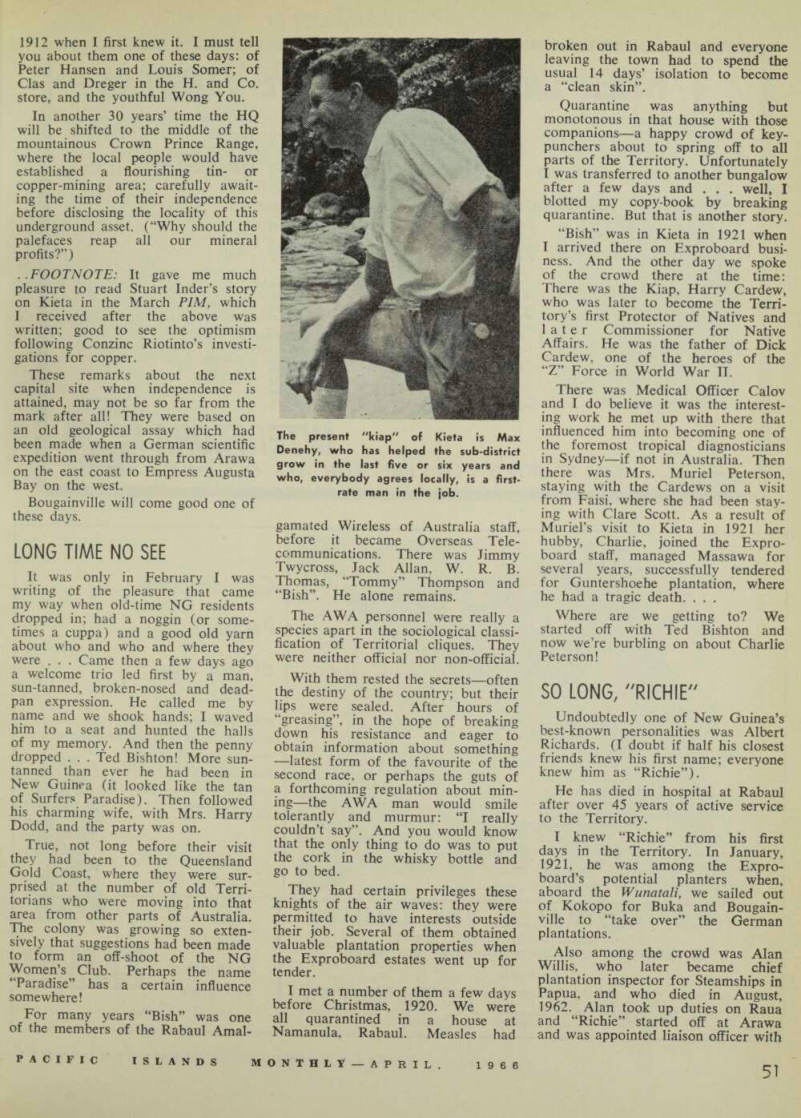
The present "kiap" of Kieta is Max Denehy, who has helped the sub-district grow in the last five or six years and who, everybody agrees locally, is a first rate man in the job.
Rabaul HQ, as Arawa was the nearest estate to the wireless station at Kieta.
In the early thirties “Richie” started his escalatory journey on the Exproboard ladder of promotion, and ended up by being the sole representa tive for the board in New Guinea.
In recent years he has had in different health and the general atmosphere, created by the winds of change, has not acted as a sedative to his rather over-wrought nerves.
Rest peacefully, “Richie”. You well deserve it.
Candid Comment
I am not quite sure whether journalistic ethics allow a columnist to pat the editor on the back, but I’ll take a chance. It was very good to read what Stuart Inder had to say as a result of his latest survey of the New Guinea situation, (March,
Pim, P. 11).
His realistic summing-up leaves no doubt that after 13 years “of close interest” in New Guinea (as he himself describes it) he has found his see- legs and, with feet well planted on the ground, and kindly wording, has passed on his findings in the story to which I refer.
The search for a new Administra tor certainly creates a problem; not the search so much as the satisfactory selection of a man capable of leading the Administration and serving the multi-racial people in the most profit able manner for the country.
A man with such qualifications would be one who would not want to phone Canberra every time he wanted to blow his nose.
And how much hope has the Territory got of obtaining a man like that? It’s all very well with our generous annual grant, to belabour the saying: “He who pays the piper calls the tune”, but how are you going to reconcile that with a gaggle of UN members from Asia and Africa? (Perhaps one of the retired presidents of an African nation would fancy the job?) With most of the old team of executives getting out from under, it is not going to be easy-going for the next crowd. But I cannot see the positions, as they are now, being filled by any outstanding personalities.
A strong character does not fancy being a rubber-stamp for Canberra. • Dr. Douglas Stuckey, a cardio logist, and a thoracic surgical team beaded by surgeon Mr. J. Howard- Brown will visit Papua-New Guinea in May.