Prosperity, Changing Ways
pp. 43-49 · Read in the full issue

Are Killing Off Buka's
Weird Cargo Cult
By Stuart Inder, recently on Bougainville
The weird Buka cargo cult is beginning to wither on the vine—blighted by prosperity, commonsense, hard work and time. On parts of Buka they still practise free love, and scorn Church and State, but the rot is setting in.
THE Buka cult is not now a threat to the peace and good order of the Bougainville district’s 66,000 people, for if nothing succeeds like success nothing is more souring than a series of frustrations such as the Buka cult has had. And it was a series of frustrations, of a different sort, which brought the cult into existence in the first place.
I spent a few days on Buka recently, to see what changes there had been in this trouble spot since PlM’s last detailed account of the cult in October, 1963. The previous year the cult had made the national headlines after a series of riots, when 600 people were arrested, many of them subsequently being gaoled.
PIM concluded its 1963 report in these words: “Everybody agrees the solution is not easy. According to the Administration the best method of tackling the problem is to build up Bougainville, particularly Buka, economically and socially and so remove the reasons the Hahalis people have for their discontent with the old order. This is now being done. Meanwhile the question is: Will the situation remain static or will there be another flare-up like the incidents of 1962?”
Buka Begins To Stir
The recent developments on both Buka and Bougainville, with new roads, more transport and a general flurry of activity, were obvious to Tie on my recent visit. The district is finally beginning to stir, and there s a new atmosphere in the villages.
The new get-up-and-go has imothered any new flare-up on Buka. And down around Kieta, which vas another trouble spot on my last dsit to Bougainville, exploration for ninerals has brought a new prosperity md confined the local brand of :argo cult in an area far to the south (see “Kieta Looks Forward”
March, p. 17).
The Buka cult involves about
3,600 native villagers on northern Buka, an island cheek by jowl with Bougainville Island, and administered from Sohano as part of the P-NG Bougainville district. Total popula tion of Buka is about 14,000.
The cult people live in eight villages in the Hahalis area, stretch ing along 30 miles of coastline. They have formed themselves into the Hahalis Welfare Society, designed in a Communist-communal fashion, pushed out the missions and an nounced that they don’t want any Administration help, for they have their own “government”. They want nothing to do with local government councils.
Under the rules of the Welfare Society, all monies earned by the villagers for produce and other sales go into a community fund for the general welfare; the churches are run like prayer meetings without
benefit of clergy; the bride price is banned and marriages have ceased, but married women are interchange able and selected single girls are available in special “clubhouses” for any of the men of the villages.
Children born of these unions are the “property” of the community. (Over)
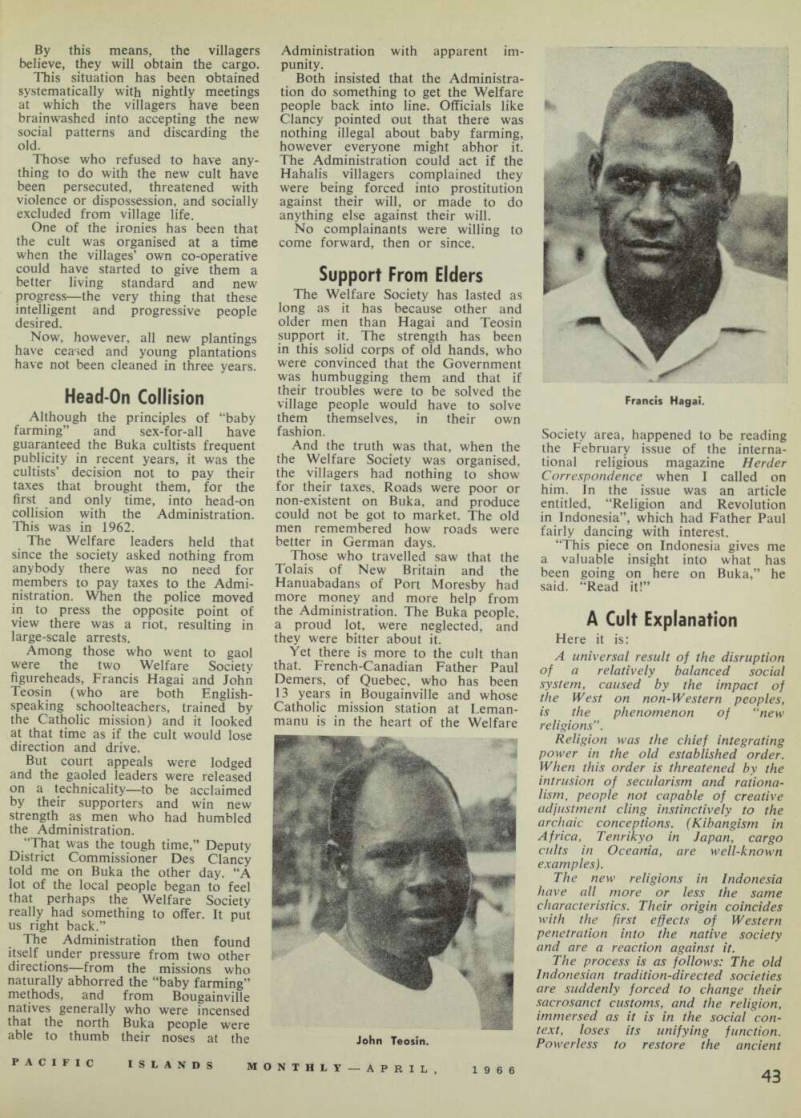
Father Paul Demers, of the Lemanmanu Roman Catholic Mis sion, in the heart of the Buka cult area, is one of the leaders of the forces at tempting to convince cult members that they face disaster if they continue their practices. He formed an opposition de velopment society of those who refused to join the cult.
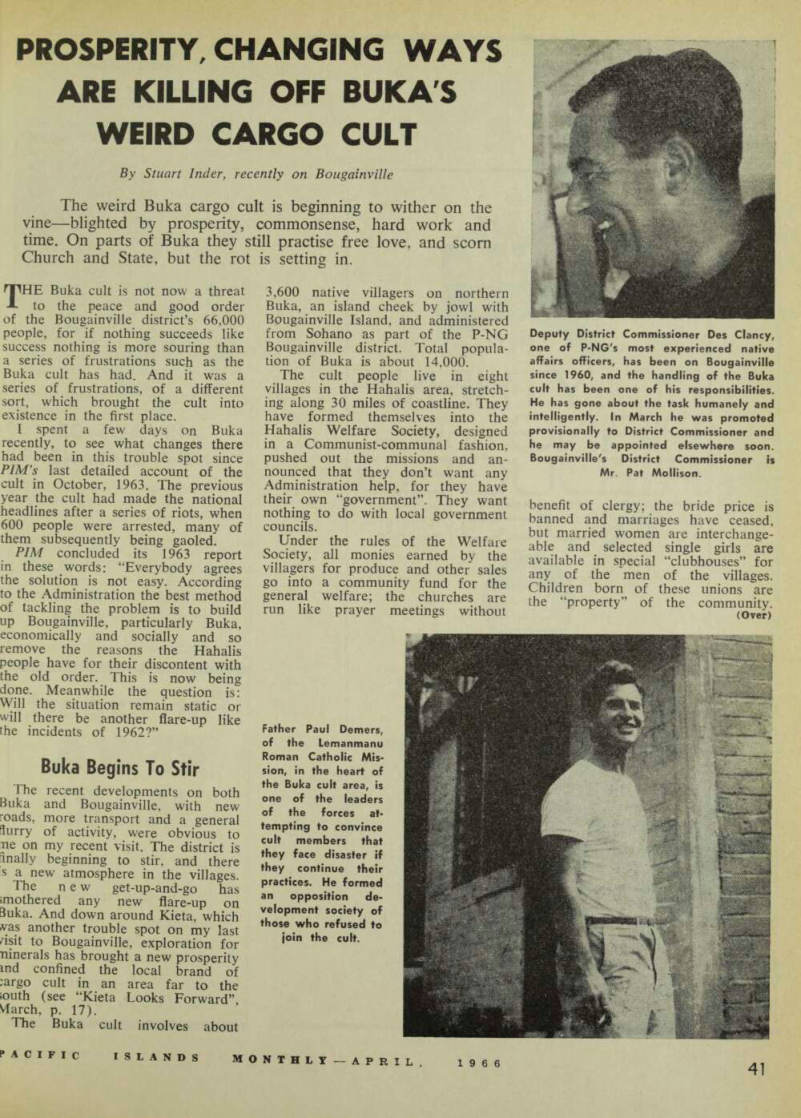
Deputy District Commissioner Des Clancy, one of P-NG's most experienced native affairs officers, has been on Bougainville since 1960, and the handling of the Buka cult has been one of his responsibilities.
He has gone about the task humanely and intelligently. In March he was promoted provisionally to District Commissioner and he may be appointed elsewhere soon.
Bougainville's District Commissioner is Mr. Pat Mollison.
By this means, the villagers believe, they will obtain the cargo.
This situation has been obtained systematically with nightly meetings at which the villagers have been brainwashed into accepting the new social patterns and discarding the old.
Those who refused to have any thing to do with the new cult have been persecuted, threatened with violence or dispossession, and socially excluded from village life.
One of the ironies has been that the cult was organised at a time when the villages’ own co-operative could have started to give them a better living standard and new progress—the very thing that these intelligent and progressive people desired.
Now, however, all new plantings have ceased and young plantations have not been cleaned in three years.
Head-On Collision
Although the principles of “baby farming” and sex-for-all have guaranteed the Buka cultists frequent publicity in recent years, it was the cultists’ decision not to pay their taxes that brought them, for the first and only time, into head-on collision with the Administration.
This was in 1962.
The Welfare leaders held that since the society asked nothing from anybody there was no need for members to pay taxes to the Admi nistration. When the police moved in to press the opposite point of view there was a riot, resulting in large-scale arrests.
Among those who went to gaol were the two Welfare Society figureheads, Francis Hagai and John Teosin (who are both English speaking schoolteachers, trained by the Catholic mission) and it looked at that time as if the cult would lose direction and drive.
But court appeals were lodged and the gaoled leaders were released on a technicality— to be acclaimed by their supporters and win new strength as men who had humbled the Administration.
“That was the tough time,” Deputy District Commissioner Des Clancy told me on Buka the other day. “A lot of the local people began to feel that perhaps the Welfare Society really had something to offer. It put us right back.”
The Administration then found itself under pressure from two other directions—from the missions who naturally abhorred the “baby farming” methods, and from Bougainville natives generally who were incensed that the north Buka people were able to thumb their noses at the
Administration with apparent im punity.
Both insisted that the Administra tion do something to get the Welfare people back into line. Officials like Clancy pointed out that there was nothing illegal about baby farming, however everyone might abhor it.
The Administration could act if the Hahalis villagers complained they were being forced into prostitution against their will, or made to do anything else against their will.
No complainants were willing to come forward, then or since.
Support From Elders
The Welfare Society has lasted as long as it has because other and older men than Hagai and Teosin support it. The strength has been in this solid corps of old hands, who were convinced that the Government was humbugging them and that if their troubles were to be solved the village people would have to solve them themselves, in their own fashion.
And the truth was that, when the the Welfare Society was organised, the villagers had nothing to show for their taxes. Roads were poor or non-existent on Buka, and produce could not be got to market. The old men remembered how roads were better in German days.
Those who travelled saw that the Tolais of New Britain and the Hanuabadans of Port Moresby had more money and more help from the Administration. The Buka people, a proud lot, were neglected, and they were bitter about it.
Yet there is more to the cult than that. French-Canadian Father Paul Demers, of Quebec, who has been 13 years in Bougainville and whose Catholic mission station at Leman manu is in the heart of the Welfare
Society area, happened to be reading the February issue of the interna tional religious magazine Herder Correspondence when I called on him. In the issue was an article entitled, “Religion and Revolution in Indonesia”, which had Father Paul fairly dancing with interest.
“This piece on Indonesia gives me a valuable insight into what has been going on here on Buka,” he said. “Read it!”
A Cult Explanation
Here it is: A universal result of the disruption of a relatively balanced social system, caused by the impact of the West on non-Western peoples, is the phenomenon of “new religions”.
Religion was the chief integrating power in the old established order.
When this order is threatened by the intrusion of secularism and rationa lism, people not capable of creative adjustment cling instinctively to the archaic conceptions. (Kibangism in Africa, Tenrikyo in Japan, cargo cults in Oceania, are well-known examples).
The new religions in Indonesia have all more or less the same characteristics. Their origin coincides with the first effects of Western penetration into the native society and are a reaction against it.
The process is as follows: The old Indonesian tradition-directed societies are suddenly forced to change their sacrosanct customs, and the religion, immersed as it is in the social con text, loses its unifying function.
Powerless to restore the ancient
John Teosin.
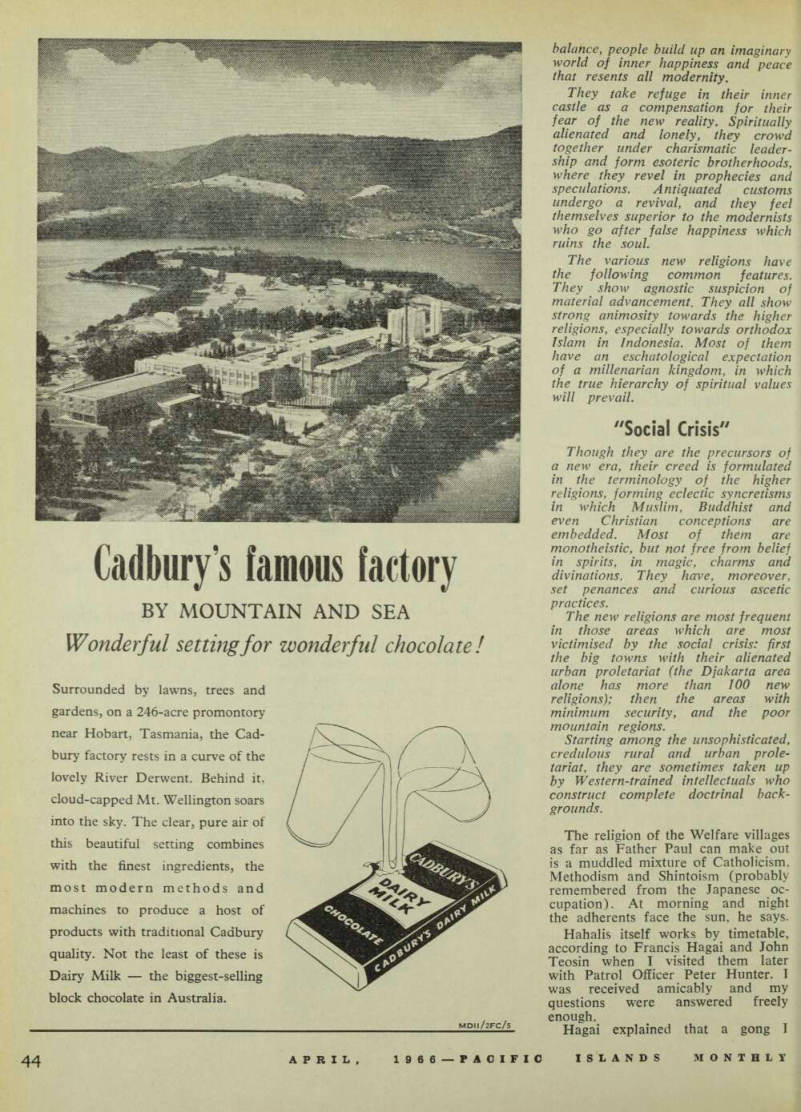
Francis Hagai.
balance, people build up an imaginary world of inner happiness and peace that resents all modernity.
They take refuge in their inner castle as a compensation for their fear of the new reality. Spiritually alienated and lonely, they crowd together under charismatic leader ship and form esoteric brotherhoods, where they revel in prophecies and speculations. Antiquated customs undergo a revival, and they feel themselves superior to the modernists who go after false happiness which ruins the soul.
The various new religions have the following common features.
They show agnostic suspicion of material advancement. They all show strong animosity towards the higher religions, especially towards orthodox Islam in Indonesia. Most of them have an eschatological expectation of a millenarian kingdom, in which the true hierarchy of spiritual values will prevail.
"Social Crisis"
Though they are the precursors of a new era, their creed is formulated in the terminology of the higher religions, forming eclectic syncretisms in which Muslim, Buddhist and even Christian conceptions are embedded. Most of them are monotheistic, but not free from belief in spirits, in magic, charms and divinations. They have, moreover, set penances and curious ascetic practices.
The new religions are most frequent in those areas which are most victimised by the social crisis: first the big towns with their alienated urban proletariat (the Djakarta area alone has more than 100 new religions); then the areas with minimum security, and the poor mountain regions.
Starting among the unsophisticated, credulous rural and urban prole tariat, they are sometimes taken up by Western-trained intellectuals who construct complete doctrinal back grounds.
The religion of the Welfare villages as far as Father Paul can make out is a muddled mixture of Catholicism.
Methodism and Shintoism (probably remembered from the Japanese oc cupation). At morning and night the adherents face the sun, he says.
Hahalis itself works by timetable, according to Francis Hagai and John Teosin when I visited them later with Patrol Officer Peter Hunter. I was received amicably and my questions were answered freely enough.
Hagai explained that a gong I
could see in the centre of the village was rung at 6 a.m. and 6 p.m. for worship, 8 a.m. for school, 12 noon and 1 p.m. for the lunch break and 4 p.m, for knock-off time. One gong was sounded for worship and three gongs for the other routines.
“The gong goes two times when we want to have a discussion,” said Hagai.
Hagai appeared to be the more self-possessed of the two men, and the more active. Teosin, the word spinner with the mystic touch, able to get his audiences to believe that he has the secret of the cargo, was reserved, quiet and friendly.
New Brothels
With a group of young men, Hagai and Teosin were sawing timber for a house frame when we arrived.
The frames were to go on existing concrete foundations in front of one of the long “clubhouses”, or brothels, that are built of native materials.
The brothels are divided into small cubicles, with walls at about chest height so it is possible to hear what is going on in the next cubicle; and if you stand up, to see what is going on too.
The new clubhouses, said Hagai, would be of permanent materials and each would house only two girls.
It would be better accommodation for them. I got the impression that the concrete foundations had been up for some time and that the building activity in the village was for my benefit, for Hunter had sent word we were coming.
I later asked one of the girls, who came out of one of the cubicles, naked from the waist up, whether she was looking forward to the new houses.
“No,” she said firmly. She pre ferred the long houses, and although I pressed the point she would offer no explanation why. She also indicated that she didn’t expect the new houses would be built for some time yet.
From my observations, and from the information of the missions and the Administration, the society is catching up with the economic facts of life.
Not far from Hahalis, on the main Buka road which has been built by the Administration since the first out break of the cult, there is a fine large trade store built by the Welfare Society. It has some expensive fittings in it, but it is quite empty of goods or personnel and has been since it was erected.
The Welfare Society has had many adventures in the purchase of new and secondhand vehicles, which can’t
be kept running, and only one truck was working when I was there.
The missionaries say that “pauper ism reigns supreme” in the villages when it comes to food, housing and clothing—although at one time the people were above average with these items.
The society had promised all its members houses and high wages, but neither the houses nor the wages have been forthcoming. The society apparently is living off its savings.
There is grumbling among the adherents, who want to know what happens to their copra money and to the annual tax they pay to the society (which is in addition to the
$4 each Administration head tax), The missions say more of the Welfare people are beginning to become disillusioned with the cult— despite pressure exerted on them to remain (some of the mission people believe that fear of poison and violent death keeps many adherents in the cult, although the Administration can get no evidence of this), At the height of cult activity the children left the five mission schools in the area (there are no Administra tion schools on Buka) but they have since returned. Hagai and Teosin have asked for an Administration school to be built, but the Admini stration’s reply is that there are
S 4 each head tax they have continued attend (mission schools are sub sidised by the Administration).
The Welfare villages also use one or other of the five mission hospitals in the area, and the missionary sisters have delivered many of the babies born out of the clubhouse unions. The clubhouses have 80 girls, ranging in age from 14 to about 20.
Nobody knows for sure how many babies have been born under the cult, but Father Paul says 10 babies have been delivered in the hospitals.
He is concerned at what happens to the babies in the villages.
“There is no community owner ship of these children,” he says.
“They are looked after by their mothers, whom nobody helps. There is no family life,”
Some of the more sensible of the older people. Father Paul says, don’t agree with the outlawing of marriage by the cult, and this has sent them back to the missions. Others, he thinks, will follow.
The building of the Buka road is probably the biggest single thing to turn the tide against the cult. It goes 51 miles from the airstrip at Buka Passage—all up the fertile east coast of Buka and around the top of the island. The road has come at a time when copra prices have been rising, and produce can now be got out to market.
I drove the length of it, and it is a fine road.
New Shoots Possible
There was a set-back a year or two ago when Bougainville was for a long stretch without adequate ship ping to Rabaul, and cocoa supplies rotted on Buka. Frequent repetition of this kind of thing could still cause disaster, for although the cult is withering, new frustrations for the other villages on Buka could always send new life into the Welfare vine, and start fresh new shoots.
Father Paul, surrounded as he is by the Welfare villages, knows this very well, for he is the leader of the strongest of the breakway move ments from Hahalis.
“Some way had to be found to group together the people who refused to be pushed into the com munistic way of life,” he explained.
“And since talking was useless, some business had to be started to show the people that wealth does not come through some magical incantation of the cargo cult, but by hard work and development of new sources of income.”
In 1962 Father Paul formed the Haku Development Society with a few men from each of seven villages. He developed it into a
savings and loan society, and a cooperative sawmilling enterprise, and last year they formed themselves into the Haku Local Government, which was united with the Buka Local Government Council.
The members were thus saved from the flood that threatened to engulf them, giving them cohesion and the strength to stand firm. The new enterprises made up socially for the exclusion the people suffered in village life.
The membership is now 110 men —all heads of families, and they represent probably 500 people. They have put cash into the co-operative, and monthly meetings serve to instil m the members the principles of co-operation and business.
With a Dolmar portable horizontal chain saw, the members of the society engage themselves in logging and milling operations, to produce timber for their own houses and some for outside sale. The houses, with roofs of aluminium or galvan-
ised iron, cost about $5OO, and some of the money is lent by the savings society at 2k per cent, interest.
But it’s been operation bootstrap.
The scheme works slowly because of lack of capital to build more houses, or lower their cost. Greater use of timber could be made in the houses if the society had another saw. One could be used to sell timber on the market and the other for the members’ own houses.
The society also needs extra money for cement water tanks for the houses. Tanks are lacking, and last year for the second year in a row dystentery epidemics caused deaths of babies—ll last year Thus there is a fight still ahead on Buka if the cult is be wiped right out. As in 1963, the task is still to “build up Buka, economically and socially”, and this won’t be done in a night even with the help of the many fine people on Buka like Father Paul Demers.