Captain Cook's Yorkshire
pp. 87-89 · Read in the full issue
Has Many Mementoes Of
Famous Explorer
By G. Bernard Wood
The historic voyages of Captain James Cook to the Pacific in the 18th century are common knowledge, but a great deal of interest can be derived from reversing the process, as it were, and seeking out some of the places that served young Cook as his springboard to world fame.
COOK was born in a two-bedroomed thatched cottage at Marton-in-Cleveland, near Middlesbrough, Yorkshire, on October 27, 1728.
Unfortunately the cottage was demolished when Marton Hall was built nearby, but amends have recently been made by the erection in the village of a school to Cook’s memory.
Shipped To Australia
* , ,T r , . • An £. a hhcHigh Marton s old church, in which Cook was baptised, has been rebuilt, it still contains medieval sculptures that must have caught the eye of the future explorer.
In 1736 Cooks father, also named James, took employment on the manor farm at Great Ayton, five miles away.
The cottage which the family occupied (some say it was actually built by Cook senior) was taken down in 1934 and shipped to Australia. (Faithfully rebuilt to the original design, it stands in the Fitzroy Gardens, Melbourne. In exchange, Great Ayton received an obelisk hewn from that part of the Australian coast first sighted by Cook and his crew in 1769),
Another memorial obelisk stands on the crest of Easby Moor nearby.
Most Yorkshiremen still mourn the loss of the humble cottage at Great Ayton, but the village school remains and here one can see the bench, horn cup, and iron lantern used by the brilliant young scholar who, it is said, was never known to make a mathematical mistake, After leaving school at the age of 13 Cook helped his father on the f , arm : Mr. Thomas Skottowe the lord of the manor, who had pa j d f or Cook’s schooling, doubtless expected him to become a prosperous merchant when, at 17 years of age, forsook agriculture and moved to staithes as assistant to William Sanderson, a grocer and draper. But a very different career was in store f or . p.
UangGT
Although Sanderson’s shop has since been engulfed by the sea, Staithes is essentially the same quaint fishing village that Cook knew.
Today, its renowned inn, the Cod and Lobster, seems continually in danger of following Sanderson’s shop into the waves—rough seas in-
variably drench this old smuggling rendezvous, and visitors’ cars have to run the same gauntlet.
Little wonder that in such sur roundings Cook’s thoughts soon drifted from shopkeeping to naviga tion.
But he did not run away to sea, as is often stated. In fact it was Sanderson himself who took the youth to Whitby, 10 miles down the coast, and introduced him to John Walker, a Quaker shipowner.
Cook’s three-years’ apprenticeship with Walker was served on his master’s collier-brigs, and in between the voyages of that period he lived with the Walker household in Grape Lane. Consequently, this 17th-century house has long been known as “Captain Cook’s”.
Grape Lane is a narrow thorough fare near the harbour bridge. “Cook’s House” has some amusing porthole windows, and visitors are sometimes shown the attic where Cook slept and studied. Here it will be pointed out, the roof-timbers include old ships’ masts adapted for the purpose.
His apprenticeship completed, Cook
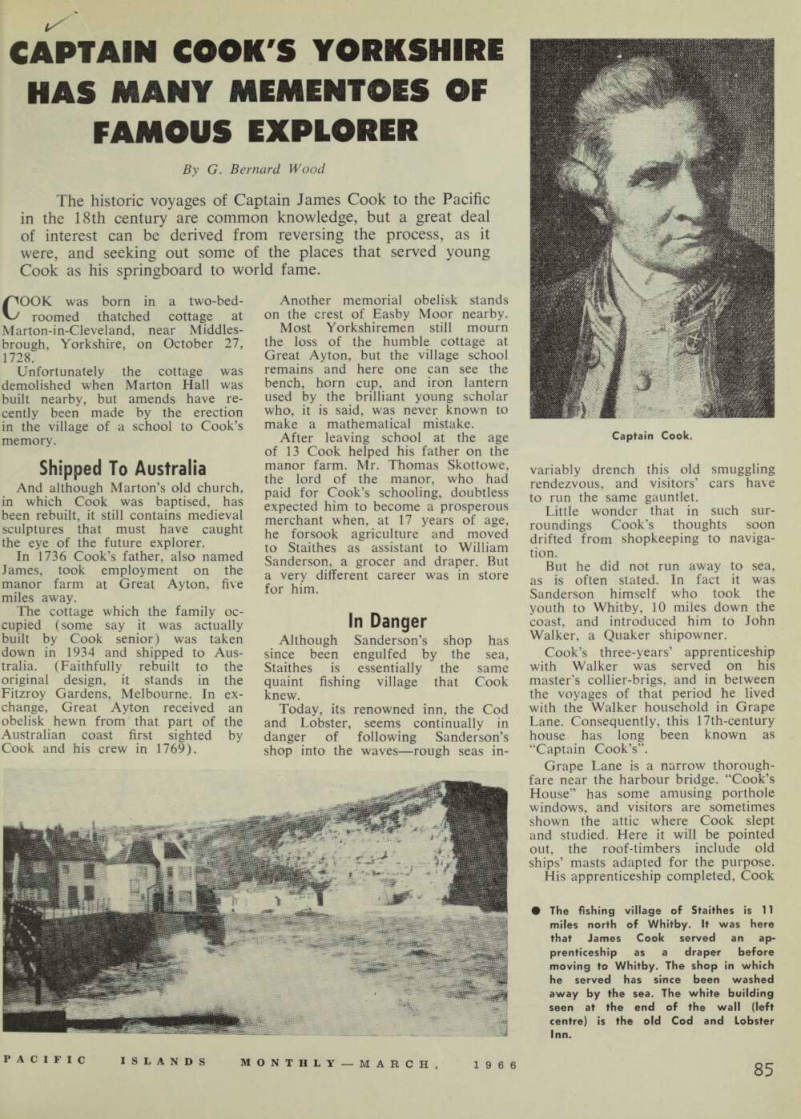
Captain Cook.
The fishing village of Staithes is 11 miles north of Whitby. It was here that James Cook served an ap prenticeship as a draper before moving to Whitby. The shop in which he served has since been washed away by the sea. The white building seen at the end of the wall (left centre) is the old Cod and Lobster Inn.
served on many sea-going vessels, first as seaman and later as master.
He began to study astronomy and was later entrusted with several im portant coastal surveys. In 1768 he was given command of a scientific expedition to the South Seas and this is now referred to as his first voyage.
Mary Prowd, the motherly house keeper who had formerly kept young Cook supplied with candles for his nightly studies, was advised that, as he was now a naval officer of high repute, he should be treated with becoming dignity.
But at the sight of him m his grand uniform she forgot all the instructions, greeted him like a son, and still called him “James, honey”.
Worth Exploring
Many changes are occurring in this part of old Whitby. The Tin Ghaut, a picturesque landing place adjoining Cook’s House, disappeared a few years ago, and Bridge Street has been widened at the expense of other old-established features.
Nevertheless, this quarter is still well worth exploring for surviving relics of Cook’s days—for example Abraham’s Bosom (a stretch of harbour frontage near Cook’s House), the delightfully-named Arguments Yard, and the fantastic 14th-century cliff-buttress that supports Church Stairs. The latter are the famous 199 steps leading from Church Street to St. Mary’s Church at the cliff-top.
St. Mary’s was transformed in the 18th century by the insertion of cabin-like windows, mast-like pillars, galleries that resemble quarterdecks, and exterior staircases clearly derived from ships’ companionways.
The craftsmen responsible were local shipwrights—the very men who built the sturdy wooden vessels that Cook was to sail round the world.
Other neighbouring sights at Whitby include strange little jetties; backyards that are redolent of bygone smuggling, and ancient hostelries—notably the White Horse in Church Street, where seamen once foregathered to discuss Cook’s latest adventures.
In fiction, old Whitby is nowehere better described than in Sylvia's Lovers, by Mrs. Gaskell. Several of the incidents which she relates, especially those about Press gangs’ activities, are authentic and were passed on to her by a local banking family who had known Captain Cook and had helped to finance the ship ping enterprises of his day.
From the back windows of Captain Cook’s House one can look across the harbour to what remains of the shipyards where his famous
vessels were built. These were the Endeavour (first voyage, 1768-71), the Resolution and Adventure (second voyage, 1772-75), and the Discovery (third voyage, 1776-80).
In the surviving shipyard, near the present railway station, Captain Alan Villiers is having a replica of Cook’s Endeavour built in readiness for a voyage to Australia to mark the bi-centenary of Cook’s visit in 1770.
Mementoes
Whitby Museum, which adjoins ii a f it • t} the Pannett Art Gallery in Pannett Park, has a wonderful section devoted to Captain Cook and his discoveries We see first the Munster Rolls as once kept by local shipowners. Some of these record Cook’s early employment on the collier-brigs Freelove and Three Brothers; also his periodic twopenny subscriptions “for the relief and support of maimed and disabled seamen, and the widows and children of such as shall be killed, slain or drowned in the merchant service” —an early form of marine insurance.
Scale models of the Endeavour and the Resolution stand near the explorer’s Davis backstaff (used for taking nautical measurements), while all around are some of the souvenirs Cook brought home from his memorable voyages.
There is a remarkable display of Maori bric-a-brac including curious dresses, shields and clubs, and a native model of a war canoe.
Australia is represented by another fine display; boomerangs and stone axes as used by the Aborigines to provide a valiant background for a coral pool, which can be taken to reflect the Great Barrier Reef.
From the South Sea Islands there are attractive ornaments made from seashells, teeth, and mother-of-pearl; coconut scrapers; queerly-shaped fish hooks, and some richly-coloured birds’ feathers which were made into a cape for Captain Cook’s wife Elizabeth.
Other personal tokens of Captain Cook displayed in the museum are the silver medal struck in his honour by the Royal Society, and a fine Wedgwood medallion.
A replica of Cook’s head, fashioned in Whitby jet by a local craftsman, went to Australia a few years ago, but the life-size bronze statue made by John Tweed in 1912, is never likely to be taken away. Standing on the West Cliff above Whitby harbour, it shows Captain Cook holding chart and compass; below him, on the stone plinth, is a carved replica of the Resolution facing out to sea.
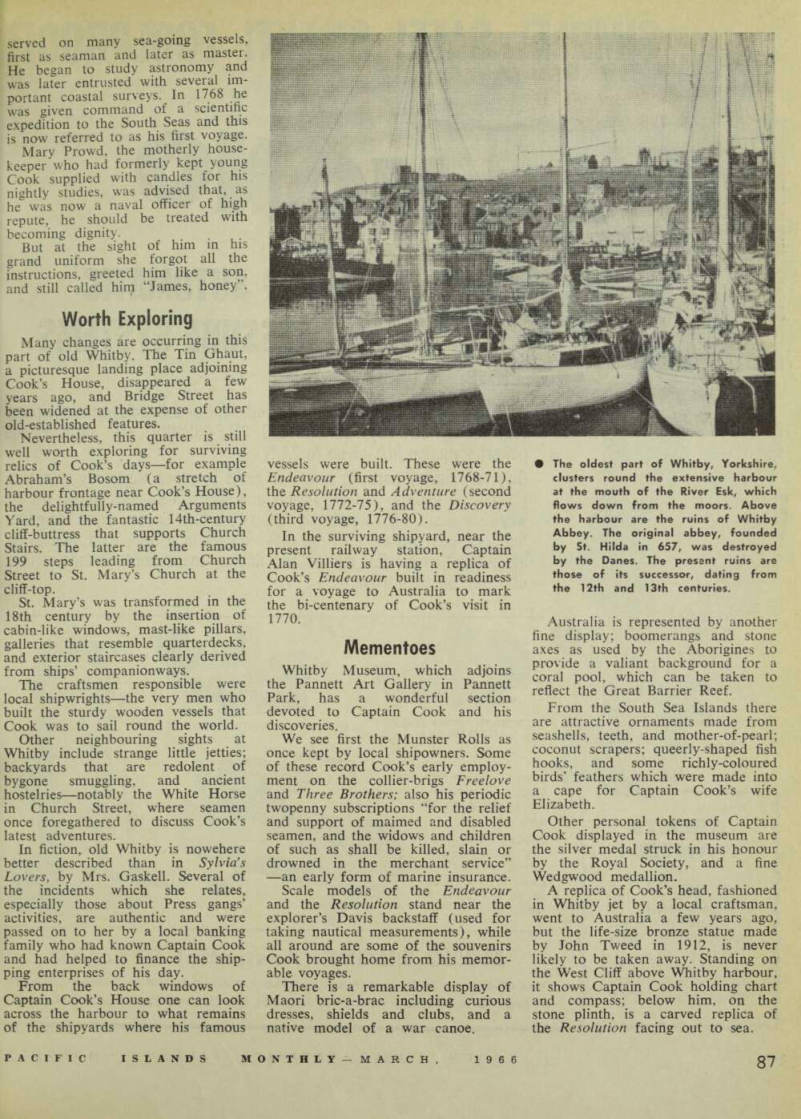
The oldest part of Whitby, Yorkshire, clusters round the extensive harbour at the mouth of the River Esk, which flows down from the moors. Above the harbour are the ruins of Whitby Abbey. The original abbey, founded by St. Hilda in 657, was destroyed by the Danes. The present ruins are those of its successor, dating from the 12th and 13th centuries.