Samoa's "Big Blow" Makes A Shambles Of Historic Vailima, Home
pp. 83-85 · Read in the full issue
Historic Vailima, Home Of R.L.S.
By a Staff Writer
The hurricane of March 16, 1889, which wrecked three American and three German warships in Apia harbour with the loss of 146 lives, was a memory of only nine months when the famous Scottish author Robert Louis Stevenson arrived in Apia in the schooner Equator after a long cruise in the South Pacific.
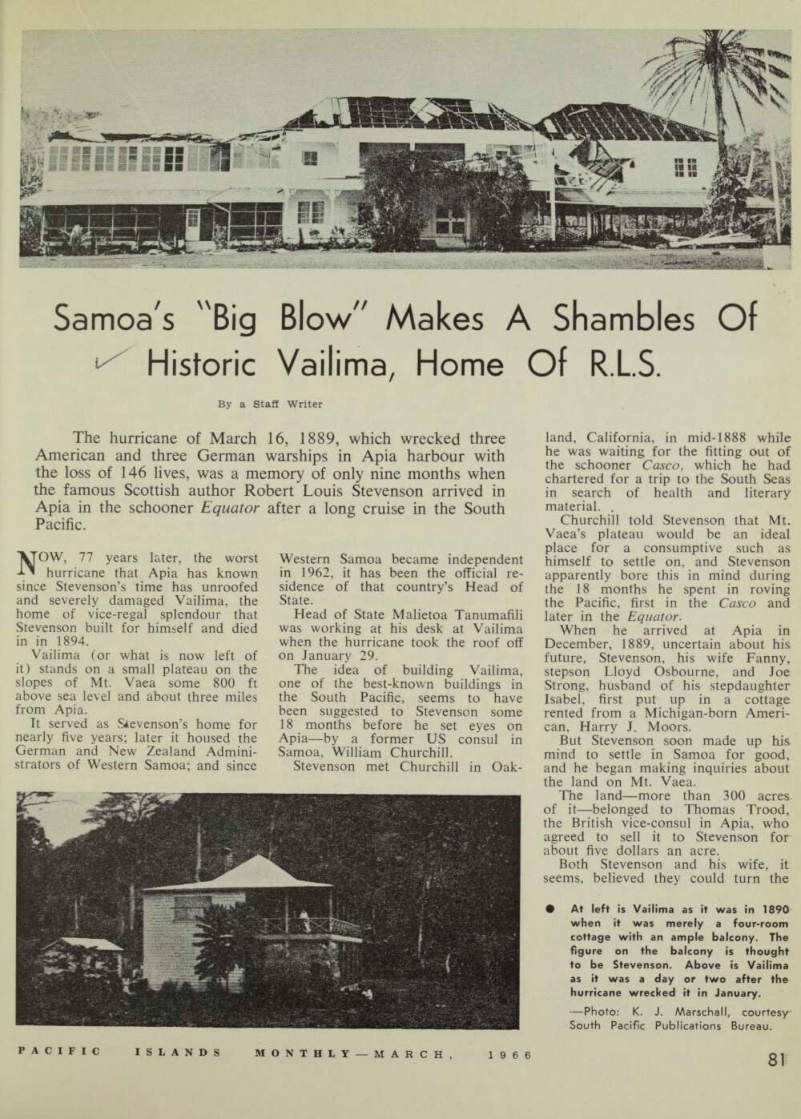
NOW, 77 years later, the worst hurricane that Apia has known since Stevenson’s time has unroofed and severely damaged Vailima, the home of vice-regal splendour that Stevenson built for himself and died in in 1894.
Vailima (or what is now left of it) stands on a small plateau on the slopes of Mt. Vaea some 800 ft above sea level and about three miles from Apia.
It served as Stevenson’s home for nearly five years; later it housed the German and New Zealand Admini strators of Western Samoa; and since
Western Samoa became independent in 1962, it has been the official re sidence of that country’s Head of State.
Head of State Malietoa Tanumafili was working at his desk at Vailima when the hurricane took the roof off on January 29.
The idea of building Vailima, one of the best-known buildings in the South Pacific, seems to have been suggested to Stevenson some 18 months before he set eyes on Apia—by a former US consul in Samoa, William Churchill.
Stevenson met Churchill in Oak-
land, California, in mid-1888 while he was waiting for the fitting out of the schooner Casco, which he had chartered for a trip to the South Seas in search of health and literary material. .
Churchill told Stevenson that Mt.
Vaea’s plateau would be an ideal place for a consumptive such as himself to settle on, and Stevenson apparently bore this in mind during the 18 months he spent in roving the Pacific, first in the Casco and later in the Equator.
When he arrived at Apia in December, 1889, uncertain about his future, Stevenson, his wife Fanny, stepson Lloyd Osbourne, and Joe Strong, husband of his stepdaughter Isabel, first put up in a cottage rented from a Michigan-born Ameri can, Harry J. Moors.
But Stevenson soon made up his mind to settle in Samoa for good, and he began making inquiries about the land on Mt. Vaea.
The land—more than 300 acres of it—belonged to Thomas Trood, the British vice-consul in Apia, who agreed to sell it to Stevenson for about five dollars an acre.
Both Stevenson and his wife, it seems, believed they could turn the
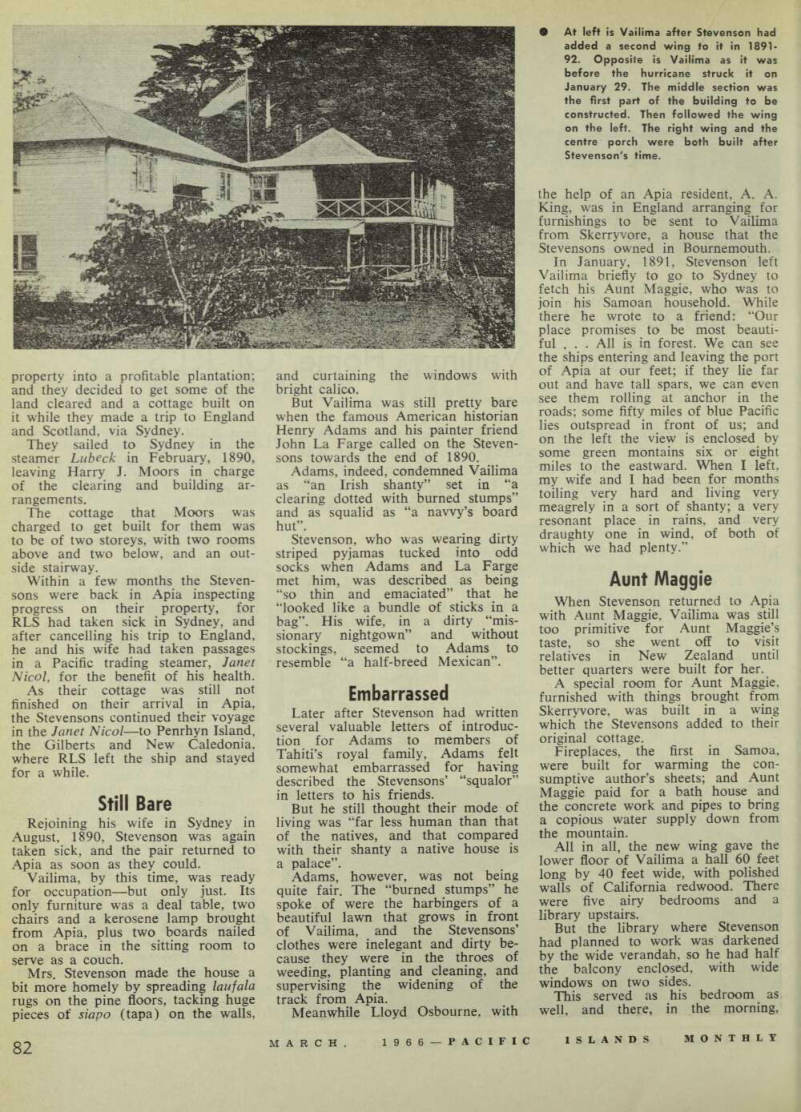
At left is Vailima as it was in 1890 when it was merely a four-room cottage with an ample balcony. The figure on the balcony is thought to be Stevenson. Above is Vailima as it was a day or two after the hurricane wrecked it in January.
Photo: K. J. Marschall, courtesy South Pacific Publications Bureau.
property into a profitable plantation; and they decided to get some of the land cleared and a cottage built on it while they made a trip to England and Scotland, via Sydney.
They sailed to Sydney in the steamer Lubeck in February, 1890, leaving Harry J. Moors in charge of the clearing and building ar rangements.
The cottage that Moors was charged to get built for them was to be of two storeys, with two rooms above and two below, and an out side stairway.
Within a few months the Steven sons were back in Apia inspecting progress on their property, for RLS had taken sick in Sydney, and after cancelling his trip to England, he and his wife had taken passages in a Pacific trading steamer, Janet Nicol, for the benefit of his health.
As their cottage was still not finished on their arrival in Apia, the Stevensons continued their voyage in the Janet Nicol —to Penrhyn Island, the Gilberts and New Caledonia, where RLS left the ship and stayed for a while.
Still Bare
Rejoining his wife in Sydney in August, 1890, Stevenson was again taken sick, and the pair returned to Apia as soon as they could.
Vailima, by this time, was ready for occupation—but only just. Its only furniture was a deal table, two chairs and a kerosene lamp brought from Apia, plus two boards nailed on a brace in the sitting room to serve as a couch.
Mrs. Stevenson made the house a bit more homely by spreading laufala rugs on the pine floors, tacking huge pieces of siapo (tapa) on the walls,
and curtaining the windows with bright calico.
But Vailima was still pretty bare when the famous American historian Henry Adams and his painter friend John La Farge called on the Steven sons towards the end of 1890.
Adams, indeed, condemned Vailima as “an Irish shanty” set in “a clearing dotted with burned stumps” and as squalid as “a navvy’s board hut”.
Stevenson, who was wearing dirty striped pyjamas tucked into odd socks when Adams and La Farge met him, was described as being “so thin and emaciated” that he “looked like a bundle of sticks in a bag”. His wife, in a dirty “mis sionary nightgown” and without stockings, seemed to Adams to resemble “a half-breed Mexican”.
Embarrassed
Later after Stevenson had written several valuable letters of introduc tion for Adams to members of Tahiti’s royal family, Adams felt somewhat embarrassed for having described the Stevensons’ “squalor” in letters to his friends.
But he still thought their mode of living was “far less human than that of the natives, and that compared with their shanty a native house is a palace”.
Adams, however, was not being quite fair. The “burned stumps” he spoke of were the harbingers of a beautiful lawn that grows in front of Vailima, and the Stevensons’ clothes were inelegant and dirty be cause they were in the throes of weeding, planting and cleaning, and supervising the widening of the track from Apia.
Meanwhile Lloyd Osbourne, with
the help of an Apia resident, A. A.
King, was in England arranging for furnishings to be sent to Vailima from Skerryvore, a house that the Stevensons owned in Bournemouth.
In January, 1891, Stevenson left Vailima briefly to go to Sydney to fetch his Aunt Maggie, who was to join his Samoan household. While there he wrote to a friend: “Our place promises to be most beauti ful .. . All is in forest. We can see the ships entering and leaving the port of Apia at our feet; if they lie far out and have tall spars, we can even see them rolling at anchor in the roads; some fifty miles of blue Pacific lies outspread in front of us; and on the left the view is enclosed by some green montains six or eight miles to the eastward. When I left, my wife and I had been for months toiling very hard and living very meagrely in a sort of shanty; a very resonant place in rains, and very draughty one in wind, of both of which we had plenty.”
Aunt Maggie
When Stevenson returned to Apia with Aunt Maggie, Vailima was still too primitive for Aunt Maggie’s taste, so she went off to visit relatives in New Zealand until better quarters were built for her.
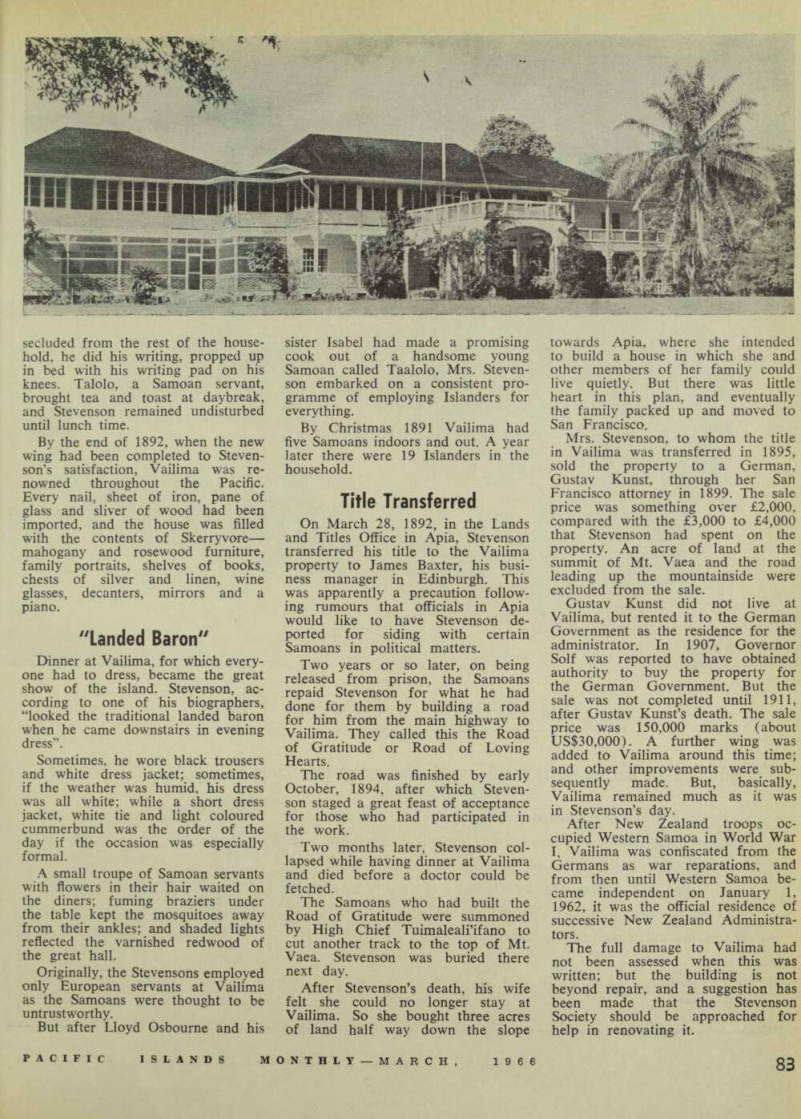
A special room for Aunt Maggie, furnished with things brought from Skerryvore, was built in a wing which the Stevensons added to their original cottage.
Fireplaces, the first in Samoa, were built for warming the con sumptive author’s sheets; and Aunt Maggie paid for a bath house and the concrete work and pipes to bring a copious water supply down from the mountain.
All in all, the new wing gave the lower floor of Vailima a hall 60 feet long by 40 feet wide, with polished walls of California redwood. There were five airy bedrooms and a library upstairs.
But the library where Stevenson had planned to work was darkened by the wide verandah, so he had half the balcony enclosed, with wide windows on two sides.
This served as his bedroom as well, and there, in the morning,
At left is Vailima after Stevenson had added a second wing to it in 1891- 92. Opposite is Vailima as it was before the hurricane struck it on January 29. The middle section was the first part of the building to be constructed. Then followed the wing on the left. The right wing and the centre porch were both built after Stevenson's time.
secluded from the rest of the house hold, he did his writing, propped up in bed with his writing pad on his knees. Talolo, a Samoan servant, brought tea and toast at daybreak, and Stevenson remained undisturbed until lunch time.
By the end of 1892, when the new wing had been completed to Steven son’s satisfaction, Vailima was re nowned throughout the Pacific.
Every nail, sheet of iron, pane of glass and sliver of wood had been imported, and the house was filled with the contents of Skerryvore— mahogany and rosewood furniture, family portraits, shelves of books, chests of silver and linen, wine glasses, decanters, mirrors and a piano.
"Landed Baron"
Dinner at Vailima, for which every one had to dress, became the great show of the island. Stevenson, ac cording to one of his biographers, “looked the traditional landed baron when he came downstairs in evening dress”.
Sometimes, he wore black trousers and white dress jacket; sometimes, if the weather was humid, his dress was all white; while a short dress jacket, white tie and light coloured cummerbund was the order of the day if the occasion was especially formal.
A small troupe of Samoan servants with flowers in their hair waited on the diners; fuming braziers under the table kept the mosquitoes away from their ankles; and shaded lights reflected the varnished redwood of the great hall.
Originally, the Stevensons employed only European servants at Vailima as the Samoans were thought to be untrustworthy.
But after Lloyd Osbourne and his
sister Isabel had made a promising cook out of a handsome young Samoan called Taalolo, Mrs. Steven son embarked on a consistent pro gramme of employing Islanders for everything.
By Christmas 1891 Vailima had five Samoans indoors and out. A year later there were 19 Islanders in the household.
Title Transferred
On March 28, 1892, in the Lands and Titles Office in Apia, Stevenson transferred his title to the Vailima property to James Baxter, his busi ness manager in Edinburgh. This was apparently a precaution follow ing rumours that officials in Apia would like to have Stevenson de ported for siding with certain Samoans in political matters.
Two years or so later, on being released from prison, the Samoans repaid Stevenson for what he had done for them by building a road for him from the main highway to Vailima. They called this the Road of Gratitude or Road of Loving Hearts, The road was finished by early October, 1894, after which Steven son staged a great feast of acceptance for those who had participated in the work.
Two months later, Stevenson col lapsed while having dinner at Vailima and died before a doctor could be fetched.
The Samoans who had built the Road of Gratitude were summoned by High Chief Tuimaleali’ifano to cut another track to the top of Mt.
Vaea. Stevenson was buried there next day.
After Stevenson’s death, his wife felt she could no longer stay at Vailima. So she bought three acres of land half way down the slope
towards Apia, where she intended to build a house in which she and other members of her family could live quietly. But there was little heart in this plan, and eventually the family packed up and moved to San Francisco.
Mrs. Stevenson, to whom the title in Vailima was transferred in 1895, sold the property to a German, Gustav Kunst, through her San Francisco attorney in 1899. The sale price was something over £2,000, compared with the £3,000 to £4,000 that Stevenson had spent on the property. An acre of land at the summit of Mt. Vaea and the road leading up the mountainside were excluded from the sale.
Gustav Kunst did not live at Vailima, but rented it to the German Government as the residence for the administrator. In 1907, Governor Solf was reported to have obtained authority to buy the property for the German Government. But the sale was not completed until 1911, after Gustav Kunst’s death. The sale price was 150,000 marks (about USS3O,OOO). A further wing was added to Vailima around this time; and other improvements were sub sequently made. But, basically, Vailima remained much as it was in Stevenson’s day.
After New Zealand troops oc cupied Western Samoa in World War I, Vailima was confiscated from the Germans as war reparations, and from then until Western Samoa be came independent on January 1, 1962, it was the official residence of successive New Zealand Administra tors.
The full damage to Vailima had not been assessed when this was written; but the building is not beyond repair, and a suggestion has been made that the Stevenson Society should be approached for help in renovating it.