Sigatoka Sand Dunes Yield
pp. 63-65 · Read in the full issue

Secrets Of Fiji's Past
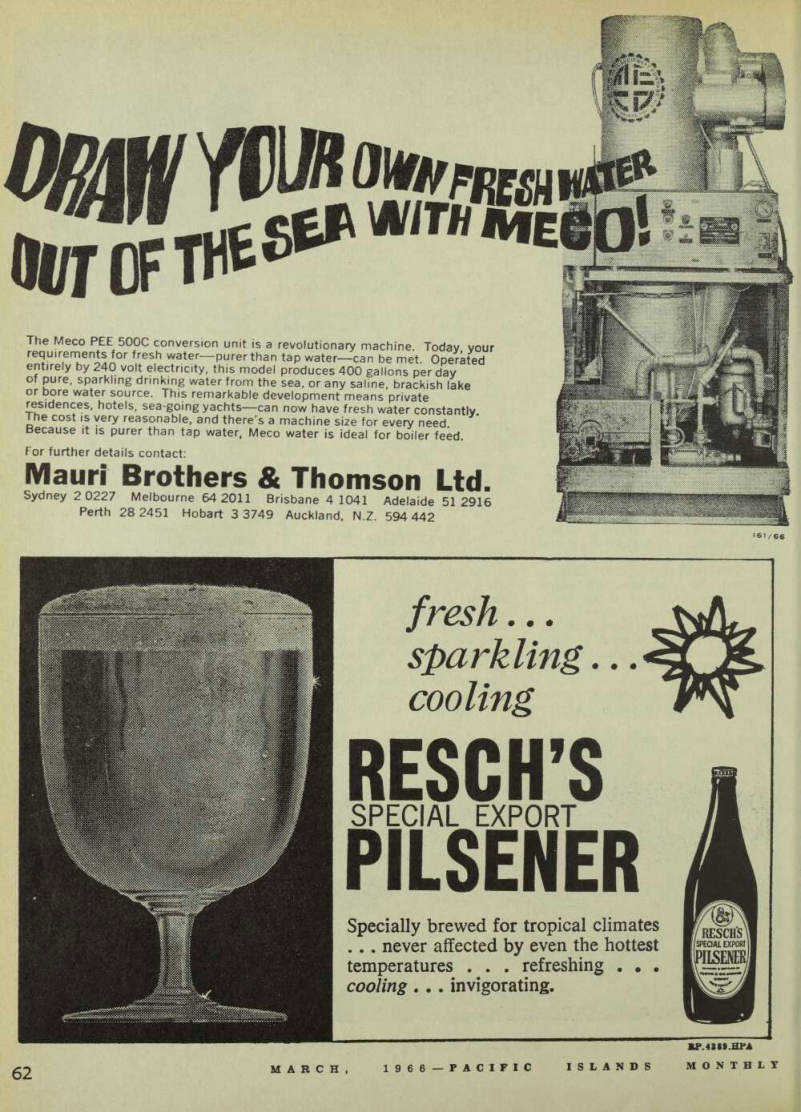
From a Suva Correspondent Reaching out as a long finger at the mouth of the Sigatoka River on Viti Levu, about 80 miles from Suva, are great sand dunes rising sharply and impressively to almost 150 ft above sea-level.
THIS great mass of sand—an area of interest to industrial concerns in Japan not long ago, is a well-known landmark to travellers along the Queen’s Road as they motor from Nadi to Suva.
Small boats going from Vatulele Island about 20 miles away, also use the dunes as a landmark on their journey to the mainland as the white seaward face can be seen a long way off, even at night.
Swept by the trade winds, with ever-shifting sand greeting the hiker and heavy surf pounding the reefless beach, the Sigatoka dunes are a lonely place today. Fragments of ammuni tion and sand-blasted bottles are. a reminder of the American forces who trained there in the war years.
Closer inspection, however, reveals more fragments—of pottery and stone, silent witnesses of a vanished popula tion who hauled up their canoes, fashioned their pottery and made their homes amid the dunes more than 2,000 years ago.
The long stretch of sand and the relics hidden in it conceal a stop' of migration and settlement in Fiji in times too remote for tradition to record.
Now it has become a detective story and a kind of jigsaw game, with the
spade and glue combining with the latest in scientific know-how to wrest from the sands the bits and pieces which will tell the unknown story of the past.
Tracing this story and uncovering the mysteries beneath the shifting sands is the Fiji Museum’s Director, Bruce Palmer.
He is leading a team of investigators in an extensive project made possible by generous help from the National Science, Foundation in the United States and the Bishop Museum in Hawaii.
For three and a half months, the arduous job of excavating the dune deposits has been borne by Mr. and Mrs. Lawrie Birks, of Auckland, who had previously excavated in Tonga,
Trays, Water Jars
Hundreds of tons of sand have been painstakingly dug by Mr. and Mrs.
Birks and their two Fijian assistants, lone and Ratuva, of Yadua Village.
Despite the extremely difficult con ditions, the Birks have at last re vealed the complicated story of early settlement groups who brought with them a refined pottery technique with quite distinctive forms of decoration.
The earliest horizon lies a little above high-water mark and contains
pottery similar to Tongan fragments dated at 590 BC and to similar ones from Lapita in New Caledonia which go back to 800 BC.
Finely decorated flat trays and massive water jars are among the types of pottery vessel found there.
Partial reconstruction of some pots has so far been possible, and Mrs.
Birks hopes that others may be com pletely restored.
Strangest of all are the pottery cylinders which have assymetrical wings or projections rising from them. What was their purpose?
Utilitarian? Religious ceremonial?
Decorative? Even Mr. Palmer is puzzled, but he inclines to the view that the mysterious objects—never be fore found in Fiji—were some form of stand for pots.
Also recovered from this early layer are several stone adzes which will enable the Museum team to draw comparisons with similar types from other areas.
Lying above this early layer and separated from it by several feet of sterile sand is a very rich layer of entirely different pottery, some of it decorated by having had carved paddles pressed into the damp clay while other crude dishes still bear, surprisingly, the clear impressions of the leaves which the ancient potters placed on the sand to form a working area for their pottery.
A New Zealand archaeological student, Rosalie Lambert, from Canterbury University, is busy work
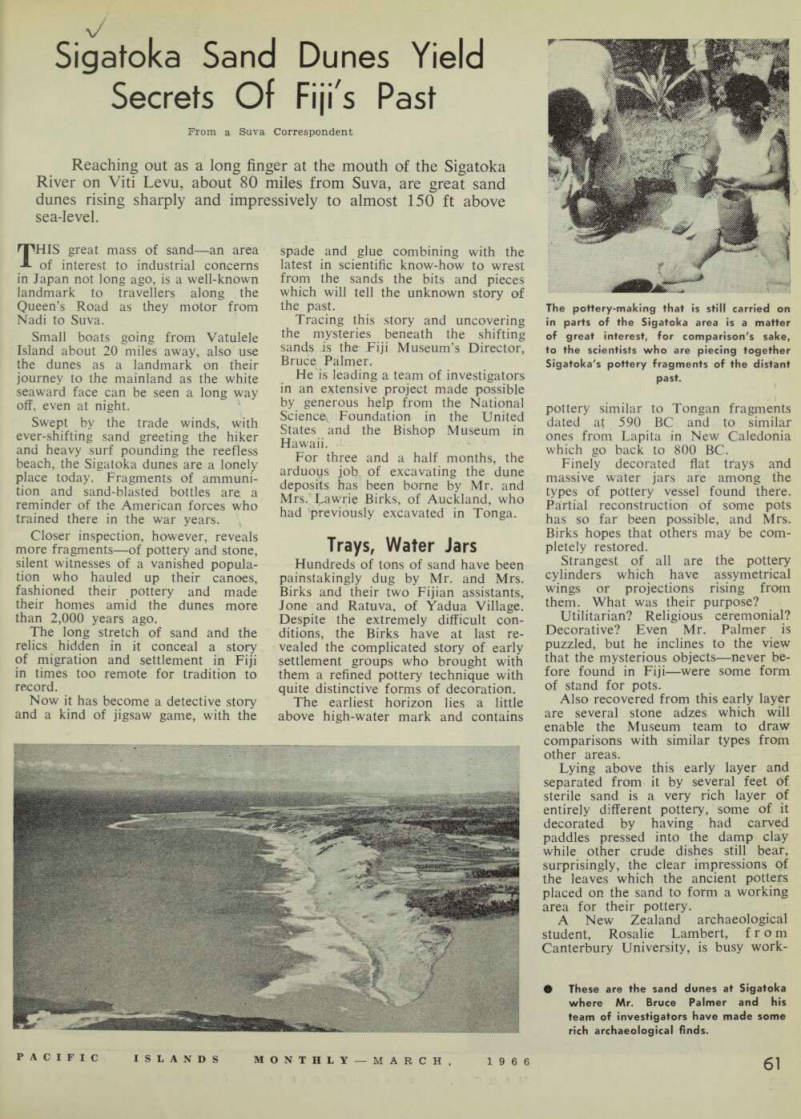
The pottery-making that is still carried on in parts of the Sigatoka area is a matter of great interest, for comparison's sake, to the scientists who are piecing together Sigatoka's pottery fragments of the distant past.
These are the sand dunes at Sigatoka where Mr. Bruce Palmer and his team of investigators have made some rich archaeological finds.
ing on the local flora trying to trace the trees from which the potters took their leaves for the working floor.
While all this work is going on, other members of the Museum team have concentrated on recording traditional pottery-making still carried on in several Sigatoka villages so that the archaological pottery may be com pared with that of the present day.
In this work, Mr. Palmer has been aided by Elizabeth Shaw, of Auckland University, and Meredith Sykes and Peggy Dickinson, both graduates from the United States.
Besides the work on pottery, the Fiji Museum has begun the long job of locating and surveying the dozens of fortified sites on alluvial flat and high ridges along 50 miles of the Siga toka Valley.
When this work is done, it will enable the team to tie in the dune site with other sites up the valley, and in this way it will be possible to tell a lot more about the story of Sigatoka from the sea to the high land areas of the interior.
Local Interest
The Fijian people of Sigatoka have shown great interest in the work go ing on around them.
Some day, they are told, the history dug out of the sand may dovetail with their own versions of history re corded in their songs and dances.
They feel happy that their part of Fiji is receiving the attention it de serves from the archaeologist.
Certainly, says Mr. Palmer, they have been most helpful to the Fiji Museum parties in the field. In their turn, the Museum people are pleased to be able to investigate this part of Fiji and make so many friends among the local people.
Much remains to be done, but a promising start has been made with much achieved in a short time.
Several more months of concen trated work should clear up some of the puzzles which remain, but there will be a lot of hard digging and much laboratory and library work before the full story can be told with any clarity and continuity. • Artifacts obtained from Nukuleka and a site near Atele College on Tongatapu, Tonga’s main island, have been dated by the radio-carbon method to the fourth century AD—not to the 14th century AD, as stated in PIM for January, p. 71. Mr. Jens Poulsen, a Danish archaeologist at the Australian National University, in Canberra, excavated the artifacts in 1963-64.