Mosquitoes
p. 62 · Read in the full issue
facts and fads about
A look at the haunts, habits and control methods of one of the world’s most prevalent and dangerous insects.
OINCE time immemorial, man has been plagued by the tiresome and, often dangerous, nocturnal activities of the mosquito, a pest recognised as the carrier of such dreaded diseases as malaria, yellow fever and dengue; and whose persistent attacks have had a hand in the winning of wars, de posing of monarchs and the digging of canals.
As a direct contrast to his blood sucking mate, the innocuous male mos quito is content to while away his days sucking the juice of fruit or vege tables.
Research has revealed that the female adult must obtain a “blood seal” before she is able to propagate the species—and as a result there are few people in the world today (for the mosquito is as much at home within the Arctic Circle as she is in the Tropics) who can claim that they have not suffered a night of repeated buzzing, irritating attacks resulting in lack of sleep and itchy, bumpy skin in the morning.
Mosquitoes thrive in stagnant water, from which the larvae obtain bacteria, protozoa, etc., to feed upon, and it is quite likely that there are several pockets of still water near your home that are the breeding grounds to several thousand mosquitoes. Water in old cans, blocked gutters, disused drains, old motor tyres, as well as stagnant pools are the main breeding places. Although, by utilizing favour-
able wind currents, female mosquitoes are sometimes able to cover 25 miles in a night, it is the breeding ground of still water close to your home from which you suffer “the bite at night”.
Generally, mosquitoes locate their blood meals by “homing in” on a victim, in much the same way that an aircraft employs radar or radio beams for navigation. One method is
by body heat, which results in con vection currents fanning upwards and outwards from the subject, and which prove ideal “home aids” for the female.
Vibration is the other “homing aid”.
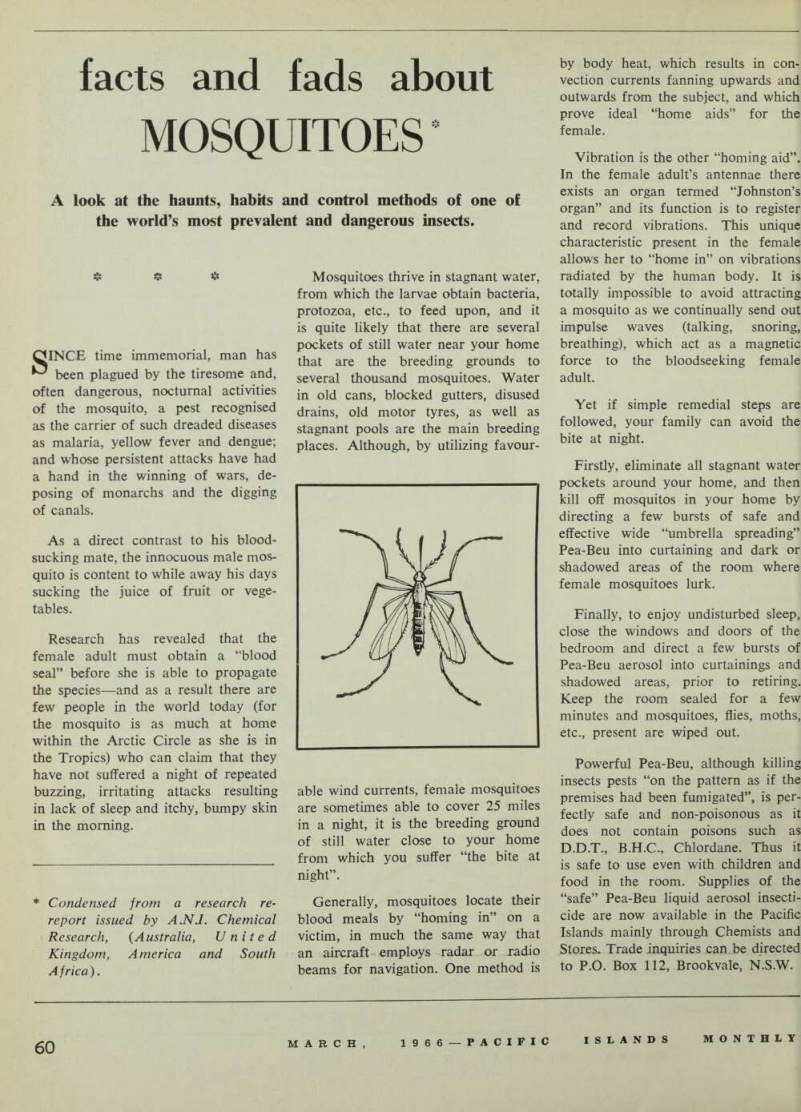
In the female adult’s antennae there exists an organ termed “Johnston’s organ” and its function is to register and record vibrations. This unique characteristic present in the female allows her to “home in” on vibrations radiated by the human body. It is totally impossible to avoid attracting a mosquito as we continually send out impulse waves (talking, snoring, breathing), which act as a magnetic force to the bloodseeking female adult.
Yet if simple remedial steps are followed, your family can avoid the bite at night.
Firstly, eliminate all stagnant water pockets around your home, and then kill off mosquitos in your home by directing a few bursts of safe and effective wide “umbrella spreading”
Pea-Beu into curtaining and dark or shadowed areas of the room where female mosquitoes lurk.
Finally, to enjoy undisturbed sleep, close the windows and doors of the bedroom and direct a few bursts of Pea-Beu aerosol into curtainings and shadowed areas, prior to retiring.
Keep the room sealed for a few minutes and mosquitoes, flies, moths, etc., present are wiped out.
Powerful Pea-Beu, although killing insects pests “on the pattern as if the premises had been fumigated”, is per fectly safe and non-poisonous as it does not contain poisons such as D.D.T., 8.H.C., Chlordane. Thus it is safe to use even with children and food in the room. Supplies of the “safe” Pea-Beu liquid aerosol insecti cide are now available in the Pacific Islands mainly through Chemists and Stores. Trade inquiries can be directed to P.O. Box 112, Brookvale, N.S.W.
* Condensed from a research re report issued by A.N.I. Chemical Research , ( Australia, United Kingdom, America and South Africa).