Protest Cruise Against Nuclear Test
pp. 103-111 · Read in the full issue
A 48 ft ship is to be sailed into the French nuclear testing area in the Eastern Pacific this year as a protest against the explosion of atomic weapons, according to a report in the Otago Daily Times, of Dunedin, NZ.
The vessel, which was said to be still under construction at a secret site in Sydney, is to be sailed by five Australians and probably six others from Singapore, France and other countries.
Two crew men already selected are Mr. Bob Smith, a Sydney waterside worker, and Mr. Edward Stantion, a Quaker farmer of Kurrajong Heights, NSW. Mrs, Eloise de Ville, a Frenchwoman in Sydney, has offered to join the crew, and the sponsors are also considering recruiting three other women.
The paper quoted the president of the Committee Against Atomic Testing, Mr. Tim Hornibrook, as saying that the sponsors of the protest cruise hoped that the crew would be arrested, thus creating an “incident” which would focus world attention on the protest, and shame France into abandoning the tests.
The vessel, named Marlin 11, is scheduled to call at New Zealand, Fiji, Tonga, Western Samoa, Cook Islands and Pitcairn before proceeding to the uninhabited islands near the blast site on Mururoa Atoll, where she is expected to be joined by two boats from New Zealand and one from Chile.
According to the Otago Daily Times, Mr. Hornibrook says the sponsors believe that under maritime law it would be piracy for the French to force the ships out of the area.
Service To Norfolk
Island To Be Regular
Holm and Company Ltd., of New Zealand, which last year inaugurated a passenger-cargo service between New Zealand and New Caledonia, via Norfolk Island, with the 1,800-ton vessel Holmburn, has announced that its service will be placed on a per manent basis this year.
The company expects to make nine trips a year at five or six-weekly intervals. More frequent trips may be made if more cargo is offering.
Big Build-Up Of Cargo
In Port Moresby
The urgent need to ease the strain on Port Moresby’s wharf space and cargo storage facilities was again em phasised early in January when more that 8,000 tons of cargo were stacked on the main wharf and in the two main cargo sheds, and 22 ships were due in the port by the end of the month with large cargoes.
Shipping authorities expected that January would see the worst con gestion in the port on record.
The build-up of cargo on the wharf and in the cargo sheds early in the month was partly the result of a big inflow of cargo over the Christmas and New Year holidays, and partly due to wet weather, which slowed down the movement of it.
Port Moresby’s main T-shaped wharf, which is 700 ft long, was built
in 1953-54 when the total amount of overseas cargo handled in the port was 72,192 tons.
Since then, there has been an in crease of several hundred per cent in the inflow of cargo, but despite repeated complaints from shipping men, there is still no definite plan to build more facilities.
Jap Fisher Sinks
At Levuka
The Koyo Mam No. 18, a Japanese fishing vessel, overturned and sank at Levuka, Fiji, in December while refuelling from a bulk storage tank.
Two of the three men on board jumped ashore when the ship started to list, and the third dived into the water and swam ashore.
The fisher started to list while fuel was being pumped into the forward port tank.
She turned turtle while efforts were in hand to correct the list.
An hour after high tide the stern was completely submerged, and only a small part of the forward part of the keel was above the surface.
"Waimate" Hits
Suva Wharf
The USS Co’s freighter, Waimate, on her December visit to Suva, made a deep gash in the face of the King’s Wharf when she did not stop on ap proaching it at about four knots.
The captain ordered an anchor
>verboard when she failed to stop >ut the manoeuvre was unsuccessful.
The Waimate’s bow was dented, ind damage was estimated at £l,OOO.
Recruits For P-Ng
Javal Patrol Boats
Thirty-five natives are to be re ruited in Papua-New Guinea to lan the naval patrol boats which will oon be based in the Territory.
The first recruits have already been hosen and sent to Manus Island to repare for their initial training 9urse, which will start this year.
The initial fleet of five patrol boats ill eventually be increased to 20.
S Ship On Survey
Ssignment
A United States Military Sea ransportation Service ship, the arris County, has arrived in the 3uth Pacific to help to establish a lapping survey post.
The Harris County is a converted ,nk landing craft, modified by the Idition of a raised landing deck om which a US naval helicopter aerates in support of the Pacific ogramme being undertaken by the nited States Air Force.
One of the first tasks of the arris County was to make her dicopter available to ferry men and aterials to Castle Rock, a high land ark near Lautoka, Fiji, where a rvey station has been established.
The Harris County carries a com ement of 70 Navy, Army and Air }rce men and civilians, and is ider the command of Captain L. G. irth.
Converted Training Vessel
Arrives In Moresby
The 217-ton training vessel Arcturus, which will be used to produce the future officers and sea men of Papua-New Guinea’s merchant service, arrived in Port Moresby in the second half of December.
The Arcturus was formerly the whaling and survey vessel Norfolk Whaler, and was bought and con verted by the P-NG Administration for £90,000.
The refit was done at Ballina, New South Wales.
The Arcturus sailed from Ballina on December 5 under the command of Commander J. S. Hill, officer-in charge of the Administration Nautical School at Napa Napa, near Port Moresby. Also on board were 15 Papuan and New Guinean trainee
seamen, a Papuan marine engineer apprentice, and two European officers.
On arrival in Port Moresby, Com mander Hill said cadet officers for coastal vessels would undergo a three to four-year training course, using the vessel’s facilities.
Explosives End Career
Of Cook Islands Trader
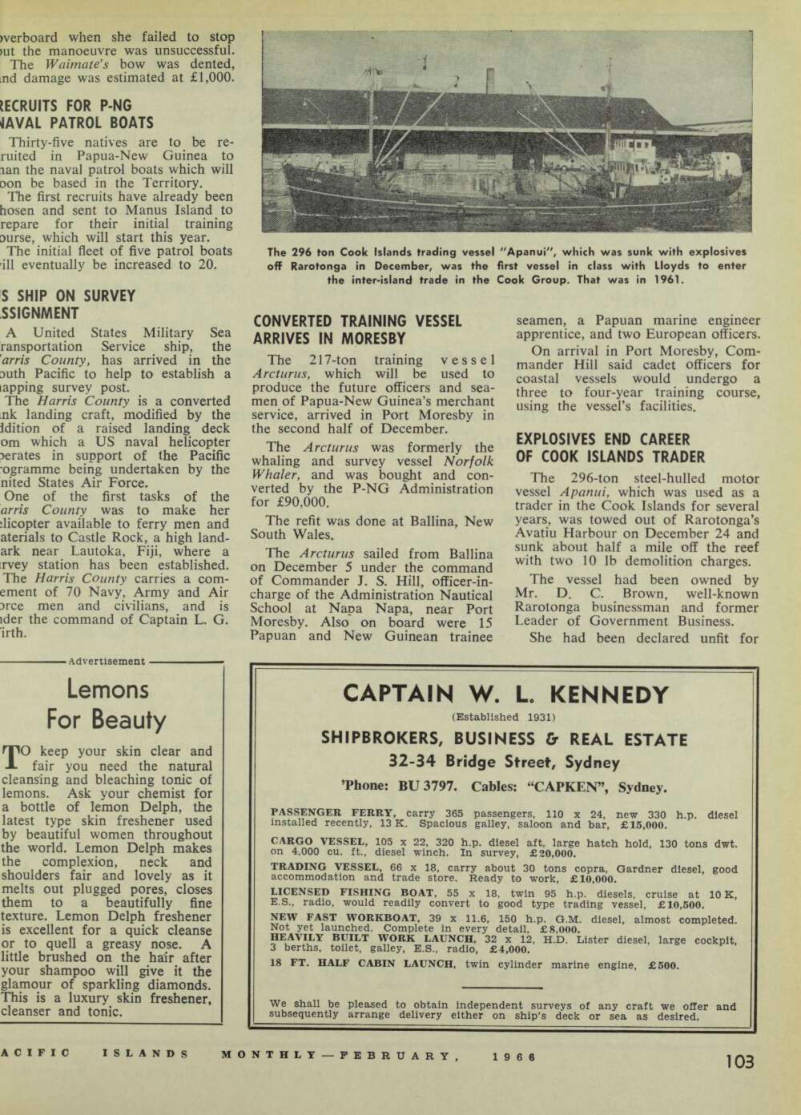
The 296-ton steel-hulled motor vessel Apanui, which was used as a trader in the Cook Islands for several years, was towed out of Rarotonga’s Avatiu Harbour on December 24 and sunk about half a mile off the reef with two 10 lb demolition charges.
The vessel had been owned by Mr. D. C. Brown, well-known Rarotonga businessman and former Leader of Government Business.
She had been declared unfit for
The 296 ton Cook Islands trading vessel "Apanui", which was sunk with explosives off Rarotonga in December, was the first vessel In class with Lloyds to enter the inter-island trade in the Cook Group. That was in 1961.
sea about 18 months ago. Since then she had remained moored in Avatiu harbour, leaking and badly rusted.
The Apanui was built in Hamburg n 1938 and was known as Gold mder before being renamed.
In February, 1961, Captain Hugh Williams, of Rarotonga bought her rom the Northern Steamship Com >any, of Auckland, and converted ier to take 16 passengers and 385 ons of cargo.
A few months later, when he lecided to retire to Sydney, Captain Williams sold the ship to Mr. Brown.
W. H. Percival reports from larotonga that the Apanui is the ixth ship that Mr. Brown has lost, 'he others were the motor ship Caroro, which was wrecked in bad /eather on a reef at Aitutaki in 949; the Fairmile launch Mahurangi, /hich foundered in the passage at ututaki in February, 1954, after rriving in a leaking condition; the IV Rannah, which was wrecked in storm at Avarua, Rarotonga, in lovember, 1954; the ex-Brixham •awler Inspire, which foundered in ivatiu Harbour in 1958 and was iter blown up as a navigational azard; and the ketch Taveuni which mndered in Avarua and was later lown up for the same reason.
Ishing Boat In
10Resby For Repairs
A Queensland fishing boat, rrowetta, which broke down about 25 miles south of Port Moresby on muary 3, was temporarily repaired sea and then sailed to Port loresby for further repairs.
The owner-skipper, Captain C. alter, said at Port Moresby that the jar box on the propeller shaft over rated and seized.
The anchor failed to hold in deep ater and the ship drifted danger- Lisly close to a reef under the in- Lience of a strong wind.
Captain Latter and the crew of wen worked all night to clear a ozen oil pump, and make temporary ;pairs before setting out for Port loresby.
Iorris Hedstroms Bow
Ut Of Shipping Business
Morris Hedstroms have given up inter-island shipping service in iji. This has been trasferred, ong with the company’s remaining sssel, the Adi Keva, to Island In istries Ltd., a subsidiary of W. R. arpenter and Co. (Fiji) Ltd.
Morris Hedstrom Ltd. is owned j W. R. Carpenter Holdings Ltd.
Several months ago the company •Id the Tuvalu to Captain Athol usden of the New Hebrides, and
towards the end of last year, Captain Rusden also took the Tui Cakau off Morris Hedstrom’s hands.
That transaction left the company with only one ship, the Adi Keva which, as the Morag, was bought from a Dutch company a year ago last December.
The Adi Keva has now been trans ferred to Island Industries Ltd. which will handle all the local shipping for the Carpenter group of companies.
With the acquisition of the Tui Cakau, Captain Rusden now has three former MH vessels, the Altair, Tuvalu and Tui Cakau.
Formosan Masters
Fined In Sohano
The master of a Formosan fishing ship, Hing Chai, has paid a fine of £3OO, imposed in the court at Sohano, Bougainville, for fishing illegally for clams inside the reef at the Carteret Islands, east of Buka.
The ship was held for about two weeks, till money arrived from Formosa to pay the fine.
The Hing Chai left Sohano soon after wards.
But late in December another Chinese master was in similar trouble at Sohano. He had been fined £250, and like the master of the Hing Chai,
had to send to Formosa for money to pay it.
Formosan fishing vessels have been constantly in the news in the past few months for poaching in P-NG waters ( PIM, Dec., p. 105 and Jan., p. 105).
The New Guinea Times-Courier reported early in January that a strange fishing trawler, believed to be Formosan, had been seen several times fishing within the three-mile limit off Aitape.
New Vessel For P-Ng
Administration
The P-NG Administration has taken delivery of the second of six general purpose vessels that it intends to buy.
The new vessel is the 58 ft Anzana, which arrived in Port Moresby from Bundaberg in Dec ember .
The first vessel, Maravut, was delivered last July and was allocated to the Department of Public Health to extend health work.
New Wharf At Lambom
A new wharf has been opened at Lambom at the southern end of New Ireland. It was built by the Lambom people, with the help of a grant of £l5O from the P-NG Administration.
Better Conditions Sought
For P-Ng Watersiders
The Port Moresby Workers’ As sociation is seeking holiday pay, sick pay, and a general improvement in conditions for waterside workers.
It has served a log of claims on the Employers’ Federation of Papua-
NOW THERE IS NONE: The crew and officers of these four ships of Morris Hedstrom Ltd., Fiji, had a celebration in November, 1964, when all were in Suva together. Now Morris Hedstrom does not own any of them. The "Tuvalu" and "Altair" (left) and "Tul Cakau" (right) have been sold to Captain Athol Rusden, of the New Hebrides, and the "Adi Keva" (second from right) has been transferred to Island Industries Ltd., a subsidiary of W. R. Carpenter and Co. (Fiji) Ltd. (See below).
4ew Guinea seeking annual leave of wo weeks on full pay after each ompleted 12 months of service; re reation leave on a pro rata basis or employees who complete periods •f service of other than a year; six lays’ sick leave a year on full pay, rith the right to accumulate sick ;ave not taken; and 20 days of sick jave recognised as service within a ompleted year of service.
Other claims include the issue of afety equipment, helmets, gloves nd boots; morning and afternoon ;a breaks; and a week’s notice, or ayment in lieu, in the case of dis lissals.
The association has asked the to discuss the proposed [aims.
Iz Aid Sought For Cook
;lands harbours The Cook Islands Government has >ked the New Zealand Government >r two loans, totalling £76,500, for ork on harbours at Mangaia and ; Avatiu, Rarotonga.
“Over the past few months it has jcome apparent that these harbours e a key to economic development,” ie Cook Islands Premier, Mr. Albert enry, said in a radio broadcast in ecember. “If we produce more picultural products for export to arotonga and overseas, then we must isure proper facilities are available 1 freight produce from our islands.”
Mr. Henry said that there were :tensive pineapple plantings on Mangaia and that these would be creased in the next few years as land Foods Ltd. had told the overnment that it would accept 10,000 cases of pineapples a year equal quantities from Mangaia id Rarotonga.
But at present, Mangaia was ex :riencing heavy losses because in
adequate harbour facilities delayed loadings.
To expedite the building of a larger harbour to accommodate inter-island vessels, the New Zealand Govern ment had been asked for a loan of £41,500.
Mr. Henry said that if the cargo handled at Mangaia did not exceed 10,000 tons a year, an increase in dues from 5/- to 10/- a ton should be sufficient to repay the loan over 15 years.
On the question of Avatiu Harbour, Mr. Henry said this had been much improved over the past year, but shoaling through flood and wave action had shallowed it, and unless further and prompt improvements were made, inter-island vessels would be unable to use it.
The estimated cost of the required improvements was £35,000, and the New Zealand Government had been asked to make this amount available by way of loan.
To repay the loan and leave some thing over for maintenance and minor capital inmprovements, the Govern ment was prepared to increase the levy on cargo (except possibly pineapples from Mangaia) from 2/6 to 5/- a ton.
Certified Ship
"Entirely Unseaworthy"
The Fiji Marine Board does not rate very highly at present with Mr.
Dan Costello, of Lautoka, the pro prietor of Fiji Meats Ltd., for only two months after buying a ship carrying a Marine Board certificate of seaworthiness, the ship was con demned as “entirely unseaworthy”.
The ship is the Ratu Bulumakau, previously the CSR Co. tug, Kusarawa.
Mr. Costello ran the ship com
mercially between Lautoka and the Yasawas, carrying passengers.
The ship was built in 1910 and a few years ago it was bought from the CSR Co. by Mr. T. A. Puddefoot, of the PWD at Lautoka.
She is 64 ft overall, and has a beam of 13.6 ft.
When Mr. Costello bought her in October, 1965, she carried a cur rent Marine Board certificate of sea worthiness, issued the same month.
The certificate was due to expire in March, 1966.
Mr. R. L. Snell, a PWD executive engineer at Lautoka, signed an initial full survey report when he made a survey in August, 1965.
He reported that the Ratu Bulu makau was “in order as seen”, and his final recommendation was, “I recommend that this vessel be per mitted to sail on inter-insular voyages and that a certificate for six months be issued”.
At the end of November, after several voyages to the Yasawas, Mr.
Costello was told verbally by a Marine Board officer that the ship was not seaworthy.
He withdrew her from service im mediately and sent her to Suva for a survey.
Mr. S. H. A. Lee, a Marine Board surveyor, surveyed the ship, and said in a memorandum that “the vessel in her existing condition is entirely unseaworthy”.
In a comment on the report of the August survey which said that the lifeboat was capable of carrying 11
Although Avatiu Harbour at Raro tonga has been much improved over the past year, shoaling and wave action have shallowed it, and the Cook Islands Government is now seeking a loan from New Zealand to make prompt improve ments (see this page).
persons, Mr. Lee said he found it capable of carrying only five.
Among numerous defects in the ship, he found several instances of dry rot in the timber, inadequate bolting of the engine beds, lack of seating accommodation for the 26 passengers shown in the original certificate, and lifejackets in a poor condition.
Mr. Costello is reported to have said that he is not so much con cerned with being saddled with an unseaworthy ship as with the fact that, unwittingly, he could have brought about another Kadavulevu disaster.
Weather Station Set Up
On Rarely Visited Island
The French Navy, the Army and New Caledonian labourers col laborated recently in an expedition to rarely visited Surprise Island to install an automatic meteorological station.
Surprise Island is a sand spit just beyond the maze of reefs which marks the end of the island of New Caledonia.
It is almost on the 163rd degree of East longitude, and about halfway between the 18th and 19th parallel.
The island is inhabited by vast colonies of sea fowl—a fact that members of the expedition did not appreciate much physically.
The expedition, comprising 20-odd
soldiers and officers, and 12 Belep Islands labourers, who were picked up en route, were taken to the island in the French Naval patrol boat La Lorientaise. The Navy also had the task of taking the expedition off the island three weeks later.
The automatic weather station was set up and put in working order two days ahead of schedule, despite a number of trials. These included: • Heavy seas which made the landing of material and supplies difficult and sometimes dangerous. • The teeming colonies of birds, which, although interesting optically, filled the air with frightful odours and transmitted to the expedition numerous irritating ticks.
On the other hand, the expedition greatly appreciated the talents of the Belep Islanders in underwater fishing and in bringing up splendid collec tions of shells.
Before leaving the island, the ex pedition planted 120 young coconut palms.
"Crestbank" Sails Again
After Grounding
The Bank Line freighter Crestbank sailed for Brisbane on December 31 after having gone aground on a reef outside Gizo, Western Solomons, on the 19th.
The ship was carrying 3,000 tons of lead and 2,000 tons of copra when she went on the reef. Her position for some time seemed des perate.
The Burns Philp ship Montoro, en route to Honiara, tried to assist, but could do nothing to shift her.
Then the salvage tug William Barenz, from the Philippines, was called in.
The Crestbank was finally towed off the reef by the British Solomons Trading Company ships Philanne and Tangiri on Christmas Day.
Representatives of the Bank Line and the insurance underwriters, who had come by plane to the Solomons, praised the service rendered by the British Solomons Trading Company under the control of Captain Thorens.
About 40 tons of copra, 50 tons of lead and two tons of Gizo cocoa were jettisoned, as they were oil soaked. All fresh water was pumped overboard, and 200 tons of cargo was removed to the Trading Com pany sheds at Gizo, Two divers helped make repairs to the Crestbank in Gizo harbour. These were made while the cargo was being discharged.
The salvage tug from the Philip pines stood by and later sailed for the United States.
Maiden Voyage
For Ore Carrier
A new ore carrier, Noumea Maru, arrived in Noumea, New Caledonia, in early January, on her maiden voyage.
The ship, which is owned by the Daiicho Chuo Kisen Kaisha line, stayed two days in Noumea, then went up the coast to load 15,000 tons of nickel ore.
The Noumea Maru is 460 feet long, has a beam of 65 feet and draws 29 feet. She can load 15,800 tons and has a speed of 14 knots.