Pacific Shipping
pp. 101-113 · Read in the full issue
Cruising Yachts
Drastic Action Needed On Fiji's Shipping Problems
An over-supply of tonnage in certain regions, wasteful practices in cargo handling, high labour and repair costs, a deteriorating fleet of small vessels, and a chronic shortage of capital for modernisation at present characterise the shipping side of Fiji’s inter-island trade, according to Mr. A. D. Couper, of Canberra.
MR. COUPER, a master mariner with 10 years’ experience, is now a research scholar at the Aus tralian National University.
For the past couple of years, he has been investigating the small ships trade of the Central Pacific for his PhD thesis. But he interrupted this task recently to make a special report on the problems of inter-island ship ping and trade in Fiji for the Fiji Government.
Mr. Couper says in this report that of the 32 ships in Fiji’s inter-island fleet in February, 1965, all but three were either overdue for replacement or due for replacement in the next six years.
Mass Obsolescence
But the economic condition of the industry did not hold out hope for suitable replacements; and there was a danger of mass obsolescence if a systematic programme of replacement was not initiated soon. Meanwhile, demands for cargo and passenger
space in the inter-island vessels would continually increase.
“By 1970,” Mr. Couper says, “copra production may have reached 50.000 tons [compared with about 40.000 tons at present]; cocoa pro duction in Tavenui and Koro may be up to 1,000 tons; with, in addition, higher demands for local timber, beef cattle and fresh produce.
“As the economic, social and educational life of Fiji advances, and with an increase in population, the demand for passenger space will con tinue to increase.”
Mr. Couper goes on: “Develop ment plans envisage a rate of growth in the national income of above 4.5 per cent per annum. Transportation will play an important role in achieving this growth rate. Increased copra production, diversification of agriculture, and other opportunities for earning money in places outside Viti Leyu is increasingly dependent on efficient transportation.
“A rising living standard in the
islands will undoubtedly be reflected in a demand for a greater share in the social, educational and economic facilities which have tended to con centrate at the main centres. This demand can be met in part by pro viding a safe, scheduled service to each area.
“Transport can, however, affect not only the extent of economic development, but also its direction by concentrating on parts of an island. ”In this way, the economic activities of certain villages can be increased to that of local marketing centres, and the spread of some urban facilities to these islands made possible.
“There is a case for the centralisa tion of trading activities throughout the regions of the archipelago. In the long run this would benefit shipowners and shippers.
“The feasibility of providing access
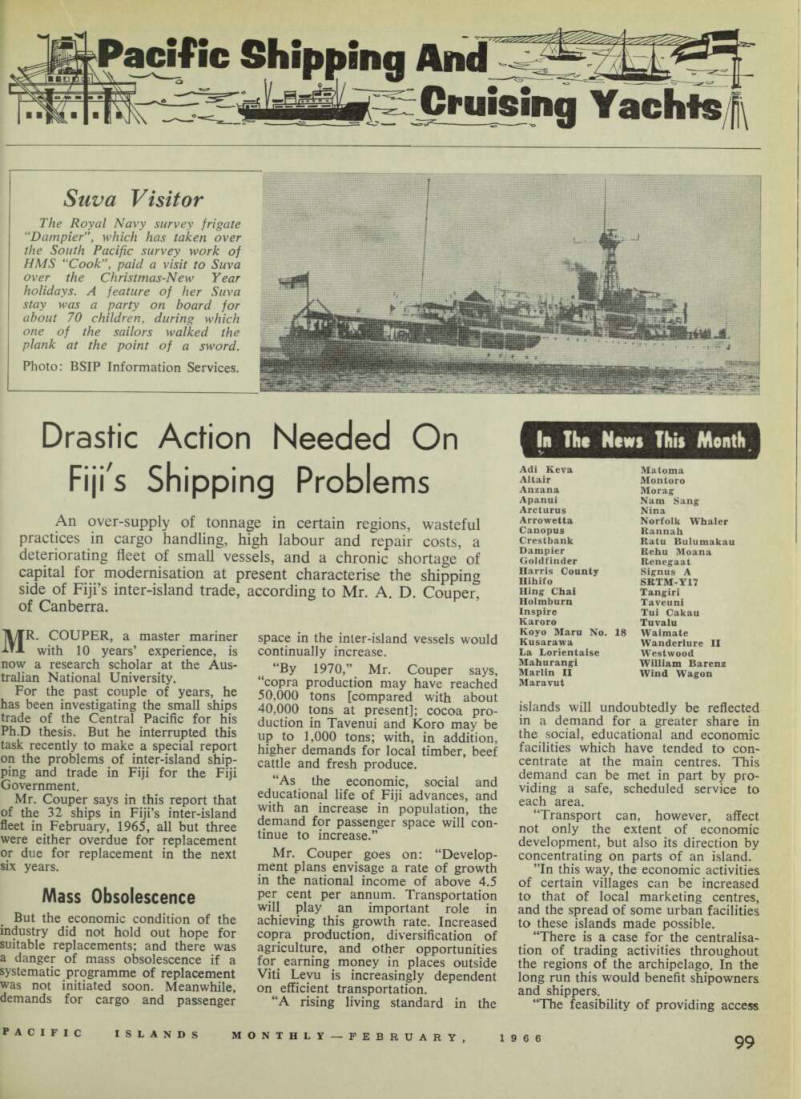
Suva Visitor
The Royal Navy survey frigate “Dampler”, which has taken over the South Pacific survey work of HMS “Cook”, paid a visit to Suva over the Christmas-New Year holidays. A feature of her Suva stay was a party on board for about 70 children, during which one of the sailors walked the plank at the point of a sword.
Photo: BSIP Information Services.
roads and using a tractor and trailer method to reduce road haulage costs requires further investigation. In some regions, small coastal craft would be best suited to operating a service between villages and local market centres.
“To be economic, feeder services must be used to meet the needs of people for coastal travel; for building up copra at the local centre, and dis tributing cargo from the centre; and for making regular contact with the scheduled services of the core fleet n the carriage of fresh produce.
“On small islands, sufficient con ;inuity of use would not be attained yy a feeder service. There, packhorses vould seem more economical.”
In a list of recommendations for mproving Fiji’s inter-island transport system, Mr. Couper says that the department of Marine should have he right to assume wider controls )ver such matters as freight rates and he utilisation of shipping resources.
Competition
“The limiting of competition and he protection of operators who are irepared to run scheduled services is sssential,” he says.
“The Department of Marine could upervise this in the same way as the transport Control Board does for oad services.
“Vessels should state their area of iperation, and a sufficient number hould be licensed to provide a imited over-supply of tonnage in he area.
“The Department of Marine should lave powers to prevent ‘pirating’.
“Owners who have been granted icences for an area must agree o provide a scheduled service to all slands in their area.
“In operating a service under icence, the shipping companies and ►wners must agree to carry all inward nd outward cargoes without dis rimination against commercial rivals operating stores in their zones.
“Shippers and island people should lave the right to appeal to the department of Marine if services are nadequate or inefficient.”
Mr. Couper says there does not ppear to be a case for a shipping übsidy under the present conditions
►f inefficiency, although a vessel
•perating a scheduled service to )no-i-Lau might warrant some sup port. A small subsidy might also be iccessary during a period of change ►ver to more efficient arrangements.
The long-term aim of the uthorities should be the consolidation •f trading places with proper storage
(Continued on p. 112)
and loading facilities so that the long periods that inter-island ships now spend on voyages, through calling at many small loading places could be reduced, thus increasing the earning ability of vessels.
Mr. Couper suggests that there should be two stages in the con solidation of trading places.
In the first stage, consolidation should take place in those areas where inter-island vessels now load small quantities at several villages.
Stage II should see the extension of the consolidation policy to the big producers.
“Zoning and centralising,” Mr.
Couper says, “will reduce the number of vessels required for inter-insular trading. If the Safety at Sea Com mission recommendations are intro duced during this stage, then many old vessels will be made redundant without hampering movement of pas sengers.
“In view of the bad record of island-based craft, the Department of Marine should encourage owners of old or uneconomic vessels to seek employment in the island feeder services.
“With less exacting surveys and other requirements such vessels may find profits as feeders at Vanua Balavu, Wainunu-Savusavu Bay, Udu Point- Labasa, and Natewa Bay.
“A replacement and modernisation programme should be introduced during Stage I [of the consolidation of trading places]. It is difficult, however, to envisage real improve ments in the passenger and cargo vessels of the small ship sector without additional capital becoming available.
Suggested Fleet
“It is worthwhile, therefore, con sidering the suggestion of the ‘Sum mary of Submissions to the Safety at Sea Commission’, namely that ‘a small fleet of approximately six vessels of an approved type be built and leased out to approved owners...’
“Vessels of a standard design could ae built locally, and/or overseas with ?overnment assistance.”
Mr. Couper says that with a 25 )er cent, increase in copra production, md with Stage II of the consolidation )f trading places completed, Fiji’s ransport task could probably be carried out with:
• Four modern cargo vessels of about 250 tons net, two with freezer space and tourist accommodation, to operate Vanua Levu, the Lau Islands and Rotuma. • Four steel landing craft or wooden-hulled vessels, of 40 to 80 tons, operating scheduled services to Lomaiviti, Kadavu, Western and Southern Lau. • One transporter of the landing craft type to carry road vehicles, cargo and passengers between Elling ton and Nabouwalu. • One transporter of the landing craft type, operating Lautoka-Yasawa Islands. • A coastal and feeder fleet of
small cutters, steel-hulled launches or small landing craft.
Scheduled services would con centrate on centres where, if possible, access had been improved to allow trading vessels to enter, a jetty con structed and cargo sheds built.
Alternatively, beach or reef flat locations suitable for the operation of landing craft should be chosen.
At these trading centres, local labour would be employed for cargo working, a copra grader located, and vessels cleared for safety require ments.
The centres would be connected to other villages and estates by access roads.