Hear, French
p. 71 · Read in the full issue
Yes, Sharks Can
Divers Say
By a Staff Writer
believe that, initially, at least, sharks are not attracted by blood, but by the cries of an injured fish, animal or person. It is only after the cries have drawn their attention that they are guided by the smell of blood.
To prove their theories, Le Journal de Tahiti added, Foucher-Creteau and Jannel had taken 3,500 metres (six hours) of film, which they would reduce to a documentary of H hours.
Anew Caledonian bird dub, Societe Caledonienne d’Ornitho logie, was formed in Noumea recently to try to make New Caledonians more conscious of the good that birds do and of the fact that several local birds are in danger of extinction.
At an exhibition staged in Noumea in December, there was a document ary panel pointing out that two New Caledonian birds had become extinct in the last century, and that five other species were now in danger of be coming so.
The five species include the game pigeons, notou and collier blanc (Ducula goliath and Vitientis neo caledonica); the cagou, New Cale donia’s emblem; and the Ouvean par rot (Eunimphicus cornutus uveaensis).
“The Ouvean parrot,” PlM’s Noumea correspondent says, “is a most affectionate little creature, which is found only on Ouvea, one of the Loyalty Islands. It is green with blue-edged wings, and a tail capped by a little crest.
“It is the subject of a most detes table traffic which most people would like to see ended.
“Natives coming to Noumea from Ouvea bring the birds to sell for pocket-money, asking up to 3,000 francs a pair (£l5).
“I have seen native women come off the plane more than once carry ing little bags with a couple of tiny
Experiments into the sense of hearing of sharks in the Tua motus, a long voyage in a hollow log to the Ellice Islands by a strange lizard, and efforts by a group of New Caledonians to save some of their country’s birds from extinction . . fFHESE are among a number of A nature stories to come out of the Pacific recently.
The story of the shark experiments was published in the Papeete daily newspaper Le Journal de Tahiti under the heading, “Yes, Sharks Can Hear”.
It told how a couple of French film-star divers, Foucher-Creteau and Claude Jannel, had been conducting the experiments at Rangiroa Atoll.
These had confirmed what the two men had secretly expected to discover for a long time—namely, that sharks react to sound waves.
In the experiments, the first ever conducted, Foucher-Creteau and Jannel caught various kinds of fish, including trumpeter fish, and register ed their cries.
Then the cries were retransmitted into the water, minus the fish, and— hey presto!—along came the sharks.
A trifle confused and somewhat unnerved, the sharks swam round the broadcasting apparatus, then, visibly angry over being disturbed for nothing, they went away again.
Foucher-Creteau and Jannel now
nestlings inside. Mortality must be heavy.
“No species can stand such abuse for long.”
A LIZARD of a type never before seen on the island arrived at Nanumea, the northernmost island in the Ellice Islands recently. An islander, Telongo Olekeni, found it hiding in a hole in a log that had drifted up on the island.
The lizard is said to have been nine inches long, with a hard, scaly body, and long claws.
It was killed at once and thrown into the sea, thus making it im possible for experts to indentify it positively and try to establish where it had drifted from.
Reporting these facts, the GEIC newsletter, Colony Information Notes, asked anyone finding unusual things in future to keep them for indentifica tion for the benefit of “those people who are trying to find out the direc tions of the ocean currents and winds, and to investigate the ways that the first people might have come to the Pacific Islands”.
A glance at the map suggests that Nanumea’s lizard probably came from Samoa, Fiji or the Solomons as these groups are the nearest ones to Nanumea likely to produce logs with strange lizards inside them, Samoa and Fiji are about 800 miles from Nanumea, while the Solomons chain, including the Santa Cruz Group, is from 600 to 1,200 miles away in a due east to south-easterly direction. • Western Samoa’s first two air mail stamps, which went on sale on December 29, feature a flying fish (2/-) and a tropical bird in flight (8d). They were designed by Mr.
L. C. Mitchell, a New Zealand artist.
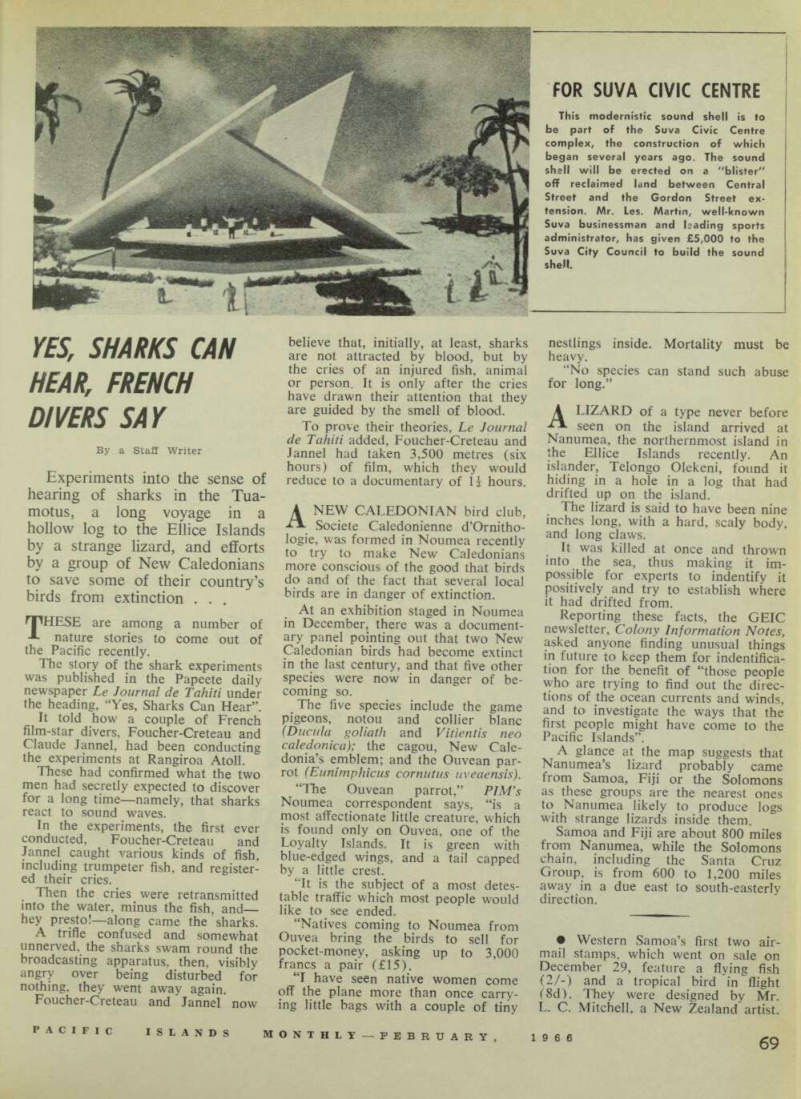
For Suva Civic Centre
This modernistic sound shell is to be part of the Suva Civic Centre complex, the construction of which began several years ago. The sound shell will be erected on a "blister" off reclaimed land between Central Street and the Gordon Street ex tension. Mr. Les. Martin, well-known Suva businessman and leading sports administrator, has given £5,000 to the Suva City Council to build the sound shell.