Concert Celebrity
pp. 67-69 · Read in the full issue

Career With Trapp Family Brought Him Fame
Swaps Role For
Mission Work
From Beryl Cates in Suva
“I can’t say 1 liked being a celebrity much at all!”
This is how Monsignor F.
Wasner a tall, sparse
Austrian, with good-humoured,
bespectacled eyes, and lean,
ascetic features sums up his quarter of a century on the concert platforms of the world.
NOW a missionary at Naisalagi, on the north-west side of Fiji’s main island of Viti Levu, Monsignor Wasner is again the object of interest as the movie of the famed Trapp family singers, The Sound of Music, revives memories of a family whose charm and artistry captured the world.
It was as chaplain, singer and conductor with the Trapp family that Monsignor Wasner found himself in the public limelight.
He travelled with the family everywhere and appeared with it in concerts until 1960 when he voluntarily changed roles and began missionary work in Fiji.
Monsignor Wasner’s first contact with the Trapp family was made
when, as a newly-ordained priest recently-returned to Salzburg from Rome, he was asked by a fellow priest to say Mass in a private family chapel.
The chapel was in the home of Baron von Trapp, and after Mass the Trapp family followed a custom of singing hymns, harmonising and improvising as they sang.
A brilliant pianist and organist, and the possessor of a superb baritone voice—as viewers of the original movie, The Trapp Family Singers, will testify Monsignor Wasner found himself naturally
drawn to participate in the family’s vocal devotions.
The baroness, the children and their chaplain began singing as a group, on the radio and at concerts, until eventually they found them selves performing at Salzburg’s famous Festival Concert at which were theatrical entrepreneurs from all over the US and Europe.
Offers poured in for the group to appear elsewhere, including the US.
Monsignor Wasner was then actively engaged in Catholic journalism, and as Hitler’s rise to power was jeopardising his safety,
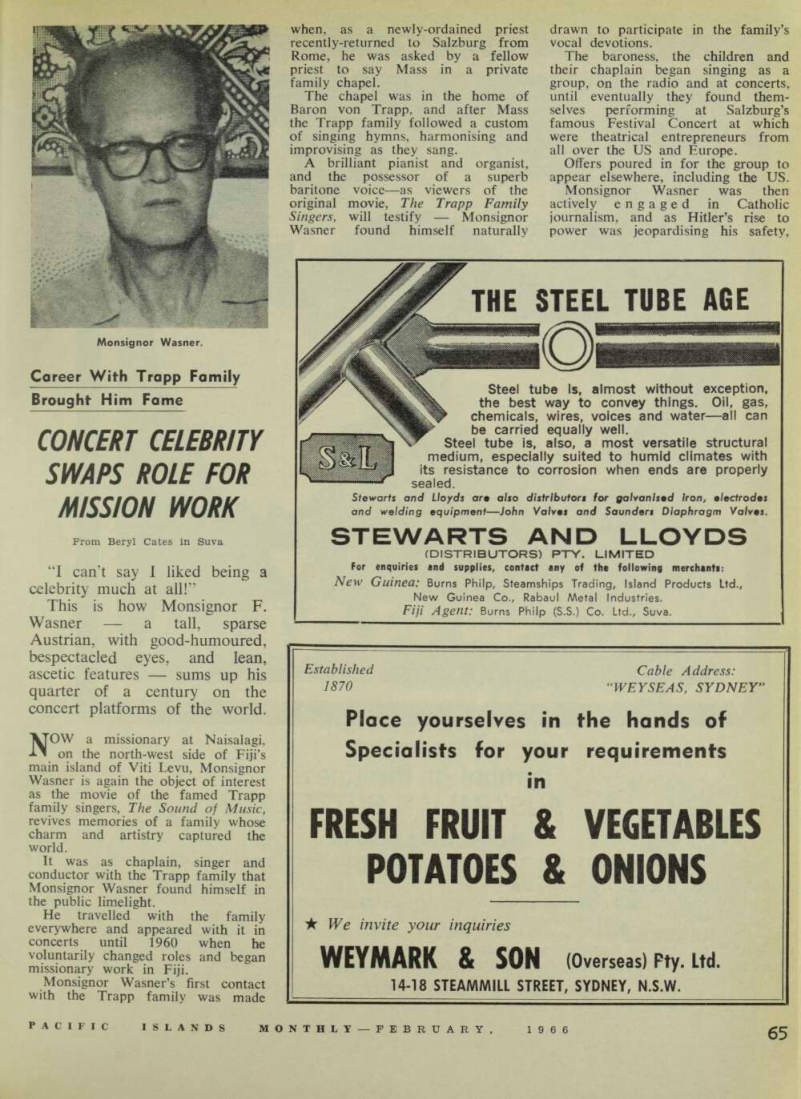
Monsignor Wasner.
he was advised to accompany the Trapp family on an American tour.
The tour lasted until 1950, and covered the US, Canada and South America. It made its way back to Europe that year, but shortly after wards returned to America to tour again with even more success.
In 1955 the singers made their way south and were acclaimed in Fiji, New Zealand and Australia.
While in New Zealand they met Bishop Foley and it was through him that they became acquainted with missionary work in the Islands.
Later, in Sydney, the family and its chaplain met Sacred Heart fathers on leave from missionary work in Papua-New Guinea.
As a result, three of the Trapp children decided to forsake their singing careers and volunteer to serve in Papua-New Guinea as lay mis sionaries for three years.
That term has now expired, but one of the children, Maria, is to return for a second three-year term this year, after leave in the US.
Pacific Visit
Interested in missionary work also, Monsignor Wasner accepted an in vitation from the Apostolic Delegate in Australia, Archbishop Carboni, to visit mission stations throughout the South Pacific.
Baroness Trapp accepted a similar invitation and spent eight months touring mission stations in the Pacific.
Both returned to Europe, to go to Munich to advise on the film, The Trapp Family Singers. When the film was finished, Monsignor Wasner remained in Europe for a time to do some historical research.
He is held in high repute as a historian and has several books to his credit.
In 1960, he returned to America, and from there wrote to Bishop Foley offering his services as a missionary in Fiji. The offer was accepted, and after four months in the Yasawas, he was stationed at Naisalagi.
With the assistance of a Fijian priest, Father Kavuru, Monsignor Wasner tends the needs of a widely scattered parish, a great deal of which has to be covered on horseback.
Music still occupies part of his time, and he is investigating the use of Fijian and Hindi in the liturgy of the Church.
On one of his infrequent visits to Suva—to see yet again The Sound of Music —Monsignor Wasner told what had become of individual members of the Trapp family.
Of the children of the late Baron von Trapp’s first marriage—he died
in 1952—the eldest son, Rupert, is a doctor, married, with a family and living at Rhode Island, US.
Werner, the second son, is a farmer in Vermont, US.
Agatha, the eldest daughter, con ducts, with a friend, a kindergarten attached to the Catholic Church in Baltimore.
Maria is the lay missionary soon to return for her second term in Papua-New Guinea.
Hedwig lives with and assists Baroness von Trapp, who conducts a ski lodge in winter and a tourist resort in summer in Vermont.
Johanna is married to a professor in Austria; and Martina died in the US.
The three children born of Baron von Trapp’s second marriage are all in America. Rosemary is a nurse; Eleanor is married to a professor; and John is in the Army.