Decisive Year Ahead For
pp. 47-51 · Read in the full issue
Cook Islands Premier
A PIM Special Survey
The new year began in the Cook Islands with the Group’s first self-governing legislators still in that halcyon period when they can claim that most of their troubles are legacies from the previous administration.
BUT probably no one realises better than its Premier, Mr.
Albert Henry (who is also Minister for External Affairs, Finance, Economic Development, Migration, Aviation, Shipping and the Post Office) that this let-out won’t be so valid in January, 1967.
This is not to say that the new government’s plans for coping with the situation, by placing the emphasis on economic development rather than social development, aren’t more practical than those usually hatched by newly self-governing territories.
What they probably do not do is to take sufficient account of the Group’s two fundamental problems— its size; and the fact that two-thirds of its revenue comes in the form of grants from New Zealand.
To run a group of islands (total land area 93 sq miles and population less than 20,000) as a fully-function ing, democratic state is going to take all the genius that most Cook Island ers think Mr. Henry possesses.
But there were indications in a series of talks that the Premier made over the local broadcasting system in December that he himself believes that, before his plans for the regeneration of the Cooks can be carried out, something has got to give.
The thing is—what? Or, more pro bably, who?
Decision Awaited
The talks—one a night, for a week —followed the visit of the Cook Islands Economic Mission to New Zealand in November. Mr. Henry at that time led a team of five to the Dominion for top-level financial dis cussions with the Government. The purpose was to get more money.
The Mission was well received, left behind a 20-page financial report on revenue and expenditure and plans for the Group’s economic progress for the next five years, and in mid- January was back home awaiting the decision of the NZ Cabinet as to whether larger grants will be forth coming.
If they are, and they are sufficient to cover the economic and social development projects the Government has in mind (water supplies, hospitals and schools, particularly in the outer islands; banana replanting; increased copra and citrus fruit pro duction; harbour improvement, etc.) Mr. Henry’s government is in for a comparatively easy time and will in crease its popularity.
If NZ does not agree to increased grants and the Cook Islands Govern ment still wishes to carry out its development programme, then Mr.
Henry will have to reallocate the revenue he already has; or raise more internally; or both.
Amongst the financial burdens that Mr. Henry makes a point of stressing that he inherited from pre vious administration policy, are a public service which eats up 40 per cent, of total revenue; an education system that takes 20 per cent.; and
capital expenditure on uncompleted public works that takes the rest.
The public service consists of about 100 expatriate New Zealand officers, and about 900 local officers who, if they have comparable qualifications, are paid at almost the same rate.
The permanent public service is now costing about £NZ620,000 a year to maintain, with the certainty under the present set-up that it will cost a further £50,000 each year in salary increments.
In addition to the permanent officers, there are about 750 casual workers paid on a daily basis who cost the Group a further £150,000 a year.
Political Suicide
In short, the Cook Islands has a public service that it cannot afford.
To attempt to reduce it to manage able proportions would, however, be likely to be political suicide, even for Mr. Henry. For years young Cl Maoris have been training in NZ for high public service appointments (there were 100 of them there at the end of 1965).
If these return to the Group only to be given salaries far below those of the New Zealanders they replace most will simply go back to NZ which still maintains its ever-open door for Cook Islanders.
Mr. Henry’s short-term solution to the public service problem is to ask the NZ Government for more money to support it.
His government has, however, made some effort to contain ex penditure on education—a not al together popular move. Beginning in 1966 every child with the necessary
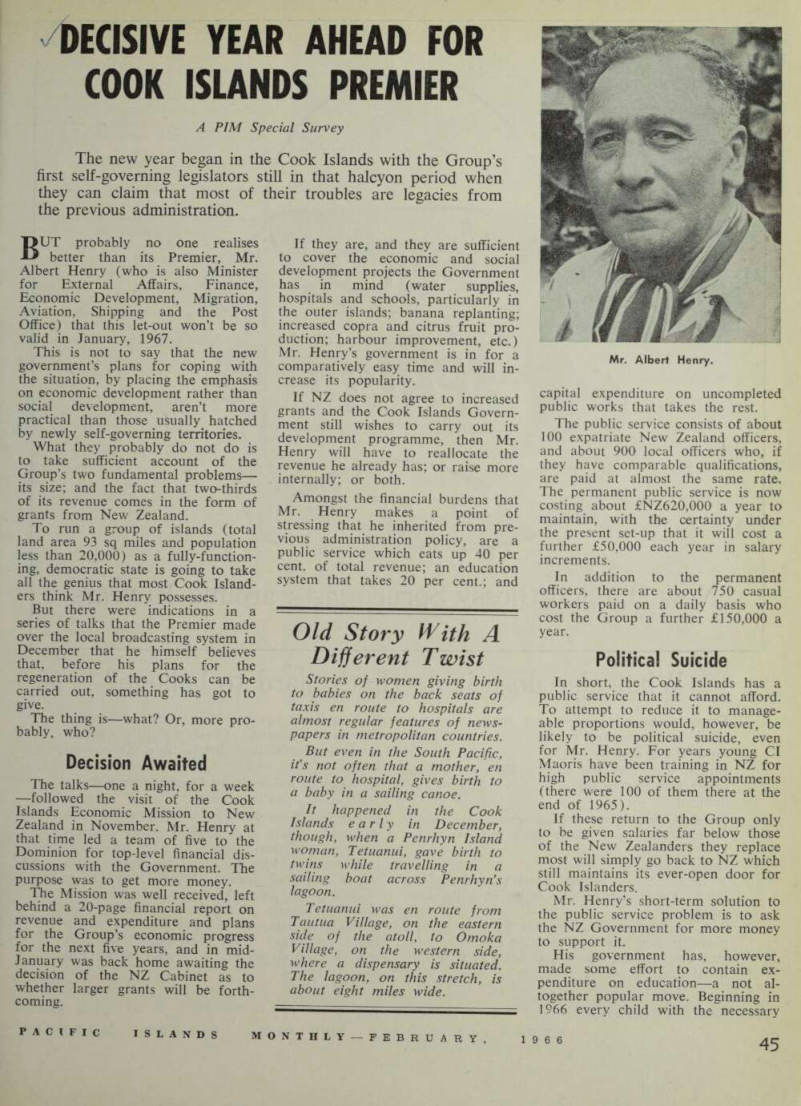
Mr. Albert Henry.
ability will be offered secondary education to Form IV level (second year); but from this point only 27 per cent, of those who complete Form IV will be eligible for the final, third year (or Form V) at the end of which they may sit for the School Certificate.
In compensation for this, the Education Department intends to establish a non-academic Form V at the chief secondary school in the Group, Tereora College, in which 24 students will be instructed in technical, agricultural and home-skills “more suited for life in their own country”.
Explaining why all this has been necessary, the Government has pointed out that the present £330,000 a year that the education of Cook Islands youngsters is costing could well rise to £500,000 within the next few years; that the percentage of passes among those sitting for the School Certificate has been very low; and that there are too few “white collar” jobs available in the Cooks even for these anyhow.
More Migration Likely
(It was calculated in December by Mr. Julian Dashwood, one of Mr.
Henry’s ministers, that there were a dozen such jobs currently offering and 200 students who would be leaving Tereora at the end of the year to seek them).
As a measure for getting the people back to the outer islands and to cultivating their own land, the new Government’s education policy might be regarded as a hard-headed, realistic one. What is more likely
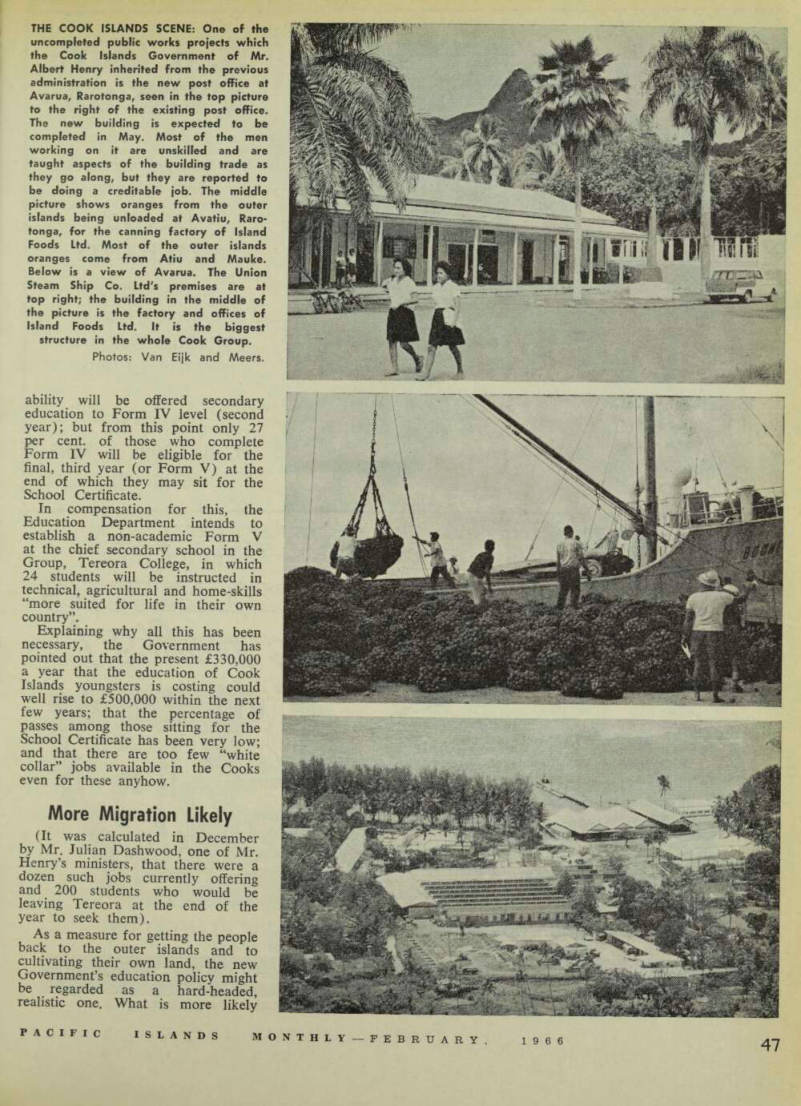
THE COOK ISLANDS SCENE: One of the uncompleted public works projects which the Cook Islands Government of Mr.
Albert Henry inherited from the previous administration is the new post office at Avarua, Rarotonga, seen in the top picture to the right of the existing post office.
The new building is expected to be completed in May. Most of the men working on it are unskilled and are taught aspects of the building trade as they go along, but they are reported to be doing a creditable job. The middle picture shows oranges from the outer islands being unloaded at Avatiu, Raro tonga, for the canning factory of Island Foods Ltd. Most of the outer islands oranges come from Atiu and Mauke.
Below is a view of Avarua. The Union Steam Ship Co. Ltd's premises are at top right; the building in the middle of the picture is the factory and offices of Island Foods Ltd. It is the biggest structure in the whole Cook Group.
Photos: Van Eijk and Meers.
to result from it, however, is an increased migration of young people to New Zealand.
Among the half-completed pro jects that the new government in herited from the old administration are the Rarotonga post-office; the Rarotonga hospital; Avatiu harbour development in Rarotonga; and road works, water works and school building on the same island. All of these are essential, in the present Government’s view, although it does not agree with the order in which they were tackled nor to the neglect of similar facilities for outer islands.
It would, however, be folly and uneconomic, Mr. Henry pointed out, to stop any of these woks now.
What the government wants, he says, is additional revenue to put into developmental projects outside the main island of Rarotonga.
Not all of Mr. Henry’s financial burdens can be laid at the door of the old administration. One of these is the old age pension which was one of his election promises and, although revolutionary for Polynesian society, is already in operation. He expects to finance this by the sale of more and better postage stamps to the philatelists of the world, although NZ philatelists have not taken too kindly to his plan to exploit them
(see p. 59). Nonetheless the pensions are going to cost the Government £lO,OOO in the first year.
There has also been a recent wage increase for unskilled workers which puts the Government’s own wage bill up by £14,500 a year.
Whether the NZ Government opens its coffers wider or not, it is obvious that local Cook Islands residents are going to have to dig down deeper into their pockets as well. Mr. Henry has already said as much.
The New Zealand Government has been asked for a loan of £41,000 to build a larger harbour in Mangaia and a further £35,000 to improve Avatiu harbour on Rarotonga. If granted, it is proposed that both should be paid off by increased levies on cargo handled at these ports.
At the same time, other means of raising general revenue are being considered and will be presented at the next meeting of the Legislative Assembly—a fact that, no doubt, is sending tremors of anticipation down the spines of the vulnerable minority, particularly the larger firms which have always been apprehensive of what Albert Henry might do.
At present the main local Cook Islands revenue comes from income tax, import and export duties, the sale of Government-controlled liquor, licence fees, etc.
Something more can be squeezed out of all of them; or an entirely new revenue-raising item invented, but one thing is certain: if the new Government expects New Zealanders to go on subsidising it, it has to show it means business on the home-front.
Therefore 1966 should be an interest ing year in the Cooks; and a decisive one for Premier Henry. • For details of the harbour plans for Mangaia and Avatiu, see p. 107.
Mangaia, the second-largest island in the Cook Group, is a major producer of pineapples. But this small harbour is all that the island has at present for shipping its produce to Rarotonga. Mr. Henry's Government has asked New Zealand for a loan of £41,000 to build a bigger one. —Photo: Van Eijk and Meers.