Tonga Honours
pp. 41-42 · Read in the full issue
A Beloved Queen
Tonga’s beloved monarch, Queen Salote, who died in Auckland on December 16, was buried in Nukua lofa on December 23. A full report was published in PlM’s January issue, but on these pages is a more personal account by Fiji-born Mr.
W. G. Johnson, prominent South Pacific business leader.
By W. G.
(“Tui") Johnson,
managing director of W. R. Carpenter and Co. (Fiji) Ltd.
We sailed from Suva to Tonga for Queen Salote’s funeral aboard the Carpenter vessel Komaiwai, which made the journey in 40 hours each way, which was 10 knots.
TT was a little boisterous approach- A ing Tonga, but we arrived at Nukualofa, the capital, about noon on Wednesday, December 22—the day before the funeral.
Among our passengers was the Bishop in Polynesia, and we flew his flag on arrival. When the Bishop landed, the flag was taken down and the Australian flag, and the Carpenter house flag, were flown at half-mast.
On the evening of the day of our arrival, I was admitted to His Majesty King Taufa’ahau Tupou IV, and I was able to convey directly to him the condolences of the directors of the company as well as my family.
The King stayed up all night receiv ing mourners.
Previous to the audience with the King we entered the Royal Chapel, which adjoins the palace and paid our respects to the body lying in state and left a piece of native cloth brought from Fiji.
The morning of the following day broke very unpromisingly, with rain squalls to windward. The funeral was to commence at 10 a.m., but only a few minutes before that time we were sheltering from the squalls.
An order of procession had been drawn up and a minute or two before 10 a.m. we took our places. There was a light skiff of rain and after that the day broke beautifully fine, and remained so.
At 10 a.m. precisely the first salut ing gun was fired, and the casket, which was on a platform, guarded constantly by two chiefs also on the
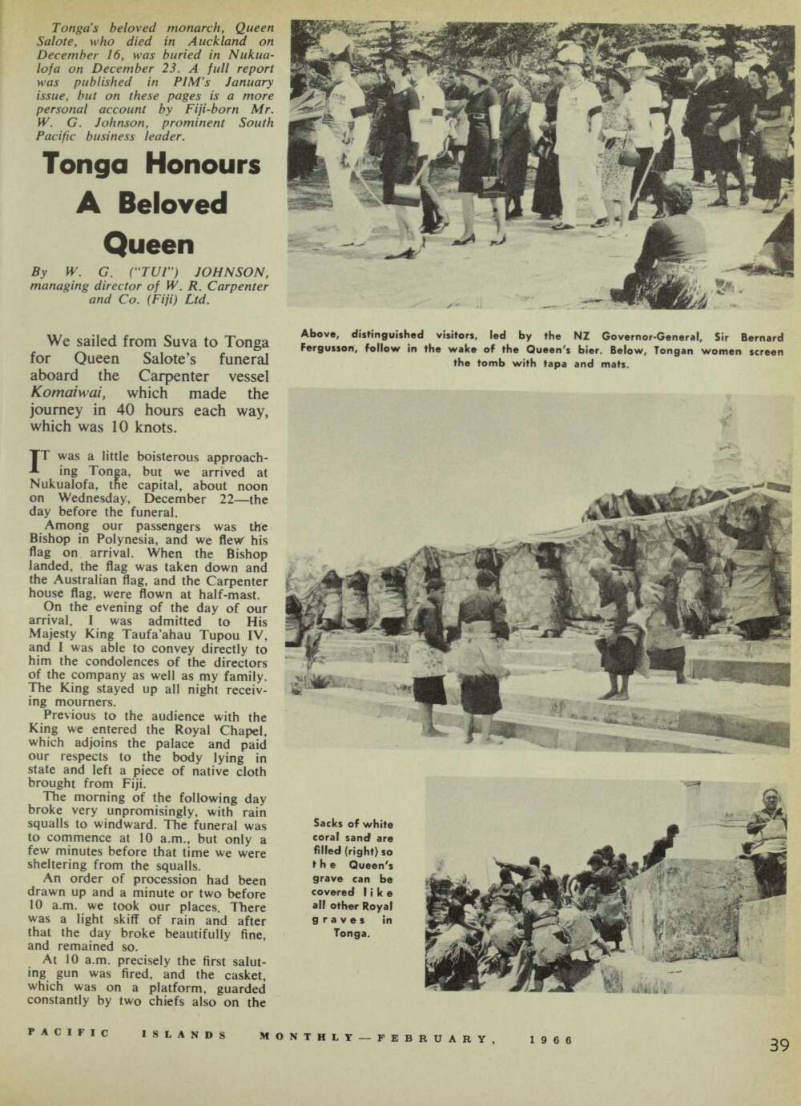
Above, distinguished visitors, led by the NZ Governor-General, Sir Bernard Fergusson, follow in the wake of the Queen's bier. Below, Tongan women screen the tomb with tapa and mats.
Sacks of white coral sand are filled (right) so the Queen's grave can be covered like all other Royal graves in Tonga.
platform, was brought out of the chapel. It was carried by about 200 bearers. The casket was under a pergola erected on the platform.
Having come out from the grounds of the Royal Chapel there was a slow procession to the tombs in which the Royal families of Tonga are buried, a distance of about half a mile, along a pine-tree bordered road. At the tombs a service was conducted by four Methodist missionaries. The first three read from the Bible and prayer book, then the Rev. Wood, who had for some time lived in Tonga (and is now resident in Australia) delivered an oration.
The Tongan people then took over their form of burial, which was most impressive.
The tombs are in tiers, the up permost being about 15 feet above ground level. The whole upper tier was surrounded by Tongan women holding a finely woven mat which was in one piece. The women stood with their heels on the lower edge of the mat, with the mat behind them, and held the upper edge by their hands extended above their heads.
This single mat must have been almost 200 yards in length.
A similar thing was then done around the lower tier with tapa. The piece of tapa to go around the lower perimeter must have been nearly a
quarter-of-a-mile long.
Women predominated at this stage, there being only a few aged men and women directing the burial. More finely woven mats were placed in the tomb.
The screens obscured the tomb into which the casket was subsequently moved, and when the casket had
been put into position and the tomb sealed the grave was covered with sand and gravel and the screens re moved.
This part of the burial was done in utmost privacy.
From the time of commencement at the chapel until the burial was completed it was about 2i hours.
There were thousands of school children lining the roads and from the time the body arrived in Tonga until the burial sacred music was sung or played by the Tongan bands and choirs, of which there are many, as the Queen was very fond of music.
The Fijian chiefs who attended were Ratu George Cakobau, Ratu Mara, Ratu Penaia Ganilau and Ratu Edward Cakobau. Edward has a considerable standing with the Tongan people and is always very warmly greeted by the present King. When he landed at the airport in Tonga great deference was shown him by the Tongan people there.
As the Komaiwai was about to depart from Nukualofa the personnel and all those who had gone over on her were presented with a quantity of food, being part of the feast.
This food comprised two huge cooked pigs and a number of small pigs and vegetables and was gratefully accepted.
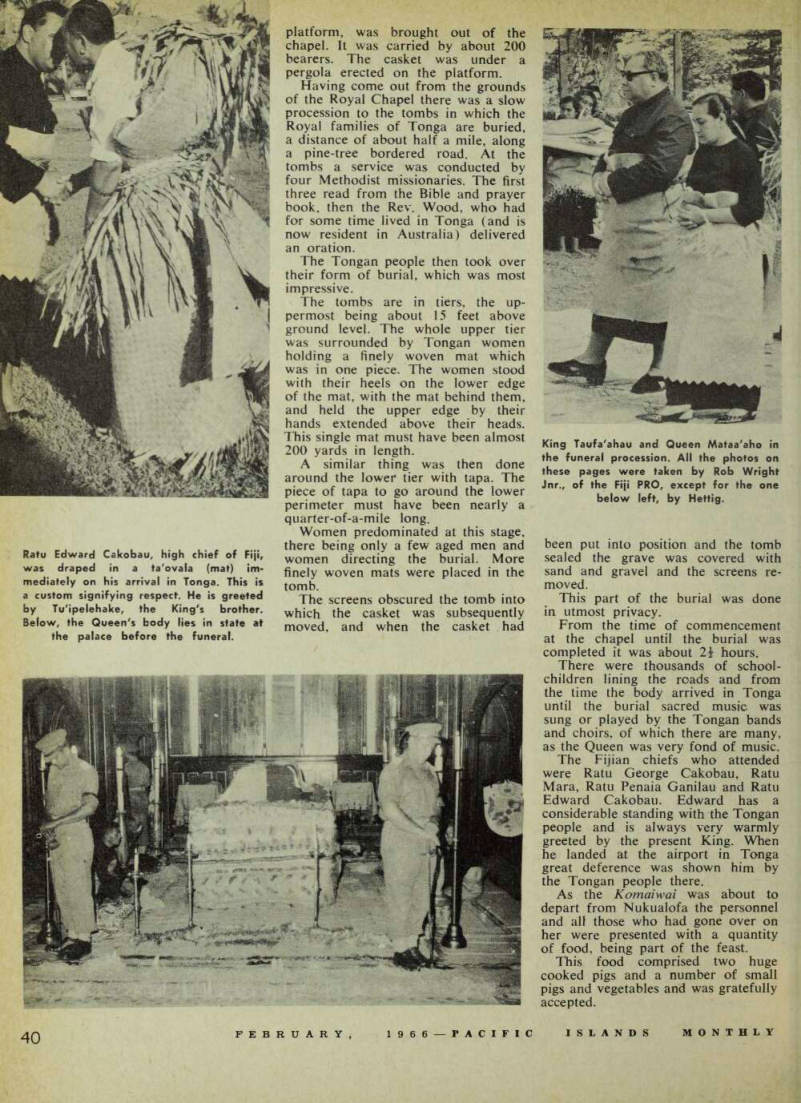
Ratu Edward Cakobau, high chief of Fiji, was draped in a ta'ovala (mat) im mediately on his arrival in Tonga. This is a custom signifying respect. He is greeted by Tu'ipelehake, the King's brother.
Below, the Queen's body lies in state at the palace before the funeral.
King Taufa'ahau and Queen Mataa'aho in the funeral procession. All the photos on these pages were taken by Rob Wright Jnr., of the Fiji PRO, except for the one below left, by Hettig.