The Editors' Maillag
pp. 71-73 · Read in the full issue
The Robinson Memorial
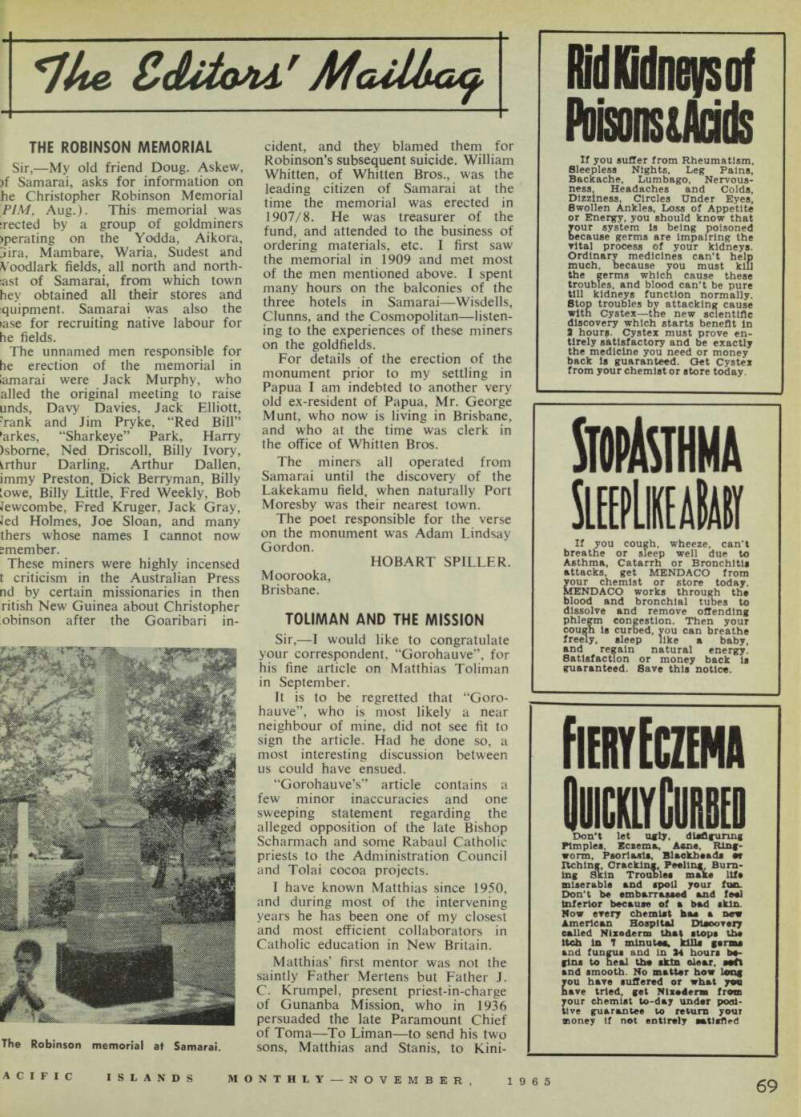
Sir, —My old friend Doug, Askew, )f Samarai, asks for information on he Christopher Robinson Memorial PIM, Aug.). This memorial was :rected by a group of goldminers >perating on the Yodda, Aikora, Sira, Mambare, Waria, Sudest and Voodlark fields, all north and north east of Samarai, from which town hey obtained all their stores and equipment. Samarai was also the lase for recruiting native labour for he fields.
The unnamed men responsible for he erection of the memorial in lamarai were Jack Murphy, who ailed the original meeting to raise unds, Davy Davies, Jack Elliott, Tank and Jim Pryke, “Red Bill” ’arkes, “Sharkeye” Park, Harry )sbome, Ned Driscoll, Billy Ivory, Arthur Darling, Arthur Dallen, immy Preston, Dick Berryman, Billy 'owe, Billy Little, Fred Weekly, Bob Jewcombe, Fred Kruger, Jack Gray, Jed Holmes, Joe Sloan, and many thers whose names I cannot now These miners were highly incensed t criticism in the Australian Press nd by certain missionaries in then ritish New Guinea about Christopher obinson after the Goaribari in-
cident, and they blamed them for Robinson’s subsequent suicide. William Whitten, of Whitten Bros., was the leading citizen of Samarai at the time the memorial was erected in 1907/8. He was treasurer of the fund, and attended to the business of ordering materials, etc. I first saw the memorial in 1909 and met most of the men mentioned above. I spent many hours on the balconies of the three hotels in Samarai—Wisdells, Clunns, and the Cosmopolitan—listen ing to the experiences of these miners on the goldfields.
For details of the erection of the monument prior to my settling in Papua I am indebted to another very old ex-resident of Papua, Mr. George Munt, who now is living in Brisbane, and who at the time was clerk in the office of Whitten Bros.
The miners all operated from Samarai until the discovery of the Lakekamu field, when naturally Port Moresby was their nearest town.
The poet responsible for the verse on the monument was Adam Lindsay Gordon.
Hobart Spiller.
Moorooka, Brisbane.
Toliman And The Mission
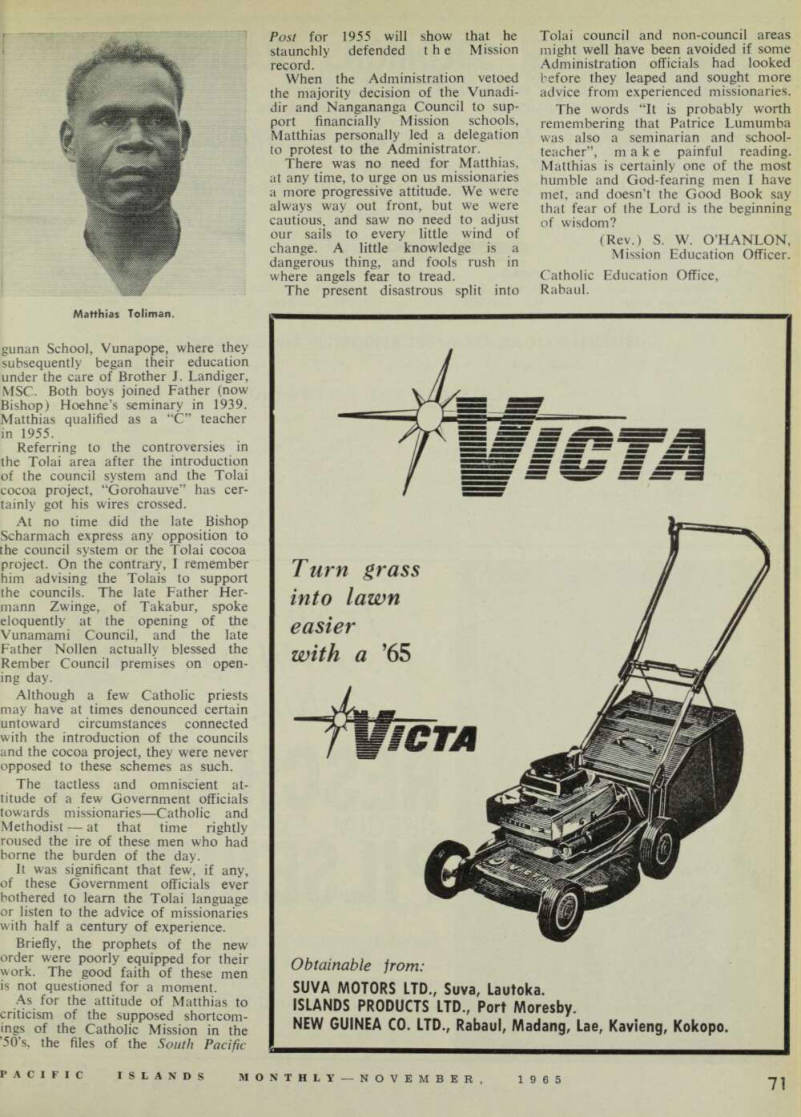
Sir, —I would like to congratulate your correspondent, “Gorohauve”, for his fine article on Matthias Toliman in September.
It is to be regretted that “Goro hauve”, who is most likely a near neighbour of mine, did not see fit to sign the article. Had he done so, a most interesting discussion between us could have ensued.
“Gorohauve’s” article contains a few minor inaccuracies and one sweeping statement regarding the alleged opposition of the late Bishop Scharmach and some Rabaul Catholic priests to the Administration Council and Tolai cocoa projects.
I have known Matthias since 1950, and during most of the intervening years he has been one of my closest and most efficient collaborators in Catholic education in New Britain.
Matthias’ first mentor was not the saintly Father Mertens but Father J.
C. Krumpel, present priest-in-charge of Gunanba Mission, who in 1936 persuaded the late Paramount Chief of Toma—To Liman—to send his two sons, Matthias and Stanis, to Kini-
The Robinson memorial at Samarai.
gunan School, Vunapope, where they subsequently began their education under the care of Brother J. Landiger, MSC. Both boys joined Father (now Bishop) Hoehne’s seminary in 1939.
Matthias qualified as a “C” teacher in 1955.
Referring to the controversies in the Tolai area after the introduction of the council system and the Tolai cocoa project, “Gorohauve” has cer tainly got his wires crossed.
At no time did the late Bishop Scharmach express any opposition to the council system or the Tolai cocoa project. On the contrary, I remember him advising the Tolais to support the councils. The late Father Her mann Zwinge, of Takabur, spoke eloquently at the opening of the Vunamami Council, and the late Father Nollen actually blessed the Rember Council premises on open ing day.
Although a few Catholic priests may have at times denounced certain untoward circumstances connected with the introduction of the councils and the cocoa project, they were never opposed to these schemes as such.
The tactless and omniscient at titude of a few Government officials towards missionaries—Catholic and Methodist —at that time rightly roused the ire of these men who had borne the burden of the day.
It was significant that few, if any, of these Government officials ever bothered to learn the Tolai language or listen to the advice of missionaries with half a century of experience.
Briefly, the prophets of the new order were poorly equipped for their work. The good faith of these men is not questioned for a moment.
As for the attitude of Matthias to criticism of the supposed shortcom ings of the Catholic Mission in the ’so’s, the files of the South Pacific
Post for 1955 will show that he staunchly defended the Mission record.
When the Administration vetoed the majority decision of the Vunadidir and Nangananga Council to support financially Mission schools, Matthias personally led a delegation to protest to the Administrator.
There was no need for Matthias, at any time, to urge on us missionaries a more progressive attitude. We were always way out front, but we were cautious, and saw no need to adjust out sails to every little wind of change. A little knowledge is a dangerous thing, and fools rush m where angels fear to tread.
The present disastrous split into
Tolai council and non-council areas might well have been avoided if some Administration officials had looked before they leaped and sought more advice from experienced missionaries, The words “It is probably worth remembering that Patrice Lumumba was a j so a seminarian and school teacher”, make painful reading.
Matthias is certainly one of the most humble and God-fearing men I have me t, and doesn’t the Good Book say that fear of the Lord is the beginning Q f wisdom 7
(Rev.)
S. W. O’Hanlon,
Mission Education Officer, Catholic Education Office, Rabaul.
Matthias Toliman.