Remedy Suggested
p. 69 · Read in the full issue
For Moresby's
Shanty Towns
From Derek Round, AAP-Reuter correspondent, in Port Moresby An “official” shanty town for
organised low-cost housing has
been suggested to cope with the
growing problem of overcrowd
ing and inadequate facilities in
Port Moresby’s “unofficial”
shanty towns.
THE proposal has been made by a committee of the Council of Social Services of Papua, which re cently investigated housing problems in the capital. The committee found about 20 shanty settlements scattered around Port Moresby.
About 3,500 people, or about 15 per cent, of the estimated 23,000 Papuans and New Guineans in the capital, live in them.
They have been growing up on native and Government land and some have been established for many years. Most of them are organised on village lines. When one family leaves a house—or part of a house —to return to its home village, another member of the family or clan moves in.
Services Lacking
The newcomers take over the rights and duties which apply in the settlement, although few of the shanty dwellers have any rights to the land they live on.
The committee has recommended settlements had inadequate water supplies and lacked sanitary and garbage services.
Many living in the settlements still pay tax to Local Government councils in their home areas although they are living on land which comes under the jurisdiction of Port Moresby councils.
The Committee has recommended that the Papua-New Guinea Admini stration set aside at least one area in or near Port Moresby as an “official” shanty town for organised low-cost housing.
The area would be provided with roads, footpaths and drains, some street lighting, communal water points, individual earth latrines and garbage disposal facilities. Schools
would be provided for the settle ments.
The committee suggested allot ments of about one-fifteenth of an acre each, pegged to indicate the maximum area allowed for building.
It suggests that building regulations should be kept to a minimum.
House sites would be available at a weekly or fortnightly rent, payable in advance. The rent would in clude land, rates and taxes and water, garbage and sanitary service charges.
The committee said it hoped the rent would not be more than 10/to 12/- a week. Many shanty dwellers pay more than this now to live in settlements without services.
Departing tenants would have the right to sell or remove any improve ments they had put on the allotments.
“If possible, the settlement should
be designed to allow it to be re developed for better housing should changing conditions make this desirable,” the committee’s report said.
“The result of our proposals would be an official shanty town,” it said.
“But in theory, services would be adequate and buildings far enough a part to reduce health and fire risks.
“If it is possible to insist on one family—a man, wife and children— to a house, overcrowding should be reduced.”
No Comment
The Administration, which has so far made no comment on the com mittee’s proposals, has been trying to discourage villagers from crowding into Port Moresby and other towns where there is a shortage of ac commodation and jobs.
Officials say privately that the Administration is likely to be as unenthusiastic about an “official” shanty town as it is about “unofficial” ones.
The Administration is concentrat ing on trying to overcome the backlog of housing needs for its own local and overseas staff.
But the Administrator, Sir Donald Cleland, revealed recently that the Administration was considering plans for a single housing authority which would be responsible fo v housin'* Government officers and for urban housing programmes.
Until this is set up, there appears to be little possibility of anything being done to get rid of the present shanty towns.
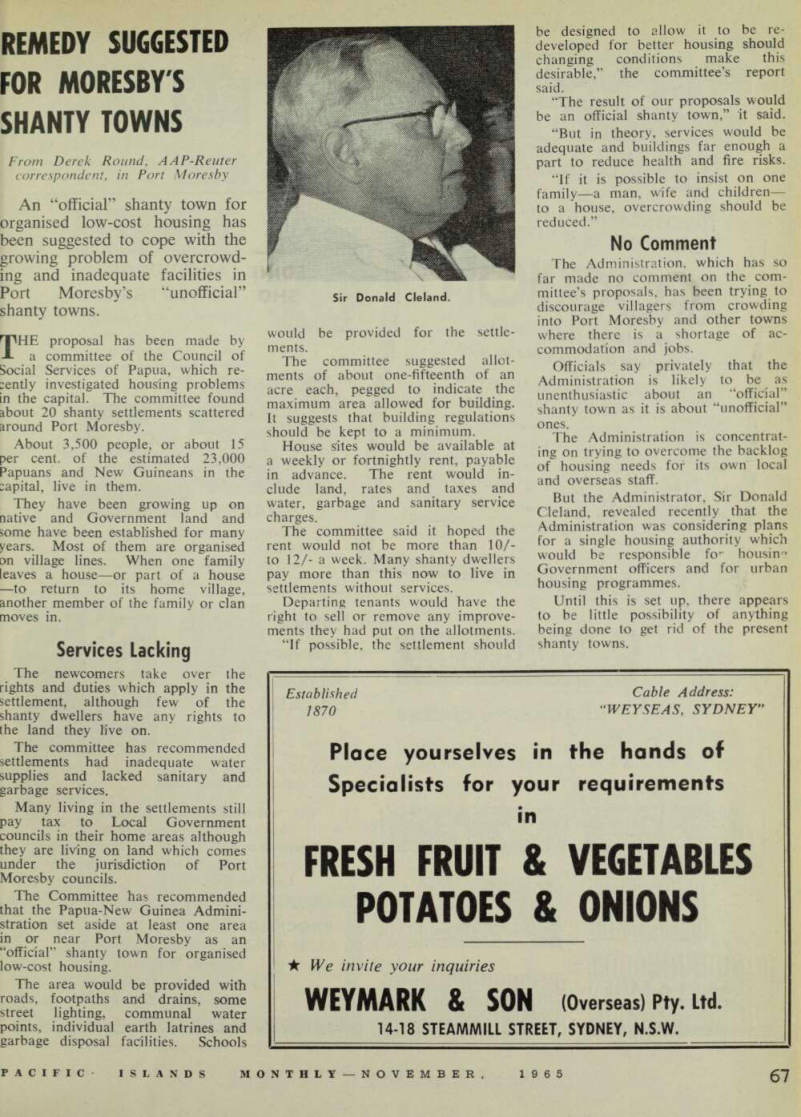
Sir Donald Cleland.