Opening Of New Auckland
pp. 63-67 · Read in the full issue


Airport Should Bring
Travel Boom In The
South Seas
By “PIM’s” Aviation Writer
The opening of Auckland’s big new jet airport at Mangere on November 24 will change the entire South Pacific aviation picture. New aircraft and new services will generate new pat terns and attract more passengers through the South Pacific than at any time in its history.
THE new airport—to be known as the Auckland International Air port—is expected to bring a real South Seas travel boom as the air lines work hard at filling big new aircraft.
Whatever riches might be won in the future as a result of Auckland’s promotion to the big league in avia tion, the best of the immediate advantages will probably go to the home team —Air New Zealand.
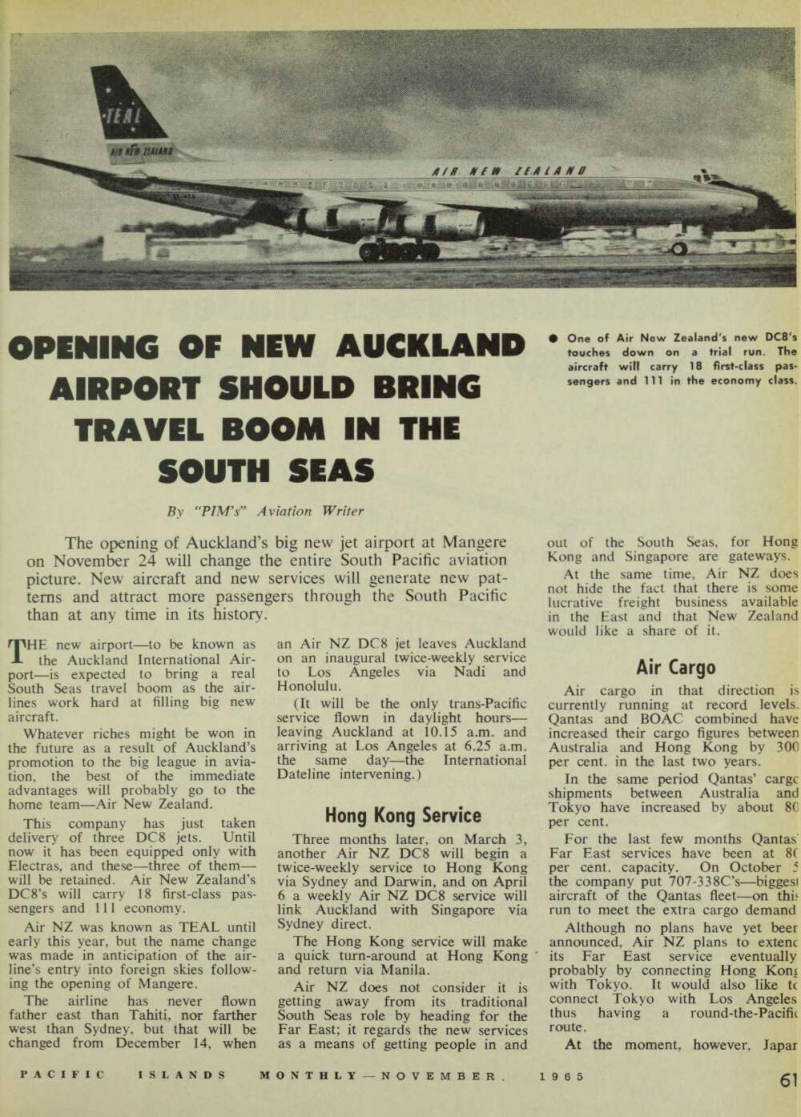
This company has just taken delivery of three DCS jets. Until now it has been equipped only with Electras, and these—three of them—will be retained. Air New Zealand’s DCB’s will carry 18 first-class pas sengers and 111 economy.
Air NZ was known as TEAL until early this year, but the name change was made in anticipation of the air line’s entry into foreign skies follow ing the opening of Mangere.
The airline has never flown father east than Tahiti, nor farther west than Sydney, but that will be changed from December 14, when
an Air NZ DCS jet leaves Auckland on an inaugural twice-weekly service to Los Angeles via Nadi and Honolulu. (It will be the only trans-Pacific service flown in daylight hours— leaving Auckland at 10.15 a.m. and arriving at Los Angeles at 6.25 a.m. the same day—the International Dateline intervening.)
Hong Kong Service
Three months later, on March 3, another Air NZ DCB will begin a twice-weekly service to Hong Kong via Sydney and Darwin, and on April 6 a weekly Air NZ DCS service will link Auckland with Singapore via Sydney direct.
The Hong Kong service will make a quick turn-around at Hong Kong and return via Manila.
Air NZ does not consider it is getting away from its traditional South Seas role by heading for the Far East; it regards the new services as a means of getting people in and
out of the South Seas, for Hong Kong and Singapore are gateways.
At the same time. Air NZ does not hide the fact that there is some lucrative freight business available in the East and that New Zealand would like a share of it.
Air Cargo
Air cargo in that direction is currently running at record levels.
Qantas and BOAC combined have increased their cargo figures between Australia and Hong Kong by 300 per cent, in the last two years.
In the same period Qantas’ cargc shipments between Australia and Tokyo have increased by about 80 per cent.
For the last few months Qantas Far East services have been at 8f per cent, capacity. On October 5 the company put 707-3 3 8C’s—biggest aircraft of the Qantas fleet—on thn run to meet the extra cargo demand Although no plans have yet beer announced, Air NZ plans to extenc its Far East service eventually probably by connecting Hong Konj with Tokyo. It would also like tc connect Tokyo with Los Angeles thus having a round-the-Pacifk route.
At the moment, however, Japar
• One of Air New Zealand's new DCB's touches down on a trial run. The aircraft will carry 18 first-class pas sengers and 111 in the economy class.
and New Zealand have no air traffic agreements.
In the South Pacific itself, the opening of Auckland International Airport will mean a faster Air NZ service to Pago, American Samoa.
DCB’s, flying via Nadi, will replace the present Electras on this route on November 29. The service will still be a weekly.
Unhealed Breach
It is ironic that the aviation breach between New Zealand and France has not been healed and that the Pago service cannot be extended to Tahiti—the route that Air NZ pioneered. New Zealand regards its treatment by the French as shabby.
The Qantas weekly service via Tahiti and Mexico to London has turned out to be that airline’s glamour route, and is running at full capacity.
Qantas hopes soon to put on two services a week through Tahiti—the second one probably terminating in Mexico City.
With the Auckland airport open, the nearest Air NZ will get to Tahiti is a complementary schedule arrangement with Pan American, which, on November 25, will operate a weekly 707 service Auckland- Tahiti-Honolulu and on to the US West Coast. The PanAm service
will also connect in Tahiti with a direct service to the West Coast.
Pan Am’s Pacific services will be changed more extensively than those of any other airline as a result of the opening of Auckland’s new airport.
If it were not for the war in Vietnam, the changes would be greater, for the airline planned to operate seven services a week across the Pacific. As it is, the aircraft it needs are being used in troop move ments.
Even so PanAm will operate five services a week to the US from November 25—two from Sydney via Nadi and Honolulu, one from Sydney via Pago and Honolulu, one from Sydney via Auckland and Honolulu, and the Auckland-Tahiti- Honolulu service.
The Sydney-Auckland service will put PanAm across the Tasman for the first time.
From November 25, the PanAm DC7C which has been connecting Auckland-Nadi-Pago will be can celled.
If aircraft were available, PanAm would probably add extra services through Auckland and Fiji.
Not Competitors
Most trans-Pacific services are now operated by Qantas, which on October 10 added another service ;o the US, giving it 10 a week.
Although Qantas, like Air NZ, vill step up its trans-Tasman services vith the opening of Auckland, it vill not compete with Air NZ on my other routes out of New Zealand.
BOAC will, however. From November 26 the present BOAC wice weekly service from London o Auckland will be extended to 'Jadi and return. The Comets at >resent in use will be replaced by 'o7’s.
BOAC would very much like to ravel north and link up with its ervices through Honolulu, but at the noment it can find no way of doing o. Presumably it regrets having ;ot out of the South Pacific some 'ears ago, when Britain relinquished >art-ownership of TEAL.
BOAC would also like to parallel he Qantas service through Tahiti.
Air India, which at present flies r o7’s from Sydney to Nadi as an xtension of its London service, is
hopeful of extending the Nadi leg to Auckland to take advantage of some of the new traffic—but how to do it is a problem. There are no plans at present.
Alitalia, the Italian airline, is another international carrier with eyes on Auckland across the Tasman from Sydney where its present service from Rome termin ates. But the Italians have no rights across the Tasman.
Japan Airlines have a better chance than the Italians. JAL may fly to Sydney in 1966, and could ask for a Tasman extension later, in exchange for Air NZ rights in Tokyo.
67 Tasman Services
The opening of Auckland will generate more new traffic across the Tasman than anywhere else. There will not only be additional services, but bigger aircraft.
Qantas and Air NZ have recently begun operating 707’s and DCB’s to Christchurch, and from the opening of the Auckland airport they will operate there too. PanAm also will be using 707’s.
In addition, more Electras have become available for other Tasman
services to airports too small for the pure jets.
This will mean thousands more seats a year across the Tasman. In the period just before this Christmas there are expected to be 67 services a week across the Tasman, carrying more than 6,000 passengers both ways.
Will there be passenger traffic and cargo available for this sudden new growth of South Pacific services generated by Auckland’s new air port?
All the airlines are confident that there will, and point to the fact that tourism in the Pacific basin is currently showing a greater increase than any other area in the world.
Qantas is well ahead with a big new hotel in Sydney; PanAm, which already has a hotel in Melbourne, has now started on one in Auck land, and has almost finished its Pago hotel.
Air NZ has opened a Brisbane office and has just bought a new building as an office block in King Street, Sydney.
This is merely a beginning.
The airlines say the sky’s the limit in the South Pacific.
• Auckland's new international airport at Mangere has been built partly over reclaimed coastal land like the one at Faaa, Tahiti. It is 8,500 ft long.
Work on it began in 1962.
Photo: Whites Aviation Ltd.