A "Satisfactory''
p. 62 · Read in the full issue
State Of Decay
From R. F. Rankin, in Apia.
How does an observer make an appraisal of Western Samoa’s situ ation when an expert from the Economic Development Secretariat announces that satisfactory progress is being made in all sectors of the 1965 Development Plan, and in the same week, another expert claims that the country is in a serious state of economic decay?
AFTER four years of first-hand experience with experts, the Samoan is inclined to agree with them all and then let nature take its course! But in this case the facts don’t seem to warrant much optimism, because they concern Samoa’s important copra industry.
The worsening condition of Samoa’s coconut plantations in the 13 years since his previous visit has led FAO coconut specialist W. V. D. Pieris to declare, “The future of Western Samoa and the Western Samoans is very bleak. At this moment the country and its people are in a state of serious economic decay.”
He writes this in his report “The Coconut Crisis in Western Samoa” dated July 28 of this year and re leased to the public in Apia only in the first week of October.
Although he warned 13 years ago that trees were 20 years overdue for replanting and that jungle was over taking plantations, Pieris claims that Samoan lands are now even worse jungle than in 1952. Areas where palms have died of old age are not being replanted.
“Without fundamental change, there is little hope of action on Samoan lands where nature is the principal rejuvenator of coconut
groves. Besides the Trust Estates there is only one other, in Puipaa (Retzlaff’s) where replanting has commenced,” he claims. And ever then the 500 acres planted each year by Trust Estates is only hall what it should be.
Mr. Pieris says although copra is the mainstay of Samoa’s economy, oyer the last 10 years exports have either stood still or diminished.
The recession in the copra industry has been caused by neglect, by destruction of palms by the rhino ceros beetle, and by fear of the beetle’s continued presence amount ing almost to fatalism.
He says that because of the matai system of land tenure, increased production on Samoan lands will be achieved only “with infinite trouble and little hope of success”.
He advocates rehabilitation of estates and large scale planting of new land by individuals and cor porations.
He also advocates training for agricultural staff.
“There is not now, and there never has been, a single officer on the staff of the Department of Agri culture of Western Samoa with sufficient knowledge and experience of coconut planting. This has beem the principal reason for bad agri culture on coconut estates andl Samoan holdings,” says Mr. Pieris..
He says that the Copra Boardl should have a key role to play ini any rehabilitation scheme and thatl the Board should be supported by ai coconut advisory council with am independent chairman, as in Fiji,, where a coconut rehabilitation scheme has already been launched.
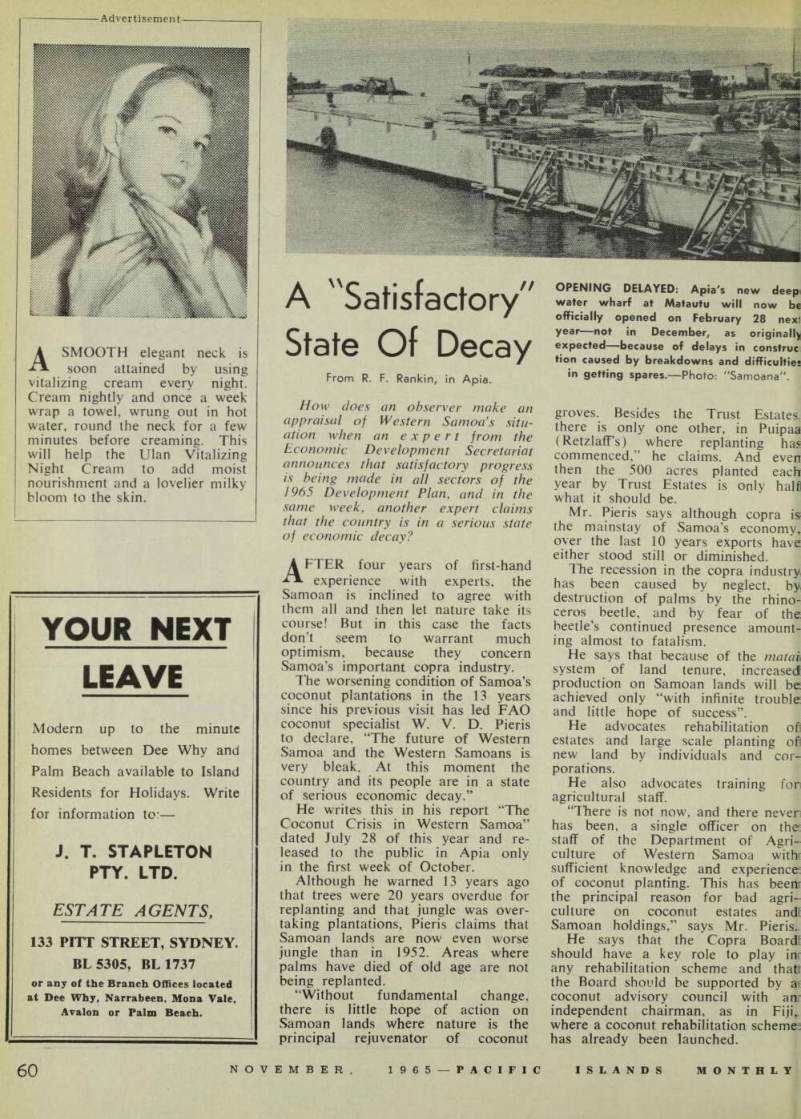
OPENING DELAYED: Apia's new deep water wharf at Matautu will now be officially opened on February 28 next year—not in December, as originally expected—because of delays in construe tion caused by breakdowns and difficulties in getting spares.— Photo: "Samoana". '