The Water Will Be
pp. 60-61 · Read in the full issue
Laid On At Last In Nukualofa
From Dorothy Lavin, in Nukualofa Tonga last summer e> perienced one of the rainiest w« seasons on record, and th millions of gallons of water ths thundered to waste in the dom brought home forcibly th necessity for water conservator UNTIL recently, backyard tank have been the only means c conserving water, and in the village these were few and far between However, since the Tonga Goverr ment first approached WHO am UNICEF for assistance, 40 village have been provided with piped wate supplies.
Now the three villages which forr the capital of Nukualofa, togethe with Haveluloto, are to receive thi same benefit.
The job of procuring water i Tonga is more difficult than in mam other places because there are m catchment areas.
Mr. Ben Adan, WHO engineer i: charge of the scheme, explains that as in most Pacific Islands, rain ove the years has seeped through the soi and coral rock formation, until it ha reached sea level. Then, owing t: the difference in density, the rai;i water has gradually displaced a;, area of sea water, forming a lens.
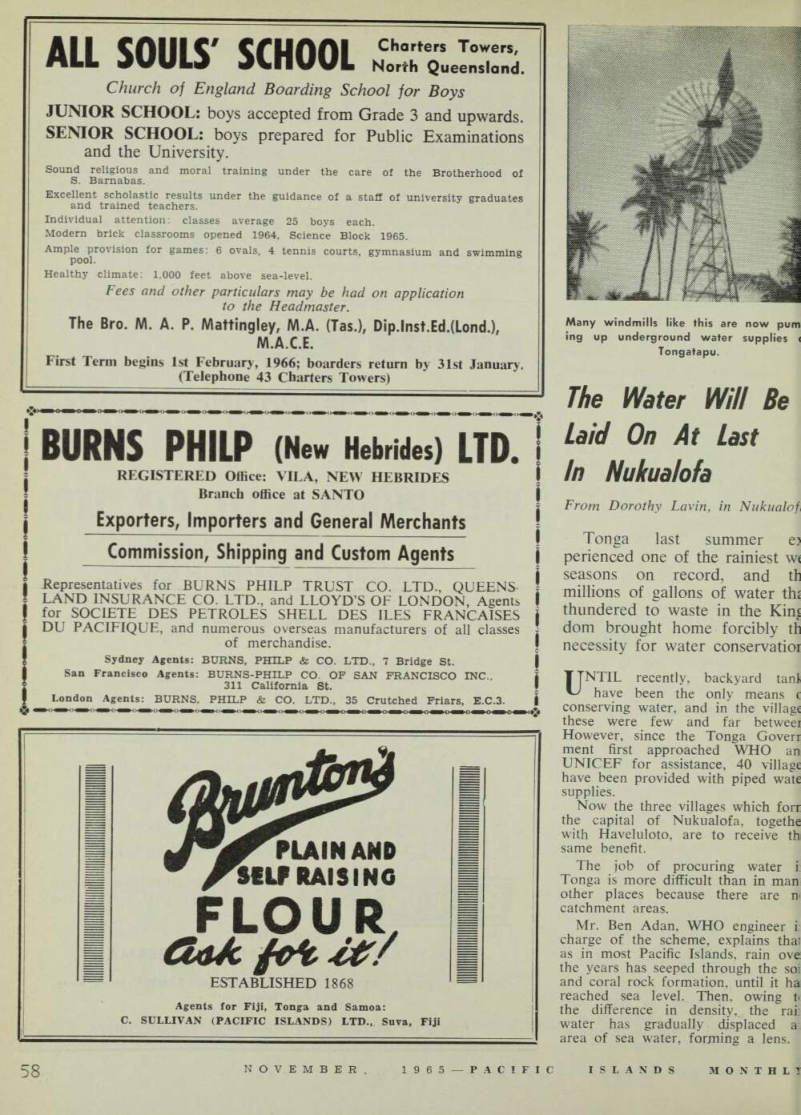
Many windmills like this are now pum ing up underground water supplies [?] Tongatapu.
This fresh water forms a dome bove sea level, and sinks below it ) a depth of about 40 feet for every >ot above.
Tonga’s wells are therefore dug > a carefully calculated depth, to raw off water from the top dome, ist above sea level, where the water constantly fresh. This water, hich is of such purity that no ad fives or treatment are necessary in onga, is pumped to header tanks ►r distribution.
Five wells are being dug at [ataki’eua, four miles from Nuku ofa—two of which are ready for stallation. Work is going ahead ith the other three.
Progress has been slow because, >art from the use of dynamite, the ork is done by hand with labour ovided by the local villagers. Each jcket load of soil and rock has to i laboriously hauled by hand to ie surface, but picks and shovels e wielded with a will, as Tongans g for their water. With the deepest ell to date, at 146 ft, it is quite an idertaking.
On completion of all the wells at [ataki’eua, power pumps will pump e water up into a covered reservoir the highest point, approximately ) ft above sea level. This will give head of 85 ft at the surface of the JO,OOO gallon reservoir.
Water will gravitate through a ain line to Nukualofa and then be ped to the three villages which ake up the capital.
Costs are estimated at approx
imately £70,000 and the scheme will serve the present population of 15,000 and provide water sufficient to take care of the increased population over the next 20 years, at an average rate of 15 gallons per head per day. The supply will be to standpipes and provision is available for people to pipe water to their own homes at their own cost.
Finance for the head works at Mataki’eua and main line to Nukualofa is being met by the Tonga Government. The remainder of the installation will be provided by both Government and the villages con-
cerned, with some help from WHO and UNICEF.
Early next year it is expected the new service will be available to both the hospital and new tourist hotel, after which full reticulation for Nukualofa will be carried out.
The assistance of WHO and UNICEF in making this water supply possible for the Kingdom will result in better health and sanitary con ditions. It will mean the end of the water shortage suffered every dry season, and it will increase crops considerably. Nukualofa looks for ward to it with considerable relief.