Of Condominium
pp. 57-59 · Read in the full issue

New Hebrides People Seek Statement On Future Of Condominium
A motion asking the British and French Governments to make a statement on their policy on the future of the Anglo- French Condominium of the New Hebrides was introduced at the 10th session of the New Hebrides Advisory Council in Vila in September.
THE motion was moved by a British member, Mr. S. J.
Breusch, who said that, in company with many other people, he believed it was essential to have a statement from the two Governments on the territory’s political future.
He said there was a need for de velopment and investment, for new plantations, industries and roads; but if people were to invest in the New Hebrides, they would want to be sure of a reasonable return. Fiscal and social stability were needed for this economic development.
Mr, K. Hutton, who supported Mr.
Breusch, said it was more important for the stability of the country to attract overseas investment than to depend upon aid from Britain and France.
"Much Could Be Done"
“If we could get an assurance that the Condominium will continue for another 10 or 20 years, much could be done,” he added.
After other members had supported the motion, the British Resident Commissioner, Mr. A. M. Wilkie, said he did not know what guarantees would come from the two Govern ments, but it was more important to have faith in those governments and in the good sense of the people of the New Hebrides of all communities.
Earlier, in a joint speech to open the Advisory Council session, Mr.
Wilkie and the French Resident Com missioner, Mr. Jacques Mouradian, made it clear that changes in the ad ministration of the New Hebrides were being contemplated.
They said that as a result of dis cussions held in Paris in July between the British and French Ministers re sponsible for the New Hebrides, they fthe Resident Commissioners) had been asked to study various aspects of administration and the possibilities of various constitutional, judicial and land reforms.
Referring to economic affairs, the Resident Commissioners said that during the early part of the year, copra prices had been buoyant but because of pests and drought, the territory had not benefited from them as much as was hoped. Prices had since declined somewhat.
Cocoa prices were unusually low and many planters found it un economic to process their crops.
Manganese
However, manganese prospects had improved and the Compagnie Fran caise des Phosphates de I’Oceanie ex pected to export between 78,000 and 80,000 tons in 1965. Prices had been fairly stable at about 62 cents per long ton unit.
Meanwhile, tuna production at the South Pacific Fishing Company’s fac tory in Santo had been below expec tations due to a shortage of ships and a reduction in catches. Because of losses incurred by the company, the export duty on fish had been
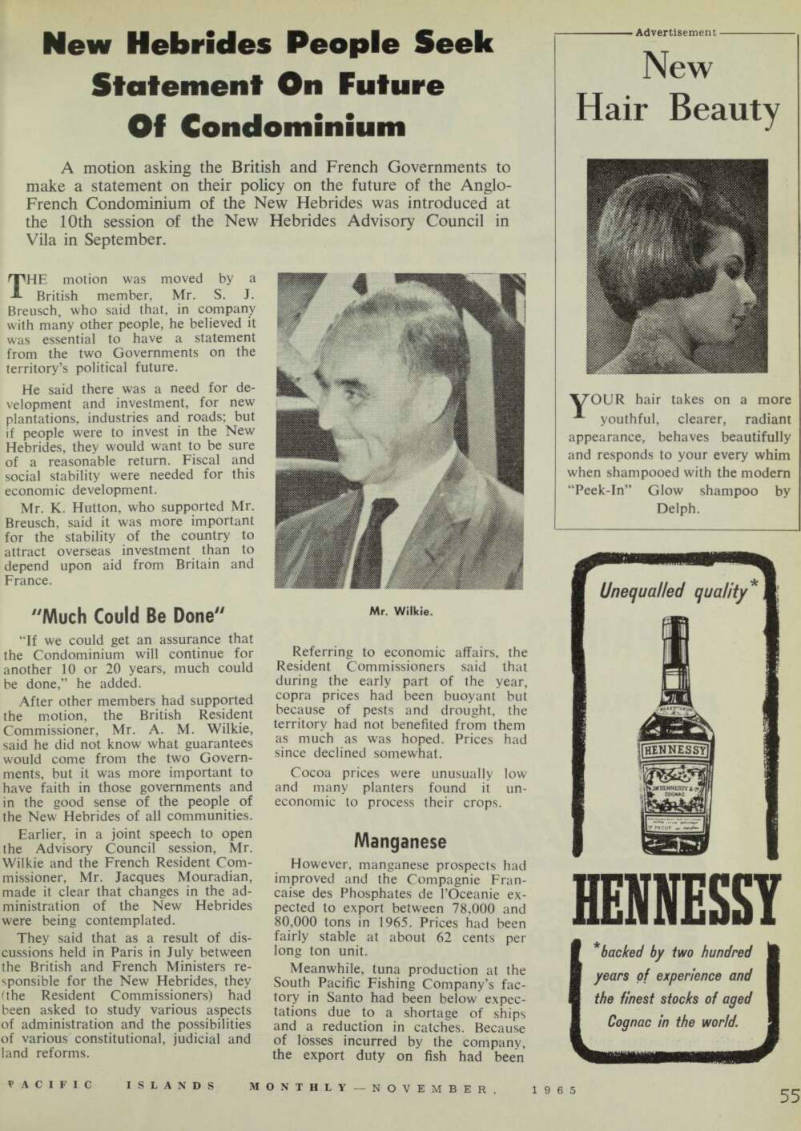
Mr. Wilkie.
iuced for one year to a nominal per cent.
Prospects for the beef industry ntinued to be good. Exports to the and of July were 103.5 tons, valued £5tg.31,784, compared with only .6 tons, valued at £Stg. 17,423 for j whole of 1964.
Referring to the long-projected larf for Vila, the Resident Com ssioners said it had been decided build this in Pontoon Bay.
Consulting engineers had been ap inted and negotiations were pro dding so that necessary land could acquired. The two Metropolitan wernments were being asked to e their authority for the raising loans.
Airlines Expanding
On the question of aviation, the sident Commissioners said that : two local airlines operating in : Group were steadily expanding ;ir business, and that 18 airfields re now in operation. Anew air d at Lenakel on Tanna was aost complete.
However, the steady growth of il aviation was creating problems organisation in such services as adio.
Dther points made by the Resident mmissioners were: • The WHO anti-tuberculosis npaign in the New Hebrides was w in Tanna. Generally speaking, results of the survey indicated t TB was perhaps not quite such serious problem as had been •ught, and that it should be pos le to control it with the means at Government’s disposal.
• During the year, French and English-speaking schools had been opened; a start had been made on the British Secondary School at Malapoa; and tenders for a French Lycee had been called. The Agri cultural Training School at Tagabe had been opened in June, but there was no further progress with plans for technical training for mechanical engineering and carpentry. • Increasing interest was being taken in all forms of sport. Athletics performances recorded at the Queen’s Birthday sports showed that the New Hebrides had a good chance of sending a worthwhile team to the
South Pacific Games in Noumea next year.
THE airport at Vila, New Hebrides, which for many years had only elementary facilities, now has a lounge and bar, where liquor, tea, coffee, soft drinks and snacks are available on the arrival and departure of aircraft. Tea is also served on Sunday afternoons.
A playground is being built where children can play safely.
The idea of the new bar came from Mrs. K. Baynes, of Vila, and the responsibility of running it is being shared by Mrs. D. Lanson.
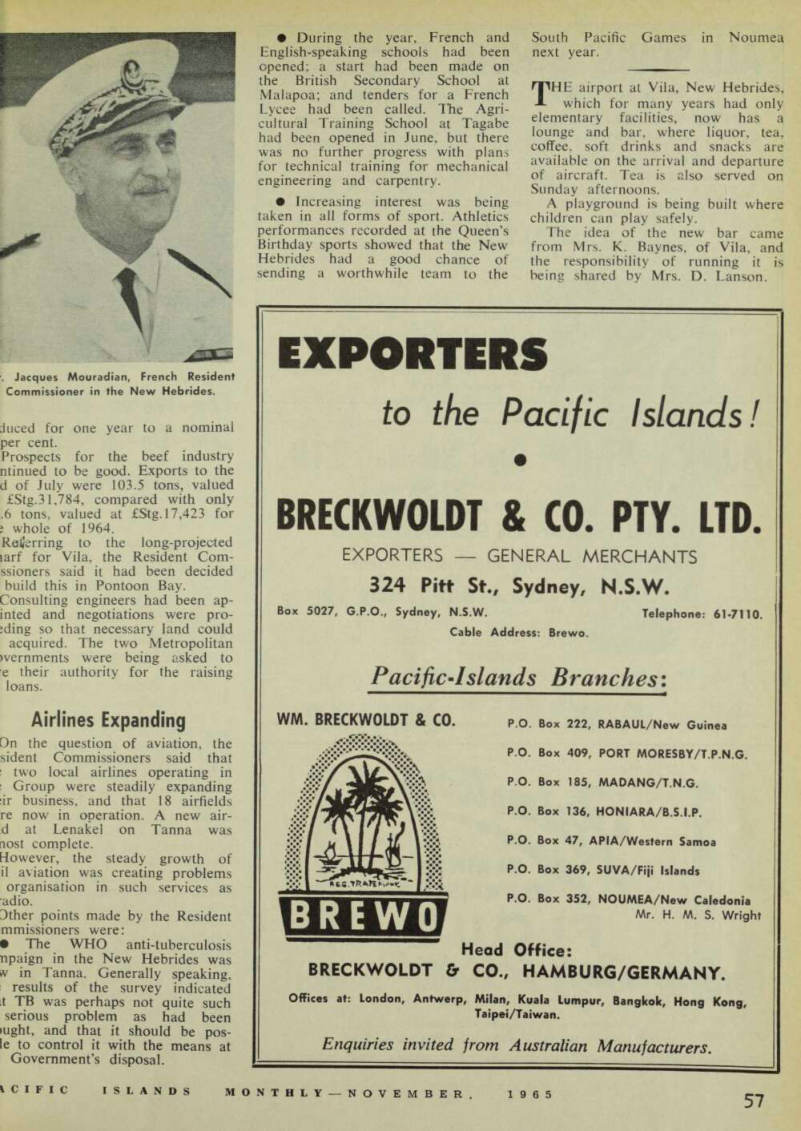
Jacques Mouradian, French Resident Commissioner in the New Hebrides.