First University
pp. 29-30 · Read in the full issue
Swift Moves On South Pacific's First University
The University of Papua-New
Guinea, established —on paper only—in May this year, has be gun to move quickly. In October
it was advertising throughout
English-speaking countries for its first academic staff, and it plans to enrol its first pre liminary students next March.
THE university is to be established in Port Moresby, in buildings yet to be planned, but in the meantime it will use the existing facilities of the Administrative College.
The initial planning for the uni versity—the first university to be established in the South Pacific islands—is in the hands of an interim council. Chairman of the council is Professor P. H. Karmel, who was ap pointed in September.
Other Members
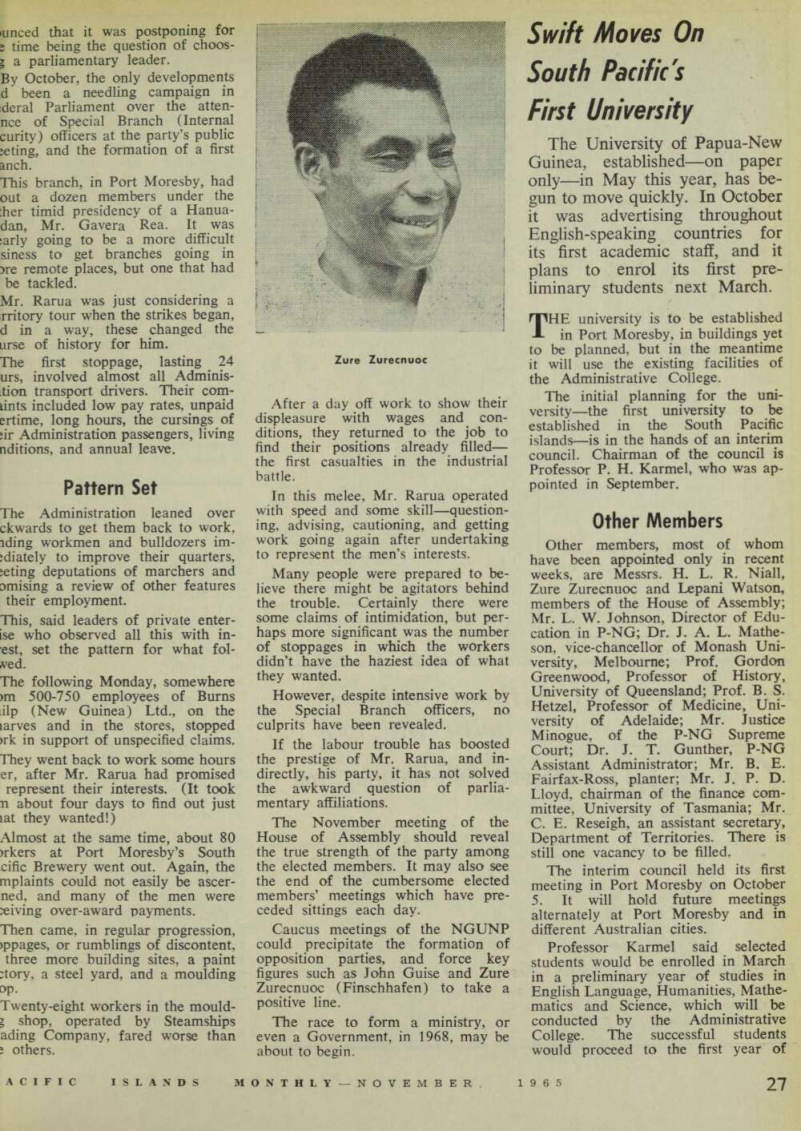
Other members, most of whom have been appointed only in recent weeks, are Messrs. H. L. R. Niall, Zure Zurecnuoc and Lepani Watson, members of the House of Assembly; Mr. L. W. Johnson, Director of Edu cation in P-NG; Dr. J. A. L. Mathe son, vice-chancellor of Monash Uni versity, Melbourne; Prof. Gordon Greenwood, Professor of History, University of Queensland; Prof. B. S.
Hetzel, Professor of Medicine, Uni versity of Adelaide; Mr. Justice Minogue, of the P-NG Supreme Court; Dr. J. T. Gunther, P-NG Assistant Administrator; Mr. B. E.
Fairfax-Ross, planter; Mr. J. P. D.
Lloyd, chairman of the finance com mittee, University of Tasmania; Mr.
C. E. Reseigh, an assistant secretary, Department of Territories. There is still one vacancy to be filled.
The interim council held its first meeting in Port Moresby on October 5. It will hold future meetings alternately at Port Moresby and in different Australian cities.
Professor Karmel said selected students would be enrolled in March in a preliminary year of studies in English Language, Humanities, Mathe matics and Science, which will be conducted by the Administrative College. The successful students would proceed to the first year of
an Arts degree course in March, 1967.
The council has already begun seeking a vice-chancellor, who as chief executive officer will play a key role in the university’s development and detailed decisions will wait his advice. The posts of registrar and university librarian will also be filled as soon as possible, and the librarian will be expected to start acquiring a comprehensive library immediately he takes up duty.
Foundation Chairs
The librarian will be lucky in that the university has already arranged to earmark a basic collection of New Guinea literature following the death of Mr. G. A. V. Stanley in Port Moresby in October. New
Guineana is becoming increasingly
difficult to buy on world markets.
Mr. Stanley’s estate will sell his collection to the university. Some of the books are rare or scarce. Un fortunately some are also in poor condition because of the effects of climate.
The foundation chairs of the uni versity, now being advertised, will be English Language, Education, History, Geography or Economics, Mathe matics, Physics or Chemistry, Biology and Law.
They carry salaries of £A5,450, plus £IBO a year for married ap pointees and accommodation at reasonable rents. Applications close on December 15.
The librarian is being offered £A4,550 —the same salary as the registrar.
The university is also currently advertising for senior lecturers and tutors, who will be responsible for teaching students during the pre liminary year of studies next year.
Professor Karmel commented in Port Moresby: “The great enthusiasm of the people of the Territory, of the Administration and other bodies for the development of the university promises that the university will soon be a reality.”
Technical Institute
At the same time as the university announcement came a statement on the Institute of Higher Technical Education, which will come into existence alongside the university.
Chairman of the institute council, Sir Herbert Watkin, said in Port Moresby that first courses would begin in 1967 in temporary accom modation at the Lae Technical School, but plans would meanwhile be made for the first buildings in Port Moresby.
First course will be civil engineer ing, with next priorities given to electrical and mechanical engineering, surveying, architectural engineering, management and accountancy. Edu cation entrance level will be the Territory School Leaving Certificate.
Advertisements for a director and an administrative officer are now being placed.