Industrial Disputes Create
pp. 27-29 · Read in the full issue

Fair Winds For New Party
From a Port Moresby Correspondent
The New Guinea United National Party, almost becalmed after a rather inexpert launching late in August, is now in a fair position to sail fast before the freshening winds of industrial unrest in Papua-New Guinea.
CHE party, the only one yet in existence in the Territory, seems srtain to gain a powerful industrial ing from the rash of strikes and rotest meetings during October, here was a major strike or dispute t least every Monday, and two on >me days.
The new party’s president, Mr. ►ala Oala Rarua, also happens to be resident of the Port Moresby /orkers’ Association. As the only ade union organisation in the town atering for non-public servants, it 'as in great demand to channel the lossoming claims for higher pay and etter conditions to management.
With six stoppages and four other ases of industrial discontent during le first three weeks of October, Mr.
Larua found himself with his hands all. But the association’s popularity urgeoned, and membership grew by 50 or more per week.
By the end of the month, the MWA had on its books a record ,500 financial members.
Mr. Rarua has yet to demonstrate his skill as a trade union leader by winning any industrial gains for his supporters, but if he can deliver even some of the goods, he will have built up a valuable body of urban support for Mr. Rarua as party chairman.
The NGUNP started its organisa tion from the top, as it were, and right from the beginning, faced the problem of how to get down to the grass-roots level.
The party, as first announced to the public, consisted of a group of 16 members of the House of Assembly, clustered around Mr. Rarua.
Resignations
The first hope was that these and other Parliamentarians—known, suc cessful and free to travel—would carry the party to the electorate, and with their imprimatur, quickly sell it to the indigenous proletariat in both the towns and the rural villages.
This, of course, would have been just too easy.
As it was, hopes of quick success were torpedoed within days.
Firstly, by the virtual resignation of five MHAs—John Guise, of Milne Bay; Peter Simogun, Wewak-Aitape; Paul Lapun, Bougainville; Robert Tabua, Fly River; and Graham Pople, Gumine. 'l’hen by a damaging per sonal attack in the House by Frank Martin, Madang-Sepik, on some of the people in the party’s Provincial Guiding Committee. The five parlia mentarians had expressed some sur prise at being named foundation members of the party and withdrew from active participation, mainly by pleading that they had conflicting in terests.
Mr. Martin, on information given him by an original member of the party group, labelled (under privilege) two members of the Provincial Com mittee as Communists, another two
as homosexuals and a fifth as an alcoholic. He did not name them. (The Administrator later said that the Government had no evidence to suggest that there were any active Communists associated with the party.) The party had been given some rough handling in other ways. Mr. lan Downs, Highlands Special Electorate, had asked the leader of the House, Dr. Gunther, without notice, whether the new party was Adminis tration-sponsored, and whether Mr.
Rarua’s employment with the Ad ministration was likely to continue. (Mr. Rarua was at that time special executive assistant to Dr. Gunther.) Dr. Gunther gave a categoric “no” to the first part of the question, and went on to say that Mr. Rarua was resigning, without pressure, in the coming week—and he has since done this.
Branded As Socialist
Early, the party had been branded as socialist in some Australian news papers, and it was well known that the Federal president of the ALP, Mr. Keefe, Professor Henry Mayer, of Sydney University, as well as Tom Mboya and Dr. Gunther himself, had all made contributions to the party’s platform statement.
Mr. Rarua strongly denied the party was socialist, or affiliated with the ALP. It was, he said, an or ganisation tuned to the needs of Papua-New Guinea, and owed nothing to outside organisations.
All this controversy made other members of the House reluctant to commit themselves to support at such an early stage, and the party, dis appointed at the turn of events, an
Oala Oala Rarua
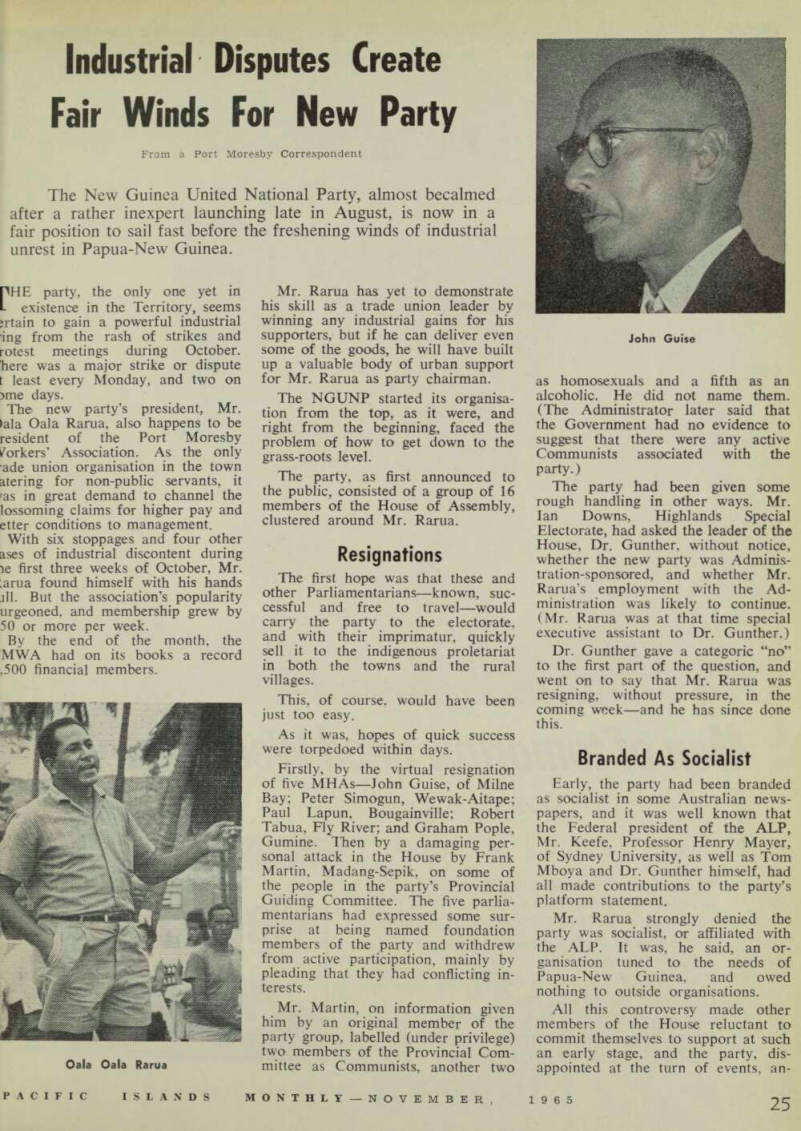
John Guise
»unced that it was postponing for 5 time being the question of choos y a parliamentary leader.
By October, the only developments d been a needling campaign in ideral Parliament over the atten nce of Special Branch (Internal curity) officers at the party’s public jeting, and the formation of a first anch.
This branch, in Port Moresby, had out a dozen members under the :her timid presidency of a Hanua dan, Mr. Gavera Rea. It was :arly going to be a more difficult siness to get branches going in are remote places, but one that had be tackled.
Mr, Rarua was just considering a rritory tour when the strikes began, d in a way, these changed the urse of history for him.
The first stoppage, lasting 24 urs, involved almost all Adminis tion transport drivers. Their com lints included low pay rates, unpaid ertime, long hours, the cursings of ;ir Administration passengers, living nditions, and annual leave.
Pattern Set
The Administration leaned over ckwards to get them back to work, iding workmen and bulldozers im jdiately to improve their quarters, jeting deputations of marchers and omising a review of other features their employment.
This, said leaders of private enter ise who observed all this with in est, set the pattern for what fol ded.
The following Monday, somewhere >m 500-750 employees of Burns ilp (New Guinea) Ltd., on the tarves and in the stores, stopped >rk in support of unspecified claims.
They went back to work some hours er, after Mr. Rarua had promised represent their interests. (It took n about four days to find out just lat they wanted!) Almost at the same time, about 80 >rkers at Port Moresby’s South cific Brewery went out. Again, the mplaints could not easily be ascer ned, and many of the men were reiving over-award payments.
Then came, in regular progression, >ppages, or rumblings of discontent, three more building sites, a paint :tory, a steel yard, and a moulding DP- Twenty-eight workers in the mould l shop, operated by Steamships ading Company, fared worse than i others.
After a day off work to show their displeasure with wages and con ditions, they returned to the job to find their positions already filled— the first casualties in the industrial battle.
In this melee, Mr. Rarua operated with speed and some skill—question ing, advising, cautioning, and getting work going again after undertaking to represent the men’s interests.
Many people were prepared to be lieve there might be agitators behind the trouble. Certainly there were some claims of intimidation, but per haps more significant was the number of stoppages in which the workers didn’t have the haziest idea of what they wanted.
However, despite intensive work by the Special Branch officers, no culprits have been revealed.
If the labour trouble has boosted the prestige of Mr, Rarua, and in directly, his party, it has not solved the awkward question of parlia mentary affiliations.
The November meeting of the House of Assembly should reveal the true strength of the party among the elected members. It may also see the end of the cumbersome elected members’ meetings which have pre ceded sittings each day.
Caucus meetings of the NGUNP could precipitate the formation of opposition parties, and force key figures such as John Guise and Zure Zurecnuoc (Finschhafen) to take a positive line.
The race to form a ministry, or even a Government, in 1968, may be about to begin.
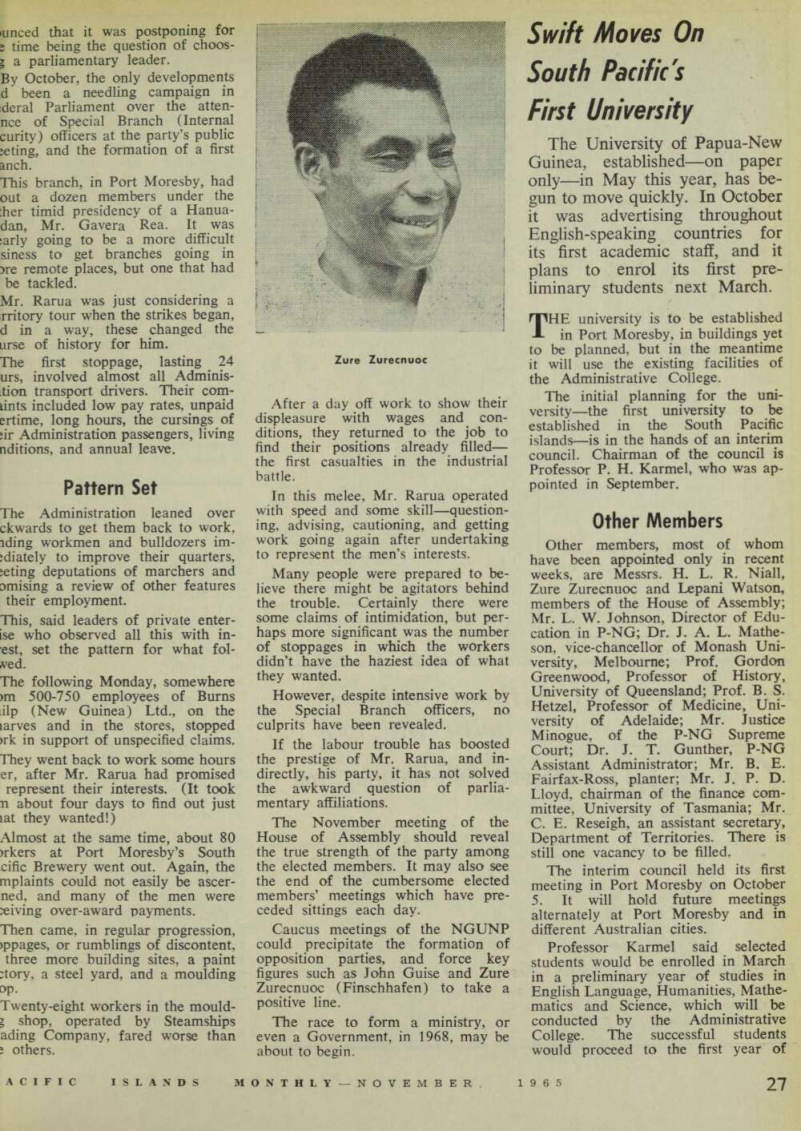
Zure Zurecnuoc