'Uda Boromo'
pp. 26-145 · Read in the full issue

Death Of Ng's
By a Special Correspondent
The newly established University of Papua-New Guinea will one day soon take possession of a library of rare New Guinea books, each carry ing a bookplate reading: “From the Library of G. A. V. Stanley—Terri torian, explorer, petroleum geologist, geographer, historian, writer, coast watcher and friend of the native people (Uda Boromo)”.
BOROMO means “Bush pig”. which, applied to GAV, was a term of respect. It means a self sufficient man of the jungle, for the Papuan holds the pig in high esteem.
G. A. V. Stanley died in Port Moresby hospital on October 6, at 61. He knew he was dying and arranged to send out roneoed letters to those inquiring after him, in the following terms: Dear —. G. A. V. Stanley advises that he has received your welcome letter. He deeply regrets that he is unable to write a handwritten reply.
The fact is that he is paralysed from the waist downwards and is extremely weak in the hands. He is mortally sick and his demise is probably only a matter of days. Please do not mourn for me but wait patiently the announcement of my death in the newspapers. — G. A. V. Stanley.
The unorthodox was typical of the colourful GAV, and his death re moves from the scene a personality of a type that cannot be replaced.
George Arthur Vicars Stanley was born in Coogee, Sydney, and gradua ted from Sydney University with first class honours, with both geography and geology as major subjects, under the influence of two great men— Edgeworth David and Griffith Taylor.
His first prospecting venture was to the Solomons, and then to the Aitape coast of New Guinea where he helped evaluate oil prospects for the Anglo-Persian Oil Company, which was working on behalf of the Australian Government.
When the Territory was opened for private prospecting companies, Stanley joined Oil Search Limited— an association he maintained for more than 20 years and which took him over many parts of the Terri tory. Later he was consultant to the Papuan Apinaipi Petroleum Com pany and prepared for them a monu mental report on the region between Port Moresby and the Purari River.
His last work was for the Common wealth Bureau of Mineral Resources, which commissioned him to compile the information from all sources relevant to the prospective petroleum basins of New Guinea. He got well along the road, but there is yet much to be done.
Stanley’s initial field work was more primitive than modern petroleum surveys. He went forth into the jungle and mapped on his own for week after week, without radio, without air support, without elaborate logistics of any kind, and without meeting other white men for months at a time. A trained geographer and field geologist, his maps were of a high standard of
(Continued on p. 143)
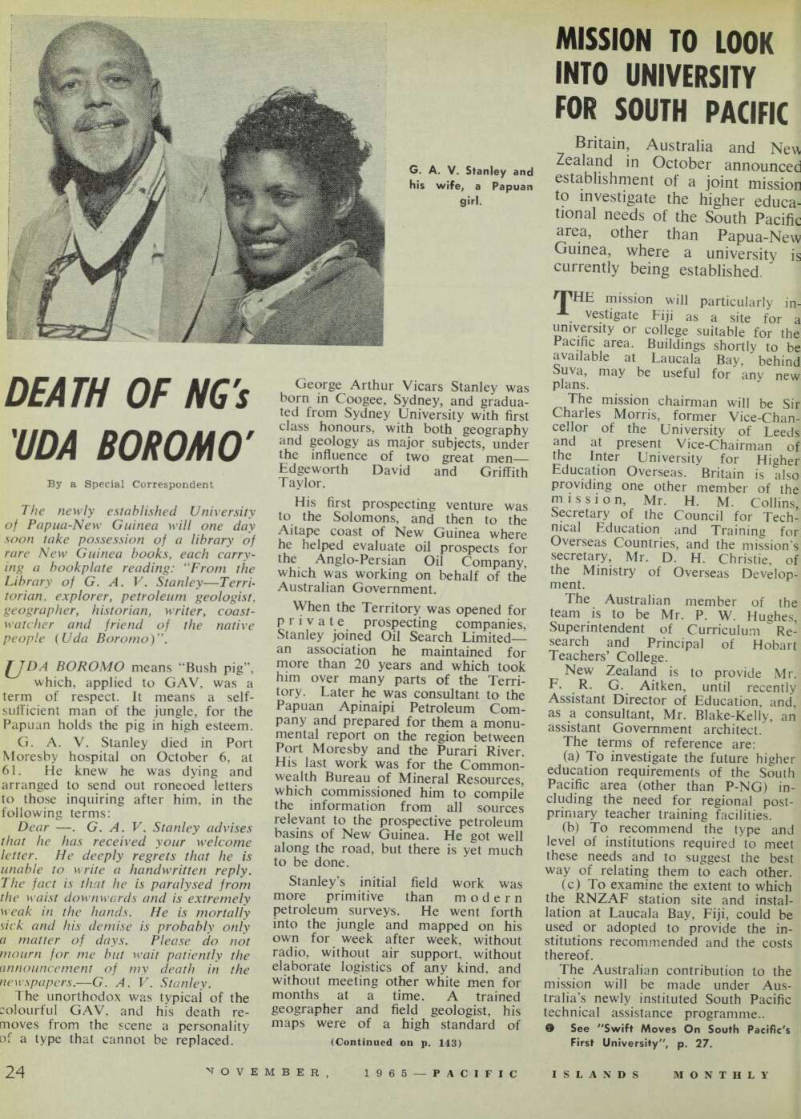
G. A. V. Stanley and his wife, a Papuan girl.
accuracy, and his geological observa tions impeccable.
No other geologist in history has examined and recorded as many New Guinea rock outcrops as has Stanley, nor has discovered as many oil seepages. He organised himself to stay in the field indefinitely, and although he looked forward to ship borne supplies reaching him every couple of months, he could always have stayed on in relative content ment.
This self-sufficiency was to stand him in good stead during the war, when, as a naval officer, he joined the Allied Intelligence Bureau and was assigned to the division respon sible for sustaining the active loyalty of the peoples who had been over-run by the enemy.
Stanley, entirely on his own, a one man army, was emplaced in the Sepik foothills near Maimai, deep within enemy held territory, and there he stayed, gathering information, dis seminating stories which grossly mis led the Japanese, encouraging the native peoples and extending their loyalty, but nevertheless running the gauntlet, hour by hour, of capture and assassination by those who thought the Japanese would win or who had been bought by them— many months of the most precarious existence imaginable in fever-ridden, very wet jungle without shelter or proper food or medicine. The DSC awarded to Stanley for these efforts was one of the hardest earned decora tions of the war.
Among his output of writings and scientific papers is a long series on the history of New Guinea. Its geo graphy he knew better than anybody.
In recent years his home in Port Moresby was always a rest house for any itinerant native, no matter how far afield he might have come; his address was the accepted poste restante for them all. Stanley loved nothing better than to talk with his guests, and inevitably his knowledge deepened, while his personal sympathy and understanding melted barriers of race, skin and culture and exposed to each other the hearts and aspirations and anxieties of men.
He became a full member of a Papuan tribe and the tribal respon sibilities he inherited bore heavily on him and significantly changed the pattern of his later life, which, to understate the position, was little
understood by many of his white contemporaries.
Few understood the depth and intrinsic measure of the man. Years of sequestered jungle life made him a contented recluse, added to which was a somewhat deliberate and mischievous pose as an eccentric, an outre, all of which widened the gulf separating him from conventional society.
Native boys whom Stanley reared were encouraged to learn the know ledge of the white man, but they were also sent back to their villages to absorb the rites of the fishing fleet and the rites of their tribal seniors.
No ward of Stanley’s would wake one day to find he had acquired some of the patina of the white man, to become an outcast alien in his tribal home.
Palu. his Papuan wife from Tupeslei, was married to him first by tribal law, then by civil contract and finally before the mission priest.
It was an improbable union. Port Moresby, self-conscious and uncertain of its own mores in the rapidly changing race relations, did not understand or approve. How little they know the real story behind it all, and the fine human qualities which could be distilled from it.