Protest Against
p. 25 · Read in the full issue
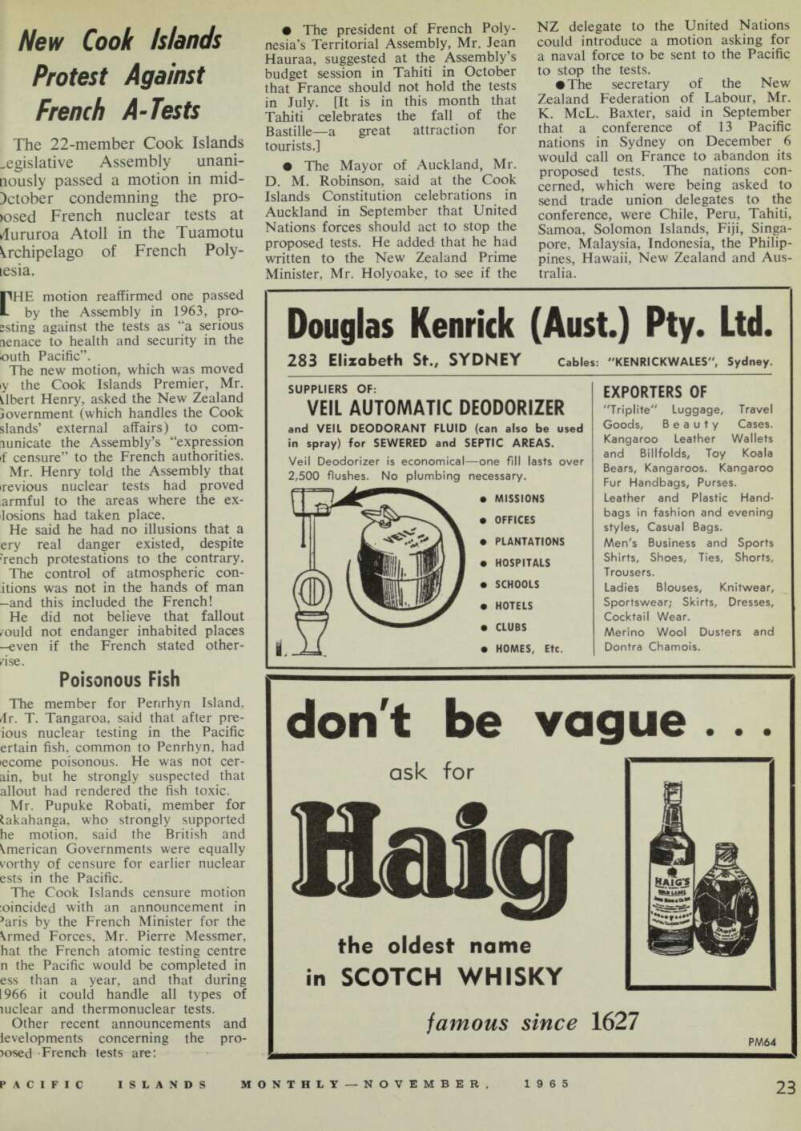
New Cook Islands Protest Against French A-Tests
The 22-member Cook Islands
legislative Assembly unani
nously passed a motion in mid-
October condemning the pre
ssed French nuclear tests at dururoa Atoll in the Tuamotu
Archipelago of French Poly
lesia. rHE motion reaffirmed one passed by the Assembly in 1963, pro ssting against the tests as “a serious aenace to health and security in the outh Pacific”.
The new motion, which was moved »y the Cook Islands Premier, Mr.
Albert Henry, asked the New Zealand jovernment (which handles the Cook stands’ external affairs) to com municate the Assembly’s “expression »f censure” to the French authorities.
Mr. Henry told the Assembly that irevious nuclear tests had proved armful to the areas where the ex losions had taken place.
He said he had no illusions that a ery real danger existed, despite Tench protestations to the contrary.
The control of atmospheric con ations was not in the hands of man -and this included the French!
He did not believe that fallout would not endanger inhabited places —even if the French stated other wise.
Poisonous Fish
The member for Penrhyn Island, Ax. T. Tangaroa, said that after pre ious nuclear testing in the Pacific ertain fish, common to Penrhyn, had >ecome poisonous. He was not cer ain, but he strongly suspected that allout had rendered the fish toxic.
Mr. Pupuke Robati, member for lakahanga, who strongly supported he motion, said the British and American Governments were equally vorthy of censure for earlier nuclear ests in the Pacific.
The Cook Islands censure motion coincided with an announcement in J aris by the French Minister for the \rmed Forces, Mr. Pierre Messmer, hat the French atomic testing centre n the Pacific would be completed in ess than a year, and that during [966 it could handle all types of mclear and thermonuclear tests.
Other recent announcements and levelopments concerning the pre ssed French tests are:
• The president of French Polynesia’s Territorial Assembly, Mr. Jean Hauraa, suggested at the Assembly’s budget session in Tahiti in October that France should not hold the tests in July. [lt is in this month that Tahiti celebrates the fall of the Bastille—a great attraction for tourists.] ' w r a , ixwou • ayor °f A uck l^ nd > D. M. Robinson, said at the Cook Islands Constitution celebrations in Auckland in September that United Nations forces should act to stop the proposed tests. He added that he had written to the New Zealand Prime Minister, Mr. Holyoake, to see if the
NZ delegate to the United Nations could introduce a motion asking for a naval force to be sent to the Pacific to stop the tests. •The secretary of the New Zealand Federation of Labour, Mr.
K. McL. Baxter, said in September that a conference of 13 Pacific nations in Sydney on December 6 ld call on France to abandon its p ro p Osec tests. The nations con cerned, which were being asked to send trade union delegates to the conference, were Chile, Peru, Tahiti, Samoa, Solomon Islands, Fiji, Singa pore, Malaysia, Indonesia, the Philip pines, Hawaii, New Zealand and Aus tralia.