yesterday
p. 93 · Read in the full issue
Several reports on the brutal and tragic deaths of Islands people while in the hands of the Japanese were among the features of PIM for October , 1945. This was the first post-war issue of the magazine. Here are some extracts :
11/HEN a force of 250 Ausfor the natives, had been murdered by the Japanese in retaiiation for an air raid th ® n ru^we^ r< found°^ y the a transferred* o to i Q/i's r W!K n i<. o rpvpalpd that more , i non cnirUprc anH than 1 000 soldiers and cmlians who keen taken pnsoner by the Japanese Rabaul VI !942 had been lost when the
taking ZS
to Japan, was torpedoed off Luzon, Philippines. Only a few score civilians (mainly missionaries) had been found alive out of about 350 believed to have been imprisoned by the Japanese in New Guinea.
A FRENCH novelist, Maurice de Kobra, had prepared a will leaving his library of 17,000 volumes and works of art to the town of Papeete, Tahiti, because he regarded Tahiti as “one of the
remote places of the earth”, and one least likely to be destroyed by an atomic bomb. (How times have changed!) CELEBRATIONS had been held in all parts of the world to mark the 150th anniversary of the London Missionary Society which sent the first Protestant mis sionaries to the Pacific (Tahiti) in 1797. The LMS was formed when representatives of various Protestant churches met in London on September 23, 1795.
MR. E. J. WARD, Australia’s Minister for External Terri tories, said in the Australian Parliament that Port Moresby would be the seat of the pro visional Administration of Papua and New Guinea. He said that civil administration would be re stored by October 1, 1945, and that natives would be given better conditions and eventually the opportunity to share in their own government.
Lieutenant-colonel f.
W. Voelcker had been ap pointed Administrator of Western Samoa in succession to Mr. A.
C. Turnbull.
MEMBERS of the Pacific Terri tories Association (evacuees from Papua and New Guinea) had decided to appeal to Aus tralia’s Governor-General, the Duke of Gloucester, for assistance in returning to their homes and interests in the two territories.
The evacuees claimed to have encountered indifference from Ministers and high officials in seeking to return.
THE Japanese garrison on Ocean Island had formally surrendered to the GEIC Resident Commissioner, Colonel V. Fox- Strangways, and Brigadier J. R.
Stevenson aboard the Australian frigate Diamantina on October 1, 1945.
Mr. W. H. Watson, Raro
tongan businessman and Island Council member, had re turned to Rarotonga after being the first private citizen to make a round trip by air to New Zealand via Aitutaki, Samoa, Tonga and Fiji. During the tour Mr. Watson made arrangements for the installation of a small clothing factory in Rarotonga, and for improvements in the already established footwear industry.
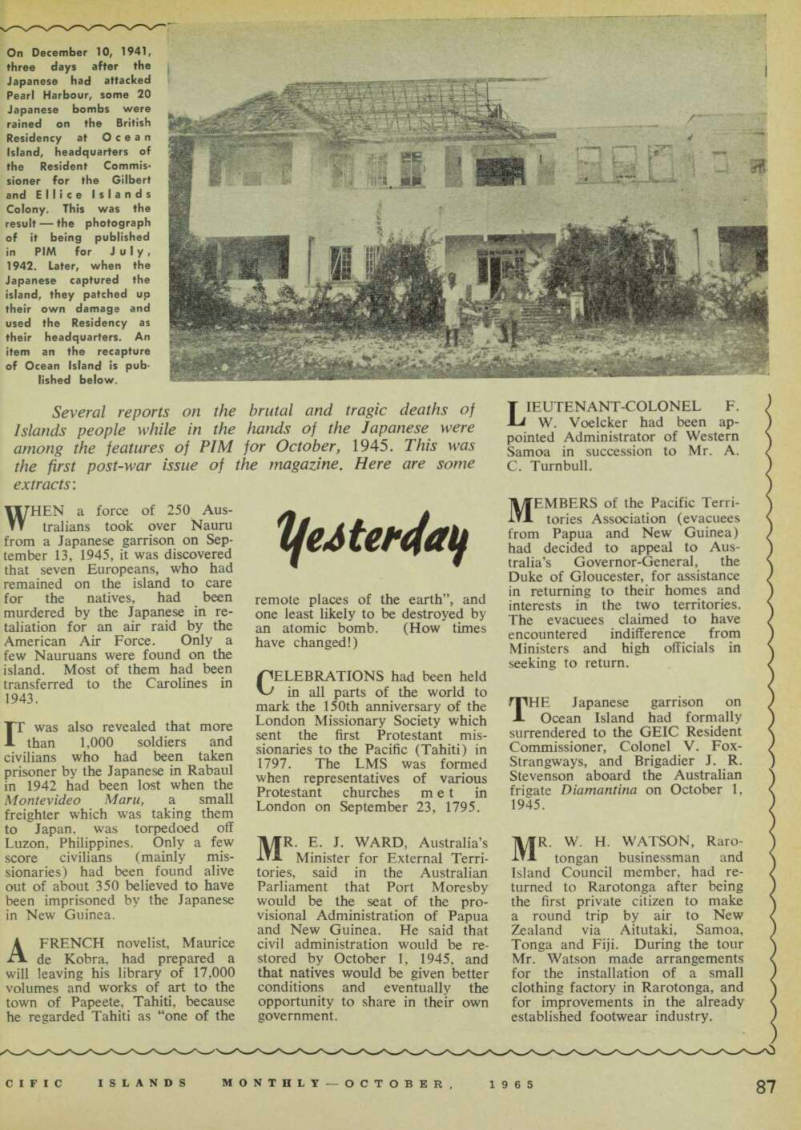
On December 10, 1941, three days after the Japanese had attacked Pearl Harbour, some 20 Japanese bombs were rained on the British Residency at Ocean Island, headquarters of the Resident Commis sioner for the Gilbert and Ellice Islands Colony. This was the result the photograph of it being published in PIM for July, 1942. Later, when the Japanese captured the island, they patched up their own damage and used the Residency as their headquarters. An item an the recapture of Ocean Island is pub lished below.