Monthly
Pacific Islands Monthly
Ictober, 1965
3/- 60 US cents 50 French Pac. frcs.
I & i he New/s 1 agazine Of The South Pacific
Established 1930
;red at G.P.0., Sydney, and at P. 0., f nr Irani mictlnn ku ••
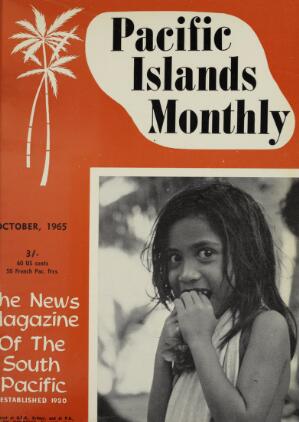
OUR COVER: This was probably the fii time that this little girl from Sikaiana the Solomons had had her photogra taken—and she wasn't too sure whetf she liked the idea. Sikaiana, an ate about 110 miles east of AAalaita, is Polynesian outlier in the heart Melanesia. It has about 250 peop Photo: Ted Marric
Advertisements & other items, pp. 2-8 (7 items)
October, 1965 Pacific Islands Month L..
Australia Is A Big Country
Big and generous in everything unusual, theatre bookings and restaurant reservations!
Australia has much to offer holiday visitors. You have nothing to do but enjoy yourself.
For example, the wonders of the Great Barrier Trans-Australia Airlines serves 140 ports Reef that stretches for over 1000 miles. The throughout Australia and Papua/New Guinea, gaiety of the sun, sand and surf on Queens- Do more —see more, on a TAA ‘Fly-Away land’s Gold Coast. The awesome, colourful Holiday’. beauty of the Red Heart of Australia; and the Contact your nearest travel agent or Transquiet tranquillity of Tasmania, or the tropic Australia Airlines office, wonders of Papua/New Guinea.
All this is yours to enjoy through Trans- Australia Airlines. * Li TAA can offer a huge range of low-cost, packaged ‘Fly-Away Holidays’ to any of the above areas and TAA will take care of everything. Travel, bookings by air, road, rail or sea, accommodation, sight-seeing trips —even
Trans-austrau
lift HiItNULY WAY
PYNEBOARD
FOR FURNITURE AND BUILT-INS
PROOFED AGAINST WHITE ANTS
AND BORERS
You save money with Pyneboard because . . .
No timber framing is needed panels simply glue together to form strong, rigid units.
Off-cuts can be used simply butt-glue them together to make larger panels.
Pyneboard is an excellent base for paints and veneers, the smooth surface is ready for finishing.
Panel sizes up to 12' x 6'.
AVAILABLE AT LEADING
ISLAND MERCHANTS
<*s■*>
IUUDIirS^/MAIEIIUS
Mode in Australia: Marketed by C.S.R. Building Materials v. Division of The Colonial Sugar Refining Co. ltd.
-iltff tj (rnMei
COPRA...
GREATER DRYING
PERFORMANCE FOR
LESS OUTLAY
THAT'S A.S.P.!
ft y ii . f ' - V' ii; v. ' ■ 1 ' Now! ... the most economic production of first-grade copra can be achieved effectively, economically, with the new A.S.P. Hot Air Copra Dryer employs automatic control of exhaust air humidity during re-circulation ... requires minimum floor area for compact operation.
COMPARE THE NEW A.S.P. HOT AIR COPRA DRYER...
FEATURE BY FEATURE ... AND PROVE YOU GET MORE,
IMPROVED DRYING PERFORMANCE FOR LESS OUTLAY...
WITH A.S.P.!
4sk for full details and illustrated brochure: n Australia: A.S.P. (OVERSEAS) PTY. LTD., 26 Ridge Street, North Sydney.
Tel.: 92-0271. Cables: "Chatspa" Sydney. n New Guinea; A.S.P. (N.G.) PTY. LTD., Box 166, P. 0., Rabaul, T.N.G.
Tel.: Rabaul 2370 Cables: "Chatspa" Rabaul.
(0/SEAS) PTY. LTD.
SPECIALLY DESIGNED FOR
PLANTATION AND FARM
Throughout the Pacific, the greatest tractor value in the 40 h.p. class is the very popular McCormick International B-414.
NO EXTRAS TO BUY!
B-414 is specially designed for plantations
and farms in the Pacific area.
Regular equipment includes:
• 12.00-28 4-ply Tyres Rear. • 6.00-16 4-ply Tyres —Front. • 540 r.p.m. Trans. P.T.O. • Swinging Drawbar and Frame. • Key-type Starter Cutout Switch. • Heat Indicator. • Tractormeter. • De luxe Seat. • Vary-Touch Hydraulics. • Three-point Linkage. • Rear Wheel Weights, e Front End Weight. • Front and Rear Lights. • Self Sealing Coupling.
Automatic Hitch.
McCORMICK INTERNATIONAL B-414
For further information, contact any of the following Distributors'.
NEW GUINEA: N.G.G. Trading Company, LAE.
Steamships Trading Co. Ltd., RABAUL.
New Guinea Goldfields Ltd., WAU.
Hagen Auto Port, MT. HAGEN.
FIJI: Niranjan's Service Station, SUVA.
TAHITI; Hintze & Company, PAPEETE.
PAPUA: Steamships Trading Company Ltd.,
PORT MORESBY.
NEW HEBRIDES: Kerr Bros. Pty. Ltd.,
SYDNEY.
NEW CALEDONIA: Agence Automobile,
NOUMEA.
SOLOMON ISLANDS: Solomon Motors Ltd., HONIARA.
“——ESTER COMPANY OF AUST. PTY. ITD, SOUTH MELBOURNE. WORKS: DANDENONG, GEELONG, PORT MELBOURNE
H 1347'EP1 T
BURNS PHILP (SOUTH SEA) CO. LTD.
GENERAL MERCHANTS AND SHIPOWNERS
SHIPPING,, CUSTOMS AND FORWARDING AGENTS
Fiji:
SUVA.
LEVUKA.
LAUTOKA.
LABASA.
SAVU SAVU.
BA.
SIGATOKA.
TAVUA.
ROTUMA ISLAND.
TAVEUNI.
AGENTS FOR:
QUEENSLAND INSURANCE CO. LTD.
BURNS PHILF TRUST CO. LTD.
SHELL COMPANY (P. 1.) LTD.
OVERSEAS AGENTS
BURNS, PHILP €r CO. LTD., Sydney.
BURNS, PHILP Cr CO. LTD., London.
BURNS PHILP CO. OF SAN FRANCISCO
SHIPPING AGENCIES
• The New Zealand Shipping Co. Ltd. • Shaw Savill & Albion Co. Ltd. • Port Line Ltd. • Bank Line Ltd. • General Steamship Corporation Ltd. • Blue Star Line • Cunard Line • Compagnle des Messageries Maritimes • British India Steam Navigation Co. Ltd. • Royal Interocean Lines • Nederland Line Royal Dutch Mail/Royal Rotterdam Lloyd.
EXCLUSIVE DISTRIBUTORSHIPS INCLUDE
• AKAI TAPERECORDERS
• DUNLOP PRODUCTS
• EPIGLASS PRODUCTS
• FERGUSON TRACTORS
• HELENA RUBENSTEIN
• HITACHI ELECTRONICS
• HOLDEN VEHICLES
• JOHNSON'S WAXES
• ROLEX WATCHES
• REVLON COSMETICS
• PENTAX CAMERAS
• SUNBEAM APPLIANCES
INTERNATIONAL AIR TRANSPORT ASSOCIATION REPRESENTATIVES for
QANTAS EMPIRE AIRWAYS LTD. AIR NEW ZEALAND LTD.
UNION DE TRANSPORTS AERIENS :: ALITALIA PAN AMERICAN AIRWAYS
ASSOCIATED COMPANIES
BURNS PHILP (NEW HEBRIDES) LTD.
AUTOMOTIVE SUPPLIES CO. LTD.
CORRIE & CO. LTD. • NARAIN FURNITURE CO. LTD.
SPECIALISED SERVICES
EXPERT ADVICE ON WORLD AND LOCAL TOURS
TRAVEL SHIPPING FORWARDING CUSTOMS
FORMALITIES INSURANCE.
REGISTERED OFFICE: SUVA, FIJI
Code Address: "BURNSOUTH"
HAVE YOU
NOTICED
HOW MUCH
BETTER
GILBEY’S
GILBEY’S
GINA
So why mix with others?
I
LCIFIC ISLANDS MONTHLY OCTOBER, 1965
Ii
OCTOBER, 1965 PACIFIC ISLANDS MONTH I!
Iii
CIFIC ISLANDS MONTHLY— OCTOBER, 1965
Iv
OCTOBER, 1965 PACIFIC ISLANDS MONTHI
%Cific Islands Monthly— October, 1965
Pacific Islands
Monthly
Owned And Published By Pacific
Publications Pty. Ltd., 29 Alberta
St. (Box 3408, G.P.0.), Sydney.
Telephones: 61-9197, 61-7101, 61-4369.
Telegraphic Address: PACPUB, Sydney.
Chief Executives
Managing Director: R. W. Robson.
General Manager: Selwyn Hughes.
Book Publishing Division
Editor; Judy Tudor.
Pacific Islands Monthly
Editor: Stuart Inder.
Assistant Editor: Robert Langdon.
Branch Offices
Melbourne: Newspaper House, 247 Collins Tel.: 63-7053.
Fiji: Pacific Publications (Fiji) Ltd., Fiji Tin Building, 20 Gordon Street, SUVA. Tel.: 56i Fiji Times Office, Vidilo Street, LAUTOK; Tel.: 420.
Papua-New Guinea: Pacific Publications (N.
Pty. Ltd., Portlock St. (P.O. Box 16), P Moresby. Tel.: 2504. Representative: M Joan Carter.
Representatives
New Zealand: J. D. Whitcombe, C.P.O. E 2229, Queen Street, Auckland. Tel.: 704 C Hawaii: C. C. Spencer, 203 Yap Bldg., Waialae Ave., Honolulu. Tel.: 775538.
United States; Mrs. A. L. Craib, 1631 8i Avenue, Oakland 21, California.
Tel.: LOckhaven 8-1201.
United Kingdom; S. R. Warman, Candlew House, 116-126 Cannon Street, London, E.C Tel.: Mansion 3674/7. Tel.: City 2355 i H. A. Mackenzie, 4A Bloomsbury Squa London, W.C.I. Tel.: Holborn 3779.
Agents
All main trading firms and stores in the Pacific Islands.
Pacific Publications Pty. Ltd. is the Austral! agent for THE FIJI TIMES.
Subscription Rates:
Australia, New Zealand, all British Commr wealth South Pacific Territories, Tonga, N Hebrides and Western Samoa: 3/- Itr currency (36/- local currency for 12 montli Elsewhere in the South Pacific: 50 Frei Pacific francs or 60 US cents (600 Fren Pacific francs or $7.00 US posted for months). Posted to the UK, US and all otll countries: £Stg.2 or $7.00 US.
"Pacific Islands Monthly" is air-freighted all subscribers and agents in the South Paciti copies to other areas go by surface mail I
Advertisements & other items, p. 8 (1 item)
2
OCTOBER, 1965 PACIFIC ISLANDS MONTHL
In This Issue
Eneral
3-operation in Commerce 16 3ncern Over Fishing Practices 51 >lynesian Origins 65 ;ceptionally Cold Weather 67 rritories Department Bibliography 93 ofua" Damaged by Fire 105 ighter Outlook for Copra 133
Werican Samoa
odern Fishing Boat 103 go Pago as Tourist Centre 113
)Ok Islands
gh Commissioner Resigns 5 If-Government Celebrations 5 ands Claimed by US 24 '-Aitutaki Air Service Mooted 127
Ister Island
ms for Airport 125 II terthoughts on London Conference 7 w Industrial Council 15 est's 60th Anniversary 24 d Prediction on Ratu Mara 25 ning of TV Series 25 :ific Theological College 29 nabans Bitter Against Britain 32 tuma Co-operative Society 61 ns Adopt New Habits 81
•mer Governor's Autobiography 97
jh Costs Hit Shipowners 99 itoka Wharf Problems 103
More Ships Call 107 Sigatoka Coast as Travel Centre 117 BOAC to Extend Air Services 127 Australian Investment 132 Lower Profit for Sugar Mills 134 Copra Pest Reaches Koro 134 Factory for Paper Products 135
French Polynesia
Death of Oscar Nordman 8, 154 Mururoa Explosion Kills Three 16 Nationalist Chinese Consulate Closed 21 First Chile-Tahiti Flight 125 New Air Services 125 Spearfishermen's Success 131
Gilbert And Ellice Islands Colony
Angry Ocean Islanders 32 Time for Constitutional Progress 53
Kermadec Islands
Macauley Island's Rats 85
New Caledonia
Boost for Games Hopes 9 French Education Plan Rejected 69
New Hebrides
First Harbourmaster 59 "Dictatorship"; Gilbertese Workers 67 Malekula's Coastline Alters 75
Niue
Drivers Can Be Furiouser 49
Fishing Problems 51 Book on Henry Head 92
Norfolk Island
Wheat Flourishing 61 New Career for Whale Chaser 105
Papua-New Guinea
High Hopes for Misima Mines 7 Japanese Zero Reconstructed 8 New Britain Defence Needs 11 Public Service Unrest 12 Ship for Bongainville Co. 16 Kinjibi Coffee Directors 16 Cadet Scheme for W. R. Carpenter 16 Tip on Administator Denied 27 Shirt-Making 27 Judy Tudor on Politics 45 Visit by Dr. Margaret Mead 53 New Postage Stamps 63 Brett Hilder Profile 83 Quest for Anthem, Name, Flag 89 Book by Danish Writer 95 "Braeside" Off Run for Repairs ... 101 Whale Chaser to be Training Ship 105 Director of UN Information Centre 131 Cocoa Growers Ask for Subsidy 133
Solomon Islands
New Scientific Discoveries 83 Drive for Tourists 125 Chief Information Officer Appointed 129
Tonga
Tourism Plans 16 Banana Production 71
United States Trust Territory
Official Flag; National Day 89
Western Samoa
Education in "State of Crisis" 69 Top UN Representative Retires 73 Copra Policy Review 133
DEPARTMENTS: Topicalities, 24; People in Pictures, 42; Territories Talk-Talk, 55; The Editors' Mailbag, 65; Planters' Digest, 71; From the Islands Press, 76; Magazine Section, 81; New Books, 91; Shipping, 99; Cruising Yachts, 109; Travel, 113; People, 129; Commerce, 132; Shipping, Airways Schedules, 141; Deaths of Islands People, 154.
Advertisements & other items, pp. 9-10 (3 items)
3
ACIFIC ISLANDS MONTHLY— OCTOBER, 1965
4
OCTOBER, 1965 PACIFIC ISLANDS MON THU
Now! Warr-Free
Ideal for South Pacific. Klinkii Placarol
doors withstand all climate conditions, even temperature & humidity extremes.
WHY PLACAROL IS
A BETTER DOOR
FOR [YOUR] NEEDS
KLINKII PLACAROL
DOORS always retain original shape and size, will not twist, warp, or swell. They are stronger, yet lighter.
KLINKII PLACAROL makes perfect doors
for every building. They are completely
stable through unique new construction.
Use them for homes, hotels, motels, res-
taurants, offices, factories, showrooms,
schools, colleges, flats . . . anywhere you need a door.
A > Closely packed PLACAROL curls of KLINKII Pine are placed side by side on their edges inside frames.
Precision-cut curls maintain exact dimension of length, width and thickness. This core has the advantage of extra strength for light weight.
KLINKII Plywood Panels are securely glued to frame, curls and lock-block by this worldtested ultra modern process.
esltUl
;, I ; =ill ' f 4 m t.
Famous Klinkii quality frames hold lock block in firm position.
Klinkii Placarol doors are available in all standard sizes.
NEW GUINEA: Burns Philp (N.G.) Ltd. —all branches. Colyer Watson (N.G.) Ltd. —all branches New Guinea Co. Ltd. —all branches. A. H. Bunting—Goroka; Peter England Angoram PAPUA: Burns Philp (N.G.) Ltd. —all branches. Steamships Trading Co. Ltd. —all branches. Island Products Ltd., Port Moresby. PACIFIC ISLANDS; Morris Hedstrom YAust.) Ptv. Ltd., Suva. Morris Hedstrom (Aust.) Pty. Ltd., Apia. Burns Philp (South Sea) Co, Ltd., Fiji. Burns Philp (New Hebrides) Ltd., Vila. W. S. Tait & Co. Pty. Ltd., Santo.
BOUGAINVILLE: Steamships Trading Co. Ltd., Rabaul. New Guinea Co. Ltd., Rabaul.
Burns Philp (N.G.) Ltd., Rabaul.
KPDpiSI
From Top Took
Mr. Dare Resigns From Top Took Islands Post
The New Zealand High Com missioner in the Cook Islands, Mr. A. O. Dare,< resigned in September to accept an appoint ment as district inspector for the State Services Commission in Christchurch, NZ. He will leave the Cook Islands shortly.
Mr. Dare became High Com missioner when the Cook Islands became self-governing on August 4. He had been Resident Com missioner since 1960.
From 1951 to 1954 he was assistant inspector for the Public Service Commission in Auckland.
He was Official Secretary in Rarotonga from 1954 to 1956, Resident Commissioner on Niue from 1956 to 1958, and Assistant Secretary to the Department of Island Territories from 1958 to 1960.
Announcing Mr. Dare’s re signation, the New Zealand Minister of Island Territories, Mr. J. R. Hanan, said the Government hoped an early an nouncement could be made on his successor.
“Mr. Dare can take great per sonal satisfaction from the very real progress which has been made both economically, socially and politically during the years he has been head of the executive government in the Cook Islands,” he said.
Mr. Dare
Three Days Of Celebrations
Mark New Era In The
Cook Islands
From W. H. Percival on Rarotonga
Three days of celebrations to mark the attainment of in ternal self-government in the Cook Islands were held on Raro tonga in September. The celebrations began when an RNZAF Hercules aircraft touched down on Rarotonga’s airstrip from New Zealand on September 8 with a large party of official guests.
THE guests included the Governor- General of New Zealand, Sir Bernard Fergusson, and Lady Fergus son; the NZ Prime Minister, Mr.
K. J. Holyoake; the NZ Minister of Island Territories, Mr. J. R. Hanan; the Leader of the Opposition, Mr.
Nordmeyer; the chairman of the Parliamentary Committee on Island Territories, Mr. D. Riddiford, MP; representative of the Maori people of New Zealand, Mr. M. Rata, MP; and their wives.
Other guests were Professor C. C.
Aikman, of Victoria University, Wellington, and Professor J. W.
Davidson, of the Australian National University, Canberra, who helped to formulate the new constitution for the Cook Islands; and Messrs. J.
McEwan and L, J, Davis, Secretary and Assistant Secretary respectively of the NZ Islands Territories Depart ment.
It was the largest group of dignitaries ever to visit Rarotonga on a single occasion.
Islands Songs
The visitors were greeted by the NZ High Comissioner in the Cooks, Mr. A. O. Dare, the Cook Islands Premier, Mr. Albert Henry, the arikis (chiefs), Cabinet Ministers, judges, and other local leaders.
Schoolchildren formed ranks near the aircraft and welcomed the visitors with Islands songs.
Boys and girls from the Nikao Teachers’ Training College—the boys in palm frond skirts and the girls in pareus and frangipani gar lands—then entertained the visitors with drum dances.
At 8 a.m, next day, columns of Boy Scouts, Girl Guides, the Boys’
Brigade and Junior Missionary Volunteers marched through Avarua to the Administration Building in a parade of decorated floats depicting
the main stages of Cook Islands’ history—the pre-Christian era, the arrival of the missionaries, the British Protectorate established in 1888, the link with New Zealand in 1901, the first Legislative Council, and finally self-government in 1965.
Besides the official visitors from New Zealand, the parade was watched by Prime Minister Mataafa, of Western Samoa, the Australian High Commissioner to New Zealand, Dr. Donald Cameron, a representative of the Secretary-General of the United Nations, Mr. B. Claussen, and visitors from Niue.
In the afternoon the Vice-Regal party attended a feast in the grounds of Taputapuatea where their hosts were Makea Nui Ariki, CBE and her husband. Teams of dancers from Aitutaki, Mauke, and the northern atolls provided entertainment.
Some rain fell during the dancing,
Mr. Albert Henry
which was taken as a good luck sign by the dancers. It was also welcomed from a practical viewpoint as Rarotonga had been suffering from near-drought conditions and the water supplies were dangerously low.
A Constitution Ball and an open air dance were held at Avarua in the evening.
Next morning, the Governor- General formally opened the eighth session of the Cook Islands Legislative Assembly.
The ceremony was held in the Victory Theatre so that 500 guests could be accommodated.
Red carpets covered the floor, and palm fronds and banana leaves decorating the walls gave the theatre an Islands atmosphere.
The Governor-General told the Assembly that the future of the Cook Islands was being watched with great interest by countries overseas.
Sir Bernard Fergusson read a message from the Queen, and presented a gift of dispatch boxes to the Assembly.
Partners Now
Mr. Holyoake, NZ’s Prime Minister, spoke next. He said that the people of New Zealand and the Cook Islands were now partners and, unless the Cook Islanders wished otherwise, they would continue to have the links they had enjoyed in the past.
The financial assistance given to the Cook Islands in the past would not be changed by the Constitution.
He expressed confidence that the Cook Islands’ new Government would be able to cope with its responsibi lities. “We believe we can give no more precious gift than that of self government,” he said, “which Britain gave us a century ago.”
He added that New Zealand had presented the Cook Islands with a Speaker’s chair, a table for the Legislative Assembly, and two teak chairs for the use of important visitors to the Assembly. In addition there was a special grant of £7,000 — a Constitution Day gift—for the extension of radio broadcasting to the outer islands.
Mr. Holyoake then presented the signed proclamation to the Speaker, Mrs. Marguerite Story, thus com pleting the formal opening of the Assembly.
Other speeches were made by Prime Minister Mataafa; Mr. Nord meyer: Dr. Cameron; Sir lan MacLennan, of Great Britain; Mr.
Rata; a representative of Niue; and a representative of the 6,000 Cook Islanders living in New Zealand.
Mrs. Story, replied for the House, after which Mr. Albert Henry spoke.
Mr. Henry said that the emergence of the Cook Islands as a self-govern ing state in close association with the former administering power would be watched from many quarters with an interest out of all proportion to the Cook Group’s size.
The Cook Group was a small and financially poor nation, but possessed the desire for progress. Cook Island ers had no wish to remain “a per manent charge upon the charity of another country”.
“We attach the greatest import ance to the assurances given to us that Cook Islands products will be accorded free and unrestricted entry into New Zealand,” the Premier said.
“We would go further and ask for some measure of protection com mensurate with that granted to your own primary producers.”
Referring to the controversial subject of tourism, Mr. Henry said that although it was realised that other territories had derived greatly increased revenue from tourism, his Government would not make a hasty decision which, while bringing in tourist money, might well place his people on the road to bitter dis illusionment.
Tourist money tended to disappear in a spiral of rising prices, and an inevitable deterioration of the tradi tional way of life took place—the way of life which attracted visitors in the first place.
Events in other countries had warned them that although tourism was “a potentially lucrative industry,
it was also a potentially dangerou: one”.
Concentration on tourism coulc ruin an unsophisticated people, am could further aggravate the critica labour shortage in the Cook Islands Mr. Henry said that young am able Cook Islanders continued t< leave their home islands for lack o opportunity and encouragement.
If this continued, the Cook Grouj would become “a nation of oL people and young children”, depend ing more upon remittances from thei relatives overseas than upon thi rewards of their own labour. In centives should therefore be provide* to keep the working population a home,
"Challenge"
“Despite the many problems whic: accompany any period of chang and transition, we welcome th challenge of a new era,” Mr. Henn added.
An umukai (feast) was held fc the visitors that afternoon s Arorangi, arranged by the Spor Association. Then came a spor march past, the finals of the 196 c athletics championships, and inte:; island basketball, tennis and Rugb matches.
In the evening, which was fine am moonlit, a large crowd watche boxing and Pukapuka-style wrestlin at Taputapuatea, a spectacular fir works display, and drum danc« performed by members of vario? youth clubs.
The Vice-Regal party and officii visitors left by Hercules aircraft fo New Zealand next day.
Prime Minister Mataafa of Western Samoa (standing) addresses the Cook Island; Legislative Assembly in the Victory Theatre on Rarotonga on September 10. The Mi Governor-General, Sir Bernard Fergusson, is the central figure; the Cook Islands Premier Mr. Albert Henry, is on the left in light suit and glasses.—Johnson's Photo Studioi
Advertisements & other items, p. 11 (1 item)
Acific Islands Monthly October, 1965
Some Afterthoughts On Fiji's
Constitutional Conference
From L. G. Usher, who was in London for the Fiji Constitutional Conference
With the return, by various routes, of the delegates to the London Conference on Fiji in July, the Colony is only now beginning to hear some of the background of that meeting—which cost some £20,000 and was attended by all unofficial members of the Legislative Council.
rHE United Kingdom delegation, headed by Mrs. Eirene White, parliamentary Under-Secretary of Jate for the Colofties, insisted during u , c ? n [ erence that the proceedings hould be conducted behind a veil f deep secrecy.
It was not too difficult to pierce lis veil because the delegates from iji were much more conscious than Irs. White or the Colonial Office fficials, concerned only with what ad been done at other Marlborough louse conferences and determined ot to do anything so faring as to reak precedent, were that the :ople of Fiji wanted to know what as hannpnina T , , g ' they had of course, every right i know, and through The Fiji Times id other media they were told.
But, they would have known still ore, if the conference had been lid in Fiji, and in public.
This is a lesson to be learned for Xk. Slf: ♦ r T 7... f . , The delegates from Fiji jvere tired, pecially in the early stages when any of them were recovering from
the effects of the quick air journey halfway round the world, A German investigator claims that no international conference should begin till everybody taking part has been on the spot, preferably sleeping or resting, for at least 48 hours. The Fiji delegates to London, knowing the results of trying to reconcile the body’s clock with the time clock, will endorse this.
The conference time-table did not help. In the first week it was not so bad, because formal meetings were held at fairly fixed hours during the day.
Rllf tU Q . . .
But thls was the week of social functions, so after a meeting in the morning and another in the after noon the delegates would go to a party. They would get back to their hotel fairly late and then go out among the restaurants of Soho or The Strand to have a meal.
It was midnight or more before th ey were in bed, and they had to be up again early in the morning to study their papers for that day’s meetings.
The meetings of the first week were concerned with routine aspects of the constitution, about which the Fijian and European and two of the Indian delegates had had detailed talks before leaving Fiji.
But the four “Federation” Indian members, Messrs. A. D. Patel. C. A.
Shah, S. M. Koya and J. Madhavan, had refused to take part in these preliminary discussions. They would, they said, declare their views on con stitutional matters only at London.
New Stage
With the beginning of its second week, the conference moved into a new stage. Delegates began bargain ing and lobbying and holding separate meetings to try to find a “con sensus”.
This sort of thing is what politic ians and bureaucrats love about in ternational conferences, but it is wearing and disturbing to people who are not used to devious ways of doing things.
It seems odd, in retrospect, that so many people in Fiji, including most of the delegates, should have taken so little into account the fact that the United Kingdom Government would have strong views on certain things which the members thought had been “decided” in Fiji. The UK Government pressed for action that would reduce trouble from the United Nations anti-colonialists.
Thus the Fijian and European delegates gradually found that through a combination of pressure, per suasion and discussion they would have to modify some of their pre- London declarations.
Because of the distance from Fiji, they had to do this on their own.
They hoped that those whom they represented, but could not consult,
Mrs. Eirene White.
would understand and accept the changes and the reason for them.
The UK Government strongly op posed the further electoral fragmenta tion of Fiji, which was involved in a proposal that separate Legislative Council seats should be allotted to minority groups, such as the Chinese and the Rotumans.
So the Fijians agreed that Rotu mans and other Pacific Islanders should be included in the Fijian roll, and the Europeans agreed that their community should form part of a larger group, including the Chinese and others not catered for.
This made it possible for the first time to give every adult citizen of Fiji a vote in Legislative Council elections and a chance to become a member of the council.
Special Position
It had been proposed in Fiji that the special position of the Fijian people in their own land should be recognised by the election of two additional members of the Legislative Council by the Council of Chiefs.
To gain agreement on this, the European delegates agreed that the two extra Fijian members should be balanced by a reduction of two in the number representing their own group.
This kind of give-and-take was not achieved without some misgivings. It was the result of long, often worrying discussions, at Marlborough House, in hotel bedrooms and the corners of public rooms, over meals and drinks, early in the morning and often extending far into the night.
But when agreement was reached on a particular point, the delegates concerned felt that they had done their best, and that they had at least reconciled varying views and had reached agreement through discus sion and debate.
The “Federation” group chose a different role.
Before the conference, they had suggested they had proposals, long and wisely considered, ready to be whipped out of the bag at London.
But when it came to the point, the other delegates were first surprised, and then increasingly irritated, to find that there were no such plans.
The Federation four had nothing to contribute except an inflexible in sistence that everybody else should agree to the immediate introduction of a “one-man one-vote” common roll system of election —quite regardless of the strong opposition to this re peatedly expressed by Fijian, Euro pean and a substantial section of Indian people in Fiji.
It became clear that the four had come to the conference not to discuss but to demand.
Because they had nothing to con tribute, and were unwilling to try to find common ground with the others taking part, negotiation with them
was impracticable.
The Colonial Office produced a common roll scheme on a limited scale (euphemistically camouflaged as “cross-voting”).
Logically, this should have been welcomed by the common roll advocates, as it gave them a chance to demonstrate by actual experience that their arguments were sound.
But no, the same inflexible demand remained that everybody else should give in to then.
It became increasingly clear, there fore, that the conference must end with agreement to differ, and pre paration of the final report began.
Then Mr. A. I. N. Deoki, who had aligned himselt with the Federatioc group on the common roll issue produced an alternative scheme tc the one then being embodied in the conference report.
The other delegates, who saw nc reason why they should drag pro ceedings on any longer when thej had themselves worked so hard tc reach agreement, rejected this new proposal.
The Federation group saw in thi: a face-saving opportunity.
Denounced
The Deoki scheme became an “Indian” compromise, and the Uniteo Kingdom Government (it alway;’ goes well at the United Nations to denounce an imperialist power) wai denounced for refusing to proloni the conference indefinitely to conside' the compromise, and refusing fi force the Fijian and Europeai delegations to accept it.
And this, incredible from an.i rational viewpoint, is the screen behind which the four are nov seeking to hide their sorry perfort mance at London, and to hide thi ineffectiveness of their presentation of the viewpoint and interests cr those they claimed to represent.
In the circumstances, perhaps Mi C. A. Shah was the wisest of thr group.
Throughout the whole of the formal sessions of the conference Ir said not a single word.
High Hopes For Misima Gold Mine
If future developments prove present assumptions to be correct, the l ode on t the Property of Pacific Islands Mines Ltd. at Misima Island, Papua, could well prove to be one of the world’s major cold ore discoveries, ’ the president of Cultus Exploration Ltd., Mr. J. F. Sullivan said in a report to shareholders in late September.
Mr. Sullivan said plant and production costs were being confirmed with a view to bringing a mine into production at Misima. The method of financing the mine project would then be determined The report estimated that it would take a year to get a mine and mill into operation.
Cultus Exploration Ltd., a Canadian concern, signed an agreement TJnnnnn 1^0 lu™/ 8 , Mlnes Ltd -> last year Providing for it to spend t4UU,OOO on the development of the Misima mine in return for a 60 per cent, interest. K A report made to Cultus in September by Mr. F. L. C Price a consulting engineer, said proven gold reserves on the Misima property had a gross value equivalent to £A3.B million, and could yield a profit of more than £A2 million.
Advertisements & other items, p. 13 (1 item)
7
ACIFIC ISLANDS MONTHLY OCTOBER, 1965
They Used To Ask Oscar
Because He Knew
Tahiti businessman, Oscar Nordman, one of the Pacific's most picturesque personalities, died in Tahiti at the end of August at the age of 73.
In his heyday, almost everybody in the Pacific knew Oscar, who was regarded as an expert consultant on everything, and the phrase, "Ask Oscar, he knows" eventually became his slogan. An outline of Oscar's colourful career appears on p. 155.
When One Plus One Makes A Zero
In demand today, but pretty hard to come by, is the Japanese Zero, which, 23 years ago, created much havoc in the New Guinea area.
This one, recently reconstructed from two airframes, by an employee of the Australian Department of Civil Aviation, now stands at Kavieng Airport, New Ireland. About 18 months ago, Japanese and American interests were interested in buying Japanese war planes, particularly of the Zero type, for museums, etc. However, the correspondent who sent us this picture believes they did not locate any in New Guinea.
Advertisements & other items, p. 14 (1 item)
8
OCTOBER, 1 9 6 5 -PACIFIC ISLANDS M O N T H L T
Surprise Fiji At
Boost For Games Hopes
New Caledonians Surprise Fiji At Swimming, Tennis
Two teams of athletes from New Caledonia who visited Fiji in August and September have shown that Fiji is not likely to get away with as many gold medals in the Second South Pacific Games at Noumea next year as they got at the First Games in Suva two years ago.
THE first team, swimmers, visited Fiji under the auspices of the Ligue Caledonniene de Natation.
Out of 17 races against a Suva team, the New Caledonians won 12, and their girls broke two Fiji records and equalled another.
Next day, the New Caledonians won eight out of 12 events against a Lautoka team.
This was a big change from the 1963 Games when Fiji won 14 out af the 15 events—the only one that hey didn’t win being a butterfly *ace, in which they didn’t compete.
In Suva, Christine Legras, of Noumea, beat the Fiji girls’ 440 freestyle record with a time af 6 min. 0.6 sec.; and Marie-Anne Nicollet equalled the 1 min, 39.6 sec. •ecord for the girls’ 110 yards areastroke.
In the medley relay, Noumea’s Maud Monvoison, Margaret Madeo, Marie-Anne Nicollet and Christine clipped 1.5 sec. off the Suva Swimming Club’s record. Christine ilso broke the record for the 220 rards freestyle which was won by ecord breaker Olive Pickering, of Suva, who is only 10 years old.
Fiji could perhaps draw some consolation from the fact that no 3ames records were broken, and that lardly anybody in the home teams lad done any real training.
But round about the time that he New Caledonians were creating lavoc among them, another New Caledonian swimming star, 16-year >ld Miss Simone Hanner, was dis inguishing herself in France.
Simone, who returned to Noumea rom France in mid-September after . month’s special swimming training, >ecame champion of France in the 100 metres freestyle cadet section luring her stay. Her time was 2 min. 3.5 sec.
The second sports surprise for the ujians at the hands of the New Caledonians was in lawn tennis.
In the Fiji Open Championship, in Lautoka, the New Caledonians won two of the four sections—the men’s and women’s singles.
Guy Pesnel won the men’s singles. 6-1, 6-2 from Fiji’s B. K. Reddy; and Anne-Marie Mouralt won the women’s singles from Mrs. A.
Duberal of Fiji, 6-1, 6-1.
Fiji was superior in the men’s doubles, showing as it did in the first Games in 1963 that it was better in team work. R. Duberal and his
partner, S. I. Taylor, defeated J.
Carnivelli and G. Berge, of Noumea, by sets of 6-3, 6-3. In the women’s doubles, Mrs. Duberal and Dr. A.
Low, after losing the first set badly by 2-6, recovered to give Mrs. L.
Porcheron, and Mrs. Mouralt a sound defeat with a score of 2-6, 7-5, 6-0.
The mixed doubles, held in Suva, was an all-Fijian final, but not before the New Caledonians had made the Fiji players work hard in earlier games.
Advertisements & other items, pp. 15-16 (3 items)
* A C I F I C Islands Monthly October, 1965
New Vmspar Super Gloss
4r Jx
HOUR
2 4 va ar 5
SUPER
GLOSS
WHITE
USE U/C NO 32
NEW VMSPAR SUPER GLOSS
Gives you faster, easier painting-lor a tougher, brighter finish How smart everything looks when you paint with Valspar Super Gloss!
And this famous paint not only goes on easier and stays brighter, but it protects your woodwork, walls, and metal pieces as well. Use Valspar Super Gloss around your home, your boat, everywhere. Try also: Valspar High Gloss Wood Stain, Valspar Clear Varnish, Valspar -jv Yacht Varnish.
Pacific Agents: Morris Hedstrom Ltd., Fiji—Tonga—West Samoa British Solomons Trading Co. Ltd., Solomon Islands Gilbert & Ellice Islands Colony Wholesale Society, Gilbert & Ellice Islands Colony.
MORRIS
HEDSTROM
LIMITED
HEAD OFFICE: SUVA, FIJI
LONDON OFFICE
Morris Hedstrom Limited Barclay's Bank Buildings, 73 Cheapside,
LONDON, E.C.2.
AUSTRALIAN REPRESENTATIVE
W. R. Carpenter & Co. Ltd. (Merchandise Division) the A.&N.Z. Building 68 Pitt Street, Sydney
REGISTERED CABLE ADDRESS:
DEUMBA—SUVA, AAORRISHED—LEVUKA, CAMOHE
SYDNEY, SUVAMARK—LONDON, MORRISCO
NUKUALOFA, DEUBA—APIA, CODES: ALL
For Friendly Service and complete satisfaction it's Morris Hedstrom Ltd. in I General Merchants Produce Buyers
i Importers and Exporters
Ship Owners
I Plantation Owners Commission and Insurance Agents
AGENTS & DISTRIBUTORS FOR:
Adhesive Tapes, Ltd.
Bush Radios, Ltd.
Bowater—Scott Corporation, Ltd China Navigation Co.
John Dewar Gr Sons, Ltd. Electrolux Limited.
Evinrude Outboard Motors.
I Ford Motor Co.
I General Electric Cc. Ltd.
Goodyear Tyre Gr Rubber Co.
Guinness Exports, Ltd.
Medley, Thomas & Co. Ltd.
Imperial Chemical Industries, Ltd Matson Navigation Company.
Mobil Oil Australia Pty. Ltd Max Factor & Co. Inc.
Napier Bros. Ltd.
Parker Pen Company Ransomes, Simms Gr Jefferies, Ltd.
Rootes, Ltd.
Smiths English Clocks, Ltd.
Tanqueray Gordon Gr Co Ltd Taubmans, Ltd.
Yorkshire Imperial Metals Ltd Morris Hedstrom Limited are
LLOYD'S AGENTS
in Fiji and Samoa
FIJI - SAMOA - TONGA
10
OCTOBER, 1 9 6 5 PACIFIC ISLANDS MONTHLT
Urgent Need To Build Up
New Britain Defences
By Ron Levi
If we are to have a defence force established in the New Guinea area, and it looks very much as if we are, then it is of the utmost importance that the planners give grave considera tion to the building up of the island of New Britain before
anything else.
BRITAIN is the strategic hub of the New Guinea Islands, md no defence of the New Guinea nainland is possible unless this sland is secured and held.
The Japanese were well aware of his fact when they made it the ►bjective of their initial attack on 4ew Guinea in January, 1942.
They went straight to New Britain nd secured it before making another love, south or east.
In the case of war in the New juinea area, New Britain would be ery much in the same position, and serve the same purpose as
Malta during the North African Campaign in Word War II as it is easily defended, besides being the geographical pivot for the whole area.
If we examine the problem of defending New Guinea today we will recognise that any attack will come from the same direction, and follow the same pattern as it did in 1942, and will be mounted in one of two ways.
It will either be infiltrating, guerilla warfare from across the border, or a lightning total attack.
In the first case, with New Britain well secured and in our hands, it is the ideal advance base for strike and patrol aircraft, and a jumping off place for airborne troops.
This is because—and this is im portant—it is well protected from the possibility of sneak guerilla at tacks on airfields by the surrounding ocean.
One has only to take a cursory look at the effectiveness of guerillas in Vietnam to realise the importance of this.
Secondly New Britain is ideally situated for aircraft sweeps over the border.
If the old wartime strip at Vunakanau were brought back to operational standard, it would provide a strike base within 650 miles of any part of the West New Guinea border.
As an alternative base, Hoskins, further south, would be 500 from the border.
If we are to expect a total attack,
New Britain must be strengthened and made secure NOW, as un doubtedly it would be the focal point of the initial attack because: • The invader would have to protect his flank. • It is the logical situation for an advanced naval base and stores depot because of its well-protected, deep-water harbours, besides being the geographical centre for a push south and east.
Undefendable
Whoever holds New Britain holds the key to the defence of the New Guinea mainland. With New Britain in enemy hands the mainland is undefendable.
The whole of New Britain’s 800 or 900 miles of north-eastern coast line is open to an enemy. The Jap anese knew this, even though they were in virtual control of all the islands to the east and north-west.
With it in our hands, well-equipped and well-manned, any attack from the only other alternative route could be thwarted.
When will this attack come? In my opinion, at the end of the war in Vietnam, whether the Communists win or lose.
Don’t let us be caught twice un prepared.
The Communist drive southwards is already well under way, and pro gressing very favourably for them.
The Vietnam war is almost won, Indonesia is primed and ready for an all-out switch to Communism.
There is only New Guinea left!
If you trace the route from Peking through Vietnam, along the Indo nesian chain of islands to New Guinea, then turn sharply south to Brisbane, it looks remarkably like a giant sickle.
ore trained men such as Sergeant [?]uwe, of Popondetta, Papua, a member the Pacific Islands Regiment, are eded to defend New Britain, according the author of this article. Sergeant [?]uwe is showing how to fire the M-60 general purpose machine-gun.
This map shows the position of crescent shaped New Britain and its chief town, Rabaul, in relation to Australia, the main land of New Guinea and other Pacific islands.
About The Author
Ron Levi, the author of this article, is a prominent planter at Kokopo, New Britain. He is president of the New Britain Planters’ Association and a member of the Kokopo Town Advisory Council. He was a candidate in the New Britain Special Electorate in last year’s P-NG House of Assembly elec tion.
Advertisements & other items, p. 17 (1 item)
11
ACIFIC ISLANDS MONTHLY OCTOBER, 1965
' Grave Unrest’ Among P-NG
Officers Over Future
By J. G. Smith, L I.B., President of the Public Service Association of Papua-New Guinea.
The rapid political changes in Papua-New Guinea have caused Australian permanent public servants to ask for some thing more than generalities from Australia concerning the security of their future.
OVERSEAS officers are entitled to know, and badly want to know, under just what circumstances they will become entitled to compensation if they lose their jobs, and how that compensation will be calculated.
But although they have been asking for this information for a consider able time, so far they have been given no guarantees. Meanwhile, be cause of apprehension about the future, valuable public servants are resigning.
The Papua-New Guinea Public Service at present has 3,315 overseas officers in its emp10y—2,362 of whom are permanent. Practically every senior position in the Territory Public Service is occupied by a permanent overseas officer. But, there has been a loss of 157 permanent officers in the first five months of this year, and there was a similar drain last year.
As early as September, 1962, in answer to Public Service fears the then Minister for Territories, Mr.
Hasluck. said: The Government has authorised me to give assurances that. (a) For its part, it intends that the help of Australians should be avail able to the Territory Public Service under expatriate conditions until there are sufficient qualified people willing to work under local Territory con ditions to staff the Public Service fully. . . (b) Whatever course constitutional change in the Territory may take, the Government proposes to ensure that those expatriate public servants who are working in the Territory under arrangements made by the Government for providing help to the Territory will not have their remuneration or conditions of service changed, unless such changes are decided upon or accepted by the Australian Government, the only ex ception being any changes resulting from proceedings before the Public Service Arbitrator. {c) The Australian Government will take whatever steps are necessary to maintain remuneration and conditions of service in accordance with the
foregoing, and also to ensure that the entitlements of expatriate officers or their dependants under the existing Territory Public Service superan nuation scheme are fully honoured. (d) Any permanently appointed expatriate officers who continue to serve in the Territory in carrying out the Government’s intentions to provide the help referred to, and whose careers are terminated before normal retirement age for the sole reason that they are replaced by people serving under local conditions, will be assisted to find other employ ment or will be provided with reason able compensation for loss of em ployment.
The assurances contained in the final paragraph of this statement did not go far enough.
The Territory public servants wanted, and still want, a scheme which will compensate them for (a) loss of career, in broadly the same circumstances as those under which compensation has been paid to former officers of the British Over seas Civil Service at the time ter ritories were about to become inter nally self-governing and (b) being superseded for promotion as a con sequence of the localisation of the Public Service.
Minister Anxious
The Public Service Association asked Mr. Hasluck for such a scheme in September, 1963. In November, 1964, the PSA submitted detailed proposals for a scheme to Mr.
Hasluck’s successor, Mr. Barnes, and was told that the Minister was anxious to have a scheme in existence by the end of that year.
In a Press statement at that time, the president of the PSA said: “It is not for the Commonwealth Government simply a question of justice to the officers concerned. It is also a grave and urgent matter of practical politics.
“Very many permanent officers have now come to feel that by one
factor or another their working live; in the Territory are liable to be cui short, and that they will have t« start over again in Australia—suffer ing all the disadvantages of late comers.”
A thorough survey of employmen opportunities open to Territor public servants in Australia wa made in 1964 by one of Australia* leading firms of management con sultants, on behalf of the PSA, am this revealed that many oversea officers would find in Australii nothing like the jobs and remuners tion they received in the Territory This was mainly due to the fao that many skills developed in th Territory had no market in Au; tralia.
The Minister was told that 35: overseas officers had resigned durin 1963/4 and that resignations wen continuing.
It was, I think, becoming cles that the Territory would in a fe; years be deprived of the services o most of its permanent public servani unless something were done to assui them of their future.
The Territory would need th services of competent, skilled publi servants for many years to come.
On May 17 this year, the Ministr approved a PSA Press release whio quoted him as saying: “The Ministc stated that he was in complej agreement that an announcement o a compensation scheme was urgent: desirable. He stated that his depan ment, in collaboration with otha Commonwealth Departments, ha prepared a final scheme for Cabin©
Konedobu, Port Moresby headquarters [?] the P-NG Administration, seen from the air. Known locally as "Happy Valley" there is not too much humour among it public servants at the moment.
nd that he hoped an announcement 'ould be forthcoming from Cabinet nthin three weeks ” (my italics).
On August 4 a delegation from le PSA once again saw Mr. Barnes nd reiterated that there was grave nrest in the Public Service due to lack of a decision about the com ensation scheme.
The delegation read to the Minister number of the most recent resolu ons from branches of the PSA enchantly criticising the Govern lent’s failure to announce such a :heme.
Mr. Barnes said his department ad made a submission to Cabinet, hich had considered it twice and ould consider again.
He said he regarded it as imthat the number of overseas Ticers in the Territory be increased / at least 2,000 during the next five ;ars, so that recommendations con ined in the World Bank report >uld be implemented.
Mr. Barnes added that this would ; difficult to achieve unless the •esent high rate of departures of ;rmanent overseas officers was sub antially reduced.
The Public Service Association dieves that it will be impossible to irry out even part of the World ank submissions unless the services permanent Australian public rvants in the Territory are tained.
Yet a decision on compensation still awaited. Meanwhile the Aus alian Government has refused to iplement another request by the sA that the Government legislate guarantee Australian officers their perannuation benefits—a guarantee at would see that their superan lation would be paid to them in ustralia. in Australian currency.
At present the superannuation heme is dependent on Territory gislation.
The basis of the Government’s fusal is that no further guarantees e needed in view of the assurances yen by Mr. Hasluck in 1962.
I believe this decision to be a ave error, because it won’t help e morale of the public servants or rest the high rate of resignations, le public servants are sorely afraid at such legislation may be neces ry, whether or not the Government inks so.
Since the overseas officers can see > good reason why this further rety should not be given they are •t to read a sinister implication into e fact that there has seemed to be firm determination not to give the surance. And who can blame them r reading it thus?
Advertisements & other items, pp. 18-20 (4 items)
12
OCTOBER, 1965 PACIFIC ISLANDS MONTHL
13
ACIFIC ISLANDS MONTHLY OCTOBER, 1965
I
&
The Tilley Stormlight
is built for action . . . in all working conditions. One filling of 1 pints of kerosene gives twelve hours of brilliant,
unfailing, light.
For economical everyday use, and in emergencies, rely on the
Tilley Stormlight.
O In case of difficulty write for name of your nearest stockists to: FIJI; Mr. K. Witherington, McGowan Building, Suva.
AUSTRALIA and NEW GUINEA: T. H. Bentley Pty. Ltd., 1092 Mt. Alexander Road, Essendon, W. 5, Australia.
LONG-PLAYING RECORDS
* POLYNESIAN GUITAR The
Guitars Of Bill Wolfgramme, Trevor Edmondson and Bill Sevesi Island Rhythm, Hula Blues, Hawaiian Hotel March, Vikings On The March, Meama Chimes, Kohala March, Kalina Waltz. Hula Love. How Do You Do, Tiger Shark, etc. VP 126 * TOMI TOMI Bill Wolfgramme and His Islanders Tomi Tomi, Hawaiian Love, Kohala March, Beyond The Reef. Kalina Waltz, On The Beach At Waikiki, In The Royal Hawaiian Hotel, Hula Love, I Found A Little Grass Skirt, Farewell Blues, etc VP 115
★ RHYTHM OF THE ISLANDS
Daphne Walker, George Tumahai and Bill Sevesi's Islanders Rhythm Of The Islands, Sweet Hawaiian Chimes, On A Honolulu Hula Vikings On The March, A Flower Lei, Nothing Else To Do In Ma-La-Ka-Mo- Ka-Lu, Honolulu, Moana, Island Rhythm, I'd Like To See Samoa of Samoa, etc. VP I 14
★ SOUTH SEA AFFAIR
Daphe Walker, George Tumahai and Bill Sevesi's Islanders Hawaiian Harmony, The March To Diamond Head, Honolulu Tomboy, South Sea Affair, Hawaiian Hotel March, Pretty Kehulani, Song Of Old Hawaii, My Tahitian Diary, Aloha Means Quite A Lot, Pagan Moon, Hula Breeze, Hawaiian Affair, etc. ... VP 111
EXTENDED-PLAY RECORDS
* SONGS OF THE ISLANDS
Daphne Walker and Bill Sevesi and His Islanders Honolulu, A Flower Lei, Pretty Kehulani, I'd Like To See Samoa Of Samoa VE 137
* FAREWELLS OF THE PACIFIC
Band Of The Fiji Military Forces Australia: Waltzing Matilda; N.Z.; Now Is The Hour; Hawaii: Aloha Oe; Fiji: Isa Lei VE 108
* ISLAND FAVOURITES Daphne
Walker and George Tumahai with Bill Sevesi’s Islanders Lani Jo, Lovely Hula Girl, Analani E, Beyond 1 m - ■ sf: Desire VE 53
POLYNESIAN FAVOURITES
Daphne Walker and George Tumahai with Bill Sevesi's Islanders Kaahi, Ukelele Lady, Little Brown Gal, Sophisticated Hula, Malihini Mele, Isa Lei VEEP 6
THE BEAT OF TAHITI—Eddie Lund
and His Tahitians Papio, Papai Mai Ta'u Rata, Mama Iti E. Puhi Puhi Te Avaava VE 144 LA TAHITIENNE Nat Mara and His Tahitians—Ma Loulou Ma Belle, Tiare Tipanie, Vahine Veve Au, Moana Pacifica VE 122
lUicholson’s PAN ICS
416 GEORGE ST., SYDNEY • 251641 338 GEORGE ST., SYDNEY • 252331
Unequalled quality for seven generations
pENNESSYI
HENNESSY
the name that means most
in brandy
FARM-FRESH
REWA
MILK
STERILISED to retain that farmfreshness months after it's bottled . . . keeps indefinitely (unopened) without refrigeration, because it's germ-free.
HOMOGENISED for the same constant purity, quality and flavour from first drop to lastl
EXPORT INQUIRIES to
P.O. Box 237, Suva, Fiji
14
OCTOBER. 1965 PACIFIC ISLANDS MONTHL
Brings Big Sigh Of
New Labour Council Brings Big Sigh Of Relief In Fiji
From a Suva Correspondent The formation in Fiji in Sep al her of a Joint Industrial
luncil as negotiating machinery
r the Fiji Government and its
►n-salaried workers might seem
ordinary sort of event. It isn’t. f was an achievement which probably averted bloodshed in ; Colony.
At long last, after two years of •rry. argument, recriminations and gotiations, a formula has been md to solve a problem which has devilled industrial relations in wernment circles.
Partners in the new JIC are the wernment, the Public Employees’ lion and the Fijian Government jrkers’ Union.
Fhe two unions for Government rkers were created by racialism.
Fhe Public Employees’ Union, med in 1948, largely through the of Mr. Mohammed Ramzan, braced all workers, Fijian and lian. employed by the Government.
Led by Mr. Ramzan, the Colony’s •st experienced trade union leader 0 has had considerable tuition jrseas. the union had established strong position as a bargainer.
Fijian Breakaway
Jut that position was greatly akened about two years ago when Fijians, who complained they re being swamped by the union’s lian members, broke away and med their own.
Originally a splinter group, it idly attracted almost all the Fijian vernment workers. Added impetus 1 given to its recruiting campaign en constitutional issues became Colony’s top talking point.
Sacked by almost half the Govern nt workers, the Fijian Union ed for bargaining status and 3ped a log of claims in front of then Director of Public Works. . John Common. bargaining status was refused. - Government wanted the one on. There was a lot of haggling, lot of threats and much shilly llying by the Government.
Most of this went on in secret.
There was little publicity in the Press, save for the publication of a demand by the Fijian Union for a satisfactory reply to its request for recognition.
Industrial Expert
A date early this year was named as the deadline. This passed, but before the situation could explode— as it might have done—the Govern ment sought outside help.
The British Government sent an industrial relations expert, Mr. E.
Barber, to Fiji who succeeded where everyone else had failed.
Recognition, as complete as that
enjoyed by the older union, the Public Employees’ Union, has been given to the Fijian Government Workers’
Union.
The older union has generously withdrawn its opposition to the breakaway body, and the JIC has been formed.
The Governor, Sir Derek Jakeway, recognised the importance of the formation of the council by opening its inaugural session on September 22.
His speech and those of Govern ment and union representatives left no one in doubt that a big sigh of relief has gone up all round at the successful launching of the council.
Advertisements & other items, p. 21 (2 items)
Cific Islands Monthly October, 1965
inpiPiNG
You get 2
wit
SOUTHERN CROSS
inpiPiNG
n fll lAIITY Manu,acture ‘ l to Australian standard Kll9 from the best U UUnLI I I material available, with strict quality control every inch of the way, SOUTHERN CROSS Polythene Piping has the highest possible quality.
El OrpWipr The SOUTHERN CROSS FIELD ADVISORY SERVICE will give CJOLIIVIuL advice on the correct application and installation. Their technical knowledge and vast-experience could mean big savings. This is a ERE SERVICE from any SOUTHERN CROSS Office, and is without parallel in Australia. There is a size and type to suit your requirements perfectly.
SEND FOR FULL DETAILS AND PRICES
£
priceless
M
BRISBANE;
Cnr. Ipswich & Ashover Roads, Rocklea, Qld.
SYDNEY:
1 Grand Avenue, Granville,
N.S.W.
Nutshell
In A Nutshell
THE growing trend of co-operation between territories of the South Pacific was considerably reinforced by the decision made in Apia in mid- September by representatives from Fiji, Tonga, Cook Islands and West ern Samoa to set up a central secretariat to assist in the develop ment of the banana trade, and later of trade in other Islands produce.
Attending the September meeting were Hon. Ratu Mara and Messrs.
R. Major and B. Brown, from Fiji; Dr. Tamarua and K. Sadaraka, from the Cooks; Messrs, Simiki and Vete, from Tonga; and Hon. G. F. D.
Betham, Hon. Laufili Time, and Messrs. H. A. Levestam, P. P. Heller, T. M. S. Cunliffe, A. Gerakas and D. Ashby, from Western Samoa. • A reorganisation of Kinjibi Holdings Ltd., New Guinea coffee planters, is likely following the election of three new men to the board in October. Two of the positions were filled after two direc tors, P, C. E. Cox and H. R. Hagon, who sought re-election, were over whelmingly defeated. The former chairman, Mr. M. W. Flack, did not offer for re-election because of ill health. The board now comprises Messrs. R. Corben, M. Casey, A.
Schindler (the three new directors), C. W. Ford and J. H. Lee. • The MV Edenhope, which the Bougainville Co. Ltd. bought re cently from the Australian Coastal Shipping Commission, sailed from Sydney for Port Moresby and other New Guinea ports on October 1. • Reports from West New Guinea in October indicated that the future of the regular Biak-Sukarnapura-Lae air services run by Garuda Indonesian Airways is in doubt. The airline said it was awaiting “new authorisation for flights to Lae”, although Aus tralian sources said authorisation had been given. • A Noumea report in October said the French nuclear testing centre at Mururoa atoll, in French Poly nesia, had claimed its first victims— three killed and four wounded— following a violent explosion. Two of the dead were Tahitians.
Cadet Scheme For P-Ng
Nobody remembers now when the prosperous, long-established but conservative Islands trading firm of W. R. Carpenter last called a Press conference to talk about its affairs —so history of some sort was made in Sydney and Port Moresby in September when the company held simultaneous Press conferences to announce a training scheme for cadet executives in Papua-New Guinea.
IN Sydney, the conference was presided over by Mr. W. R.
Carpenter, associate director of W. R. Carpenter Holdings Ltd.; in Port Moresby by Mr. D. G. Cannon, a director of Pacific Trading Co., Carpenter’s P-NG subsidiary.
Under the scheme. Pacific Trading will train 18 cadet executives from among New Guineans for each of the next three years; further intakes being assessed in the light of ex perience.
The company will pay all educa tional and living expenses during the cadets’ training (which will be fulltime), and make a cash allowance of spending money and give them on-the-job experience during school \acations at standard weekly rates.
No similar scheme is in existence in the Islands.
Six of each year’s intake will be given agricultural training, six will be trained in mechanical engineering and six will do commercial courses.
The agriculture trainees will attend the P-NG Agriculture College near Rabaul, and the mechanical and commercial cadets will be trained at Lae. Cadets who complete their courses will receive certificates or diplomas ranking with similar quali fications in Australia.
Mr. Carpenter said that traint cadets could rise to manageri positions, in the company’s copi cocoa and tea industries, its lerritor wide chain of stores and offices, copra crushing plant and motor wor shops.
“The scheme has been launch because the directors believe loc people should be given the oppc tunity to accept senior responsibili in commercial enterprises,” N Carpenter said.
“The future positions and salari of these trainee executives is limit only by the extent by which they a prepared to work and apply thei selves, and the normal limitatio imposed by personal ability.”
The company is now seeking first group of 18 cadets. Applicai will need to be holders of the Intt mediate Certificate or be amo those who expect to pass tl examination this year.
In Port Moresby, Mr. D.
Cannon, said: “The task of findi 18 suitable youths in competitii with all other employment soun is a formidable one when it realised that probably only 5 youths of Intermediate standard v emerge from Territory schools t year.”
They'll Have To Go Up To Come Down!
The sellers of Tongan handicrafts on the mala’ae on Nukualofa’s waterfront will probably have to change their ways soon—when Nukualofa’s new tourist hotel is completed and tourists begin flowing into Tonga.
At present the Tongans are possibly the only people in the Pacific who put their prices down whenever a ship is in port—a custom that local Europeans take advantage of when they want to buy Tongan handicrafts.
But the Tongans will probably soon learn to put their prices up foi the tourists, so that the tourists, who usually expect to do some wrangling before buying, can beat them down again to the prices they are willing to accept.
Meanwhile, a tourist and publicity committee has been set up in Tonga to plan for the influx of tourists expected when the new touris< hotel opens.
The committee is expected to recommend to Cabinet a new publicity brochure on Tonga and the beautification and sprucing of the main islano of Tongatapu, especially the town of Nukualofa and its waterfront.
Advertisements & other items, pp. 22-26 (4 items)
16
OCTOBER, 1965 PACIFIC ISLANDS MONTH!
!pPKp|
LACTOGEN’S NEW COMPLETE FOBMDLA
supplies all the nourishment your baby needs every day. *
Nestle’s
Viau2 e \i, J ' u,iot
ftepy Foods
m'*Vm
:toceK
*LE
THAOS U MASK
'formula for infant feed
hDded v,t AMINS A, B. C AND D AND ORGANIC I a formula for infant feeding *°° E 0 VITAMINS a. B. C AND 0 AND 0«W NIC
NET WEIGHT 2% LB.
•ft Product containing not low than 6% Milk Fit
* 11 FLUID OZ. NET
M STRALIA
■ ■* ■ : • .- t • t,;; w r * «'■:
* ... mm - 1 I % mr i i ;' :V HP ill *•' is s nasi V
Why the Datsun Bluebird
is called a big little car.
Outside, it’s a 13-foot compact... a practical size for easy handling and parking. And it doesn’t need an oversized, gasoline-eating engine for speeds to 80 mph.
Here, the “littleness” ends. Inside ... room to spare for five. It has large-car roadability and riding comfort. A 4-speed transmission, and floor-mounted shift add to driving pleasure. Plus, Datsun Bluebird durability... proven and reproven on highways around the world.
Japan’s Largest Exporter of Automobiles NISSAN MOTOR CO.. LTD. Tokyo, Japan
NISSAN
DISTRIBUTORS: Territory of New Guinea: Rabaul Garage Ltd., P.O. Box 63, Rabaul. Fiji: Niranjans Auto Port Limited, P.O. Box 450, Suva. American Samoa: B.F. Kneubuhl, Pago Pagojutuila. Western Samoa: H. & J. Retzlaff, P.O. Box 195, Apia. New Zealand: Wilton Motor Body Co., Ltd., P.O. Box 1072, Auckland.
S’ 4 s*
I IS*
V & V \ i /
• BAKER’S FLOUR • WHEATEN SHARPS
• WHEATEN MEAL • BISCUIT FLOUR
• CAKE FLOUR • HUTMILL STOCK & POULTRY FOOD Robert Hutchinson Limited offer you the above products in jute, calico and hessian sacks, and flour and meal in drums. All Hutchinson flours and sharps are entoleted, a process which guarantees maximum keeping qualities, even under the most adverse conditions.
WRITE NOW FOR FULL DETAILS
ROBERT HUTCHINSON LIMITED
HARTINGTON ST., GLENROY, VICTORIA, AUSTRALIA
Telephones 306-7261 Telegraph “Hutmill” 7U fpsi&m&U ncane In tytouA, Milled
* * * * * rnimmi
CONSULATE
cJ€&n/Aol c^ieb/i,
FILTER TIPPED CIGARETTES
get away
from the everyday...
swing over to
cool clean Consulate
for that surprising extra it gives you
CONSULATE
THE ONLY VIRGINIA MENTHOL CIGARETTE
ANOTHER FINE PRODUCT OF ROTHMANS OF PALL MALL (AUSTRALIA) LIMITED
18
OCTOBER, 1965 PACIFIC ISLANDS MONTHL
Aci F 1 C Islands Monthly October. 1965
-By Order
Another Consulate Closes In Tahiti -By Order
The Nationalist Chinese Con
late in Papeete, Tahiti, has
en closed by order of the ench Government in Paris er serving the Chinese com ini ty in French Polynesia since 44.
HE closure follows France’s recognition of Red China nearly ) years ago and the simultaneous iture of diplomatic relations with Nationalist Chinese Government Taiwan (Formosa), fhe Governor of French Poly ia, Mr. Jean Sicurani, notified the tionalist Chinese Consul-General, . Argon C. Kuan, of the French vernment’s decision on August 23, the decision was not made )lic until September 2. dr. Sicurani said that the French vernment would not permit a Red inese consulate to be opened in liti. fhe Nationalist Chinese Consulate :he second to be closed in Tahiti ; year. The first was the Con ite of the United States, which > closed by order of the French vernment on April 30 (P/M, y, p. 123). 4o reason was given for that ision, but its object, obviously, ; to clear all American Govern nt officials from the Tahiti area ause of France’s plans to hold :lear tests at Mururoa Atoll in the unotus.
Long Expected
fhe US Consulate decision came a surprise, as only three months lier the French Government had iroved the re-opening of the con ite after a lapse of 17 years. )n the other hand, the decision dose the Nationalist Chinese Con ite had long been expected, lowever, the decision was arently delayed because French ynesia’s 8,000-odd Chinese are -Nationalist China, fhe local community had its pn a century ago when about )0 coolies were imported into liti from Hong Kong to work a cotton plantation founded by an hman, William Stewart. Other inese migrated to Tahiti from
Kwangtung Province during the Chinese Revolution of 1911 and during World War I.
By 1926, they numbered about 4,000. Four years later, the French Government restricted Chinese immigration.
Through thrift, industry and the use of family ties, the Chinese have gained control of a large share of French Polynesia’s commerce, agri culture and handicrafts industries.
But few of them are French citizens, even though they, their parents, grandparents and even great grandparents were born in the terri tory.
The circumstance of their birth does not automatically make them Frenchmen, and to become French citizens, they must apply for naturalisation in the same way as foreign-born immigrants—a formality that is apparently too troublesome in most cases.
Now, if they wish to travel abroad, the Chinese, who are not French citizens, will have to obtain visas from the Nationalist Chinese Embassy in Wellington, New Zealand.
The consulate building in Papeete was built in 1949 with money raised by subscription among the Chinese community.
Advertisements & other items, pp. 27-29 (2 items)
21
L C I F I C ISLANDS MONTHLY OCTOBER, 1965
Burns Philp Trust
Is there a loophole
In your will ?
THAT-
r ■v
Th e
Even the most carefully planned Will may under-estimate the vital importance of its Executor, Anyone who persuades a friend to accept this responsibility is taking quite unnecessary risks. Executorship requires professional knowledge, wide experience, and the ability to act quickly in an emergency. It makes no allowance for accident, illness, unavoidable absence, or one man’s pre-occupation with his own affairs.
However, the appointment of Burns Philp Trust as your Executor will remove all doubts about the future. Full responsibility will be assumed by professional men— Trust Officers who know what to do and when to do it.
A 20-page brochure, giving full details of Burns Philp Trust services and obligations, can be obtained from any B.P. Branch.
Trust Officers at Head Office accept full responsibility for the affairs of Islands clients. A senior Trust Officer visits Papua-New Guinea at regular intervals. Write for free advice on your problem; there’s no obligation when you consult B.P. Trust.
BURNS PHILP TRUST
COMPANY LIMITED
Executor • Administrator • Trustee Attorney • Agent.
Head Office: 7 Bridge Street, SYDNEY.
Telegrams: “BURNSTRUST”, SYDNEY.
Also Registered Offices at Melbourne, Brisbane, Port Moresby (Papua), and Vila (New Hebrides).
Canberra Agent: BURNS PHILP TRUSTEE COMPANY (CANBERRA) LIMITED Suite 11, Landtrust Building, East Row, CANBERRA CITY, A.C.T.
op * O'- Arnott’s NICE Biscuits Crisp and fine in texture, lightly sprinkled with sugar. o Arnott’s LEMON CRISP Biscuits A mixture of sweet and savoury a slightly dry biscuit with a tangy lemon cream.
EATMEAL
WH hrh> dE ° Arnott’s ORANGE SLICE Biscuits Orange cream between tasty vanilla biscuits.
Arnott’s SHREDDED WHEATMEAL Biscuits Wholesome crunchy goodness and the flavour of new wheat.
Arnott’s MILK ARROWROOT Biscuits All-day energy for children a favourite with all the family.
Arnott’s SAO Biscuits Ideal for snacks, suppers or between meals. *s* 5 Arnott’s SCOTCH FINGER Biscuits Chunky and butter-rich, with the true shortbread flavour. m 1S& lot** Arnott’s CHEESE JATZ Biscuits Crisp as could be with a fine cheese flavour perfect for entertaining.
There is no Substitute for Quality
Topicalities
Two apparently unconnected events in recent months have set us wondering whether Uncle Sam’s left hand always knows what his right hand is doing when it comes to Pacific affairs.
THE first event was the publication in Washington in May of an official booklet entitled United States and Outlying Areas which outlines the “exact status within the frame work of the US Government” of “all outlying areas under US pro tection”.
The second event was the vote on August 31 by the United Nations Special Committee on Colonialism taking note of a report submitted by a team of UN observers commending the manner in which the elections were conducted in the Cook Islands in April for that territory’s first Legislative Assembly under self government.
The link (and apparent contra diction) between the booklet and the UN vote is that the booklet says that four of the islands in the Northhern Cook Group are claimed by the United States, while the vote of the UN committee (of which the US is a member) recognises the validity of the Cook Islands elections, and, in effect, cancels out the US claims.
Disputed Islands
The booklet is the fifth geographic bulletin to be compiled and released by the US State Department’s Bureau of Intelligence and Research, It has sections on Alaska, Hawaii, Puerto Rico, the Virgin Islands, Canal Zone, American Samoa, Guam, etc., and “disputed islands in the Pacific”.
In the section on disputed islands, it is stated that “in the south-central part of the Pacific Ocean lie 25 islands over which the US claim to sovereignty is disputed. The United Kingdom claims 18 of them; New Zealand 7”.
The booklet says that the islands claimed by the United States and the United Kingdom are Caroline Atoll and Christmas, Flint, Malden, Star buck and Vostok Islands in the Line Group; Funafuti, Nukufetau, Nukulaelae and Nurakita Atolls in the Ellice Group; and Birnie, Gardner,
Hull, McKean, Sydney and Phoenix Atolls, and Canton and Enderbury Islands in the Phoenix Group.
The islands claimed by the United States and New Zealand are Atafu, Fakaofu and Nukunono Atolls in the Tokelaus; and Danger (Pupapuka), Manihiki, Rakahanga and Penrhyn Atolls in the Northern Cook Group.
Although the booklet claims to assemble “information which is useful, hard to find and important for an understanding of the geography of our country”, it contains no specific statement on why the United States lays claim to the 25 islands enumerated.
Guano Act
It appears to us that the main basis for the US claims is the Guano Act, which was passed by the US Congress on August 18, 1856, to enable Americans to claim unoccupied islands in the name of the United States for the purpose of removing guano (phosphate).
But whatever the bases for the US claims are, there seems to be no evidence that the US has ever sought to take control of the four disputed islands in the Cook Group (nor, for that matter, of those in the Ellice Group and Tokelaus).
The US vote in the United Nations Committee on Colonialism on August 31 was tantamount to saying that the US has no hankering to possess any of the Cook Islands now.
So it seems to us that Uncle Sam might just as well formally renounce such claims as he once had to Puka puka, Manihiki, Rakahanga and Penrhyn.
Certainly, such a move, which would cost the United States nothing, would go down well in the Cook Islands, where the attainment of self government has given the people a sense of nationhood they did not have before.
With such people, the continuation of an ancient claim to sovereignty over some of their territory by a colossus such as the United States
could, with much justification, t interpreted as an unfriendly act.
It could, moreover, start son anti-United States sniping in the U Committee on Colonialism, wher on August 23, the Cook Islam Premier, Mr. Albert Henry sale “We may be one of the smalle distinct peoples in the world, and y you have taken an interest to s< that we as a people have a right i exist.”
Special Day For
A Friend Of Fiji
Father L. Soubeyran, one i -T Fiji’s oldest Roman Cathol missionaries, October 1 will be very special day.
It will be the 60th anniversa] of the day on which he left h native France for Fiji—never to r turn.
Now bent, bearded and 85 yea old, Father Soubeyran has spent h entire priestly life in Fiji and Rotun —apart from two brief visits Sydney in 1920 and 1953.
He spent 48 years on Rotuma, an he has been chaplain at Makogai, tl leper island, since 1954.
Ordained on July 16, 1905. he le France on October 1, arriving Fiji on November 25, 1905.
Eighteen months later he w 1 appointed to Rotuma. For 40 his 48 years on that island, he w' plagued with active filaria, a Jisea* which he contracted shortly after bl arrival.
Despite his swollen leg an impaired health, he rose daily
Father L. Soubeyran, who has spent years in Fiji (see below).
a.m. and worked until midnight mong his people. He walked— nd later rode a bicycle—all over the ►land, visiting the sick and admini tering to the needs of his large arish.
Rotumans of all ages and enominations came to love him; nd his ex-parishioners say his whole fe was directed entirely to his call ig and to the service of others.
To mark his diamond jubilee as a riest last July, Rotumans in Fiji sked to be allowed to honour the lissionary, and a celebration was eld at Samabula.
Five hundred Rotumans attended, 5 did Bishop Victor Foley, of Fiji, ad Bishop George Pearce, of Western Samoa.
There were many emotional scenes > the little, old priest moved among ic people with whom he had lived id worked for so many years.
Bishop Foley spoke in glowing rms of Father Soubeyran’s work i Rotuma.
“His work will be his memorial, id the churches and schools he has lilt, his monuments,” he said.
Father Soubeyran was cured of aria in 1948, but not before an :asperated AMO on Rotuma had oken the only known critical re ark about the gentle, old priest.
“He is foolish,” the AMO is re nted to have said. “He does not ,t enough, or sleep enough. He ould take more care of himself id his own needs.”
Father Soubeyran is now back at akogai. He has no desire to return the homeland he left so long ago. 1938 he was given the opportunity revisit it, but he rejected it,
i Backward Look At
in Old Prediction
THE outstanding part played by Ratu K. K, T. Mara, of Fiji, the Sixth South Pacific Conference Lae in July and at the subsequent ji constitutional conference in mdon made us more than ordinarily ;erested in an item in P1M for ;cember, 1952, which we happened notice the other day while trumb l through a bound volume.
The item was written by PIM’s blisher, R. W. Robson, after one his numerous forays in the Pacific, reads: — “In Fiji, they are watching with crest and pleasure the way Ratu ara is coming to the fore as a tder of the Fijians. He has great tural ability; he has been very well (Over)
Jucated; he is still only in his lirties; he is a Catholic; and he is eld in high favour by the Council f Chiefs.
“Wise old Lala Sukuna has been le leader of the Fijians for many ;ars, and most people in the Colony >pe that he may remain in that >sition for a long time yet. But ; is inevitable in nature, the years ke their toll; and a community ways is watching for oncoming aders. Mara already has taken a rong stand in some Fijian arguments, id it is predicted that his name ill be prominent in the future, in lation to native affairs.”
RWR’s prediction, it seems, has me to pass.
Vho, Me? No, No!
|UR paragraph in June (p. 14) ’ reporting that some authoritative jw Guinea circles were tipping that Tasmanian Liberal politician, Mr.
W. J. Falkinder, DSO, DFC and it, might become Administrator of pua-New Guinea after Sir Donald eland retires next year drew a nial when it was later reprinted in ; Hobart Mercury.
“I know nothing about it,” Mr.
Ikinder told the Mercury next day. fy present plans are to seek re dorsement for Franklin at the next deral election.”
Mr. Falkinder, 43, has represented anklin in the House of Repre itatives since 1946, but has taken dose interest in Papua-New Guinea airs in recent years and has made quent visits to the territory.
ole Of A New
uineo Shirt
REGULAR travellers on the South Pacific tourist trail will recognise : style of shirt seen in the photo iph on this page—but we bet they n’t identify the stencilled design a New Guinea one.
It’s a traditional design from a emonial mask used in the Kerema trict of Papua, and this particular rt was stencilled by silk screen at YWCA handicrafts class in Port >resby.
The YWCA is currently attempt ; to build up interest among local •men in silk screen printing so it New Guinea fabric designs can exported as New Guinea’s own— d not as somebody else’s, which is iat appears to be happening at ;sent.
Mr. and Mrs. Cecil Abel, of Port Dresby (where Mr. Abel is a tutor
in Government at the Administrative College) first saw the potential some years ago, and began printing the designs on fabric, after identifying New Guinea designs on shirts worn by visitors to the Territory from Hawaii and Tahiti.
Mr. Abel could only assume that previous visitors had shown their ap preciation of New Guinea designs by copying them for their own use.
He believes that New Guineans ought to be putting them to use and so meet the overseas competition.
He’s right of course. Thousands of this type of shirt are sold to passing travellers in Tahiti, Samoa and Fiji, and there is no reason why New Guinea silk-screen operators shouldn't cash in on their own passing trade.
The shirts follow a simple square design and are meant to be worn outside the pants.
We hope that the New Guinea makers with see to it that the shirt material is of good quality and doesn’t shrink—and that the design doesn’t quickly fade.
Because of shoddy material, some shirts of this kind have a bad re putation in the eastern Pacific.
But there are still plenty of customers for the quality article.
The New Guinea shirt.
Advertisements & other items, p. 30 (1 item)
24
OCTOBER, 1965 PACIFIC ISLANDS MONTHL
South Seas Setting For TV Series
A Melbourne film company, Pacific Films, began producing a series of TV films in colour in Fiji recently for distribution in the US, Canada, Britain, Australia and New Zealand. The series, entitled “Adventures of the Seaspray”, will be mainly for young audiences. It will be in 26 episodes and will depict the adventures of a family aboard a yacht in the South Pacific. The yacht is the NZ vessel “Fitheach Ban” (above) which has been renamed “Seaspray” for the film-making. The family, all Australians, with Walter Brown playing the lead role of Father, is seen below at the mercy of a couple of “baddies”. Inspector Leone Lesi, the only Fiji policeman with a bushy halo of hair, adds a dash of local colour. Fifteen episodes will be made in Fiji, two in New Guinea, and the rest in New Zealand and Australia. The producer is Roger Mirams, of Pacific Films. Photos: Rob Wright.
Advertisements & other items, pp. 31-34 (5 items)
25
ACIFIC ISLANDS MONTHLY OCTOBER, 1965
26
OCTOBER, 1965 PACIFIC ISLANDS MONTHS
Braybon - Power Plants
AVAILABLE WITH HEAVY DUTY DIESEL ENGINES OR LIGHT WEIGHT
PETROL ENGINES WR
1,000 Watt 240 Volt Petrol Set. £ll5 (74 lbs.
TE FOR QUOTATIONS
750 Watt 12 Volt 50 Amp 24 Volt 36 Amp Batter} Charging Set. (180 lbs.) £ll5 m i 2,000 Watt 240 Volt Petrol Set. £175 (126 lbs.) 3,750 Watt 240 Volt Petrol Set. £235 (226 lbs.)
PORTABLE PETROL
SETS:
BRIGGS & STRATTON
ENGINE POWERED
Write for leaflet on plants illustrated or larger units if required. ... -V. * 2 K.V.A. 240 Volt Diesel Set. £265 (220 lbs.)
PORTABLE DIESEL
SET:
POWERED BY PETTER
AIR-COOLED DIESEL
ENGINE
Diesel sets manufactw to 150 K.V.A. capaci Quotations given.
Manufactured by: BRAYBON BROS. PTY. LTD. 27-33 WASHINGTON ST., SYDNEY. Phone No. 61-6853 DISTRIBUTED BY: STEAMSHIPS TRADING COY. LTD.; ALL BRANCHES PAPUA AND NEW GUINEA
■Advertisement* t If you’re in the sophisticated thirties this is the time to enjoy all the glamour and magic of make-up. First and foremost is to give the complexion a radiant youthful bloom by smoothing a film of oil of Ulan over the skin to nourish and to serve as an ideal make-up base. The very essence of sophistication is a skin of milky delicacy, in addition to which the Ulan will guard against the formation of tiny wrinkle-dry lines. .. . Margaret Merril
*'s OS
Specialising in Pacific
Islands Insurances
FIRE—MOTOR VEHICLE-
MARINE—HULLS AND CARGO-
EMPLOYER’S LIABILITY.
BONDS—in accordance with Administration Ordinance —COPRA insured from drier to buyer—and all other classes arranged at lowest current rates.
Established Agencies throughout the Territory of Papua and New Guinea.
RABAUL, T.N.G.
Managing Agents: New Guinea Co., Ltd.
Island Representative; I. M. Nash, Rabaul Branch.
SUVA, FIJI
Colony of Fiji Branch Office; McGowan’s Building, Margaret St., Suva.
Branch Manager: L. M. Rolls.
Southern Pacific Insurance
Co., Ltd.
Head Office: The Wales House, 60 Pitt St., Sydney.
mum
kill supplement
unwanted pasture
grasses
with Dowpon
I Don’t let grassy weeds cut crop yields and eat up profits. Clear your plantations of Para Grass, Guinea Grass, Johnson Grass and reeds with Dowpon, the systemic weedkiller. Dowpon is absorbed through the foliage and translocated to the roots thus killing the entire plant.
DOWPON
SYSTEMIC
GRASS KILLER
grasses
with V.M.S.
I Minerals are vital but excesses can be as bad as deficiencies! Feed V.M.S., Vallo Mineral Supplements, and save.
Each V.M.S. provides a simple elemental source of a particular nutrient. Thus no one nutrient need be taken in excess to obtain an adequate supply of a second.
VALLO
MINERAL
SUPPLEMENTS
Further information about these products and Lane's complete range of weedkillers, fungicides, insecticides, fertilizers and disinfectants can be obtained from Mr. A. H. Cates, P.O. Box 89 (telephone Suva 4867) or from Lane's Pty. Limited, P.O. Box 59, Bankstown, N.S.W., Australia. * T.M. OF THE DOW CHEMICAL COMPANY
27
% c I F I C ISLANDS MONTHLY OCTOBER. 1965
28
OCTOBER, 1965 PACIFIC ISLANDS MONTHL
"Distinctively
He Hopes New
College Will Be
Pacific "
7 rom the Rev. L. D. Fullerton, first )rganising Secretary of the Pacific Geological College, Suva, and now of New York.
Professor George A. F.
Cnight, first principal of the new
Pacific Theological College in
Juva, Fiji, was due in Suva in ate September to take up his
ippointment—with high hopes
or the college’s future.
A NGLICAN, Congregational, i. Methodist and Presbyterian hurches in the Pacific have joined i establishing the college, which is eing built at Veiuto, overlooking uva harbour.
“It is my hope,” Dr. Knight told le before he left New York, “that s the college grows, it will develop ito a distinctively Pacific institution, nd not a pale copy of a British or jnerican theological school.
“We will learn as we go along, hope we will be able to wed the zademic standards of the Western orld to the emerging life of the acific.
Relevant
“The college must be relevant to le Pacific, not to London!
“I hope that in time the college ill produce its own theologians, who ill think in Pacific concepts, so that le eternal truths of the Christian nth will be expressed far more leaningfully for Pacific peoples.”
Dr. Knight, who was accompanied > Suva by his wife and daughter mn, a recent Arts graduate in hicago, hopes to visit many of the acific territories from which his udents will come before the college pens next year.
He wants to meet church leaders tid the staffs of regional theological :hools to discuss the contribution lat the college can make to the acific as a whole.
Dr. Knight comes to the college ith an international reputation as Biblical scholar. He has published 3 books. His first professorial ap ointment was in 1947.
Before his present appointment, he as Professor of Old Testament at
McCormick Theological Seminary in Chicago for five years; lecturer in Old Testament and Semitic Languages at the University of St. Andrews, Scotland, from 1959 to 1960; and Professor of Old Testament in Knox College, Dunedin, New Zealand, from 1947 to 1958.
Professor James Muilenburg, one of America’s leading Biblical scholars, told me: “You are certainly very fortunate to be getting a man of Dr. Knight’s calibre. He has an established reputation as a scholar and is an excellent teacher. We all think very highly of him.”
What is of equal significance is that Dr. Knight’s students think as highly of him as do his fellow pro fessors.
Brilliant Teacher
Two of my fellow students took courses under Dr. Knight at Mc- Cormick Seminary in Chicago. One described him as a “brilliant teacher” who “takes a personal in terest in his students in a way which I have never seen in any other professor”.
He added; “He sets high standards but he has the ability to appreciate the students’ difficulties; and although he is a distinguished scholar, he does not live in an ivory tower.”
The other student, a German doing a doctoral degree here, has told me many times of Dr. and Mrs. Knight’s warm-heartedness, and how their home is always open to foreign students. (Dr. Knight readily admits that his wife “makes a good cup of tea”).
I have had the opportunity of spending some time with Professor Knight and his gracious wife in New York. They will bring a wide ex perience to their new work in Suva, and a great deal of charm and a capacity for warm understanding of students.
Educated In Scotland
Dr. and Mrs. Knight were both born in Scotland, as were their children. Dr. Knight was educated at Glasgow University, taking an MA with honours in Semitic languages.
He was also prizeman in Greek, Geography and Hebrew, and was very active in student affairs. He holds doctors’ degrees from Glasgow University, the Melbourne College of Divinity and from Coe College of the Presbyterian University of lowa, USA.
His first appointment, after finish ing at University, was to Budapest in 1935 as director of the Church
Scotland’s Schools and Mission the Jews in Hungary.
When war came, he became rector of all non-Aryan relief work Hungary and Yugoslavia for all otestant churches of the west, mdling refugees from Germany.
In 1940, he returned to Scotland id in the next six years served two rge Scottish churches. In 1947 he gan his distinguished teaching reer.
Author
Professor Knight’s first book was iblished in 1942; his 13 th—his -ond to be published this year— s just come off the press in the lited States.
A list of articles he has written r learned journals is as long as nr arm”.
Like his books, they are con med mainly with either interpreting e Old Testament or with dialogue tween Christians and Jews. His ajor work, A Christian Theology of e Old Testament was issued in a atch edition in 1962.
In 1956, Dr. Knight was a visiting iturer at Leiden University, Holland, lis was during his sabbatical leave, icn he also studied the work of eological colleges in Thailand, ngapore and Indonesia.
Dr. Knight has done many things lich demonstrate the students Jgment that he is no professor “m ivory tower”.
In 1960, he was knighted by the leen of the Netherlands in re gnition of his relief work among fugees, and his contribution to the ttlement of Dutch migrants m sw Zealand. He is an Officer in e Order of Orange Nassau.
Experienced Broadcaster
Not surprisingly, Dr. Knight is :e-chairman of the World Council Churches’ Committee on the lurch and the Jewish People.
Dr. Knight has had extensive ex rience in broadcasting. During the ir, his church in Glasgow was rmanently wired to the BBC and broadcast services some 65 times, Jf of these being in the overseas ogrammes.
Back in Scotland in 1959-60, he is editor of the Scottish BBC digious News and appeared on tele don. In New Zealand he was a ;quent broadcaster.
He served for a time as chairman the National Council of Churches immission on Religious Broadcast g, and also as the Chairman of e New Zealand Radio “Brains -ust”.
Advertisements & other items, pp. 35-37 (3 items)
29
ACIFIC ISLANDS MONTHLY OCTOBER, 1965
Yorkshire
Advertisement
New
Hair Beauty
hair takes on a more *■* youthful, clearer, radiant appearance, behaves beautifully and responds to your every whim when shampooed with the modern “Peek-In” Glow shampoo by Delph.
THE
YORKSHIRE
INSURANCE
CO. LTD.
(Incorporated in England)
ALL CLASSES OF
INSURANCE
Including
Fire Accident Guarantee —Motor Workers Marine
PAPUA AND NEW GUINEA BRANCH
James Arcade, Cuthbertson St., Port Moresby.
Manager, J. L. Walters.
CHIEF ISLAND REPRESENTATIVES
Port Moresby . . . E, A. James & Co.
Rabaul A.S.P. (N.G.) Ltd.
Lae W. J. Smyth Madang . . . Rabaul Trading Co. Ltd.
Manus ... Edge! I & Whiteley Ltd.
Honiara, 8.5.1. P. . . E. V. Lawson, Ltd.
Suva ... Williams & Gosling Ltd.
Noumea R. Laubreaux Norfolk Island . . . Martin's Agencies Apia E. A. Coxon & Co.
mwm
/ / / A This wonderful new residual pest killer is available now from all Flick Agents.
Contact Flick Pest Control for expert personal attention. Inspections are free, treatments guaranteed. For your nearest RESIDENT Flick Man enquire through: NEW GUINEA —Steamships Trading Co.; P. L. James & Co., Rabaul; A. Woodward, Wewak; New Guinea Co., Lae and Madang. FIJI—W. A. Flick & Co., Bank of N.S.W. Building, Phone 3425. NEW CALEDONIA —Societe Havraise Caledonienne, Noumea. And BURNS PHILP BRANCHES everywhere.
'Remember—one Flick and they're gone I
pmm. smfA i
mwm
eeOCROACHB
AND AMTS
W $ / operate cap. press nonle <Jown«rJ Infested surfaces. Apply * AIDER “ . of Infestation with particular attent"* crevices, cupboard. <*** pieces. Repeat application** or swabbipj. Ooewt
He'd do better with a
HANOI
KERO-PET
Stormproof
LANTERN !
Twice as bright as electric light!
Don't put up with dim, eye-straining light get a HANDI Pressure Lantern for brilliant 300 candle-power lighting in your home, carava. for fishing, boating ANYWHERE! gives you approximately 12 hours of brilliant lighting.
The HANDI is completely stormproof, easy, safe to use and one filling Beautifully finished, rustproofed. You can pay a lot more for a lantern, but you can't buy better.
AVAILABLE IN KEROSENE AND PETROL MODELS
Other HANDI quality products include: The HANDI Portable Twin- Burner Stovette and the HANDI Pumpless Petrol Iron. Ask for HANDII
HANDI WORKS ./
Compo Road, Rocklea, Phoru- 47 212
BRISBANE QUEENSLAND \aUSTRALIA
Iron in comfort without fatigue
with the new. . .
Kerosene Self-Heating Iron
Coleman
• Pre - heats with methylated spirits in 90 seconds. • Built-in pump and large filler opening. • Heat is evenly applied over baseplate. • Burns for 2 hours on one filling. • Easily dismantled for servicing.
Representatives for the Pacific Islands: Robert Gillespie (N.G.) Ltd. Robert Gillespie (N.G.) Ltd. Pearce & Co., Ltd. 22 Young St., Sydney Rabaul, Port Moresby, Suva 334 Queen St., Brisbane Lae, Madang Cable: "Robergill".
PHILIPS
quality products designed for your country,
your home, your family.
Representatives in the South Pacific area;
Br. Solomon Islands * British Solomon Trad Co. Ltd; Honiara. Gtzo Cook Islands J. and P. Ingram & Co.: Rarotonga Christmas Island The British Phosphate Commissioners Eastern Samoa Max Haleck, Page Pago : F>|{ Islands Fiji Trading Co Ltd.; Suva ■ Guam N sia on la and 8 ew Norfolk nd ahiti Tar Thaw & Weaver Ltd,. Duty; Free Shop: Nandi Airport Kirby C0..0f Guam: Agana -i ‘ ;ge Boudand Co.; Agana isi. Imp. & Exp Co.; Majuro Phosphate Commissioners Saliande; Noumea . v> ew Guinea) d-td. ; ■ Burris Phi Ip (Mew Hebrides) Ltd.; Vila and Luganville ''omptoirs Franca is des Nouveiles Hebrides; Vila and Luganville .A. Prentice & Co. ' * Burns Phiip (South Sea) Co, Ltd. , ' ; The British Phosphate Commissioners % Socrrit£ Franco Ocriamenne; Papeete <ar 'Tbert& Ellice Islands Colony Wholesale Society: Betio ernment Stores Department. Nuku Alofa Haapai Co PHILIPS FOR: LAMPS • RADIO • TELEVISION • RADIOGRAMS • RECORD PLAYERS • ELECTRONIC VALVES • MEASURING APPARATUS • ELECTRIC DRY SHAVERS • HOUSE- HOLD APPLIANCES • X-RAY APPARATUS • H.F. GENERATORS • WELDING MACHINES • FLUORESCENT LAMPS • AMPLIFIERS • CINEMA EQUIPMENT • TELECOMMUNICATION EQUIPMENT • AUTOMATIC AND LINE TELEPHONY INSTALLATIONS • TAPE RECORDERS (See also advertisement on p. 36.)
31
ACIFIC ISLANDS MONTHLY OCTOBER, 1965
Spokesman For Islanders
Islanders
One of the chief spokesmen for the Banabans on Rabi Island is the Rev. Tebuke Rotan {pictured), who is Methodist minister to the predominantly Methodist community on Rabi.
Tebuke, who is 35, is also respected by his fellow islanders because he has an education, although Tebuke himself doesn’t agree that he has. In the years when he should have been re ceiving a secondary education, he was being ill-treated by the Japanese on Ocean Island, or at Kusaie, in the Carolines, to which the Banabans were deported during the war.
When the Ocean Islanders were moved to Rabi soon after the war, Tebuke was sent by his father, Rotan Tito, to various Fiji schools and finally to King’s College, Brisbane, for theological training. He came back to Rabi as a lay preacher in 1960 and was ordained in 1963, but he complains he knows little of anything “except some verses in the Bible”.
He appears a dedicated, sincere man, and his Gilbertese sense of humour is seldom below the surface—so long as phos phate royalties are not being
discussed.
Stuart Inder.
Angry Ocean Islanders Hav
No Kind Words For Britain
By Stuart Inder, Editor of the Pacific Islands Monthly
‘‘Come and write the truth about how our people have nothing, and live on unripe breadfruit and boiled bananas.
Come and leam how we are the owners of a rich phosphate island, yet all the riches are given to people who have nothing to do with us!”
THE speaker was the Rev. Tebuke Rotan, Methodist minister to Rabi Island, in the Fiji Group, whose people, originally from phosphate producing Ocean Island, were re settled there after World War 11.
Because the native name for Ocean Island is Banaba, the people of Rabi (pronounced Rambi) are generally known as Banabans.
Tebuke had approached me in Suva, where I was on holiday with my wife and children, begging me to visit the island and write a report in Pacific Islands Monthly.
The Banabans were poverty-stricken and some even were starving, he said. They were angry because everyone in Fiji seemed to believe they were rich, lazy and spoiled.
“But we are being cheated by the British Government, who are reaping enormous benefit from our phosphate
on Ocean Island,” he said. “We hat the British Government. They ar treating us as if we were primitiv savages.”
Tebuke pressed me so strongly t investigate his people’s situation th£ I agreed to go to Rabi.
We went the quickest way—by ai to Savusavu, on Vanua Levu, Fiji second largest island, and then b taxi ( 2\ hours) to Buca Bay on th arm of the big island.
There we found the Rabi launc awaiting us. Across five miles c sea loomed Rabi, high and timbere* It is 10 miles long by five across £ its widest part. Its highest point -1,500 ft Mt. Banaba—was tipped b cloud.
Farther out, and off to starboar as our launch headed across th Georgia Channel, we could see th much larger island of Taveuni, il 4,000 ft peaks as usual lost in clouc At a specially-convened meetin of the Rabi Island Council that nigh I learned that the fierce views e? pressed to me in Suva by the Tebuke Rotan were not just his owi Every member of the eight-ma council—two members are electe by popular vote in each of the fou villages on the island—held the sam strong views.
The basis of their outlook wa that they were the owners of Ocea Island, but they could get no justic nor even a hearing, from the Britis Government. What they usual! learned about plans for Oceai Island, they said, came from th pages of PIM.
They queried me carefully aboi a report from Tarawa in the lull issue, announcing that the rate c phosphate extraction on Oceai Island was temporarily to be step ped up from 310,000 tons a year t! 350,000, and that a higher royaltJ was to be paid to the Governmem ITiey said they had heard nothin! of this from any other source, am that as the landowners, they wen opposed to an increase in production
Rotan Tito, Chairman of the Rabi Island Council.
Why hadn’t they been asked about ? It was merely one of a whole le of such official omissions, they id.
Before that council meeting lished, well after midnight, the anabans had told me much un ritten history about their fight for bigger share of phosphate royalties.
The man who has led this fight t many years was in the room help explain it—Rotan Tito, ther of Tebuke, who has been [airman of the Rabi Island Council er since the move to Rabi.
Only for one period of 18 months as he not in the chair—and then e post was held by Tebuke, who id returned fresh from Brisbane id was regarded as a man who ight help win the cause.
Rotan Tito, now about 62, was a y preacher in the Gilberts when he ve up his ministry in 1927 to turn home to Ocean Island and present his people in an appeal for greater share of royalties.
He continued to be an important fluence in the life of the Banabans len World War II came, and he came the leader of the Banabans, ilbertese and others when the panese transported them to Kusaie the Carolines.
He interceded with the Japanese i behalf of his people time and ain, and was frequently beaten up r his trouble.
Rotan told me how, until e royalty fight in 1927, the mabans were being paid 6d a ton, id the British Phosphate Commis >n, which exploits Ocean Island’s losphate, paid 6d a ton to the ilbert and Ellice Islands Govern ent, of which Ocean Island was a irt.
These royalties had been paid ice 1913 when the Government gotiated an agreement with the mabans for 145 acres of their land r phosphate-mining.
In 1927, when the BPC required ore land, the GEIC Resident Com issioner Mr. (later Sir) Arthur
Grimble, proposed that the Banabans be paid £l5O an acre for surface rights and a royalty of IOJd a ton on phosphate exported.
“The people did not agree with the proposal,” said Rotan. “They told Mr. Grimble that their own wish was that there should be no compensation for surface rights, but only a royalty of £5 a ton. Mr.
Grimble was very angry and said we could not get it.**
"Threatened, Fooled"
Rotan explained how the Banabans had held out for their £5 royalty, even when the Phosphate Commis sioners, themselves, arrived to negotiate. He had spoken on behalf of the Banabans at that time.
When the talks broke down, Mr.
Grimble had “threatened and fooled the Banabans” by prohibiting games and imposing a night curfew.
The Government then compulsorily acquired the land that the Banabans would not give up, and stated it would pay the Banabans at the rates originally proposed by Mr. Grimble.
Trouble came to a head when the BPC started mining the compulsorily acquired land.
When the angry Banabans as sembled to march against the BPC employees, Mr. Grimble resisted them with armed police, “releasing the prisoners to accompany his con stables”.
The royalty rate of KHd a ton continued until the Japanese oc cupied Ocean Island in 1942.
In 1947 the royalty was increased
to 1/3 a ton and in 1958 to 1/9.
The rate of 1/9 continued until July last year, when it was set at its present figure of 2/8.
Not at any time, the Banabans said, had they been allowed to negotiate without a European coun sellor being present to tell them what they should do.
The Banabans said it was unjust that the Nauruans had been receiving much higher royalties than they had during most of the post-war period (see panel) and that the BPC paid nearly all of the Administration costs on Nauru (at present totalling about £900,000 a year).
But the Banabans made it clear that the crux of their frustration and discontent was that the BPC has been paying a total royalty of 25/8 on Ocean Island phosphate, and that 23/- of this has been going to the Gilbert and Ellice Islands Colony, of which they are no longer a part.
The Banabans were adamant that this 23/- is an illegal tax on their earnings. They were aware, they said, that the GEIC depended on that money—£3s6,ooo a year—to keep the colony of 51,000 people going.
But it was Britain’s problem to finance the Colony, and Britain had no right to use Banaban money to support one of its colonies without reference to the Banabans.
What was worse, they said, the Banabans were left poverty-stricken while Gilbertese labourers who worked on Ocean Island all had radios and bicycles and could afford to send tinned food home.
“We, the landowners, have
lothing!” said an angry councillor. ‘Britain has stolen our birthright md banished us to Rabi without lelp!”
The council claimed that develop nent on Rabi was stifled because >f lack of money. The island needed :learing for new coconut plantings.
V beef industry could be started, and l fish industry—if there were money or a freezer. Rabi also needed a arge boat to transport copra and to :mploy some of the islanders.
There were opportunities to export imber to Fiji if the Banabans could nstall a saw mill. The road had lardly begun.
School buildings were needed in he villages, and money was needed o send children to secondary school n Fiji. At present, only 10 were iway in Fiji because of lack of noney, and the whole island would ►e retarded if its children did not :et the education their parents russed because of the war.
The councillors said they had spent ! 10,000 in salaries on five Banaban Advisers (British officials appointed >y the Fiji Government) since they iad been on Rabi and that this noney could have been better spent Isewhere.
Having listened to the Rabi sland Council for more than four lours, I was left in no doubt that tie Banabans were worried sick over tieir future.
They fear that when the phosphate oyalties cut out in about 20 years, tiey will be left with nothing but a übsistence economy; and their hildren will be second-class citizens f Fiji, crushed in the hungry crowd.
They feel that Britain has delibera -ly cheated them and that the Fiji jovernment has neglected them— efusing to interest itself in their pecial problems.
It occurred to me that Head Chief lammer Deßoburt, who has relatives mong the Banabans on Rabi, may ave been inspired to fight for a
The Rabi school bus loads up. The kiddies pack into a trailer drawn by a tractor, which is good fun except on wet days. Centre picture shows a typical bedroom in one of the con crete houses on Rabi. Furniture is makeshift and sparse, and a piece of rope usually does as hanging space.
Below, men of Buakonikai village get on with the job of moving a hill so they can build a church on the site.
They have been volunteering their labour on this project twice a week for 10 years and they estimate they have another five years ahead of them. Only mechanical help is a tractor —without a bulldozer blade.
stter deal for his own people be mse of the Banabans’ plight.
Next day, I visited Rabi’s four illages. Three can be reached by >ad, although the road into one of iem is a hair-raising switchback ;miniscent of a forest fire trail, and afficable only by four-wheel drive and-Rover or tractor. The fourth illage, Buakonikai, is a long launch ip from the end of the road.
Roads are an issue on Rabi. dthough there are 36 miles of >astline there are only six miles of ot-very-good dirt road. The six dies have been completed, from land funds, only in the last two or iree years of the 20 years that the anabans have been on Rabi.
Their Own Road
The Rabi people built the road lemselves because the Fiji Govern icnt wouldn’t, and because they ere tired of living “in the bush”, ith communication only by launch.
The Rabi villages are big. The irgest, Uma, has a population of 00, and the next, Buakonikai, has lore than 400.
All are growing bigger. On present ends, the population will double i 20 years.
Of the present population of ,908 persons, 377 are under the ge of four, 557 are between five nd 14 and 429 are between 15 and 9.
The Rabi people are proud of their 3ad. So when the mainland police irned up recently demanding to now why the island’s vehicles aren’t registered and its drivers not censed, the council became in ignant. The road was its own, it aid, built of its own blood, and it ould do what it liked on it.
When the police pointed out, not
unreasonably, that there was nothing to indicate that Rabi’s road wasn’t a public road, the council promptly erected a sign, “Private Road, No Trespass”. The next stage in the battle is now awaited.
As it happens, the Fiji Government stands to lose little in licensing or registration fees for vehicles on Rabi. The only vehicles are one Land- Rover and six tractors, all owned by the council; two cars, one motorcycle and 10 bicycles. One of the council’s tractors hauls a trailer which operates a free bus service up and down the six miles of road, mainly to get the children to school and back.
One of the two cars is owned by the master of the inter-island vessel Ratanui, a well-heeled Banaban by Banaban standards.
The other is a beat-up ex-taxi bought by a syndicate of local families for a few pounds. The motor cycle was left by the school teacher.
The allegedly prosperous Rabi people own transistor radios in about the same proportions as they own cars and bicycles. The first village I visited, Tabiang, with 200 people, turned out to have one radio. At Buakomkai (population 400), there were nine, Buakonikai village is the only one without permanent housing. Con crete houses, the people hope, may get there in a year or two.
When the Banabans arrived on Rabi in 1945—there were then 1,003 of them—they were settled into 150 tents and 12 small wooden Army huts. Two years later the school was still in a tent and hospital facilities were primitive. Inadequate housing helped bring serious sickness and even death in those early years and the Banabans haven’t forgotten or forgiven although today they have a good hospital, but a bulging central school.
The small three-roomed concrete houses (lavatories and kitchens are
parate) have been erected only in e last three years with the aid of special grant from the BPC.
About 16 houses are being built year, all by local labour, and the heme is to erect 250 of them in 10-year period. About 65 houses ive been built from the BPC grant, us another 25 from council funds, tiey are rent free.
There are no tents on Rabi now, it some of the old Army huts are ill occupied and there are shanties ; flattened biscuit tins here and ere.
Already some of the first con ete houses have a dilapidated air ;cause of the lack of paint, and in hers the concrete floors have acked or are sinking. But the houses e certainly permanent and the abi people generally agree that ey are a big improvement on tents id their native-style buildings.
For me, a depressing note as the universal lack of furnishings • possessions in the houses. A bed ame was usually knocked up from d pieces of timber and covered ith mats; a cheap cardboard suit ise was pushed underneath the id or into a corner to act as a Lest of drawers”; there were perhaps sewing machine and a petrol iron, id that was about all. The inventory Idom varied.
A close look into some of the co- Derative stores and one small family ore (there is no “foreign commerce”
on Rabi) confirmed that there were no luxury items. The few tins of talc and the piece goods I saw on the shelves were mostly sold at Christmas time or as birthday presents.
The most prominent notices in the co-ops are the ones asking customers not to seek more credit unless they can pay off some of their old debts —many Banabans being in debt to the stores.
Rice And Flour Diet
The universal diet on Rabi appears to be rice, or dumplings made of flour, water and coconut. If the fish are running there is a special feast.
But the main complaint I heard was that it was difficult to cut copra and to fish at the same time.
Tinned pilchards or tinned meat are a Sunday treat, together with breadfruit, salted fish, dalo and octopus. Many of the men are away at copra cutting camps on the op posite side of the island during the week, and return by boat to their villages for the weekends.
The Rabi people do work, despite the belief to the contrary held by people in Fiji who have never been to Rabi. The Banabans work con siderably harder than the Fijians but
it is impossible for anybody to discuss the islanders’ development record without first making a close study of the effects of their transfer to their new environment.
The Banabans were on a cash economy before the war and were probably the richest islanders in the Pacific. They underwent a great up heaval during the war, and at the end of it the remnants of the community were collected and put ahsore on an island that was foreign to them, where their whole life had to be different. They were given no real start, financial or otherwise.
Various Banaban Advisers have helped them a great deal within limits, including their last one, Paul Laxton, whose tour of service was terminated just before my arrival.
Mr. Laxton appears to have fallen foul of both sides because he found himself dealing on one hand with understandably difficult and frustrated islanders and on the other with an unsympathetic and frequently stupid Fiji Government which throws a smoke-screen over the true position on Rabi whenever embarrassing questions are asked.
The Banabans want no more advisers; nor should they be forced to accept any—more especially as they have to pay the salaries of these men
splaying the Gilbertese smile on Rabi pretty Louise Bebeia. The Rabi Islanders orry about the future of the young [?]ople and want them to have something better than they had.
and have come to regard them a Government “spies”.
When the record is written, lani will turn out to be one of the key to the present problems of th Banabans. The lack of sub-divisioi Jaws and personal title have retarde development there as they have i: many other parts of the Pacific.
Nobody on Rabi wanted to mak new plantings, or clear overgrow groves, if the land eventually was t go to somebody else. Land sub division seemed always to be jus around the corner, so real develop ment could wait just a little longe (by which time, the Banabans hopec they might have more money fa development).
Bill Passed, Finally
A bill making sub-division legall possible was passed in the Fi; Legislative Council only at its las session in June—nearly 20 years afte the Banabans’ arrival on Rabi!
I say legally possible because somi months ago the Banabans got tire; of waiting for the Fiji Governmen to move (as they had once got tirei: of waiting for their road) am started to sub-divide the coconu land anyhow. In Buakonikai villag; the sub-division has been complete* and each man has his land, Alread;' new plantings are beginning to ap: pear and new heart has been pu into those who have long dreame* of development.
It could mean a new spirit on th*i island—and a new, forward outlool is needed if the islanders are to wii out in their new home. But the fuE therapy will require the removal oc the phosphate monkey from theii shoulder, and that can be done onb by a complete and impartial inr vestigation of just what Britain, Aus tralia and New Zealand —the BPO partners—have been doing to the um happy Banabans.
• These are the houses the Ral Islanders inhabit. The tradition, Gilbertese houses, whose style ws brought from Ocean Island, can sti be seen in the villages but they ar disappearing as permanent concret buildings are erected. The Gilbertes houses in the top picture opposit are in Buakonikai Village, where n permanent houses have yet been built Centre picture shows one of the ol Army huts which are still occupied b families. Lower photo is a street seen at Nuka, the main settlement, when most of the buildings are permanem The house in the centre of the groui is of aluminium, which was nc regarded as a success, and no mor of these are being built.
BEAUTY QUEEN: Attractive Miss Marie Tapare (Miss Tahiti 1966) was third runner-up in the International Beauty Pageant at Long Beach, California, in August. There were 90 entrants.
Marie won a prize of $1,500 and the handsome trophy she is holding. The pageant was sponsored by the City and Port of Long Beach and the County of Los Angeles. A publicity brochure describes it as 'the world's number one beauty event". Photo: Patrick Walsh.
YOUTH WORKER: The first leadership training course for youth work assistants in local government councils in Papua- New Guinea was held in Port Moresby recently. One of the 10 chosen for the course was 18-year-old Peru Bulo, of Asaro Local Government Council (above), seen painting a puppet.
BANK MANAGER: Mr. B. M. Warden (below), who served with the RAAF in the Pacific during the war, has been appointed manager of the Suva office of the Bank of New South Wales and chief manager of the bank in Fiji. He joined the bank in 1933.
What The Nauruans Get
Royalties paid to the Nauruans for phosphate mined on their island a slightly lower grade than Ocean Island phosphate—have increased tremendously since 1948. The royalties per ton, with the date of each increase, are:
bbtbtboritopri1/1 from 1948 3/2 „ 1 Q 60 1/4 „ 1950 3/7 „ 1961 1/6 „ 1955 3/8 „ 1963 1/7 „ 1958 13/6 „ 1964 2/7 „ 1959 17/6 „ 1965
Where Ram's Money Comes From
No phosphate money has been paid directly into the hands of the Rabi Island people since 1959, when the Rabi Council ceased distributing phosphate annuities which began many years ago.
But the council has recently decided that living conditions on the island are so poor that this year they will pay cash annuities again.
Adults will each receive £8 a year and children will receive £4. To pay the annuities, which will cost about £FIO,OOO, the council will make drastic cuts in the works programme, and on maintenance of buildings and machinery, and on staff.
Rabi has a budget of about £50,000, about £44,000 of which comes from the phosphate, either in the form of royalties or special grants for housing. The rest comes from local taxes and charges.
All money is spent on local works and salaries, including the salary of the European adviser. Average wage for Rabi Council employees is £3 a week, £5 for skilled men such as foremen, compared with a minimum basic wage on Nauru of £lO.
Wages paid by the council or the Rabi co-operative, together with money received by the islanders for cutting copra (all copra is sold to the co-operative ) are the only sources of cash income on the island.
This year a hurricane damaged about 40 per cent, of RabVs palms and copra production has been seriously reduced.
Advertisements & other items, pp. 39-46 (5 items)
33
ACIFIC ISLANDS MONTHLY OCTOBER. 1965
34
OCTOBER. 1965 PACIFIC ISLANDS MONTHL
Mungo Scott Pty. Ltd
Established 1894
IBM"*
AUSTRALIAN
cc U 4 mm
SYDNEY
AUSTRALIA
FLOUR MILLERS
SUMMER HILL, NEW SOUTH WALES
Cables & Telegraphic Address: SUPERB, Sydney
It is indeed wise to see that your neck is worthy of admiration by giving it daily care during your normal beauty routine.
Fingertip massage with a moist oil will preserve the creamy smoothness of the skin and tone the contours of the neck to keep it youthful and supple. With gentle upward strokes, start at the base of the throat and smooth the oil of Ulan under the jawline, then down the nape of the neck to the shoulders. Keep this up and you will soon have another pretty feature. . . . Margaret Merril
THE UNIVERSITY OF SYDNEY
THE
WALTER MERSH STRONG
The late Dr. Walter Mersh Strong, of Port Moresby, bequeathed his residuary estate to the University of Sydney for the purpose of encouraging education and research in subjects relating to Papua. From this bequest the University of Sydney has established the Walter Mersh Strong Scholarships to enable Papuan students to undertake a course of study leading to a degree at the University of Sydney. At least one scholarship will be available in 1966.
QUALIFICATIONS: The Scholarship is open to Papuan Students who have qualified to matriculate in the University of Sydney.
VALUE: The Scholarship is valued at £7OO per annum and also covers the Scholar’s fees within the University. It is estimated that this stipend is sufficient to allow a Scholar to live at one of the University Colleges while undertaking his course.
TENURE: The Scholarship will be tenable while the holder is considered to be making reasonably satisfactory progress towards his degree.
APPLICATIONS: Applications close with the Registrar, University of Sydney, Sydney, on January 24, 1966. They should include:— (1) a statement of the candidate’s full educational qualifications, the course he wishes to undertake and the names of referees; (2) an enrolment application form, which is available from the undersigned in November, 1965; (3) an application for matriculation in the University of Sydney.
SCHOLARSHIP
Sydney,
August,. 1965
M. A. Teller, Registrar.
BERJAK
(AUSTRALIA) PTY. LTD.
Sellers of:
Refined Lead Refined Antimony Zinc Dust Solder to all specifications Buyers of: Battery Lead Scrap All Types of Lead, Tin, Antimony, Scrap Residues and Drosses.
BERJAK (Australia) PTY. LTD. 792 Elizabeth Street, Melbourne.
Cables: "BERJAK MELBOURNE".
Telex: 30337
Whatever’s
happened to
shaving?
Something wonderful - the ’Philishave’ De Luxe! It has the superb combination of ’Philishave’
Rotary Action and unique Floating Heads. The ’Philishave’ De Luxe, in fact, is the finest shaver ever. i!
floaty
a® He& 9 You’re ahead of the others with the Philips Philishave Standard SC 7920. Built for speed and efficiency.
Two large rotary action shaving heads.
Philips Philishave Battery Shaver SC 7970 means shaving comfort everywhere. Four simple pen light batteries give a whole month of shaving.
PHILIPS
PHILIPS PHILISHAVE
for modern shaving (For Philip's Agents/Ditsributor, see p. 31).
* a comprehensive
progressive
banking service
throughout the
SOUTH
:m Mt
W PACIFIC
Pert Moresby; Champion Parade; Lae: Car; Coronation Drive and 7th St.
Naviti Street,
AUSTRALIA'S MOST
PROGRESSIVE BANK
A-N-Z|
SAVINGS ACCOUNTS
A N 2.1922 A
;# AUSTRALIA AMD NEW ZEALAND BANK LIMITED ’
concentrated quality pays off in each capful of cleansing
f
PUMPS
for all liquid fuels and lubricants
HAND PUMPS
Especially suited for Gear Oil dispensing. Direct Action press gun. Down stroke delivery. Fitted with direct drain-back to container, for economic, efficient ease of handling.
INDUSTRIAL
PUMPS
Available in two models Pedestal types (as illustrated) or, Bedplate type, available with or without the clock face meter.
Ideally suited to the dispensing needs of Contractors, Farmers and heavy contracting requirements.
ROTARY VANE
PUMPS
Ideal for the oil industry lubricating oil, solvents, chemicals, and fuel oils.
All Epex Rotary vane pump bodies are fitted with removable cylinder liners, thus eliminating expensive re-bores when the pumping body is worn, and cuts the maintenance time to a minimum.
Epex has been established in the manufacture of Pumping, Metering and Storage equipment for Petroleum and Chemical products since 1927. We are offering attractive re-seller discounts; enquiries from potential agents are sought.
Contact: — 7710
ENGINEERING PRODUCTS PTY. LTD.
418 BURNLEY ST. BURNLEY. VICTORIA. AUSTRALIA. CABLES “EPPCOI"
3rd Issue Now On Sale!
NEW GUINEA
and Australia, the Pacific and South-East Asia
CONTENTS INCLUDE:
NEW GUINEA UNITED NATIONAL PARTY
—Politics for all Seasons?
INDONESIA AND EAST NEW GUINEA— A Tactical Restraint?
FROM SABANG TO MERAUKE!— The West Irian Problem.
INVESTMENT PROTECTION— A Scheme for New Guinea.
THE PAClFlC— Nauru’s Unforgiving Situation.
SOUTH-EAST ASlA— After Singapore?
Leading contributors include J. T. Gunther, Denis Warner, Peter Fox, Helen Hughes, Ric Shand, Eric Russell, Henry Mayer, Brian Beddie, Hugh Campbell, Peter Hastings, Roger Scott, Bernard Schaffer, and others, 5/- per copy (or 20/- p. 0.) At your bookstall, or from the distributing agent: THE SYDNEY & MELBOURNE PUBLISHING CO. PTY, LTD. 29 Alberta Street, Sydney (Box 1813, G.P.0.).
PRESBYTERIAN AND METHODIST SCHOOLS' ASSOCIATION
THORNBURGH
AND
BIACKHEATH COUEGES
CHARTERS TOWERS, NORTH QUEENSLAND
for BOYS AND GIRLS from GRADE 3-UNIVERSITY-MATRICULATION
Courses available:-mLADEMIC, COMMERCIAL, INDUSTRIAL, HOME SCIENCE
MUSIC and ART OF SPEECH taught.
Excellent sporting facilities, swimming pool, good climate.
First term commences on Tuesday, 25th January, 1966.
BURSARIES ARE AVAILABLE.
Prospectus from the Principal, G. E. Thomson, 8.C0m., or Secretary, T. & G. Building, 137 Queen Street, Brisbane, Queensland.
BURNS PHILP (New Hebrides) LTD.
REGISTERED Office: VILA, NEW HEBRIDES
Branch office at SANTO
Exporters, Importers and General Merchants
Commission, Shipping and Custom Agents
Representatives for BURNS PHILP TRUST CO. LTD., QUEENS- LAND INSURANCE CO. LTD., and LLOYD’S OF LONDON, Agents for SOCIETE DES PETROLES SHELL DES ILES FRANCAISES DU PACIFIQUE, and numerous overseas manufacturers of all classes of merchandise.
Sydney Agents: BURNS, PHILP & CO. LTD., 7 Bridge St.
San Francisco Agents: BURNS-PHILP CO. OF SAN FRANCISCO INC., 311 California St.
London Agents: BURNS, PHILP & CO. LTD., 35 Crutched Friars, E.C.3.
RUIN AND
SELF RAISING
FLOUR,
CLxUc fob 4#/
ESTABLISHED 1868
Agents for Fiji, Tonga and Samoa: C. SULLIVAN (PACIFIC ISLANDS) LTD., Suva, Fiji
35
ACIFIC ISLANDS MONTHLY— OCTOBER, 1965
36
OCTOBER. 1965 PACIFIC ISLANDS MONTHL
Loyal Banabans
Gave Thousands
The Ocean Island people donated big sums to the British war effort in both World Wars.
Sir Harry Luke, former High Commissioner for the Western Pacific, in his memoirs tells how he received in 1940 a message from the 750 people on Ocean Island to say they were making a gift of £lO,OOO to the British Government. He had replied that the figure was too much for such a small population.
Their reply was to increase the sum to £12,500, “as a token of their loyalty”.
Advertisements & other items, pp. 43-45 (3 items)
37
’ ACIFIC ISLANDS MONTHLY OCTOBER, 1965
38
OCTOBER, 1965 PACIFIC ISLANDS MONTH L.
39
ACIFIC ISLANDS MONTHLY OCTOBER, 1965
People In Pictures
Pictures
DANCERS BACK: This troupe of Samoan dancers and singers returned to Pago Pago recently after a visit to Australia to help publicise Pago Pago's new hotel (see p. 113). The troupe is headed by Chief Freddy Letuli Olo (far right). Earlier, the troupe appeared at the New York World Fair. —Tele-Photos.
SPORTS WINNER: Nason Towanamai (above) was winnsr of the highest aggregate marks in the infants annual sports held recently by the Court Street School, Rabaul, P-NG. The school, formerly for Europeans only, now has over 30 native students.
TWO OF A KIND: At right are the chubby nine-month-old twins of Mr. and Mrs. Chimanlal V. Dass, of Amy Street, Suva, Fiji. Alike, even to the hair styles they are Jai (left) and Kush. —Photo: Nitin Lai.
OFF TO LONDON: David Tupou, 24, (left), flew to London from Tonga in September to serve two years in bar risters' chambers, after which he will return to Nukualofa. Earlier this year Mr. Tupou was admitted as a barrister and solicitor in New Zealand —the first Tongan to be admitted to the Bar there.
Only two other Tongans, the Premier, Prince Tungi, and the Tongan Crown Solicitor, Daniel Tufui, have gained over seas Law degrees. Mr. Tufui is a member of the Queensland Bar; the Premier took his degree in Australia but did not seek admission.
Advertisements & other items, p. 50 (1 item)
Perma-Sharp
stainless steel shaving is here!
m m "V m
Perma Sharp
tripie-life
v "
3 times more good shaves
guaranteed from every Perma-Sharp blade
How many good shaves do you get from an ordinary blade? 2- men get at least 6 good shaves with Perma-Sharp 3- men get at least 9 good shaves with Perma-Sharp 5-shave men get at least 15 good shaves with Perma-Sharp Only Perma-Sharp guarantees you 3 times more shaves —because Perma-Sharp stainless steel has already proved its triple-life performance in Britain and U.S.A.
Everywhere men are talking numbers. “I get 9 shaves with one Perma-Sharp blade.” “13 for me.” “17 —all close, all comfortable!”
Why Perma-Sharp STAYS sharp It's friction that causes the painful drag with ordinary steel blades.
Perma-Sharp stainless steel edge slides through bristles with no more friction than wet ice sliding on wet Ice. It's a new experience in shaving comfort and ease!
Political Half-Light
Honourable Members In A Political Half-Light
Judy Tudor looks at New Guinea politics
and politicians
Eighteen months after election to the Papua-New Guinea House of Assembly about 80 per cent, of members know what they are about, according to Mr. H. L. R. Niall, whose opinion should carry more weight than most.
IE was District Commissioner for the Morobe District before he signed to stand for election to the ouse. As most people know, he ent in unopposed and was sub quently elected Speaker, so that he ust sit there now, attired in gown id lop-eared wig, and listen to all le hot air that is spilled in the ouse. Somehow he manages to }t noticeably fall asleep, although >w he does so I know not.
Nor do I know whom he counts nong the 20 per cent, non-effective embers of the House (and likely ey are not all native); but as e House’s arbiter in and out of Iking sessions, he has his paternal oubles.
Best Expected
In the days of the old Legislative ouncil, the Government paid for the commodation of out-of-town mem :rs while the Council was meeting, aturally, every member expected e best accommodation that was Fering, and irrespective of where how he lived normally, he got Since the House of Assembly re aced Legco and members now all aw salaries, they are paid, in Idition, £5 a day expenses during tings and make their own arrange ents. The most expensive ac »mmodation is now left severely one, the European members try g to settle for something that can i covered by the sum allowed; and e native members trying to make a ofit out of the deal.
According to what Speaker Niall ls told me, he has had to “knock ick” one European member who, hen the accommodation situation in >rt Moresby was tight, asked to be lowed to put up a stretcher in the ouse in one of the offices reserved r members.
He has also, on occasion, had to
tell native members to wash their shirts and tidy themselves up. Most of these lads live, during sessions, with New Guinea friends in local villages and shanty-towns that spread like a fungus in some parts of Port Moresby, outstripping reticulated water supplies and all other services.
Water for washing shirts or persons is scarce and facilities for doing either virtually nil.
Nonetheless, within the House, looked at from a distance at any rate, they appear turned out from one mould, or one tailor, regimentally correct in almost identical suits of dark, drip-dry cloth. These days only John Guise, Leader of Elected Members, still affects the wrap-round lap-lap or rami; the rest go all-out for trousers. Guise has European in his ancestry and in these days of burgeoning nationalism perhaps feels that he has to stress the fact of his Papuan blood more than the others.
Intellectual Face
His soft voice, his taut-skinned intellectual face, remind me always of a Pondicherry Eurasian rather than a Papuan, although I’ve no doubt that he’d not be pleased to have anyone say so.
A large proportion of the native members (all those from the NG side) are Pidgin-English speakers and this, I think, has given a fillip to the language that was supposed to be on the way out. Not only do these native members address the House in it, but European members who are able have taken to using it also—those who represent open electorates invariably so.
This, I think, puts it over the official members, all but one of whom is a Head-of-Department and most of whom have lost, or have never had, any contact with the
people of the country outside the Port Moresby town limits.
Motuan, along with English and Pidgin, is one of the official languages, but it is rarely heard even Papuan John Guise occasionally speaking in Pidgin. Although the simultaneous translation of Pidgin into English has improved and is now far closer to actually being simultaneous, the nuances of what is being said—or rather the way in which it is being said—are lost in translation and largely go over the heads of those who must sit per manently clamped into ear-phones.
Fiery, Dramatic
The native members are fiery and dramatic speakers rather than erudite, even in their chosen language. They gesticulate wildly, rant and rave and some have voices that all but lift the roof. Boiled down, what they say could be put into a few English sentences, although this does not pre vent their saying it in several different ways, over and over again, and tak ing 10 minutes to do it.
This is traditional native oratory.
In the days of my youth we some times spent nights in native villages and occasionally would come across someone who evidently wanted to get something off his chest. He would walk up and down the village, perhaps all night, slapping his sides with his spears, waving his arms, yelling his head off. As he would be speaking in tok-ples we’d have no idea whether he was inciting his friends to riot, planning mayhem or announcing a local war.
I remember one such night in a
Mr. Niall.
ill village that looks down on what now Maprik, in the Sepik, when le skinny old man, naked and with raggling whiskers, had been more tan ordinarily rampaging, iciferously storming around the llage into the small hours. The rest ; the village had gone into their luses and shut themselves in and ir own boys had insisted on roost g under the house we were in (an ninous sign). With the racket going i, none of us had slept till late, it in the morning I asked one of ir lads what on earth had been oot.
Ah, he said, the lapun (old man) id been saying that someone had )t into his garden and stolen a impkin. Naturally he was kros mas.
Members of the House also fre lently speak as though they are :ry cross but what they say (looked from a Western point of view), is 'ten of not much more national iportance than a metaphorically nched pumpkin.
The member with the greatest nguage difficulty still is Handabe iaba, from Taxi, in the Southern ighlands, He speaks neither English, [otuan nor Pidgin and still brings s own interpreter with him into the □use.
The Speaker first refused to “hear m” and sent him off to learn one ; the accepted languages. I under and he has been going to the immer School of Linguistics in the ighlands but, up to date, without ly notable success. At the Budget ssion just ended, Handabe uttered ice and there was complete and tter silence from the ear-phones
until half-way through the oration, at which stage they sprang to life, I think because his interpreter had slipped an English equivalent into the hands of the translators while the Speaker turned a blind eye.
But none of this is to say that the House is not a going concern.
If Speaker Niall says that members are about 80 per cent, effective, he is probably right; but the way in which they are effective is something else again.
One would need to be a Solomon or very naive indeed to stick one’s neck out over prognostications on
either the present legislature or the political future of Papua-New Guinea. But it seems to me that there are already indications in this House of Assembly that the Terri tory is very likely to follow along the , well-worn lines of political evolution already seen in other ex colomal territories, As things stand at the moment, the elected non-official members have the numbers—s 4 to be exact. But the minority of 10 official members of the Hous ? f ll act as thou « h the V were - m fact - ,he government, They introduce controversial
Handabe Tiabe.
legislation without consulting either the non-official majority or, what is worse, the elected members who sit in the Administrator’s Council, the policy-making body that takes the place of the old Executive Council.
More and more frequently the Administration is being forced into inglorious compromise on the floor of the House over some of its legisla tion; or when measures are forcibly amended by the majority and forced through, on final disallowance of Ordinances by the Administrator or the Governor-General.
As native members gain more confidence and feel the power that they have, this sort of government by attrition becomes more and more unworkable. I doubt that it will survive the life of the present As sembly unless the P-NG official policy-makers can get closer to the grass-roots of the country’s political thinking and further away from the Head-of-Department approach. They could wield far more influence on native members of the present House if they rid it of three-quarters of the Departmental chiefs and replaced them with official members from field staff—District Commissioners or even ADC’s.
Perhaps they are realising this but acting on it only reluctantly. Re cently, when one of the Depart mental official members left the service he was replaced on the official benches of the House by a District Commissioner Mr. Tom Ellis.
Ellis is a Before, his parents also were Territorians, and his whole life has been devoted to New Guinea.
He rules his Western Highlands District with a rod of iron but in a way that everyone, European and native, understands and respects.
All the signs are already in the House that despite all the trappings borrowed from the Mother of Parlia ments in Westminister—Speaker in long wig, clerks in short wigs, a gold mace, standing orders and all the conventions of inherited parlia mentary procedure—the minds of the majority of native members are already running in a very different groove.
In some ways the native politician is more devious; in some ways more direct than ours. He works at a problem from a different, strictly non-European angle and comes up with something that fits into the pattern of native, not Western, think ing—a fact that neither Canberra nor Port Moresby yet appreciates.
I think that the three bills intro duced by private native members during the recent Budget session illustrate this very well.
One was the (to us) ridiculous measure designed to curb native gambling—which all native members said threatened to undermine the whole of the Territory’s economic life.
They proposed to do this by pro hibiting the import or local manu facture of playing cards; and of placing those packs already in the Territory in the custody of licensed gaming-houses. People who wanted to play had either to go to the gaming houses or to hire a pack of licensed playing-cards therefrom and return it thereto as soon as practicable after the game was finished.
European members said that the legislation would make the Territory the laughing stock of the world but native members would not hear their arguments. They pushed the bill through and passed it on for the Administrator’s assent. (The follow ing week a European member intro duced another bill to rescind the first).
The second piece of private native legislation was designed to force villagers to cultivate unused native land. Those who supported the bill said that many villagers could never find money to pay local council taxes while at the same time they let patches of good land lie idle.
Against sustained opposition from official and some European non official members, they spoke for the motion all one afternoon. Even, when at the end of the debate, the Assistant Administrator got up to say that to pass the bill was useless, as it was ultra vires the Papua-New Guinea Act and violated international labour agreements on forced labour, and therefore would have to be dis allowed, they would have none of it. The member who introduced the bill forced it to a vote.
Finally, there was the Bird of Paradise Bill. Native members argued that as these rare birds had been killed from the beginning of history to the 1920‘s by local people, now, in certain areas, where there was little other means of economic development, BOP shooting should be allowed under controlled con ditions.
Unpopular
The bill was unpoular with the majority of non-native members and brought the nature-lovers of the world up in arms. Perhaps it was as well for international peace that this bill was defeated.
The three bills meant little of themselves but the closeness with which they were hugged to native members’ hearts leaves little doubt that when New Guinea’s parliament begins to speak with a truly New Guinea voice it is going to be about many things that have not concerned Western politicians since long before Magna Carta.
At the end of 1965, Papua-New Guinea finds itself in a strange period of political half-light. While Aus tralia says, on the one hand, that the native people are free to choose their future how and when they like, on the other she acts as though she will be in the Territory for at least the next half-century.
At the same time Australia has created a situation in the Territory under which aspiring native politicians (who have been chanting monotonously for the last five years only that they “want Australia to stay”), have absolutely nothing to say next, and nothing to demand, but that one ultimate thing: A fixed date for self-government.
Mr. Tom Ellis.
Advertisements & other items, pp. 51-54 (3 items)
45
ACIFIC ISLANDS MONTHLY OCTOBER, 1965
All-New And Tough!
New-Size tractors from Ford
Lift the hood and you II see that New-Size Fords not only look new— they are new, from the ground up! • Totally new diesel englnes-heavier, stronger, tougher. Built to pull and work steadily and efficiently, day after day, with dependability you’ll appreciate. • Now four power sizes-37, 46, 55 and 65 horsepower*. There’s the right size to match your work, at the right combination of price and performance. • New transmission choices-Rugged 6-speed, husky new dualrange 8-speed, or Ford’s revolutionary shift-on-the-go 10-speed. • Ample built-in weight and strength to convert Ford’s thrifty new engine power into greater pulling power, to work faster, help reduce crop production costs.
Choose one of the four New-Size Fords! It will pay you to see your nearest Ford Tractor-Equipment Dealer or contact; The Area Manager
OVERSEAS TRACTOR OPERATIONS
c/o FORD MOTOR COMPANY OF AUSTRALIA, LTD. 995-997 Sydney Road North Coburg, N. 14 Melbourne, Victoria, Australia im I'l H.
TRACTORS
EQUIPMENT
' ' i ~-v. ■ M •Manufacturer’s S.A.E. rating All-New Ford Super Dexta 3000 46 HP of rugged, responsive all-purpose power with industry-leading selection of transmissions, power take-offs, and other equipment to fit the widest range of operations.
m
j/w%ys7s
HELLABY’S
CANNED MEATS
ff
CROWN
M ff
PACIFIC
(1 WO f 1
ARROW
to 's!
HELLAfiy ♦ *- CO
WESNKkedt
c
and
The fact that it’s MADE in the Territory makes ail the difference. Walpamur has developed its paints in the Territory especially for Territory conditions with a powerful mould-resisting fungicide additive which ensures troublefree finish and outstanding durability.
WALPAMUR QUALITY PAINTS INCLUDE
Walpamur Coloramic Gloss Enamel Walpamur Coloramie Satin Enamel Walpamur Latex Flat Wall Finish Quick-drying Treadwell Floor and Paving Paint Neva rust Roof and Structural Paint Exterior and Interior Undercoats Sealers Primers for Wood and Metal Anti Fouling Paint Made in New Guinea by
THE WALPAMUR CO. (N.G.) LTD.
LAWES ROAD, KONEDOBU, PORT MORESBY Phone 4420. P.O. Box 106, Port Moresby
«1«HOORS
47
ACIFIC ISLANDS MONTHLY OCTOBER. 1965
Be Furiouser Now
Niue's Drivers Can
A new transport ordinance in creasing the speed limit from 25 to 35 miles an hour on open roads and from 15 to 25 miles an hour through villages has been brought into force on Niue.
The ordinance also requires that boundaries of villages be clearly marked. This will help road users, because, at present, probably nobody can say exactly where villages begin and end.
In the past, it was safer to crawl everywhere at 15 miles am hour than risk appearing in court on a furious driving charge.
Advertisements & other items, p. 56 (1 item)
Super Shell
HOW TO KEEP WINNING AT MONTE CARLO.. .1963, 1964,1965 Britain’s Graham Hill knows how to keep winning the famous Monaco Grand Prix. He’s the only driver in history to have won it three times in succession. Luck has very little to do with Graham’s success at Monte Carlo. He races his B.R.M. exclusively on Super Shell containing Methyl Benzine. Try Graham Hill’s winning system Next time you go for petrol go for Super Shell.
contains the modern power booster—Methyl Benzine
Grips With Some
Niue Gets To
Fishing Problems
Prom a Niue Correspondent A Fish Protection Bill, de signed, among other things, to eradicate the creeper known as lakau niukini and to prohibit its use in poisoning or stunning fish, was introduced in the Niue
Island Assembly recently.
THE lakau niukini creeper is sup posed to have been brought to Niue from New Guinea. It is capable of killing humans as well as fish.
Two other types of poison are used for “catching” fish on Niue— kieto, which is a fruit berry from a tree and a mild poison, and kahuhu, another creeper.
There is apparently plenty of fish poisoning carried out by the people, especially at the back of the island where it can be done more easily unobserved.
The plant or fruit to be used is steeped in water and then poured into a pool.
Such poisoning often affects a wide area, for the tide takes the poison out to sea and poisons fish which will never be scooped up for food.
However, fish poisoning isn’t always frowned upon, especially when big fish are scarce and the oeople want fish to eat. Then a nass fish-poisoning is organised, ising the mild kieto poison.
At high tide, just as the tide starts o leave the reef, people gather on he edge of the reef and beat the water to keep the fish on the reef md in the pools, and then at low ide, they poison them.
Probably the last mass fish poison ng on Niue was organised by Alofi dllage on the reef at Utuko in Alofi n 1951.
Bait Fish
During the Assembly’s discussion >n the Fish Protection Bill, concern yas expressed with the fishing times or the ulihega, which is a small ish used for bait.
In some villages, it was said, the >ld custom was not being observed )f waiting for most or all of the ishermen in a particular area to irrive before everyone moved out o the ova ulihega (fishing grounds
for bait fish) to start fishing at the same time.
Some fishermen were going out to the grounds before the others, and people coming late from the bush where they had been working on their plantations, or government workers who didn’t finish until 4 o’clock, were angry.
Three quarters of an hour before sunset is apparently a reasonable time to start catching bait fish, but if somebody goes out too early, the bait fish are well fed by the time the late comers arrive, and the late comers get no bait.
It’s a serious situation on Niue.
Fishermen have come to blows over bait fishing, paddling ashore in their canoes and then fighting it out with fists.
To have some sort of control over this problem, the Assembly agreed that a provision be added to the bill for consideration when it comes up for a second reading.
Widespread Concern
Over Islanders'
Fishing Practices
The use of poisonous plants, ex plosives and small mesh nets to catch fish is a matter of serious concern in several Pacific territories because these practices have created a fish shortage.
At the South Pacific Conference in Lae in July, a BSIP delegate, Mariano Kelesi, said: "If we do not do something to protect our fish from dynamiting and the use of local plants to stupefy them, our reefs will be outfished" (PIM, Aug., p. 30).
He said that besides dynamite, Solomon Islanders used fire-crackers to stun fish. The plant they used to stupefy them was derris root.
Ratu K, K. T. Mara, Fiji's Member for Natural Resources, told the Lae conference that Fiji had had legisla tion prohibiting the use of explosives and derris root in fishing for about 10 years.
But several months ago, he had had to move the passing of legisla tion banning fishing over a large area to enable fish to build up in numbers again.
A Tongan delegate at the con ference, Masao Soakai, told me that fish were now scarce in Tonga be cause Tongans had "abused their natural resources" by using dynamite and small mesh nets to catch them.
—Robert Langdon.
Advertisements & other items, pp. 57-58 (1 item)
QiaidsMaoeYlbuni
Advertisement KEEP your skin smooth and pliant by using vitalizing cream every night. Smooth over the skin in a gentle upward and outward movement to feed vitalizing elements to skin cells and replenish a dwindling natural supply. Dry wrinkles will be eased away as the Ulan Vitalizing Night Cream brings youthful softness to the skin.
Vigour Renewed
WITHOUT OPERATION
If you feel old before your time or suffer from nerves, brain and physical weakness, you will find new happiness and health in an American medical discovery which restores youthful vim and vigour quicker than gland operation. It is a simple home treatment in tablet form, discovered by an American doctor. Absolutely harmless and easy to take, but the newest and most powerful invlgorator known to science. It acta directly on your glands, nerves and vital organs, builds new, pure blood, and works so fast that you can see and feel new body power and vigour in 24 to 48 hours. Because of its natural action on glands and nerves, your power and memory often improve amazingly.
And this amazing new gland and vigour restorer, called VI- Stim, has been tested and proved by thousands In America, and is now available at all chemists here. Get Vi-Stim from your chemist to-day. Put It to the test. See the big Improvement in 24 hours. Take the full bottle under the guarantee that it must make you full of vim, vigour and energy, and feel 10 to 20 years younger, or money back. « T* M • To restore
Vi-Stim tsus*
Appetising Cheese Grill
A quick, nourishing light meal—with the extra goodness of KRAFT* Cheddar Here's the simple way to serve appetising, light meals or a nourishing breakfast, and know you're giving the family the goodness they need. Cheese Grills with KRAFT Cheddar are rich in proteins and vitamins. For each serving: Lightly butter a piece of toast.
Cover with slices of KRAFT Cheddar Cheese, and grill until melted. Top with grilled tomato and bacon.
KRAFT
for good food and good food ideas *Reg’d. Trade Mark.
KRAFT Cheddar is rich in protein, vitamins and minerals because it takes a whole gallon of creamy milk to make every pound of this fine cheese. Available in the familiar blue 8 oz. and 1 lb. cartons.
G.E.L.C. "Ready For
High Commissioner's View
Constitutional
Step Forwar "
The Gilbert and Ellice Islands Colony has reached the stage in its constitutional development when it should take another step forward towards more represen tation and more responsibility, according to the High Commis sioner for the Western Pacific, Sir Robert Foster.
SIR ROBERT said this in a talk over Radio Tarawa at the end of August after making a two-week tour of the Colony, which took in eight islands.
Sir Robert said there were a number of things that could be done, but that any constitutional changes were a matter for discussion between the Resident Commissioner, the people and the Colonial Office.
The first thing to do was to deal with the new development plan for the Colony which would be dis cussed in the Advisory Council at the end of the year, and which would stress the importance of better communications.
“If we are to get on and progress, it is essential that people should be able to travel about much more freely than they can at present,” Sir Robert Foster said.
"Very Generous"
“Good communications not only allow Government officers to get round and do their work, but also the people on the different islands will get to know each other better.”
Sir Robert went on: “When you see the development plan, I think you will agree that the United Kingdom has been very generous over the amount of money which it will give for the plan. It rests with the Government to try to make the money go as far as possible.
Three particular ideas will be stressed. The first is that the money should be used in the main for the benefit of the Colony as a whole and, in particular, for those things which are expensive or which need a lot of skill.
“The second idea is that island local government shall be
strengthened by training for the staff, by defining more clearly what the island responsibilities are, and by providing the means to carry out those responsibilities.
“The third idea is that the central government should first help the islands which are prepared to help themselves.”
Sir Robert Foster said that after the development plan had been dealt with, the constitutional advances could be tackled.
“When we come to that,” he said, “I hope everyone will bear in mind the need to knit together all these islands so that the people on them will feel that they all belong together
to a country rather than to separate islands.
“That may take a little time, but it is essential if progress is to be sound and solidly based.” • An American ethnologist. Dr.
Margaret Mead, will arrive in Papua- New Guinea on October 6 to inspect progress of a five-year anthro pological project she is directing at Manus. The project is being sponsored by the American Museum of Natural History, New York. Dr.
Mead spent two months on Manus Island late last year, and expects to return several times during the next few years.
Advertisements & other items, pp. 59-60 (1 item)
Turn grass
into lawn easier with a ’65 Obtainable from: SUVA MOTORS LTD., Suva, Lautoka.
ISLANDS PRODUCTS LTD., Port Moresby.
NEW GUINEA CO. LTD., Rabaul, Madang, Lae, Kavieng, Kokopo,
s wm ii • : IB I: ' m
Cadbury's famous factory
BY MOUNTAIN AND SEA
Wonderful setting for wonderful chocolate!
Surrounded by lawns, trees and gardens, on a 246-acre promontory near Hobart, Tasmania, the Cadbury factory rests in a curve of the lovely River Derwent. Behind it, cloud-capped Mt. Wellington soars into the sky. The clear, pure air of this beautiful setting combines with the finest ingredients, the most modern methods and machines to produce a host of products with traditional Cadbury quality. Not the least of these is Dairy Milk the biggest-selling block chocolate in Australia. mdii/2fc/s
Introducing
CORRASCOPE FILM
in Beautiful Colour
50 ft. (8 mm.) 100 ft. (16 mm.)
200 DIFFERENT SUBJECTS
Japan Hong Kong Philippines Veitnam Bangkok Singapore Borneo Ceylon India Teher Greece France Italy Spa Switzerland Netherlands Engla U.S.A. Panama Peru Boliv Honolulu Tahiti Fiji; Etc.
Catalogues Upon Reauest
FILMO DEPOT
313 Marina House, Hong Kong.
Safe Mosquito Spray
%' c “TO non Non-Toxic Hadabug Hadabug kills mosquitoes, flies all insects, yet is safe to use around children, food, and pets. Pleasantly scented, it is perfect for the bedroom.
JOHNSTON’S HADABUG
BURNS PHILP CO. LTD.
Madang, Pf. Moresby, San Francisco.
Territories TALE-TALK
With Tolala
When you are bedridden (as I was recently) there is nothing so good for company (at my age) as a good book.
And I was fortunate in having a copy of Keith Willey’s Assign ment New Guinea.
1T was described in August PIM “Tropicalities” as a “light-hearted romp through the country”. The country, of course, being Papua-New Guinea. I found it a delightful hotchpotch of what has been happen ing in this paradoxical country which has been so much neglected, and yet over-publicised by Pressmen of various capabilities and differing motives.
Keith Willey appears to be an honest bloke. Well, he has to live up to his Walkley Awards; but, judg ing from his writings (I have never met him) I should say that wouldn’t bother him a great deal.
He reminds me of Bobbie Burns’
“a chiel amang you takin’ notes and, faith he’ll prent it”. And that’s exactly what Willey has done.
If some of his informants have swerved a bit from the path of veracity; well, it makes a good tale.
And what country, which has neglected to tape-record its every event, does not find a divergence of opinion when critics browse through these same yams and get out their yard-sticks (or maybe micrometers) to test veracity?
No Abstract Daub
On the whole I found Keith Willey’s selection of yarns, legends, folklores—call them what you will— as handed on to him by pioneers, pseudo-B4s and Behinds, fairly successful in painting a true, tradi tional picture (all noses in the right place, thank you), and not an abstract daub.
There are one or two statements which I feel I must challenge in view of what I am pleased to call my more authentic information.
On page 79 he refers to the three masted brigantine Samoa as being “the flag-ship of the New Guinea Company”. This vessel, skippered by Captain Peters, was owned by the “Long Handle Firm”, or the DH&PG. whose NG headquarters were placed on Mioko Island. It was a Samoan
firm and for years used New Guinea as a source for recruiting native labourers for the plantations in Samoa.
His reference to Boluminski as “Lieutenant-Governor” of New Ireland elevates that gentleman a little bit. Not for a moment would I deprive him of any credit or prestige which surrounded him on New Ireland. I know what he did; I know how the natives honoured him.
His first lieutenant was Capt.
Doellinger for a number of years, then Doellinger was appointed Com missioner at Kieta down in Bougain ville and it was there I met him and we became good friends.
He used to navigate his own little wood-burning steamer, Buka (a sister ship of Nusa which belonged to the New Ireland district) fuelled by the local natives with heaps of firewood stacked at strategical points in the district. (Can you imagine our present government being so frugal?)
Older Natives
Willey’s quoting of Luander saying it was a “good time before, long time belong Germany”, was a very true statement of opinions held by a great number of the older natives. (This is a topic T hope to touch on later).
But I cannot accept all that Willey’s friend Dave Herbert told him as being gospel; I will give him full marks, however, for his evalua tion of Errol Flvnn as a “nasty little sod”.
But Dave damns himself (assum ing Willey has correctly reported him) by calling the natives “niggers”, Rabaul had its aristrocracy, again presumably quoting from Herbert: “Captain Rondahl owned most of the Gazelle Peninsula”.
This unassuming, gentlemanly, Swedish seafarer made no assaults on Rabaul’s aristocracy at any time; he married a half-sister of Queen Emma, possessed Kabakaul planta-
tion, which certainly included Cape Gazelle—but not the Peninsula.
And as for another Dave state ment that “Franz Patz” owned a plantation. Well, poor old Paatzsch, as everyone in Rabaul in the 1930’s knew, worked for Gottfried Furter in Rabaul.
The nearest plantation he ever owned was when he was manager for Hernsheim & Co., of Bougain ville plantation, Arawa, before World War I.
Incidentally, “Rabaul’s Great Strike” was on January 3, 1929; not in 1928 as Willey quoted—presum ably from Dave.
Notwithstanding all my pragmatic dotting of “i’s” and crossing of “t’s”
I really enjoyed Keith Willey’s book.
As you read it, you feel he is writing exactly what he wants to write and has no stuffed shirt standing over him telling him what to say in the interests of This or That or Some thing Else.
Doyen Of The B4S
T7K)R the last few months I have •I 1 been able to dig up a photo, taken in the past, of old-time identities. This month I have a present-day photo of an old-time
Moresby Wedding
Mr. Denis Gulliver, son of Mr. and Mrs. W. Gulliver, and Miss Lana Yip, daughter of Mr. and Mrs. Yip Kang, formerly of Rabaul, were married at United Church, Port Moresby, re cently. The couple will make their home in Goroka in the New Guinea Highlands.—Photo: Chin H. Meen.
dentity, and I do think that Rudolf anke is about the oldest European n New Guinea. Perhaps I should [ualify that and say “lay” resident, "here could be one or two priests ir brothers in the missions who beat ludolf’s record, which is now at jast 60 years in the Territory.
The St. Paul Massacre. It was he massacre of missionaries at St.
'aul in the Baining country in 1904 lat was indirectly the cause of the anke family going from North Queensland and settling at Neinduk 'here old man Janke and the two oys, Rudolf and George, carved out very nice coconut plantation.
There was a daughter, Dora, after horn they named their neat ketch.
J 1 too soon came World War I nd then later expropriation. . . .
Inducements
The St. Paul massacre brought a amber of German farmers from ueensland to settle along the Bain g coastline in response to the ducements offered by the German ilonial government for creating a oser settlement of Europeans Ijacent to an area which had been ibjected to such tragedy through itive treachery.
From the eastern tip of Massawa, Ataliklikun Bay, to Cape Lambert the west, the coastline and hinter nd was cut up into small “peasant ildings” (under 1,000 hectares) for ttlement by these specially onsored farmers.
As time went on plantations be me known at such places as Neu obisberg, Neu Kauem, Lassul, pper and Lower Seeberg, Neinduk, ivanakus, Galtum, Gavit, Lilinakaia, unambere, Rangarere.
The names of the planters have r the most part been forgotten by e. I do recall the Jankes, the erners on Galtum, the Batzes on linakaia, and the Bolten Brothers, 10 ran the Nambung sawmill. And ere was Till and there was Porteau, it I don’t think the last-named two me to the Bainings under the Land heme.
Rudolf Janke’s wife, Johanna, is a daughter of Ernst Till. He d his wife survived the Jap fu sion for I met them in the RC imp at Ramale, following the mistice in 1945. He died a couple years later.
Then there was Guntershohe tate, up in the hills, managed at e time by Alex Ortloff, a member the syndicate that owned the ice. Alex later managed the ikopo Hotel; he was a brother-in v of Wilhelm Mirow, and Mirow,
in turn, was big social and com mercial tonnage. Despite the hard times of expropriation and general austerity, Mirow retained his status; he had been brought up in the Wahlen School, than which none could excel.
There was another interesting feature as a result of the St. Paul massacre, a tragedy organised by a discontent, To Maria, who was for some time the “trusted” shoot-boy of the Mission station.
For years it had been the custom with Europeans to send out a “shoot boy”, holding a government permit, to shoot pigeons or pigs for the larder. The St. Paul Mission had To Maria as “shoot boy” and he performed his task quite well. There was, however, no check on the ammunition taken out and that expended.
Tragedy
It came out at the inquiry that To Maria had been gradually build ing up a stock of cartridges from the ammunition given to him for his daily shoot and which he later used in the massacre.
A regulation was then introduced making it compulsory for all employers of “shoot boys” to count all cartridge shells before and after expeditions.
All this seems a long way from our photo of Rudolf Janke and his Johanna, but it isn’t really. Rudolf was the quiet, solid type. I don’t remember ever seeing him flustered.
Unlike his brother George, who was one of the lads of the Village and the owner of one of the few motor cars in Rabaul in the early 1920’5, Rudolf has plodded steadily
on and, I think, he is happy that way.
He is a good practical planter and is an asset to the Territory with his detailed knowledge and experience.
One Score Years Ago
THERE is always a glow of happiness and gratitude around my heartstrings at this time of the year.
On September 13, 1945, Major Charles Bates, of ANGAU, with other members of the unit, including Major Fairfax Ross and Lieut. John Gilmore, came striding down the hillside of the Ramale Mission Con centration Camp, in the Kokopo area, and we knew for sure then that World War II was over and we could relax.
It was only a matter of time then before we passed through poor, old beshambled Rabaul, on to Jacquinot Bay, then Lae, and eventually embarked on the good ship Marella, with Skipper Donaldson (whom I had travelled with in Matunga in 1915).
Calling at Cairns, we made Sydney on October 26 where the inimitable Bert Gaskin took us under his wing and so all was well. We were home again.
I had a reminder a few weeks ago of the day when the four of us Rabaul internees (Creswick, McKechnie, Ellis and myself)—on August 19 to be exact—were trans ferred by motor lorry from the headquarters Japanese Tunnel Town of Namari (located back up in the hills behind Kurakakaul), to the Catholic Mission camp at Ramale.
Well do I remember greeting, in
Rudolf Janke and his wife Johanna.
e Tolai dialect, several parties of fives along the roadside as we sped :>ng in the Jap military truck.
These greetings of mine, picked up the natives, who naturally knew thing of the armistice terms, be me the foundation for a rumour at a Talatala (Methodist mis >nary) was still alive in the district and had not boarded the prison vessel ontevideo Maru. I believe it sated several vain hopes.
Postscript : In “Yesterday” in Sep nber’s PIM (p. 87) I note a erence to men of the Australian th Division landing at Rabaul on ptember 10, 1945, and a Captain yce Morris, RAN (presumably >m HMAS Vendetta) going ashore and seeing “a group of eight Lite prisoners. . . . Later he took ;m to Jacquinot Bay”. An un iformed report at the time gave a ; of the prisoners and included Till and “two men called ndnagel”. The others mentioned re Ellis, Creswick, McKechnie i Thomas.
None of those named was a ■isoner” but an internee and all re in the Ramale Roman Catholic ssion camp at the time mentioned.
None of them, so far as I am are, ever met Capt. Morris. The left Rabaul on September for Jacquinot Bay, flying by talina. -apt. Morris probably got his ninal rolls mixed and those whom met were the military POWs who, mderstand, were kept on Watom md by the Japs.
Queen Emma
JUST as I was closing down along came R. W, Robson’s welcome book, Queen Emma and I must say that PIM’s Chief Executive deserves full marks for a stupendous research job, well done.
Emma Kolbe has become almost a legendary character of the Pacific; the main topic of hundreds of articles, short stories and historical reviews, written for the most part by people with little knowledge of the woman, her times or her surroundings.
So far as New Britain in the early part of the century was concerned,
Emma was even then shrouded in a good deal of mystery. She held her cards close to her ample bosom, to use a modern phrase.
But now, even the quick glance of the book I have been able to have shows me that RWR has given the world a collection of authenticated data which should dispel many of the fantasies which have surrounded the lady for these many years.
Future writers on this Queen of the South Seas will have no excuse now for inventing fantastic tales about her; her life was quite exciting enough without embellishments from the pens of imaginative writers.
More of Queen Emma anon.
Advertisements & other items, pp. 62-64 (2 items)
Get better ploughing - better traction
N&W ir V i mM v n i s»< S* r. & r** 1* g*
Team up a Massey-Ferguson 65 Disc Plough with the new MFI3S tractor and you’ve got the best tractor ploughing outfit ever to work tropical country.
Manufactured in Australia’s largest agricultural machinery plant, the MF6S is ideal for the deep ploughing tasks. A fully mounted 2 to 4 disc plough, it features a new furrow assembly, adjustable for lateral and lead settings, providing absolute control of side thrust.
Sealed disc bearings require lubrication only once per season. Discs are 26" or 28" and there's ample clearance for mixing heavy surface trash with topsoil.
The world’s best selling tractor, the grand new MFI3S gives you all the advantages of the unique Ferguson System in the control of mounted implements.
It is the most efficiently versatile tractor for the jack-of-all-trades agricultural tasks.
GET THE COMPLETE DETAILS FROM YOUR MASSEY-FERGUSON DISTRIBUTOR W FIJI, TONGA, WESTERN SAMOA PAPUA, NEW GUINEA: Burns & OTHER PACIFIC TERRITORIES: Philp (New Guinea) Ltd.
Burns Philp (Sth. Sea) Co. Ltd. SOLOMON ISLANDS: R. C. Symes NEW HEBRIDES: Agence Rente- Pty. Ltd., Honiara, cost Santo and Vila. TAHITI: Ets. Donald, Papeete.
NEW CALEDONIA: Meto, Noumea. m
mmz. mmm
W. H. GROVE
& SONS LTD.
Established 1896
P.O. BOX 490, AUCKLAND,
NEW ZEALAND.
ISLAND
MERCHANTS
REPRESENTING
MANUFACTURERS
THROUGHOUT THE
PACIFIC ISLANDS
In Fiji as
W. H. GROVE & SONS
iORWOQD BAGSHAW LTD.
JU "" Australia’s (WMj "JJ* ” f MT
quality farm EQUIPMENT
Lan CM ear i nd* De ve Iltop me n t*!E q u ipm ®h *• 6 m 6 Small Milking M ga llon capacities.
Steam Boilers " a "“. Chaffcutters.
Hammermills, Grain , household firewood.
: sr32swi~» lorao.p
Over 125 years of service.
Ask for our “Pacific Prices” they are set
especially
for you. fell information and to meet your every need, e
EXPORT DIVISION
“south'austral, A
57
ACIFIC ISLANDS MONTHLY OCTOBER, 1965
A Harbourmaster
For Vila, At Last
The Superintendent of Public Works in the New Hebrides Condominium Government, Mr.
J. Monteil, has been appointed Vila’s first harbourmaster.
Mr. Monteil’s duties already include the supervision of the Condominium airfields.
His appointment as harbour master follows criticism in a judgment given in Vila several months ago by Mr. Justice Trainor, in the High Court of the Western Pacific, that Vila had no pilot nor harbour master “in spite of legislation enacted seven years ago estab lishing these posts” (PIM, Feb., p. 103).
The number of overseas ships calling at Vila each year is about 150.
Advertisements & other items, pp. 65-66 (3 items)
59
\ C I F I C ISLANDS MONTHLY OCTOBER, 1965
Exporters
to the Pacific Islands!
BRECKWOLDT & CO. PTY. LTD.
EXPORTERS GENERAL MERCHANTS
324 Pitt St., Sydney, N.S.W.
Box 5027, G.P.0., Sydney, N.S.W. Telephone: 61-7110.
Cable Address: Brewo.
Pacific-1 Br
P.O. Box 222, RABAUL/New Guinea
P.O. Box 409, PORT MORESBY/T.P.N.G.
P.O. Box 185, MADANG/T.N.G.
P.O. Box 136, HONIARA/8.5.1.P.
P.O. Box 47, APIA/Western Samoa P.O. Box 369, SUVA/Fiji Islands P.O. Box 352, NOUMEA/New Caledonia Mr. H. M. S. Wright Head Office:
BRECKWOLDT & CO., HAMBURG/GERMANY.
Offices at; London, Antwerp, Milan, Kuala Lumpur, Bangkok, Hong Kong, Taipei/Taiwan.
Enquiries invited from Australian Manufacturers.
WM. BRECKWOLDT & CO.
i ■4
Stormproof. Fireproof. This is the
ideal roof for Territory homes
trongor than When tropical storms follow scorching sunshine, only the strongest roofs can last. That is why Lysaght Red Orb is the logical choice for roofing in Papua and New Guinea. The world’s strongest roofing material, its extreme rigidity makes it virtually shatterproof, fireproof and stormproof. Durability under severe tropical conditions is ensured by the use of 1.75 ozs. of zinc coating per square foot.
Looks smart, too —particularly with the current “clean-cut” trend in domestic architecture.
LYSAGHT
RED ORB
CORRUGATED STEEL SHEET
Available ex stock from: BURNS PHILP (NEW GUINEA) LTD., Port Moresby, Rabaul, Samarai, Madang, Goroka, Wewak, Kavieng, Lae. NEW GUINEA CO. LTD., Rabaul, Madang, Goroka, Mt. Hagen, Kavieng, Lae. STEAMSHIPS TRADING CO. LTD., Rabaul, Madang, Goroka, Lae, Mt. Hagen, Pt. Moresby, Samarai. RABAUL METAL INDUSTRIES LTD., Rabaul. ISLAND PRODUCTS LTD., Port Moresby.
R3ong
60
OCTOBER, 1965 PACIFIC ISLANDS MONTHLI
On Rotuma, They're Not
Co-Operative Society Has Brought Changes
"In Hock" So Much Now
From a Suva Correspondent
When the Rochdale Pioneers, that small but big-hearted group of Lancashire cotton workers, scraped together their hard-won pennies, saved £2B and bought a small slum store in Rochdale’s Toad Lane where the modem co-operative movement was bom, they little dreamt that their ideas would, 120 years later, help to free Pacific Islands communities from economic pressures.
rHE co-operative movement, born as a constructive alternative to competitive industry, has spread so successfully throughout the Rotuman Group of Fiji, 400 miles from the Colony’s capital of Suva, that the whole community, once virtually “in lock” to the big trading companies if Burns Philp and Morris Hedstrom, ire now partners in their own trad ing business.
In the middle 1950’5, a group of Rotumans, viewing with dismay, like Jie Rochdale weavers, their increas ing dependence on the local stores, lecided to do something about it.
The new Pioneers, headed by Wilson Inia, headmaster of Malhaha Secondary School, surveyed the Rotuman scene.
The trading companies bought iheir copra, charging them freight rates to get it to Suva. The Rotumans’ bread and butter, their meat, their sugar, their milk, canned goods, clothing, all came from tillage stores run by the companies.
The firms, Morris Hedstrom and
Burns Philp, had divided the islands into respective spheres of influence, with the influential men of the villages acting as storekeepers for commission, which eventually reached a figure of 2/6 in the £.
The stores were firmly entrenched, and their turnover was so large that frequently the storekeepers’ com mission exceeded the manager’s salary.
Isolated
And Rotuma is so isolated, so far from regular shipping routes, that Suva might as well have been at the other end of the world. The odd ship came and went, but it was always a BP’s ship, or an MH’s inter-island trader, and freight was £lO a ton between Rotuma and Suva.
Money came hard but ebbed away easily. The Rotumans love a great occasion. It is nothing to spend £2OO on a funeral, plus another large handful of money for a tombstone.
Weddings are expensive but popu lar events.
The Rotuman has a new-born liking for a concrete house.
The money was always forth coming from the trading companies, but this meant that whole com munities were “in hock” to the companies.
Wilson Inia and his friends ap proached the Government-run Co operative Department and on March 4, 1957, was born the Rotuman Co-operative Association. It became the parent of a host of small village co-ops which mushroomed almost overnight.
One of the first jobs of the new movement was to obtain independent shipping. They chartered the old Kurimarau from Alving Berg, which was a great success. Today, with the
Morris Hedstrom's store on Rotuma.
Kurimarau gone, the Rotumans charter the Tongan Government ship Aoniu, at a price which works out at £2/13/4 a ton for freight and £l/10/1 a ton for lighterage at Rotuma—less than half what they paid the trading companies.
They decided to handle their own copra marketing. Once again they were successful.
Last year, the Rotuman Co operative Association, which in 1963 grouped all the individual village societies into one large association, handled 1,620 tons of Rotuman copra, which produced an average gross price of £5B/14/8 a ton, a few pounds more a ton than the price paid to producers who sold to local crushers.
The association turned to other commodities. Provision stores were opened and the villagers’ necessities began to come from those stores instead of along the previously well beaten tracks of the company stores.
Good Customers
The RCA stores became good customers of the Suva Co-operative Association, which now eschews the trading companies and buys direct from overseas, except where locally produced goods are concerned. (With co-ops springing up all over Fiji, the Suva Association has now assumed the role of a Co-operative Wholesale Society similar to the giant co-ops abroad. It acts as a regulator of prices, preventing exploitation, and, buying in its own chosen markets, it passes the benefits of free trading to the Rotuman and other societies.) Last year the RCA’s merchandise turn-over amounted to £83,000.
Indebtedness is disappearing. The association has set up its own savings deposit section and at the end of 1964, in spite of withdrawals, in spite of funerals, weddings and other money-spending efforts, deposits amounted to £5,900. The associa tion has 599 members representing about 599 families, about two-thirds of the Rotuman community.
And last year the Rotumans re ceived from their co-operative £9,000 in bonus and dividends. • Three postage stamps marking the 20th anniversary of the signing and ratification of the United Nations Charter will be issued in Papua-New Guinea on October 13.
The denominations will be 6d., 1/and 2/-.
Convict Days
It’s Like The Old Convict Days All Over Again
Sixty-six acres of wheat, the largest area sown since the convict days, are now flourishing on Norfolk Island.
The wheat is being grown with the encouragement of the island’s Administrator, Mr.
Roger Nott, who is a former New South Wales Minister of Agriculture.
The seed for the crop was especially imported by the Administrator from his own farm in New South Wales.
Mr. Nott said recently that the Norfolk wheat, at this stage of the season, was equal to any that he had ever grown.
He estimated that the locally grown wheat would be produced at half the cost of imported grain, the bill for which, over the past 12 months, has been more than £3,000.
Mr. Nott has also arranged for the importation of hybrid sorghum seed from the New South Wales Department of Agriculture, and this is expected to arrive soon.
Nine farmers have intimated that they are interested in grow ing sorghum, which has the same food value for pigs and poultry as wheat, and can be harvested with the same
machinery .•
Merval Hoare.
Advertisements & other items, pp. 68-70 (1 item)
Glass Merchants
I w 0 p
AUSTRALIA'S LARGEST
8 MIRROR
MANUFACTURERS
• Sheet, Figured Rolled and Plate
Glass: Cut-to-size or in Case lots.
• “Armourplate” Glass.
• Structural Glass.
• Spandrel Glass.
• Solar Insulation Glass.
• Glare Reducing Glass.
• Anti-Glare and Heat Absorbing
Glass.
• Multiple Glazing Units.
• Safety Glass. ★ We
GLASS DIVISION
• Laminated & Toughened Glass.
• Diffuse Reflection Glass.
• Glass Blocks.
• Glass Louvre Blades.
• Brilliant Cutting.
• Sandblast Decoration.
• Stone Engraving.
• Glass Bending.
• Roof Lights. • Glazing Bars.
• Mirror Fitting Sundries.
cut to any size, shape or
• “Copperbak” Mirror cut-to-size
and in stock sizes.
• Gold framed Wall Mirrors.
• Unframed Wall Mirrors.
• Cheval and Vanity Mirrors.
• “Golden Ray” and “Platnum”
Mirrors.
• “Triple Tone” Mirrors.
• “Glitterlite” Flexible Mirrors.
• Antique Mirror.
• One-Way Vision Mirrors.
• Mirror for Industry.
design.
SHOPFITTING DIVISION
• Shop Fronts and Interiors • Club, Hotel & Cafe Interiors • Architectural Metalwork • Detailed Joinery • “Permalock” Partition Component Part* • "Penciline” Partitioning • Crush Bars and Kick Plates • Counter Screens and Grilles • Show Cases and Counters • Metal Mouldings • "Kawneer” Aluminium Sections • Entrance Doors and Screens • "Armourplate” Doors • Metal Nosing • Metal Letters • "U-rect-it” Store Equipment • "System Abstracta” Display Fittings • Glass & Shop Fitting Trade. Tools, Supplies Shopfronts and Interiors can be supplied prefabricated for installation by others Hardware &
BUILDING MATERIALS DIVISION
• "Formica” Decorative Laminate • "Formica” Engraving Material • "Bangor” Sliding Door Tracks • "Masonite” and "Masonite” Products • "Cowdroy” Track and Accessories for sliding glass doors and windows • “Cowdroy” Cupboard and Door Tracks • "Lldco” Track for sliding glass doors and windows • “Lidco” Multiframe aluminium extrusions and accessories • "Pyneboard” and "Caneite” • "Vinlon” Rigid Vinyl Roofing and Sheeting • "Blu-line” Insect Gauze • "Clip-on” Stainless Steel Fly Screens • "Naco” Adjustable Louvres • "3M” Contact Adhesives.
ORDERS AND ENQUIRIES THROUGH THE GENERAL MERCHANTS IN YOUR AREA.
CATALOGUES AND PRICE LISTS AVAILABLE.
MIRROR IN STOCK SHEETS
We carry a range of sheets up to 72" wide for you to cut to size. Can be processed after cutting, Electrolyticaliy copper backed. Available in loose sheets or packed in 250 ft. or 500 ft. cases.
Laminated (clear and tinted) and “Armourplate” windscreens for most makes of cars and trucks can be cut to your template.
Full details and prices on application.
Laminated windscreens provide maximum driving safety.
The "sandwich” plastic holds the glass fragments.
FRANK G. O'BRIEN LTD.
223-231 BOTANY ROAD, WATERLOO, SYDNEY, AUSTRALIA
AQUALITE SHOWER SCREENS
17 types to select from, clear, obscure, coloured and "Armourplate” glass with sandblast, colour filled or brilliant cut designs in chrome plated brass or aluminium frames.
F 0113.94
/r I I \ 'rfc A i m <» i'Ss Nylex Garden Hose and Polyethylene Water Pipe w $ Nylex Vinyl Print Curtaining
TTTX
Nylex Furnishing Fabric X. ' Nylex Floor Tiles v/ W Nylex P.V.C.
Coffee Covering Film B 9
NYLEX*
PLASTICS
for the Home, Industry
and Agriculture
You’ll find hundreds of uses for Nylex plastics in the home and on the plantation! Many industries benefit from the greater efficiency and economy of Nylex Plastics . . . and the workmanship and materials are guaranteed. See how Nylex Plastics can help you!
Nylex Garden Hose Nylex Housewares Nylex Vinyl Print Curtaining Nylex Pressure Hose Nylex Furniture Fabric Nylex Styrene Foam Insulation and Building Material Nylex Super-Vinyl Floor Tiles Nylex Toilet Seats Nylex Playmate Toys Nylex Polyethylene Water Pipe Nylex Reinforced Vinyl Nylex P.V.C. Coffee Covering Film
Note —the name is
NYLEX*
Manufactured by
MOULDED PRODUCTS
(Australasia) Limited
Australia’s largest and most experienced plastics organisation For further information write to Export Division, Moulded Products (Australasia) Limited 165 Cremorne St., Richmond, VICTORIA
★ SULLIVAN EXPORT SERVICE ★
C. SULLIVAN (EXPORT) PTY. LTD.
66 PITT STREET, SYDNEY
(Corner of O'Connell and Pitt Streets) Telephone: 8L5071 (6 lines). Telegrams and Cables; CHASULL, Sydney.
c. SULLIVAN (Q'LAND) PTY. LTD.
318 Adelaide Street, Brisbane Telephone: 84958. Telegrams and Cables: CHASULL, Brisbane.
C. SULLIVAN (N.Z.) LTD.
Windsor House, Queen Street, Auckland Telephone: 43-307. Telegrams and Cables: CHASULL, Auckland.
Offices at: LONDON, SAN FRANCISCO, HONG KONG,
AND AT SUVA AND LAUTOKA, FIJI;
RABAUL AND LAE, NEW GUINEA.
fresh ...
sparkling .
cooling
RESCH’S
SPECIAL EXPORT
PILSENER
Specially brewed for tropical climates . . . never affected by even the hottest temperatures . . . refreshing . . . cooling . . . invigorating.
' RESCHS
SPECIAL EXPORT
PILSEJVER
RP.43B9.H±’A
The Editors' Maillag
Polynesian Origins
Sir, —Mention has been made more than once in your magazine that the Caucasus is the original home of the Polynesians and that “most scientists accept this theory”.
It would be of great interest to me, and, I am sure, to many of your readers, to read a resume of this latest explanation.
This theory, to my recollection, has not been exposed in PIM.
However, if it has, I would certainly like to have a copy of the issue wherein it made its appearance.
Our local museum is also unware of this latest approach. On their behalf, could you kindly give me a list of books, articles or brochures covering the matter?
Alexander Taran.
Papeete, Tahiti.
Editors’ Note ; The theory that the Polynesians are of Caucasian origin (i.e. are members of the white race) is not new. It was first put forward by some of the early South Seas explorers and was later adopted by such Pacific scholars as Bopp
(1842), Fornander (1870), Gill (1876), MacMillan Brown (1907) and Peter Buck (1938). In 1908, A. H. Keane wrote in a book The World’s Peoples : “That they [the Polynesians] are an Oceanic branch of the Caucasian division is now admitted by all competent observers '.
An article on the “Races of Man” in Collier’s Encyclopedia (1961) indicates that present-day experts are still agreed on the Caucasus theory. What the experts do not always agree on is how the Polyne sians got from the Caucasus to where they are now. For a full list of books touching on this subject, reader Taran is referred to the early pages of Thor Heyerdahl’s American Indians in the Pacific.
New Hebrides Dictatorship
Sir, —Those of us with “humble thoughts” on Santo enjoyed im mensely the August PIM and would wish to add our comments on various topics therein. The article on page 9 headed “End May be Near for New Hebrides Dictatorship” particu larly interested us.
Sometimes “dictatorship” is neces sary for swift progress when placed in the right hands. Unfortunately, the human element is too self seeking and unpredictable to be per mitted to hold the destiny of any one country in its dictatorial hands.
The pre-war years offered the New Hebrides a few French and British leaders who remained long enough to understand the people and its customs. Progress may have been slow then, but at least there was harmony coupled with a sense of security when these islands were guided with wisdom in true family style.
War’s aftermath brought along a series of fast-changing Administra tors, some with a devil-may-care attitude. Taxes were imposed fast and furiously, and spent just as quickly. Local opinions were con sidered superfluous and in 1957 an Advisory Council was tolerated with nominated members as a cover-up measure. (Just now, six elected members have been included whose voices would barely be audible in a roomful of stand-over tacticians).
Any old or long-standing resident in the New Hebrides will agree that anyone who dares criticise the “smooth and comfortable” running
of the Administrations will be listed in the “Black Book” and morally “gunned-down” for the rest of his days. Those who wish to make progress must resort to flatteries, etc. —a manner of activity distasteful to anyone with an atom of pride.
If a Legislative Council is in the offing, the majority of Joint Rules and Regulations, with their multiple Joint Decisions, will have to be scratched, as, most of these laws are irregular since police forces of both nationals are inadequate to enforce them. In most cases they cannot even keep up with the 10 Com mandments!
The article, “UK May Ask NZ, Australia to Take Gilbertese” (p. 10) also prompts comment.
Already a resettlement plan for the overpopulated Gilbert Islands has taken place in the Solomons. It appears that these new settlers are being served on a golden platter (to the dismay of Solomon Islanders) and that the British Government sends out Government vessels to catch fish for them!
It’s about time that overpopulated places were taught the rudiments of work to survive, as molly-coddling them is painfully ridiculous.
New Hebridean natives are for tunate to be in a land of plenty (fertile soil, regular rainfall) and consequently do not feel the urge to work, except occasionally to earn enough for clothing and liquor.
In order that plantations and general industries may survive for posterity, we, in the Group, must rely on imported labour for stability and continuity in our work.
Why is it that our local govern ments make it tedious for us to im port Gilbertese workers if they lack space and food at home? The few already here on plantations have settled in quite well. More would care to come but, unfortunately, are the victims of Red Tape.
Madam X
Santo, New Hebrides.
The Reason Why
Sir.—ln your August issue (p. 15) you ask why it is that South Aus tralians make good chairmen, and therefore get themselves the job of Speaker in the Australian Parliament more often than men from other States?
The answer is quite simple, and lies in the fact of South Australia’s geographic location with respect to the other States of Australia. On the one side there is the “Golden West”, the pride of all who live in Western Australia, and on the other the more centralised “Industrial
East”, concerning which a similar pride exists. So the role of the South Australian, wedged in between, is that of mediator, and thus men emerge of the calibre of Mr, R. S.
Swift [chairman of the South Pacific Conference in Lae in July] when it comes to taking charge of meetings and the like. South Australians acquire this cast, which in this re spect sets them aside from other Australians.
John Milne.
Apia, Western Samoa.
• It was unusually cold in several South Pacific territories in August Suva had its coldest August since 1945, with a minimum of 61,6 on August 4 and a mean temperature of 72.4. On Niue, the temperature dropped to 59 degrees on the night of August 6—a registration below 60 being of rare occurrence on that island. And on Rarotonga, the thermometer registered 49.7 degrees on one occasion—the lowest old timers could remember.
He Raised Them,
Then Married Them All!
Pastor R. A. Millsom, of the Seventh-day Adventist Church’s Central Pacific Union Mission in Fiji, was the minister at three wedding ceremonies with a dif ference in Australia in August.
The ceremonies were for his three children, Miss Fay Millsom, a nursing sister, Dr.
Reginald Millsom, a doctor, and Miss Ruth Millsom, a school teacher.
The three weddings took place on consecutive Sundays.
Miss Fay Millsom was married in Sydney on August 15, to Mr.
B. Whelan, a salesman; Dr.
Millsom was married in Sydney to Miss G. Allen, a nurse, on August 22; and Miss Ruth Millsom, was married to Mr. C.
Fisher, an accountant, in Mel bourne, on August 29.
Pastor Millsom and his wife returned to Fiji after the third ceremony.
Advertisements & other items, pp. 71-74 (1 item)
The United
WILL PURCHASE
At Full Market Price:
SPECIMEN NATURAL RED AND PINK
CORAL —Fans and branches, any size with minimum breakage and preferably with base attached.
NATURAL PEARLS—In any size and in all shapes and colours.
HINGE PEARLS, BLISTER PEARLS and
other pearl-like formations cut from shells in all sizes and colours.
SPECIMEN MINERALS Natural formations with minimum damage or breakage and preferably in the matrix rock.
GEMSTONE MINERALS Coloured stones of any size or shape (identification of samples at no charge).
Airmail postage plus sample value promptly returned. Sender, please place name and return address on package.
SWOBODA, INC.,
672 No. La Peer Drive, Los Angeles, California 90069, U.S.A.
The UNITED
Insurance Co. Ltd.
(Inc. In New South Walea) m
FIRE, MARINE AND ACCIDENT
INSURANCES EXPERTLY
ARRANGED
PAPUA AND NEW GUINEA
Lae Branch: 18a Central Ave., Lae.
G. V. Spurrier, Manager.
Port Moresby Office: Cuthbertson Street.
J. A. V. McVean, Resident Inspector.
FIJI
Branch: McGowan Building, Cnr. Margaret and Gumming Sts., Suva.
N. B. Goodall, Manager.
WILD
HEERBRUGC
Write for descriptive literature:
WILD (AUSTRALIA) PTY. LTD.
291-295 Sussex Street, Sydney. 'Phone: 26-6945 65 Flemington Road, North Melbourne. 'Phone: 304451
Your level
under a jeep!
Don't worry, it is still ready for use. The new elegant plastic container can withstand pressure of up to 1,400 kg. (over 1£ ton).
Thus the small Wild Levels NKOI and N 10 are now even better protected against possible damage, especially on construction sites.
For the highest requirements specify WILD surveying instruments with Swiss precision.
The small tilting level Wild NlO, fully protected in its modern plastic container.
Gillespie’s Anchor Flonr Is milled from selected high quality Australian wheats and (r is entoleted for purity. Its consistent high quality has made it the best-known, most asked-for brand of flour In the Islands. (Entoletion is a special purifying process which reduces the risk of insect infection.)
GILLESPIES
ANCHOR
FLOUR
GILLESPIE BROS. PTY. LTD., ANCHOR FLOUR MILLS, SYDNEY. Cable Address: Gillespie, Sydney.
GILLESPIE BROS. (Q'LD.) PTY. LTD., Albion, Brisbane. *r A» s
THE
Established Cable Address:
1870 “ WEYSEAS, SYDNEY "
Place yourselves in the hands of Specialists for your requirements in
FRESH FRUIT & VEGETABLES
POTATOES & ONIONS
★ We invite your inquiries WEYMARK & SON (Overseas) Pty. ltd.
14-18 STEAMMILL STREET, SYDNEY, N.S.W.
THE STEEL TUBE AGE
Steel tube Is, almost without exception, the best way to convey things. Oil, gas, chemicals, wires, voices and water —all can be carried equally well.
Steel tube Is, also, a most versatile structural medium, especially suited to humid climates with its resistance to corrosion when ends are properly sealed.
Stewarts and Lloyds are also distributors for galvanised Iron, electrodes and welding equipment—John Valves and Saunders Diaphragm Valves.
STEWARTS AND LLOYDS
(DISTRIBUTORS) PTY. LIMITED
For enquiries and supplies, contact any of tha following merchanti: New Guinea: Burns Philp, Steamships Trading, Colyer Watson, New Guinea Co., Rabaul Metal Industries.
Fiji Agent: Burns Philp (S.S.) Co. Ltd., Suva.
CONTACT
DUN LITE
FOR EVERY PROPERTY AND
PLANTATION POWER NEED
ENGINE
OPERATED
POWER
PLANTS
AC and DC
Single & 3-Phase
m ♦« : or over 30 years Dunlite have been the recognised leaders n the manufacture and supply of lighting and power plants fo those not connected to the main power lines. Today Dunlite plants feature prominently in most outback areas of Australia —and as automatic mains failure plants for industry, nospitals, radio stations, and auxiliary plants for electricity authorities, telephone exchanges, etc. Whenever and wherever an economical, reliable power supply is needed Dunlite is the logical choice. There are over 200 models in the Dunlite range —AC and DC, single and 3-phase—one of which will exactly suit your power requirements, operate all your appliances, workshop and plantation equipment.
WIND DRIVEN
POWER PLANTS
Power free from the wind with a Dunlite geared lighting plant!
Provide lighting facilities and operate household appliances!
Suitable for all conditions and climates! From 12-110 V; 300- 1,500 watts.
BELT DRIVEN
ALTERNATORS
An easy and economical 240 V AC power supply when connected to your present stationary engine. Easy to install, easy to maintain, and with Dunlite reliability. Will operate all equipment. From 1-30 KVA single phase; 12-75 KVA 3-phase.
HEAVY
DUTY
BATTERY
CHARGERS
Also ★ DC Generators ★ AC Power Packs ★ Transformers ★ Rectifiers Dunlite chargers are completely portable, easily operated, thoroughly safe feature low operating cost, variable charge rates. A model for every pure, to charge from 2-60 V.
Manufactured by:
Distributed by:
DUNLITE ELECTRICAL
COMPANY PTY. LTD.
21-27 Frome Street, ADELAIDE, S.A.
Cables/Telegrams: "DUNLITECO" Adelaide.
Rural Service Pty. Ltd. 65 Ipswich Rd., Woolloongabba, Brisbane.
Steamship Trading Co. Ltd., Pt. Moresby.
N.G.G. Trading Co. Ltd., Lae.
New Britain Electrical Co., Rabaul.
Colyer Watson (N.G.) Ltd., Goroka.
New Caledonians
Reject French
Move On Education
From Fred Dunn in Noumea New Caledonia’s Territorial Assembly has turned down an offer by the French Metropolitan Government to take control of secondary education in New Caledonia.
THE Assembly decided not to accept the offer at a special session in late August. Voting was 16 to 13 —the majority Union Caledonienne Party swaying the decision.
The offer was subject to the con dition that the money saved by the Metropolitan Government’s proposed take-over would be devoted to primary education in the territory.
In turning down the offer, the Union Caledonienne took the view that the Metropolitan Government’s move might be one more step towards making New Caledonia just another department of France, which would leave the local government with little power, and would make the country automatically subject to all laws passed in France, including income tax.
Key Posts
Earlier, New Caledonia’s Governor, Mr. Jean Risterucci, told the Assembly what has often been said before—that New Caledonia is not producing enough men or women of sufficient education to take over key posts in the local administration.
Mr, Risterucci said the fault lay with primary education, in that the ill-equipped and under-staffed schools were unable to prepare all scholars for higher education.
There was only one remedy for this, and that was for New Cale donia to accept the Metropolitan Government’s offer.
In a few years, 60 per cent, of the country’s revenue would be needed for education and New Caledonia would find itself in a desperate situation.
Mr. Risterucci said France was not trying to deprive the local Assembly, of any of its powers. It was only natural that, as France and New Caledonia were both members of the big French family, the stronger mem ber should wish to lighten the burden of the lesser member.
Schooling In
Western Samoa's
"State Of Crisis"
From R. F. Rankin in Apia Western Samoa’s Director of Education, Mr. C. J. Williams, made a blistering attack on tlie state of education in Samoa in his annual report for 1964, which was tabled in Parliament at the end of August.
HE claimed that education in the country was “in a state of crisis” and that the limit had been reached to what could be done on present resources without lowering standards.
Progress had been made, he said, but it had not been fast enough to keep pace with the rapidly-rising school-age population and the urgent needs of the country for more and better-trained personnel.
“The major difference now from the position of a year ago is that this crisis has now reached a climax,” he said.
Mr. Williams blasted the inaction and lack of understanding of politicians, claiming that his report for 1963, which contained a care ful and detailed statement of the problem, had not even been dis cussed by the Assembly yet.
There was no doubt that the people wanted more and better education, and that higher standards] particularly at the secondary level] were essential to the success of the! country’s future development.
“The costs will necessarily become] higher each year, but, in the long run, the costs of not providing the means to further educational ad vancement will be even higher,” Mr.
Williams said.
“The Government has accepted as policy, that education should con tinue to develop, and that within it, secondary and vocational education including teacher training, must have priority. But the basic question ol where and when sufficient funds will be available remains un-; answered.”
Mr. Williams said each year more and more children in the primary age group alone were eligible for elementary education.
Without finding additional funds for staff, buildings, etc., for second ary education, there was no hope oi providing qualified local staff for even junior secondary education.’ much less for senior levels and other professions.
The Government had almost reached the generally recognised level of expenditure of 25 per cent, of the total Budget, and while demands were rising, revenue was virtually static.
Mr. Williams added that neither the Education Department nor the Treasury could reconcile the re peated demands of the people and the Assembly for more and better education with the inability tc match these demands with sufficient funds to implement the measure; desired.
Commonwealth Scheme
Since Mr. Williams presented hi; report, the first teachers to serve ir Samoa under the Commonwealth, Education Scheme—two Canadiar, secondary school science teachers— have arrived in Apia.
Samoa, an associate member ol the British Commonwealth, wa; admitted to the Commonwealth Education Scheme at a conference in Ottawa last year attended b) its Minister of Education, Papal!
Poumau.
Under the scheme the teachers basic salaries are paid by th<’
Canadian Government, with Samoi providing certain allowances am housing. It is hoped to get more teachers under the scheme fron England and Australia next year.
Mr. C. J. Williams.
Advertisements & other items, p. 76 (1 item)
tQc/tW&OcC
RidlQdnevsof
Poisonsiflcids
If you suffer from Rheumatism.
Sleepless Nights, Leg Pains.
Backache, Lumbago. Nervousness, Headaches and Colds, Dizziness, Circles Under Eyes, Swollen Ankles, Loss of Appetite or Energy, you should know that ▼our system is being poisoned because germs are Impairing the vital process of your kidneys.
Ordinary medicines can’t help much, because you must kill the germs which cause these troubles, and blood can’t be pure till kidneys function normally.
Stop troubles by attacking cause with Cystex—the new scientific discovery which starts benefit In 2 hours. Cystex must prove entirely satisfactory and be exactly the medicine you need or money back Is guaranteed. Get Cystex from your chemist or store today.
LOCK UP WITH
tQc/tW&OcC
E&
for top security..
Don’t take risks when your valuable and often irreplaceable possessions are at stake. Invest in a first class padlock—
a Lockwood—for “top security”.
Up to 78,000 different key combinations
ensures that only your key will open your padlock. The shackles are of casehardened steel or all brass, and are
available in various lengths. Most
Lockwood pin-tumbler padlocks can be
“master-keyed”.
night latches.
Sturdy reliable mechanism. Available with or without snib. Nos. 100. 201 and 206 illustrated.
STREAM LATCHES.
Many popular durable famsM*.
No. 211 illustrated. No. 200 rostile” also available. •N*r-
PNEUMATIC CLOSER NO
401. For all doors up to 40 lbs. weight.
”°f" H "C^ INDERMOR T K
LOCKS.
Precision. depen
securit: Moving parts soL brass Over 30 at plications in J A y a i l a bI. ai i master-key’ ,y steni
°OOR TOUCI
LATCH.
Just push door t open, puli it to dose Easy to install an« features strong snib
NO's 300. 300/101 LATCH
Sturdy. Attract- ° H Iv .e. Can be snib bed from in- M * ,de 300/101 , as exterior fever handles.
NO's 403, 404 HYDRAULIC
CLOSERS.
For all doors. Brackets, and arms for every install- inp
OGDEN INDUSTRIES PTY. LIMITED
Edward Street, Huntingdale, Victoria.
Largest manufacturers of cylinder locks in the Southern Hemisphere.
msm
SiffltoM
If you cough, wheeze, can’t breathe or sleep well due to Asthma, Catarrh or Bronchitis attacks, get MENDACO from your chemist or store today.
MENDACO works through the blood and bronchial tubes to dissolve and remove offending phlegm congestion. Then your cough Is curbed, you can breathe freely, sleep like a baby, and regain natural energy.
Satisfaction or money back Is guaranteed. Save this notice.
Mczema
Quickly Curbed
Don't let ugly, disfiguring Pimples, Eczema. Asne, Ringworm, Psoriasis, Blackheads er Itching, Cracking, Peeling, Burning Skin Troubles make life miserable and spoil your fun.
Don’t be embarrassed and feel Inferior because of a bad skin.
Now every chemist has a new American Hospital Discovery called Nixoderm that stops the Itch in 7 minutes, kins germs and fungus and In 24 hours begins to heal the skin clear, se#t and smooth. No matter how long you have suffered or what you have tried, get Nlzederm from your chemist to-day under positive guarantee to return your money if not entirely satisfied
Pacific Planters’
Digest
Combating Avocado
Pear Disease
RICH in Vitamin A (56.8 i.u. per ounce), the delectable avocado pear is among the most nutritious (and fattening) of Island fruits.
Some trials are currently being carried out in the Islands with the use of fungicides to control the pear’s most destructive disease, avocado foot rot (Phytophora root rot).
This disease, a fungus, can also affect many other crops including pineapples and papaws.
The fungus attacks the small feeder roots turning them black or brittle, and finally killing them.
Leaves of affected trees are smaller and paler than normal, often wilted and drop easily. Little, if any growth is produced, and, as the disease ad vances, the branches die back. The fruits are reduced in size and number. The fruit is not infected while on the tree, but this may occur if the fruit falls on infected soil.
Until fungicide trials have been completed, the best means of pre venting the spread of the fungus is by using clean and treated seed (place in a hot water bath at 120 to 130 deg. Fahr. for 30 minutes before planting), and also by grow ing seedlings in clean or fumigated soil. Trees should be planted in well drained areas, and not over-irrigated.
Mineral Supplements
LIVESTOCK which eat dirt, bones, wood and other assorted materials are in search of mineral elements lacking in their normal food intake.
This search-feeding has been noted in many areas of the world. No where is it more pronounced than in tropical regions where the absence or limited availability of elements is marked.
Deprivation of these necessary elements affect meat and milk pro duction, and when lacking in the extreme can result in death.
To determine what mineral ele ments are missing from stock diets, the ideal is, of course, a laboratory analysis of grass, grain, silage and all feed consumed. This is not always feasible, however, particularly in Island territories.
A quick way to overcome the
problem has been made with a com pletely new type of mineral supple ment now being introduced into Fiji, Samoa and the New Hebrides.
The minerals are being fed, each one separately (free choice) to stock in each of these areas. Stock will make their own selection, con centrating on that particular nutrient lacking, or not available, in sufficient quantity in normal pasture.
The advantage of free choice in take over the previous idea of holus bolus mixed mineral dosage is that, with the latter, stock receive elements already in ample quantities in the diet.
Excessive intake of any one mineral can complicate problems.
For example, feeding an excess of iron will tie up the phosphorus and produce iron rickets.
There are 13 assorted mineral supplements and they cover a wide range of necessary elements including phosphorus, iodine, magnesium, calcium, vitamin A, potassium and sulphur.
Weed Control In Papaws
WEED control between papaws has always presented difficulties.
Power-drawn or power-operated weeding implements leave strips along the sides of the rows which must continue to receive constant at tention with hand chipping.
Regular hand chipping is costly and time-consuming, hence weed control in papaws by chemicals has been investigated.
A large number of weedicides have been tested in established papaws at varying rates and times of applica tion. These include PCP, monuron, diuron, simazine, atrazine, SES, chloro-IPC, and dalapon.
With the exception of dalapon, all have been applied as pre-emergence sprays to initially weed-free, moist soil using from 120 to 200 gallons of water to the acre, depending upon soil moisture at the time of applica tion.
All of the pre-emergent weedicides tested have given reasonable control.
However, it was found monuron, diuron, atrazine and PCP gave best control, for periods varying from 11 to 18 weeks after application.
Interested growers wishing to try
either moruron, diuron or atrazine as pre-emergence sprays should apply the chemicals at the rate of 3 lb to the acre of the commercial product, calculated on the sprayed row area.
These materials should be applied as evenly distributed spray to weed free moist soil, using from 120 to 200 gallons of water.
The aim is to achieve even distri bution over the soil and, by holding the spray nozzle reasonably close to the ground, to avoid spray drift on to the foliage. Spraying should cease if weather conditions are found to be too windy.
In trials, dalapon produced a scorching and curling of the leaves of broad-leaved weeds but this was only temporary and the weeds soon recovered. On the other hand, it gave good control of grasses, particu larly when they were in active growth at the time of application.
If grasses are the problem, dalapon at 20 lb to the acre applied as a spray in a similar quantity of water should provide control.
Weedicides will have no adverse effect on the growth of the papaws if the chemicals are applied correctly.
Tonga Shows The Way
TONGA is currently setting a high standard in banana production which most South Pacific banana producing areas could well follow.
The kingdom has got down to tin tacks with its agriculture. An all out war on pests and diseases is being waged, and strict fertiliser programmes are being followed.
The old-time “ranching” method of banana planting is of the past.
Every available area of land is being utilised, and Tonga now insists that its growers follow correct planting methods.
Gratifying results are becoming more and more evident, and Tonga stands much to gain from its efforts.
Advertisements & other items, p. 78 (1 item)
You can Depend on CRAMMOND
BABY NEEDS THIS HELP
TO KEEP HAPPY & WELL!
Unhappy babies can’t tell you what makes them cry with pain and discomfort. Even the most attentive mother sometimes is at a loss to know how to comfort her little one. So frequently it’s teething trouble that causes crankiness, feverishness and other distressing symptoms. You can relieve these troublesome upsets by giving your baby Fisher’s Teething Powders. Since 1876 mothers all over Australia have found Fisher’s Teething Powders the most effective and soothing aid to baby’s sore gums, digestive disturbances and intestinal upsets due to teething. The original Formula is further improved in accordance with the latest medical knowledge.
Another great virtue of Fisher’s Teething Powders is their safety. They do not contain Calomel, Opiates, Bromides or any harmful substances. Even if the babe by mischance should eat several’ they could do no harm.
By giving your baby a Fisher’s Teething Powder as needed, you not only keep the little one happy and well, but save yourself all those upsets and nervous tensions that beset a mother when her baby suffers distress. Be sure to get a supply of Fisher’s Teething Powders from your chemist or store. Only 2/6 for 20. If you have any difficulty buying Fisher’s Teething Powders, write direct to Fisher & Co. Manufacturing and Pharmaceutical Chemists, 554 George Street, Sydney, Australia.
You can Depend on CRAMMOND
CTR 25
TRANSISTOR POWERED
TRANSCEIVER
P.M.G. approved throughout Australia Papua and New Guinea Width: 17 in.
Height: 10 in.
Depth: 11 in.
Weight: 30 lbs.
Designed and Engineered by
CRAMMOND RADIO
MNFG. CO. PTY. LTD.,
463 Vulture Street,
BRISBANE, QUEENSLAND.
Territory Distributors
AMALGAMATED ELECTRONICS LTD.
PORT MORESBY
Man Bows Out
Influential U.N.
In W. Samoa
From R. F. Rankin in Apia An era of vital import to Western Samoa’s development came to an end in mid-August when the regional representative of the United Nations Technical Assistance Board, Mr.
Harry L. Spence Jr., left for retire ment in the United States.
HE represented the United Nations Secretary-General at Western Samoa’s attainment of independence on January 1, 1962, and has been in timately associated with the develop ment of Samoa during the 3i years since.
In the second month of independ ence he drew up the guidelines for development that resulted in the Stace- Lauterbach economic survey of human and natural resources, and recom mendations for development; the Elvins report aimed at bringing the administrative structure more in line with the needs of the country; FAO assistance; and the greatest UN Special Fund aid per head of any country in the world.
There are now about 20 UN ex perts working in various fields in Western Samoa.
In the years since independence Mr. Spence probably affected political attitudes and trends within Samoa more than any other man.
The wide acceptance now of the need for tourism, foreign investment, and internal and foreign loan capital largely springs from his efforts, backed by the Technical Assistance Board.
However, Mr. Spence and the UN programme came in for their share of criticism and there are some who claim the UN is ruining the country.
Mr. Spence, himself, admits facing difficulties, but claims that Western Samoa has used UN aid to greater effectiveness than any country he has seen—and after 15 years as a senior UN official, he has seen most of the developing nations in the world.
“The United Nations greatest contribution has been as a catalytic agent in the introduction of new attitudes and new ways,” he told me.
He said some of the achievements of Samoa since independence were: The establishment of Alafua Agricultural College; the setting up of a statistical department; the completion of a fiscal survey and the establishment of an economic development secretariat; the yaws, tuberculosis and
filariasis campaigns; fellowships in various fields and assistance in teacher training; the establishment of trades training; increased efficiency in Public Works, with harbour projects, and a new trans-island road; electrical ex pansion; town planning; furniture manufacture; agricultural extension— the sugar mill, rhinoceros beetle pro ject, bunchy top campaign and timber research; new schools and hospitals; greatly improved airline and com munication facilities; new biscuit and soap factories; the setting up of a UN regional office in Apia, and the join ing by Samoa of ECAFE and the South Pacific Commission, “No one can deny that this country has achieved a great deal in the short
Mr. Spence.
ipan of 3i years since independence,”
Hr. Spence said.
His greatest disappointment, he vent on, was in the field of agriculture.
There was not sufficient political ippreciation of the need for expanded igricultural extension services, and he UN project had run up against ome unexpected personnel difficulties.
However, the basic problem was leeper than this.
“To work hard, people must have he incentive for a better life, and hey must be sure of enjoying the fruit »f their production in fulfilling their lesires,” he said. “This is denied hem under the traditional matai ystem.”
Mr. Spence said he had great ad niration for the Samoan social ystem, and he believed the good hings of the matai system could be alvaged as the country moved ahead.
But there was a great need for lexibility in the social structure, and or greater willingness at the top to tiake decisions and follow them hrough.
He added: “Despite the problems tow and ahead, I leave the country pith the good feeling that it is fol ding the right path to success that omes only through economic in ependence that makes political in ependence a reality.”
Advertisements & other items, pp. 79-80 (1 item)
S. E. Tatham & Co. Pty. Ltd.
fINCC 1914
414 COLLINS STREET, MELBOURNE, AUSTRALIA
Cables: “SET” Telephone: 60-1125 Australian Buying & Shipping Agents for Gilbert & Ellice Islands Colony Wholesale Society
Pacific Islands Agents
For many leading Australian Manufacturers of
• CONFECTIONERY • BISCUITS
• CANNED MEATS • FLOUR & RICE
• MILK PRODUCTS • SOAP PRODUCTS
etc., etc.
Resident Representatives in
PAPUA and NEW GUINEA
FIJI, TONGA and SAMOA
BRITISH SOLOMON ISLANDS
GILBERT & ELLICE ISLANDS
FRENCH TERRITORIES
Associate Company
S. E. TATHAM (Fiji) LTD.
Suva G.P.O. Box 671 Lautoka P.O. Box 366 Our watchword is SERVICE!
TOP SELLING CIGARETTE
THE TERRITORY
PLAYER’S
GOLD LEAF
KING SIZE FILTER
cleaner... fresher... more enjoyable
i
KING SIZE
ONG SIZE FILTER
FOR
20
FILTER
THE CLEAN CIGARETTE... WITH THE FRESHER FLAVOUR Cl 94-4/64
Earthquakes Alter
Coastline Of Malekula
The coastline of Malekula Island, New Hebrides, has risen by as much as three and four feet in places, following the series of earthquakes that shook the group early in August ( PIM, Sept., p. 15).
Captain Harry Kirkwood, master of the RCS Euphrosyne 11, says that ships will have to go carefully in these waters until the anchorages have been re surveyed.
The British Resident Com missioner, Mr. A. M. Wilkie, said after a tour of Malekula at the end of August that stretches of reef and large out crops of coral, which had not previously been exposed, were now standing clear of the water.
On parts of the coast, he added, the sea receded for a considerable distance, leaving sea snakes and a large variety of other marine life stranded in rock pools and on the coral.
Advertisements & other items, p. 81 (2 items)
75
ACIFIC ISLANDS MONTHLY OCTOBER, 1965
Ton gal a
'N/' Australia’s top quality unsweetened evaporated milk
BEAR BRAND
MILK
FUt -L CREAM EVAPOR* T *°
i * i •VTTit
* S/LIUC
CHOCOLATE
flavour
Ton gal a
FULL CREAM
FLAVOURED
MILK
IN CANS
4.favourite flavours
CHOCOLATE STRAWBERRY
PINEAPPLE BANANA
DISTRIBUTING AGENTS:
W. ANGLISS & CO. (MIST.) PTY. IT todr^
From the Islands Press
PERHAPS the biggest problem for Fiji in the near future will arise from the land. There will not be enough of it for the population of Fiji. . .
What we thought would not happen so soon to Fiji is now be ginning to happen. Matanqali [tribal] lands, which used to be leased to immigrant [lndian] farmers are now being disputed.
The owners of these lands, at the expiry of the lease, want the lands to be returned to them for their own use. On the other hand, the immigrant farmers have been profitably using their leased lands.
Fiji cannot side-step the problem now facing her unless immediate steps are taken to search for ways to counter the crowding of Fiji and the scarcity of land available for use. Editorial in “Vo la gauna”, Fijian-language weekly, Suva.
OWNERS of dogs are reminded of their total liabilities and responsibilities in ensuring that their dogs are kept under proper control at all times. An extract from the present Niue Island Dogs Amendment Ordinance of 1958 reads: (a) If any dog, in any place, rushes at, attacks or startles any person whereby the life or limbs of any person are endangered, such dog may be immediately killed and the owner or keeper of the dog may be liable to a fine; (b) Any person, who sees a dog being at large in any place, biting or attacking any person, or who is himself bitten or attacked by such dog, may destroy the same without being answerable to the owner for any damage oc casioned thereby.— Public notice in the “Niue Newsletter”.
THERE appears to be general agreement that this country [Western Samoa] is committed to tourism by economic necessity if not by personal preference. But there are few who think that this potential is so hard to see that it is necessary to pay out £4,000 to experts to define it. There are even fewer who believe it is necessary to build a half million
pound hotel with government funds in order to capitalise on this industry. But perhaps the experts can prove the doubters wrong.
Any wise man listens to the voice of experience, but when all boiled down, the best of advice is merely plain commonsense, and this is not, as many of our politicians seem to think, a monopoly of overseas experts. The essence of leadership lies in the recognition of this commonsense. —Editorial in “Samoana”, Apia.
LAST night was truly a beautiful evening. The moon light—just right, the air—balmy, the sky—clear, the stars—bright, the aroma of flowers—pleasant, an overall impression of a travel folder tropical night.
All this lulls one into a sense of goodwill and serenity provided you don’t find yourself near the Hotel. The shocking stench from the stream brings one back to earth with a bang.
What a foul smell right at Rarotonga’s front door! The juicing factory has a waste pro ducts disposal problem—but at the moment they are far too generous in sharing it with the rest of Avarua.— Letter from Neil Mortimer in the “Cook Islands News”.
IN what way shall Papuans and New Guineans learn better about the modern way? The best way is to ask questions. Many Papuans and New Guineans are too shy to ask questions. This is not good enough. The more you ask questions the more you learn better.
We hope that all Europeans who work in the Territory will be prepared to answer such questions, I went to the rugby ground at Boroko. Above a gate there is a notice put up: “Members only”.
I read the notice, but I said to the man who collects money, “I want to pay If- and go round and sit under the kunai house”.
The man shouted, “Members only”. I asked him to explain to me why he said, “Members only”.
I asked him what is the difference if I paid 2/- and go and sit in
the kunai house through that gate. He shouted, “Go away, this is for the members only”.
I went away learning nothing from the question I asked. This shows me that some Europeans do not want to educate us or teach us to be like them.— Letter from James Anum, Teachers’
College, Port Moresby, in the “South Pacific Post”, Port Moresby.
SEMESA SIKIVOU has done a service to his fellow Fijians by pointing to one aspect of the London constitutional conference agreement which could seriously affect the nature and quality of future Fijian representation in the Legislative Council.
It is the proposal, apparently pressed on the conference by Mrs.
Eirene White and her Colonial Office colleagues, that any Fijian civil servant who is elected at the first election under the new con stitution must immediately resign, and that, in future elections, any Fijian civil servant must resign on declaring himself a candidate for election. This proposal, unless modified by some saving pro visions, is both unrealistic and un reasonable.
It fails to take into account the fact that, in the past, the principal avenue of employment open to Fijian scholars and those who, by tradition or achievement, have been accepted as leaders has been in the Government service.
This situation applies to a very large extent even now, and will certainly continue to do so.— Editorial in “The Fiji Times”, Suva.
Economically and socially, there is every indication of a new dawn, especially in the South Pacific. . . . Both American Samoa and Western Samoa are about to acquire a tourist industry. French Polynesia is undertaking an ambitious programme of public construction, Fiji continues to progress. The list of these in dications is almost endless, but certainly one of the most impor tant is the gradual raising of the educational level in South Pacific countries. Editorial in the “Samoa Times”, Pago Pago.
Advertisements & other items, pp. 83-86 (1 item)
Steamships Trading Company Ltd,
General Merchants, Wholesalers and Retailers, Shipowners, Shipping, Customs, Insurance Agents, Stevedores, Sawmillers Shipwrights and Engineers, Aerated Water Manufacturers, Cold Stores, Robber, Coconut and Cocoa Planters.
HEAD OFFICE : PORT MORESBY, PAPUA
BRANCHES IN : MADANG POPONDETTA LAE RABAUL
SAMARA! GOROKA MOUNT HAGEN
REPRESENTING:
SHIPPING:
The China Navigation Co. Ltd The Karlander Line
AIRWAYS:
Ansett-A.N.A.
Trans-Australia Airlines Ansett-M.A.L.
INSURANCE:
National Mutual Life Association of Australasia Harvey Trinder (N.G.) Ltd. (Insurances at Lloyd's of London)
AUTOMOTIVE & MACHINERY DIVISION:
Armstrong-Holland Pty. Ltd.
British Seagull Co. Ltd.
Carrier Air Conditioning Pty. Ltd Crossley Brothers Ltd.
Deutz Plant & Equipment (Aust.) Pty. Ltd International Harvester Co. of (Aust.) Pty. Ltd Mono Pumps (Aust.) Pty. Ltd.
Outboard Marine International Prince Motors Ltd.
Rootes Ltd. (Export Division) Villiers Engineering Co. Ltd.
Willys-Overland Export Corp.
SHIPYARD & ENGINEERING DIVISION:
Beaufort (Air-Sea) Equipment Ltd Hong Kong Steel Ropes Ltd.
Matthews Fire Alarm Pty. Ltd.
Orange Steel Tank Co. Pty. Ltd Rolls-Royce of Australia Ltd.
Sidney Williams & Co. (Pty.) Ltd
FREEZER & COLD STORE:
Farbwerke Hoeghst A.G.
J. C. Hutton Pty. Ltd.
International Canners Pty. Ltd.
Peters-Arctic Sales Division
MERCHANDISE DIVISION:
A.R.C. Engineering (N.S.W.) Pty. Ltd.
Burnie Board & Timbers Pty. Ltd.
Braemar Engineering Co. (Q'ld.) Ltd.
Black & Decker Power Tools Central Agencies —Coates Cottons Cyclax Cosmetics Cyclone Company of Aust.
Dinmore Pottery Daymond Rotary Hoists Email Westinghouse Electrical Eterna Watches Fesq & Co. Red Mill Rum Gillespie Bros. Flour Glenloth Wines, South Aust.
Hanimex Photographic Equipment Hecla Electrical Products Henry York Fertilisers 1.C.1. Plantation Requirements Julius Marlow Shoes James Buchanan's Whiskey John Lysaght (Aust.) Ltd.
Lightburn & Co. Ltd.
Mildura Wines Minnesota Mining & Manufacturing (Aust.) Ltd Mobil Oil Aust. Ltd.
N. V. Appleton Louvres Oliver Sportsgoods Ltd.
Phoenix Biscuits Pope Products Ltd.
Reynolds Tobacco, Camel Cigarettes Ramset Engineering Spartan Paints Ltd.
Swift & Co. Ltd., Heatane Gas Taubmans Exports Pty. Ltd.
Turnbull Distributors, Water Sport Goods Taikoo Sugar Thomas Hardy Tintara Wines United Chemical Weedicides Wunderlich Ltd.
AERATED WATER FACTORY:
Jusfrute Ltd.
COFFEE & COCOA MACHINERY:
E. H. Bentall & Co. Ltd.
SYDNEY BRISBANE LONDON
BUYING ENQUIRIES: Nelson & Robertson Pty. Ltd., Nelson & Robertson Pty. Ltd., Whiteaway, Bickley & Bell Ltd., 197 Clarence Street, Sydney. Stanley Street, South Brisbane. 4-7 Chiswell St., London, E.C.I.
THE
CHINA NAVIGATION
<O.,LTD.
OFFERS
THREE WAYS TO SEE THE EAST
m * M * ! 8 Hit ||f in m.s. “CHANGSHA” and m.s. “TAIYUAN’ 1- From Port Moresby—m.s. “Changsha'’ and “Taiyuan" call each month at Port Moresby on the way from East Australia (Melbourne, Sydney, Brisbane) to Manila and Hong Kong. Start your leave, or business trip to the East, with a relaxing sea voyage— returning to Australia by sea or air.
Accommodation to suit all tastes and pockets:— • All single/double cabins, dining room and bar are air-conditioned. • Cabins with private bathrooms are available, • Relax in the Mandarin Bar. • Loaf in the swimming pool. 2. From Ports in Papua/New Guinea, Santo, Vila and Noumea—From approximately August/September China Navigation will replace two of their “C” class vessels on their monthly South Pacific Service to the Territories by the recently acquired “Yochow” and “Yunnan.” These cargo liners carry 11 passengers in superbly appointed staterooms (7 singles, 2 doubles) and will offer Territorians a unique way of visiting Japan (approximately 14 days/7 ports) and Hong Kong (4 days). WATCH FOR FURTHER
ANNOUNCEMENTS.
3. From Fiji and Honiara. The new monthly service from Fiji to Japan and Hong Kong via Honiara with m.s. “Sinkiang” and “Szechuen” is yet another opportunity for relaxed travel to the East. Both ships carry 12 Ist class passengers.
FOR FURTHER DETAILS OR BOOKINGS CONTACT YOUR TRAVEL AGENT OR LOCAL C.N. Co. AGENT (see next page)
PIM.I .65C
THE
CHINA NAVIGATION COMPANY LTD.
OF LONDON
—v ■'V£ mm 4
Pft
ll IE; pc ft I* it
PROVIDES A COMPREHENSIVE
PACIFIC ISLANDS SERVICE
• Fortnightly service Sydney, Brisbane to Port Moresby and Samarai by “Shansi” and “Soochow.” • A new monthly service Irom Japan and Hong Kong to Fiji direct and Honiara by “Sinkiang” and “Szechuen” returning to Japan direct. • A monthly service from Japan and Hong Kong to New Guinea and Papuan ports and Noumea by “Yochow”, “Yunnan” and “Chengtu” with regular calls at Santo and Vila returning to Japan direct. • A monthly service from main Australian ports, including Hobart, to Rabaul direct thence Manila, Hong Kong, Keelung, Okinawa, Japan by “Nanchang”, “Wenchow” and “Wanliu.” • A monthly service from Melbourne to Port Moresby by
Changsha” and “Taiyuan” (see opposite page).
PAPUA and NEW GUINEA: Steamships Trading I Co. Ltd., Port Moresby, Samarai, Lae, Madang, Rabaul. Cables: ‘Steamships’.
WE WAR: Burns Philp (New Guinea) Ltd Cables: Burphil’.
NEW CALEDONIA: Etablissements Ballande i Rue de L’Alma, Boite Postale 18, Noumea. Cables: ‘Ballande’. 8.5.1. P.; British Solomons Trading Co. Ltd.
Honiara. Cables: ‘Trade’.
NEW HEBRIDES: Les Comptoirs Francais des Nouvelles-Hebrides, Vila and Santo. Cables: Comptoirs Francais’.
JAPAN: Butterfield & Swire (Japan i Ltd . Tokyo, Yokohama, Osaka and Kobe. Cables; Swire’.
FIJI: Morris Hedstrom Ltd., Suva, Lautoka, etc.
I Cables; Deuba’.
WESTERN SAMOA: Morris Hedstrom Ltd., Apia. Cables: ‘Deuba’. [ TONGA: Morris Hedstrom Ltd., Nukualofa and Vava’u. Cables: Morrisco’.
TAHITI: Etablissements Donald, Papeete.
Cables: ‘Donald’.
EAST’N. MANAGERS; Butterfield & Swire Ltd., 9 Connaught Rd., Central, Hong Kong. Cables: Swire’
General Agents in Australia
SWIRE & YUILL PTY. LTD.
8 Spring Street, Sydney. 27-4701. Cables: ‘Swireship’
P1M.2.65C
3 lx..
EVA
Ml
i|T WEIGH
14 Vi
in its most convenient form
Here’s the liquid milk you can use for cooking and drinking, for creaming coffee, and as a topping on desserts. Carnation Evaporated Milk is simply country-fresh milk with over half the water removed, leaving pure, double-rich milk with the texture of finest dairy cream.
AS MILK
Dilute creamy-rich Carnation with water for pure milk.
One I4i oz. can makes In pints.
Wherever a recipe calls for milk, use diluted Carnation.
Carnation is 100°7o pure and safe
Carnation Evaporated Milk is sterilised not once, but twice the second time after the milk has been sealed in the can. Unopened it keeps indefinitely. No other form of milk is so safe . . . none so nourishing and digestible.
AS CREAM
Pour creamy-rich Carnation straight from the can.
Delicious with coffee, fruits and favourite desserts.
I
EIGHT
(13 14’/*
Fiji Nuns Show The
New Habits Are Modern And Distinctive
World A Thing Or
Two About Fashion
From Beryl Cates in Suva Until now Fiji women could scarcely be re garded as pacemakers in the world of fashion. In most matters of design they’ve been content to leave it to overseas countries to set the trend.
Hence it comes as something of a shock to learn that a local group of women has designed— and what is more, is wearing—clothes which will cause comment right around the world.
In design there is nothing startling in the new fashion. The reason it will cause world-wide interest is that its wearers are nuns—Fiji’s own order of the Sisters of Our Lady of Nazareth, an autonomous congregation since 1952.
r\)R nuns the style is revolutionary, r Gone are the veils, the voluminous skirts, the capes and the dnctures of the old days.
Now the uniforms or habits are leat comfortable dresses. Sulu mderskirts accompany the dresses : or the Fijian and other Islander nembers of the community, and iraped saris cover those of the two Indian women in the order.
The change was made quietly and
without hesitation by local nuns to comply with continual urging from Rome to nuns all over the world to modernise their dress.
In making the change, Fiji’s nuns became one of the first orders in the world to modernise completely.
Others in other countries are still wondering uncertainly where to begin.
Bishop Approves
The Fiji sisters’ action gained the enthusiastic approval of the Vicar Apostolic of Fiji, Bishop Victor Foley. It was the bishop himself who told the sisters of the current ecclesiastical desire for change.
Almost immediately on hearing of this, the Mother Superior of the order, Sister Mary Martina, and her council of four sisters set about to design new clothes suited for tropical conditions.
Modern and distinctive, the new habits enhance rather than detract from the modesty and spirituality of the wearers.
The dress itself is a simple button through; the bodice is collarless; the sleeves are short and cuffed, and the skirt is knife-pleated and mid-calf in length.
For domestic work the nuns wear frocks of fawn haircord with brown sulus beneath and brown sandals on their feet.
When teaching, nursing or study-
ing, a cream terylene frock replaces the fawn, and the brown sulu is retained.
On Sundays and for formal occasions, the dress is cream and a matching cream sulu is worn with white sandals.
Suspended from the neck on all occasions is a silver chain and cross.
The reluctance of overseas orders to modernise is understandable when viewed in the light of tradition and the desire for emulation of early foundresses who lived and worked in other centuries.
Yet, shorter though the tradition of the Sisters of Nazareth may be, it stretches further back than most people realise.
It began in 1882, when a young Fijian girl expressed to a newly arrived group of missionary nuns her desire to become a sister. By 1888
The two nuns on the left are wearing the old-style habits for Fiji's nuns; those on the right, the new. The Fijian and other Islander members of the order wear white dresses and sulu underskirts. The two Indian nuns (one is pictured at top, right) wear draped white saris and white blouses. As the all-white Indian habit does not photograph distinctly, the picture below of sari-clad Indian girls is published for comparison.
Photo: Stan Whippy.
iere were several young girls, living ; religious, though not wearing a ibit nor bound by any promises or >ws.
Known as vukevuke, they worked ith nuns at mission stations assisting ith cooking and laundry, super sing classes in sewing and local afts, and helping with medical work.
Seeing the valuable work these rls were doing, and their devotion id perseverence, Bishop Vidal scided in 1891 to form a religious immunity of Fijian sisters.
Temporary Vows
At first only simple annual omises were made, but in 1901, ishop Vidal convinced of the lidarity of the vocations, allowed e first sister to make temporary iws. The vukevuke grew in num ;rs and strength. Its members idertook every task willingly and imbly, with no thought of material ward. The vukevuke asked only be allowed to serve.
During the early years of forma >n and establishment, the Fijian nguage and customs predominated.
In 1933 Bishop Nicolas made the st attempt to educate the sisters, id although he met with some iccess, it was left to Bishop Foley, ter his succession in 1944, to bring fulfilment the earlier hopes of s predecessors.
From the beginning, Bishop Foley ged that the sisters learn English, lopt cultural pursuits and begin irious studies.
Nuns were sent to religious houses New Zealand and Australia to ain as teachers and nurses. To cilitate and accelerate the educa >n of the sisters in Fiji, the bishop vited the Sisters of Charity from fdney to teach novices and pre ssed sisters at Cawaci.
Emphasis on education has con med for members of the congrega an, which now includes 136 embers, scattered among 10 ations in Fiji and one in Rotuma.
Of these members, 106 are Fijians, I are Rotumans, two are Indians, /o part-Chinese, two Gilbertese, ght Tongans and five Samoans. In e novitiate, there are 15 novices id three postulants.
Now many of the nuns have re rned from overseas education and e teaching or nursing, and others ive been sent away to replace them NZ or Australia.
As well as the student nurses and achers overseas, six others are Ding domestic work and studying Me economics in NZ and four thers are at Canberra studying nglish, and commercial subjects.
Advertisements & other items, p. 88 (1 item)
Vegemite
For vitality choose VEGEMITE*
the pure concentrated yeast extract
Enjoy VEGEMITE on toast . . . spreads more easily and smoothly than any other extract.
Add VEGEMITE to soup for extra flavour . . . extra Vitamin B.
VEGEMITE sandwiches taste so much better and give more vitality. 7^ VEGEMITE makes a delicious hot drink . . . mixes so easily.
VEGEMITE is the pure concentrated yeast extract, and yeast is the richest known natural source of the essential Vitamin B complex. No other yeast or vegetable extract can give you so much vitality. You need VEGEMITE daily.
Every ounce of VEGEMITE yeast extract contains 1.7 mgm.
Vitamin 81, 1.8 mgm. Riboflavin and 15.0 mgm. Niacin.
VEGEMITE
MADE BY
KRAFT]
*Reg’d Trade Marks.
KRI2I
His Territory
A Brett Hilder Profile
Days Go Back To 1922
John Charles Mullaly, OBE,
who celebrated his 70th birthday last month, is a New Guinea planter of many years’ ex
perience.
BORN in Melbourne in September, 1895, he went to Christian Brothers’ schools, then on to the university to read Law.
While still in his first year, he enlisted in the AIF in October, 1915, and saw action in the Middle East, though not at Gallipoli.
He was in the 3rd Light Horse Brigade to start with, but later trans ferred to the 43 rd Battalion to fight the rest of the war in France. He had an inside view of all the great battles, was wounded, and was com missioned in the field.
On returning to Australia, Jack found it hard to settle down, and jumped at a chance to go to New Guinea in 1922 as audit inspector of the Expropriation Board. This job required him to travel all over the Territory, inspecting plantations and their books.
He then transferred to Native Affairs, and became District Officer at Kavieng in 1925. Next he married
Ruth Saunders, and bought and settled down on Natava Plantation, New Britain. This plantation, 15 miles north-west of Rabaul, is still in his possession, although he now lives mostly in Sydney.
Jack became a member of the Territory’s Legislative Council in 1933, and also a member of the Executive Council.
In 1937 he was awarded the OBE for his work during the eruption at Rabaul; and in 1939 he joined the
Ngvr.
General MacArthur appointed him Director of the Combined Operations Intelligence Centre in 1942, a post he held until 1944 with the rank of lieutenant-colonel. He then became CO of the Training Battalion of the Pacific Islands Regiment.
At the end of the war, he got back to his plantation as fast as he could.
In addition to copra, he planted a lot of cocoa as a secondary crop.
He has seen the good job done by the Copra Board since the war, and now is keen to see a Cocoa Board set up with the same purpose.
Jack and his wife Ruth now live in a large home at Mosman. They have one daughter, Ann Barbara, who is married to Dr. Russell Cole.
Brett Hilder.
Mr. Mullaly.
BSIP Discoveries
Are New To Science
Two discoveries new to science have so far been recorded by the Royal Society Expedition to the British Solomon Islands, which began work in the Protec torate in June.
One discovery is a type of iguana lizard which originated in the South American tropics.
These lizards have been re corded previously in the Galapagos Islands, Samoa, Tonga and Fiji, but not in the Solomons.
The other discovery, made near Wainoni Bay, is of an entirely new species of pandanus.
The leader of the expedition, Mr. E. J. H. Corner, says this discovery alone has justified the botanical side of the Royal Society expedition.
Mr, Corner says there are three kinds of plant in the pandanus family, and that the new species is unusual in that it flowers from the trunk, below the single head of leaves, like a betel nut palm.
Advertisements & other items, pp. 89-90 (2 items)
83
ACIFIC ISLANDS MONTHLY OCTOBER, 1965
Carry a Ronson and people notice
' ■ ■ ■ m m ..,. >: . V * j'-$ ■ . „x- -mmvsrnm ■c ■ ■■ ’ ape*'* iftiii i The Ronson Varaflame Premier gives 3,000 lights on one filling of butane gas.
( The 3J+2 steps we took to build it show at once)
In your hand, a Ronson not only feels right, it looks right. Because it has been built to be admired all its long life. You sense this the first time you handle a Ronson. Sense it in the confident way it clicks alight without fumbling. In the silky feel of its finish. This is the reward of workmanship, of 342 different steps each taken with the same end in view: to make the finest lighter possible.
That’s why we inspect every single Ronson 115 times. Why we use only top-grade cartridge brass. Nickel plate it. Then put on just a little more chromium finish than is really needed. And why it takes seven weeks to build a Ronson.
When you twist the control wheel of the exclusive Varaflame system on your Ronson and watch the flame go up or down obediently, when you see it light
first click, or notice a friend glance at it in your hand, then you’ll be glad you chose a Ronson. You’ll find there are many elegant styles to choose from. recognised round the world for quality lighters and electrical products
Macauley Island Rats
An Explanation For Those Macauley Island Rats
From Gordon Russell in Wellington
So there were rats and mice Macauley Island in 1788! ch was the verdict of the ister and mate of the convict
nsport vessel Lady Penrhyn
en they found and surveyed
s pocket-size and precipitous
unber of the Kermadecs on ry 31 of that year.
HIS we know from the published account of the voyage by utenant John Watts, who was passenger in the ship, and also m the unpublished journal of the p’s surgeon, Arthur Bowes, as light to our notice by Robert igdon in PIM for May, 1964 (p. i n spreading over the continents this globe, rats and mice made ir own arrangements; but in cross the Seven Seas they looked to devices of man and were not w to use these as sailings offered.
A Dollar Apiece
•Ve are assured of this from the tings of Pigafetta, a “noble gentle n” who accompanied Magellan on first European crossing of the :ific in 1521. le recorded how rats were fetch a Spanish dollar apiece among starving, scurvy-ridden zealots >ard Magellan’s ship Trinidad. fhe forebears of all the tightrope iking scavengers that now beset lands of the Pacific in the form the ship’s rat ( rattus rattus) and common brown rat ( rattus ' vegicus ) arrived in European sels, and so it was with the nmon mouse, a European pro :t. •Vhen, therefore, Western mariners
of the 18th century came upon an unrecorded and uninhabited Pacific island, they did not expect to find it overrun by the old familiar rodents, and the concern of Arthur Bowes at the presence of rats and mice on Macauley Island in 1788 is understandable.
Poser For Naturalists
He would not concede that anyone had preceded them, but, he wrote, “. . . how these vermin could possibly come there where no ship had ever before been, and situated as this island is in the midst of a prodigious ocean, is a matter to be considered by future naturalists”.
The year 1788 is an early date in European maritime history in the Pacific, early enough to make it fairly easy for us to probe this mystery.
The Lady Penrhyn was one of the 11 ships of the First Fleet to bring colonists to Botany Bay following its discovery by Captain Cook in 1770.
After discharging her freight of 102 female convicts, the Lady Penrhyn reached Tahiti via Macauley Island three months before the arrival of Bligh in the Bounty.
It is not difficult to account for the movements of the handful of ships that could have preceded the Lady Penrhyn to Macauley Island,
assuming that our maritime records are complete.
We can eliminate all Spanish vessels for a start. Despite the Spanish obsession with Terra Aus tralis, there has never been any suggestion that a Spanish vessel ever reached as far south as the Kermadecs in the southwest Pacific.
This leaves only Abel Tasman, in 1643, Captain Cook on his second voyage in 1773, and three French men, Surville in 1769, Dufresne in 1772 and La Perouse in 1787.
As far as we know these were the only explorers to log positions anywhere near the Kermadecs before 1788, and none reported the sighting of any island in that vicinity.
It is just possible, of course, that both rats and mice could have drifted to Macauley in a boat washed away, or a pork or biscuit cask jettisoned from one of these vessels.
Polynesian Voyagers
Failing this rather remote possibility, the only other explanation would seem to be a missing chapter in the annals of Pacific exploration.
Let us suppose that the master and mate of the Lady Penrhyn saw rats only; that the mice described by Bowes were, in truth, baby rats.
It is possible to give a reason for
[?]auley Island, which rises a height of 780 ft, has area of 764 acres. It is e 600 miles north-east of Auckland.
the presence of one type of rat Macauley Island in 1788, in quanti No doubt Captain Sever v familiar with Captain Cook’s fi] ings on the Polynesians and his bel that they had been great voyag in their heyday.
But he would not have kno’ that the Polynesians had brought 1 little rattus exulans into the Pad many centuries before his day; tl this apparently succulent and ju; vegetarian was a staple food theirs; and that they had deliberafi conveyed it by canoe from cent: Polynesia to New Zealand.
Such is the traditional eviden It is also a recorded tradition tl the canoe Kurahaupo of the Mai “fleet” was wrecked in the Kermadt some 700 years ago, en route New Zealand.
The finding of stone adzes Raoul Island confirms the eai settlement of Polynesians in tl group.
Raoul, the main island of t Kermadecs, was sighted by D’Ent casteaux in 1793, five years after t discovery of Macauley Island, a in time it became a favourite hai of the whalers.
The Polynesian rat exulans v, common on this island up to 19* but it has since been exterminat by the European rat norvegicus.
Visitors Rare
Some day, perhaps, we may fii on this lonesome isle some clue as its first human visitors. Not mai people have scaled its precipitc shores since the master and the mz of the Lady Penrhyn made it 1788.
But last November it looked for moment as though we might lea something of interest. A party New Zealand scientists were land! that month on Raoul, and th planned to make a thorough vestigation of Macauley Islam weather and shipping permitting.
But Raoul chose to erupt violem at this intrusion, and the scientii were evacuated in a hurry.
As Robbie Burns had it, “the b»i laid schemes o’ mice and men gaj aft agley”.
Advertisements & other items, pp. 91-92 (3 items)
85
tCIFIC ISLANDS MONTHLY OCTOBER, 1965
86
OCTOBER, 1965 PACIFIC ISLANDS MONTHL
Rice-A-Riso
The Savoury Rice Dish
Brooks
I You can make an exciting family meal tonight in 17 minutes! How? Why with Rice-a-Riso. Rice-a-Riso’s a delicious savoury rice dish, Rice-a-Riso’s a meal in itself and you can make Rice-a-Riso even more tantalising by adding your favourite tit bits. Wonderful served cold with salads. Look on the back of the pack for tempting recipes. Rice-a-Riso comes in 6 hearty flavours: chicken, beef, curry, mushroom, Spanish and Chinese.
For Trade Enquiries: Reckitt & Colman Pty. Limited, Wharf Road, West Ryde, N.S.W., Australia
A RECKITT & COLMAN PRODUCT
HP6B2
yesterday
Several reports on the brutal and tragic deaths of Islands people while in the hands of the Japanese were among the features of PIM for October , 1945. This was the first post-war issue of the magazine. Here are some extracts :
11/HEN a force of 250 Ausfor the natives, had been murdered by the Japanese in retaiiation for an air raid th ® n ru^we^ r< found°^ y the a transferred* o to i Q/i's r W!K n i<. o rpvpalpd that more , i non cnirUprc anH than 1 000 soldiers and cmlians who keen taken pnsoner by the Japanese Rabaul VI !942 had been lost when the
taking ZS
to Japan, was torpedoed off Luzon, Philippines. Only a few score civilians (mainly missionaries) had been found alive out of about 350 believed to have been imprisoned by the Japanese in New Guinea.
A FRENCH novelist, Maurice de Kobra, had prepared a will leaving his library of 17,000 volumes and works of art to the town of Papeete, Tahiti, because he regarded Tahiti as “one of the
remote places of the earth”, and one least likely to be destroyed by an atomic bomb. (How times have changed!) CELEBRATIONS had been held in all parts of the world to mark the 150th anniversary of the London Missionary Society which sent the first Protestant mis sionaries to the Pacific (Tahiti) in 1797. The LMS was formed when representatives of various Protestant churches met in London on September 23, 1795.
MR. E. J. WARD, Australia’s Minister for External Terri tories, said in the Australian Parliament that Port Moresby would be the seat of the pro visional Administration of Papua and New Guinea. He said that civil administration would be re stored by October 1, 1945, and that natives would be given better conditions and eventually the opportunity to share in their own government.
Lieutenant-colonel f.
W. Voelcker had been ap pointed Administrator of Western Samoa in succession to Mr. A.
C. Turnbull.
MEMBERS of the Pacific Terri tories Association (evacuees from Papua and New Guinea) had decided to appeal to Aus tralia’s Governor-General, the Duke of Gloucester, for assistance in returning to their homes and interests in the two territories.
The evacuees claimed to have encountered indifference from Ministers and high officials in seeking to return.
THE Japanese garrison on Ocean Island had formally surrendered to the GEIC Resident Commissioner, Colonel V. Fox- Strangways, and Brigadier J. R.
Stevenson aboard the Australian frigate Diamantina on October 1, 1945.
Mr. W. H. Watson, Raro
tongan businessman and Island Council member, had re turned to Rarotonga after being the first private citizen to make a round trip by air to New Zealand via Aitutaki, Samoa, Tonga and Fiji. During the tour Mr. Watson made arrangements for the installation of a small clothing factory in Rarotonga, and for improvements in the already established footwear industry.
On December 10, 1941, three days after the Japanese had attacked Pearl Harbour, some 20 Japanese bombs were rained on the British Residency at Ocean Island, headquarters of the Resident Commis sioner for the Gilbert and Ellice Islands Colony. This was the result the photograph of it being published in PIM for July, 1942. Later, when the Japanese captured the island, they patched up their own damage and used the Residency as their headquarters. An item an the recapture of Ocean Island is pub lished below.
Advertisements & other items, pp. 93-94 (3 items)
87
CIFIC ISLANDS MONTHLY OCTOBER, 1965
88
OCTOBER, 1965 PACIFIC ISLANDS MONTHI
Erinmor
m Si Mcr -IV s ‘**o There really is nothing quite like Erinmore’s rich, satisfying flavour.
It comes from a century-old blending process SECRET to the makers of Erinmore.
Treat yourself to a tin of Erinmore today - taste the rich flavour of this cool, slow-burning tobacco!
ERINMOR
FLAKE AND MIXTURE IN VACUUM TINS
EF2
[?]Pua-New Guinea
Ey're A Jump Or
[?]O Ahead Of
By a Staff Writer
fhe United States Trust ritory of the Pacific Islands icronesia) is the latest terri j in the Pacific to adopt cially a flag of its own.
IE flag became official on August 19 when the Territory’s High imissioner, Mr. M. W. Coding, ed into law a bill that had been ed by the Congress of Micronesia ;s first session in Saipan in July, nother bill signed into law at the e time designated July 12 as ronesia Day to commemorate the iguration of the Congress of ronesia. he new flag has a circle of six ;e stars centred on a field of light he six stars represent the six ricts of the Trust Territory— iana Islands, Marshall Islands, ape, Truk, Yap, and Palau. The ; background symbolises freedom loyalty. he Trust Territory, which is scat d over three million square miles cean, comprises three archipelagos le Carolines, Marshalls and ■ianas —with a land area of only square miles. It has a population
Sl,Ooo.
he Micronesian islands, along l 10 other territories, became teeships of the United Nations 1947, and were placed under ted States administration. All but of the other trusteeships— iru and New Guinea—have now ieved self-government.
Still Dithering
i adopting a flag and national of their own, the Micronesians e put themselves a couple of ps ahead of the people of Papua the Trust Territory of New nea, who are still dithering about it to call themselves collectively, who are still looking for a onal emblem, anthem and flag, he latest efforts to make some dway in these fields have been le by John Guise, Leader of the :ted Members in Papua-New nea’s House of Assembly. He written to hundreds of schools, il government councils and or isations asking for suggestions.
This follows recent recommenda tions of the United Nations Trustee ship Council, which urged the ter ritory to adopt a national flag and anthem as a step towards greater unity.
Suggestions for a name and flag, and the words and music for an anthem, will be considered by a House of Assembly select committee on constitutional and political development, of which Mr. Guise is chairman.
The committee, which will make recommendations on the Territory’s constitutional development, is due to report to the House by 1967, and will also make interim reports.
"Urgent"
In his letter to schools and organisations calling for suggestions for a name and flag, Mr. Guise said, “We all realise that such matters must be decided as soon as possible, if the country is to become unified, and your urgent co-operation is requested.”
Papua was called British New Guinea, before it came under Aus tralian control in 1906.
The present Trust Territory of New Guinea was. originally Kaiser Wilhelmsland and later Deutsch Neu Guinea under German rule. After World War I, it became the Mandated Territory of New Guinea Apart from plain “Papua” or “New Guinea”, a number of sug gestions have been made recently.
These include Paguinea, Papua guinea, Pagini, Newpanea, Melapang (Melansesia, Papua and New Guinea), Papanga, Nugini, and Papgini.
One suggestion, incorporating the territory’s bird of paradise, is to call the country Paradesio. The people of the territory would be Paradesians, One New Guinean has even sug gested “New Paradise”.
The United States Trust Territory's new official flag was designed by Gonzalo Santos of the Marianas, in a contest sponsored by the former Council of Micronesia in 1962.
Advertisements & other items, pp. 95-96 (3 items)
89
CIFIC ISLANDS MONTHLY— OCTOBER, 1965
South
The new look for an old friend
MORESBY PAPUA
EXPORT SPECIAL
m■
REWERYU^
fJHwanc
SOUTH
PACIFIC
The Territories’ finest
LAGER
Brewed just right for your taste
Electrolux
Kerosene
Deep Freezer
Electrolux kerosene-operated deep freezer conserves up to 100 lb. dry weight of pre-frozen packaged foods for many weeks in tropical ambient temperatures as high as 100 deg. Fahr. (38 deg. Cent.) or even higher, provided there is a drop at night. Even fresh foods (meat, game, fish, vegetables, butter, etc.) may be kept or several weeks or many times longer in C 80 than in an ordinary refrigerator Uses no ice or electricity. The Electrolux C 80 operates anywhere by kerosene, economically and with high efficiency.
Anywhere
in the
Tropics . . . 9 W k m 4k w /m % i Vs.
S' NEW GUINEA CO. LTD. ISLAND PRODUCTS HI Rabaul, Madang, Lae, Kavieng, Kokopo.
Port Moresby
BURNS PHILP (N.H.) LTD.,
Vila, Santo
E. V. LAWSON LTD.,
Honiara
90
OCTOBER, 1965 PACIFIC ISLANDS MONTHL
The Month's New Reading
Two Aspects Of
Australia's Aborigines
It is hard to keep up with the proliferating literature about he Australian aborigine, but at least it ensures that no visitor teed depart without being able to read up on scores of spects of the subject.
new books treat two popu lar subjects with professional ;rtise. The first, Ayers Rock, is Charles P. Mountford, a well vn Australian ethnologist; the nd, Dawn of Art, is by Karel ka, investigator and collector for ipean museums.
Imost every tourist to Australia’s itre” visits Ayers Rock, the con it’s biggest boulder. It rises 0 feet above the flat desert, 200 s south-east of Alice Springs, and \ miles around its perimeter. Its s are steep and it has no soil :ring. Its vivid colouring, particu r in the morning and evening, lufficient to drive most colour era enthusiasts into transports of ?ht. oday, of course, regular tours are lucted to the Rock, and there 1 motel of sorts there to ac modate tourists overnight. But before it became a tourist nick, Ayers Rock was important he life of the aborigines of the mdjara tribe, and it is on this ct that Mountford concentrates.
Water-Holes
ven non-anthropologist types it gain a better appreciation of significance of what they are ;ing at—or climbing over—by ing this book. here are 11 water-holes at Ayers k, some of them permanent; and i in the driest season the •igines obtain water from the : on the western side of the Rock digging in the sand. Numerous « in the base of the Rock give m. dry shelter, and, before the /al of the white man, it was a 1 place to hunt the wild game came to drink at the water-holes, ecause the bare Rock sheds all rain that falls on it, it is ounded by a fertile belt—fertile
for that part of the world—in which tubers, grass-seeds and berries grow well in their seasons.
For all these reasons, Ayers Rock was a place of resort for the Pitjandjara—a place where it was possible for comparatively large numbers of people to stay long enough to carry out the complicated rituals of tribal life, particularly that of initiation.
Mr. Mountford does not give the geographical reason why Ayers Rock is there —presumably it is a relic of the last ice age or a survival from the time when this part of Australia was an inland sea.
The aborigines themselves are, however, under no such geological restrictions. They believe that the Rock rose miraculously out of a large flat sandhill at the close of the creation period, and that 10 different totemic mythical beings created its topography.
A large section of the book deals with the Pitjandjara myths relating to the area. There are also detailed descriptions of the carvings and cave paintings found at Ayers Rock.
The book has five colour plates and a large number of black-and white photographs and drawings. It is printed throughout on art paper.
Four Visits
In the course of 12 years, Karel Kupka, author of Dawn of Art, visited Australia four times. He was “looking for an art, living and practised in our own times, yet still related to the most primitive artistic expression”.
For this he settled on Arnhem Land, the vast aboriginal reserve in the Northern Territory where, despite some missionary and government influence, man still retains more of his original primitive nature than probably anywhere else on earth.
Most of Kupka’s book deals with painting of various forms and sculpture; and although Kupka writes as an artistic observer and not as an anthropologist, this very fact, from the narrative point of view, makes it far more interesting and in telligible to the layman than more scientific treatises that frequently confuse with their highly technical data.
The most typical of Arnhem Land art forms is the bark painting for which there has been an increasing demand in “civilised” Australia and the outside world since the end of World War 11.
There is no indication yet, however (or not, according to the author) that this has become commercialised.
Most bark paintings come from
traditional sources and the techniques s 'are as old as time.
The colours used are natural red, brown and yellow ochres, pipeclay white and black made from crushed charcoal. The artists’ brushes are made from frayed bark, splinters of wood chewed at one end. or twigs to which hairs, fibres or feathers are attached.
Paints are mixed with water—a fact that makes conservation a difficult problem for collectors.
Largely Symbolic
The artist, in his natural element, having painted and expressed him self, takes no particular care of his painting and few survive more than a few months in the tropical climate of Arnhem Land.
The aboriginal artist uses his painting to reflect his personal beliefs and innermost thoughts, but, at the same time, such painting is largely symbolic.
Every dot and line can have real meaning that can be recognised by the initiated, says the author. It is a sort of rudimentary pictography that serves not only a ritual but a practical purpose. It is also the means whereby the youngsters can be educated in the history—and the myths—of their tribe.
Although most of the book con cerns painting on bark, one chapter is devoted to aboriginal sculpture in wood and other materials.
The book is lavishly illustrated with over 30 colour plates and others in monotone and black and white.— JT.
(Ayers Rock, 65/-; Dawn Op Art,
70/-. Both published by Angus and Robertson, Sydney.)
Why Angels Have
Haloes And All That
All quiz-masters, amateur and professional alike, should rejoice at “How Did It Begin?” by Rabbi R. Brash, Chief Minister of Temple Emanuel, Sydney.
Its 350 pages are packed with the origins of everyday customs and superstitions.
As well as being a Rabbi, Dr. Brasch is well known on radio and television shows in Australia, as a contributor to magazines, and as a preacher and lecturer all the way from Ireland to Alice Springs. He has spent years of research all over the world for the material for this book.
It is a fund of information about such things as why Chris tians, Jews and Mohammedans alike say “Amen” at the end of prayers; why brides wear veils: men button their clothes on a different side to women; why a pawnbroker’s sign is three brass balls. It also tells about the origin of writing; a doctor’s red lamp; Christmas cards; hotcross buns; and haloes for angels. (HOW DID IT BEGIN. Longmans; paper-back, 22/6; Cased edition, 49/6.)
Advertisements & other items, p. 97 (1 item)
91
CIFIC ISLANDS MONTHLY— OCTOBER. 1965
Recapturing The
Flavour Of
Early Sydney
The second volume of Aus tralia’s first newspaper, the Sydney Gazette and New South
Wales Advertiser, covering the
12 months from March, 1804, to February, 1805, has been produced in facsimile. The first volume appeared in 1963. rFHE reproduction has been by ■*- modern offset lithography, but the task has been formidable.
Sometimes the original copies of the newspaper from which the re production was made have deteriora ted in the 150 years since they were printed.
Sometimes the copies were poor even when fresh from the Press, because the type had been unevenly inked, or some letters were broken or missing altogether.
Nonetheless the reproduction not only has great curiosity value but is a mine of information for the historically minded. The newspaper was Government-owned and George Howe, its first printer-editor, was an ex-convict.
The background of the life of the infant colony is laid bare in its pages of uneven type where advertise ments, Government proclamations and news items appear side by side, without any apparent order.
Payment In Kind
Serjt. Packer, of Pitt’s Row, advertises a great list of goods from “best tea” to “fancy cambrick”. and intimates that although a liberal allowance will be given for “ready money”, good wheat will be accepted in payment.
The Government, on the other hand, announces that so many swine have been received in payment of Government debts that no more will be received until further notice.
William Thomas Evans, of brown complexion, dark brown hair (tied), and Joshua Glover Maude, of yellow complexion and light brown hair (cropped), both of South Wales, have deserted their ship Calcutta and respectable residents are warned not to employ either of them.
A convict, committed on a charge of stealing a parcel of buttons from the dwelling house of John Holt, was
examined and sentenced to 1C lashes and work in the Gaol Gam Appropriately, just above this ite; (culture not being entirely neglected appears a verse called The Visic of Melancholy.
The use, in the body type, of tK letter “f” where we would use “s makes the old newspapers eve quainter. “Passion” spelt “Paffion surely has a more raffish look ths George Howe intended.
The second facsimile edition has modern index and like Vol. I published under the Dixson Found;! tion by the Public Library of NSW i association with Angus and Roben son Ltd.
(The Sydney Gazette —Vol. I
63/-.)
The Fountainhead
Of Niue's Heads
Books entirely devoted to Niue Island are so rare that when one turns up for review , it is worthy of special notice, no matter how small it is. Such a book (40 pages) is “Henry Head of Niue Island”, by Joye Taylor, a grand-daughter of the book's subject.
Henry Head, patriarch of one of Niue’s best-known families, was an Englishman who, after serving in the British Navy and working on the Western Aus tralian goldfields, took passage in the missionary ship “John Williams” and was shipwrecked on the coast of Niue in 1867.
After the wreck, he was cared for by the missionary, Dr. John Lawes, and his wife, who were then the only Europeans on the island. He later turned down an opportunity to return to Australia, and settled down to help Lawes in his missionary and Bible translation work.
Head married the High Chiefs daughter and had 15 children; was appointed Deputy Commissioner for Niue in 1879; and wrote the letter to Queen Victoria asking her to make Niue a British protectorate.
He died when he was well into his nineties, but Joye Taylor’s book—which has been published for the New Zealand Department of Island Terri tories—does not say when. — RL.
Advertisements & other items, p. 98 (1 item)
92
OCTOBER, 1965 PACIFIC ISLANDS MONTHL
[?]is “Bully” Days
T oted Artist [?]ooks Back To
As one of the foundation unbers of the old Sydney dletin, probably no one is tier qualified to write about
early contemporaries than
togenarian, artist-writer Nor in Lindsay who has himself ver ceased to be a figure of itroversy.
TS Bohemians of “The Bulletin”, ■ just published, is illustrated with own black and white drawings, medium that first gave him ree to that Australian weekly gazine that was then “the only tural centre this country sessed”.
Tie Sydney Bulletin today is led by a daily newspaper group I bears not even a distant re iblance to The Bulletin created 1 dominated by J. F. Archibald il he died about the end of World r I. He is mostly remembered ay by the Archibald fountain in ney’s Hyde Park and the annual :hibald Prize for portraiture.
Vhen Lindsay joined its staff in 1, The Bulletin was in its hey- It was the spiritual home of ry Australian who ever wrote a agraph or made a drawing, t was, says the author, the means ;reby the Australian national ego ; fulfilled, for The Bulletin was only the national Australian *nal; it was Australia in concrete n.
Wandering In Limbo
Up to its appearance, the Aus ian-born were wandering in a bo begotten by a nostalgia in the y settlers who called England ne’. The Bulletin initiated an ized discovery that Australia was ne’ and that was the anvil on ch Archibald hammered out the gh substance of the national ego, i to the crude device of making Englishman in Australia a comic re.” i the first story in his book, dsay describes how The Bulletin :e. in Lower George Street, was established meeting place on irday mornings for all contributors ) lived in Sydney, hey gathered before the ground r counter with clippings of their
contributions in their hands and were paid on the spot at space rates. Out of town contributors had to clip their contributions from the paper and post them in.
Lindsay regarded this practice as an “astute device” as it forced each contributor to buy a copy of the paper to see whether his contribution was in; and a great many casual contributors—he estimated it at about 50 per cent. —did not claim payment at all.
This unorthodox method of pay ing contributors prevailed in the old
An "Annotated Bibliography of Select Government Publications on Australian Territories", which is in tended to present "a reasonably comprehensive list" of publications issued between 1951 and early 1964 by the Australian Department of Territories and the six Australian Territory Administrations, has just been issued by the Territories Department.
Bulletin virtually up to the time, only a few years ago, that it was taken over by larger interests. The rule remained: no claim, no pay.
The subjects of Lindsay’s 17 pen sketches range from Steele Rudd of Dad and Dare fame to Banjo Patterson whose verses about the Man from Snowy River have become part of the Australian language, although Lindsay’s portrait of him depicts him as a person who re mained a somewhat exclusive aristocrat.
These portrayals of famous literary and artistic Australians of the past are—just as the author says— sketches; an artist’s impression. They are by no means standard biographies. In some cases Lindsay’s contact with the subjects was slim, yet what he has to say about each of them turns them into human in dividuals and removes them from the myth that is already gathering around them. At 84, Norman Lindsay has outlived them all.
(Bohemians Of “The Bulletin”.
Angus and Robertson. 37/6.)
"Circumstantial evidence—no cards, but someone heard him say, 'God Save The Queen'."
Advertisements & other items, pp. 99-100 (3 items)
93
CIFIC ISLANDS MONTHLY OCTOBER, 1965
94
OCTOBER, 1965 PACIFIC ISLANDS MONTHL
S Pty. Ltd
Established 1890
22 JAMISON ST., SYDNEY
G.P.O. Box 5315, Sydney Telegraphic: "Success", Sydney.
FOR PROMPT, CAREFUL AND EXPERT ATTENTION
TO REQUIREMENTS OF MERCHANTS AND TRADERS
THROUGHOUT THE PACIFIC
SOLE DISTRIBUTORS IN THE PACIFIC
'NOBEL" Intercom Telephones 'SEBEL" Steel Furniture 'FAIRWAY" Fibreglass, Lifebuoys etc.
'PLASTEVIC" Vinyl Antifouling Paint.
'BREVILLE" Elec. Hair Clippers & Curlers, etc.
'WALTER GREGORY" Aerosol
Insecticidal toiletry, etc.
'SAWMASTER" Woodworking Machinery 'FULDA" Tyres Canned Fish Biscuits Groceries Sacks S.S. Sinks Lawnmowers Cookers all types Fish Lines
AND
Torches Paper Products Pharmaceuticals Furniture Toys Textiles Blankets
WE SELL ON WORLD MARKETS
Coffee Cocoa Shell Copra etc.
Address
22, JAMISON STREET, SYDNEY
G.P.O. Box 5315, Sydney.
Telegraphic: "TAITCO" Sydney.
S PTY. LTD
Specialists in
Hong Kong Clothing
Best the Paperbacks
f ar BEHIND BAMBOO, by Rohan ivett, is a personal war diary. The ithor was a war correspondent in ngapore and was captured there 1942, He spent three years as a DW of the Japanese on the island id on the notorious Burma-Siam ilway. (Pacific; 7/6.)
The Desert Column, By Lon
Idriess. This is one of the early oks from this author —first printed 1932—and one of the best. Idriess is a trooper with the sth Aus ilian Light Horse in Gallipoli and ales t i n e in World War I and is very personal diary of a typical istralian “Digger” covers the period ay, 1915 to January, 1918 when was invalided home unfit for rther service.
Boldness Be My Friend, By
chard Pape, is the autobiographical count of the capture and escape empts of a British airman in uman-occupied territory in World ar 11. Author Pape is currently irking in Port Moresby with the NG Administration and recently it back his Military Medal, award for the exploits recorded here, cause the Beatles were given the BE. (Pan, illustrated, 6/-.)
Strike Hard, Strike Sure,
Ralph Barker, is a collection of e accounts of British (including stralian) bomber expoits in World ir 11. (Pan, illustrated, 6/-.) stralian
Lhe Beckoning Shore And
Rever To Remain, By The
j E. V. Timms, is part of his ;a of colonial Australia. The first t'el covers early Sydney; the ond, early Perth, WA. (Pacific oks; 7/6 and 6/- respectively).
[He Sentimental Bloke &
HER VERSE, by C. J. Dennis, is author was in his hey-day at time of World War I and to i extent, perhaps, he is dated, vertheless, his verSe, especially t concerning the Bloke and reen, is part of the country’s folk s' and near the heart of every Aus ian. (Pacific Books; 6/-.)
Jushranger Of The Skies,
Arthur W. Upfield—an early poleon Bonaparte detective story
of the Australian outback. (Pacific Books; 6/-.) BRIGALOW, by R. S. Porteous.
One of the best novels of outback cattle station life to come out of Australia. It has humour, romance and authentic background. (Pacific Books; 7/6.)
The Silver City By Lon
Idriess, is the story of Broken Hill and the huge mining industry that provides the reason for its existence. (Pacific Books; 7/6.) Fiction SHABBY TIGER and its sequel, RACHEL ROSING, are two novels by Howard Spring that have seen many reprintings since they were first published in the mid-thirties.
Also by the same author, THERE IS NO ARMOUR, a first-person story told by Edward Pentecost, RA, who begins with his childhood in suburban Manchester and ends it, in 1946, after his personal holocaust of World War 11. (Fontana; 6/-; 6/-; 8/-.) NIGHT SONG is a first novel by Negro writer John Williams who takes New York’s jazz- world as his background and draws his characters from the interracial society that in habits it. (Fontana; 6/-.)
The Pretty Ones And
Whistle For The Crows, Both
by Dorothy Eden, are romances that border on being thrillers. The first concerns Emma and her new husband about whom she soon begins to hear rumours—of a disappearing ex-wife and a disappearing governess. There are equally mysterious deaths and scandals in the second novel, plus a background of southern Ireland. (Hodder; 6/- each).
From Here To Eternity,
James Jones, famous bestseller (six million copies) about US Army life, with a fair whack of sex and four letter words thrown in. This new reprint makes a whopping paperback of 800 pages. (Fontana; 9/-.)
The Thin Red Line, By James
Jones, almost as fat (500 pages) is available as a companion volume for the first time. More Army (this time on Guadalcanal) and more four letter words. (Fontana; 8/-.)
Thrillers
Go Ahead With Murder,
by Michael Halliday, prodigious writer of thrillers who now has a couple of score to his credit. Cliff Benyon, expatriate American living on the Riviera, has not been back to his family for 20 years. But within minutes of learning that he has inherited $3 million he is murdered and an imposter takes his place. (Hodder; 6/-.)
Lord Edgware Dies And
The Mirror Cracked From
SIDE TO SIDE, both by Agatha Christie. The first was originally published in 1933 and the second in 1962. (Fontana; 6/- each).
Danish View Of
The Pacific
Back in July, 1961, when the Danish schooner "Noona Dan" (pictured) was in Suva at the start of a scientific expedition in the Pacific, PIM reported that there was a film photographer on board by the name of Arvid Klemensen who planned to write two books on his experiences with the expedition.
Well, Mr. Klemensen has now produced the first of his two books. It is called "Strange Island" and it describes life among native people in the Philippines; at Mussau Island, in the Bismarck Archipelago of New Guinea; and in the Bainings area of New Britain, etc.
The book is a most attractive production with 31 beautiful illus trations in colour. But like many such productions, the text does not match up to the book's appear ance, and it is seriously marred by numerous errors in the spelling of proper names. —RL
(Strange Island. Ure Smith.
Sydney. 49/6.)
Advertisements & other items, pp. 101-102 (3 items)
95
CIFIC ISLANDS MONTHLY OCTOBER, 1965
96
OCTOBER, 1965 PACIFIC ISLANDS MONTH L,
Pacific
Tu>c him Seek* about the
QUEEN EMMA
by R. W. Robson
i * ** m
The Samoan-American Girl Who Founded a
Commercial Empire in 19th Century New Guinea This is the true but colourful story of Emma Eliza Coe, born in Apia, Samoa, in 1850 of an American father and a Polynesian mother. She was high-spirited, eye-catching in the sultry way of part-Polynesian girls, proud of her royal Malietoa blood; welleducated in Sydney and San Francisco.
She had, too, her full share of Yankee shrewdness, and even while she engaged in love affairs that shocked the more sober elements in Samoa, she became deeply involved in commerce and politics.
After her first marriage (in Samoa) ended, she joined an Australian, Tom Farrell, in a trading enterprise, and arrived in then savage, primitive New Guinea in the late 1870’s as his de facto wife.
In New Britain she got possession of rich areas before Germany annexed it as part of New Guinea; Farrell departed: and her Dalmatian lover and her brother were murdered by natives. Later, she married a German officer and just before World War I sold her planting and trading empire for a huge sum. In 1913, in Monte Carlo, in mysterious circumstances, she and and her husband died within hours of each other.
This is not only the story of how a part-Samoan girl entered a man’s world, but also the history of an era when European empirebuilding was accounted a virtue.
PRICE; 30/- SA3, $U.5.4.25
Illustrated;24o pages, cloth bound.
r
PlM’s PACIFIC
—Stories from the South Seas
Navigators and painters, poets, writers, sailors, traders, idealists and scallywags have drifted across the Pacific, largest of all oceans, in the last 150 years. Some paused briefly; others stayed to blend their culture with that of the original inhabitants. All have had some part in producing that Pacific mystique that still intrigues the romantic.
Much of this still remains although the Islands are now changing, along with the rest of the world. Thirty-seven of the people who know them best have contributed to PlM’s PACIFIC. They come from all walks of life —from ex-Governors to pub-keepers; from journalists to cruising yachtsmen. But all have worked, lived and sometimes have been born in the Islands.
Their subjects range through personal experience, adventure, discovery, history and travel; there is something about each author in the biographical notes that introduce each of the stories, all of which appeared in the Pacific Islands Monthly between 1950 and 1965.
PIM commenced publication in August, 1930, with the idea of letting the people of one Islands Group know what went on in the next Group and thus the magazine has always taken a different —and often amusing—view of Islands life.
PRICE: 27/6, $A2.75, $U.5.4.00
Illustrated; 224 pages, cloth bound.
Order direct from: PACIFIC PUBLICATIONS, GPO Box 3408, Sydney, NSW; or the
following agents:
• “Fiji Times” Office, Gordon Street, Suva • Desai Book Shop, Suva and Lautoka • at all booksellers and stores in all Pacific Islands • New Zealand—Mr. J. D. Whitcombe, C.P.O. Box 2229, Queen Street, Auckland • United Kingdom—S. R. Warman, 73 Cheapside, London, E.C.2. • United States —Mrs. A. L. Craib, 1631 80th Avenue, Oakland 21, California. • Booksellers in Australia.
Former Fiji
Life Story Of Former Fiji Governor
Although he had one of the lortest terms as Governor of iji—from 1945 to 1947—Sir lexander Grantham is con dered by many residents of the olony to have been one of the »t.
THOSE who remember him thus - will like to read his autobio aphy, Via Ports, recently published a limited edition by the Hong ong University Press.
Sir Alexander began his Civil :rvice life in Hong Kong, as a det, in 1922; it was back to Hong ong that he was transferred, as overnor, in 1947—probably be use the Colonial Office considered at HK needed his abilities more an Fiji.
Nearer His Heart
He remained there until his retire ent in 1957, and it is obvious that s China postings were a great deal jarer his heart than any of the hers —although they included the en well-worn path to Governor- K>d —the Pacific, West Indies and frica.
Nonetheless, he has some pleasant ings to say about his sojourn in e Pacific made at a time when e Governor of Fiji was also the igh Commissioner for the Western icific. The office was split after r Alexander left, the HCWP now ing in Honiara, BSIP.
In his role of HCWP, Sir Alexander id American-born Lady Grantham
visited all the territories—BSlP, the New Hebrides, the Gilbert and Ellice Islands and—as the relationship with Tonga was then more direct Nukualofa.
They probably regarded those two years as something of a respite from the more pressing problems of West Africa, from whence they came in 1945, and those of war-mangled Hong Kong to which they went two years later.
Fiji they found pleasant, and Government House, Suva, well laid out but much in need of re furnishing. It had, according to Sir Alexander, been built to replace another destroyed by a hurricane.
Its exterior design follows closely that of the museum in Colombo, which took the fancy of Fiji’s Governor at the time GH was being re-built. So that there could be no doubt, he sent a picture-postcard of the museum, and HM contractors had it faithfully carried out—which accounts for the slightly wedding cake air Fiji’s Government House presents to the world.
Both Granthams took keen delight in their touring, both by small vessels and by RNZAF flying-boats, and thus gained a first-hand knowledge, not only of how the indigenous people of the Islands lived, but of what Britain’s overseas public servants had to put up with in bring ing government to them.
Dog Kennel
He describes how Mrs. H. E.
Maude (at the time that Mr. Maude was Resident Commissioner of the GEIC, before he resigned to join the South Pacific Commission and sub sequently the National University in Canberra), had a large dog-kennel made for herself and placed on the deck of one of the Colony small ships. In this, says Grantham, “the cultured but practical wife of the RC . . . slept, as the only way of getting a decent night’s rest and not being pitched out of her bunk or overcome by the suffocating heat in the cabin below”.
The two tours that the Governor himself enjoyed most, however, were his five-day safaris on horseback across Viti Levu and Vanua Levu.
Thirty pages of this most interest ing book are devoted to Fiji and the South Pacific. Except for one page, the former Governor wisely leaves Fiji’s political and economic pro blems alone. What he does say, however, emphasises the very grave character of the politico-economic situation in Fiji, the result of racial incompatibility, and the high birth rate of the Indian community.
When it came time to leave the South Seas he did so with regret: “The reality (was more) enchanting than the dream, and exceeding all my expectations. The memory of the Islands and the charm of their peoples will ever remain with me.”
Sir Alexander’s story is told at tractively in simple and chatty style.
Perhaps it over-simpifies the job of Colonial Governor in the uncertain times we are living through, but his account of the private and public moments of a top public servant will offend no one and entertain quite a few. The book is of 208 pages; illustrated and indexed and with map endpapers. (VIA PORTS. Published by Hong Kong University Press, distributed in Australia by Oxford University Press. 68/-).
For Shiplovers
The 22nd "Annual Dog Watch", the journal of the Shiplovers' Society of Victoria, has just been published (at 5/6) with its usual quota of articles about old ships and seafar ing incidents. Unlike the last few issues, the current issue has little about the South Pacific in it apart from pictures of the old TSS "Levuka" and SS "Suva" which used to run between Sydney and Fijian ports half a century ago, and which may stir a memory or two among old timers.
Australia's Stars
Of The Stage
And Screen
A large-sized book at a large-sized price called "Stars of Australian Stage and Screen" is enough to put any non-Australian completely off; to make him ask: Are there any?
Strangely enough there are.
They extend from such luminaries as Diane Cilento, Peter Finch, Cyril Ritchard and Robert Helpmann, back into grandfather's day of Marie Lohr and Nellie Stewart and even beyond.
The book is written by Hal Porter, novelist and playright.
Australian theatre began in the late 18th century when the Colony of New South Wales was a feeble infant. June 4, 1789, is the date fixed for the event —a production of "The Recruiting Offcer" in honour of George Ill's birthday, in which the cast was composed of soldiers of the garrison and convicts, in almost equal parts.
Since then affairs have looked up considerably and although it is still true that youngsters have frequently to go abroad to become famous in their own country, a few expatriates became famous in Australia before they went on to bigger things over seas.
The book is composed mainly of the biographies of the stars them selves, interspersed with the history of the theatre and theatres in Aus tralia, As such it is something that should be enjoyed equally by people of all generations who are interested in the dramatic arts.
(Stars Of Australian Stage
AND SCREEN. Rigby Ltd. 45/-.)
Advertisements & other items, pp. 103-104 (2 items)
97
ACIFIC ISLANDS MONTHLY— OCTOBER, 1965
S. G. White Pty. Limited
mmm a n ■ -fe: H Ballina, Richmond River, NS.W.
WOOD AND STEEL SHIP BUILDING
SHIP REPAIRS
AND ALL FORMS OF MARINE
AND GENERAL ENGINEERING
Cargo Copra, island vessels, fishing boats and yachts, cargo winches and windlasses, etc.
QUOTATIONS INVITED
Ships slipped up to 300 tons Owned by:
S. G. WHITE PTY. LIMITED
WORKS:
10 Lookes Ave., Balmain, N.S.W.
Phones: W 82170, W 82171, W 82119.
Diesel and General Engineers
SYDNEY
CITY OFFICE:
Grosvenor St., Sydney Phone: BU 5062
Cruising Yachts
Pacific Shipping And Cruising Yachts
High Costs Hit Islands
Small-Ship Owners
From a Suva Correspondent Early in September, a small inter-island cutter, Adi Kabukeigau, slid down the slips at Charles Whippy’s boatyard in Suva and rode gently on the swell in Wain Bay. It was the newest addition to Fiji’s merchant fleet.
rEARS ago, such launchings were - fairly common. Nowadays they e rare, as few Islands shipowners n afford the high cost of a new ip, or even a refurbished old one ch as the Adi Kabukeigau, which an ex-naval craft, ex-whaler, cou rted into a cargo-cum-passenger ip for the Gau and Labasa trade.
Figures were not available when is was written to demonstrate the ect on Fiji’s shipping of the world de price spiral which is hitting at 5 economy of every country.
But it is safe to say that Fiji’s erchant fleet of 50-ton, 80-ton and O-ton ketches, cutters, schooners d motor vessels has been more an halved in the last 30 years.
The Adi Kabukeigau (Mist of the au) is the third “secondhand”
vessel to enter Fiji’s inter-island service within the last 12 months.
The first was Carpenter’s copra ship, Komaiwai; and the second was the Fijian Princess 11, the former Japanese fish catcher which local shipping owner Arthur Evans wrested off the reef at Nairai earlier this year.
Museum Pieces
Additions, however, are few and far between, and the day is coming, some local salts prophesy, when small insular vessels—the top-heavy looking Somerset Maugham-type of craft —will be almost museum pieces.
On the other hand, there are those who say that the small coastal vessel will always be at hand in Fiji waters, and the Government must
also think so, because plans for Suva’s port expansion include more berthing space for local shipping.
But one thing is certain. The owner-skipper—the small firm run ning one or two ships—will be blown to the sea wall by economic stringency.
On this subject, Captain A. A.
Visser, formerly shipping manager for Morris Hedstrom’s and now in the New Hebrides (see p. 103), says: “You will always have round the coast some sort of small cutter, but the trend is changing.
“It is gradual but it is coming, and the small man will go. Prices are increasing so rapidly in the shipping world that only the larger firms will be able to carry on.
“Even the big firms are having to rely on obtaining secondhand ships.
The largest firms in Fiji, Carpenters and Burns Philp, would think twice of acquiring a really first-class new ship.
“For a comparatively small vessel right off the stocks—the 250 to 300ton type—the price in Europe is anything round £stg 100,000. Even secondhand, maybe 10 years old, the price would be about £stg3o,ooo.
“What small trader can afford that?
“I designed an island trading ship
Carpenter's copra ship "Komaiwai", formerly the Aus tralian coastal trader "Parndana", has been operating in Fiji since 1963.
)out 300 tons nearly three years and sent off to Europe for a ition. was given a price of £75,000. year I asked for a quotation for same type of ship. It had in ed by more than 20 per cent, uch a rise in prices has not confined to Europe. Prices in south Pacific have been affected le upsurge of trade in Europe, ie Common Market and by other mces, such as the big rise in ; cost.” ptain Visser said the small iwners were also hampered by ig too few ships, n essential part of shipping,” he on, “is to be able to give a ar service. In the Islands, pos more than anywhere else, you to operate on a regular schedule, ;ing out cargo to your consumer mers in the outer islands and ing back his copra. [e expects you on a certain date if you fail to turn up, well, ; the end of your trade there, can’t go freelancing with your like the tramps of old. i time, the only people who will ble to keep up a regular service ie the big companies who operate ; than one vessel and have also handise to sell. fading firms which have stores arious islands use their ships to port stocks and supplies to their s and bring back copra from islands. That keeps down the of running and they don’t have m with empty bottoms, he small man can’t always get >es for both journeys.” r. Arthur Evans, a partner in the
Princess Shipping Company, whose salvage of a reef-gripped Japanese fishing vessel added a fine ship to his company for only a fraction of the cost of a secondhand ship, thinks the small man will have to struggle to keep afloat. . 4t couwi e uTld y ?n rS in?e?:island S tmder y °o U f between 50 and 80 tons for from £lO,OOO to £12,000. Today it would cost you £3o,ooo—if you were lucky.”
Mr. Evans said small shipowners relied solely on income from passengers and freight, which they did not always get. Running costs had risen and they were the same whether the ships were full or empty. Very often they ran half-loaded. • rate ? we ? t T 2 r ceQ j m 1962 but they had to be dropped again in 1964 because of consumer resistance”.
“At the moment most of the small companies are using old ships, but the time will come when they will need replacements,” Mr. Evans said.
“Prices are very high now but if they continue to rise, most small shipowners will find it impossible to n/ ep l acement f-, • » v radio which many cotters do no. n °“AIl those things will put up the cost, and make it impossible for the small man to compete with the big companies,” he said.
"Braeside" To Be
Repaired In Hong Kong
Burns Philp’s passenger-freighter Braeside will go to Hong Kong for repa i rs a fter her next voyage to p a pua-New Guinea, beginning in Sydney in late October.
Some of the plate we rf damaged when she went on a ree f near Port Moresby about 18 months ago.
The owners could not send her to either the Newcastle State Dock yard, or Cockatoo Island, Sydney, for the repairs because those yards have too much other work, The repair work in Hong Kong is expected to take about two weeks, The Braes i de w m probably miss only one of her normal voyages, and should be back on her regular service in 1966 ■ adakiccc cuidc rn JArANtit brilrb IU
Touch At Moresby
One of the largest shipping com panics in Japan, the Kawasaki K Line, is to route ships through Port Moresby on the Japan-Australia run.
The first of these, Meisei Maru,
POr Aew e ctle-
d u f h a l^ eri “f a 0 n 7&ribS“m before returning to Japan, A spokesman for the ship’s agents in Port Moresby said that for her maiden voyage, the Meisei Maru had
Captain Visser.
ed more than 1,000 tons of 5 for Port Moresby. >rt agents for the new line in Moresby are Islands Products ted.
Lern Fisher Based
>Ago Pago
ie of the most modern fishing in the world, the 202-Namhae, joined the Korean fishing fleet the Starkist Cannery, at Pago >, American Samoa, ie ship is capable of cruising at nots for 50 days, and can carry 0-ton catch. lown as a long-line fisher, she es a crew of 24 and about 70 i of tough fishing line, which is out in a huge circle. It takes :rew 12 to 14 hours a day to ; the line in with its tuna catch.
Imate" To Replace
Jana" On Islands Run
ie Waimate, 5,154 tons, built for USS Co. in 1951, will replace Vaiana on the triangular Pacific ds service from Australia to the ic Islands and New Zealand and to Australia. ie Waiana, which has been on icrvice for about five years, will withdrawn when she reaches land early in October, ie future of the Waiana, one of three pre-war ships left in the Co. fleet of 58, has not been led. e islands served on the trian voyage are Fiji, Samoa and ;a.
Stralasia" To
, At New Guinea
ie Austasia Line plans to in ice a 12,000-ton passenger ) ship, the Australasia, to the ralia-P-NG-Malaysia route, e company this year introduced other new ships, Makati and r ysia, on routes through P-NG.
Irf Storage
3Lem At Lautoka
ade at Lautoka in Fiji has grown mch in recent years that there iow' insufficient wharf storage sub-committee from the Lautoka nber of Commerce, which re y investigated wharf problems, come up with a request that ) square feet of additional space btained immediately by acquiring abour mess hall, ie sub-committee said that as Tted cargo was expected to in ;e by more than 50 per cent, by
1969, a further 15,000 square feet of storage space would be required to cope with it.
The sub-committee also considered that an extra berth would be required for overseas shipping by 1969.
Captain Visser For
New Hebrides
Captain A, A. Visser has resigned as shipping manager of Morris Hedstrom Ltd., Fiji, to go to the New Hebrides, where he will go into partnership with Captain Athol Rusden.
However, he does not expect to cut his connection with Fiji, as he will make visits in Captain
Rusden’s ship Darega, which will be on a regular schedule between the New Hebrides and Fiji.
Before he succeeded Mr. H, O. EL Palmer as Morris Hedstrom ship ping manager a few years ago, Capt.
Visser was in Tonga for three years as master of the Government ship, Aoniu.
He went to Tonga from his native Holland, where he was delivery master in a Dutch shipyard.
An Irishman, Mike Cassidy, who was deputy shipping manager for Morris Hedstrom’s, has been ap pointed to succeed Captain Visser.
Captain Visser was a member of the Fiji Marine Board.
Fua" Damaged By
In Auckland
le USS Co’s Tofua was unable save Auckland on schedule for September-October trip to Fiji, »a, Niue and Samoa because of which broke out in the ship September 9. le fires, which burned for about ; hours, destroyed a large itity of general cargo, le loss was estimated at £B,OOO 10,000.
Tongan Government
new long-line fishing vessel for fongan Government was launched srwick-on-Tweed, North England, August 26. Officially named ina by Tonga’s Queen Salote, jhip will be ready to be shipped onga about the end of October, lilt by the Fairmile Construction Ltd., Pakeina has an overall h of 73 ft 9 in., a deadweight 0 tons, and a hold capacity of ons of refrigerator space.
V\Er Whale Chaser
Ie Training Ship
ie Norfolk Whaler, a 125 ft. er whale chaser, has been ht by the P-NG Administration ise as a training ship for officers ie home and coasting trade in Territory. ie vessel was built in 1957 at na, New South Wales, at a of about £lOO,OOO. e was used for several years by Norfolk Island and Byron Bay
Whaling Company in its operations off the Australian coast and around Norfolk Island. More recently she was under charter to the Hydro graphic Survey Company.
The ship is powered by two GM engines, giving a speed of approx imately 11 knots. She is of heavy wooden construction.
According to P-NG’s Acting Director of Trade and Industry, Mr.
N. J. Thomson, it will cost £90,500 to convert her to Administration requirements.
By comparison, a new steel ship about 100 ft in length would cost at least £200,000, Mr. Thomson said.
Mr. Thomson said the conversion
would include the building of ac commodation and mess-rooms and the re-arrangement of the navigating bridge to suit the training function.
When completed, the vessel would be capable of accommodating the captain, four instructor officers and 30 trainees, who would constitute the crew.
The primary function of the training ship would be to provide practical and theoretical instruction for future officers —masters and engineers.
Cadets would serve three to four years on the training ship, and would receive intensive instruction to enable them to sit for the local
The "Norfolk Whaler", which has been bought by the P-NG Administration for use as a training ship, is seen here in her early days eight years ago as a whale chaser.
ine Board examinations for ficates of competency as masters; engineer cadets would supple t the two years spent ashore in :shop training by serving in the ing ship for a year, again under uction both in theory and in tice. le educational standard required cadets would be at Intermediate . When practicable the ship id also be used for the training re-sea trainees. r. Thomson added that the con on of the ship was already in ress. The ship would be ered to the Administration
Jy More Ships
L At Fiji
le number of overseas ships ig at Fiji ports increased by ap imately 25 per cent, last year the previous year. 1964, 518 ships with a registered tonnage of 1,494,463 went to compared with 423 ships of 3,605 tons in 1963.
A Ketch In
ÜBle
le 46 ft Suva ketch Tovalea was centre of a sea drama early in imber when she ran out of fuel l voyage from Kadavu to Suva 27 people on board. She also out of drinking water because mgers and crew used it all for na brewing. le ketch was wallowing helplessly heavy swell and drifting further land when owner-skipper John On, of Toorak, Suva, and four lis crew launched an outboard •red dinghy and set off for Suva help. ; they were attempting to ride breakers over the main reef at , their dinghy capsized. Pushing dinghy in front of them, they i to the shore at Nasese. a few minutes they had reached Wharf and the Union Steam Company’s launch Ranadi ered their SOS. i hours later the Ranadi was at Suva with the Tovalea in
1 Pontoon Launched
Luva Shipyard
ie Fiji Public Works Depart ’s boatbuilding yard in Suva the scene of two interesting nonies at the end of August, ie first was the launching of the i pontoon Dau Keli-Keli (the who digs) by Mrs. J. P. Barron, of the Director of Public Works.
The second was the laying of the keel for a new steel landing craft by Mr.
Barron.
The pontoon will carry a crane for dredging and other work. It is the first venture of its kind undertaken by the PWD, It is of steel welded construction, utilising I in. steel plate on three channel-iron main keels, and reinforced with angle-iron frames, with a box support of 6 in. pipe columns to support the weight of the crane.
Designed by Mr. N. L. MacKenzie, Executive Engineer, Marine, who also supervised the construction, the keel for the pontoon was laid on April 5 and local welders and steel workers were employed on the construction.
The craft, of 15 tons, has an overall length of 68 ft, with 31 ft of moulded beam, and a depth of 8 ft.
Draft when fully loaded will be 2 ft 10 in., and the displacement when light will be 55 tons. The crane unit, which it is designed to carry, weighs
30 tons. There is capacity for 40 tons of oil fuel and 40 tons of fresh water.
The accommodation below is for one dredge master, and a crew of four in two two-berth cabins. In addition there is a galley, mess room, shower, and toilet facilities, making the unit self-contained, Provision has also been made for the installation of suction dredging equipment, should this be decided upon at a f uture date, The landing craft—the keel of w hich was laid by Mr. Barron wjn be constructed on the lines of wartime landing craft. It will have a landing ramp incorporated in the hull to facilitate the loading and unloading of earth-moving equipment such as tractors, graders, etc. This will be particularly useful when new airstrips are to be built on out lying islands. The landing craft will be self-contained and powered with twin 250 h.p. Rolls Royce super charged diesel engines.
Two views of the crane barge "Dau Keli-Keli" which was built by the Fiji Public Works Department. (See below.) — Photo: Rob Wright.
In The Newt This Month
Adi Kabukeigau Australasia Aoniu Awahnee Bailo Vento Blue Shark Bounty Braeside Canaima Damala Darega Dau Keli-Kell Dove Extended Adolescence Felix J Fidelis Fijian Princess II Gannet Jinni Kairos Komaiwai Larntarni Mahati Malaita Malaysia Mariposa
Matua Meisei Manx Monterey Morning Sun Narnhae Neophyte Nivanga Norfolk Whaler Nuivakai Paisano Pakeina Princess Persephone Ranadi Rehu Moana Roulette Spree Tarnure Taonui Tofua Tovalea Ululani Waiana Waimate Wakaya Windswift
Advertisements & other items, pp. 105-114 (10 items)
99
CIFIC ISLANDS MONTHLY OCTOBER, 1965
Taikoo Dockyard
HONG KONG
SHIP AND ENGINE BUILDERS AND REPAIRERS
in m *
LEFT:—
M.T. "PANGKOR"
BUILT FOR THE
KRIS SHIPPING CO.
OF MALAYSIA,
UNDERGOING TRIALS
PRIOR TO BEING
HANDED OVER TO
OWNERS.
RIGHT:—
M.S. "KAREPO"
ONE OF TWO CARGO
SHIPS BUILT FOR
UNION STEAM SHIP
COMPANY OF NEW
ZEALAND LTD.
m m % Sk ••
AUSTRALIA:
SWIRE & YUILL PTY. LTD.
"Swire House", 8 Spring St.,
SYDNEY
General Representatives:
NEW ZEALAND:
C w. F. HAMILTON & CO. LTD.
Lunns Road, Middleton,
CHRISTCHURCH
if it 9 s better Hutu you 9 re tvuntiny say
rtgafe
it’s blended Overproof, underproof, in quarts, pints & 5 oz. flasks.
BLENDED AND BOTTLED BY JOHN WALKER AND SONS
M.V. FAUABU TWOMEY
Leper Mission vessel operating in the Solomon Islands
Powered by
GARDNER 6L38 Marine Diesel Eng 6 Cylinders. 150 B.H.P. at 1000 R.P.M.
Fitted with 2:1 Reducing Gear
af evev
port . .
Economy, reliability and exclusive power-to-weight, power-tospace design of Gardner Marine Diesel Engines put them in the forefront in ports throughout the world. u
Gardes
MARINE PROPULSION
MARINE AUXILIARY
DIESEL
For Immediate Delivery
The Gardner 6L38 Marine Diesel Engine. Developing 150 B.H.P. at 1,000 R.P.M. Includes reverse gear and reducing gear. Arranged for fresh water cooling with heat exchanger or keel coils.
A wide range of engines for marine applications. Ratings from 28 to 230 B.H.P.
Choose from: FIVE LW Series Engines.
TWO L3B Series Engines.
The 6LX Series Engine.
Gardner offers a range of engines virtually custom built for every type of craft —new or old. Full specifications are available from Agents for N.S.W., Papua, New Guinea and South West Pacific Islands
FERRIED & DICKINSON
PTY. LTD.
Telegrams: "FERREOUS", Sydney
SALES SERVICE SPARE PARTS:
Herbert Street, ARTARMON, N.S.W., Australia P.O.
Telephone: 43-1215 Postal Address: Box 21, Artarmon, N.S.W., Australia
TRANS PACIFIC MARINE LTD.
(INCORP. CAPTAIN G. W. DUNSFORD LTD.)
• SALVAGE CONTRACTORS
• SHIP AND CARGO SURVEYORS
• NAUTICAL ADVISORS, COMPASS ADJUSTERS
• ADMIRALTY CHART AGENTS
• SHIP, LAUNCH AND YACHT BROKERS
• NAVIGATION TUITION!
We Arrange Delivery of Vessels and Sell NAUTICAL BOOKS,
SEXTANTS, COMPASSES, and LIFESAVING EQUIPMENT.
“Anything to do with Ships and Shipping’
NAVIGATION FOR YACHTSMEN
This correspondence course by Captain G. W. Dunsford, AA.I.N. (Master Mariner —Square Rigged) has been completely revised. It teaches Ocean and Coastal navigation. Quick, accurate and simple methods, an interesting course beautifully bound and complete with chart instruments, etc. Special Australian Supplement on local coastal navigation. n ☆ For further particulars, write:
TRANS PACIFIC MARINE LTD.
P.O. Box 3269, Auckland, C.l. N.Z.
Cables: "PACMARINE" Auckland.
HONGKONG AND WHAMPOA DOCK
COMPANY LIMITED
Cable Address: Kowloondocks, Hong Kong.
(Founded 1863 )
KOWLOON DOCKS, HONG KONG
SHIPBUILDERS
SHIP REPAIRERS
FIVE BUILDING
BERTHS
FOUR DRY DOCKS
"Esso Tsuen Wan" Twin Screw Harbour Oil Tanker for Hong Kong The Hongkong & Whampoa Dock Company has built and delivered to Esso Standard Oil (Hong Kong) Ltd. a harbour oil tanker which will commence employment at once in her local service The vessel was constructed to the Builder's design, to Owners specification, and to the requirements of Lloyd's Register of Shipping Class + 100 A.l. The following are the main particulars:— Length Overall 170 feet 3 ins.
Breadth Moulded 36 feet 0 ins.
Depth Moulded 12 feet 0 ins.
Draught 9 f ee t 9 ins.
Deadweight 890 tons The hull is of ell welded construction. The hull is shotblasted and pointed and the internals of the cargo tanks are shotblasted treated with epoxy resin paints. Mounted on deck are five 4,000 gallon tanks for the carriage of special fuels or oil. The interior of these tanks being treated in the same manner as the cargo tanks.
Main propelling machinery comprises two Cummins LTR-6-M Marine Oil Engines, each 325 B.H.P. @ 900 r.p.m. coupled to 3.04:1 reduction gearboxes to give a propeller speed of 300 r.p.m.
A trial speed of 9| knots was obtained in the fully loaded condition.
Two identical marine auxiliary sets are installed, each compi a Gardner 6LX marine oil engine directly coupled to a 35 100 volts D.C. Generator, arranged for operation as single only.
Cargo Pumps comprise two horizontal Hamworthy pumps, eaci 150 T.P.H. at 80 p.s.i. when operating a cargo of "Bunkei oil at 90 deg. Fahr. Pumps are driven by the main eno In addition two centrifugal electric driven Lee Howl Cargo Pi each having a capacity of 200 A.G.P.M. against a head ol feet, and suitable for "Low Flash Point" oil fuel and gas cargo, are fitted.
Other machinery and fittings include Emergency Lighting equipi fresh and sanitary water pumping set, C0 2 system to protecll machinery space and cargo oil tanks, fire and ballast pi compressed air system, and the usual navigational and fittings.
The electrical installation and wiring is specially constructet suit a tanker carrying low flash point cargo.
Steering is by an electric-hydraulic steering gear manufacture* Frydenbo, Bergen, capable of operating twin rudders from over to hard over in 30 seconds. It includes automatic immediate change over arrangement at helm for emergency tra to hand hydraulic operation.
AUSTRALIA: GOLLIN & CO.,
Street, Sydney, N.S.W.
ENQUIRIES
Representatives in
LTD., 40-50 Clarence NEW ZEALAND: PLUNKET & FALCONER LTD., 64 F
Street, Auckland, C.l.
WELCOME—either direct or through our Representatives.
■ Advertisement
Lemons
For Beauty
'0 keep your skin clear and fair you need the natural lansing and bleaching tonic of nons. Ask your chemist for bottle of lemon Delph, the ;est type skin freshener used beautiful women throughout s world. Lemon Delph makes 5 complexion, neck and oulders fair and lovely as it sits out plugged pores, closes sm to a beautifully fine rture. Lemon Delph freshener excellent for a quick cleanse to quell a greasy nose. A tie brushed on the hair after ur shampoo will give it the rniour of sparkling diamonds, lis is a luxury skin freshener, sanser and tonic.
CAPTAIN W. L. KENNEDY
(Established 1931)
SHIPBROKERS, BUSINESS & REAL ESTATE
32-34 Bridge Street, Sydney
Phone: BU 3797. Cables: “CAPKEN," Sydney.
CARGO VESSEL, 750 tons deadweight on 12’ 8” draft, diesel machinery aft, 2 hatches, 6 winches/derricks, Lloyds class, £35,000 CARGO VESSEL, steel 120 x 24, twin diesel, large hatch/hold, carry 220 tons, 4 el. winches/derricks, £17,500.
CARGO VESSEL, 125 x 24, wooden turpentine sheathed, carry about 300 tons, twin 200 h.p. Ruston diesels, 4 el. winches/derricks, £lO,OOO.
CARGO VESSEL, 75 x 20 x 8.6 loaded, H.D. Blackstone diesel 160 h.p. Large hatch/hold, winch and derrick. Roomy accommodation aft, £7,500. 64 FT. WOODEN TRADING VESSEL, copper sheathed, trade room, Gardner marine diesel. Good order, £lO,OOO.
FISHING VESSEL, 50 x 14.6, completely fitted for tuna fishing including bait, tank and net, poles, 110 h.p. diesel, radio and E.S., Flying bridge. Just through major refit, £9,500. 48 FT. WORK LAUNCH, built 1955, 6LW Gardner marine diesel, well deck, suit cargo. Sound and well kept, £4,000.
CARGO VESSEL, 85 x 20, BL3 Gardner diesel, large hatch/hold, 4,500 cu. ft., hydraulic winch, some passenger accomodation. Radio. In survey, £12,500. 18 FT. HALF CABIN LAUNCH, twin cylinder marine engine, £5OO.
We shall be pleased to obtain independent surveys of any craft we offer and subsequently arrange delivery either on ship’s deck or sea as desired.
PASSENGER - FREIGHT AND
MOTOR BOAT
owner s
How Long Is It Since You Checked Your Safety Equipment?
WE PROVIDE YOU WITH THE FOLLOWING
CHECK LIST
This is a guide and by no means complete. 1. Anchors—C.Q.R. Dreadnought, Etc. 21. 2. Barometers 3. Bearings—Rubber—Bronze, Etc. 4. Bilge Cleaner 5. Bollards, Deck Hardware, Etc. 6. Bowden Wire Controls 7. Brackets Gangway 8. Caulking Compounds Vulcatex, Seamflex 9. Chains. Anchor Galv. or Black 10. Chain Links 11. Clear View Screens. "Kent" 12. Clocks. 8 Day All Brass or C.P. 13. Clothing Marine "Taft" 14. Cocks Drain 15. Compasses 16. Dekol. Dry Rot Preservative 17. Dividers Chart 18. Extinguishers 19. Fenders. Kapok-Rubber Range 20. Flags—Flag Poles, Ropes, Etc.
Flares Range Distress Signals 22. Gudgeon Rudder (Fittings) 23. Hand Rails 24. Holmes Lights 25. Hooks Boat 26. Horns Electric—Gas & Hand 27. Instrument Panel 28. Lamps Aldis-Cabin-Elect. &
Oil P&S, M&S
29. Lifeboat Rations 30. Lifebuoys—Lifejackets 31. Liferafts R.F.D. 32. Oars—Row Locks, Etc. 33. Rule Parallel 34. Searchlights 35. Sextant 36. Shackles. Thimble W/R Grips, Etc. 37. Rope—Coir—Manilla—Wire, Etc. 38. Pumps Henderson —Vortex Write for further details
W. KOPSEN & CO. PTY. LTD.
Australia’s leading marine specialists 376-382 KENT STREET, SYDNEY, N.S.W.
PLACE YOUR ORDERS NOW FOR EARLY SHIPMENT
Choose your
size from
the
Electrolux
a \ o rJ
new economy line
Full range of mo< Low priced Economical to run Luxuriously equip Efficient Renowned for re
bility
NEW COMPRESSOR REFRIGERATORS
For homes with electricity. These elegant models are fitted with extremely economical cooling units which compress electricity costs to the minimum.
KEROSENE REFRIGERATORS
For perfect cooling in non-electrified areas. Ele< lux kerosene refrigerators are completely silent have no moving parts to wear out. j m HI The new Electrolux economy line offers you a full range of refrigerators which caters for everybody—with both compressor me that really economise on electricity and kerosene models.
There s a wide range of sizes, all beautifully equipped, with plenty of space for food and large bottles. You'll find exactly v you need in the size that you want —In the Electrolux new economy line.
Distributed by:
W. R. CARPENTER & CO. LTD
and their agents,
NEW GUINEA CO. LTD.
RABAUL, MADANG, LAE, KAVIENG, KOKOPO.
BURNS PHILP (N.H.) LTD., Vila, Santo
ISLAND PRODUCTS LTD.
PORT MORESBY.
E. V. LAWSON, Honiara
101
HFIC ISLANDS MONTHLY OCTOBER, 1965
102
OCTOBER, 1965 PACIFIC ISLANDS MONTH!
103
CIFIC ISLANDS MONTHLY OCTOBER, 1965
104
OCTOBER, 1965 PACIFIC ISLANDS MONTH
105
3IFIC ISLANDS MONTHLY OCTOBER, 1965
106
OCTOBER, 1965 PACIFIC ISLANDS MONTHE
107
DIFIC ISLANDS MONTHLY— OCTOBER, 1965
108
OCTOBER, 1965 PACIFIC ISLANDS MONTH
Cruising Yachts
0 Morning Sun, 32 Ft
rmuda-rigged ketch, with skipper ian Wilson and Paul Winterhalter, th from Sydney, arrived at Fairfax rbour, Port Moresby, on August after a 22-day voyage from ►umea, New Caledonia, tVhen Morning Sun set sail from •umea on July 28, the crew in ded to set a course for Fiji. The t week was spent cruising around Loyalty Islands, but after battling itrary winds for the next three is, they decided to run before the ith East Trade Winds and head fards Port Moresby, fhe crew plan to cruise the Papua 1 New Guinea coasts, outlying nds, then eastwards across the rific. i LARNTARNI, 48 ft cutter, has n bought from Mr. W. Wakefield, Melbourne, by Lee Quinn, the lerican yachting skipper, who is 1-known in the Pacific for his ference for all-girl crews. Quinn’s vious vessel, Neophyte, a 45 ft :h, was cut in two by a freighter Sydney heads in June {PIM, July, 107). )uinn will sail Larntarni under name of Neophyte Too. The :er was being refitted at Bulimba, jensland, in early September, anwhile, Quinn, with two crew nbers from Neophyte, was look for one or two new girl crew nbers. The girls who stayed with inn after Neophyte was sunk are bara Sodt, an American, and ny Shaddock, from Tasmania. )uinn expected to leave Brisbane nid-September for a cruise to the tier Reef, Torres Strait islands, n Guinea and Indonesia. > BARLO VENTO, 65 ft Ameri schooner, owned and skippered Mr. and Mrs. Hardie Wright, Tonga in mid-September for a. Barlo Vento has spent the last years on a round the world trip ch is expected to last more than years. r or the past 2i months, the ights have been filming Tongan toms and crafts and following whaling boats.
'rom Suva, Barlo Vento will sail Vanu Mbalavu, Fiji, to film the drive, an unusual ceremony ried out on a fresh water lake.
• KAIROS, a 32 ft West German steel sloop, arrived in Pago Pago from Tahiti on August 26. Since leaving Hamburg on May 27 last year, she has called at Falmouth, Vigo, Lisbon, the Canaries, the West Indies, the Panama Canal Zone, the Galapagos, the Marquesas, Tahiti and Bora Bora.
Owner Ernst-Jurgen Koch, of Hamburg, is accompanied by his wife, Elga. “Everything was interest ing and we have had no troubles on the trip”, Koch told a PIM correspondent in Pago. 0 DAMALA, 35 ft trimaran, owned and skippered by Emile van Bommell, which left Nelson, NZ, for Tahiti early in August ( PIM, Sept., p. 107), was forced to put into Auckland on August 26. Her ply wood fairing between the hull and two floats had been damaged by heavy seas while going up the east coast of the North Island. SPREE, a ketch from New Zealand, sailed back to Rarotonga in early August suffering severe storm damage to the coach deck after a huge wave broke over her about three days out from Raro tonga en route to New Zealand.
On board were owner-skipper Hugh Grigg, Pat Tuxford and Reuben Marsters, a Cook Islander, who was going to NZ to join members of his family. 0 GANNET, 20 ft Bermuda sloop, sailed by Ron Russell, of Great Britain, arrived in Brisbane in early September after a 16-day crossing from Suva. Since setting out from Britain in May, 1961, Russell has covered about 17,000 miles in Gannet —sailing solo almost all the way.
He sailed first to the Mediter ranean, then to the West Indies— making the Atlantic crossing in 40 days. Since then he has called at a number of Islands ports.
He plans to stay in Brisbane for some time. 0 REHU MO AN A, 40 ft British catamaran, skippered by Dr. David Lewis, arrived in Tahiti in early September, nearly seven weeks after leaving Easter Island.
With Dr. Lewis are his wife Fiona, daughters Susan and Vicky, and a woman friend, Miss Priscilla Cairns.
They are on a cruise round the world from Britain.
The voyage started last summer, when Dr. Lewis sailed from Plymouth to Newport, Rhode Island, in the trans-Atlantic single-handed race.
His family joined him in the United
States for the passage down through Magellan Straits to Valparaiso.
From Tahiti, the catamaran will sail for New Zealand, where Dr.
Lewis spent his childhood and did his first sailing. • PAISANO, a 56 ft Marioni ketch, skippered by John Hazlehurst, a stockbroker of Colorado Springs, USA, left Port Moresby on Sep tember 14 for Thursday Island.
With crew members Chuck Nettuno and Marshall Lubin, both of Cali fornia and John’s attractive Tahitian wife Jeanne, Paisano will then go on to Darwin, Cocos Island, Seychelles, Aden, the Red Sea, Mediterranean and across the Atlantic to New York.
They expect to be in New York by September, 1966.
The Hazelhursts liked Moresby very much especially the hospitality of the yachting fraternity.
Paisano means “fellow country man” in Spanish and was bought by
tin Hazlehurst in 1962. She was merly named Aurelia and was ilt in 1924 at Massachusetts, USA.
Faisano left New York early in S 3 and sailed through the Panama nal and reached Port Moresby via main Pacific Islands. • AWAHNEE, 53 ft ferro-cement ter, arrived in Suva on August from Pago Pago, Apia, Wallis i Futuna. She had earlier sailed m Auckland to Niue.
Carrying owner-skipper, veterinary geon Dr. Robert Griffith, his wife I their son, Reid, aged 10, and “rew of three, Awahnee stayed in fa until mid-September when she led for Rotuma, the New Hebrides, Solomons, Papua-New Guinea I Australia. [he Griffith family hope to go on England, and return to their native ifornia in about two years.
Jsing a blueprint drawn by Uffa c, the famous yachtsman friend the Duke of Edinburgh, Dr. fifths built Awahnee in 10 months Auckland, using two tons of lent, five tons of sand, two tons steel, 3i tons of ballast steel and • tons of lead.
Tie wire, reinforced with steel s laid from keel to gunwale and t to stern, was shaped into a II and the cement “plastered on”, i ferro-cement hull needs no sup ts so that there is 30 per cent. *e living space inside the vessel. > BOUNTY, 34 ft wooden ketch, ved in Pago Pago, American loa, on August 28 from Niue. On rd were owner-skipper Desmond ott, his wife Dorothy, son Alan, i 10, and Luman H, Moody, of lolulu who joined Bounty in iti, where the original NZ crew nbers signed off. he Elliotts left their home in NZ May 5. They sailed to Rarotonga Tahiti, then, with Luman Moody :rew, cruised the Society Group Aitutaki, Niue and American 10a. 1 ULULANI, 63 ft ketch, skip id by Ray Jones, reached Auck [ from Sydney on September 3 r riding out eight gales in the nan. She left Sydney on August on a four-month cruise to the amas (PIM, Sept., p. 109).
Sari Marais, Royce
ert’s 45 ft ketch, arrived in the ihelles (Indian Ocean) from apore in late July—after a long I in South-East Asia. Sari Marais in a cruise round the world in
the Virgin Islands in May, 1960, and spent many months in the South Pacific. From the Seychelles, she was to head for Madagascar, Mombasa and the Suez Canal. • CAN AIM A, 38 ft ketch from Venezuela, left Suva for the New Hebrides on September 9. The ketch, which is on a voyage round the world, had reached Suva from Apia on September 1.
On board are Antonio Moreno, 29, skipper; Joaquin Garcia, 28; Jose Redondo, 31; and Jose Fort, 24. • W A KAY A, 42 ft ketch, arrived in Nukualofa from Tahiti at the end of August with Auckland as the next port of call. Wakaya was built from kauri by skipper/owner Ted Hay, of New Zealand, who sailed her to Tahiti from Auckland with a crew of three. At Tahiti, Ed Zitnik, an American, joined the ketch, but he plans to make for Suva when she leaves Tonga for Auckland. • WINDSWIFT, 34 ft ketch from Wanganui, NZ, called at Norfolk Island en route to Noumea early in September. Owner-skipper is Mr. Jack Nightingall. • JINNI, 40 ft American ketch, owned and skippered by Reemes Mitchell, which cruised extensively in the Pacific last year, sank in about 70 ft of water after striking a sand bar off Moreton Island, near Bris bane, Queensland, on August 31.
A Brisbane diver, Mr. J. Engwirda, has contracted to salvage and slip Jinni. • FELIX J, a 30 ft converted junk, sailed solo by Felix John Noble, a 63-year-old American of Polish descent, was wrecked on the south-east point of Christmas Island, in the Central Pacific, on the even ing of August 17.
Noble had set out from San Diego, California, 60 days earlier “to see the world”.
A report from Tarawa says that Noble is no stranger to shipwreck.
He has been wrecked three times previously, and was once towed into Honolulu having lost his rudder.
Noble, a vegetarian, who is retired and does a little painting, said that as he approached Christmas Island he calculated his position accurately, but in his excitement used the chart of Christmas Island in the Indian Ocean, and so turned north to round the south-east tip instead of south.
He was caught in an on-shore tidal current and when his vessel would
not answer the helm, he threw out anchors.
They held long enough for him to get through the breakers before the cables snapped and his boat was driven over the reef on the high tide and on to the beach on the edge of the Bay of Wrecks. This area is barren and waterless, with a shale and salt pan surface.
Noble spent two days salvaging what he could from the wreck. He then set off with three quarts of water to follow a tar-sealed road from the south-east end of the island.
He walked for 36 hours and while resting under a bush he heard a vehicle pass on the road. He put his pack in the middle of the road and the next vehicle, a 10 ton truck full of labourers from Poland Village, saw it and stopped.
Noble had intended to water at Fanning Island, but was driven south by severe storms.
Schoolboy Sailor
Resumes Trip
Sixteen - year-old American schoolboy Lee Graham (pictured), who is sailing his 24-foot sloop “Dove” round the world, left Honolulu on September 15 for the South Pacific.
His only companions are Suzette and Joliette, his cats.
Graham expected to reach Canton Island in about 10 days.
From there he will go on to Fiji.
He reached Honolulu from San Pedro, California, on August 18 after a voyage of 25 days (PIM, Sept., p. 99).
Up For Sale
After having been battered by the elements on the high seas for more than four months, David Meigs' 35 ft trimaran "Extended Adolescence" was put up for sale in Pago Pago at the end of August.
"Extended Adolescence", with Meigs, a 23-year-old American, sail ing solo, put into Pago on August 20 after Meigs had virtually been given up for lost on a voyage to Honolulu. Meigs had left Pago for Honolulu on April 12 but bad weather and contrary winds forced him to backtrack after he reached the vicinity of Kingman Reef. Nothing was heard from him until he returned to Pago four months and eight days later. (PIM, Sept., p. 11.) Our picture of "Extended Ado lescence" was taken before Meigs' attempted voyage to Honolulu.
Advertisements & other items, pp. 115-118 (5 items)
109
ICIFIC ISLANDS MONTHLY OCTOBER, 1965
110
OCTOBER, 1965 PACIFIC ISLANDS MONTHI
lasEi)
HOUSE PAINT
ktcrior WHITE
EXTERIOR
CONTENTS-ONE SJUION
Can it last 5 years in the tropics ? 814137 HR
We can only claim what we know is true.
It is true that in our own tests in the tropics, DULUX Hi-Gloss was still standing up well after five years.
In temperate climates, some people get six or seven years.
But then, some only get four.
It depends on lots of things. Like the way the wall faces —the surface it’s applied to—whether directions are followed.
Can you expect five years from Hi- Gloss in the tropics?
Probably. But we can’t guarantee paint life. No paint maker can.
What we can guarantee is that the staying-power of DULUX Hi-Gloss isn’t equalled in any other gloss paint.
And that Hi-Gloss lasts longer in the tropics than any other gloss paint.
So why use any other gloss paint?
dulux Hi-Gloss also goes o easily. And any of the 50 beautifu colours will look just great on you house—for five years. Or more.
lasEi)
That wonderful Pan Am feeling
It’s a feeling reserved for those travellers who choose Pan Am.
Wherever they go —the U.S.A., Europe, Africa, Asia, throughout the Pacific or ’round the World travellers feel better because they’re flying Pan Am. No wonder. Pan Am is the World’s Most Experienced Airline.
Pan Am’s Experience means more to them and to you than all that we or anyone else can offer you on a Jet trip.
It means more than the convenience of hundreds of Pan Am flights linking major cities of the world.
It goes far beyond the fact that Pan Am has 900 offices throughout the world.
It has everything to do with your frame of mind— the sure feeling that’s yours when you know that you’ve chosen to fly the very bes there is: the World’s Mos Experienced Airline.
First on the Pacific...
First on the Atlantic...
First in Latin America...
First ’Round the World...
You’re better off with Pan Am— world’s most experienced aiding CONTACT YOUR LOCAL PAN AM TRAVEL AGENT OR PAN AM
PA463G
111
CIFIC ISLANDS MONTHLY— OCTOBER, 1965
112
OCTOBER, 1965 PACIFIC ISLANDS MONTH
Page Page—A new
Place To go
A Regular Pim Department
Reporting News Of South
Seas Tourism And Travel
From The Inside
OAGO PAGO, American Samoa, will become a major tourist centre in the South Pacific when a new hotel, now nearing completion, opens for business soon. The hotel is close to the water’s edge in Pago Pago’s famous harbour (above). It is one of the projects initiated by American Samoa’s energetic Governor, H. Rex Lee, whose blonde wife Lillian is seen at left in carefree mood with a couple of typical Samoans.
The new hotel will give tourists the oppor tunity to get to know a part of the Pacific made
famous by the English novelist Somerset Maugham with his short story Rain. A few facets of the area are pictured here—at left, a Samoan chief, Tuli Le’iato, in traditional costume; below, the Lee Auditorium, popularly known as “The Turtle”, which was built in traditional style for the Fifth South Pacific Conference in 1962; right, a Pago street market with tourists viewing the wares; and, at right below, the Executive Office and Court House, an example of old-style South Seas architecture.
The new hotel, to be called the Pago Pago Intercontinental, is air-conditioned and has a swimming pool and private beach. Seventy-six of the rooms are in a Polynesian long house and 24 are in two-room cottages like Samoan fates.
The hotel is owned and has been financed by Samoans, supplemented by loans from the US Area Redevelopment Administration and the Bank of Hawaii. It will be operated by the Intercontinental Hotels Corporation, a wholly owned subsidiary of Pan American Airways which serves the territory by jet.
It is a far cry from the old Rainmaker Hotel, a ramshackle establishment with an atmosphere reminiscent of Maugham’s Sadie Thompson saga, which was all that Pago previously had to offer tourists.
Its showplace is the Rainmaker Restaurant which commands, a spectacular view of Rain maker Mountain and Pago Pago Harbour. The restaurant, opening on a rock garden, features giant coconut columns, carved and inlaid with shell fountains, cascading down 40 feet. The bar of the hotel uses beaded curtain and Samoan
war clubs in its motif, while the snack bar uses the turtle theme so popular in Polynesian legend.
The hotel occupies a site called Goat Island (now joined to the mainland) where a US Navy officer’s club once stood.
Once the hotel opens its doors, American Samoa will be a convenient hub for island hopping tourists in the South Pacific.
Americans bound for Aus tralia, for example, can stop off in Pago and make side trips to Tahiti, the Cook Islands, Western Samoa, Tonga and Fiji.
Advertisements & other items, p. 122 (1 item)
Your Way
rui
uu mm r v ■ i n TO rz\ 9* ** 1»T 5* >* V m
BY BOAC ROLLS-ROYCE JETS
Stop off along the way . . . BOAC makes it so aasy. And only BOAC gives you the supreme comfort of the world's most advanced airliner, the Rolls-Royce VC 10, now in regular service between Singapore and London (and transatlantic, too). Join BOAC at Auckland, Sydney or Darwin. Flight details from any Travel Agent or TAA (BOAC’S General Sales Agents in Papua/New Guinea).
ALL OVER THE WORLD BOAC TAKES GOOD CARE OF YOU 9121 ritish Overseas Airways Corporation with Air India, Qantas and Air New Zealand
A49.AU.86. IOOSc.
travel
Bright Future For The Warm And Friendly Sigatoka Coast
From Stuart Inder, in Sigatoka
The stretch of Fijian coast which I predict to have the brightest tourist future is the 30 miles of Viti Levu between Korolevu and Cuvu (pronounced Thuvu). The centre of this coast is only 70 miles from the international airport at Nadi and can be reached by taxi in about two hours. Another two and a half hours along the same scenic road takes you to Suva.
A LREADY nailing the reputation of this coast at one end is the Corolevu Beach Hotel, one of the >est known hotels in the South Seas, 'low work has begun at the opposite nd, Cuvu, on clearing a site for a nodera new hotel which should make l reputation for this part of the tretch, too.
In between, there is a buzz of hotel ind residential activity destined to urn the whole stretch into a Gold ?oast, a Riviera. It has become one ►f the “most wanted” areas of Fiji o visit and to live in—a popular •lace for the semi-retired who appreci te a pleasant view, a pleasant climate nd who want to be away from a nore demanding life without being ut off from civilisation.
New residential land is becoming lore difficult to find.
The climate is mild because it is >n the border of the wet and dry sides >f the island. Its scenery is generally
tropical and its seascapes usually superb, for the road hugs the coast for the entire stretch.
Its main beach, at Cuvu, and Cuvu’s
companion beach, at Yanuca, are two of the best beaches in the South Pacific Islands—and perhaps they might be the best. I have not seen better in my own travels.
Islands beaches are not noted for either the quality of their sand or their surf. Their sand is sometimes black, and usually studded with debris including sharp coral pieces. Surfs are mostly non-existent because of the fringing reefs.
Cuvu and Yanuca have pure, deep
In September work began on clearing for a modern new hotel to be erected on Yanuca island near Sigatoka. Only a narrow channel divides Yanuca from Cuvu Beach, seen in the foreground, lower left. The new hotel will be built over looking the beach on the point of the island, at centre right of the picture. The island will be connected by a causeway to the Queen's Road, on the mainland. This development will help popularise this fast developing section of the Fiji coast.—Photo: Rob Wright.
One of the new bure type self-contained apartments now be ing erected on the Tubakula Beach estate on the Siga toka coast. Inside they are on two levels.
sand of the quality found on Aus tralia’s East Coast surfing beaches, and the reef is broken, allowing the Pacific rollers to provide reasonable shoots.
The Cuvu beach at present is mainly used by South Pacific Sugar Mills, who have residential cottages there for employees, but the beach is avail able to the public—and the public will certainly use more of it when the Yanuca hotel is built.
Yanuca is an island separated from the main Cuvu beach only by a narrow channel, which can be waded at low tide. When the hotel is built a causeway will also link it with the Queen’s Road.
Wimberly Design
The new hotel, as yet unnamed, is aeing erected by the same group vhich controls the Fiji Mocambo and he Skylodge Hotels at Nadi, Most af the shareholders are American, md the chairman, George A. Wilson, s an airline pilot.
It’s possible that additional money rom another source may be used in instructing the hotel—l understand hat one of the large Islands trading
travel
firms is interested in having a piece of it—but the hotel will be built any way with present funds, and clearing work began in early September. Cap tain Wilson expects it to be ready for occupation by January, 1967.
Architect is George Wimberly, of Honolulu (famous as the designer of the Pago “Turtle”) and the hotel will be a split level one, to take in the fabulous view and the breezes. Main rooms will be in a central block, but later plans call for separate bungalows along the beach if required.
I can’t think of a better site for a hotel anywhere.
Yanuca and Cuvu are about eight miles from Sigatoka, the main town ship on this coast. Sigatoka straddles the mouth of the Sigatoka Valley, a beautiful stretch of Fiji which cuts back for more than 30 miles into the hinterland (all of it accessible by road). Passionfruit, watermelons, vegetables, tobacco and sugar cane make the valley lush and beautiful.
There is a big population of Fiji-
Indians in this area, most of them farmers, but with a good sprinkling of storekeepers, laundry men, bus and taxi proprietors, etc. They are relaxed and friendly people, who make visitors genuinely welcome.
One here does not have the im pression, so easily gained in Suva, that the real interest in the visitor is in the number of traveller’s cheques he carries.
Indians and Fijians are naturally polite people and it is on this coast that one feels it; that one appreciates that there is a basic harmony of living in Fiji, a harmony which will fully flower if the political malcontents and the grasping men of commerce, of all races, choose to let it.
Pleasant People
The man walking his cow, driving his bus, growing his watermelons or serving behind the counter of his general store is a real and warm per son here on this coast, and real people are what the real visitor wants to meet.
Yanuca is still on the drawing boards, but five miles from Sigatoka, towards Korolevu, is Reef Lodge, a
w hotel that is now becoming own to overseas tourists. It was ened about 18 months ago, and is med by a New Zealand syndicate.
The hotel has 32 rooms in a central )ck, and overlooks the beach. It a accommodate 70, Tariff includes d and breakfast (the other major tels in Fiji usually charging for all sals separately). A double lanai is 5, and a single is £F3/10/- Lunch 12/6 and dinner 15/-.
There is room service and a Fijian nd in the lounge every evening, mager is a New Zealander, Mr.
I. Cowlishaw, and the atmosphere relaxed, the service both efficient d friendly.
The local residents occasionally )p in for a hotel meal and a change scenery.
Tubakula Beach
Virtually alongside the Reef Lodge a complex of bure-type cottages ng erected at what used to be led St. Anne’s-on-Sea.
St. Anne’s was started by Mr. E. F. rbett in 1959, and comprised five f-contained beachside cottages ich visitors rented, supplying their n food. the end of last year the cottages, more than four acres with a beach ntage, were bought by Cathay •tels, Fiji, owners of the Grand :ific Hotel, Suva, and the Cathay •tel, Lautoka. Mr. Corbett has been ained as manager.
Fhe standard-type cottages are be : removed, and are being replaced
by A-frame, bure-type cottages (see p. 117) in the Fijian tradition.
Each contains six beds and all offices.
Construction of these is well ad vanced, and a line of six or eight should be ready for occupation by Christmas. They are virtually on the beach, and are designed to catch the breezes. The owners hope they will attract overseas visitors looking for something comfortable and different, at lower-than-hotel prices.
The eventual plan is for 31 cottages to be built, together with a central building containing probably a super
market and bar. There will also be a swimming pool, although the beach swimming in the area is excellent, as some of the coral has been bulldozed away.
The new Cathay property has been named Tubakula Beach Bungalows.
Next door are Baxter’s cottages— the design being different but the idea being the same—comfortable, self contained accommodation for those who don’t want to stay at a hotel.
Visitors with children should be warned that among the multiplicity of signboards on the property is one
bidding children to use the swim ig pool, although the beach and oon are, of course, wide open and koning. rhe Korolevu Beach Hotel, pride the Northern Hotels’ chain, is )ut 15 miles down the Suva road m Reef Lodge, and Korolevu is ckly recovering from the fire in gust which destroyed 26 of the nous Fijian-type bures at the height the tourist season. The bures that re lost were the most luxuriously >ointed, and they are being replaced with more bures but with two rey units in concrete. This method building is faster and safer, and t of them should be finished by ristmas.
Korolevu Plans
Managing director of Northern tels, Mr. David Ragg, does not ieve that the new type of build s will take away the atmosphere the hotel, which has been so efully built up on its bure style architecture over the years. He s there are sufficient bures still naming, together with the main itral lounges built in Fijian style, enable the hotel to retain the nosphere that has been part of recipe for success.
Nevertheless, some visitors will 1 that the hotel isn’t quite the ne, and no doubt for a time the ;el will have to depend on its ;h standard of service to help recipe for success, rhe Korolevu fire has affected,
and will affect, building styles along this stretch of the coast for some years. Those in the hotel in dustry say they cannot afford to risk serious losses by putting all their eggs under bure-type roofs, and thatch is likely to be out as a hotel building material on a large scale.
he Reef Lodge Hotel, overlooking the beach at Korotogo, has recently been extended with this wing. All the rooms have a sea view.
Advertisements & other items, p. 124 (1 item)
Aid. Dew Ie Aland
■S.
K ; > « V V ■m. * ‘M J * ' ' b i rxx
What can you give an airline
on its twenty-fifth birthday?
A tie, perhaps? A pair of monogrammed windsocks?
We think not. Besides, we already have just about everything service, courtesy, and as friendly a bunch of employees as you’d find in a day’s orbit.
Then why not a matched set of DCS jetliners in AIR NEW ZEALAND colours? The newest version, custombuilt for South Pacific service.
There’s nothing we’ll like better, especially since we’re due to serve Hawaii and Los Angeles any day now, and the Orient next year.
And there’s nothing you’ll like better, either, than the swift, comfortable, delightful DCS, Slashing your flight time, and adding extra ease, extra efficiency and extra friendliness to the pleasures of our Blue Ribbon service.
So here’s our birthday present to you a date with DCS. New Zealand-Australia services begin October 3, with Fiji, Samoa, Hawaii and U.S.A. to follow soon after.
Be sure to join the party! See your travel agent, that’s the ticket.
AID. DEW IE ALAND
ANZ6S2I
★ THE FIVE STAR JETLINE
in association with Q ANT AS and BOAC
mocambo
Fiji
Hotel
Located on Namaka Hill, overlooking the Pacific Ocean with its coral islands and colourful valleys of sugar cane.
All rooms air-conditioned, private baths, ample hot water. 24-hour food and beverage service, barber and beauty salons. Swimming pool, golf, bowl ing, tennis and horseback riding. Our Hostesses will arrange one to three-day tours to outer islands or through the native villages.
Tariff: Contact your Travel Agent or Mr. G. J. Durbin.
Advertisements & other items, pp. 125-126 (3 items)
* A C I F I C Islands Monthly October, 1965
120
OCTOBER, 1965 PACIFIC ISLANDS MONTHLI
Ansett-Ana 727
m** n m 0 HAVE YOU NOTICED HOW SMOOTH OUR NEW 727 FAN JETS FLY?
Once upon a time, vibration was a major cause of travel fatigue. Not anymore.
Ansett-ANA 727 Fan Jets are vibration-free.
You feel no sensation of flying whatsoever, even cruising at well over 600 mph.
You arrive wonderfully fresh and relaxed, ready to enjoy yourself. Nice thought to remember next time you fly anywhere, isn’t it?
ANSETT-ANA — A MEMBER COMPANY OF
ANSETT TRANSPORT INDUSTRIES LTD.
ANSETT-ANA 727
SYSTEM OF THE GOLDEN JETS
The Complete Fan Jet / Prop Jet Service
Of The Beholder In
Beauty Is In The Eye
The Sigatoka Valley
A rural scene, with a wide river meandering through green fields, is always an attractive picture, and this one is worth halting a few moments for on the 30 mile drive along the Sigatoka Valley. Yet when you are young, and you happen also to be in the valley at the height of the watermelon season, there is some scenery that is even more inspiring, and not even the legs of an unromantic pair of pants fluttering from a nearby clothesline will detract from the sheer beauty of the place. These watermelons sell to passers-by for about 3/each.
Advertisements & other items, pp. 127-130 (5 items)
121
CIFIC ISLANDS MONTHLY OCTOBER, 1965
122
OCTOBER, 1965 PACIFIC ISLANDS MONTH L.
Ihstamatk Cameras
KODAK
easy to load, easy to use
(you can’t make a mistake!)
* O The Kodak instamatic 50 Camera is the easy way to start photography. Just drop in the Kodapak Film Cartridge, flick the rapid-wind lever and it’s ready to take crisp sparkling pictures. It takes colour or black-and-white snapshots and colour slides, too.
The perfect gift is the Kodak Instamatic 100 Camera Outfit. Drop in the Kodapak Film Cartridge, close the camera and you’re ready to shoot! There’s even a pop-up flash for taking indoor shots. The outfit contains camera, film, flashbulbs and batteries.
The Kodak Instamatic 300 Camera makes phototaking easier for you.
Has a built-in electric eye that sets the f/8 lens automatically you get the best shot.
All you do is aim and shoot for a perfect picture every time you press the button. Supplied complete with always-ready case.
The secret of success for all the famous Kodak Instamatic Cameras is the Kodapak Film Cartridge. There’s no fumbling, no threading of film the Kodapak Film Cartridge just drops in the camera. It takes all the worry out of film loading!
Films available in Kodapak Cartridges include Verichrome Pan (for black and white prints) Kodachrome-X (for colour slides) Kodacolor-X (for colour prints) Ektachrome-X (for colour slides) Inspect Kodak Instamatic Cameras at your nearest Kodak dealer.
From Kodak Dealers throughout the Islands.
KM9S2S
Kodak
KODAK (Australasia) PTY. LTD. 379-381 George Street, Sydney.
' PLAN YOUR
LEAVE
Let our experts show you how to include interesting stopovers on your next visit by air to U.K.— Westward via Hong Kong, Bangkok, Athens, Rome and Paris or eastward via Papeete, Acapulco, Mexico City, Nasau and Bermuda.
Our complementary services include: o Air & Sea reservations throughout the world. • Hotel bookings. • Compilation of itineraries. • Obtaining Visas. • Sightseeing tours. • Personal & baggage Insurance. • Hire or Rent-a-Car bookings. • Rail and bus reservations. • Supplies of brochures.
Write now to
AWITRACO
TRAVEL CENTRE
a division of American Trading and Shipping Co. Pty. Ltd.
17/19 BRIDGE STREET,
SYDNEY.
Travel Manager; D, B. JONES.
Telegraphic Address: "Amtraco", Sydney.
The Company with the world wide connections.
YOUR NEXT
LEAVE
Modern up to the minute homes between Dee Why and Palm Beach available to Island Residents for Holidays. Write for information to:—
J. T. STAPLETON
PTY. LTD.
ESTATE AGENTS ,
133 PITT STREET, SYDNEY.
BL 5305, BL 1737
or any of the Branch Offices located at Dee Why, Narrabeen, Mona Vale, Avalon or Palm Beach.
What a wonderful way to see
fascinating, friendly
FIJI!
All year round you'll find Fiji a wonderful holiday resort, and where better to enjoy it to the fullest than as a special guest of NORTHERN HOTELS! Tariffs are planned to fit your budget—luxury suites, self-contained "Bures" or comfortable rooms—they're yours to choose.
At fabulous KOROLEVU BEACH HOTEL— the resort that made Fiji famous —at the air-conditioned CLUB HOTEL, Suva, or
at NANDI, LAUTOKA, TAVUA, BA, RAKI
RAKI and SIGATOKA, wherever you travel around Viti Levu, the main island in the Fiji Group, you'll find a warm welcome at a NORTHERN HOTELS hotel.
Discuss your tour with your travel agent, he will be happy to make all arrangements, of if you prefer, write to us direct—
NORTHERN HOTELS LTD., BOX 285,
SUVA, FIJI
i - & ■ %
My Hat!
Only Qantas offers four jet routes around the world . . there’s the Singapore-Bangkok way or the Honolulu-U.S.A. way . . the Hong Kong-Orient way or the Tahiti- Mexico way. And wherever in the five continents you fly with Qantas you’ll feel at home with Qantas’ unique Australian blend of friendliness and efficiency. Start talking it over today with your Travel Agent or Qantas.
Australia's Round-World Airline
QANTAS
44 years of dependable service QANTAS EMPIRE AIRWAYS LIMITED, in association with Air India. Air New Zealand, 8.0.A.C. and S.A.A.
Q11C.44.
Holidays in Sydney?
Before you visit Sydney contact us about buying a near-new Holden. We’ll have the Holden you want ready when you arrive. When you leave we’ll BUY BACK AT
A PR E-ARRANGED
PRICE. Why not write us now and get full details. You’ll find it’s cheaper than hiring a car.
T rr. 6.
SUTTONS MOTORS HOMEBUSt
112 PARRAMATTA ROAD, HOMEBUSH, N.S.W. Rhone; 76-031
123
k c I F I c ISLANDS MONTHLY OCTOBER, 1965
124
OCTOBER. 1965 PACIFIC ISLANDS MONTHL
travel
Solomons Start
A Drive
For Visitors
travel
From a Honiara Correspondent The British Solomon Islands
lamber of Commerce, in
miara, has launched a fund to [p put the Protectorate on the irist map. Members are being ced to find the money for
jrseas publicity and represen
ion.
EPRESENTATION will be 1 through Hewlett Keeling & Asso tes Ltd., of Sydney, whose man ng director, Mr. Bob Hewlett, is il known in the South Seas, ilicity for the Solomons will origin r be distributed among tourist ces in Australia and New Zealand, later it will extend to the US. j BSIP Government will help with printing of local publicity material, n a letter to members, the mber’s chairman, Mr. J. Close, s the executive “has been aware the growing interest in new tourist as throughout the Pacific and is of opinion that the Solomon Islands one of the major tourist interest tres. While there are many blems yet to be overcome, such as arger airfield, more hotel accom dation, action is already in process I we can look forward to great im vement in these fields within the r future.”
At. Close points out to fellow mem s that the Solomons is still un >wn, except for the name Guadal al and its war-time association.
Tie Solomons can be reached from Iney by air through Trans-Aus ia Airlines, which has a service n Sydney via New Guinea, and m Fiji by Fiji Airways, which rates from Nadi via the New irides. It is usually necessary to •k on the Fiji plane well ahead, there is no difficulty in getting ts on the more expensive and ger route via New Guinea.
EOPLE in Chile and Tahiti have been talking of the possibility a regular air service between their > countries following the corn ion of the first flight from
Santiago, Chile, to Tahiti and back on September 12.
The flight was accomplished in a an early vintage Catalina skippered by Commandant Parrague, of the Chilean Air Force, and a crew of four. Chile’s Director of Tourism, Mr. Rene Pairoa, also made the trip.
Stops were made both ways at Easter Island, where an aerodrome, capable of taking DC-6’s, is due to be opened next year.
The distance from Tahiti to Santiago is about 5,000 miles.
PAN American Airways will begin a direct air service on Mondays between Auckland and Tahiti with Boeing 707’s after Auckland’s inter
national airport at Mangere opens on November 24. From Tahiti, the flight will continue to Los Angeles.
The new service will provide the first direct New Zealand-Tahiti link since the French Government with drew landing rights in Tahiti for TEAL (now Air New Zealand) at the end of 1963 ( PIM, Jan., 1964, p. 9).
Pan American also plans to originate a service in Tahiti 24 hours after the arrival of the Auckland flight, providing a direct link with Honolulu and Los Angeles, THE assistant general manager of Air New Zealand, Captain J.
McCrane, told the New Zealand
ess in September that his airline is considering the introduction of i air service between New Zealand id Aitutaki, Cook Islands, with >ckheed Electras.
“But I don’t know about the ning," he said. “It’s a matter of inging the Aitutaki airstrip up to e required standard for use by ectras, and of our other service mmitments.”
He added that since Air New aland’s flying-boat service to the >ok Islands ceased nearly five years o, it had been the airline’s policy bring the islands back into its yional network as soon as adequate •port facilities were available.
Captain McCrane was commenting a reported statement by the Cook ands Premier, Mr. Albert Henry, it his government expected Air jw Zealand to be operating weekly ■vices by Lockheed Electra into tutaki by about next June. iTTTH the expansion of its services I in the South-West Pacific, )AC has made three staff appoint ;nts in the area to take effect on itober 8. Mr. Peter Wood, at jsent sales manger in New Zealand II become NZ manager, based in ickland. Mr. E. T. Smith, at jsent sales manager in Iran will :ome NZ sales manager, based in ickland. And Mr. Arthur Horn >w, at present manager in Iraq, 1 be BOAC special representative Fiji, based in Suva.
Captain J. N. Weir, manager, jth-West Pacific, will continue to d overall responsibility for the ith-West Pacific area. His position 1 title are unchanged. BOAC, nmencing from November 26, 1 extend to Fiji its present ce-weekly service between London I NZ via Australia. The present vice to NZ is operated by Comets these will be replaced by Boeing r ’s. They will cover the new leg 1,300 miles between Auckland I Nadi in less than three hours, fhe new services will leave Sydney Mondays and Fridays at 0900, iving at Auckland at 1345. They 1 leave Auckland for Nadi at 0, arriving at Nadi at 20 minutes t midnight on Tuesdays and nrdays.
Departure time from Nadi is 0505 Tuesdays and Saturdays, arriving Auckland 0755 and at Sydney at 5.
"he fare for the circle trip iney-Auckland-Fiji-Sydney will be 124/15/- from November to mid >ruary, when the excursion fare of /12/- will come into force. The le fares apply to Air New land.
Advertisements & other items, pp. 131-134 (5 items)
125
1 C I F I C ISLANDS MONTHLY OCTOBER, 1965
P^O-Orient Lines
If 111 ill inns* *** t I »* » , • t II P & O- Orient Superliner 'Canberra . 45,000 tons
Travel in Big-Ship Comfort
P& O - Orient world-wide services link Australia with: • New Zealand, Fiji, Hawaii, Canada, U.S.A. • Europe via Panama • Europe via Suez • the Far East . . . and there are Holiday Cruises all the year round.
All P & O - Orient liners are air-conditioned and stabilized, with every amenity for comfort and enjoyment throughout the voyage. P& O - Orient ports of call give added excitement and interest, too.
Make your next Holiday a Sea Holiday . . . and one thing is certain . . . you'll never forget the pleasure of sailing P & O - Orient.
P^O-ORIENT LINES
SPG
SMILE!
YOU’RE ON
For black and white prints, colour slides or colour home movies, you get better pictures with Ilford Film...true-to-life pictures, living colour, for wonderful memories of faces and places!
Wherever you are, you can get Ilford Film and excellent results. l L6l ILFORD FILM ... BEST FOR COLOUR OR
BLACK AND WHITE. FROM STORES
THROUGHOUT THE PACIFIC AREA.
NEDLLOYD LINES
Managers; ROYAL ROTTERDAM LLOYD—Rotterdam. NEDERLAND LlNE—Amsterdam, Regular sailings by Fast, Modern, Cargo Vessels from
EUROPEAN PORTS and U.K. via PANAMA
to
PAPEETE, NOUMEA, HONIARA, PORT MORESBY, RABAUL
LAE and MADANG
other Ports called at subject to sufficient inducement.
Vessels are equipped with refrigerated and (deep) freezing cargo space.
Also equipped with facilities for self-loading and discharge of heavy cargo of up to 240 tons.
Most vessels are equipped with comfortable, air-conditioned, passenger accommodation.
For further particulars apply to Agents — ETS. DONALD TAHITI, AGENCE MARITIME PENTECOST, BURNS PHILP (NEW GUINEA) LTD., Papeete. Noumea. Port Moresby and Lae.
WM. BRECKWOLDT & CO., NEW GUINEA COMPANY LTD., Honiara. Rabaul and Madang.
M
feif!
'•8 mrnrn , t ■i&f *** »*' %mtm * A
JHkkdbr\
a* DEFINITELY the HIGHLIGHT of a visit to fascinating FIJI the world famed
BLUE LAGOON CRUISE
through the still unspoiled, off-the-beaten-track islands of the Yasawa Group in Fiji's largest and fastest motor-yacht—the 112 ft. "Sayandra".
Sailings from Lautoka every Monday and Friday morning on the three day all-inclusive cruises.
See your Travel Agent or write for brochure to:
BLUE LAGOON CRUISES LTD.
P.O. Box 54, LAUTOKA, FIJI
Planning a trip to Honiara, Solomon Islands?
CONTACT BLUMS HOMETEL
Self contained modern flats with refrigerator and all modern facilities in each room. Low daily, weekly and monthly rates.
Cable or write: Blum, Honiara, for bookings. Tours arranged.
ENGLAND - U.S.A. - EUROPE
CANADA - SOUTH AMERICA -
SOUTH AFRICA - JAPAN
Bramair will arrange steamer and an reservations on all principol services for travel anywhere.
BOOK NOW FOR 1965 AND 1966
No service fees charged.
STEAMER AIR RAIL
GREYHOUND RESERVATIONS
COMPLETED.
Individual itineraries—a specialtyprepared FREE.
Tour Planning, Maps and Brochures Supplied.
Book Now With
BRAMAIR INTERNATIONAL
PTY. LTD.
Incorporating James Burness (Travel) Pty. Ltd. 188 Goulburn Street, Sydney, N.S.W.
Phone: 26-1601.
OFFICIAL PASSENGER BOOKING AGENTS
Going to Norfolk Island?
THEN YOU NEED
RAMBLER'S GUIDE TO NORFOLK
ISLAND
7/9 at bookstalls or from Pacific Publications, Box 3408, G.P.0., Sydney (plus 8d postage.)
Planning a South Pacific Holiday?
Don’t Forget
WESTERN SAMOA
and
AGGIE GREY'S
Famous Hotel on the Beach Front, Apia Write or cable: "AGGIE", Apia, Western Samoa.
m m
lill
-1
TRAVEL -ITS GREAT!
Australia has everything to offer the traveller—from tropics to snow, from magnificent coast-line to primitive culture, from lush pasture to stony desert.
And everywhere you travel, whether to a coastal resort or Canberra, there's a simple, free and convenient way of obtaining money through your Commonwealth Savings Bank account.
You tell us where you’re going. We arrange for you to draw money there.
What could be easier?
And confidentially, there’s only one Bank that has offices EVERYWHERE.
BANK COMMONWEALTH
Australia's Most Helpful Bank
w *# / - A ' A s
Linking the
PACIFIC
ISLANDS
with...
EUROPE, WEST INDIES,
NEW ZEALAND, AUSTRALIA and STH. AFRICA
One Class liners, Southern Gross (20,000 tons) and Northern Star (24,000 tons) air-conditioned with the latest in amenities.
Regular sailings approximately every six weeks via Panama Canal and South Africa,’ calling at a selection of the following ports: Fiji, Rarotonga, Tahiti, Acapulco, Balboa, Curacao, Trinidad, Barbados, Miami (Pt. Everglades), Bermuda, Lisbon, Southampton, Las Palmas, Cape Town, Durban, Fremantle, Melbourne, Sydney, Wellington, Auckland.
For full particulars apply: — Fiji—Any branch or agency of Burns Philp (South Sea Co. Ltd.) Cable Address: Burphil Tahiti Messageries Maritime* Papeete.
Cable Address: Messagerie Papeete.
SHAW
SAVILL
LINE
SSSSSS
J
126
OCTOBER, 1965 PACIFIC ISLANDS MONTHL
127
ACIFIC ISLANDS MONTHLY OCTOBER, 1965
128
OCTOBER, 1965 PACIFIC ISLANDS MONTHS
People
I Mr. D. W. Tudor-Pole has n appointed Chief Information icer, British Solomon Islands tectorate. Mr. Tudor-Pole, who 44. was educated at the Slade 00l of Fine Art, University of idon. and at the University of ;noble. He arrived in Honiara on just 27. > Western Samoa’s Acting Public rice Commissioner, Tuf u g a luelu Atoa, has been appointed irman and member of the ter ry’s Public Service Commission replace Vaiao Alailima, whose term has expired. Mr, Atoa 18. > Mr. Marvin J. Senter, who red with the Department of ication in American Samoa for years, left Pago Pago with his j Louisa and their two children August 30 to take up a high x>] teaching job in Hilo, Hawaii.
Marvin started in Pago as a unercial teacher and four years r was High School principal. In 7 he was appointed Director of ication. He held this position il 1963 when he became Educa i Special Assistant. His efforts in Warship work resulted in about Samoans going to US colleges. » Dr. R. de Wilde and Miss M. Pittock, a maternity and child Ith team from the South Pacific nmission and World Health ;anisation, arrived in Honiara in tember for a four-month visit to Protectorate. Their aim is to give ning courses in rural health and ernity work to medical assistants, ses and midwives. i Mr. John Milne, observer in rge of the Apia Observatory, and v Zealand Government representa of the Department of Science and ustrial Research in Western Samoa e 1962, will complete his tour of y in Apia on October 28. His lessor, Philip Muller, has already imed control of the Apia Meteoro cal Office, and will take over the srvatory on Mr. Milne’s departure, will be the first Samoan national be in charge of the Observatory Meteorological Office. Mr. Milne return to his native Tasmania via and New Zealand, and will then for two months’ leave in Japan.
• A New South Wales fingerprint Dert, Mr. Ken Simmonds, arrived Port Moresby recently to establish fingerprint section within the pua-New Guinea Criminal Investi ion Bureau. He has been seconded a year from the Sydney ClB’s ntral Fingerprint Bureau. Mr. nmonds will train European and w Guinean police offcers in finger nt work. • Mr, J. C. Standard, a geologist m the School of Applied Geology, iversity of New South Wales. ;nt three weeks on Norfolk Island August making a geological vey. Rough seas prevented him m visiting the outlying islands ilip and Nepean, so he may re n to Norfolk for a further visit, few years ago Mr. Standard made similar survey on Lord Howe md. The results were published in 53 by the Royal Society of NSW. • New Guinea planter and MHA, ■. lan Downs, in mid-September t Goroka on a five weeks business i holiday trip to Europe and the I. He was accompanied by his : e. • New director of the UN In mation Centre in Port Moresby Mr. Franklin E. Kozik, who took his new job on October 1. He xeeds Mohammed Sidky. Friendly, nnsylvania-born Mr. Kozik is a mer school teacher and freelance irnalist who has been with the UN Tetariat since 1946, and his last lignment was as director of the
UN Information Centre in San Salvador. With him in Port Moresby are his wife and two children, Robert, 12, and Christine, 10. • A team of French Polynesian skindivers, Hoata, Tapu and Arai, won two spearfishing championships in the Pacific in September. On September 3 and 4, representing France, they won the 1965 World Spear Fishing Championship held at Moorea from teams representing Australia, USA, Great Britain, Japan, Brazil, Spain, Italy, New Zealand, Monaco and the Argentine (in that order).
And on September 11, representing
their own territory, they beat seven international teams for the Pacific Cup in New Caledonia. An Aus tralian, Ron Taylor, won the world individual championship at Moorea. • Former Secretary-General of the South Pacific Commission, Mr.
T. R. Smith, was visiting Suva in September, doing some Pacific re search in the Barker Library and Archives. Mr. Smith these days is lecturer in Political Science and Public Administration at Victoria University, NZ, and finds that his students are keenly interested in Pacific history.
[?]ARD FOR SCOUT: Gregory Forgan th, 17-year-old son of Captain and William Forgan-Smith, of Port resby, was recently presented with Queen's Scout Badge by P-NG's Chief ut Commissioner, Mr. Carlaw. Gregory, belongs to the 1st Port Moresby op, is seen here after the ceremony [?]h his mother. Photo: Chin H. Meen.
Advertisements & other items, pp. 135-137 (3 items)
129
CIFIC ISLANDS MONTHLY OCTOBER, 1965
Cork)
EXTRA MATURED
OLD
WHISKY
DISTILLED & BOTTLED IN BOND BY
THE UNITED DISTILLERS PTY.LTD.
EDWD. WATERS S SONS
NOTICE
IS HEREBY GIVEN that the Label shown in the margin is the sole and exclusive property and proper TRADE
MARK OF THE DISTILLERS
CORPORATION PROPRIETARY
LIMITED, of 2 Rouse Street, Port Melbourne, Victoria, Australia, Distillers; used by them in respect of
WHISKY
and the Trade and Public are hereby cautioned against any infringement or improper use of the same.
Legal proceedings will be instituted against any person or persons selling or offering for sale goods, not the manufacture of the aforesaid The Distillers Corporation Proprietary Limited or the Registered User of their Trade Mark, bearing any representation of the said Trade Mark or any colourable imitation thereof.
Patent and Trade Mark Attorneys, 30 Russell Street, Melbourne, Victoria, Australia.
CORIO
EXTRA MATURED
OLD
WHISKY
DISTILLED & BOTTLED IN BOND BY
THE UNITED DISTILLERS PTY.LTD.
EDWD. WATERS & SONS
AVIS
L’etiquette ci-contre est la propriete et la veritable marque de fabrique
de la DISTILLERS CORPORATION
PROPRIETARY LIMITED, de 2
Rouse Street, Port Melbourne, Victoria, Australie, Societe de distillation, et utilisee par elle pour le
WHISKY
et les commercants et le public sont mis en garde par le presente centre toute contrefacon ou tout usage impropre de ladite etiquette. Des poursuites legales seront entamees centre toute personne vendant ou offrant pour le vente des produits nonmanufactures par la Distillers Corporation Proprietary Limited ou L’Usager enregistre de leur marque de fabrique et portant une contrefacon de ladite marque de la fabrique ou toute imitation.
Avoues aux Brevets et Marques de fabrique. 30 Russell Street, Melbourne, Victoria, Australia.
■Advertisement ID VERY drawer in the home can be effectively cockroachproofed. Sprinkle Pea-Beu Cockroach Powder freely in drawers line with crinkled crepe papei to allow roaches easier access tc powder. Roaches walk unsuspectingly over the odourless powder and die. Pea-Beu remains lethal to roaches indefinitely, yet is non-staining anc harmless to humans and pets.
Dissolve away
your headaches
with Disprin
l TO
relieve
PAIN
Disprin dissolves completely and enters the bloodstream faster to bring prompt relief from pain wit s far less risk of stomach upset.
Get relief with Disprin . . . the soluble aspirin.
For Trade Enquiries Reckitt & Colman Pty. Limited, Wharf Rd., Ermington, N.S.W., Australia.
HP672
QUEENSLAND
INSURANCE
CO. LTD.
(Incorporated 1886 in Australia) Assets Exceed £20,000,000.
Head Office:
QUEENSLAND INSURANCE
BUILDING, 80-82 PITT STREET,
SYDNEY.
Specialists in South Sea Fire, Marine & Accident Insurance Apply to:— FlJl—Branch Office, Suva: R.
Quartermaine, Manager and at
LAUTOKA BA LEVUKA
LABASA
Burns Philp (South Seas) Co.
Limited.
Resident Officer at Lautoka: S. D. Sharma.
NOUMEA—W. Johnston.
VlLA—Burns Philp (New Hebrides' Limited.
SANTO—Burns Philp (New Hebrides) Limited.
PAPUA & NEW GUINEA
PORT MORESBY—D. J. Granter,
Manager for Papua & New Guinea.
PORT MORESBY—SAMARAI—LAE
—MADANG—RABAUL—
KAVIENG.
Burns Philp (New Guinea) Limited.
Resident Officer at Rabaul; R. P. Hiley.
Resident Officer at Lae: K. J. Clark.
HONIARA (8.5.1. P.):
Wm. Breckwoldt & Company.
PAGO PAGO:
Burns Philp (South Sea) Co. Ltd.
OTHER SOUTH SEA ISLANDS:
Burns Philp (South Sea) Co. Ltd.
Also at any of the Company’s Offices in Australia or N.Z.
TURNERS & GROWERS LTD.
AUCTIONEERS FRUIT & PRODUCE MERCHANTS
AUCKLAND, NEW ZEALAND
WE SPECIALISE IN THE EXPORT TO THE TROPICS
OF NEW ZEALAND PRODUCE, POTATOES, ONIONS,
APPLES AND FRUITS IN SEASON
All Inquiries to our Export Organisation:
Turners Supply Company Limited
Box, 1370 Cables Auckland, N.Z. “Tusco”, Auckland
don't be vague ..
ask for
Eaicf
the oldest name
in SCOTCH WHISKY
Bjuoj famous since 1627
131
4 C I F I C ISLANDS MONTHLY OCTOBER, 1965
Pacific Commerce and Produce
Some Facts Behind Australian Commercial Interest In Fiji
From a Suva Correspondent Critics in Fiji many times have claimed that Australia, sell ing so large a quantity of goods to Fiji, and owning so large a proportion of the trading and
manufacturing enterprises in
Fiji, could do more than it does to help Fiji in various ways. criticism was answered in a -A- long, well-reasoned address to the Ba Chamber of Commerce, in Fiji, on Septmber 1, by Mr. R. N.
Hamilton, Australian Commissioner in Fiji.
The establishment, development and maintenance of the Australian controlled sugar industry in Fiji were described, in figures. In the two years, 1963 and 1964, the company exported from Fiji sugar worth £32,200,000. The taxes collected by Fiji in that period, from profits and from dividends paid, were over £850,000 and port and customs taxes collected were £600,000—£1,450.000 together. Some £1,400,000 went over seas in two years in dividends to shareholders. In the same period, the company spent over £2 million in Fiji on expansion of the industry.
£32m. Earnings
In other words, that Australia owned sugar industry, in the two years, earned more than £32 million for Fiji, plus large sums in taxation, and took £1,400,000 out.
Other Australian corporations con tributed to the economic strength of Fiji by processing Fijian material and using Fiji labour to produce:— Coconut oil and meal, which re presented £2,400,000 of the £2,900,000 worth of coconut products exported in 1964.
Biscuits, which supplied the local market (thus reducing imports). £lOO,OOO worth were exported.
Gold bullion, of which £1,400,000 was exported in 1964 (making £11,200,000 worth in 10 years). In that period, the company paid
dividends totalling only £114,000 — but ploughed back £5,000,000 of earnings in development.
Cement—3 0,000 tons in 1964, thus reducing imports.
Passionfruit juice—£16,000 worth exported in 1964.
Beer—soo,ooo gallons in 1964, correspondingly reducing imports.
Nails and barbed wire.
Preparations being made by Aus tralian concerns to begin timber milling, container manufacture, flour milling, stock food manufacture, manufacture of industrial gases, are all likely to reduce imports, said Mr.
Hamilton.
Other industries established in Fiji by Australian interests, and using Fijian labour and materials, are in the fields of shipping, publishing, bank i n g , insurance, commercial aviation and commerce generally.
Mr. Hamilton calculated that Aus tralian interests provided the facilities which produced £21,900,000 of Fiji’s 1964 exports which totalled £23,100,000. To this could fairly be added the value of the products made in Fiji by Australian enterprise, and which reduced imports considerably.
Total Profits
In 1964, the Government employed 5,279 persons for wages. The sugar company and the goldmines, alone, employed 4,657.
It was officially estimated that, in 1963, the shareholders’ funds in Australian companies operating in Fiji (not including insurance) totalled £22,500,000. The total profits of those companies, as assessed for taxation, was £4,980,000. Out of those profits, less than £1,400,000 went out of Fiji as dividends. 72 per cent of the profits made before tax was not paid away as dividends.
Mr. Hamilton calculated that the amount paid away as dividends amounted to only 6.2 per cent, of the £21,900,000 of Fiji exports for which the Australian corporations were re garded as responsible.
The Commissioner also replied to statements that Australia charged unduly high prices for goods sent to Fiji. He quoted, as part of his argument, the comment of the New Zealand Trade Mission that NZ goods met with “stiff competition” in the Fiji market, especially from Australian goods.
He also explained and defended the “adverse” trade balance between
Fiji and Australia by pointing i that Fiji bought its goods in i most suitable market and that was virtually impossible for F with its small range of exporta commodities, to attempt to strike balance with individual countrie But while defending the pres< Fiji-Australia trade position, t Commissioner pointed out that 1 imbalance could be reduced. A tralia imported well over £6O milli worth of agricultural and fisher products which conceivably could supplied by Pacific Islands like F Fiji, he said, “was immediately o side Australia’s front door”.
He replied also to the criticism tl Australia was giving millions in z —through Colombo Plan and otf agencies— to undeveloped countr to her northwest, and nothing to F 1 one of her best customers. He point out that there was an obligation upi Australia and other Western natic to give aid to undeveloped countr' which otherwise were unaide whereas Fiji enjoyed a high standard of living than those Asii countries, and already was receivii outside aid—especially from Brita —of about £4 per head of populatio In any event, he said, Australii money had been made freely ava able to Fiji, through investments, he had described. Moreover, At tralia was contributing £lOO,OOO year to the South Pacific Commissio through which Fiji received beneff Also, Australia provided education facilities—out of 11,000 oversea students now in Australia, abc 400 were from Fiji, and being i sisted in various ways.
Australia’s contribution to the a* of the Nadi international airport w 40 per cent.—or about £F2 million
Mr. Hamilton.
NG Cocoa Growers
sk For Subsidy
'ATIVE cocoa growers in New Guinea have asked the Admini tion to subsidise the growing of oa in the Territory, rhe price of cocoa in September 5 just over £l2O a ton compared h an estimated growing cost of 10 a ton. fhe New Guinea Cocoa Growers’ lociation has rejected a proposal a stabilisation scheme, folai growers say they already ke payments to such organisations the Tolai Cocoa Project and re ments on loans to growers, and not undertake payments to a >ilisation fund.
"hey said the Government per ded natives to plant cocoa and uld now help growers experiencing iculties.
"he cocoa price has dropped from average of £2OO a ton over the t few years.
'ighter Outlook
>r Copra
FTER falling back to £stg7l/13/4 per ton at the beginning of tember, the market for Philippine ; copra began to firm, and by l-month was up to £74/14/2 and wing signs of strength.
"he chairman of the P-NG Copra rketing Board, Mr. lan McDonald, I PIM that the earlier weakness uld no doubt be attributed to the that two Continental dealer is in copra and coconut oil had ed”. This led to larger quantities oming available on the market, lowever, this situation was quickly in the opening of hostilities veen India and Pakistan, with eeds, particularly laurics, rapidly ring upward as sellers began to s advantage of the increasing rand, although after some profit ing there was an easing partic rly in palm kernels.
Prices remained more or less hanged in soft oils and oilseeds, the market at the moment has a y firm appearance, and prices in sections could go higher,” Mr.
Donald said.
Already there are indications of in groundnuts and groundnut and there is an active market in abeans in the UK, despite the fact t private estimates in the US scast a soyabean crop of around I million bushels, compared with year’s record output of 700 mil i bushels.
“Copra production in Papua-New Guinea is currently running about 3,000 tons ahead of last year, the comparative figures being around 79,500 tons this year and 76,750 in 1964.
“Thus, unless there is any heavy drop in plantation output between now and the end of the year, 1965 should be a record year with a pro duction of about 117,000 or 118,000 tons.
“My board’s tentative main ports purchase price for copra remain un changed at: Hotair, £7l/10/-; FMS, £7O, Smoke, £69.”
West Somoa Reviews
Its Copra Policy
ALTHOUGH it has reserves of about £WSSOO,OOO, the Western Samoa Copra Board has up till now been prevented by law from doing much to benefit the producer, except to set and stabilise the local buying price. After years of effort by the Board the picture has now been changed, reports R. F. Rankin in Apia.
Heeding complaints by growers
against cuts to the middleman, and acknowledging the failure of Govern ment to stimulate copra production, the Assembly has amended the act setting up the Board to allow it to; • Invest for the direct benefit of producers the profits from investments (now amounting to £20,000). • Charter or purchase ships to transport Samoan copra overseas. • Purchase directly from pro ducers instead of, as at present, through the various traders. • Build its own shed on the new wharf. • Lend to the Treasury when authorised by Parliament up to 40 per cent, of the reserve fund.
The secretary of the Copra Board, Mr. Herman Thomsen, said that it was not intended to immediately im plement all these changes. He did, however, envisage building a shed on the new wharf and having copra from the villages delivered directly to the wharf shed instead of to the sheds of various firms around Apia.
He also expected the £20,000 profit from investment to be used in some scheme aimed at stimulating produc
tion. The export figures of 16,956 tons achieved in 1922 have been exceeded only three times in the succeeding years—l 947 18,181 tons), 1952 (17,037) and 1955 (17,178 tons). Pro duction is currently running at about 15,000 tons.
Meanwhile a report by FAO and SPC coconut expert W. Pieris, pre pared at the Government’s request several months ago, has been on the secret list since its receipt in Apia in August. The report, which surveys the present state of the industry and contains specific recommendations for future development, is said to be critical of the Government’s lack of direction in the industry over past years.
P
Rto Tit Rot
S 110(11* Mills
COUTH Pacific Sugar Mills Ltd., . . the CSR Company’s Fiji sub sidiary, had a net profit of £1,206,994 for the year ended March 31. The result was about 22 per cent, lower than the previous year’s profit, The dividend of 7\ per cent, will absorb £693,750.
The parent company gets the bulk of the dividend; Fiji residents, who own about 800,000 of the shares (they were offered five million shares dur ing the financial year) will get the rest.
The chairman, Mr. H. G. Nicholls, in his address to shareholders recently,
said sugar production was sligl higher than in the previous year, free world prices were much lows Mr. Nicholls said new marl that Fiji had gained had to be m£ tained in future to avoid the le of economic activity falling and ca ing undue hardship to a large p portion of Fiji’s population.
“Fiji must obtain a satisfact quota if there is to be a new ini national sugar agreement,” ] Nicholls said.
The world price level of ab £Stg.2o might persist for some tii That price was well below j reasonable assessment of the cost production in even the most effici sugar-producing countries.
Provided economy measures tak and present estimates of crop j sugar production for 1965 were alised, and there was no further dine in world price, the directors pected to be able to maintain per cent, dividend for the curr year.
Copra Beetle Reach*
Fiji's "Last Bastior
COPRA producers on Vanua Ia and Taveuni, the second £ third largest islands in Fiji, are s< ously concerned at the recent ne that the rhinoceros beetle has b< found on Koro Island, about half-v between their islands and the m island of Viti Levu.
The rhinoceros beetle, which attai coconut palms, has long been est lished on Viti Levu.
Hundreds of thousands of poui have been spent over the last f years to prevent its spread to otl copra-producing areas in the Color However, despite all precautio the beetle keeps on turning up in an where it was not known before.
Commenting on the Koro discove Fiji’s Acting Director of Agricultu Mr. K. J. Garnett, said: “We are m faced with the fact that a major cop producing island is infested. Kora the last bastion before Savusavu ( Vanua Levu) and Taveuni, so that i risk of eventual spread to these an becomes more pressing than ever.’
Mr. Garnett added that coj planters should begin a clean-up of possible breeding places on th plantations.
About a fornight later. The F Times reported that half-a-doz grubs had been found at the site the original discovery on Koro, If no other beetle markings had be seen. However, a survey of the isla by representatives of the Cocod Pests and Diseases Board still had: long way to go.
ji Foctory To Make
iper Products
EW ZEALAND. Australian and Fijian interests have joined es to establish a factory at Walu , Suva, for the production of board and paper products. hree companies, the giant Aus an Kiwi polish concern, the ted Empire Box Company of r Zealand and C. Sullivan (Pacific ids) Ltd. have registered a Fiji pany. Kiwi United (South fic) Ltd., with a capital of 50,000. he new factory is due to start ufacturing corrugated board, ligated board cartons, containers, r bags and toilet tissue in iber. The products will be sold 7 iji and in neighbouring Pacific ids at prices the company says be cheaper than imported pro s at present available.
Advertisements & other items, pp. 138-140 (3 items)
132
OCTOBER, 1965 PACIFIC ISLANDS MONTH L,
Gold, Silver
ASSAYERS & PURCHASERS
OF
and PLATINUM
In Bullion, Scrap, Mining By-Products, and Trade Residues.
MANUFACTURERS of
Precious metals in all forms for industry, research, dentist,
jeweller.
SILVER BRAZING ALLOYS AND
SOLDER
ELECTRICAL CONTACTS AND
BIMETAL
SILVER NITRATE AND CYANIDE
GOLD SILVER RHODIUM PLATING
SALTS AND SOLUTIONS
MATTHEY GARRETT PTY. LTD.
824 George Street, Sydney.
Works: Kogarah, N.S.W.
Assayers to the Bank of N.S.W. and the Reserve Bank of Australia.
FOR SALE
SEA-GOING FISHING BOAT, "Pacific
Star". 40 ft x 12 ft x 4 ft 6 ins., flush decked enclosed wheel-house forward, large cabin or hold midships 14 ft x 12 ft x 7 ft, two small holds aft. Solid pipe rails and bulwarks all round. Pump out toilet installed, stainless steel sink and 2-burner methylated spirit stove. Controls all in wheel-house, electric start diesel engine, echo or depth sounder 50 ft, 50 fathoms, electric anchor winch life rafts, life buoys, flares, fire extinguishers. Price: £A5,750.
Contact: A. F. Parry, 10a Fernleigh Rd., Caringbah, N.S.W., Australia.
POSITION WANTED
ENGINEER. With wide experience small ships maintenance, dredge construction and operation, maintenance earthmoving, handling equipment and transport, also business operations same, seeks position.
Replies to: "D.P.", c/- Box 3408, G.P.0., Sydney, Aust.
LANCE GRAHAM & CO.
SIXTH FLOOR, 56 HUNTER ST., SYDNEY.
LANCE GRAHAM Telephone; BW 5721 Member of The Sydney Telegrams and Cables: Stock Exchange “LAGRAM,” Sydney.
For all your Canvas Goods Made to measure —made to last
FREE QUOTATIONS AND ADVICE
MILLERS LIMITED, Suva & Lautoka, Fiji
G.P.O. Box 296, Suva. Cables: "Lumba", Suva
134
OCTOBER. 1965 PACIFIC ISLANDS MONTH!]
Trading Notes
Ckshalls Hold Dividend:
shalls Ltd., Sydney bread manufac flour miller, general merchant and biscuit and soap maker, had a irofit of £126,613 for the year ended 30, a drop of £BB4 on the profit be previous financial year. The ;nd is 15 per cent, for the eighth ssive year.
T INDUSTRIES: Fiji Industries Ltd., at manufacturer, had a net profit 55,275 for the year ended June 30, icrease of £14,757 on the previous The directors have recommended ial dividend of 5 per cent., making sr cent, for the year. The dividend arevious year was 9 per cent. 3HER DIVIDEND: Makurapau es Ltd., New Guinea copra and cocoa icer, is lifting the 1964-65 dividend 8 per cent, to 9 per cent, with a y final of 5 per cent. The interim raised from 3 to 4 per cent.
IH CONSIGNMENT: The Pacific ag Co., of Levuka, Fiji, in August, 650 tons of albacore and yellow fin fish to the United States in the der Shipping Company’s refrigerated “Saracen”. About 350 tons were Honolulu, and the remainder was jned to Los Angeles.
Od Year For Rubber; Sogeri
;r Plantations Ltd. lifted profit to L 27 for the year ended June 30. £16,031 in the previous financial i improved result reflected the rise irld rubber prices in the second half 164-65, and Sogeri’s ability to lift ction when prices were rising. The md remains unchanged at 12 y 2 per eri’s chairman, Mr. A. I. Johnston, in his annual report that additional areas of rubber would be coming production for many years. He that the increase of 34,406 lb on revious year came from the tapping eviously immature trees.
Free
To New Subscribers To
Rydge's Business Journal
THIS valuable 428-page book shows you how to write good persuasive letters—letters that will be received favourably, and will properly do the job for which they are intended. It also shows how a business can cor rectly and safely grant credit and effectively collect accounts without losing goodwill.
This is how a few leading com panies have commented on it: “One of the greatest business books”, “in dispensable to every organisation”, “wealth of information”.
Part I How to Write a Good Letter This Part consists of 27 chapters which deal with layout, techniques of expression, different writing styles, developing letter writing ability and dozens of other matters.
Part 2 Credit and Collection Control There are 37 chapters in this Part.
Every one is practical and all aspects of credit are completely covered. A most valuable working guide for every business.
LET us send you a copy of this outstanding book free. All you have to do is take out a year’s sub scription to Rydge’s Business Journal, Australia’s best read monthly business and financial magazine.
The annual subscription to Rydge’s is £3/15/-. Every month, for one year, you will receive (by post) Australia’s most valuable and practical business magazine and, as a special bonus, this outstanding 423-page book.
Here are some of the articles that have appeared in recent issues of Rydge’s • “How to Lead a Conference” • “Improving your Writing Ability” • Solving the Problem of Office Costs” • “Cop ing with the Impromptu Speech » “How to Write a Reference”
• “Pricing Practices that Work” • “A Salary Increase v Fringe Benefits” • “How to Reduce Adver tising Failures” • “Streamline your Stock Investment” • “A Course of Memory Development.”
Share Market Analysed Rydge’s readers are alerted (with remarkable accuracy) to future breaks in the share market as well as future rises. Shares are also recommended as being good buys. Here are some examples (the first figure is current market price, the one in brackets the market price when we recom mended it recently).
Burns Philp 72/6 (64/-) Business Equip. Hldgs.2l/3 (17/-) Mauri Bros. 17/10 (14/10) G. E. Crane 80/- (73/3) Aust. Chemicals 26/- (20/3) Frank O’Neill 11/- (8/3)
Subscriber's Year Book
A comprehensive Year Book is pre pared annually and sent free, ex clusively to Rydge’s subscribers, in May each year. It lists details about every public company in Australia.
Advertisements & other items, p. 141 (2 items)
135
D I F I C ISLANDS MONTHLY OCTOBER, 1965
Free
Send for
your
book
today.
The Manager, Rydge’s Business Journal, 449 Kent St., SYDNEY.
Please send me a complimentary copy of “How to Write a Good Letter and Credit and Collection Control” and enrol me/my company as an annual subscriber to Rydge’s.
My cheque for £3/15/- is attached.
NAME
ADDRESS
5.P.1.
Produce Prices
(Unless otherwise stated, quotations are In Australian currency. Aust. £ equals approximately 16/- Stg., NZ, or W.
Samoa; 18/- Fiji; 20/- Tonga, Solomons & WPHC areas; 196 Pac. Frs.; $U52.25.)
Copra
PAPUA-NEW GUINEA:—AII production Is delivered to Copra Marketing Board, controlled by six members, including three planters’ representatives; and the Board directs distribution and sales, and makes payments to the producers. Production goes mainly to (a) Unilever, in UK, (b) Australia for local consumption, (c) crushing-mill in Rabaul, and (d) Japan (surplus as available). Prices generally tally with ruling rate in Philippines, with premiums for hot-air dried.
P-NG Board’s Tentative Purchase Prices for Copra delivered main ports are; Hot-Air Dried, £7l/10/- per ton; FMS, £7O/-/- per ton; Smoke-Dried, £69/9/9 ?er ton.
FIJI; —No Government control—pro ducers sell where they wish. Bulk of copra goes to crushing-mills in Suva.
Sept. 20 prices were: HAD £FS9/5/-,
M £Fs6/15/-.
WESTERN SAMOA:—Official Copra Board takes all production, sells same and makes payments to producers. It goes mainly to Abels Ltd., NZ crushers, and the open market. Local price re cently was £56/12/6 Samoan, first grade.
TONGA; Sales are under Government control. Part of production goes to Europe, under arrangement with Unilever controlled by Philippines prices, and part on to open market.
SOLOMON IS.: All production marketed through official BSI Copra Board, at prices based on Philippines rate. Output goes to Unilever. UK; to Australian crushers: and the balance on to the open market. These prices, in September, were: Ist grade, £7O/-/-; 2nd grade, £6B/-/-; 3rd grade, £63/-/- per ton, f.0.b., BSIP ports (Honiara, Yandina and Glzo).
GILBERT AND ELLlCE:—Production marketed in Europe through official Copra Board, at prices based on Philippines rates less freight, etc. The Copra Board subsidises the price at: First Grade £6/4/2 per ton, Second Grade £2/2/1 per ton.
NEW HEBRIDES;—Price on Sept. 20 was approximately £A4S/-/- (9,000 Pac. francs). French price on Sept. 6 was 1,015 francs per metric ton, c.i.f., Marseilles.
COOK IS.; —Copra goes to Abels, Ltd., of Auckland, who operate the only NZ copra crushing mill. Price paid is average London price for previous three months, less handling charges. Prices for last quarter, Oct.-Dec., 1965, are £NZ7S/6/ll Ist grade, £NZ74/1/11 standard grade— both f.0.b., Rarotonga.
Other Produce
COCOA: —Islands prices are usually based on the rates for Ghana cocoa.
On September 23 these were approx. £ Stg. 145/-/- per ton, c.i.f., Sydney.
On Sept. 23, Quote No. 1: In store Rabaul. export quality £126 per ton, ex wharf Sydney, £132. Quote No. 2: Best quality, on wharf Sydney, £l2O, in store N.G. ports £ll9 (for UK, con tinent and USA shipments).
W. SAMOA: —Nominal prices quoted in Sydney, Sept. 8, were: Grade 1, £Stg.l7o/-/-; grade 2, £Stg.l3o/-/-, f.0.b., Apia.
COFFEE.—P.-N.G.: September 23, good quality A grade, per lb. 4/4y 2 ; B grade
4/2 Vz ; C grade, 3/6 Vz to 3/9 V 2, c.i.f., Sydney.
Approximate overseas c.i.f. coffee prices were reported on September 23 as: Kenya AA £Stg.44o, A £Stg.42s, B £Stg.4ls, T £ Stg.36o, C £Stg.4os; Sannani £Stg.42o; Mattari £Stg.44o; Harrari £ Stg.3Bs; Indonesian Robusta API Special £Stg.26s, API £Stg.247.
AP2 £ Stg.23o, APIO £Stg.23s. (Prices for Mattari, API Special and API were slightly higher on Sept. 28).
PEANUTS.— -P.-N.G.: Sydney agents reported Sept. 23 —f.0.b., Lae; Kernels— white Spanish 1/7 Vz lb.; Virginia bunch 1/9 Vz lb.
RUBBER.—P.-N.G. price is based on Singapore rate, which on Sept. 20 was: Oct. shipment, prompt 66V 8 Straits cents per lb (23.06 d Aust.), Oct. shipment 66% Straits cents per lb (23.28 d Aust.), Nov. shipment 67V 2 Straits cents per lb (23.54 d Aust,).
VANILLA BEANS.—Victor Karp Tulk & Co., Sydney, reported Sept. 23: White and yellow label processed, standard packs 49/6, green label 48/6, c.i.f., Sydney.
RICE (Aust.); Prices settled in Sept, were—P.-N.G.: Dry brown and dressed, 112 lb bags, £5B/10/- per ton, f.o.w.
Vitamised and enriched white, 112 lb bags, £65/-/- f.o.w. Other Pac, Islands: Dry, white or brown, etc., £6B/-/- (any quantity), f.0.w., Sydney or Melbourne.
PEARL SHELL.—Quotations for Aus tralian M.O.P. Shell on Sept. 23 by Sydney independent shell agents were: Sound £B5O, D £625, E £335, EE £235 (in store Sydney). Cook Islands: Penrhyn £NZ42S (approx.), f.0.b., Raro tonga.
TROCHUS.—Sydney buyers on Sept. 23 Indicated the following quotations to Islands producers: No. 1 Papua nominally £9O per ton, f.0.b., Papuan ports; N.G. and 8.5.1. £B5-£9O, f.0.b., Islands ports. No. 2—Papua—£Bo-£9O per ton; N.G., 8.5.1.—£75-£B5 per ton.
GREEN SNAIL SHELL.—Sydney buyers quoted on Sept. 23: No. 1; Ist grade only, £235 on wharf, Sydney. No. 2: £220 (best quality), on wharf, Sydney.
CROCODILE SKINS.—On September 23 Sydney buyers quoted for 12 in. and over, first grade quality as follows: P.-N.G.— 28/- per in., f.o.b. P-NG ports, small scale (salt water); large scale (fresh water) 17/- per in. 8.5.1. 28/- (small scale) del. Sydney.
PAPUAN GUM: £B2/15/- f.o.b. Islands port, £95 del. Sydney or Melbourne.
BECHE-DE-MER: Chang Sing Loong Co., Suva, quoted F 2- (4in. to 7 in.) to F3/- (9 in. to 11 in.) lb for well processed commercial varieties.
SHARK FINS: Chang Sing Loong Co., Suva, offers F4/6 per lb for well-dried fins of commercial quality. ICEP Pty. Ltd., 22 Taylor St., North Curl Curl, Sydney, quote 6/6 to 8/6 lb., ex-store Sydney, according to quality.
London and US Quotations
COPRA: LONDON, Sept. 23, Philippines, in bulk, $207 US (equal to £Stg.73/18/10) per long ton, c.i.f., UK/Nth. European ports. Malayan 1% c.i.f. UK/Nth. Euro pean ports, UQ. NEW YORK: Sept. 23, Philippines, $lB4 US c.i.f., Pacific Coast ports. CEYLON: 1,100 Rupees per ton, f.o.b.
Coconut Oil: London, Sept, Ship
ment, Ceylon, 1% in bulk, £ Stg.lls/10/-.
Rubber: London, Sept. 20, Oct.
shipment c.i.f., 19-15/16d Stg. lb; Spot 20%d Stg. lb; Dec. shipment 20-9/16d Stg. lb. (£1 Australian is equal to about 2.2 US Dollars or IOVz Rupees.)
The Stock Market
Sydney Stock Exchange share price : dex for “Ordinaries” on Sept. 23 v 305.37, on August 23, it was 324.84.
Sydney
Aug. 23 Bept.
Seller Selle Bali Plantations . 5/3 5/ Burns Philp . . . b79/- 74/ Burns Philp (SS) 49/6 b48/ Carpenter, W. R. . 24/9 21/ Choiseul Plntn. . 110/- 99/
C.S.R. Co. . . .
61/6 54/ Dylup Plantations b7/6 6/ Fiji Industries . . bl7/6 bl7/ Hackshall’s . . . bl3/6 14/ Kerema Rubber . 3/- 2/ Koitaki Rubber . bl2/6 14/ Lolorua Rubber . b5/6 5/ Makurapau Plntn. 4/3 4/ Mariboi Rubber . 4/1 4/ Pacific Is. Timbers 4/8 4/ Palgrave 2/10 3/ Plantation Holdings 3/10 3/ Queensland Insurance 79/- 75/ Rubberlands . . . 3/3 3/ Sogeri Rubber . . 6/3 6/ Sthn. Pac. Insurance b21/- 21/ Steamships Trading 10/7 9/ watkins Consolidated b2/2 3/:
Oil And Mining Shares
Aug. 23, Sept.23, 1965 1965 Emperor . . . s5/8 S5/- Loloma . . .
S20/6 sl8/ Bulolo G.D. . s80/s76/ N.G.G. Ltd. . s4/7 s4/3 Oil Search s2/l Vz Sl/ll Ent. of N.G. . s2d s2d Pac. I. Mines s3/4 S2/6 Papuan Apin. sl/9 sl/6 Placer Dev. . s223/sl92,
Exchange Rates
FlJl,—Through BANK OF NSW, A BANK, BANK OF NZ and THE BA] OF BARODA LTD. Australia on F basis £lOO Fiji: Buying, £Alll/2, Selling, £AII3. Fiji-London, basis £] London: B, £llO/15/-; S. £ll2. NZ-F basis £lOO NZ: B, £lll/11/9; £llO/4/3.
SAMOA.—Through BANK OF NZ. Ai tralia on Samoa, basis £lOO Samoa:
T. B. £Ai23/12/6; S. £Ai24/10/9. Sami
London, basis £lOO London: B. £99/7, S. £lOl/10/-. Samoa-NZ, basis £lOO 1 B. £100; S. £lOO/10/-. Samoa-Fijl ba £lOO Samoa: B. £111; S. £llO.
NORFOLK IS. —Commonwealth Ba quotes exchange rate Australia-Norfi Island: 5/- per £AIOO.
Papua-Ng. Commonwealth Bai
(Pt. Moresby, Lae, Rabaul, Goroka, Bulo Kavieng, Madang, Wewak), BANK ( NSW (branches: Port Moresby, Lae, Bulo Rabaul, Madang, Samarai, Gorol agencies: Wau, Boroko, Kokopo), A] BANK (Port Moresby, Lae, Rabaul) a
National Bank Of A/Asia. (P<
Moresby, Lae) quote exchange n Australia-Papua-NG; 10/- per £AIOO.
French Pacific Colonies.—Paci
francs (CPF) are used in New Ca: donia, New Hebrides, and Fr. Polynes FRENCH BANK (Comptoir Natioi D’Escompte de Paris, Sydney), in Sep 1965, quoted: Selling, Noumea, 196 Pi francs to £ Aust.; Papeete 196 (non Pac. francs to £ Aust.; 247 Pac. frar to £ Stg., approx. 90 Pac. francs to US Noumea 18 Pac. francs to 1 Fren franc (conversion rate: 1 Pac. fra equals 0.055 French franc), Paris-Londo Selling 13.75 francs to £Stg.
Advertisements & other items, pp. 142-146 (4 items)
136
OCTOBER, 1965 PACIFIC ISLANDS MONTH L.
137
ACIFIC ISLANDS MONTHLY OCTOBER, 1965
THotKeW CKxrice,
eating Jellies ever!
made in minutes—
they’re “fast dissolving!”
TTlotheM dunce,
Just watch the kids go for these fresh fruity flavours of Mother’s Choice jellies. You’ll love them too. Mother’s Choice Jellies are Superfine for fast dissolving. They mix in minutes - make a whole pint from every pack.
True fruit flavours . . . Raspberry, Strawberry, Lime, Lemon, Orange, Pineapple, Port and Tropical Fruit.
Which one would you like today?
Enjoy these wonderful Mother’s Choice Jellies with all your desserts.
And be sure to try Mother’s Choice Spanish Delight and Mother’s Choice Flummery too.
They’re delicious! \ -1 SUPtRf
r«ST U.SSOVVIHt
9
TSADIS
j*
THotKeW CKxrice,
FLOUR
Here’s why Mother’s Choice
Self Raising Flour should
be your choice
lt contains a special raising ingredient perfected for the tropics. lt has been famous for its quality for over 60 years in Australia.
There is a delicious pictured recipe on every pack, which is changed regularly, as well as basic baking recipes.
Buy Mother’s Choice Self Raising Flour in 2 lb. packs and tins and 4. lb. polythene jars. i *Alsi N
THE ONE THAT TASTES SO GOOD
because there are 43 beans in every cup!
Big Brother act
Other pickups are bound to fee! overshadowed when working in the presence of the Stout 1900. The Stout does everything so well that it’s kind of like following in the footsteps of a big brother who’s never done wrong.
The Stout carries 14 tons of anything— rocks, boulders, fragile bric-a-brac —with incredible ease. The all-steel rear deck is practically indestructible, and it’s lower for easier loading.
Inside the cab you’ll find plenty of comfort.
Plenty of safety, too —the panoramic windshield and sweeping rear window provide unobstructed vision fore and aft.
And with the Stout's powerful engine, husky frame and unquestioned durability, you'll be driving a pickup that will set an example wherever it goes. At your Toyota dealer now.
STOUT
DISTRIBUTORS: NEW GUINEA & PAPUA, THE PORT MORESBY FREEZING CO.. LTD., MARY ST.. PORT MORESBY, PAPUA - SAMOA ISLAND; BURNS PHILP (SOUTH SEA) CO,,LTD,, PAGO PAGO. AMERICAN SAMOA APIA. WESTERN SAMOA - FIJI ISLAND: AUTOMOTIVE SUPPLIES LTD., P.O. BOX 143, LAUTOKA - GUAM, RICKY’S AUTO CO., P.O. BOX 1458. AGANA
5N JAPAN’S LARGEST AUTO MAKER
MOTOR
THEO. H.
Hotel & Restaurant Supplies Kitchen Equipment Janitorial Equipment Supplies Dining Room Equipment Air Conditioning Wholesale Hardware Tools—Power & Hand Paint—lnterior & Exterior Complete Builder’s Supplies Housewares Heavy Equipment Caterpillar John Deere Bucyrus-Erie Power Electric Sets Land Clearing Implements 4. Insurance—All Coverages Among others. Represents Lloyds of London 5. Interior Design and Furnishings for Hotels and Public Buildings Drugs—Complete lines—New York prices Air Freight from Honolulu Davies Steam Ship Agency insures prompt service to all the South Pacific Exclusive agents in the U.S. for the Kingdom of Tonga Write for complete descriptive Catalogue of in stock supplies. 6. 8.
Davies THEO. H. DAVIES & CO., LTD.
Honolulu, Hawaii Cable Address: "DRACO"
Offices In: New York, N.Y. • San Francisco, Calif. • Agana, Guam • Manila, Philippines
139
ACIFIC ISLANDS MONTHLY— OCTOBER, 1965
Shipping and Airways
Inform ation
Hipping Timetables
at Taiohae Marquesas Group), Vila, Noumea and Sydney, and return by same rou^e Next inwards voyages, ex-Marseilles: Tahitien: Taiohae Oct. 5, Papeete Oct. 7-11 Vila Oct. 18-19, Noumea Oct. 20-24, Svrinev Oct 27 Caledonien: Papeete Nov. 13-17, Vila NOV. 24-25, Noumea Nov. 26-30, Sydney Next outwards voyages, ex-Sydney: Tahitien: Dep. Sydney Oct. 30, New Hebrides Nov. 3-11, Noumea Nov. 12, Papeete Nov. 18-21.
Caledonien: Dep. Sydney Dec. 6, New ?a e DeltfD?c eC '25 2i TamoTcec IS' Papeete Dec. 25-28, Taihoe Dec. Ji.
Polynesie maintains monthly passenger s Next Sydney sailings: Oct. 15. Nov.
Details from Messageries Maritimes, 2 Young St., Sydney (8U2654).
SYDNEY - NZ - FIJI - TAHITI - ... .. v
Panama - Uk
Southern Cross and Northern Star passenger vessels each make four roundthe-world voyages per year, calling at Fiji and Papeete every trip.
Southern Cross; From Southampton (UK) via South Africa, at Sydney Oct.
11 sailings are approximate and may r by as much as two weeks.
Brisbane - Sydney -
West Ng - Indonesia
lie P.N. Djakarta Lloyd Shipping ipany operates a monthly cargo service ?een Indonesia, West New Guinea and tralia. ext voyage: Visaya Regidor, dep. ibane Oct. 22, Sydney Nov. 3, Mel rne Nov. 10, thence West New Guinea Indonesian ports subject to induce ,t. etails from Mcllwraith McEacharn , Union House, 247 George Street, ney (27-1481).
Sydney - Fiji
[V Rona (4,500 tons) leaves Sydney roximately every three weeks for Suva Lautoka with cargo and passengers, t Sydney sailings; Oct. 11, Nov. 4 prox.). etails from Colonial Sugar Refining Co. 1-7 Bent St.. Sydney (2.0515).
DNEY - FIJI - TONGA - SAMOA hion Steam Ship Co. maintains ithly cargo services from Melbourne Sydney (periodically from Adelaide) Lautoka, Suva (including tranship its for Vavau and Niue), Apia and lualofa. (ext Sydney sailing: Waimate, early letails from Union Steam Ship Co. of Ltd., 247 George Street, Sydney 0528); or other branches and agents.
Sydney - Fiji - Vancouver
aciflc Shipowners Ltd., of Suva, mally operate a passenger-cargo ser ; three times yearly with the Lakemba ng the above route.
Fext sailing from Sydney: Early Jan. prox.).
Details from American Trading and pping Co. Pty. Ltd., 19 Bridge Street, Iney (27-4147).
Sydney - Geic
Jolumbus Lines of New York, operate regular passenger-cargo service from Iney to Tarawa, Gilbert and Ellice inds Colony. Next voyage: Santa Rita m Brisbane, Oct. 18.
Details from American Trading and pping Co. Pty. Ltd., 19 Bridge Street, iney (27-4149).
Sydney - New Caledonia -
New Hebrides - Fr. Polynesia
Passenger-cargo vessels of Messageries iritimes Line, from Marseilles, via ist Indies and Panama, call about every weeks at Papeete (with occasional calls
14-16, Wellington Oct. 19-21, Auckland Oct. 23, Fiji Oct. 26, Papeete Oct. 30-31, thence via Panama to Southampton, air.
Nov. 25.
Northern Star: From Southampton (UK) via South Africa at Sydney Dec. 1-3, Wellington Dec. 6-8, Auckland Dec. 9-10, T^ hlt L ~?vfomntn 5 n 16 «rr th T^ Ce i
P “^f ls Savni 1,1.
Castlereagh St., Sydney (28-1828).
Cyhmpy M 7 Tahiti
31 Unci - Pu. Imm 11
Panama - Usa
Holland-Amerlca Line passenger vessel Maasdam leaves Sydney Dec. 23, Welling ton Dec. 27, Papeete Jan. 2-3, thence Canada Line 291
Sydney - Norfolk Is.
ucu/ rAicnnuiA
Ntw Laltuunia
Jacques del Mar (owned by Societe Maritime Caledonienne, Noumea), makes a regular three weekly passenger-cargo voyage from Sydney or Melbourne to Lord Howe Is., Norfolk Is., New Cale donia (Noumea).
Next sailing; Jacques del Mar from Sydney Oct. 20.
Details from P. H. Stephens Pty. Ltd.. 13-15 Bridge St., Sydney (27-8311).
AUSTRALIA - NZ - FIJI - CANADA - USA
USA - EASTERN PACIFIC - NZ - SYDNEY - CENTRAL PACIFIC - HAWAII
• PlM's shipping and airways schedules are up to the minute. They are revised each month just before publication from information supplied by the shipping and airways com panies.
Canberra
Arcadia
Oronsay
Canberra
Sydney
Auckland
Savusavu
Suva
Pago Pago
Honolulu
Vancouver
San Francisco
Los Angeles
depart arr/dep arr/dep arr/dep arr/dep arr/dep arr/dep arr/dep arrive Oct. 25 Oct. 28 Nov. 8 Nov. 11 Jan. 8 Jan. 11* Feb. 13 Feb. 16 Nov. 14 Nov. 15 Nov. 20 Nov. 25-26 Nov. 27 Jan. 15 Nov. 4-5 Nov. 9-10 Nov. 12-13 Nov. 14 Jan. 20-21 Jan. 26 Jan. 28-29 Jan. 30 Feb. 23 Feb. 28 Mar. 2-3 Mar. 4 • Oronsay calls at Lautoka on Jan. 14, 1966.
Chusan will leave Los Angeles on Dec. 26 for a cruise to Sydney via Suva (Jan. 12-13), Nukualofa (Jan. 14 1 and Auckland (Jan. 17), arriving Sydney Jan. 20.
Details from P. and O.-Orient Lines of Aust. Pty., Ltd., 55 Hunter St.. Sydney (2-0317)
San Francisco
depart
Monterey
Sept. 23
Mariposa
Oct. 17
Monterey
Nov. 7
Mariposa
Dec. 2
Los Angeles
arr/dep Sept. 24 Oct. 18 Nov. 8 Nov. 16 Dec. 3
Bora Bora
arr/dep Oct. 2 Oct. 26 Dec. 11
Papeete
arr/dep Oct. 3-5 Oct. 27-29 Nov. 17-19 Dec. 12-14
Rarotonga
arr/dep Oct. 6 Oct. 30 Nov. 20 Dec. 15
Auckland
arr/dep Oct. 11-12 Nov. 4-5 Nov. 25-26 Dec. 20-21
Sydney
arr/dep Oct. 15-18 Nov. 8-11 Nov. 29-Dec. 2 Dec. 24-27
Noumea
arr/dep Oct. 21 Nov. 14 Dec. 5 Dec. 30
Suva
arr/dep Oct. 23 Nov. 16 Dec. 7 Jan. 1
Niuapoou
arr/dep Oct. 24 Nov. 17 Dec. 8 Jan. 2
Pago Pago
arr/dep Oct. 24 Nov. 17 Dec. 8 Jan. 2
Honolulu
arr/dep Oct. 29-30 Nov. 22-23 Dec. 13-14 Jan. 7-8
San Francisco
arrive Nov. 4 Nov. 28 Dec. 19 Jan. 13 Details from Matson Lines, 50 Young Street, Sydney (BU 4272)
Sydney - Norfolk Is. - New
Hebrides - Bsi - Bougainville
MV Tulagi (passenger-cargo) leav Sydney about every six weeks for Norfc 15.,. Vila, Santo, Honiara and BSI por Next Sydney sailings: Oct. 9, Nov. * Deiaiis iroiu Burns, Phup and Co. Lt 7 Bridge Street. Sydney (B 0547).
Sydney • Papua - New Guine
Burns Philp passenger/cargo vessi make regular voyages to New Guinea por Next vessels: Moresby sails from Melbourne f Sydney, Brisbane, Pt. Moresby, Samar Lae Madang, Alexishafen, Wews Madang, Lae, Pt. Moresby, Sydnev Ne Sydney sailing: Oct. 13.
Montoro sails from Melbourne f Sydney, Pt. Moresby, Samarai (opt Rabaul, Kavieng, Lombrum, Lae, Madar Wewak, thence Hong Kong. Next Sydn sailings; Oct. 21, Nov. 20 (approx.) Braeside sails from Sydney on Oi 29 for Brisbane, Pt. Moresby, Samar; Rabaul, Madang, Wewak, thence Ho Kong.
Bulolo sails from Sydney for Brisbai Pt. Moresby, Lae, Madang, Rabai Kavieng, Lombrum, Lorengau, Wewa Alexishafen, Madang, Lae Pt Merest Brisbane, Sydney. Next Sydney sailin Nov. 19.
Malekula sails from Sydney for Bri bane, Lae, Madang, Wewak, Mam Kavieng, Rabaul, Bougainville, I Moresby, Sydney. Next Sydney sailin Nov. 20 (approx.).
Details from Burns. Philp and Co. Lt< 7 Bridge Street, Sydney (B 0547).
Soochow and Shansi provide a reguli fortnightly passenger-cargo service fro Sydney to Brisbane, Pt. Moresb Samarai and Sydney, sailing from Syi ney every second Monday.
Next Sydney sailings: Soochow Oct. 1 Shansi Oct. 25.
Details from New Guinea Australia Lh (Swire and Yuill Pty. Ltd., agents) Spring Street, Sydney (27-4701).
Karlander New Guinea Line can vessels leave Sydney at regular interva for New Guinea ports. Next vessels: Sletholm: Dep. Sydney Oct. 8, Brisbar Oct. 12, arr. Pt. Moresby Oct. 17 Le Oct. 23, Madang Oct. 26, Wewak Oc 28, Brisbane Nov. 7, Sydney Nov. 11.
Sletta: Dep. Sydney Oct. 9, Brisbar Oct. 13, arr. Honiara Oct. 18, Kieta Oc 22, Rabaul Oct. 25, Brisbane Nov Sydney Nov. 5.
Details from Karlander NG Line (I H. Stephens Pty. Ltd., agents), 13 Bride Street, Sydney (27-8311).
Austasia Line’s passenger/cargo vess< Makati runs between Australian pon (turn round at Melbourne) and Papua New Guinea.
Next voyage; From Melbourne, depar Sydney Oct. 26. Brisbane Oct. 29 du Pt. Moresby Nov. 2, Rabaul Nov. ( Madang Nov. 9, Lae Nov. 11.
Details from Blue Star Line (Aust.) Pt: Ltd., 32-34 Bridge St., Sydney (27-1271
Sydney - P-Ng - Far East
Austasia Line’s passenger/cargo vessi Malaysia runs between Australian porl (turn round at Melbourne) and Sings pore, via Pt. Moresby.
Next voyage: Dep. Melbourne Dec. 1( Sydney Dec. 18, Brisbane Dec. 22 du Pt. Moresby Dec. 26, thence to Singapon and Malaysian ports.
Details from Blue Star Line (Aust.
Pty. Ltd., 32-34 Bridge St., Sydne<
‘Bui27D.
Australia-West Pacific Line’s Motors vessels maintain passenger-cargo service
Australia to Hong Kong and Islands odos: Prom Melbourne, dep. Sydney 15, Brisbane Oct. 17-19, Pt. Moresby 22-24, Rabaul Oct. 27-28, Lae Oct. Madang Nov. 1-2, thence Manila Hong Kong. nos; From Melbourne, dep. Sydney 2, at Brisbane Nov. 4-5, Rabaul 9-11, Lae Nov. 12-14, Madang Nov. 5, thence Hong Kong, mos: From Hong Kong and Manila, Madang Nov. 4-5, Lae Nov. 6-7, iul Nov. 8-9, Brisbane Nov. 13-16, ey Nov. 18. tails from Wilh. Wilhelmsen Agency, Jridge St., Sydney (27-6301). ina Navigation Co. Ltd. cargo vessels :hang, Wenchow and Wanliu call ;hly at Rabaul on their way north Melbourne, Sydney and Brisbane to ; Kong. xt vessel: Nanchang, dep. Sydney 16, Brisbane Oct. 19, arr. Rabaul 24, thence Manila. lina Navigation Co. Ltd. vessels igsha and Taiyuan provide a monthly enger-cargo service calling at Pt. :sby when northbound between Aus a, Manila and Hong Kong. Next si: liyuan; Dep. Melbourne Oct. 21, ley Oct. 26, Brisbane Oct. 29, arr.
Moresby Nov. 2, thence Hong Kong, ‘tails from Swire and Yulll Pty. Ltd., ts, 8 Spring St., Sydney (BU 4701). jminion Navigation Co. Ltd. (UK) sis maintain monthly passenger-cargo Ices between Sydney and Japan (via ila, Hong Kong and Formosa), return Guam and Rabaul.
Francis Drake: At Guam Oct. 15-16, Rabaul Oct. 20-21, Sydney Oct. 27-29, Melbourne Oct. 31-Nov. 6, Sydney Nov. 8-10, Brisbane Nov. 12-13, thence to Far East, returning to Guam Dec. 24-25, Rabaul Dec. 29-30, Sydney Jan. 5.
George Anson: Dep. Sydney Dec. 8, at Brisbane Dec. 10-11, Cairns Dec. 14, thence to Far East, returning Guam Jan. 21-23, Rabaul Jan. 26-27, Sydney Feb. 2.
Details from H. C. Sleigh Ltd., 115 York Street, Sydney. Tel. (2-0253).
Sydney - Tahiti - Uk
Chandris Line vessel Ellinis maintains a regular passenger service from Sydney via Papeete to Southampton, and return via Papeete to Sydney.
Ellinis: Leaves Southampton Oct. 1, arr. Papeete Oct. 8-9 and Sydney Oct. 28-29.
Details from Chandris Line, 10 Mart"
Place, .Sydney. Tel. 28-2451.
Europe - Tahiti - New Caledonia
Bsip ■ Png - West Ng
A regular passenger-cargo service from the Continent and UK, via Panama, to Tahiti, New Caledonia, BSI, P-NG and West NG is operated jointly by Neder land Line Royal Dutch Mail and Royal Rotterdam Lloyd.
Karimun: From Continent and London, arr. Papeete Oct. 17-20, Noumea Oct. 27-29, Honiara Nov. 1-2, Pt. Moresby Nov. 5-6, Rabaul Nov. 8-9, Lae Nov. 10, Madang Nov. 11, Alexishafen Nov. 12, Wewak Nov. 13, Sukarnopura Nov. 14, thence Biak, Manokwari, Sorong.
Details from Royal Interocean Lines. 261 George St.. Sydnev (2-0573).
EUROPE - TAHITI - NEW HEBRIDES •
New Caledonia - Australia
Messageries Maritimes passenger-cargo vessels run monthly between France and Noumea via East Africa and Australia.
Prom Sydney, vessels go to Brisbane and Noumea; return to France via Australian coastal ports.
Next sailings from Sydney: Ventoux Nov. 3 (Noumea Nov. 10); Vosges Nov. 21 (Noumea Nov. 28).
Other MM vessels run between France and New Zealand, via Panama Canal and Pacific ports.
Next vessel: Maori, due Papeete Oct. 16 (approx.), Noumea Nov. 7 (approx.), arriving New Zealand in mid-November.
Details from Messageries Maritimes, 2 Young St., Sydney (27-2654).
Far East - Fiji - Bsi
China Navigation Co. Ltd. vessels provide a monthly passenger-cargo ser vice from Japan and Hong Kong south wards to Fiji direct and BSI returning to Japan direct.
Sinkiang: From Japan and Hong Kong, due Honiara Oct. 8-9, Suva/Lautoka Oct. 13-20, returning to Japan Nov. 3.
Szechuen: Prom Japan and Hong Kong, due Suva/Lautoka Nov. 3-9, Honiara Nov. 13, returning to Japan Nov. 26.
• PlM's shipping and airways timetables are correct to time of publication.
FAR EAST - FIJI - NZ - SYDNEY Royal Interocean Lines operate a passenger-cargo service from Singapore to Fiji, NZ and Australia, calling periodically at Suva and/or Lautoka.
Tjiliwong at Suva/Lautoka Oct. 29- Nov. 1; Tjimanuk at Suva/Lautoka Nov. 29-Dec. 1; Tjitarum at Suva/Lautoka Dec. 23-26.
Details from Royal Interocean Lines 261 George St., Sydney (2-0573).
FAR EAST - P-NG - BSI - NEW
Hebrides - New Caledonia
China Navigation Co., Ltd., vessels maintain a monthly cargo service from Japan southwards through P-NG, BSI, New Hebrides and New Caledonia usually return to Japan direct.
Chengtu: From Japan and Hong Kong, due Wewak Oct. 12, Rabaul Oct. 14 Kavieng Oct. 17, Madang Oct. 19, Lae Oct. 23, Pt. Moresby Oct. 29, Vila Nov. 2, Noumea Nov. 6-16, thence to Japan, arr. Nov. 27.
Yunnan; From Japan and Hong Kong, due Rabaul Nov. 13, Madang Nov. 17, Lae Nov. 21, Samarai Nov. 25 Pt Moresby Dec. 1. Vila Dec. 12, thence to Japan, arr. Dec. 28.
Details from China Navigation Co. Ltd. (Swire and Yuill Pty. Ltd., agents), 8 Spring St., Sydney (27-4701).
JAPAN - SAMOA - TONGA - FIJI - N. CAL. - N. HEB. - BSI The Daiwa Navigation Co. Ltd. runs a regular passenger/cargo service from Japan to Pacific ports.
Current voyage: Tahiti Maru, dep.
Japan Oct. 3. arr. Guam Oct. 9-10, Santo* Oct. 19, Vila* Oct. 21, Noumea* Oct. 22. Lautoka Oct. 25-26, Suva Oct. 29-30, Apia Nov, 2-3, Pago Pago Nov. 4. * These ports subject to inducement.
New Zealand - Cook Is.
NZGS Moana Roa (40 passengers) makes approximately monthly voyages from Auckland (NZ) to Rarotonga (Cook Islands), with calls at Niue and some other Cook Islands when cargo warrants.
Details from NZ Department of Island Territories, Wellington (Tel. 45-117) or any office of Union SS Co. of NZ, Ltd,
Nz - Fiji • Honolulu -
Nth America
Crusader Shipping Co. has vessels running between NZ and North America via Pacific ports.
Next vessel: Crusader, dep. NZ Oct. 13 due Honolulu Oct. 23, thence North American ports.
NZ - FIJI ■ TONGA - SAMOA Tofua maintains a service from Auck land to Suva, Nukualofa, Vavau, Niue.
Pago Pago. Apia, Suva and return to Auckland. Next Auckland sailing: Oct.
Matua maintains a service from Auckland to Lautoka, Suva, Nukualofa.
Apia, Suva, and return to Auckland!
Next Auckland sailing: Oct. 26.
Details from Union Steam Ship Co. of NZ, Quay and Commerce Sts., Auck land. (Tel.: 49-430).
New Zealand - Tahiti
New Zealand Shipping Co. Ltd. vessels, operating between NZ and UK, via Panama, make a call every two months at Tahiti, northbound and southbound.
Next southbound voyage: Ruahine from London, due Papeete Oct. 25.
Next northbound voyage: Rangitane, dep. Wellington Nov. 6, due Papeete Nov. 12.
Details from NZ Shipping Co. Ltd.
Customhouse Quay. Wellington. NZ.
Tonga - Fiji - Australia
The Tonga Copra Board vessel Niuvakai operates a four to five-weekly passenger-cargo service between Aus tralia and Tonga via Fiji. Next Sydney sailing: Nov. 10 (approx.).
Details from Burns Philp and Co. Ltd. 7 Bridge Street, Sydney (80547).
Tonga - Fiji - Samoa
Tonga Shipping Agency operates a cargo and passenger service between Nukualofa and Fiji (Suva, Lautoka, Ellington, Rotuma) with MV Aoniu. Calls are also made as required at Apia (W.
Samoa) and Pago Pago (Am. Samoa).
Turn-round in Suva is usually two days, and the agents there are Morris Hedstrom, Ltd.
UK - PANAMA - SAMOA - FIJ The Fiji Direct Service is mainta by Conference vessels, sailing at reg monthly intervals out of London Panama, for Apia, Suva and Laut Bethell, Gwyn and Co. Ltd., act as L< mg Brokers in London.
Next sailing; Ex-London, Oct. 7.
Uk-Panama-Tahiti-Australi,
Cogedar Line operates a passenger vice regularly from Southampton, Panama and Papeete to Sydney. I vessels: Flavia: Dep. Tilbury Sept. 18 Papeete Oct. 12-13, Sydney Oct. 24.
Aurelia: Dep. Tilbury Sept. 27 Papeete Oct. 21-22, Sydney Nov. 2, Details from agents: H. C. Sleigh York St., Sydney. Tel. B 0253.
UK - PAPUA - NG - BSI Bank Line operates a direct service f Europe to P-NG and BSI, vessels g< on to Australia for cargo-loading returning to UK via Suez. Next vess Weybank: From Continent and Lom due Pt. Moresby Oct. 28, Samarai ( 30, Lae Nov, 1, Madang Nov. 3, We' Nov. 8, Kavieng Nov. 11, Rabaul Nov.
Honiara Nov. 17.
Lagenbank: From Continent London, due Pt. Moresby Nov. 27, Sami Nov. 30, Lae Dec. 12, Madang Dec.
Wewak Dec. 7, Kavieng Dec. 9, Rat Dec. 10, Honiara Dec. 13.
Details from Bank Line (A/asia.) ] Ltd., 269 George St., Sydney (27-2041 USA - TAHITI - AM. SAMOA • FI,
Australia
Matson-Oceanic Line operates a f: weeks passenger-cargo service from Angeles with the Sonoma, Sierra i Ventura. Terminal ports, in Austra vary with cargoes offering. Vessels at Papeete, Pago Pago, Suva, Sydi Brisbane, etc.
Next trans-Pacific sailings: F: Brisbane, Sierra Oct. 9; Sonoma I 17.
Details from Matson Lines, 50 Yo St., Sydney (8U4272).
Usa - Tahiti - Australia
Farrell Lines passenger-cargo ships US Atlantic Coast-Panama-Sydney sen make periodical calls at Tahiti on sou bound voyages.
Details from Wilh. Wilhelmsen Agee 13 Bridge St., Sydney (BU 6301).
USA - TAHITI - SAMOA - FIJI •
New Caledonia
Pacific Islands Transport Line’s vesi Thorsisle and Thor I maintain serv from West Coast Nth. American ports; Pacific Islands.
Thorsisle: Dep. San Francisco Sept, arr. Los Angeles Oct. 1-3, Papeete C 16-19, Pago Pago Oct. 23-26, Apia C 27-28, Suva Oct. 31-Nov. 1, Noun Nov. 3-5, Apia (open), Pago Pago N 9-10, arr. Los Angeles Nov. 24.
Thor I: Dep. San Francisco Nov. arr. Los Angeles Nov. 19-22, Pape Dec. 2-4, Pago Pago Dec. 8-11, A; Dec. 12-13, Suva Dec. 16-17, Noumea E 19-22, Apia (open), Pago Pago E: 26-28, arr. Los Angeles Jan. 10.
Details from General Steamship C poration Ltd., 1 Bush St., San Francis USA and Islands Agents.
Advertisements & other items, pp. 147-150 (3 items)
141
ACIFIC ISLANDS MONTHLY OCTOBER, 1965
142
OCTOBER, 1965 PACIFIC ISLANDS MONTH I'
Oaiwa Line
DIRECT SERVICE
JAPAN SOUTH PACIFIC
M.V. "TAHITI MARU" V-5
Dep. JAPAN October 3.
GUAM October 9. *SANTO October 19. *VILA October 21. *NOUMEA October 22.
LAUTOKA October 25-26.
SUVA October 29-30.
APIA November 2-3.
PAGO PAGO November 4.
* SUBJECT TO CARGO INDUCEMENT.
Heavy lift, reefer space and passenger accommodation available.
SUBJECT TO ALTERATION WITH OR WITHOUT NOTICE.
Next sailing — M.V. “Fiji Mam” V-6.
The Daiwa Navigation Co., Ltd.
OSAKA; "DAILINE" TOKYO: "FUNEDAILINE"
AGENTS:
GUAM; Atkins and Kroll (Guam) Ltd.
APIA; Burns Philp (South Sea) Company, Ltd PAGO PAGO: B. F. Kneubuhl.
NUKUALOFA: Tonga Shipping Agency.
SUVA: Banno Oceania Ltd.
LAUTOKA: Banno Oceania Ltd.
NOUMEA: Agence Maritime Pentecost.
SANTO: South Pacific Fishing Co. (N.H.) Pty. Ltd.
VILA: Burns Philp (New Hebrides) Ltd.
HONIARA: British Solomons Trading Company Ltd.
PAPEETE: Etablissements Baldwin.
FIJI DIRECT SERVICE
VIA PANAMA
Regular Sailings every four weeks
London to Suva & Lautoka
Through Bills of Lading to LABASA • LEVUKA - APIA • PAGO PAGO
NUKUALOFA - VAVAU - NIUE
For further particulars apply to BETHELL, GWYN & CO LTD. BURNS PHILP Beaufort House, Gravel Lane, (SOUTH SEA) CO. LTD.
London, E.l. Suva
Schedules For Cruises
Cruises In The Islands
A regular service for travellers in search of South Seas tours, and for Islands residents and traders who need advance in
formation on shipping move
ments.
P and 0-orient
“Arcadia”: Sydney Oct. 25, Auck land Oct. 28, Bay of Islands (NZ) Oct. 29, Suva Nov. 1. Lautoka Nov. 2, off Norfolk Is. Nov. 4, off Lord Howe Is. Nov. 5, Sydney Nov. 6. 1966 “Arcadia”, February: Sydney Feb. 14, Auckland Feb. 17, Pago Pago Feb. 20, off Niuafou’ou Feb. 22, Suva Feb. 23, off Norfolk Island Feb. 25, off Lord Howe Is. and Ball’s Pyramid Feb. 26, Sydney Feb. 27.
“Orsova”, March-April: Sydney Mar. 25, Nukualofa Mar. 31-Apr. 1, Suva Apr. 2-3, Noumea Apr. 5-6, Hayman Island Apr. 9, off Lord Howe Is. and Ball’s Pyramid Apr. 11, Sydney Apr. 12.
“Himalaya”: Sydney July 21, off Norfolk Island July 23, Pago Pago July 25, off Niuafoou July 27, Suva July 28-29, Nukualofa July 30, off Kadavu July 31, off Balls Pyramid and Lord Howe Island Aug. 3, Sydney Aug. 4.
“Arcadia”: Sydney Aug. 30, off Balls Pyramid and Lord Howe Island Aug.
31. Honiara Sept. 3, Lautoka Sept. 6, Suva Sept. 7, Noumea Sept. 9, Sydney Sept. 12.
Toyo Yusan Co.
“Oriental Queen”, Oct. 16-30, Sydney Oct. 16, Noumea Oct. 19-21, off Norfolk Island Oct. 22, Bay of Islands Oct. 24, Auckland Oct. 25-26, Sydney Oct. 30. Nov. 18-Dec. 9, Sydney Nov. 18. Auckland Nov. 22, calls will then be made at Vavau, Lautoka, Suva.
Auckland, returning to Sydney Dec. 9.
Dec. 19-Jan. 12 (1966), Sydney Dec. 19, Auckland Dec. 23-24, Nukualofa Dec. 28, Pago Pago Dec. 29, Apia Dec. 30, Suva Jan. 2-4, Auckland Jan. 8, Sydney Jan. 12.
China Navigation Co.
“Kuala Lumpur”: Leaves Welling ton Oct. 15, Noumea Oct. 20-21, Vila Oct. 22-24, Suva Oct. 26-28, Auck land Nov. 1. Leaves Auckland Nov. 3, Nukualofa Nov. 7. Haapai Nov. 8, Vavau Nov. 9, Pago Pago Nov. 9-10, Suva Nov. 14-16, Auckland Nov. 20.
Leaves Auckland Nov. 21, Suva Nov. 25-27, Pago Pago Nov. 29-30, Vavau Dec. 2, Haapai Dec. 3, Nukualofa Dec. 4, Auckland Dec. 8.
Holland-America Line
“Maasdam”: Sydney Dec. 5, Bris bane Dec. 6, Noumea Dec. 10, Suva Dec. 13. Wellington Dec." 17-18, Sydney Dec. 22.
Sitmar Line
“Castel Felice”: Sydney Oct. 26, Auckland Oct. 29-30, Suva Nov. 2-3, Noumea Nov. 5-6, Auckland Nov. 9, Sydney Nov. 13.
“Fairstar”: Sydney Dec. 22, Noumea Dec. 25-26, Suva Dec. 28-29, Sydney Jan. 2 (1966). 1966 “Fairstar”: Sydney Apr. 2, Suva Apr. 6-7, Pago Pago Apr. 9-10, Sydney Apr. 17.
“Fairstar”: Sydney Jan. 3, Papeete Jan. 10-14, Suva Jan. 20, Sydney Jan. 24.
“Castel Felice”: Sydney Jan. 27, Auckland Jan. 30-31, Suva Feb. 3-4, Noumea Feb. 6-7, Auckland Feb. 10, Sydney Feb. 14.
“Fairstar”: Sydney Apr. 2, Suva Apr. 6-7, Pago Pago Apr. 9-10, Sydney Apr. 15.
Chandris Line
1966 “Australis”, January: Sydney Jan. 14, Auckland Jan. 17-18, Nukualofa Jan. 20-21, Pago Pago Jan. 22-23, Suva Jan. 25-26, Noumea Jan. 28-29, Sydney Jan. 31.
Lloyd-Triestino Line
1966 “Marconi”; Sydney Apr. 7, Nukua lofa Apr. 11, Suva Apr. 12-13, Noumea Apr. 14-15, Sydney Apr. 17.
Cogedar Line
1966 “Flavia”: Sydney June 14, Port Moresby June 19, Darwin June 22-23.
Cairns June 27-28, Brisbane June 30- Aug. 1, Sydney July 3.
“Flavia”: Sydney July 3, Melbourne July 5, Auckland July 10, Papeete July 15-16, Bora Bora July 17, Pago Pago July 20, Suva July 23-24, Lautoka July 25, Auckland July 28. Sydney Aug. 1.
Advertisements & other items, pp. 149-150 (2 items)
143
CIFIC ISLANDS MONTHLY OCTOBER. 1965
144
OCTOBER, 1 965 PACIFIC ISLANDS MONTHD
Swais Timetables
Wns-Pacific Services
Ley - Brisbane - Honolulu •
Nth. America
y Qantas Empire Airways, with Boeing 707 V-Jets
Northbound
Dep. Sydney 1700. arr. Brisbane L 5. dep. 1900, arr. Honolulu 0730 t.. dep. 0900, arr. San Francisco 10.
Southbound
Dep. San Francisco 1145, arr. molulu 1335, dep. 1445, arr. Brisbane t. 1955, dep. 2040, arr. Sydney DO. rONEY - FIJI - HAWAII - USA V QANTAS empire airways (Boeing 707 V-Jets)
Northbound
Thurs.: Dep. Sydney 1700, arr. ,di 2240, dep. 2330, arr. Honolulu 30, dep. 0900, arr. San Francisco 40.
Thurs., Sun.: Dep. Sydney 1900, r. Nadi 0040, dep. 0125, Honolulu, n Francisco.
Wed. and Sat.: Sydney (dep. 00). Nadi (arr. 0040, dep. 0125), molulu, San Francisco, New York, mdon.
Sydney (dep. 1900), Nadi (arr. 0040, p. 0125), Honolulu, San Francisco xtends to Vancouver alternate jeks from Sydney (Oct. 8, 22, Nov. 19, etc.).
Southbound
Wed. and Fri.: London, New York, in Francisco, Honolulu, Nadi (arr. 25, Wed., Fri., Sun., dep. 0430), rdney (arr. 0645). n., Wed. and Fri. (Oct. 25, 27, 29 ily): London, New York, San •ancisco, Honolulu, Nadi (arr. 0410 ed.. Fri., Sun., dep. 0455), Sydney rr. 0710). , Thurs., Sat. and Sun.: San ■ancisco, Honolulu, Nadi (arr. 0325, iurs., Sat., Mon., Tues., dep. 0430), rdney (arr. 0645).
San Francisco (service begins from mcouver alternate Sats. Oct. 9, 23, dv. 6. 20, etc.) Honolulu, Nadi ,rr. 1855, Sun., dep. 1945), Sydney .rr. 2200). iternational Dateline is crossed be i Nadi and Honolulu.)
T Canadian Pacific Airlines
(Bristol Britannia and DCS Jet)
Northbound
Fri. iOct. 1, 15, 29, Nov. 12, 26, etc.): ep. Sydney 1300 by Britannia for uckland (arr. 1850).
Dep. Auckland 1935 Fri., arr. Nadi 540 Fri., dep. 0045 Sat., arr. Honolulu >lO Fri., dep. Sat. 0900 by DCS for ancouver, arr. Sat. 1725, dep. 1855, msterdam (arr. Sun. 1210).
Southbound
Dep. Amsterdam 1420 by DCS for ancouver (arr. Fri. 1715, dep., 1845), onolulu (arr. Fri. 2130, dep. Sat. 355 by Britannia), Nadi (arr. Mon. 745, dep. 0830), Auckland (arr. 1240).
Mon. (Oct. 11, 25, Nov. 8, 22, tc.): Dep. Auckland 1340 for Sydney, rr. Mon. 1605.
Sydney - Fiji (Or Am. Samoa)
Hawaii - Usa
By Pan American Airways
(Intercontinental Jet Clippers)
Northbound
Sat., Tues., Thurs.: Dep. Sydney 1900 for Nadi (arr. Sun., Wed., Fri. 0040, dep. 0130), Honolulu arr. Sat., Tues., Thurs., 0935, dep. 1145 for Los Angeles, arr.
Sat., Tues., Thurs. 1940.
Mon.; Dep. Sydney 1900 for Pago Pago (arr. 0255, dep. 0340), Honolulu arr. 0945, dep. 1145, Los Angeles (arr. 1940 Mon.).
Southbound
Sun., Tues., Thurs.: Dep. Los Angeles 2145 for Honolulu, Nadi (arr. 0515 Tues., Thurs., Sat., dep. 0615), and Sydney (arr. Tues., Thurs., Sat. 0830).
Sat.: Dep. Los Angeles 2145 for Honolulu,
Pago Pago (arr. 0510 Sun., dep. 0555), and Sydney (arr. 0900 Mon.). (International Dateline crossed between Nadi-Honolulu, and Sydney-Pago Pago.) SYDNEY - FIJI - TAHITI - MEXICO By Qantas Empire Airways with Boeing 707 V-Jets
Northbound
Thurs.: Dep. Sydney 2000, Nadi, arr. Frl. 0140, dep. 0225 for Papeete, arr. Thurs. 0835, dep. 2300 for Acapulco, arr. Fri. 1050. dep. 1150 for Mexico City, arr. 1240 (to Nassau, Bermuda, London).
Thurs. (Oct. 28 only): Dep. Sydney 2000, Nadi, arr. Fri. 0150, dep. 0235 for Papeete, arr. Thurs. 0845, dep. 2300 for Acapulco, arr. Fri. 1045, dep. 1145 for Mexico City, arr. 1235 (to Nassau, Bermuda, London).
Southbound
(From London, Bermuda, Nassau) Sat.: Dep. Mexico City 2145 for Acapulco arr. 2235, dep. 2335 for Papeete, arr. Sun. 0345, dep. 0445 for Nadi arr Mon. 0720, dep. 0805 for Sydney,’ arr’.
Sat. (Oct. 30 only;; Dep. Mexico City 2140 for Acapulco, arr. 2230, dep. 2330, arr. Papeete Sun. 0345, dep. 0445 for Nadi, arr. Mon. 0725, dep 0810 for Sydney, arr. 1015.
Sydney - N. Caledonia - Fiji
Tahiti - Usa
UTA-French Airlines with DCS Jets Wed.: Dep. Sydney 0940 for Noumea arr 1320, dep. 1420 for Nadi, arr. 1700, dep. 1745 for Papeete (cross Dateline) arr.
Tues. 2350, dep. Fri. 0900 for Los Angeles, arr. 1950.
Sat.: Dep. Los Angeles 0100 for Papeete, arr. 0605, dep. Tues 0130 for Nadi (cross Dateline) arr. Wed. 0410, dep. 0610 for Noumea, arr. 0705, dep. 0905 for Sydney, arr. 1100.
Alt. Mon. (Oct. 4, 18, Nov. 1, 15, etc.): Dep. Sydney 1820 for Noumea, arr. 2200, dep. (weekly) 2300 for Nadi, arr.
Tues. 0145, dep. 0245 for Papeete (cross Dateline), arr. 0900 Mon.
Sat.: Dep. Papeete 1200 for Nadi (cross Dateline), arr. Sun. 1440, dep. 1540 for Noumea, arr. 1635.
Alt. Sun. (Oct. 3, 17, 31, Nov. 14, 28, etc.): Dep. Noumea 1800 for Sydney arr. 1955.
Note: Noumea’s international airport is at Tontouta, which is about 50 miles from Noumea itself. The New Caledonian airline Transpac provides a service between Ton touta and Noumea on Wednesdays to con nect with UTA’s service from Sydney.
There is also a bus service from the airport.
Australia-New Zealand
Because days and frequencies of trans- Tasman services change at short notice, it is impossible to give reliable detailed information on the services outlined be low. Intending passengers are advised to check timetables with the airlines or travel agents.
Auckland - Brisbane
QANTAS/AIR-NZ with Electra Mk. ll’, Twice weekly, both ways.
Auckland - Melbourne
QANTAS/AIR-NZ with Electra Mk. ll’s Three times weekly, both ways.
Christchurch - Melbourne
QANTAS/AIR-NZ with Electra Mk. ll’s Three times weekly, both ways.
Sydney - Auckland
QANTAS/AIR-NZ with Electra Mk. ll’s Daily, both ways, with two services a day on most days.
BOAC, with Comet IV’s Twice weekly, both ways.
Sydney - Christchurch
QANTAS/AIR-NZ DCB’s, Boeing 707’s and Electra Mk. ll’s Six times weekly, both ways.
Sydney - Wellington
QANTAS/AIR-NZ with Electra Mk. ll’s Daily services both ways, with four services a day three times a week.
Wellington - Brisbane
AIR-NZ with Electra Mk. II One service weekly, both ways.
Wellington - Melbourne
AIR-NZ with Electra Mk. II Twice weekly, both ways.
Australia-Pacific Islands
Sydney - Fiji
Air-India with Boeing 707 Tues.; Dep. Sydney 1000, arr. Nadi 1555.
Wed.: Dep. Nadi 0730, arr. Sydney 0945.
Sydney - Lord Howe Is.
Airlines of N.S.W. (Sandringham Flying boats) Frequent services from Rose Bay Base each week. Departure time is depen dent on time of high tide at Lord Howe Island.
Sydney - New Caledonia
QANTAS, with Boeing 707 Alt. Thurs. (Oct. 14, 28, Nov. 11, 25, etc.): Dep. Sydney 1100 for Noumea (arr. 1430), dep. 1545 for Sydney arr. 1735.
Note: Noumea’s international airport is at Tontouta, which is about 50 miles from Noumea itself. The New Caledonian airline Transpac provides a service between Ton touta and Noumea on Thursdays to con nect with the Qantas plane from Sydney.
There is also a bus service from the air port.
Sydney - Norfolk Is.
QANTAS, with Skymaster DC4 Aircraft Wed.. Sat.: Dep. Sydney 0800, arr. NI 1445. Plight extends NI-Auckland-NI. (See “Inter-Territory Services”).
Thurs., Sun.: Dep. NI 1445, Sydney, arr. 1845.
Sydney - Papua - New Guinea
Trans Australia Airlines and Ansett-ANA operate from Sydney to Lae and return with Electras.
Northbound
TAA: Daily except Tues. and Sun., dep.
Sydney 2340, arr. Brisbane 0110, dep. 0155, arr. Port Moresby 0600, dep. 0645, arr. Lae 0730.
Ansett-ANA: Daily except Wed. and Sat., dep. Sydney 2345, arr. Brisbane 0115, dep. 0200 next day. arr. Pt. Moresby 0605, dep. 0650, arr. Lae 0735.
Southbound
TAA: Tues., Thurs., Pri., Sun., dep. Lae 0930, arr. Port Moresby 1015, dep. 1055, arr. Brisbane 1445, dep. 1525, arr. Sydney 1655.
Ansett-ANA: Daily except Thurs. and Sun., dep. Lae 0925, arr. Port Moresby 1010, dep. 1050, arr. Brisbane 1440, dep, 1520, arr. Sydney 1650.
Old. - Papua-New Guinea
TAA, with Fokker Friendship Prop-Jet Mon.; Dep. Brisbane 0950, arr. Towns ville 1200, dep. 1400, arr. Pt. Moresby 1715.
Wed.: Dep. Pt. Moresby 1415, arr. Cairns 1635, dep. 1735, arr. Townsville 1830, dep. 1850, arr. Mackay 1955, dep. 2010, arr. Brisbane 2230.
NOTE: On Monday a Viscount service leaving Sydney for Brisbane at 0740 con nects with the 0950 plane for Pt. Moresby.
Cairns-Pt. Moresby-Cairns
Ansett, with Fokker Friendship Pro NOTE: Services to P-NG operat Townsville during runway extensior Cairns.
Pri.: Dep. Cairns 1100, arr. Town 1520 d6P ‘ 123 °’ ari> ‘ P ° rt M ° Pri.: Dep. Port Moresby 1600, arr. T< viHe 1850, dep. 1920, arr. Cairns
Inter - Territory Serv
Fiji - Am. Samoa
PAA, with DC7C Aircraft Sun.: Dep. Nadi 1200, cross Internatl Dateline, arr. Pago Pago 1605 Sal Tues.: Dep. Pago Pago 1600, cross Ii national Dateline, arr. Nadi 1810 ’
Fiji - Gilbert & Ellice Islai
Fiji Airways Ltd., with Heron Airci Sun.; Dep. Suva 0745, arr. Nadi 0825 0910, Funafuti, arr. 1305. Mon., Funafuti 0700, Tarawa, arr. 1140.
Tues.; Dep, Tarawa 0630, Funafuti, 1110, dep. 1210, Nadi, arr. 1605 1635, Suva, arr 1715.
Fiji - New Hebrides
Fiji Airways Ltd., with Heron aircra Mon., Thurs.: Dep. Suva 0900, arr. ] 0940, dep. 1025, arr. Vila 1300.
Wed., Sat.: Dep. Vila 1235, arr. ] 1705, dep. 1735, arr. Suva 1815.
Fiji - New Hebrides - Bsi
Fiji Airways Ltd., with Heron Aircr Mon., Thurs.: Dep. Suva 0900, Nadi, 0940, dep. 1025, Vila, arr. 1300. I day (Tues. or Fri.) dep. Vila 0 Santo, arr. 0915, dep. 0945, Honl arr. 1340.
Wed., Sat.; Dep. Honiara 0630, Sa arr. 1025, dep. 1055. Vila. arr. 1 dep. 1235, Nadi, arr. 1705, dep. 1 Suva, arr. 1815.
Fiji • New Zealand
PAA, with DCTC Aircraft Sat., Thurs.: Dep. Nadi 0645 for At land. arr. 1130.
Sat., Thurs.: Dep. Auckland 1830 for N arr. 2315.
Air-NZ, with Electra Mk. IPs Daily: Dep. Auckland 2030. arr P 0015.
Thurs.: Dep. Auckland 1000, arr 1345.
Sat.: Dep. Auckland 2100, arr. Nadi 01 Daily (except Mon.): Dep. Nadi 05 arr. Auckland 0905.
Mon.; Dep. Nadi 0925, arr. Auckl 1315.
Thurs.: Dep. Nadi 1430, arr. Auckl: 1820.
Sun.: Dep. Nadi 0300, arr. Auckland Ot Thurs., Fri., flights ex-Auckland : Pri., Sat. flights ex-Nadi are operated Qantas under charter to Air-NZ.
Fiji - Tonga
Fiji Airways Ltd., with DCS Aircraft Tues., Thurs.: Dep. Nadi 0615, arr. S'l 0700, dep. 0800, arr. Nukualofa 12 Dep. Nukualofa 1300, arr. Suva 15 dep. 1600, arr. Nadi 1645.
Details from Fiji Airways Ltd., Vlcto Arcade, Suva.
Fiji - Western Samoa
tirways Ltd., with Heron Aircraft Dep. Nadi 0615, arr. Suva 0700, . 0800, cross Dateline, arr. Apia 1310. )ep. Apia 1450, cross Dateline, arr. a Sat. 1800, dep. Sat. 1830, arr. li 1915.
Caledonia - New Hebrides
UTA, with DC4 Aircraft Dep. Noumea 0800, arr. Vila 0955, . Vila 1505, arr. Noumea 1700. ; Dep. Noumea 0800, arr. Vila 0955, . 1025, arr. Santo 1140.
Dep. Santo 0700, arr. Vila 0815, . 0845, arr. Noumea 1040.
New Caledonia - Nz
AIR-NZ with Comet 4 Jet Dep. Noumea 1430 for Auckland, 1815. lep. Auckland 1100 for Noumea, arr. 0.
Caledonia ■ Wallis Island
UTA, with DC4 Aircraft ithly service (second Saturday) ;Oct. 9, Nov. 13): Dep. Noumea 0 for Wallis Is., arr. 1530.
Oct. 10, Nov. 14) ; Dep. Wallis Is. 0 for Noumea, arr. 1230.
Nz - Fiji - Am. Samoa
AIR-NZ with Electra Mk. II Dep. Auckland 2030, arr. Nadi 0015 n. Dep. Nadi 0215, cross Inter ional Dateline, arr Pago Pago Sun. 0.
Dep. Pago Pago 0655, cross Inter ional Dateline, arr. Nadi Mon. 0835. 3. Nadi 0925, arr. Auckland 1315.
3Rfoik Is. - New Zealand
Z by Qantas Skymaster (Charter) Dep. NI 1600, Auckland, arr. 1945.
Dep. NI 1600, arr. Auckland 1945.
Dep. Auckland 1030. arr. NI 1330. : Dep. Auckland 1030, arr. NI 1330.
P-Ng • Solomons
, with Fokker Prop-Jet and DCS Mon.: Dep. Lae (DC3) 0600 for haul, Buka, Munda, Yandlna, niara, arr. 1620 (Oct. 4, 18, Nov. 15, etc.).
Dep. Honiara (DCS) 0730 for adina, Munda, Buka, Rabaul, Lae, '. 1545 (Oct. 6, 20, Nov. 3, 17, .).
Dep. Lae (Fokker) 0900 for Rabaul, ka, Munda, Honiara, arr. 1635, calls ndina alt. Tues., arr. Honiara 1705. fed.: Dep. Honiara (Fokker) 0645 for inda. Buka, Rabaul, Lae, arr. 1200 ct. 13, 27, Nov. 10, 24, etc.).
P-Ng - West Ng
TAA, with DCS Aircraft Tues. (Oct. 12, 26, Nov. 9, 23, ;.): Dep. Lae 1000 for Madang, jwak, Sukarnapura, arr. 1350.
Wed. (Oct. 13, 27, Nov. 10. 24, s.); Dep. Sukarnapura 1005 for jwak, Madang, Lae, arr. 1605.
Ved. (Oct. 6, 20, Nov. 3, 17, etc.): p. Lae 0915, arr. Sukarnapura 1210. rues. (Oct. 5, 19, Nov. 2, 16, etc.); ip. Sukarnapura 0935, arr. Lae 1320.
Biak (West No-Lae
Garuda Indonesian Airways (DCS) Alt. Tues. (Oct. 5, 19, Nov. 2, 16, etc.); Dep. Biak 1815, Sukarnapura, arr. 0825, dep. 0935, arr. Lae 1320.
Alt. Wed. (Oct. 6, 20, Nov. 3, 17, etc.); Dep. Lae 0915, Sukarnapura, arr. 1210, dep. 1300, arr. Biak 1510.
Tahiti - Usa
UTA, with DCS Jet Aircraft Wed : Dep. Papeete 0900 for Los Angeles, arr. 1950. Dep. Los Angeles 0100 Thurs., arr. Papeete 0605.
Fri.: Dep. Papeete 0900 for Los Angeles, arr. 1950. Dep. Los Angeles 0100 Sat., arr. Papeete 0605.
Pan American Airways, with Intercontinental Jet Clippers Mon.: Dep. Los Angeles 0900, dep. Hono lulu 1300, arr. Papeete 1825.
Tues.: Dep. Papeete 0915, arr. Honolulu 1435 dep. 1600, arr. Los Angeles 2355.
Sat.: Dep. San Francisco 2145, dep. Los Angeles 2359, arr. Papeete 0515 Sun.
Sun.: Dep. Papeete 2200, arr. Los Angeles Mon. 0855, arr. San Francisco Mon. 1100.
W. Samoa - Am. Samoa
Polynesian Airlines Ltd., with DCS Aircraft Between Western Samoa and American Samoa —night time: 45 minutes.
Dep. Faleolo (W. Samoa): Sun. U5OO, 0745, 1900, Tues. 1400, Thurs. 0600, Fri., Sat. 1530.
Dep. Pago Pago (American Samoa): Sun., 0630, 0900, Mon. 0900, Tues. 1515, Thurs. 0715, Fri., Sat. 1645.
W. Samoa - Cook Islands
Polynesian Airlines Ltd., with DCS Between Western Samoa and Cook Islands (Aitutakl and Rarotonga).
Thurs.; Dep. Faleolo 0900, arr. Aitutakl 1500, dep. 1530, arr. Rarotonga 1635 Fri.: Dep. Rarotonga 0800. arr. Aitutakl 0905, dep. 0940, arr. Faleolo 1410.
W. Samoa - Fiji
Polynesian Airlines Ltd., with DCS Wed.: Dep. Faleolo 1000. arr. Nadi Thurs. 1330.
Thurs.: Dep. Nadi 1430, arr. Faleolo Wed., 2010.
International dateline crossed between Faleolo and Nadi.
W. Samoa - Tonga
Polynesian Airlines Ltd., with DCS Sun.: Dep. Faleolo 1030, arr. Nukualofa next day 1345.
Mon.: Dep. Nukualofa 1445, arr. Faleolo Sun. 1800.
International Dateline crossed between Faleolo and Nukualofa.
Details from Polynesian Air-Centre, Beach Rd., Apia, or any Polynesian Airways agent.
Internal Services
Fiji
Fiji Airways with Herons, Drovers, and DC3s.
Suva-Nadi: Dally, dep. Suva 0730, arr.
Nadi 0815. Thurs., dep. Suva 1230, arr. Nadi 1315. Daily (except Thurs. and Sat.) dep. Suva 1500, arr. Nadi 1545. Thurs., Sat., dep. Suva 1600, arr. Nadi 1645. Mon. dep. Suva 1600, arr. Nadi 1645. Tues., Wed., Prl., Sun., dep. Suva 1730, arr. Nadi 1815.
Thurs., Sat., dep. Suva 1830, arr.
Nadi 1915.
Sat.), dep. Nadi 1615, arr. Suva 1700.
Nadi-Suva: Daily, dep. Nadi 0615, arr.
Suva 0700. Daily, dep. Nadi 0845, arr.
Suva 0930. Thurs., dep. Nadi 1445, arr. Suva 1530. Daily (except Thurs., Thurs., Sat., dep. Nadi 1715, arr.
Suva 1800.
Suva-Ura-Suva; Dep. Suva 0725, Wed., Sun., Ura, arr. Suva 0955.
Suva-Labasa-Suva: Dep. Suva 1430, Wed., Thurs., Sat.. Sun., for Labasa, arr.
Suva 1640. Dep. Suva 0730 Wed., Sun., Labasa, arr. Suva 0950.
tavusavu-Matei-Suva; Dep. Suva 0 Mon., Fri., Savusavu, Matei, arr. a 1510. latei-Savusavu-Suva; Dep. Suva 5, Tues., Sat., Matei, Savusavu, ’Suva 1340. „
,abasa-Matei-Labasa-Suva: Dep.
a 0730, Mon., Fri., Labasa, Matei, iasa, arr. Suva 1140.
,abasa-Savusavu-Labasa-Suva; Dep.
a 1030, Tues., Sat., Labasa, Savu u, Labasa, arr. Suva 1410.
savusavu-Labasa-Savusavu-Suva ;
» Suva 1030, Wed., Thurs., Sun., usavu, Labasa, Savusavu, arr.
Us from Fiji Airways Ltd., Victoria , Suva.
French Polynesia
with DC4 and Bermuda Aircraft ices to the Leeward Group (Isles e Vent), Society Islands.
Wed., Thurs., Sat.: Dep. Papeete 0, Raiatea, arr. 0855, dep. 0915, a Bora, arr. 0935.
Dep Papeete 0700, Huahine, arr. 0, dep. 0810, Raiatea, arr. 0830, . ’ 0850, Bora Bora, arr. 0910.
Dep. Papeete 0700, Raiatea, arr. 0, dep. 0820, Bora Bora, arr. 0840.
Wed Sat.: Dep. Bora Bora 1600, atea,’arr. 1620, dep. 1640, Papeete, . 1730.
Dep. Bora Bora 0930, Tikehau, arr. 0, dep. 1515, Papeete, arr. 1630.
Dep. Bora Bora 1700, Papeete, . 1810.
Dep. Bora Bora 0900, Tikehau, arr. 0, dep. 1410, Rangiroa, arr. 1435, 1. 1505, Papeete 1630. tils from RAI, Quai Blr Hakeim, ;e, or any UTA office.
New Caledonia
iSPAC, with Heron and/or Aztec •a-Mare: Mon., Tues., Fri., dep. amea 1430, 1430, 1430, resp., arr. re 1510, 1515, 1515. Dep. Mare 10, 1545, 1545, arr. Noumea 1610, 10, 1630. sa-Lifou; Tues., Wed., Fri., dep. amea 0800, arr. Lifou 0845, dep. .5, arr. Noumea 1000. Sat. dep. umea 0815, arr. Lifou 0900, dep. (0, arr. Noumea 1015. ;a-Ouvea: Tues. dep. Noumea 1045, Ouvea 1130, dep. 1315, arr. umea 1400. Sat. dep. Noumea 0800, :. Ouvea 0845, dep. 0915, arr. umea 1000. Thurs., dep. Noumea )0, arr. Ouvea 0840, dep. 0900, arr. umea 0940. sa-Isle of Pines; Daily dep. Noumea 15, an. Isle of Pines 1115, dep. Mon., ;d., Fri., Sat., 1145, Tues., Thurs. 25, arr. Noumea Mon., Wed., Fri., t. 1215, Tues., Thurs. 1145. Sun. dep. umea 0800, arr. Isle of Pines 0830, p. 1700, arr. Noumea 1730. ea-Houailou; Mon., Tues., Fri. dep. umea 0815, arr. Houailou 0850, dep. 10 arr. Noumea 1015. Sat., Sun. p. ’Noumea 1330, 1500, arr. Houailou 05, 1535, dep. 1455, 1625, arr. iumea 1530, 1700 resp. Wed. (via >a.K dep. 0800, arr. Houoilou 0915 p. 0925, arr. Noumea 1040. ea-Poindimie: Mon., Tues., Wed., Fri. p. Noumea 0815, arr. Poindimie 0910, p. 0920, arr. Noumea 1015. Sat., ,n. dep. Noumea 1330, 1500 resp., r. Poindimie 1420, 1555, dep. 1435, 05, arr. Noumea 1530, 1700. ea-Kone: Mon., Wed., Fri. dep. iumea 0745, 1400, 1400 resp., arr. me 0845, 1445, 1445, dep. 0945, 1545, 45, arr. Noumea 1030, 1630, 1630.
• PlM's airways schedules are arranged alphabetically from point of departure under five main headings: Trans pacific Services, Australia-New Zea land, Australia-Pacific Islands, Inter- Territory Services and Internal Ser vices.
Noumea-Koumac: Mon. dep. Noumea 0745, arr. Koumac 0910, dep. 0920, arr.
Noumea 1030, Wed., Pri. dep. Noumea 1400, arr. Koumac 1510, dep. 1520, arr.
Noumea 1630.
Noumea-Kouaoua; Mon., Wed. dep.
Noumea 0815, 0800 resp., arr.
Kouaoua 0915, 0850 resp., dep. 1015, 0950 resp., arr. Noumea 1105, 1040 resp. Sat. dep. Noumea 1230, arr. Kouaoua 1320, dep. 1330, arr.
Noumea (via Houailou) 1530.
Noumea-Tontouta; Wed., and Thurs.; Connecting with UTA, Qantas flights.
Fri. Connecting with Air New Zealand flights.
New Hebrides
New Hebrides Airways, with Drovers
Vila-Southern Islands
Mon.: Dep. Vila 0830, arr. Lenakel 0945, dep. 1100, arr. Vila 1215.
Wed.: Dep. Vila 0830, Erromanga (optional), arr. Lenakel 1000, dep. 1030, Erromanga (optional), arr. Vila 1200.
Fri.: Dep. Vila 0830, arr. Lenakel 0945, dep. 1530, arr. Vila 1645.
Alt. Fri. (Oct. 1, 15, 29, Nov. 12, 26, etc.): Dep. Lenakel 1030, arr. Aneityum 1105, dep. 1400, arr. Lenakel 1435.
Fri. (monthly); Dep. Lenakel 1030, arr.
Futuna 1115, dep. 1400, arr. Lenakel 1445.
Vila-Northern Islands
Tues.: Dep. Vila 0830, arr. Tongoa 0905, dep. 0930, arr. Santo 1040, dep. 1230, arr. Tongoa 1340, dep. 1400, arr.
Vila 1430.
Wed.: Dep. Vila 1300, arr. Tongoa 1330, arr. Lonore* 1430, arr. Sara* 1505, arr.
Longana 1545, arr. Walaha 1630, arr.
Santo 1705.
Thurs.: Dep. Santo 1400, arr. Walaha 1420, arr. Longana, 1445, arr. Sara* 1510, arr. Lonore* 1530, arr. Tongoa 1630, arr. Vila 1715.
Thurs.: Dep. Santo 0800, arr. Walaha* 0820, arr. Longana 0845, arr. Lonore* 0920, arr. Sara* 0945, arr. Longana 1010, arr. Walaha* 1055, arr. Santo 1130.
Sat.: Dep. Vila 0830, arr. Tongoa 0905, dep. 1030, arr. Vila 1100. (NOTE: Asterisk represents optional stop. Lonore and Sara are on Pentecost: Walaha and Longana are on Aoba; Lenakel is on Tanna.) Details from New Hebrides Airways.
Vila.
Papua - New Guinea
Operated by TAA LAE-RABAUL-LAE (Fokker Prop-Jet and DCS) Tues.; Dep. Lae 0830, Rabaul, arr. 1025.
Mon., Wed.; Dep. Lae 0915, Rabaul. arr. 1150.
Wed.: Dep. Rabaul 1045, Lae. arr. 1235.
Mon!, Wed.: Dep. Rabaul 0600, Lae, arr. 0835.
Port Mobesby-Daru (Dcs And
Catalina) Sat (DCS): Dep. Pt. Moresby 0800, via Balimo arr. Dam 1105. returning same day 1435 direct, Pt. Moresby, arr. 1620.
Thurs. (every alt. week, by Catalina (Oct. 7, 21, Nov. 4, 18, etc.): Dep. Pt.
Moresby 0800 for Dam, arr. 1010.
Pri (every 4th week, by Catalina Oct. 1, is, 29, etc.): Dep. Dam 0900, arr.
Pt. Moresby 1115.
Pt. Moresby-West Papua (Catalina)
Wed • Dep. Pt. Moresby 0800 for Kerema, Baimuru, Kikori, Baimum (on re quest), Kerema, Pt. Moresby, arr. 1525. Reservations beyond Kerema subject to administration require ments.
Thurs. (every 4th week): Dep. Pt. Moresby 0800 for Dam, Lake Murray, Dam, arr. 1500 (Oct. 21, Nov. 18, etc.).
Pt. Moresby-East Papua (Catalina
and Beechcraft) Mon.: Dep. Pt. Moresby 0800 for Samarai, returns Pt. Moresby, arr. 1630, calls at Esa’ala alt. Mon. (Oct. 4, 18, etc.).
Alt. Mon.; Dep. Pt. Moresby 0800 for Samara!, returns Pt. Moresby, arr. 1630 (Oct. 11, 25, Nov. 8, 22, etc.).
Wed.; Dep. Pt. Moresby 0800 for Gurnev Misima, arr. 1055, return via Gurnev arr. Pt. Moresby 1420.
Lae-Madang-Wewak-M Anus
Kavieng-Rabaul Service (Dcs)
Mon Thurs.: Dep. Lae 0730 for Madang, Wewak, Manus, Kavieng, Rabaul. arr 1605.
Mon : Dep. Rabaul 0730 for Kavieng Manus. Wewak. arr. 1250 Tues.: Dep. Lae 1000 for Madang, Wewak arr. 1255.
Sat.: Dep. Lae 0900, for Madang Wewak arr. 1110.
Sat A : 01 « ep ‘ Wewak 0600 direct Lae, arr. 0810.
Sur V> . Tues - : Dep. Wewak 0600 for Madang, Lae, arr. 0845.
Wed., Fri.: Dep. Kavieng 0630 for Rabaul, arr. 0735.
Tues. Thurs.: Dep. Rabaul 1245 for Kavieng, arr. 1350.
Central Highlands (Dcs)
Mon.: Dep. Madang 0900 for Baiyer R Hagen, Banz, Minj, Goroka, Lae, arr’ 1420.
Tues.: Dep. Lae 0900 for Goroka Minj Banz, Mt. Hagen, Baiyer R„ Madang’ arr. 1425.
Wed.: Dep. Madang 0800 for Wabag
Wapenamanda, Hagen, Banz. Minj'
Goroka, Lae, arr. 1420.
Fri.: Dep. Lae 0900 for Goroka Ms Wewak, arr. 1240.
Sat., Sun.; Dep. Madang 0645 for G Lae, arr. 0840.
Thurs.; Dep. Lae 0900 for Goroka.
Banz, Hagen, Wapenamanda V Madang, arr. 1510.
Sat.: Dep. Mt. Hagen 0650 for (opt.), Lae, arr. 0820.
Sat.; Dep. Lae 0940 for Goroka, Ma arr. 1140.
Tues.: Dep. Mt. Hagen 0650 for G( Lae, arr. 0840.
Sun.: Dep. Lae 0900 for Goroka.
Banz, Mt. Hagen, Madang, arr.
PT. moresby-popondetta-lae
Sun.: Dep. Pt. Moresby 0730 for K (opt.), Popondetta. Garaina Lae 1015.
Sun.: Dep. Lae 1045 for Gai Popondetta, Kokoda . opt i Moresby, arr. 1330.
Pt. Moresby-Wau-Bulolo-Lae (
Thurs., Sun.: Dep. Pt. Moresby 1041 Wau, Bulolo, Lae, arr. 1320.’
Thurs., Sun.; Dep, Lae 0730 for Bulolo, Pt. Moresby, arr. 1005.
Madang-Goroka-Lae I Dcs)
Tues.: Dep. Lae 0900 for Goroka, Banz, Hagen, Baiyer R., Madang 1425.
Mon.: Dep. Madang 0900 for Baiye: Hagen, Banz, Minj, Goroka. Lae. 1435.
Sat., Sun.: Dep. Madang 0645 for Go Lae, arr. 0840.
Sat.: Dep. Lae 0940 for Goroka. Mat arr. 1140.
Pt. Moresby-Goroka-Madang (1
Fri., Sat., Tues., Thurs.: Dep. Ma 0740 for Goroka, Pt. Moresby 1030.
NOTE: No northbound flights from Moresby, check Lae, Goroka, Madang connections.
Lae-Rabaul-Lae (Dcs)
Tues., Thurs., Fri., Sat., Sun.: Dep. 0915, arr. Rabaul 1150.
Fri., Sat., Sun., Tues., Thurs.: Rabaul 0600, arr. Lae 0835.
Thurs.: Deo. Lae 0900 for Finschhs Cape Gloucester, Talasea, Hosl Jacquinot Bay, Rabaul, arr. 1450, Sat.: Dep. Rabaul 0900 for Jacquinot : Hoskins, Talasea, Kandrian, ( Gloucester, Finschhafen, Lae, 1450
Lae-Finschhafen-Lae (Dcs)
Tues.: Dep. Lae 0700 for Finschha Lae. arr. 0830.
Rabaul-Buin-Rabaul (Dcs)
Mon., Wed., Fri.: Dep. Rabaul 0800 Buka, Wakunai, Kieta, Bum, Ki Buka, Rabaul, arr. 1500.
Rabaul-Talasea-Rabaul Dcs)
Mon.; Dep. Rabaul 0900 for Jacqu Bay, Hoskins, Talasea, Hosk Rabaul, arr. 1040.
Tues.: Dep. Rabaul 0900 for Hosk Talasea, arr. 1040.
Sun.; Dep. Talasea 1155 for Hosk Rabaul, arr. 1330.
Thurs.: Dep. Talasea 1210 for Hosk Jacquinot Bay, Rabaul, arr, 1450.
Operated by Ansett-MAL (with DC3I and Plaggios) Mon.; Dep. 0915 Lae, arr. 1200 Raba Dep. 0545 Rabaul, arr. 0825 Lae.
Dep. 0730 Madang, arr. 0835 Lae.
Dep. 0915 Lae, arr. 1010 Gore arr. 1105 Madang,
IM's shipping and airways timetables re correct to time of publication.
Dep. 0700 Goroka, arr. 0755 Lae, ■. 0845 Wau, arr. 1025 Pt. Moresby.
Dep. 1100 Pt. Moresby, arr. 1210 1010, arr. 1310 Lae, arr. 1435 Goroka, ■. 1545 Mt. Hagen, arr. 1710 Madang.
Dep. 0915 Lae, arr. 1125 Wewak.
Dep. 0915 Lae, arr. 1045 Mt. Hagen.
Dep. 0700 Mt. Hagen, arr. 0830 Lae.
Dep. 0700 Wewak, arr. 0815 ,dang, arr. 1005 Goroka, arr. 1125 Dep. 1620 Vanimo, arr. 1735 Wewak.
Dep. 0700 Madang, arr. 0755 Mt. gen, arr. 0840 Banz, arr. 0910 MinJ, '. 1000 Goroka.
Dep. 0715 Rabaul, arr. 0815 Kavieng, . 1010 Momote, arr. 1220 Madang, ■. 1405 Wewak, arr. 1550 Vanimo.
Dep. 0845 Madang, arr. 1020 mote, arr. 1220 Kavieng, arr. 1350 haul.
Dep. 1315 Mt. Hagen, arr. 1345 Lmbu, arr. 1415 Goroka, arr. 1450 inantu, arr. 1530 Goroka, arr. 1630 . Hagen.
Dep. 3100 Mt. Hagen, arr, 1125 ndi, arr. 1210 Erave, arr. 1240 ibu, arr. 1305 Kagua, arr. 1345 Mt. gen.
Dep. 0700 Mt. Hagen, arr. 0755 ,dang.
Dep. 1100 Wewak, arr. 1145 Lumi, ■. 1220 Nuku, arr. 1315 Wewak.
Dep. 1415 Wewak, arr. 1440 Maprik ayfield), arr. 1515 Yangoru, arr. 15 Wewak.
Dep. 0730 Wewak, arr. 0845 lefomin.
Dep. 0915 Telefomin, arr. 1030 ■wak.
Dep. 0920 Lae, arr. 1200 Rabaul.
Dep. 0545 Rabaul, arr. 0825 Lae.
Dep. 0915 Lae, arr. 1020 Madang, ■. 1200 Wewak.
Dep. 0615 Wewak, arr. 0730 Madang, :. 0850 Lae. p. 0915 Lae, arr. 1010 Goroka, arr. 35 Madang.
Dep. 0630 Lae, arr. 0725 Goroka, :. 0825 Madang, arr. 1005 Wewak, :. 1225 Momote, arr. 1430 Kavieng, :. 1600 Rabaul.
Dep. 0645 Goroka, arr. 0740 Lae, :. 0830 Wau, arr. 0905 Bulolo, arr. 35 Pt. Moresby.
Dep. 1100 Pt. Moresby, arr. 1210 1010, arr. 1310 Lae, arr. 1435 roka, arr. 1540 Madang.
Dep. 0915 Lae, arr. 1045 Mt. Hagen.
Dep. 0700 Mt. Hagen, arr. 0830 Lae.
Dep. 0700 Rabaul, arr. 0800 ivieng, arr. 1005 Momote, arr. 1225 ;wak, arr. 1410 Madang, arr. 1520 iroka, arr. 1645 Lae.
Dep. 0700 Madang, arr. 0735 Goroka, r. 0850 Wau, arr. 1020 Pt. Moresby.
Dep. 1100 Pt. Moresby, arr. 1240 iu, arr. 1405 Goroka.
Dep. 1445 Mt. Hagen, arr. 1530 iroka, arr. 1605 Chimbu, arr. 1650 ;. Hagen.
Dep. 0730 Wewak, arr. 0815 Aitape, r. 0900 Dagua, arr. 0925 Wewak.
Dep. 0730 Wewak, arr. 0845 Vanimo.
Dep. 1115 Vanimo, arr. 1230 Wewak.
Dep. 1200 Wewak, arr. 1225 igoram.
Dep. 1235 Angoram, arr. 1300 “wak.
Dep. 1000 Wewak, arr. 1030 Ambunti.
Dep. 1040 Ambunti, arr. 1110 Wewak.
Dep. 0920 Lae, arr. 1200 Rabaul.
Dep. 0545 Rabaul, arr. 0825 Lae.
Dep. 0730 Madang, arr. 0835 Lae.
Dep. 0630 Lae, arr. 0725 Goroka, r. 0825 Madang, arr. 1005 Wewak, r. 1225 Momote, arr. 1430 Kavieng, r. 1600 Rabaul.
Dep. 0700 Goroka, arr. 0755 Lae, arr. 0845 Wau, arr. 1025 Pt. Moresby.
Dep. 1100 Pt. Moresby, arr. 1210 Bulolo, arr. 1310 Lae, arr. 1435.
Deo 0915 Lae, arr. 1010 Goroka, arr 1115 Minj, arr. 1140 Banz, arr. 1215 Mt. Hagen.
Dep. 0615 Wewak, arr. 0825 Lae.
Dep. 0700 Madang, arr. 0755 Mt.
Hagen, arr. 0840 Banz, arr. 0910 Minj, arr 1000 Goroka. jya ° M “ : “ {S' °fl°o0 T Mt a Hag?n° M arr Ha fS M SdT, a}° 1205 lalua, arr. liii
Brave, arr. 1305 lalibu, arr. 1340 Mt.
Hagen.
Dep. 0900 Mt. Hagen, arr. 0940 Taxi- Dep. 0915 Lae, arr. 0955 Kainantu, arr. 1025 Goroka, arr. 1125 Mt. Hagen, arr. 1210 Wapenamanda Dep. 1230 Wapenamanda, arr. 1240 Wabag, arr. 1325 Mt. Hagen.
Dep. 0700 Mt. Hagen, arr. 0830 Lae.
Dep. 0915 Lae, arr. 1030 Madang.
Dep. 1415 Vanimo, arr. 1530 Wewak.
sat ' : ss sss
111 MM R^U'arfo^Kav.lng.
arr. 1005, Momote, arr. 1225 Wewak,
r. 1410 Madang, arr. 1520 Goroka, r. 1645 Lae.
Dep. 0700 Madang, arr. 0735 Goroka. r. 0845 Lae.
Dep. 0615 Wewak, arr. 0825 Lae.
Dep. 0700 Pt. Moresby, arr. 0910 Mt. igen.
Dep. 0915 Lae, arr. 1010 Goroka.
Dep. 0915 Lae, arr. 1045 Mt. Hagen.
Dep. 0700 Mt. Hagen, arr. 0830 Lae.
Operated by uan Airlines Pty. Ltd. (“Patair”) : Dep. (DCS) Pt. Moresby 0730 for ipondetta, Kokoda, Pt. Moresby, arr, 10.
Dep. (Piaggio) Pt. Moresby 0800 for >rona (opt.), Aroa (opt.), Kairuku pt.), Bereina, Woitape, Tapinl, sreina, Kairuku (opt.), Aroa (opt.), >rona (opt.), Pt. Moresby, arr. 1130 0 mins, later if call made at Rorona, •oa, or Kairuku.) Dep. (Piaggio) Pt. Moresby 0820 for ipini, Woitape (opt.), Pt. Moresby, r. 0950 (20 min. later if call made Woitape). ; Dep. (DCS) Pt. Moresby 0730 for ipondetta, Kokoda, Pt. Moresby, arr. 10.
Dep. (DCS) Pt. Moresby 1045 for iru, Balimo, Dam, Pt. Moresby, arr. 00.
Dep. (Piaggio) Pt. Moresby 1100 for ipe Rodney, Paili (opt.), Pt. Moresby, r. 1250 (20 min. later if call made Paili).
Dep. (Piaggio) Pt. Moresby 0830 for ’oitape, Tapini, Pt. Moresby, arr. 1030.
Dep. (Piaggio) Pt. Moresby 1345 for irona (opt.), Aroa (opt.), Kairuku, ■reina, Pt. Moresby, arr. 1535 (35 in. later if call made at Rorona id Aroa).
Dep. (DC3) Pt. Moresby 0800 for . Hagen, Pt. Moresby, arr. 1530.
Dep. (DCS) Pt. Moresby 0830 for jkoda. Popondetta, Pt. Moresby, arr. 00.
Dep. (Piaggio) Pt. Moresby 0830 for ipini, Woitape, Pt. Moresby, arr. 1030.
Dep. (Piaggio) Pt. Moresby 1345 for irona. Area, Kairuku, Pt. Moresby, r. 1535.
Dep. (DCS) Pt. Moresby 1430 for ■reina, Pt. Moresby, arr. 1635. i. (Piaggio); Dep. Pt. Moresby 0830 r Woitape, Tapini, Pt. Moresby, arr. 30.
Dep. (Piaggio) Pt. Moresby 1345 for irona (opt.), Aroa (opt.), Kairuku, reina, Pt. Moresby, arr. 1535 (35 n. later if call made at Rorona d Aroa).
Thurs. (Oct. 7, 21, Nov. 4, 18, :.): Dep. (DCS) Pt. Moresby 0700 r Popondetta, Wanigela, Vivigani, suia, Popondetta, Pt. Moresby, arr. 30. (Oct. 14, 28, Nov. 11, 25, etc.): p. (DCS) Pt. Moresby 0700 for pondetta, Pt. Moresby, arr. 0900.
Dep. (DC3 I Pt. Moresby 0730 for pondetta, Pt. Moresby, arr. 0930.
Dep. (DC3 I Pt. Moresby 1030 for irney, Pt. Moresby, arr. 1400.
Dep. (Piaggio) Pt. Moresby 1100 for ipe Rodney, Paili, Pt. Moresby, arr. 10.
Dep. (Piaggio) Pt. Moresby 0830 for ipini, Woitape, Pt. Moresby, arr. 1030.
Dep. (Piaggio) Pt. Moresby 1345 for >rona, Aroa, Kairuku, Pt. Moresby, r. 1535.
Dep. (DC3) Pt. Moresby 1430 for ireina, Pt. Moresby, arr. 1635.
Dep. (DC3) Pt. Moresby 0730 for ipondetta, Kokoda, Pt. Moresby, arr. 10.
Dep. (Piaggio) Pt. Moresby 0830 for r oltape, Tapini, Pt. Moresby, arr. 1030.
Solomon Islands
Megapode Airways with a Dove
Dhio4 Mk. Vi
Tues.: Dep. Honiara 0800 and 1600, arr.
Auki (Malaita) 0825 and 1625, arr Honiara 0900 and 1700.
Tues., (in Fokker week): Dep. Honiara 0930, arr. Yandina (Russell Is.) 0955, dep. Yandina 1015, arr. Honiara 1040.
Wed. (DCS week): Dep. Honiara 0800, arr. Kira Kira 0905, dep. 1300, arr.
Honiara 1405.
Thurs. (Fokker week): Dep. Honiara 0930, arr. Yandina 0955, dep. 1230, arr.
Honiara 1300.
Fri.: (in Fokker week): Dep. Honiara
0800, arr. Munda (New Georgia) 0915, dep. Munda 0925, arr. Barakoma (Vella Lavella) 0945, dep. Barakoma 1000, arr. Munda 1020, dep. Munda 1030, arr. Honiara 1145.
Pri. (in DC3 week); Dep. Honiara 0800, arr. Yandina 0825, dep. 0840, arr.
Munda 0925, dep. 0945, arr. Barakoma 1015, dep. 1045, arr. Munda 1105, dep. 1125, arr. Yandina 1210, dep. 1230, arr. Honiara 1300. (Note: Fokker week and DCS week refer to TaA services from Papua-New Guinea. See timetable under Inter- Territory Services.) Details from Megapode Airways, P.O. Bo? 103, Honiara, BSIP.
Advertisements & other items, pp. 151-159 (10 items)
145
CIFIC ISLANDS MONTHLY OCTOBER, 1965
Communication
TWO-WAY RADIO
POWERFUL . RELIABLE
Ship to Ship • Ship to Shore • Outpost • island Project, Etc. 12 or 24 Volts DC % 9m NEW WESTON TRANSISTORISED MODEL VR6O TM (above) Many other models are available, H.F. and V.H.F., mobile units, base stations long range and portable equipment.
WESTON ELECTRONICS PTY. LTD.
For further information, please enquire as under: —
UNION STEAM SHIP CO. OF N.Z.
LIMITED
Serving the Pacific since 1875.
Regular Sailings by Modern Vessels
From Melbourne and Sydney (periodically Adelaide) to Lautoka, Suva (including transhipments for Vavau and Niue), Apia and Nukualofa.
Also from Auckland to Lautoka, Suva, Nukualofa, Vavau, Niue, Pago Pago and Apia.
Ship your cargo by a Union Company Vessel.
BRANCHES AT ALL MAIN AUSTRALIAN, NEW ZEALAND AND ISLAND PORTS.
I e_Le_f Le_x_
MARINE CONTROLS
TO SUIT ALL CRAFT
STEERING
SINGLE LEVER THROTTLE AND
GEARSHIFT CONTROLS
THROTTLE AND CHOKE CONTROLS
FOR POWER BOATS AND YACHTS
REMOTE CONTROLS FOR ALL USES
INCLUDING DIESEL ENGINES
Available from
NELSON & ROBERTSON PTY. LTD.
197 Clarence Street, Sydney, N.S.W.
Telephone: 29-2871
AUSTRALIAN & PACIFIC ISLAND DISTRIBUTORS
TRADE INQUIRIES WELCOME
To
NELSON & ROBERTSON PTY. LTD.
197 Clarence Street, Sydney, Aust.
Please send me without obligation or cost ful
particulars and details on:
(Indicate with X literature required)
TELEFLEX
□ STEERING FOR INBOARD APPLICATION.
□ STEERING FOR OUTBOARD APPLICATION.
□ STEERING FOR AQUAAAATICS.
□ SINGLE-LEVER THROTTLE/GEAR SHIFT CONTROL
INBOARD.
□ SINGLE-LEVER THROTTLE/GEAR SHIFT CONTROL
OUTBOARD OR AQUAAAATICS.
□ THROTTLE OR STOP CONTROL.
□ DUAL STATION CONTROLS.
□ IF INTERESTED IN PACIFIC ISLAND DISTRIBUTION.
NAME
ADDRESS
AUSTRALIA-WEST
PACIFIC LINE
Linking
PACIFIC
M.V. “SAM(
with the FAR EAST and AUSTRALIA
Further particulars may be obtained from: MANAGING AGENTS IN AUSTRALIA: WILH. WILHELMSEN AGENCY PTY. LTD., 13-15 Bridge St., Sydney. Phone: 27-6301.
Branch Office at Melbourne: 51 William St. Phone: 61-3031.
AUSTRALIAN AGENTS: Brisbane & Adelaide—Gibbs, Bright & Co.
ISLAND AGENTS: Madang (New Guinea)—B. J. &J. R. Back. Lae (New Guinea)—A. H. Bunting Ltd. Rabaul (New Britai Town Transport Limited. Port Moresby (Papua)—lsland Products Ltd. Wewak (New Guinea)—J. A. Corrigan Wewak (1963) Ltd.
FAR EASTERN AGENTS: Japan and Hong Kong—Dodwell & Co. Ltd. Manila —Everett Steamships Corporation.
PACIFIC ISLANDS TRANSPORT LINE
Owners: Thor Dahls Hvalfangerselskap A/S Sandefjord, Norway Motor Vessels "THORSISLE" and 'THOR I"
Regular Freight and Passenger Services between Pacific Coast Ports of U.S.A. and Canada and TAHITI - SAMOA - TONGA - FIJI - NEW CALEDONIA
NEW HEBRIDES - NEW GUINEA*
1 Bush Street, San Francisco 4, California, U.S.A. * Transhipment via Noumea.
GENERAL STEAMSHIP CORPORATION LTD
General Agents APlA—Burns Philp (South Sea) Company, Ltd.
PAPEETE Agence Maritime Inter- SYDNEY—Birr * to.irry.; lio.
SUVA—Burns Philp (South Sea) Company, Ltd.
LAE/RABAUL—Burns Philp (New Guinea) Ltd.
PORT VILA-Comptoirs Francais des Nouvelles nationale Tahiti.
PAGO PAGO—G. H. C. Reid & Co.
NOUMEA —Etablissements Ballande.
Douglas Kenrick (Aust.) Pty. ltd.
283 Elizabeth St., SYDNEY Cables: "KENR.CKWAIES", Sydney.
SUPPLIERS OF:
VEIL AUTOMATIC DEODORIZER
and VEIL DEODORANT FLUID (can also be used m spray) for SEWERED and SEPTIC AREAS.
Veil Deodorizer is economical—one fill lasts over 2,500 flushes. No plumbing necessary.
• MISSIONS
• OFFICES
• PLANTATIONS
• HOSPITALS
• SCHOOLS
• HOTELS
• CLUBS
• HOMES, Etc.
EXPORTERS OF
"Triplite" Luggage, Travel Goods, Beauty Cases.
Kangaroo Leather Wallets and Billfolds, Toy Koala Bears, Kangaroos. Kangaroo Fur Handbags, Purses.
Leather and Plastic Handbags in fashion and evening styles. Casual Bags.
Men's Business and Sports Shirts, Shoes, Ties, Shorts, Trousers.
Ladies Blouses, Knitwear, Sportswear; Skirts, Dresses, Cocktail Wear.
Merino Wool Dusters and Dontra Chamois.
KINKELDER Spraying Equipment
Produced by Leading European Specialists in Plant Protection There is a model tor
PLANTATION,
cycpY crop,
C V n 1 BUDGET and Most makes of Tractors With the "KINKELDER" LOW VOLUME mist blowing system you can SAVE UP TO 40% on your Spraying Costs— Write for free brochure describing this system to: Sole Distributors for Pacific Islands —
KERR BROTHERS PTY. LIMITED
4 O'Connell Street, Sydney PO Boy 3838. GP O . Svdnpv Cable Address: "Carefulness"
9* * it
m A HEALTHY CHILD . .
THANKS TO GLAXO BABY FOOB
Glaxo milk-food gave me the right start to a healthy, happy childhood.
It’s pure, nourishing and easily digested. There’s no check to baby’s steady progress with Glaxo.
PERFECT MILK-FOOD FOR BABY
& ■Sfi.- GLAXO LABORATORIES (N.Z.i LTD.. PALMERSTON NORTH. N.Z.
\ \ WWWNW \\ \\\ V>vv>
o c L o iifau
try these new, delicious.
AFFERENT BISCUITS FROM
DIFFERENT BISCUITS rru.
brockhoff
Whatever the occasion . \/D there’s one to please y . . . with the wonderful range of delicious Make friends with There are s 0 many biscuits from Broc made f ro m the most varieties to quality ingredients. Brockhoff wholesome. » Austra ia 's finest biscuits.
There's a biscuit to please you . whatever the occasion.
Here are a few to choose from.
% BROCKHOFF
CRACKERnCHEESE
CRACKER n CHEESE
Two tender crackers sandwiched together with a mellow cheese filling. An instant snack from the bright blue pack.
teQMM
T? BROCKHOFF
Ksites. Crisp rfg
CkESTA
TARTAN
piped cdfe Shortcake
■■■•• BROCKHOFF •
Malf-o-Milk
1 I is Coconut Bar
CLIX
A tender golden cris cracker that tastes as if it is already buttered. The cracke you can eat by itself or with savouries or dips. bxxx^MShorTbreai
EDINBURGH
SHORTBREAD
Made in the true Scottish tradition with fresh eggs, sugar and rich dairy butter.
Savoury Shapes Onion shapesks.'
SHAPES
These delicious, one-bite ready-made savouries are ready to serve anywhere, in the convenient tray pack. Savoury Shapes, true nutty flavour.
French Onion Shapes, real onion flavour.
SdMdci
1 i
‘gg'BROCKHOFF
rH£ VERSATILE CRACKER I
SALADA
A crisp, light, golden cracker to enjoy with all meals and snacks. The slight touch of salt brings out the full flavour of all spreads, toppings, & cheese.
Australia’s finest biscuits baked oven-crisp by Brockhoff.
Wrapped in MXXT/A, the most moistureproof ‘Cellophane’ in the world.
Look for the baker on the packet.
BROCKHOFF’S BISCUITS PTY. LTD.
53-71 Huntingdale Rd., Burwood E. 13, Victoria, Australia.
Cables ‘ Brockbick ’ Melbourne.
Telephone 28 0222 935
Drambuie
PRINCE CHARLES EDWARD’S LIQUEUR
More and more people are asking for the historic liqueur from Scotland.
The ancient recipe for Drambuie includes old Scotch whisky, heather honey and delicate herbs
ALL SOULS' SCHOOL North Queensland.
Church of England Boarding School for Boys JUNIOR SCHOOL: boys accepted from Grade 3 and upwards.
SENIOR SCHOOL: boys prepared for Public Examinations and the University.
Sound religious and moral training under the care of the Brotherhood of S. Barnabas.
Excellent scholastic results under the guidance of a staff of university graduates and trained teachers.
Individual attention: classes average 25 boys each.
Modern brick classrooms opened 1964, Science Block 1965.
Ample provision for games: 6 ovals, 4 tennis courts, gymnasium and swimming pool.
Healthy climate: 1,000 feet above sea-level.
Fees and other particulars may be had on application to the Headmaster.
The Bro. M. A. P. Mattingley, M.A. (Tas.), Dip.lnst.Ed.(Lend.),
M.A.C.E.
First Term begins Ist February, 1966; boarders return by 31st January. (Telephone 43 Charters Towers)
146
OCTOBER. 1965 PACIFIC ISLANDS MONTHE
147
IIFIC ISLANDS MONTHLY OCTOBER. 1965
148
OCTOBER, 1965 PACIFIC ISLANDS MONTH
149
CIFIC ISLANDS MONTHLY OCTOBER, 1965
150
OCTOBER, 1965 PACIFIC ISLANDS MO NT HI
151
CIFIC ISLANDS MONTHLY OCTOBER, 1965
152
OCTOBER, 1965 PACIFIC ISLANDS MONTH
153
CIFIC ISLANDS MONTHLY OCTOBER, 1965
Deaths Of Islands People
Dr. J. M. Hood The death occurred at Sydney’s Royal Prince Alfred Hospital on September 8 of Dr. James Maitland (Mick) Hood, who took over Dr.
Radcliff-Taylor’s practice in Rabaul two or three years ago.
Dr. Hood, who was 47, was born in Scotland and served as a captain in the Royal Scots Greys during World War II in the Middle East and European theatres. He was in volved in the Wooden Horse escape from Stalag-Luft 111. He won the MID and Croix de Guerre avec Palmes.
Dr. Hood left a widow, Verna, two sons of a former marriage’
Peter. 18, and James, 16, a daughter Mariella, 7, by his wife Verna, and a step-daughter.
Mr. A. N. Reddy Mr. Adi Narayan Reddy, widely known throughout Fiji as Thatha, died at Labasa in September at the reputed age of 103.
Mr. Reddy went to Fiji under the indenture system and worked as sidar for the CSR Co.
He was responsible for building many schools and temples in Fiji.
Mrs. J. McCown Mrs. Jonnie McCown, widow of Mr. A. G. McCown, died at her home on Ovalau Island, Fiji, on September 5.
She was a daughter of a Texan judge, and married Mr. McCown in the early 1930’5.
She was an untiring worker for progress at Levuka.
Mr. J. S. Fahnestock The death occurred in St. Mary’s County, Maryland, USA, on August -7 of Mr. John Sheridan Fahnestock, who organised two notable scientific expeditions to the South Pacific before World War 11. He was 53.
Mr. Fahnestock sailed from New York on his first expedition in the 65 ft schooner Director on January 1, 19^5—soon after he had turned 21. The oldest of his six companions, who included his brother Bruce was 25.
In Tahiti, the expedition was joined by the Fahnestocks’ widowed mother. Mrs. Mary Sheridan Fahne stock, who subsequently wrote a book called I Ran Away To Sea At Fifty.
After leaving Tahiti, the expedition visited Samoa, Fiji, the New Hebrides, Solomons, and New Guinea, where numerous specimens were collected
for the American Museum of Natural History.
The Director expedition ended in Peking in 1937 at the time of the Japanese invasion, and in the following year, the Fahnestock brothers pub lished a book called Stars To Wind ward, describing their experiences.
In 1940, Sheridan Fahnestock organised a second South Seas ex pedition in the 137 ft schooner Director 11. It, too, sent back many valuable specimens to the American Museum of Natural History; but much other material was lost when Director II was wrecked on the Great Barrier Reef, near Gladstone Queensland, in October, 1940.
Before the United States entered World War 11, President Roosevelt sent Sheridan Fahnestock to the Dutch East Indies to ascertain how the people would withstand the ap proaching Japanese invasion.
In 1942, he was commissioned as a captain in the US Army, and he headed a small patrol craft that ferried supplies from Australia to New Guinea. His brother, Bruce, an Army lieutenant, was killed in New Guinea in October, 1942.
In 1944, Sheridan Fahnestock was chief of transport command for the invasion of the Philippines. He retired from the Army the following year as a lieutenant-colonel.
From 1946 to 1963, when ill health forced him to quit, Mr.
Fahnestock was publisher of a weekly newspaper in Maryland.
He leaves a widow, a son, and two daughters.
Mr. Russell Abel A member of a pioneer New Guinea mission family, Mr. Russell William Blair Abel, died on August 2 after becoming ill while on a patrol among the Amau people of the Abau hinterland of Papua. He was 60.
Mr. Abel, a missionary teacher, had his early education in the Terri tory, then at Sydney Church of England Grammar School and Peter house, Cambridge, where he gradua ted as Master of Arts. He began work in 1927 with Incorporated Kwato Extension Association, Papua, which was founded by his parents who arrived in what was then British New Guinea in 1890 and began Kwato in its present form in 1918.
Mr. Abel was the author of a biography of his father, Charles W.
Abel, of Kwato, and translator of
the New Testament into the 5 language, the vernacular of the V Bay area.
He leaves a widow, Sheila, three children.
Mrs. A. G. Smyth Mrs. Emily Richmond Sn formerly of Western Samoa, die Sydney on September 13 after a illness. She was 88.
Mrs. Smyth, widow of the Alfred George Smyth, was bon Scotland and lived on Thursday Is and at Levuka, Fiji, before goin Western Samoa with her husband Mr. Smyth, a trader, became a minent political figure during the ; troubles and was exiled from Wes Samoa for a period.
Mrs. Smyth is survived b} daughter, Emmie (Mrs. Chisholm Sambutan One of the last remaining i who worked for the German Adn stration in New Guinea died Rabaul at the beginning of ! tember.
He was a native of New Ireh Sambutan, whose age was estimi at 83.
After working for the Germ Sambutan joined the Austra Administration staff in 1914. joined the Customs and Ma; Department in Rabaul in 1921 worked there until he died.
Mr. David Kiely David Kiely, a 23-year-old 7 tralian journalist, died in Lae September 20 from burns recei when his house was gutted by two days earlier.
Mr. Kiely, a single man, of A bourne, was a member of the s of the New Guinea Times-Cour He was admitted to hospital v severe bums over most of his b after escaping from the burr house.
The cause of the fire has not b established.
Mrs. May Griffen Mrs. May Griffen, formerly IV May Turner, of Fiji, died sudde at Auckland on August 27, aged Her home at Birkenhead, Aui land, was a headquarters for stude and visitors from Fiji.
Her husband died about 20 ye; ago.
Mr. C. Rounds Mr, Charles Rounds, member o well-known Fiji family, died at Sii on August 29, aged 60. He v the son of the late Mi. Isaac Roum
Sir Owen Corrie ir Owen Cecil Kirkpatrick Corrie. ner Chief Justice of Fiji and ;f Judicial Commissioner, Western ific, was killed in a road accident ■ Ipswich, England, on August ir Owen, who lived at Bath, was Mr. S. H. Chance Ir. Sydney Howard Chance, a ed resident magistrate and former -known resident of Papua, died Brisbane on September 13. He 72.
Ir. Chance went to Rabaul after •Id War I for the Department of ds and Surveys, and in 1920 was Dinted District Officer for Manus. 922, he transferred to the Papuan ice and served on 11 Government ons and two police camps, fith Patrol Officer Clarence ley, Mr. Chance discovered /er Falls (450 ft) on the Mobi :r and was the first European to the Papuan five-toed pig. i World War I, Mr. Chance ed in France and Belgium; and /ord War 11, he was with Military fare, American Red Cross, lec ig on native matters and survival ropical products, etc. He was the or of Lau Hereva (I Talk), a det based on radio talks. [r. Chance was married twice, [eaves a widow Agnes, and a son ter and a daughter Lois by his wife.
Mrs. Isobel Crane rs. Isobel Crane, a former resi of Fiji, was killed in a land at Muriwai Beach, near kJand, on August 27. Her 18- -old daughter, Margaret Maria, also killed. rs. Crane’s husband, Mr. E. A. le, was principal of the Lelean lorial School from 1946 to 1953, i the family left Fiji for Tonga, r. Crane and a 15-year-old ;hter, Christine, were also buried ic landslide, but were rescued.
Mr. Hankar Singh r. Hankar Singh, who had a close ciation with equestrian sports in for upwards of half a century, in Suva on September 17, aged r. Singh went into the service of Governor of Fiji when he was 15, taught the families of several ernors to ride horses, e was an active member of the Suva Polo Club, and the Suva ng Club, and was a familiar e as clerk of course at race meet-
Advertisements & other items, p. 160 (1 item)
154
OCTOBER. 1965 PACIFIC ISLANDS MONTH!
Picturesque Oscar
Nordman Is Dead
Oscar Nordman, one of Tahiti’s best-known businessmen and personalities, died in Tahiti at the end of August.
OSCAR who was 73, became ill some seven or eight years ago, and withdrew from active business life in Papeete. There was no one to fill his place—in many ways, Oscar was unique. His death em phasises the fact that another pic turesque Old-timer has gone from the Pacific —and there does not seem to be any more of the type coming along, to become Old-timers in their turn.
Oscar was a member of a large family established in Tahiti late in last century by Edward Nordman, a Swedish merchant; and while still young he went to sea. He spent most of his early working years as a steward and purser on trans-Pacific passenger ships running out of San Francisco, and he became favourably known to travellers in the old Mariposa, between San Francisco and Papeete.
Thus Oscar gained a business ex perience and a complete mastery of English, which served him well in Tahiti, when he settled down there as a victualler of ships. In this way, he engaged in various enterprises, as a caterer, hotel-keeper, ship-chandler, merchant. Any shipmaster visiting Tahiti, requiring service of any kind, was usually told to “Ask Oscar—he knows”. That became Oscar’s well advertised business slogan.
Oscar’s outstanding characteristic was friendliness. In his later life, he seemed to have well-wishers in
every country. This writer met him in various ports —frequently in Syd ney, occasionally in Auckland and in Suva.
He had had many adventures, and he loved to reminisce. When, he set tled down to it, it was difficult to break the flow.
There was the time when the youthful Oscar was instructed by his father to clear away a dilapidated old house wherein had resided a poverty-stricken artist, who had gone off somewhere—was it to the Marquesas? So Oscar pulled the house down, and burned carvings and statuettes and “a lot of old paintings”.
And at this stage of the story Oscar would begin to groan—the stuff, of course, had been the work of Paul Gauguin, and everything by Gauguin had become priceless.
One day before World War 11, Oscar Nordman, running to corpu lence, came into my Sydney office.
He had just arrived from Tahiti per steamer, and he moaned, sat down and pulled off his shoes. People came in there from many places— autres pays, autres moeurs.
Characteristic
But Oscar put his hands deep into his big shoes and pulled out tight packets of American dollars—quite a large sum. The French always have been unwilling to allow the removal of money from their territories, once it had got in there, and they then were quite fierce about it. Also, at that time, there were rules about bringing certain currencies into Aus tralia. Oscar, in characteristic fashion, literally walked over such laws.
With the funds thus available, Oscar bought a merry-go-round con traption for the entertainment of Papeete folk. It was a good idea — but the very shrewd side-show gentlemen in Sydney whom Oscar approached saw him coming, and Oscar was cruelly defrauded. He came back to Sydney afterwards, and launched a prosecution against the people concerned, but got no satisfaction from the court.
In his later years, Oscar combined the development of tourism with his other enterprises, and did much to assist the traffic in Tahiti. He had a happy home life—his wife helped him much in his business. They had two very good-looking and accom plished daughters, who kept Papeete’s social pot boiling before they were married. Scores of his contemporaries all across the world will learn with regret of the passing of friendly and enterprising Oscar Nordman, of
Tahiti.
Rwr.
Oscar Nordman
Advertisements & other items, pp. 161-162 (3 items)
155
CIFIC ISLANDS MONTHLY OCTOBER, 1965
156
OCTOBER, 1965 PACIFIC ISLANDS MONTH L
Classified Advertisements
Per line, 5/-; Minimum rate, 4 lines.
STAMPS & COINS
STAMPS & COINS purchased at highest prices: Lists available—Aust., N.Z., Fiji & Pacific, Papua-N.G., Australian States.
Send 1/- Postal Note. P. Downie, 94 Elizabeth St., Melbourne, Vic.
USED POSTAGE STAMPS of Papua-New
Guinea, Fiji, Solomons, Gilberts, Hebrides, Samoa and Tonga, wanted in regular lots of 250 and more. Top cash prices, air-mailed back. Thomas Emonson, Buxton, Norwich, England.
TOP PRICES PAID FOR ISLAND
STAMPS. Current issues, old accumulations fused or unused), covers, collections.
Seven Seas Stamps Pty. Ltd., Sterling Street, Dubbo, N.S.W., Aust.
STAMPS. Approvals, no rubbish. Australia, British, Foreign, most countries.
Try us for a change. References appreciated from new clients. Diamond Valley Stamp Services, P.O. Box 63, Eltham, Victoria, Australia.
STAMPS AMD COINS
REGULAR SUPPLIES of Pacific Islands stamps wanted urgently. Canterbury Stamps, 559 New Canterbury Road, Dulwich Hill. N.S.W., Australia.
TRADE ENQUIRIES
MAIL ORDER. Whatever you might want from Hong Kong (Photographic and Cine Equipment, Transistor Radios, Household Appliances, Chinese Brocades, Plastic Flowers, Cultured Pearls, etc.) we can supply you. Right prices and personal care assured. Please write us for quotations. Filmo Depot Ltd., 313 Marina House, Hong Kong. Established in Hong Kong since 1936.
C. S. & JOHNSON YOUNG CO., Box 423, Hong Kong. Mail order export H.K., Chinese goods. Import on consignment fungus, M.O.P. shell, sharksflns, bechede-mere. Trial consignment welcome.
The Pacific Islands Society
(Founded 1937) Visitors from the Pacific Islands to Sydney, or persons interested in Islands affairs, are invited to communicate with the Honorary Secretary of the above Society which was formed to constitute a social and cultural centre for those interested in the Pacific Islands.
Regular meetings and social gatherings, with lectures, are held at the Feminist Club Rooms, 7th Floor, 77 King St., Sydney, on the last Thursday of each month, at 8 p.m.
Address for correspondence:—
THE PACIFIC ISLANDS SOCIETY,
Box 2434, G.P.0., Sydney.
President: Mr. N. H. Foxcroft.
Phone: 59-1778.
ACCOMMODATION
OFFERS INVITED from Tahitian tan willing to accommodate couple as pa guests about two months mid 1966. V to: H. G. Dorfler, 16 Grandview G: Armadale, Victoria, Australia.
POSITIONS WANTED
EXPERIENCED British Ships Ma F. Certificate, seeks command Ii island Vessels. Familiar Pacific natives. Reply: “C.8.T.”, C/- Box : G. Sydney, Aust.
PAYMASTER. Age 45 years, single, perienced in Industrial Awards, traine Management and Industrial Relati Please write; Wallace, Box 69, Cabrami
N.S.W.
YOUNG SCOTSMAN, 24, single, educated, wishes position in buil trade plastering, concreting, qualified tradesman, wide experie Preferable Cook Islands, but anyt] anywhere considered. Please write: H. Grant, c/- Y.M.C.A., 1 City R South Melbourne, Victoria, Australia.
BOOKS, MAGAZINES
ALL THE LATEST BOOKS! Libra:
schools, Government Departme supplied. Discounts for bulk ord Personal attention to Islands custom Free catalogues: Write to: The Si Bookshop, 26 Eddy Road, Chatsw N.S.W., Australia.
ALL BOOKS AND JOURNALS ON A
TRALASIA AND THE PACIFIC BOUG
AND SOLD. Catalogues issued and £ free on application. Correspondence vited. Berkelouw, 114 King St., Sydi Telephone: 28-7874.
DO YOU READ “South Pacific New No. Then write for a free copy of monthly publication. Just send 1/- po note or stamps and receive same via mail. 1 year: 10/- via air mail, mail 7/6. Write to: V. F. Murray L P.O. Box 23 053, Papatoetoe, Auckla New Zealand.
BODEN’S BOAT DESIGNS. The i
known Naval Architect, Cecil E. Boc has compiled two excellent Boatbuild Books for the amateur builder. One a manual on Boatbuilding, the othei Design Book describing and pricing c one hundred boats to build. These bo can be yours for £l/7/- includ postage. 3 Rawson Place, Sydney, N.S..
Australia.
FOR SALE
HALF CABIN FIBREGLASS
LAUNCH, 2 cyl. Stuart Turner, £350. 28 ft diesel auxiliary sloop, £1,600. 31 ft launch, sounder, radio, 56 h.p. mar. diesel. £1,850. 48 ft. general purpose boat,’
Gardner diesel, radio, sounder, £B,OOO 90 ton wooden cargo boat, in survey £16,000. New 40 ft. workboat, reconditioned 6LW Gardner, 2:1 reduction £5,250. FLEETS, Rowe’s Bldg., Edward St., Brisbane. Cable “Fleets, Brisbane”.
DIESEL ELECTRIC Generating Sets ‘Southern Cross” 20 K.V.A. “Fetter” 12% K.V.A. “Armstrong Siddeley” 10 K.V.A (also a few larger sizes). All in splendid condition and complete in every detail Particulars write, Box 124, Leichhardt
SHIPBROKERS (AUCKLAND) LIMITED.
Sale & Purchase Brokers for Island Passenger and Trading Craft, Tugs, Lighters, and Pleasure Craft. Cables- “Shipsales”, Box 1679, Auckland.
“SAMOAN SONGS OF LOVE AND
33-1/3 LP record containing 14 of the most melodic Samoan songs— recorded in Apia. £2/10/- Samoan currency, post paid. Samoa Records, P.O.
Box 139, Apia, Western Samoa.
GENERATORS. New and used. All capacities. Available to your requirements David C. Waite, P.O. Box 205, Nadi Airport. Fiji.
FOR SALE
VALUABLE FREEHOLD BEACH PROPERTY,
at Korotogo, one of the few remaining on the Main Highway on Fiji's Famed Sigatoka Sunshine Coast, comprising 2 Self-contained Cottages in first-class order, Caretaker's House, Garage, etc., on 4 sections with nice lawns, fruit trees, shrubs, approx. acres, currently rented, v.p. available 1 month's notice.
Adjoining 2 sections under native bush, 1 acre suitable for building.
All for £F15,000.
Purchaser not requiring the 2 sections under bush may deduct £F2,500.
For further particulars, apply: Owner, c/- G.P.0., Box 285, Suva, Fiji.
WHITES PICTORIAL REFERENG
OF NEW ZEALAND
A superb complete visual referenct of New Zealand of over 400 pages of whole page representative aeria views of cities, towns and counties with informative and useful text and
maps. DE LUXE PRESENTATION
BINDING £NZ7/7/-.
Coloured enlargements of New Zealand views available in all sizes —send for full price list.
WHITES AVIATION LTD.
C.P.O. Box 2040, AUCKLAND,
New Zealand.
WANTED TO BUY
SEA SHELLS, native art and handicrafts, etc. Contact: South Pacific Traders, Box 127, P. 0., Broadway, N.S.W.. Australia.
Index to Advertisers
is Industries . 27, 29, 34, 51, 105, 130 ! Grey's Hotel .. .. 127 New Zealand .. 118 Souls College ..153 jco Travel Centre .. 123
T-A.N.A 120
t, Wm. Pty. Ltd. . 22, 23 . (Overseas) Pty. Ltd. ii-iii alia & New Zealand ik Ltd 37 alian Dairy Produce srd 160 .M. Paints Ltd. . ..110 la Slipway & Eng. Co. 98 k (Aust.) Pty. Ltd. . . 34 >ll, Gwyn & Co. Ltd. 144 , A. J. & G.. Pty. Ltd. 127 Lagoon Cruises Ltd. .. 127 ~C 116 air International Pty. 1 127 ton Bros. Pty. Ltd. . . 26 woldt & Co. Wm. . . 59 h Tobacco Co. (Aust.) 1 74 hoff Biscuits Pty. Ltd. 152 on & Co 40 1, 21, 40, oov. Mi jry-Fry-Pascall Pty. Ltd. 54 ition Company Pty. Ltd. 80 tnter, W. R„ & Co. Ltd. 90, 108, cov. iv ified Advertisements .. 156 lonwealth Bank of Aust. 128 lonwealth New Guinea ibers Ltd 4 mond Radio Co 72 . Co. Ltd i x 70 i Shipping Line .. .. 142
Davies, Theo. H 140 Drambuie Liqueur Co. Ltd. 153 Dunlite Electrical Co. Ltd. .. 68 Engineering Products Ltd. .. 38 Ferrier & Dickinson Pty.
Ltd 102 Fiji Macambo Hotel .. .. 119 Filmo Depot Ltd 54 Fisher & Co 72 Flick, W. A. & Co. Pty. Ltd. 30 Ford Motor Co 46 Frigate Rum 101 Gaston Johnston Corp. . .. 54 Gilbey, W. & A., Ltd. .. 2 Gillespie Bros. Pty. Ltd. .. 66 Gillespie, R., Pty. Ltd. . . 31 Glaxo Laboratories N.Z. Ltd. 151 Graham, Lance & Co 133 Grove, W. H. & Sons Ltd. 58 Haig, John & Co. Ltd. .. 131 Handi-Works Co 30 Hellaby, R. & W„ Ltd. .. 47 Holbrooks Pty. Ltd 86 Hongkong & Whampoa Dock Co. Ltd 104 Horwood Bagshaw Ltd. .. 58 Hutchinson, Robert Ltd. .. 19 Ilford (Aust.) Pty. Ltd. .. 126 Industrial Enterprises Ltd. . 15 International Harvester Co iv Kennedy, Capt. W. L. . . 105 Kenrick Douglas Pty. Ltd. . . 150 Kerr Bros. Pty. Ltd 150 Kodak (A'asia.) Pty. Ltd. .. 122 Kopsen & Co. Pty. Ltd. . . 106 Kraft Foods Ltd. . .. 52, 82
Lane's Pty. Ltd 28 Lysaght, John (Aust.) Ltd. . 60 Matthey, Garrett, Pty. Ltd. 133 Marrickville Holdings Ltd. . 137 Massey-Ferguson (Aust.) Ltd. 56 Mendaco 70 Millers Ltd 134 Morris Hedstrom Ltd 10 Moulded Products (A'asia.) Ltd 63 Mungo Scott Pty. Ltd. .. 34 Murray Sons & Co. Ltd. .. 88 Nederland Line & Royal Rotterdam Lloyd .. ..126 Nelson & Robertson Pty.
Ltd 148 Nestle Co. (Aust.), The 17,138 N.G. Aust. Line .. . . 78, 79 Nicholsons Pty. Ltd 14 Nissan Motor Co. Ltd. .. 18 Nixoderm 70 Northern Hotels Ltd 123 O'Brien, Frank G., Ltd. .. 62 Ogden Industries Pty. Ltd. 70
P.A.A 112
Pacific Islands Society . .. 156 Pacific Islands Transport Line 149 Parr, D 133 Parry, A. F 133 Perma-Sharp Aust. Pty. Ltd. 44 Philips, N.V 31, 36 P. & O-Orient Lines of Aust.
Pty. Ltd 125 Qantas 124 Qld. Insurance Co. Ltd. .. 130 Reckitt & Colman Pty. Ltd. 130 Rewa Dairy Co 14 Ridge's Business Journal .. 135 Ronson Products Ltd 84 Rothmans of Pall Mall (Aust.) Ltd 20 Sanitarium Health Food Co. 158 Scotts Detergents (A'asia.) Pty. Ltd 28
Shaw Savill & Albion Co.
Ltd 128 Shell Co. of Aust. Ltd. . . 50 South Pacific Brewery .. 89 Stapleton, J. T., Pty. Ltd. . 149 Steamships Trading Co.
Ltd 77 Sthn. Pacific Ins. Co. ... 27 Stewarts & Lloyds (Dist.) Pty. Ltd 67 Sullivan Ltd 64 Suttons Motors (Homebush) 124 Swoboda, E. R., Inc 65 T.A.A cov. ii Taikoo Dockyard 100 Tait, W. S. & Co. P/L . . 94 Tatham, S. E., & Co. P/L 73 Thornburgh & Blackheath Colleges 40 Tilley Lamp Co 13 Tongala Milk Products Pty.
Ltd 75 Tooth & Co. Ltd 64 Toyota Motor Sales Co. Ltd. 139 Trans Pacific Marine Ltd. .. 103 Turners Supply Co. Ltd. .. 131 Twiss & Brownings & Hallowes (Export) Ltd. .. 14 Tyneside Foundry & Engineering Co. Ltd. . . 157 Union Steam Ship Co. of N.Z. Ltd 147 United Ins. Co. Ltd 65 University of Sydney . 34 Valspar Supergloss Paints .. 9 Victa Mowers 53 Vi-stim 51 Waters, Edwd., & Sons . . 129 Walpamur Co. (NG) Ltd., The 48 Weston Electronics Pty. Ltd. 145 Weymark Pty. Ltd 67 Wild (Aust.) Pty. Ltd. . . 66 Wilhelmsen, W., Agency P/L 148 Wunderlich Ltd 159 Yorkshire Insurance Co. Ltd. 29
Advertisements & other items, pp. 163-168 (6 items)
157
CIFIC ISLANDS MONTHLY OCTOBER, 1965
Save /r)omy...Jhos@9QQ profits f
Cep
nWTTT a
viiULia
Low initial cost, running costs, labour cost and fuel consumption • Strong construction, excellent design, for dependable running in any tropical weather. • Easy to erect, operate and maintain % Runs on oil or solid fuel, with either natural or power driven draught.
There’s a CHULA COPRA DRYER TO SUIT YOUR PLANTATION Please write for full details and the name of your nearest agent.
TYNESIDE FOUNDRY (1953) LTD.
ST. PETER’S FOUNDRY, WALKER ROAD. NEWCASTLE UPON TYNE
If he’s not eating as well as he
should try a little
MAR MITE
the appetite
buiUer
■antra
HAST AND YiCFTABI!
MAKES YOUNGSTERS HUNGRY AS YOUNG LIONS
Finicky eaters soon become hearty eaters when you give them Marmite on toast ... as a hot drink . . . blended into soups and gravies. Out on its own for sparking tired appetites, making youngsters hungry as young lions! Saves money, too, because you use much less. At good grocers everywhere. 3 H Hl-4A
ALUMINIUM
ADJUSTABLE
SUN
LOUVRES
For more than 50 years the products of Wunderlich Limited manufacturers and distributors of Australia's largest range of building materials have been exported throughout the Islands of the South Pacific.
The company's range of products, which are available to meet the needs of architects and builders, is well known. • Wunderlich Aluminium Adjustable Sun Louvres are made to order to a standard shape (width and profile)—in aluminium up to 12' high —to operate from inside or outside the building.
Free Colour Catalogues Available / Head Office: 393 Cleveland St., Redfern, N.S.W., Australia. 69 0366
WSL6.6SE
F' I 1 f; ■
r Allki
ii ▲ Hr mmL-Jm
This is the
symbol of the finest
AUSTRALIAN BUTTER
AND CHEESE...
LOOK FOR IT ON THE BOX WHEN YOU BUY DAIRY FOODS.
Australian Dairy products are known throughout the world for their quality and high food value.
From sunny Australia’s richest pastures, Australian butter and cheese bring health and energy to your whole family. Rich, country milk is processed in modern, wellequipped factories to make the finest butter and cheese. Strict control ensures that only the fine quality products are exported. Buy Australian Dai products for nutrition and delicious flavour. Look fi the Kangaroo and the word “Australia” on the box!
Trade enquiries to: Australian Dairy Produce Boar 406 Lonsdale Street, Melbourne, Victoria, Austral!
AUSTRALIAN DAIRY PRODUCE BOARD
ead Office: Port Moresby, Papua
AGENTS FOR
Cable Address: BURPHIL.
DISTRIBUTORSHIPS
Burns Philp Trust Co. Ltd.
Queensland Insurance Co. Ltd.
Lloyds of London Stewarts & Lloyds Distributors Pty. Ltd.
Shell Company (Pacific Islands) Ltd.
OVERSEAS AGENTS
Burns Philp & Co. Ltd., all Australian States Burns Philp & Co. Ltd., London Burns Philp & Co. ltd. of San Francisco
TRADE INQUIRIES INVITED
SHIPPING AGENTS FOR:
Bank Line Ltd.
Burns Philp & Co. Ltd.
Cogedar Line Campagnie Des Messageries Maritime* Crusader Shipping Co. Ltd.
Cunard Steamships Co. Ltd.
Nederland Line Royal Dutch Mail P. & O. Orient Line Royal Rotterdam Lloyd The Indo-China Steam Navigation Co. Ltd.
AIR LINE AGENTS FOR:
Ansett-A.N.A.
Trans-Australia Airlines Qantas Empire Airways International Air Transport Representatives
TRAVEL DEPARTMENT
Consult our experienced personnel for planning world wide travel.
INCLUDE
Beresford Pumps Briggs & Stratton Engines British Paints Buckingham & Carnatic Textiles Canon Cameras "Cecoco" Machinery Conditionaire Air Curtain Doors International Majora Paints 'John" Valves Joseph Lucas Electrical & C.A.V. Equipment Land Rovers & Rover Cars Massey-Ferguson Tractors and Equipment Mikimoto Pearls National Radios & Appliances Noritake Chinaware Pioneer Chain Saws Rover Power Mowers Sunbeam Appliances Tempair Air Conditioners Vauxhall Cars & Bedford Trucks
EXPORTERS OF
Coffee & Cocoa Beans, Peanuts, Rubber & Trochus Shell.
BRANCHES ond SHOPPING
CENTRES
PAPUA: Port Moresby, Boroko, Samarai, Popondetta and Daru NEW GUINEA: Rabaul, Kokopo, Kavieng, Lae, Wewak, Madang, Goroka, Wau, Bulolo, Kainantu and Mt. Hagen.
SHOPPfNG CENTRE
m i m r? i if IM m i
CAPITAL £10,000,000
P V * oK * 9 OCT i
MERCHANTS
ASSOCIATED
COMPANIES:
Fifty years of Development and Service in the Pacific Islands
NEW GUINEA:
New Guinea Co. Ltd., Rabaul, Madang, Lae, Kavieng.
Coconut Products Ltd., Rabaul.
PAPUA:
Island Products Ltd., Port Moresby.
Wholesalers and Retailers.
Buyers for Island trade of all classes of merchandise from World Markets, Buyers of Island Produce: Copra, Cocoa and Coffeebeans, etc.
Agents for Australian European and America!
Manufacturers including Electrolux, Chrysler, Ford McCallum's Whisky, Viet.
Mowers, Enfield Engines.
FIJI:
W. R. Carpenter & Co. (Fiji) Ltd.
Morris Hedstrom Ltd., Suva.
Suva Motors Ltd., Suva.
Island Industries Ltd., Suva.
BUYING ENQUIRIES
LONDON: Morris Hedstrom Ltd., 73 Cheapside, London, E.C.2.
SYDNEY: W. R. Carpenter & Co. Ltd., The A.N.Z. Building, 68 Pil Street, Sydney Established 1914
CARPENTER & CO. LTD
the A.N.Z. Building, 68 Pitt Street, Sydney, Australis Cable Address;
"CAMOHE"
Telephone: BL 5421 Postal Address; G.P.O. Box 168, Sydney
158
OCTOBER, 1965 PACIFIC ISLANDS MONTHL
159
CIFIC ISLANDS MONTHLY OCTOBER, 1965
Published by PACIFIC PUBLICATIONS PTY. LTD., 29 Alberta Street, Sydney. (Telephone: 61-9197). Wholly set up and printed
printed in Australia by the Sydney and Melbourne Publishing Co. Pty. Ltd., 29 Alberta Street, Sydney.
Acific Islands Monthly October, 1965
Page scans (168)
 1
1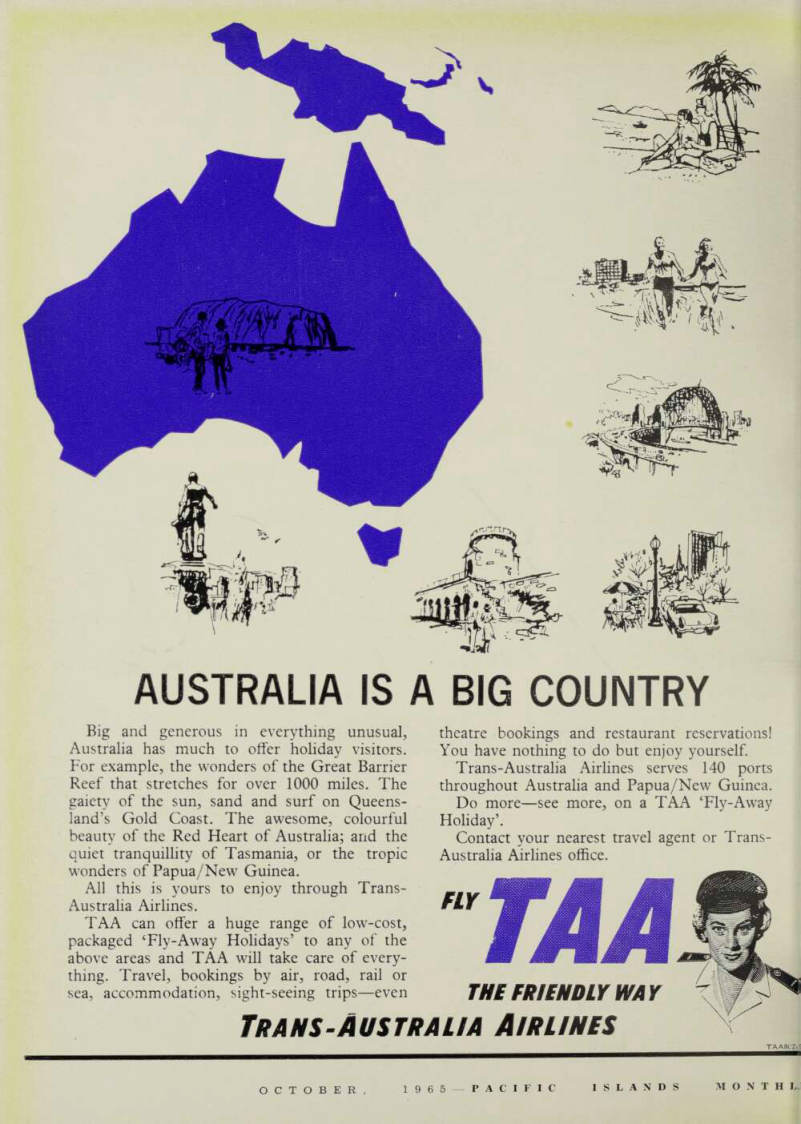 2
2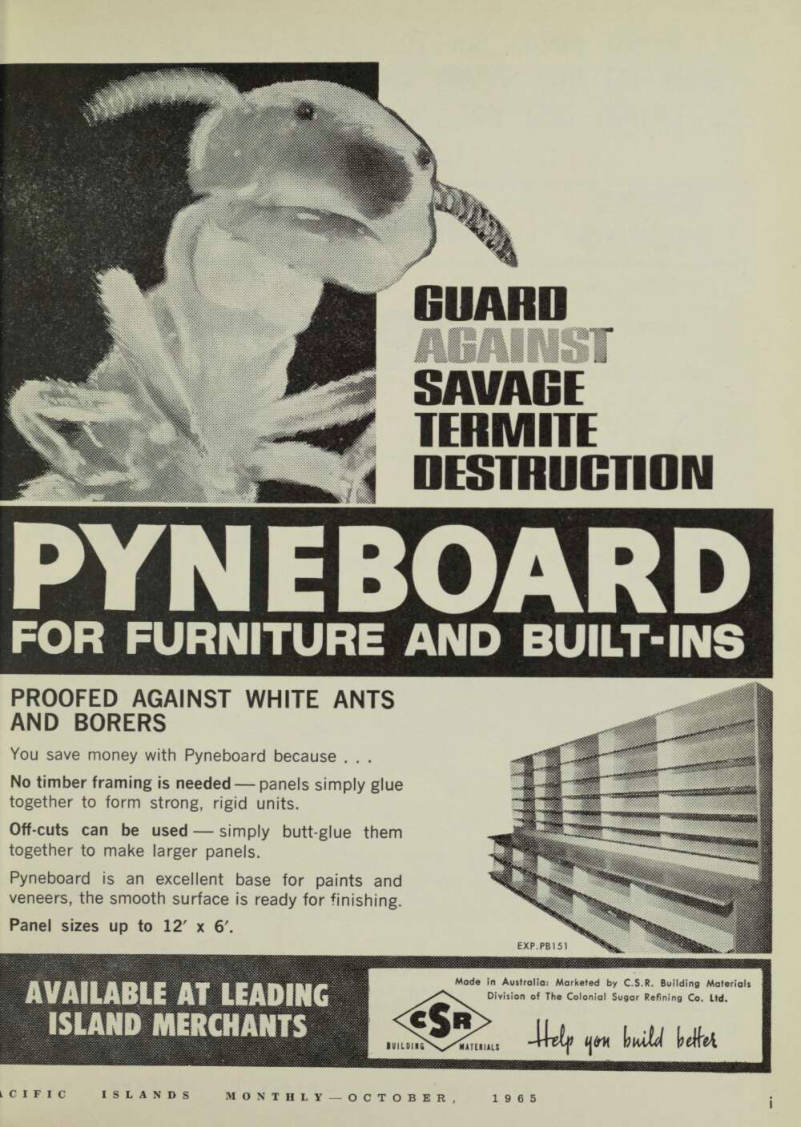 3
3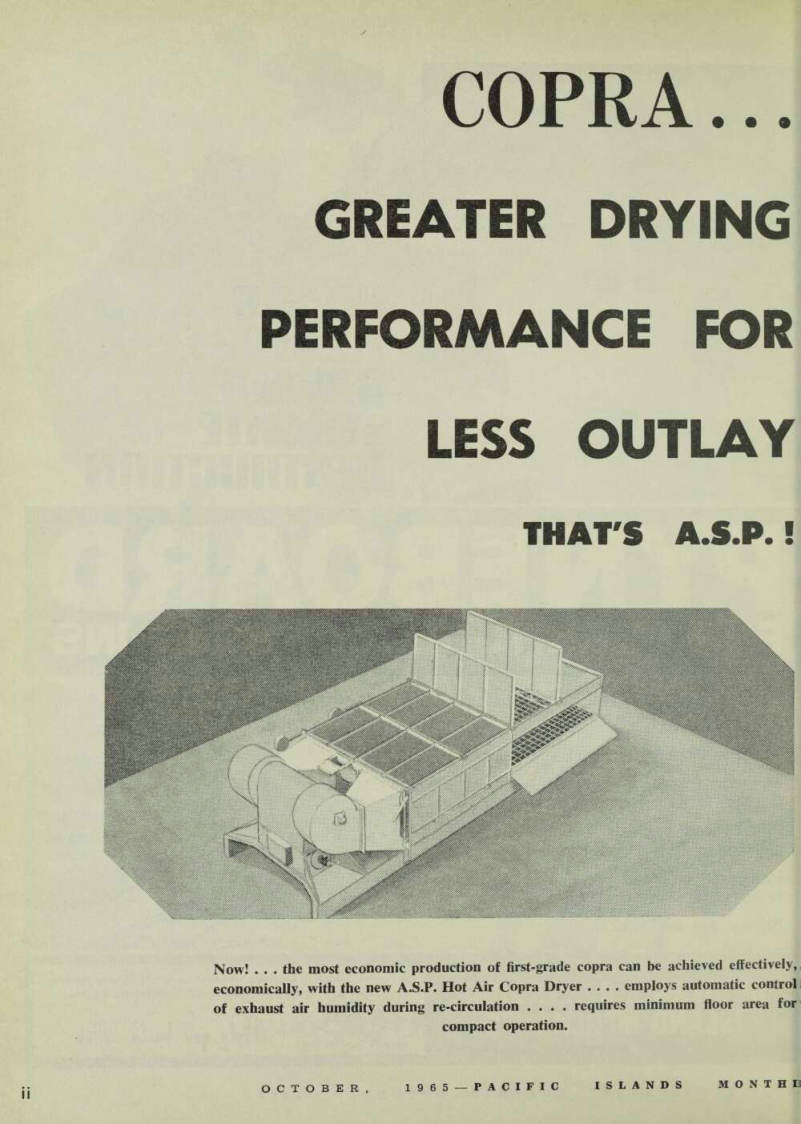 4
4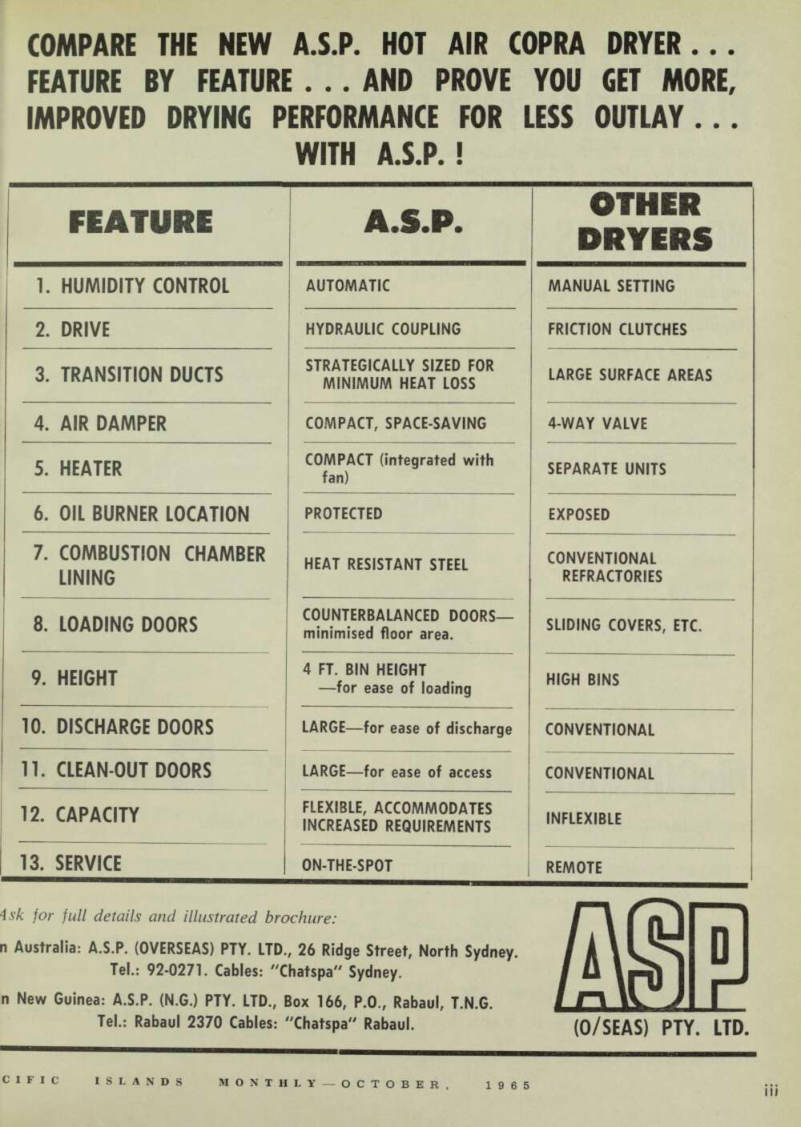 5
5 6
6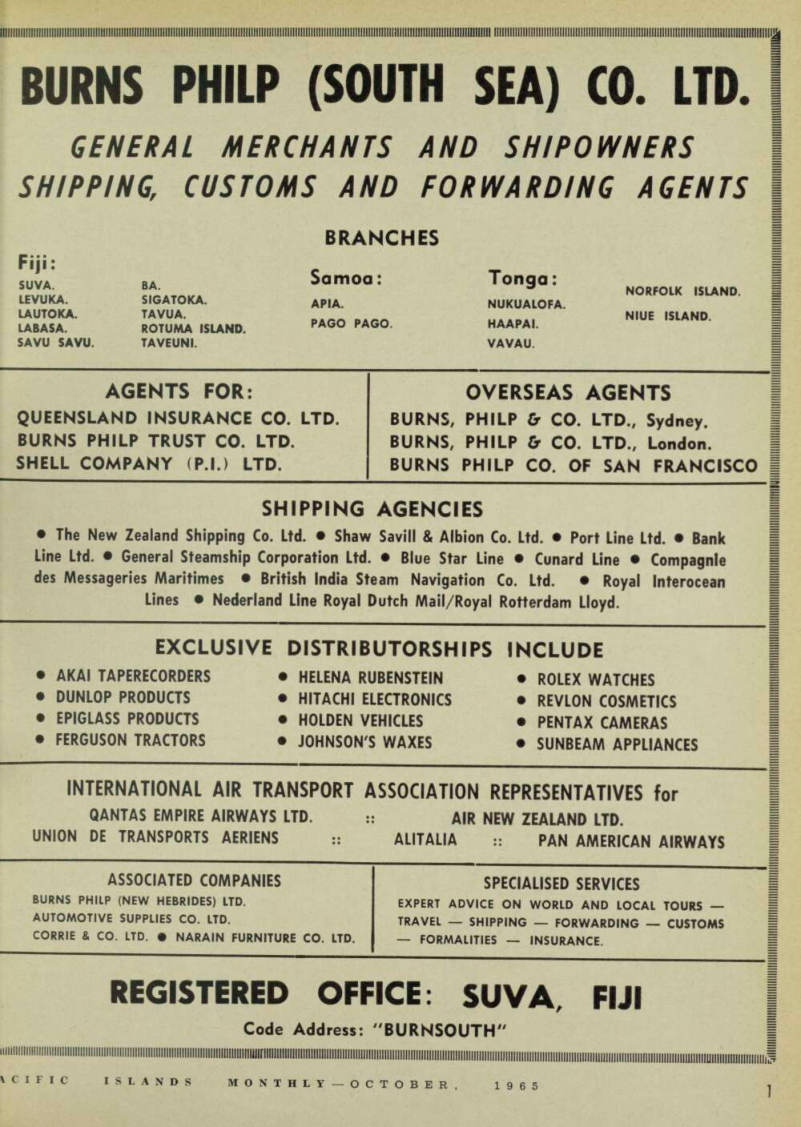 7
7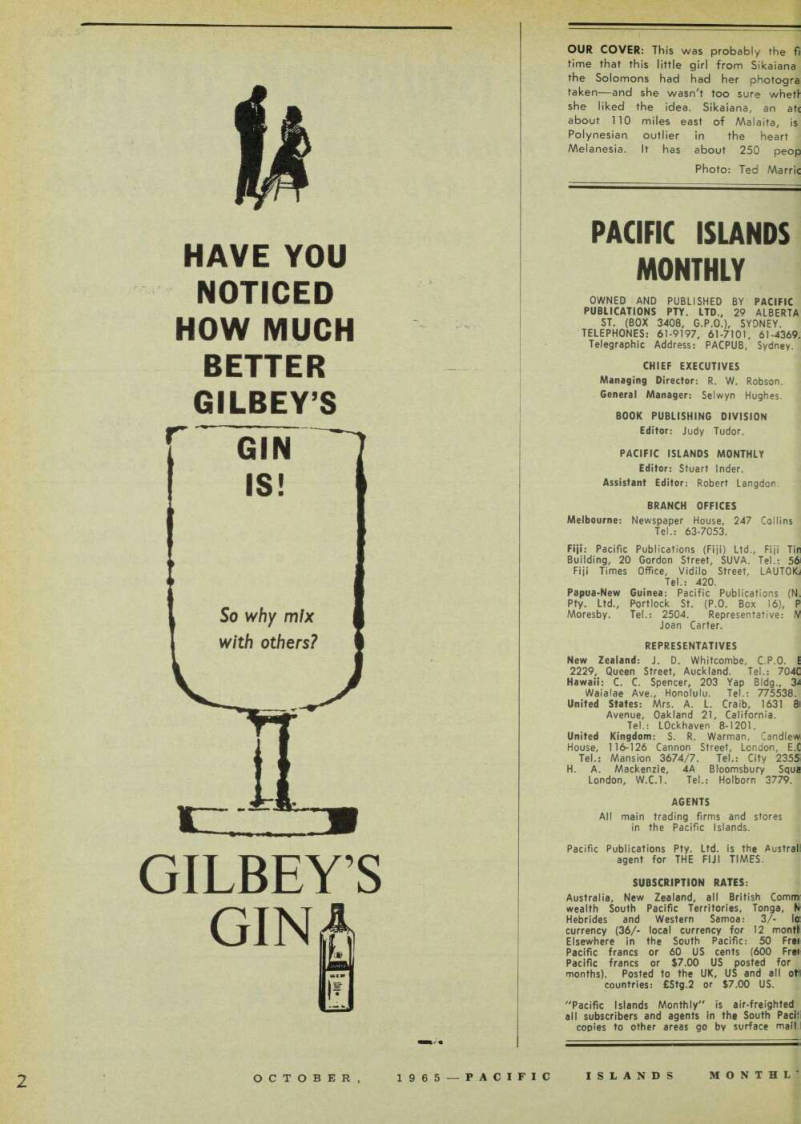 8
8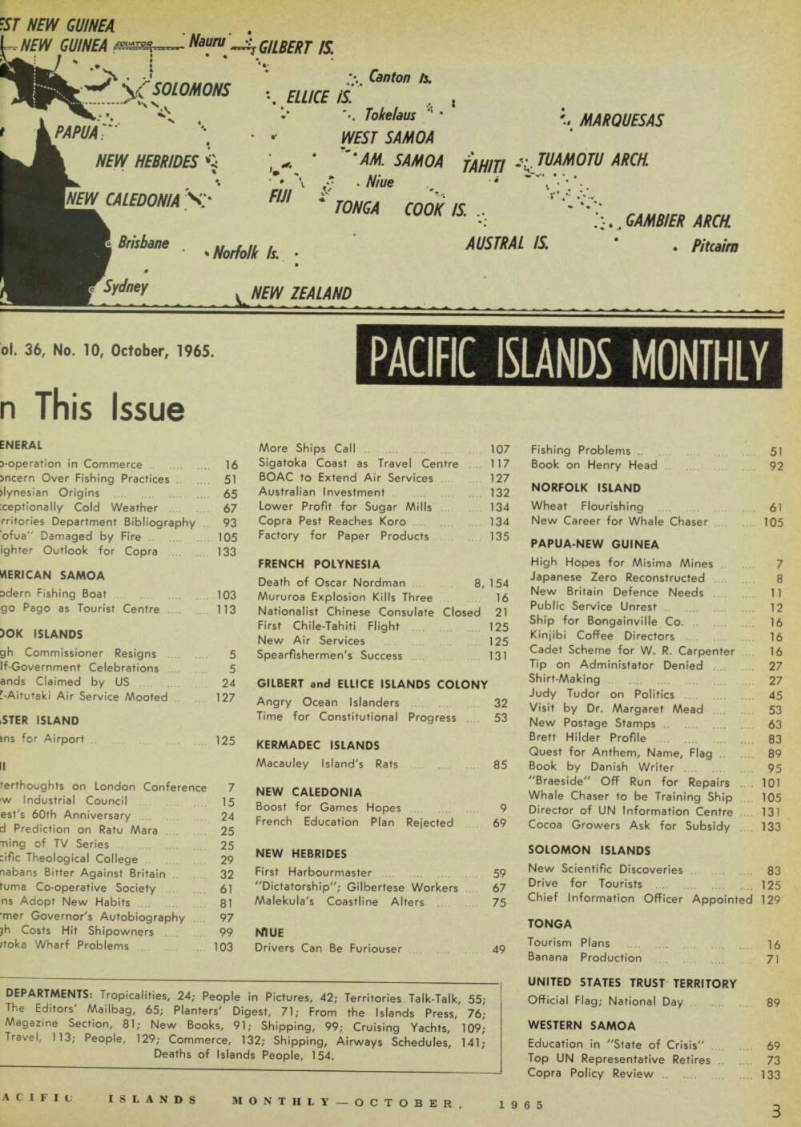 9
9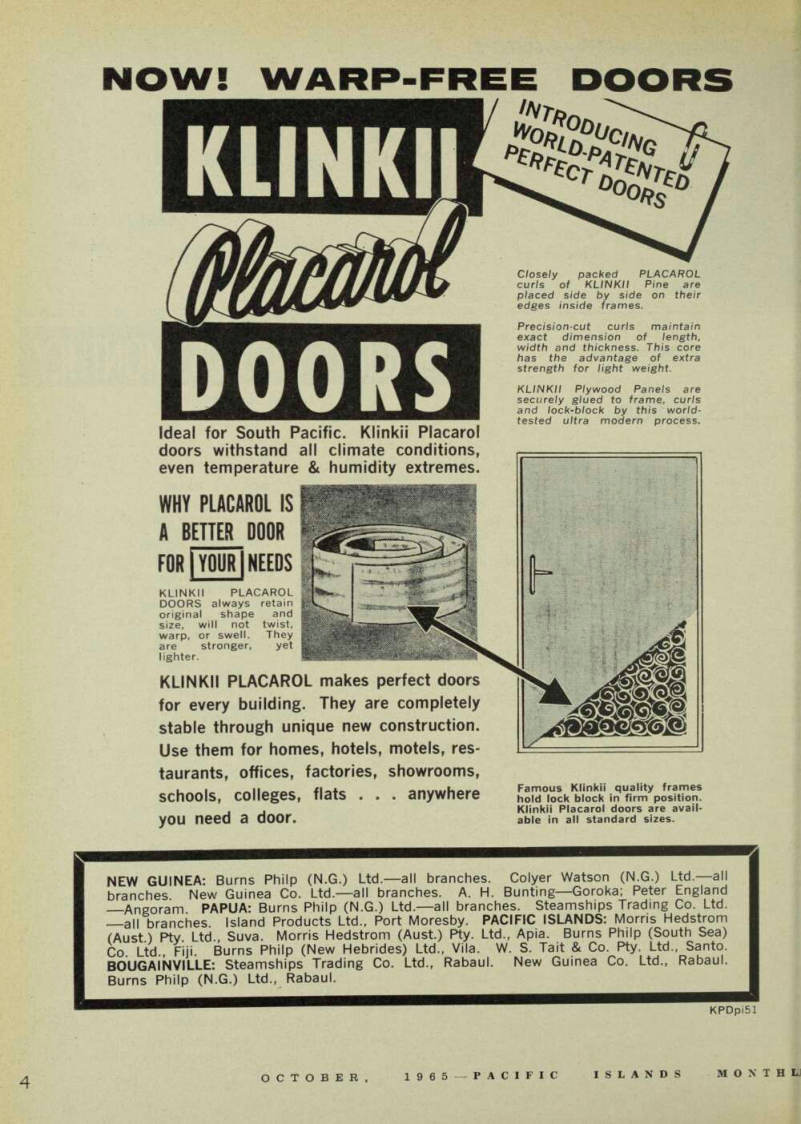 10
10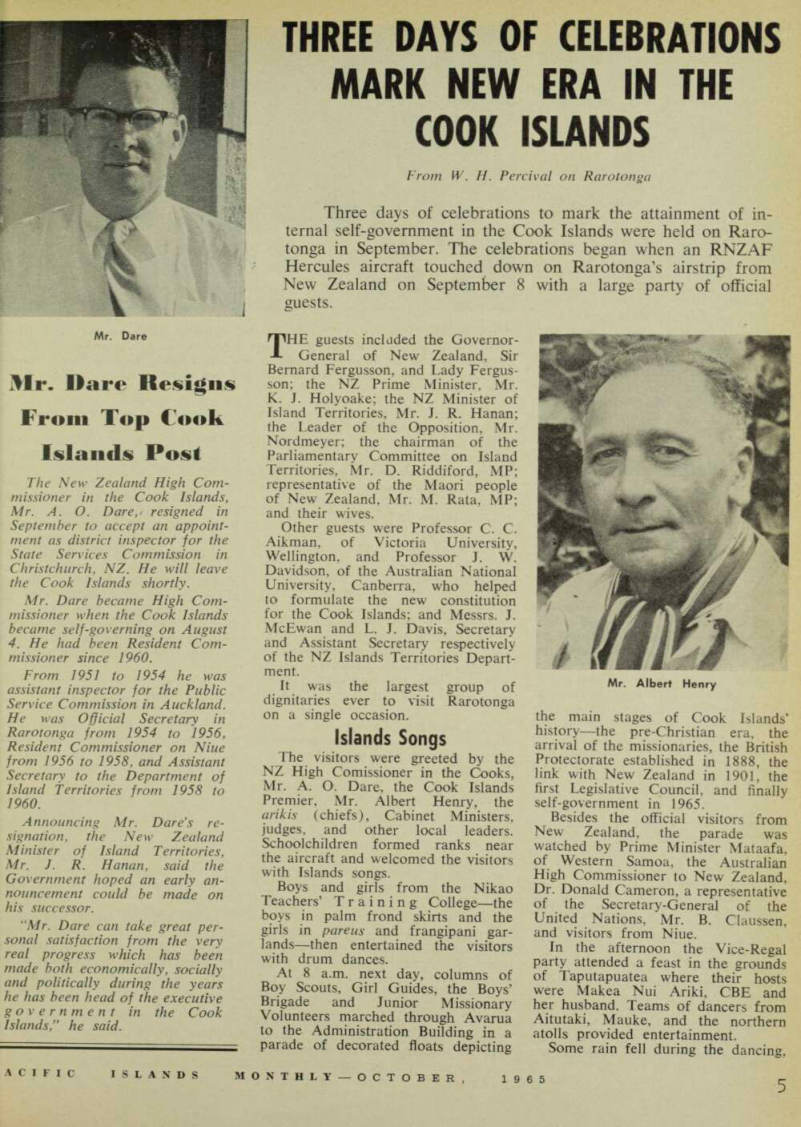 11
11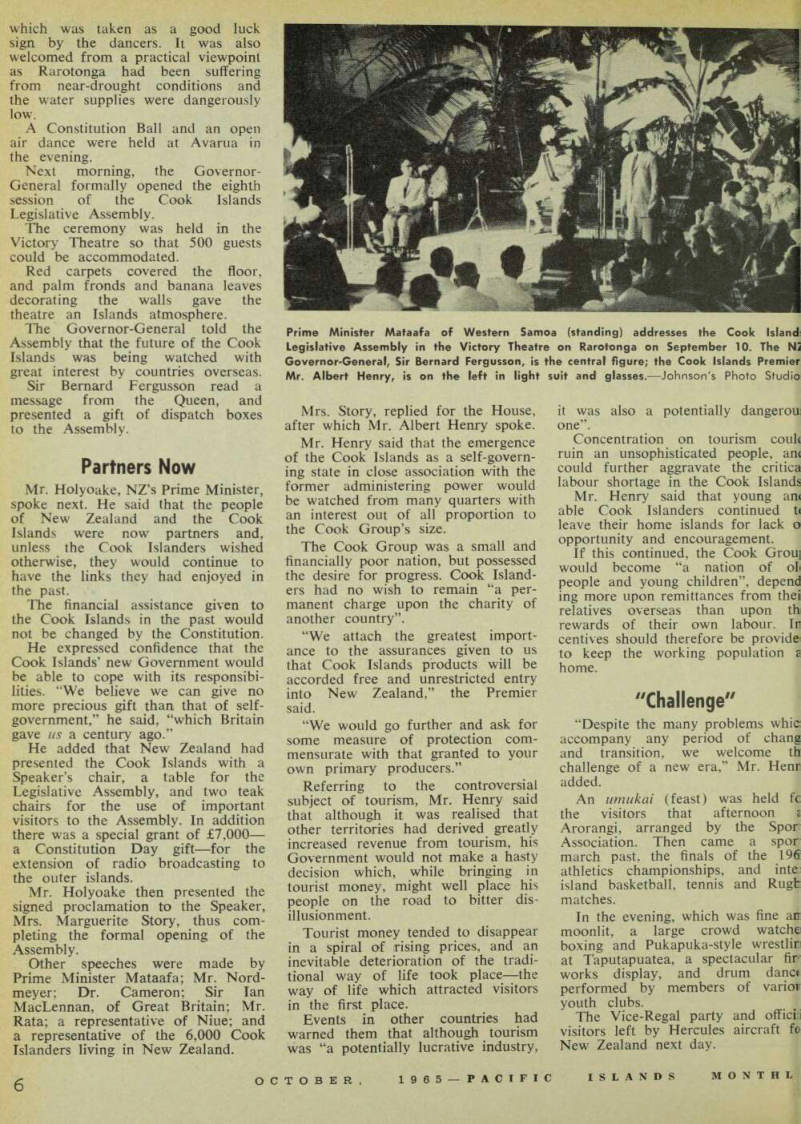 12
12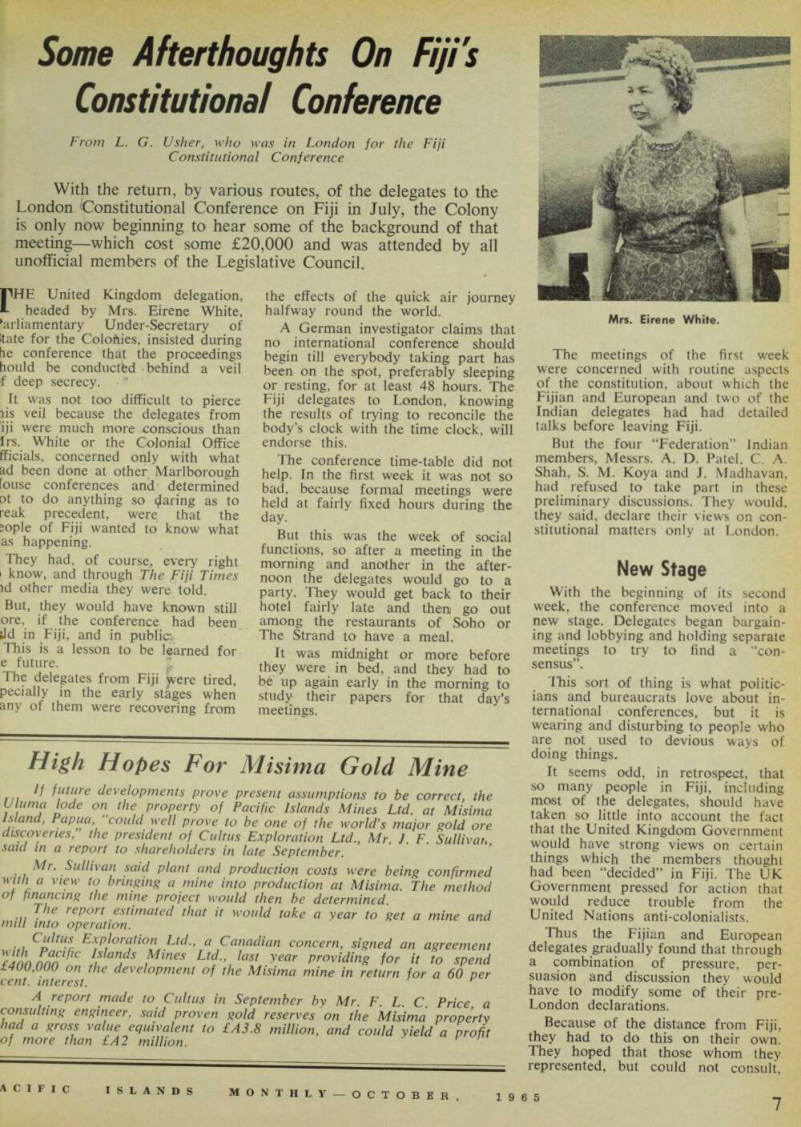 13
13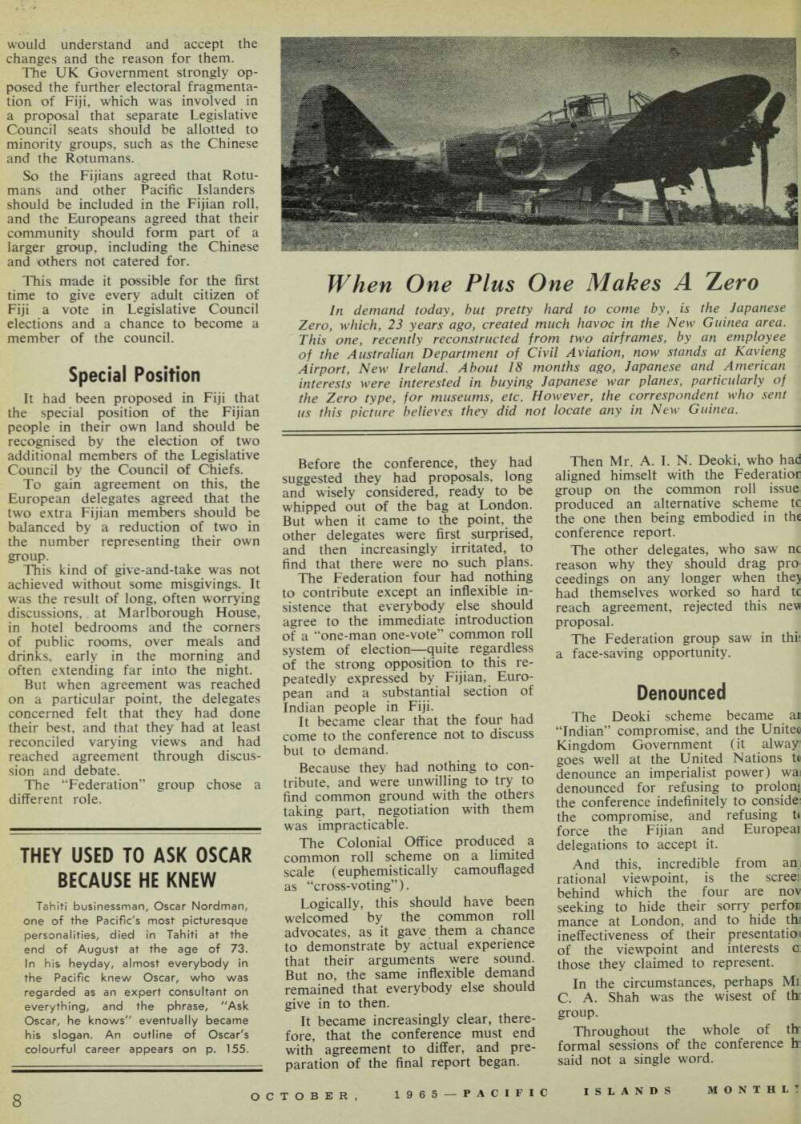 14
14 15
15 16
16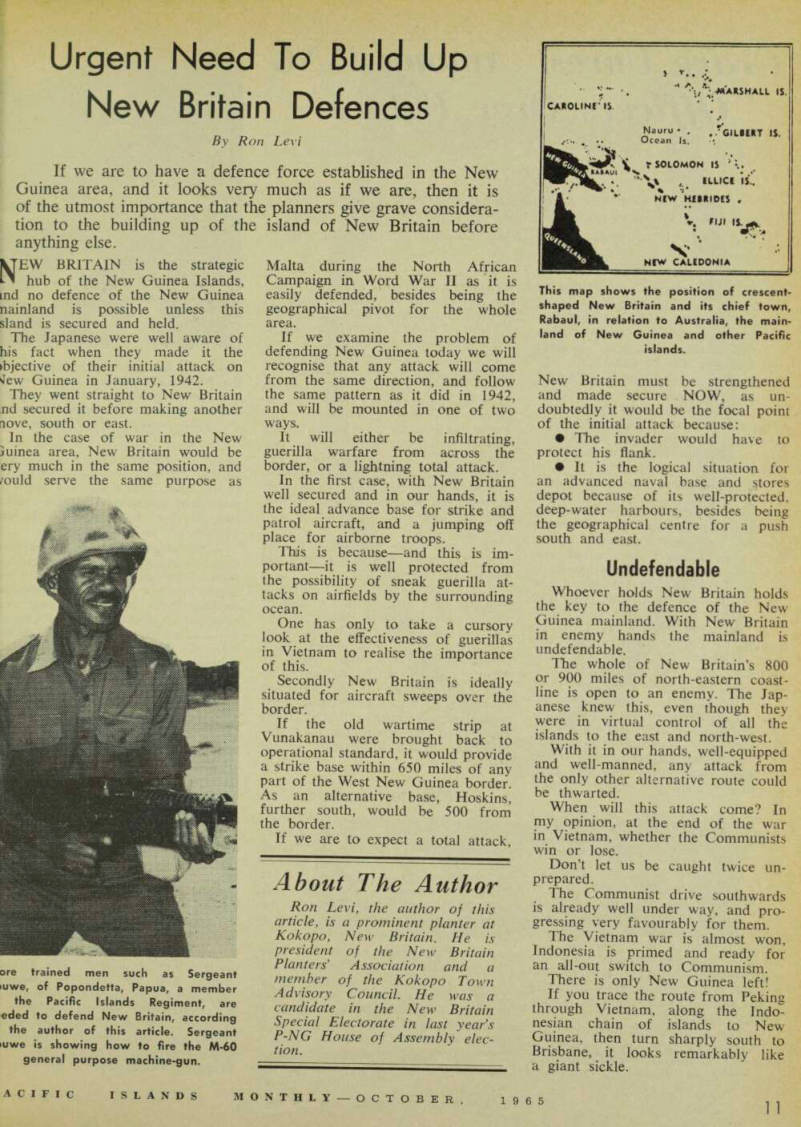 17
17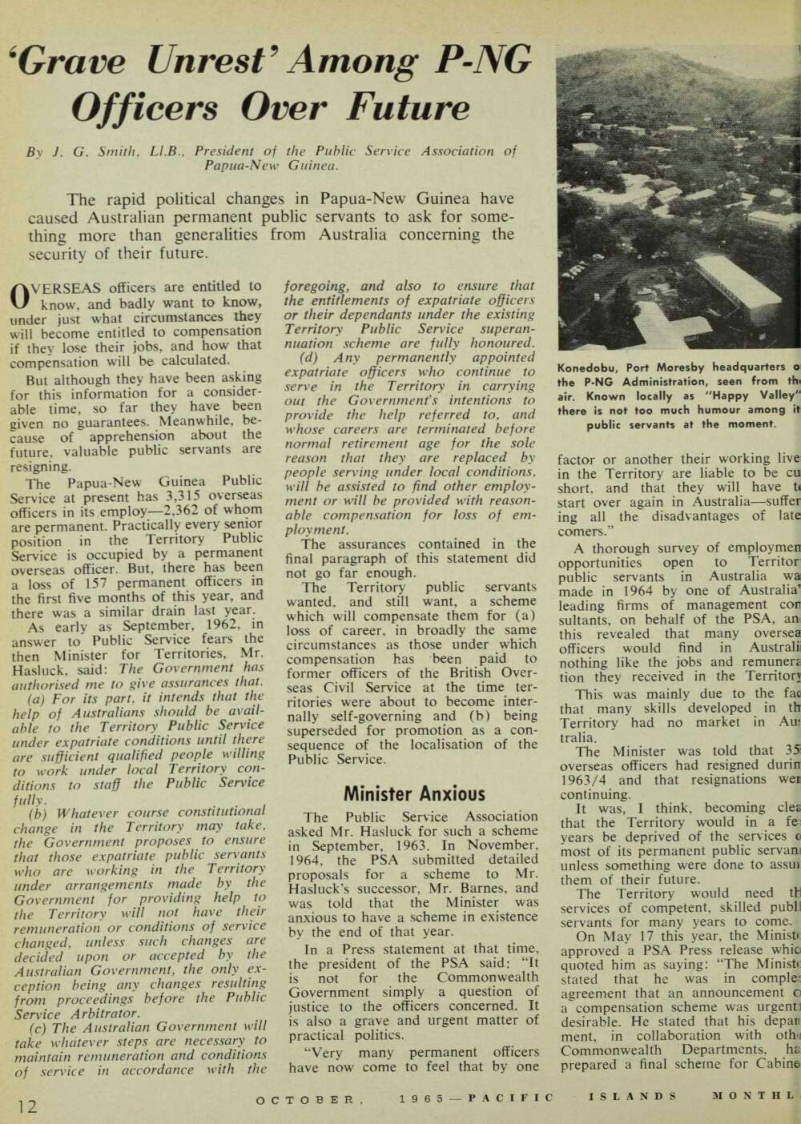 18
18 19
19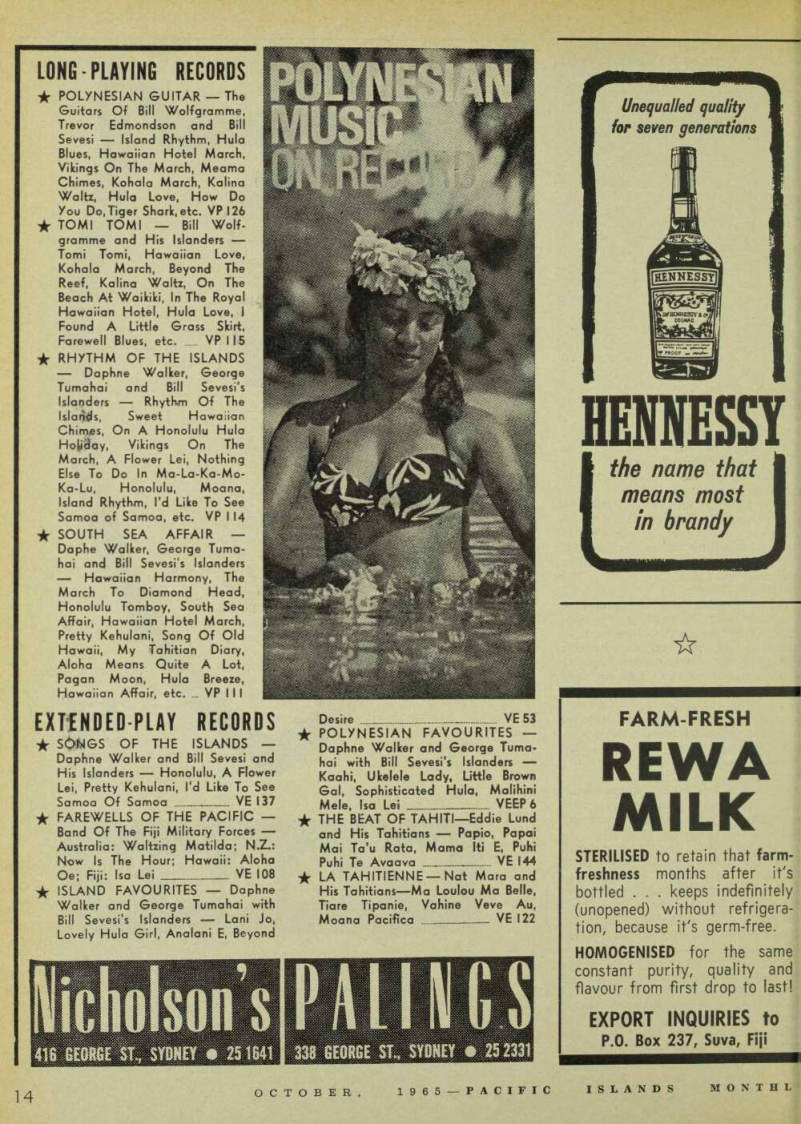 20
20 21
21 22
22 23
23 24
24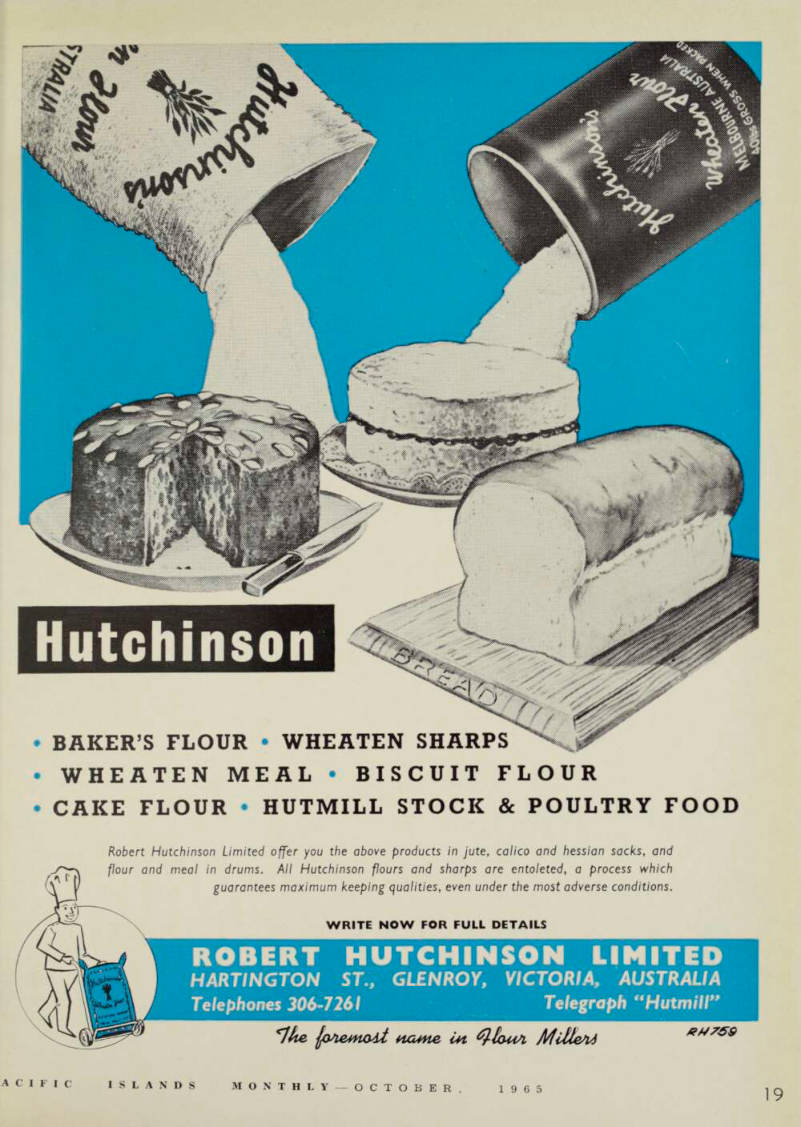 25
25 26
26 27
27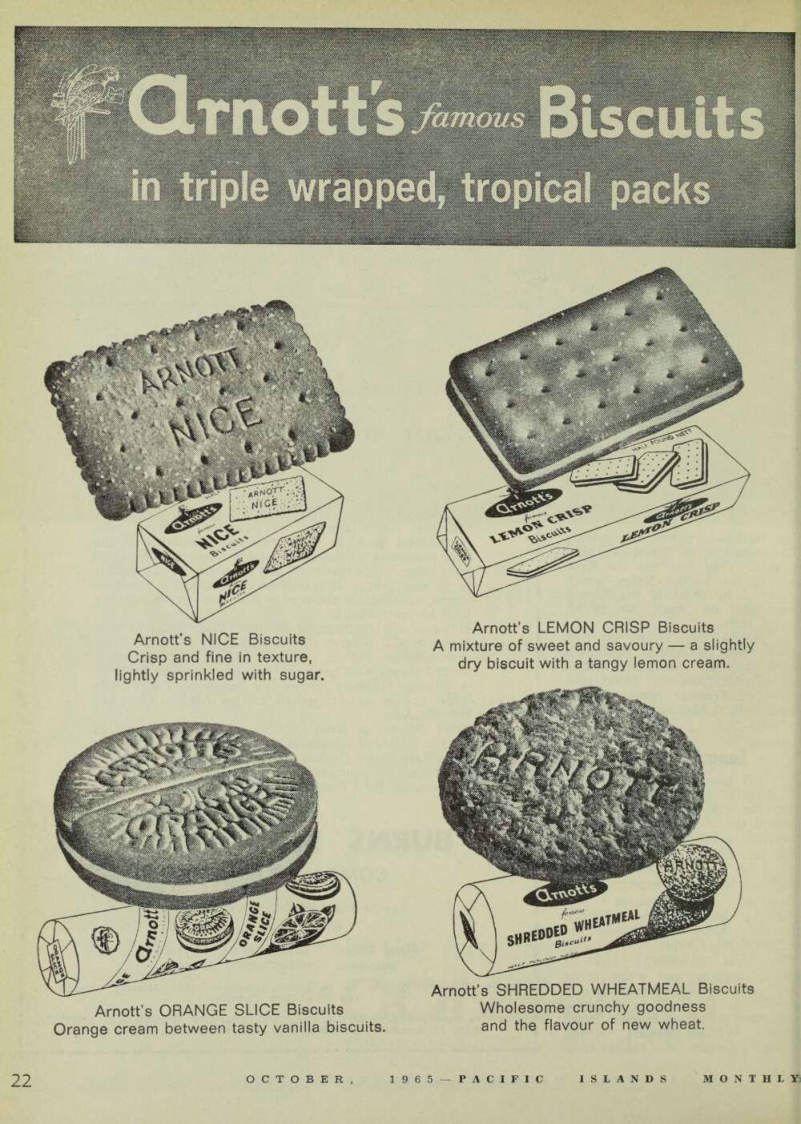 28
28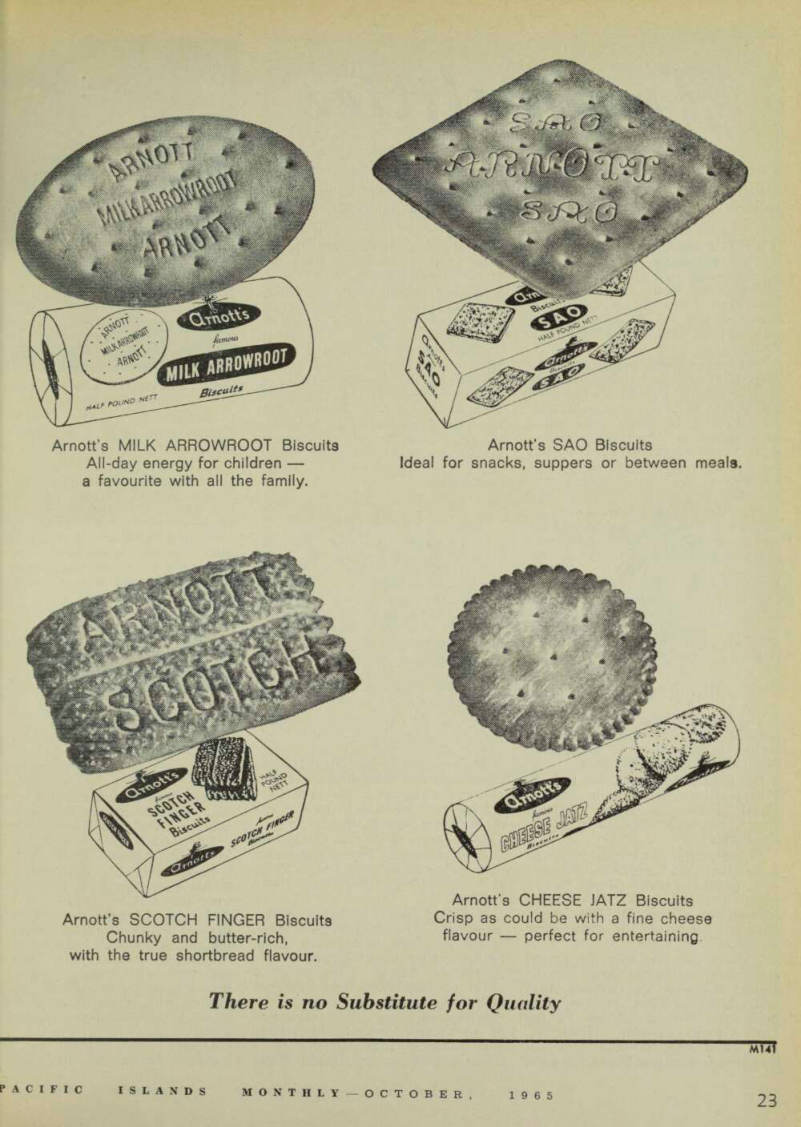 29
29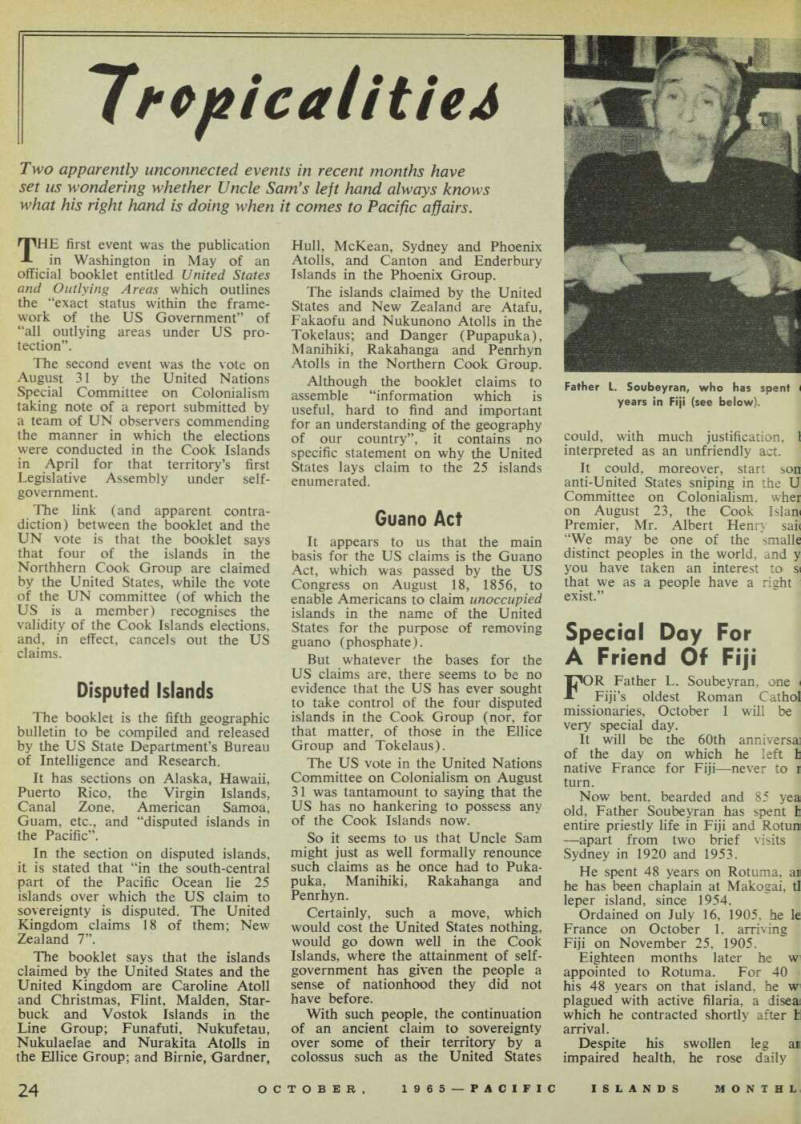 30
30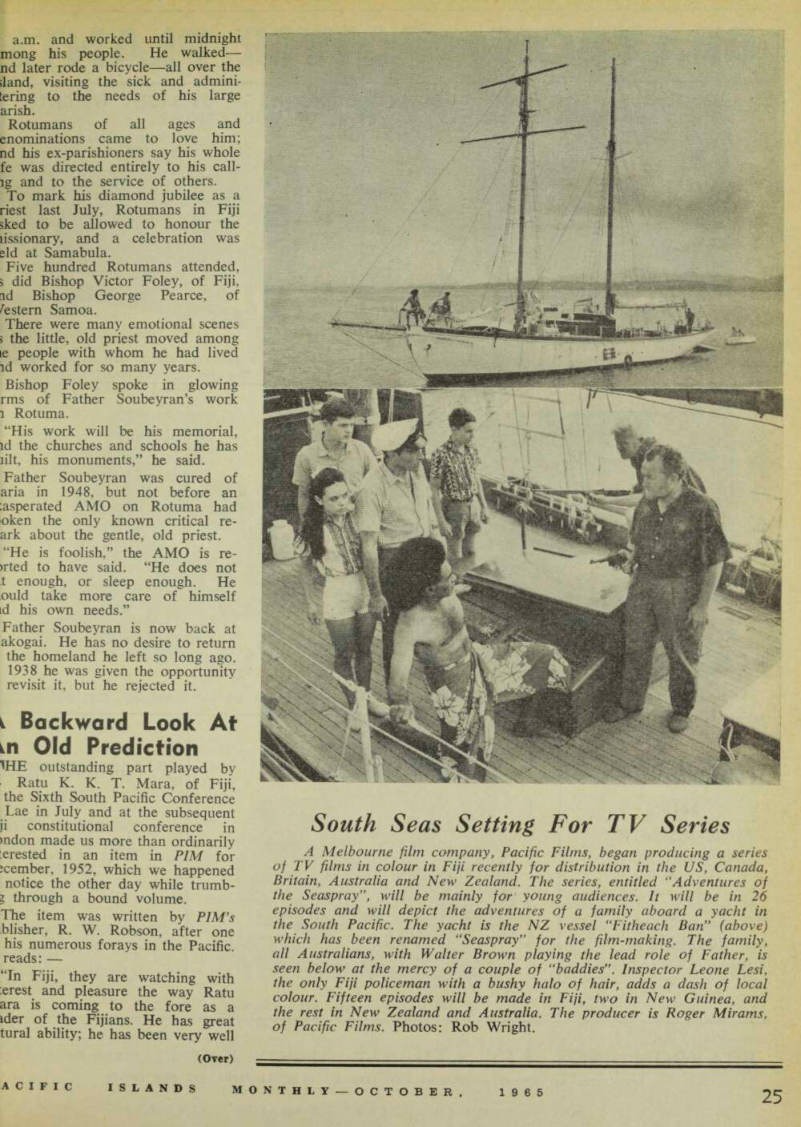 31
31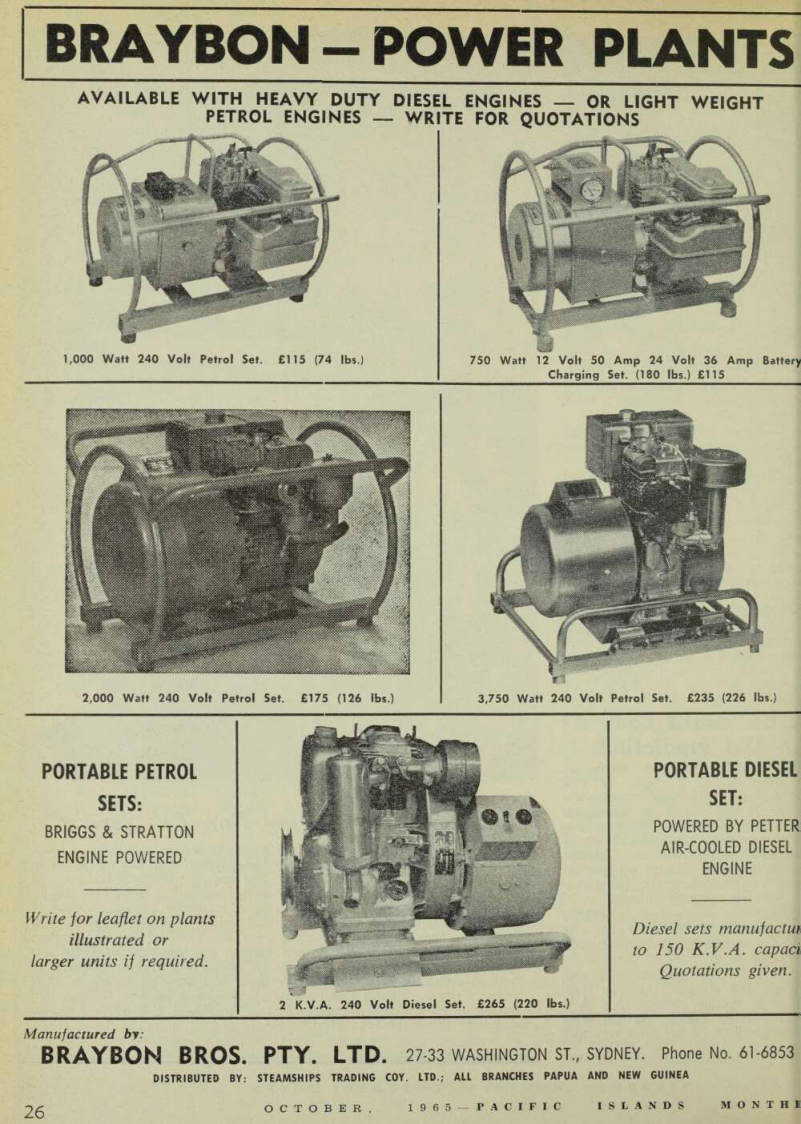 32
32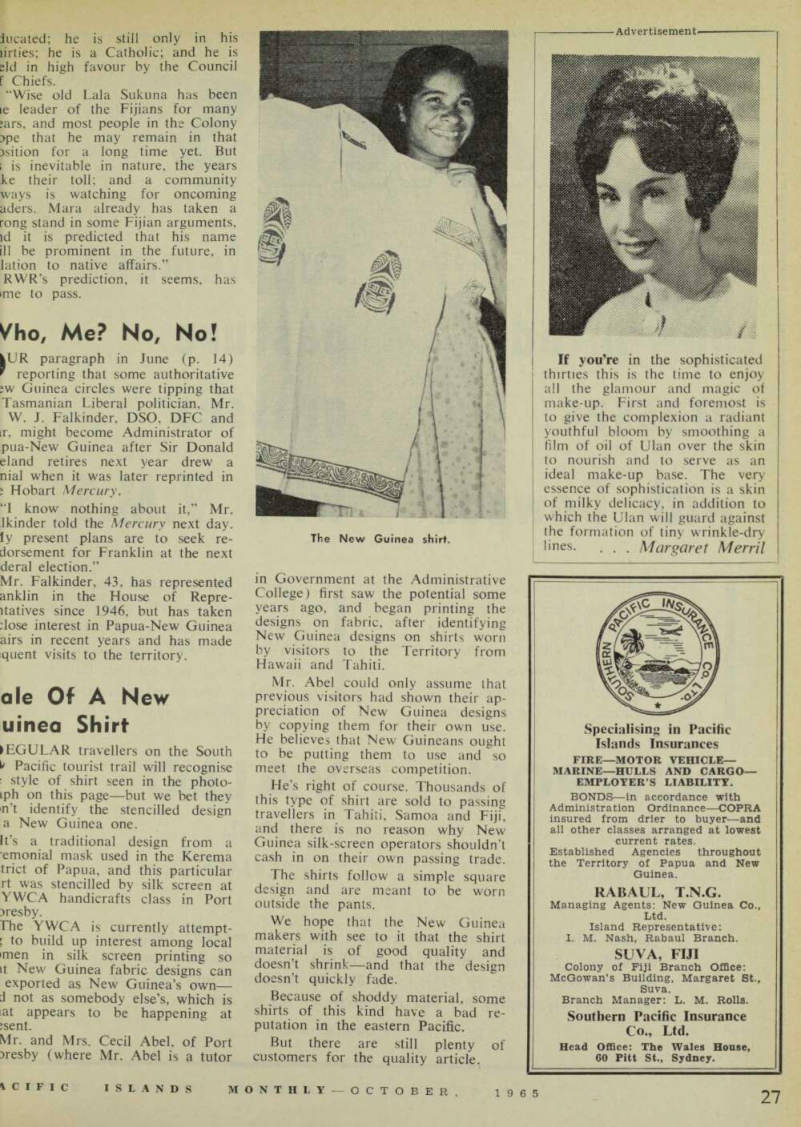 33
33 34
34 35
35 36
36 37
37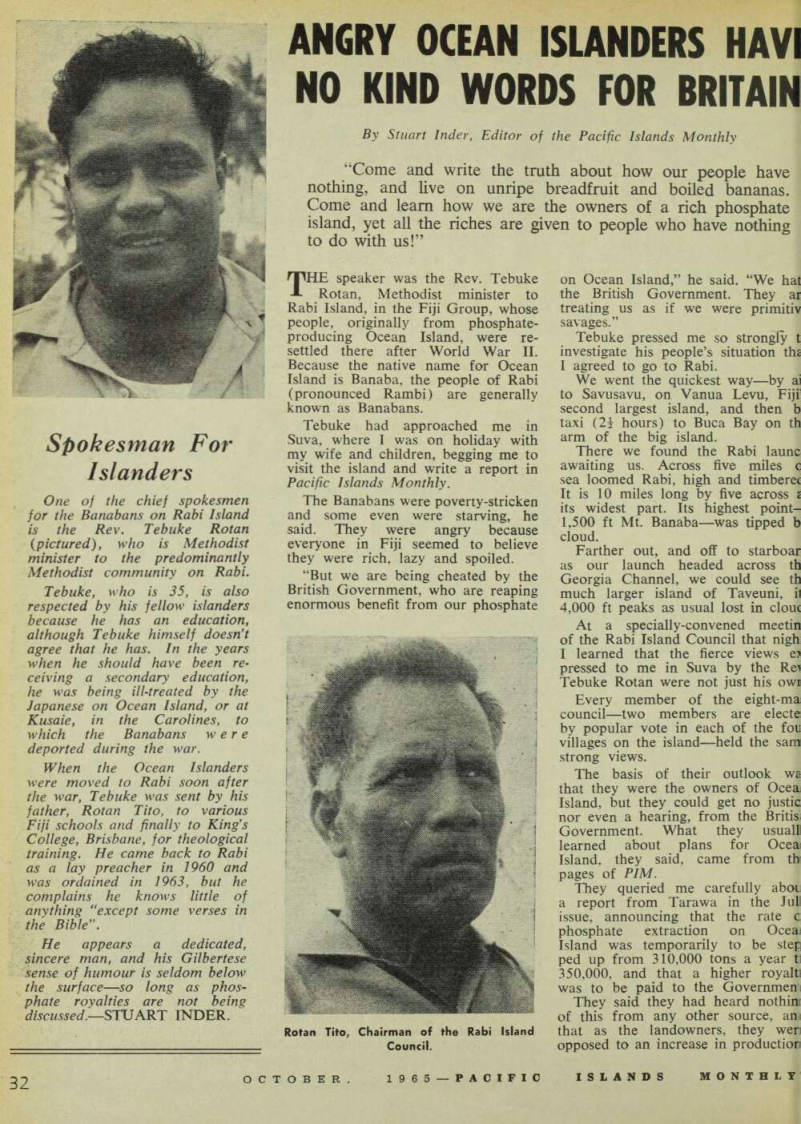 38
38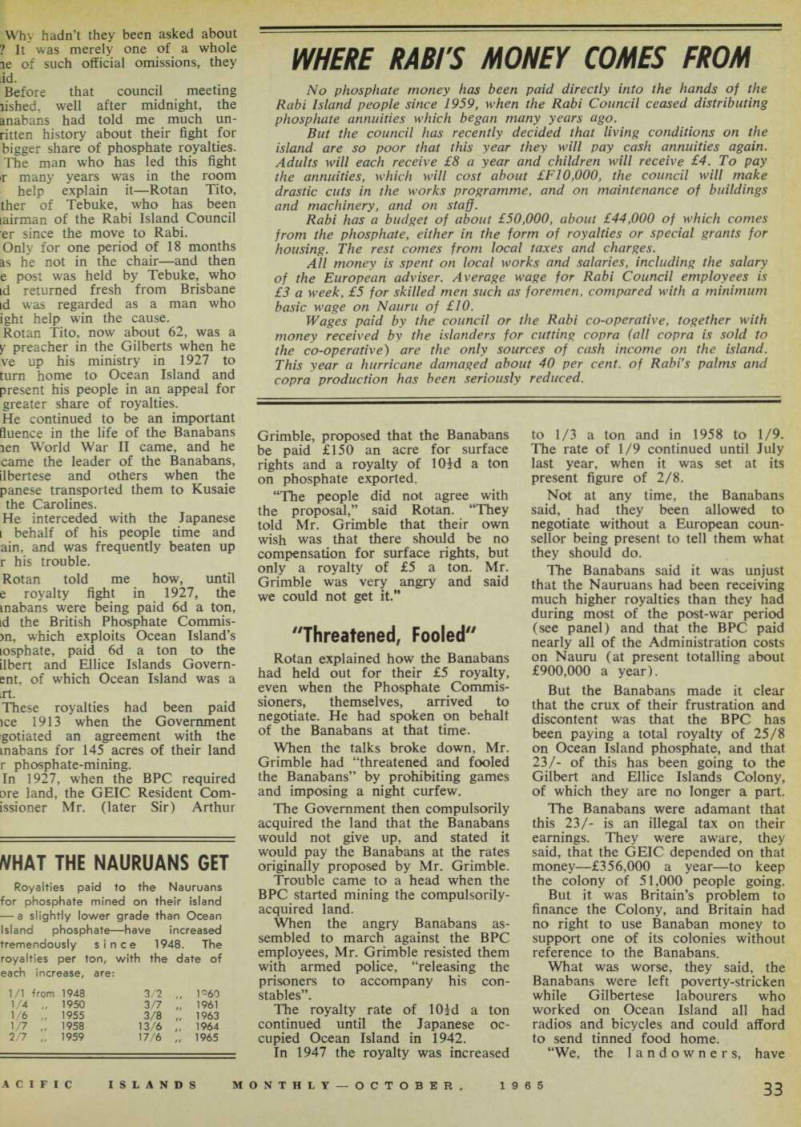 39
39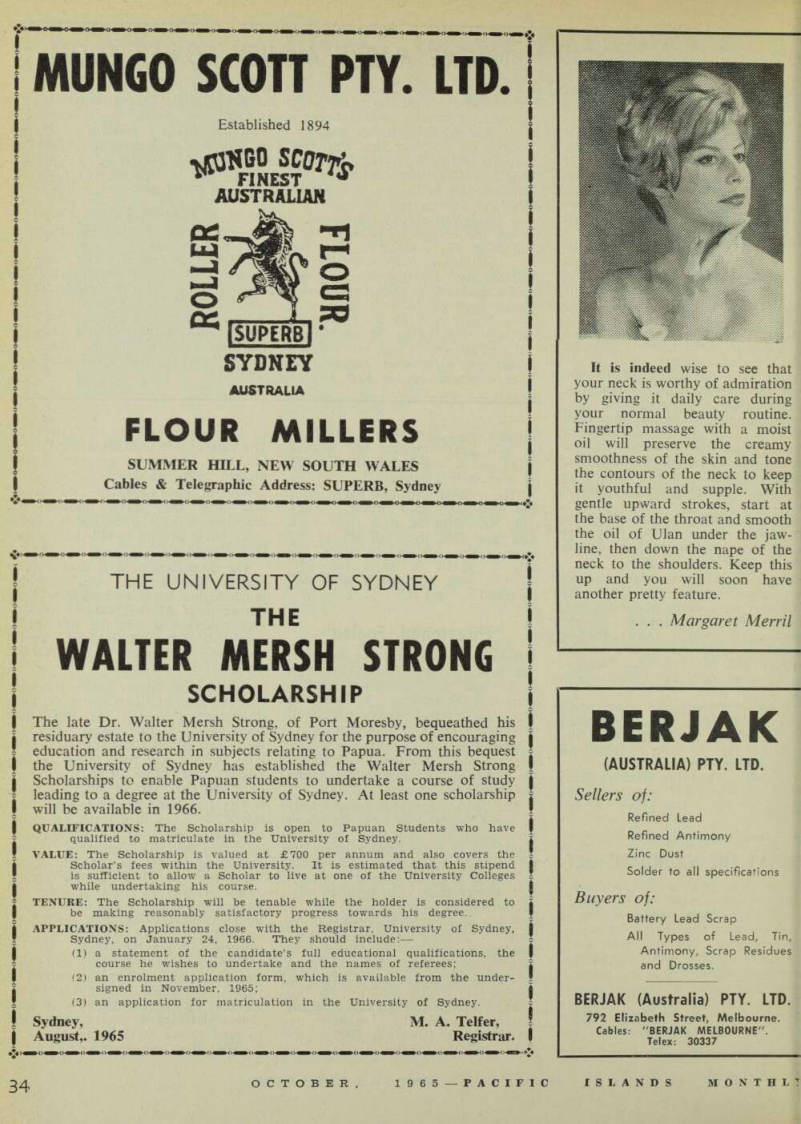 40
40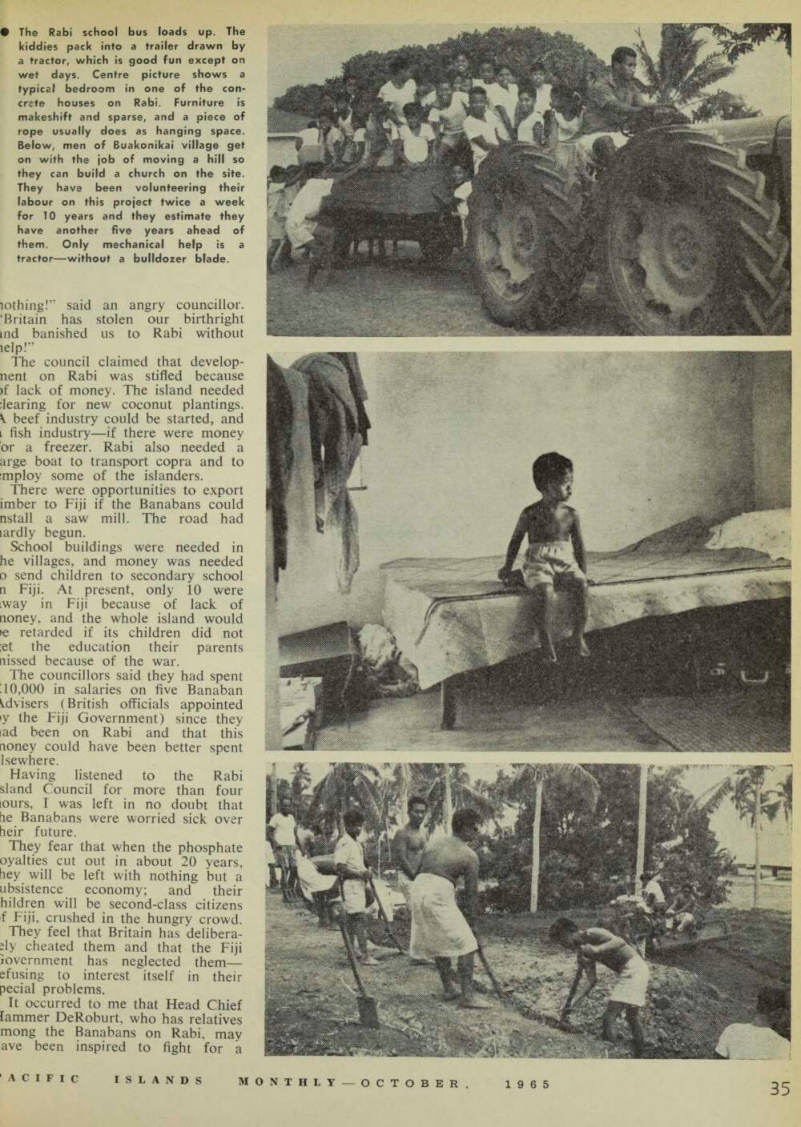 41
41 42
42 43
43 44
44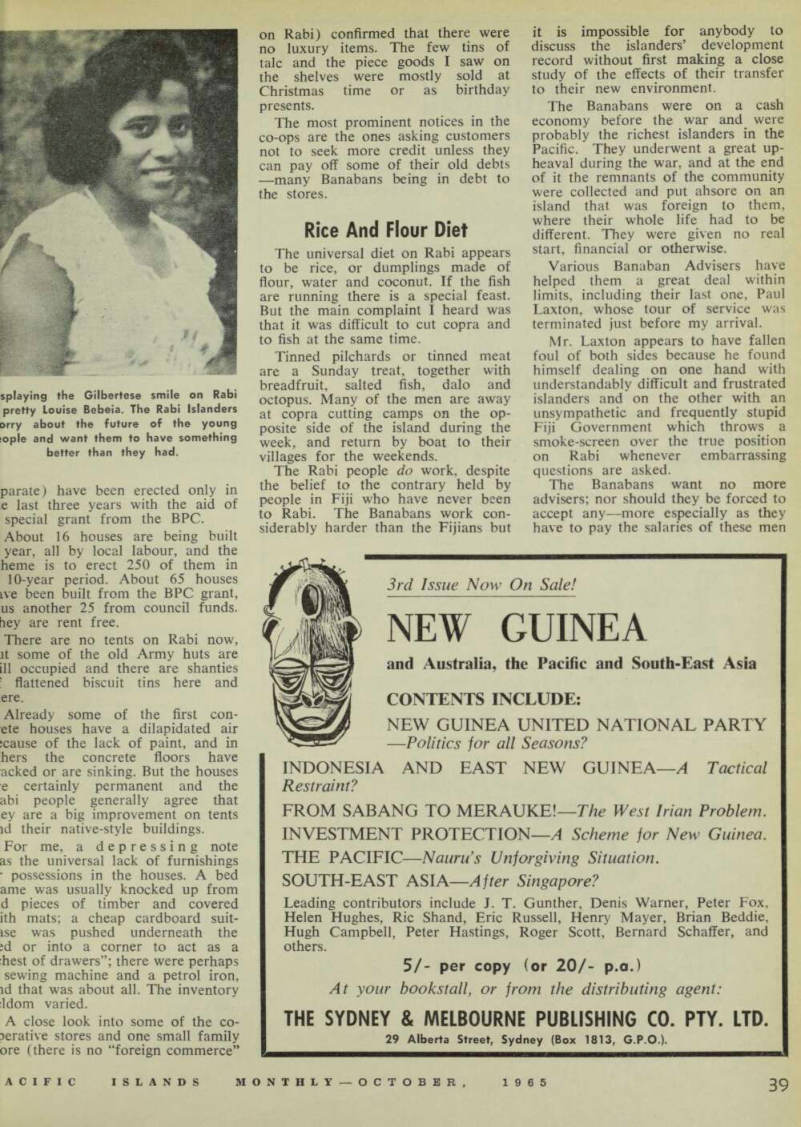 45
45 46
46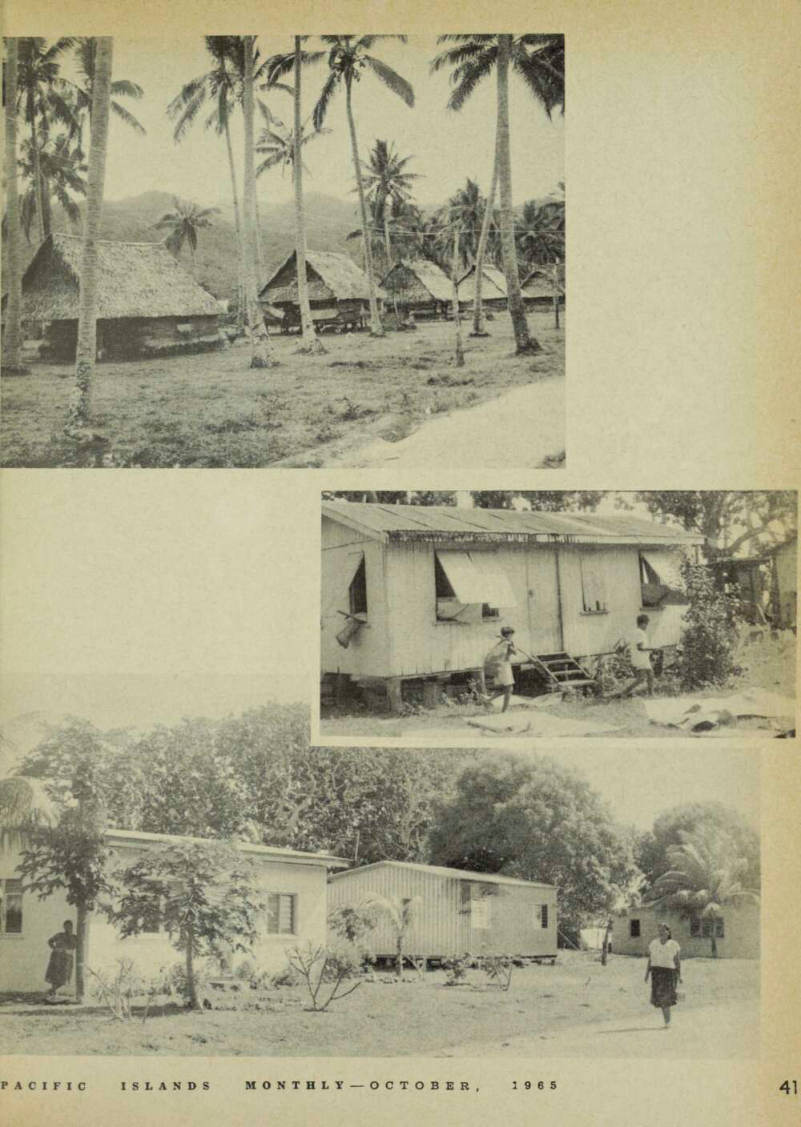 47
47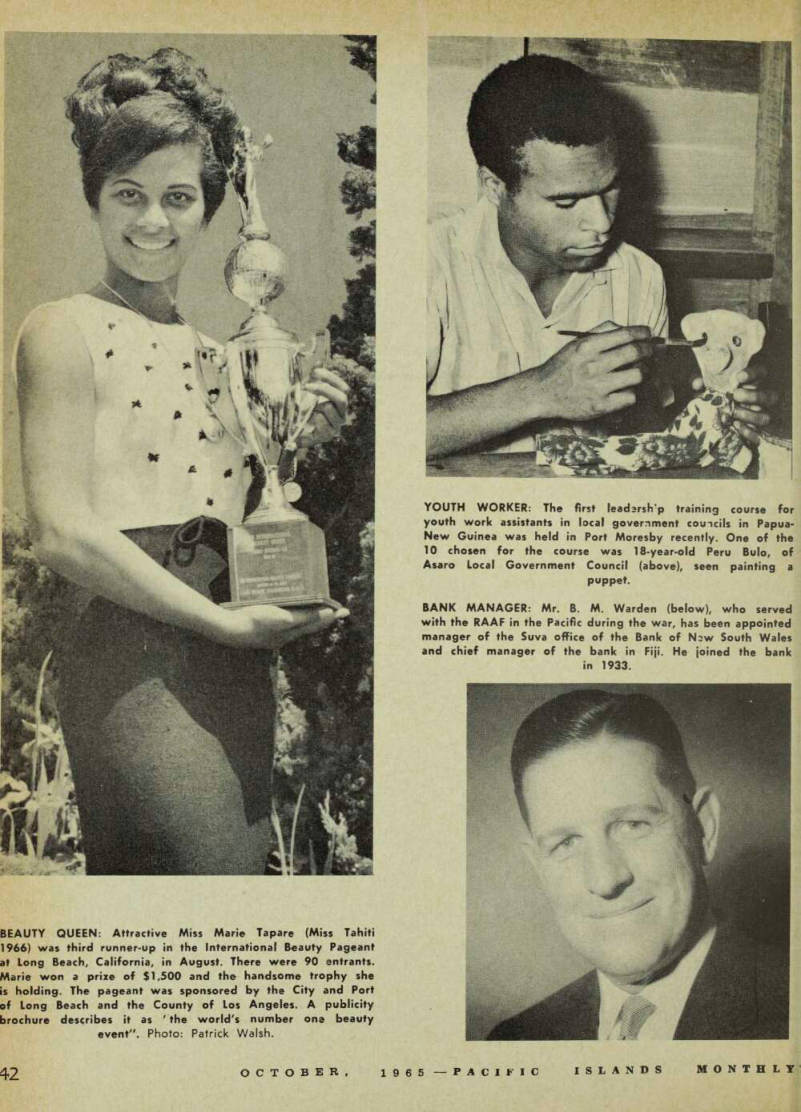 48
48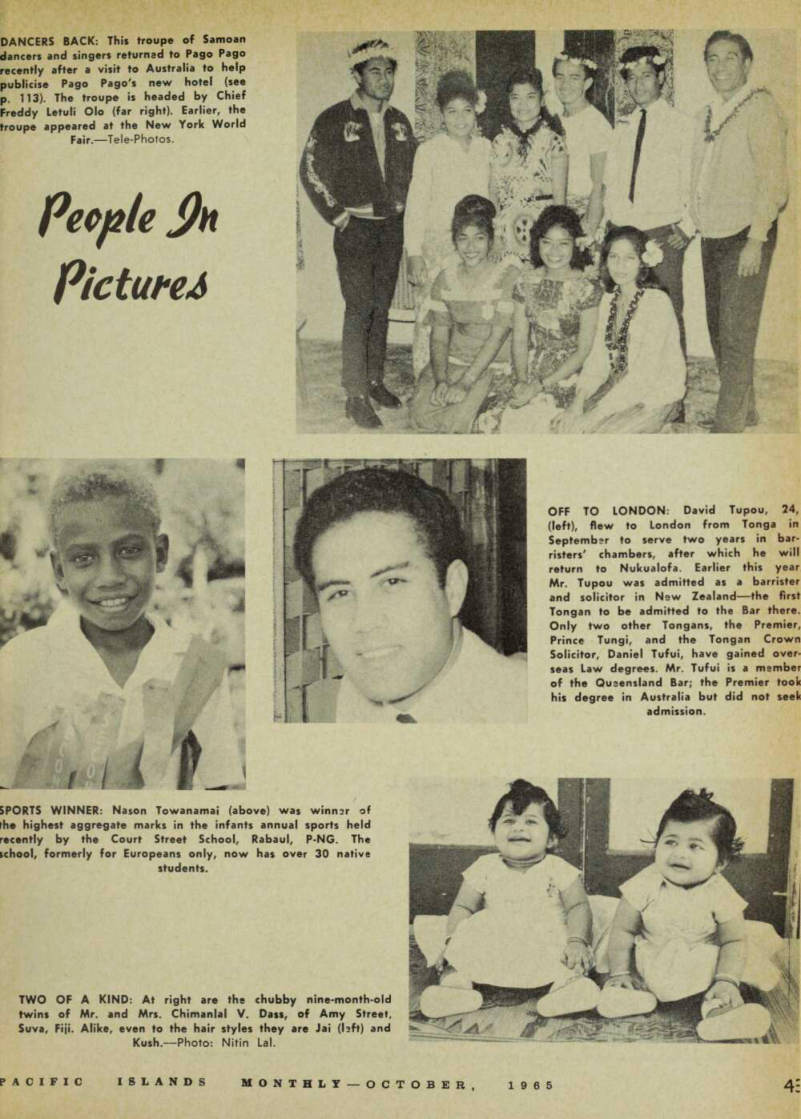 49
49 50
50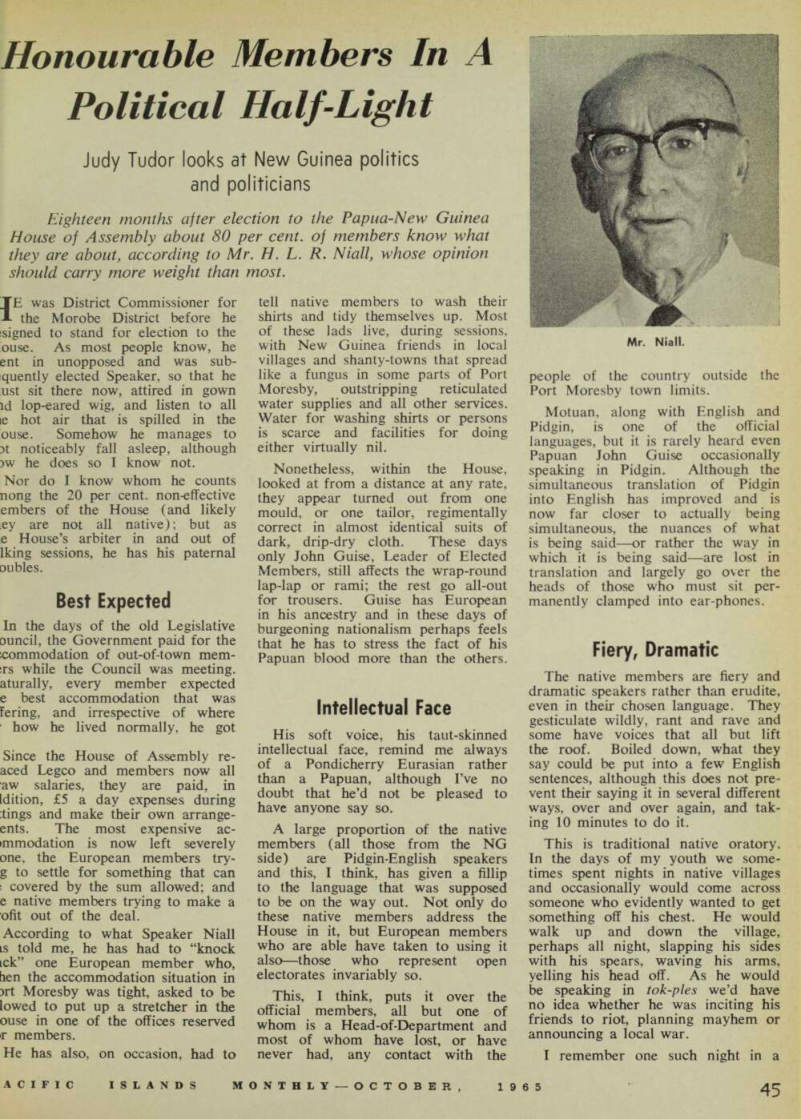 51
51 52
52 53
53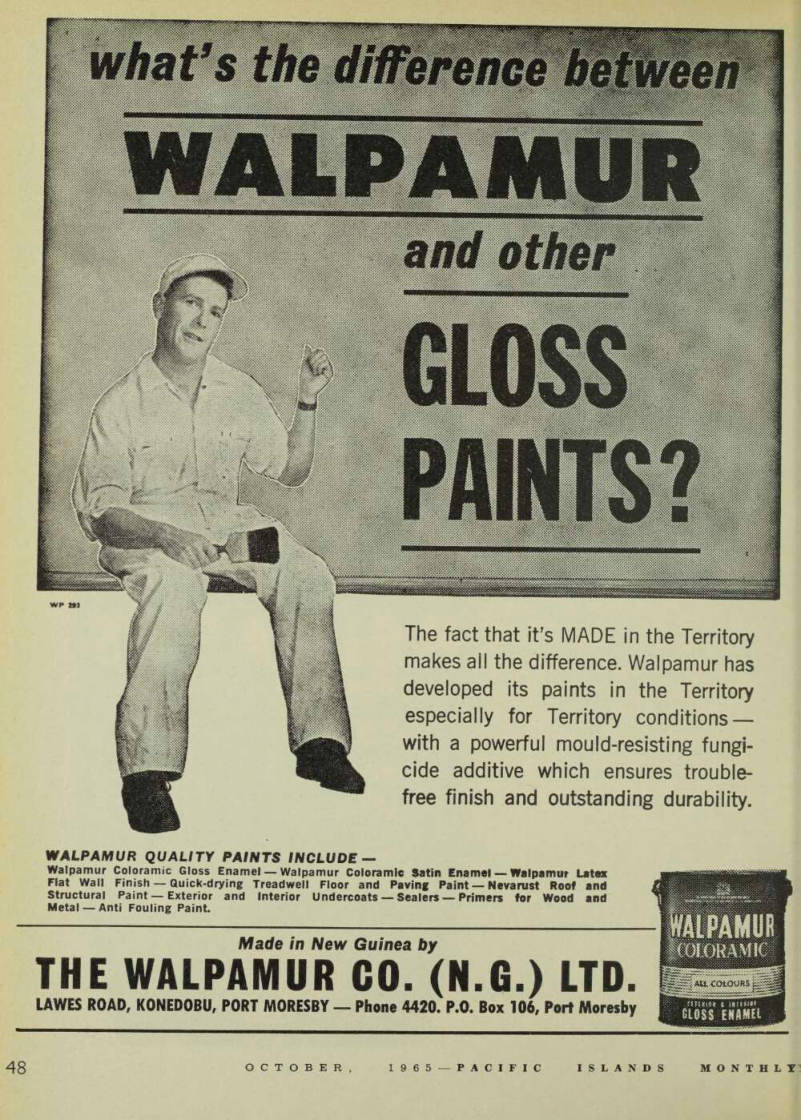 54
54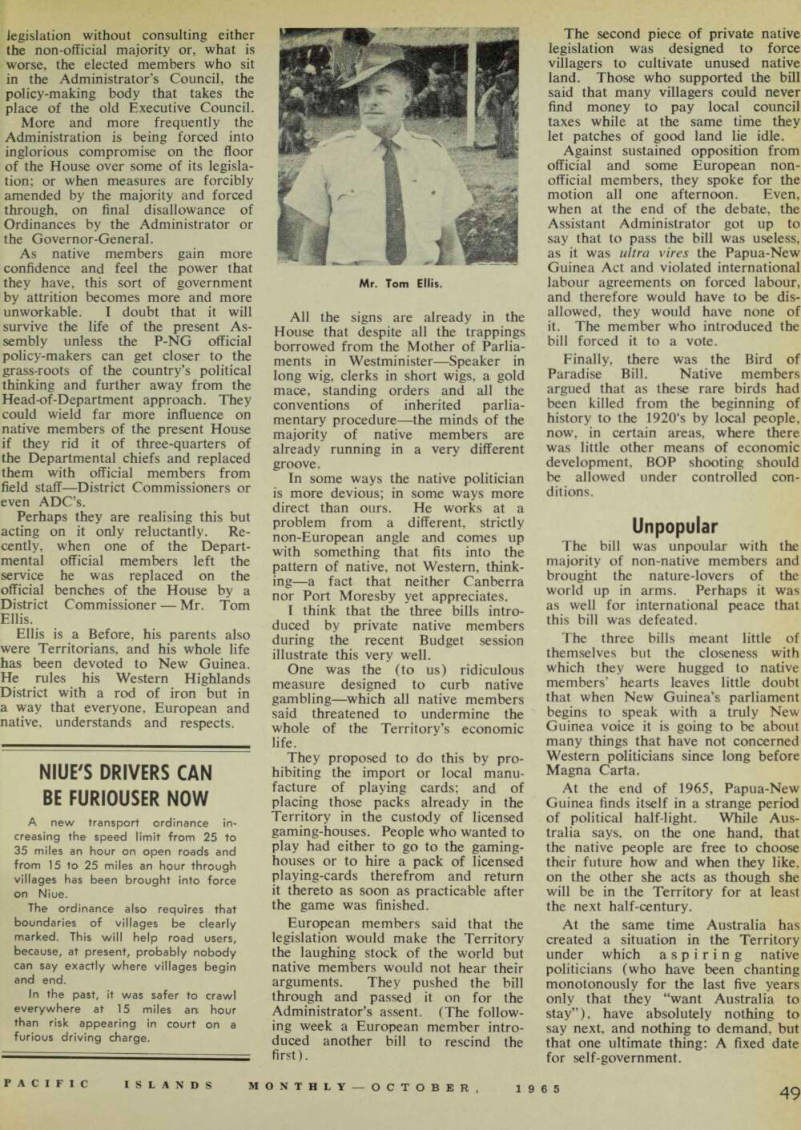 55
55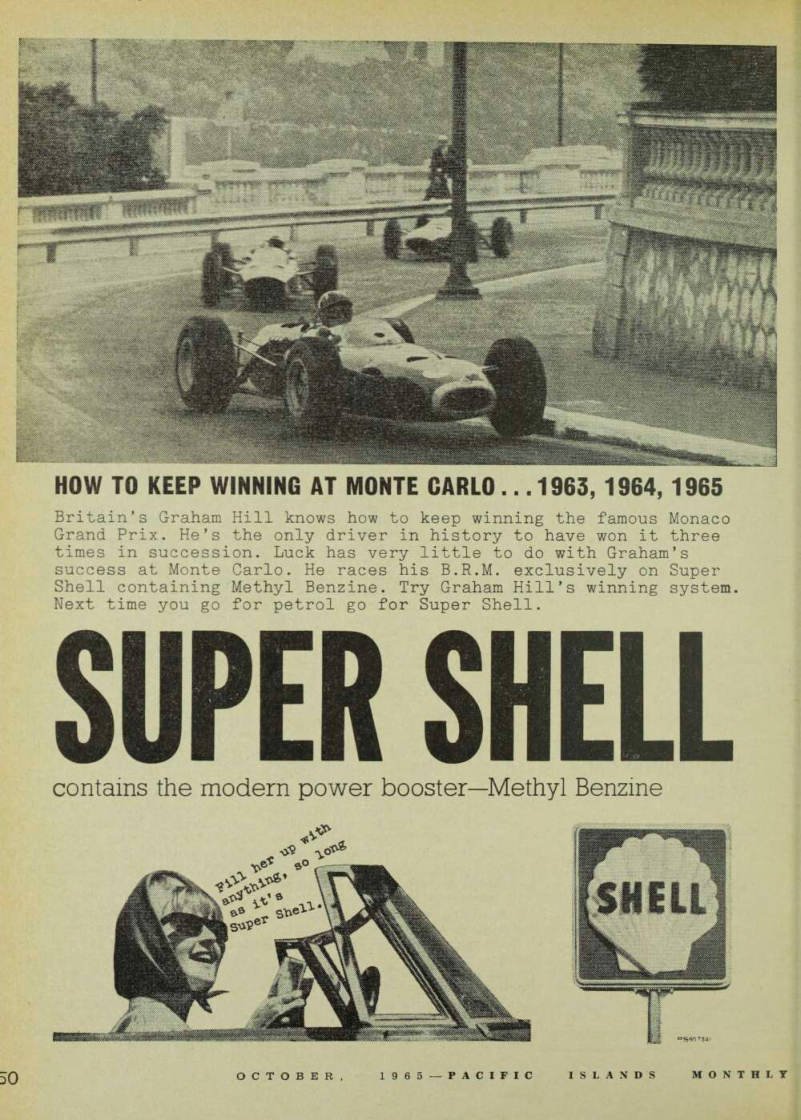 56
56 57
57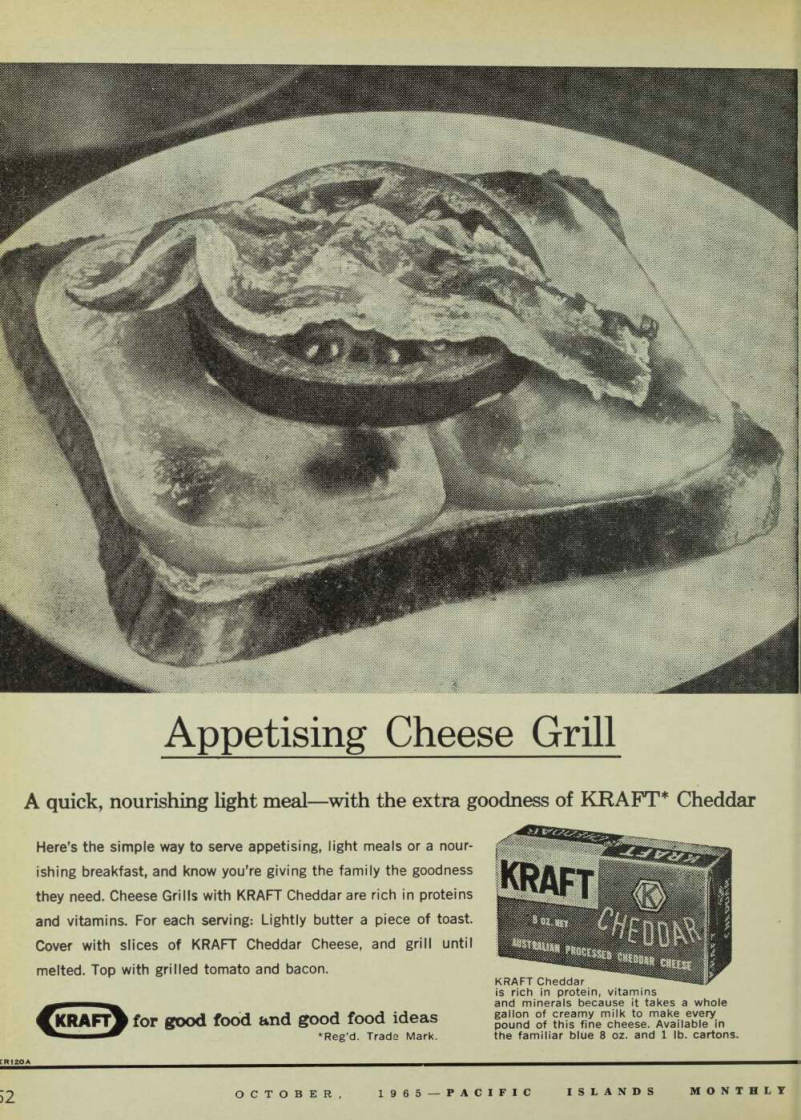 58
58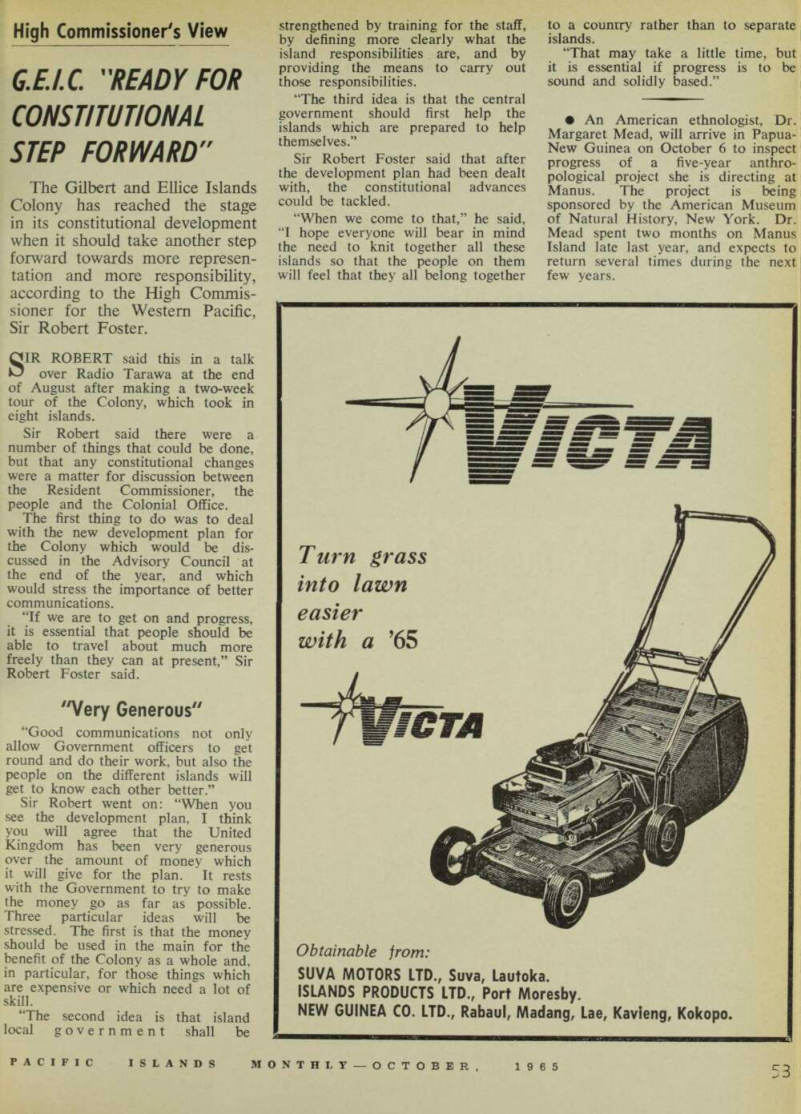 59
59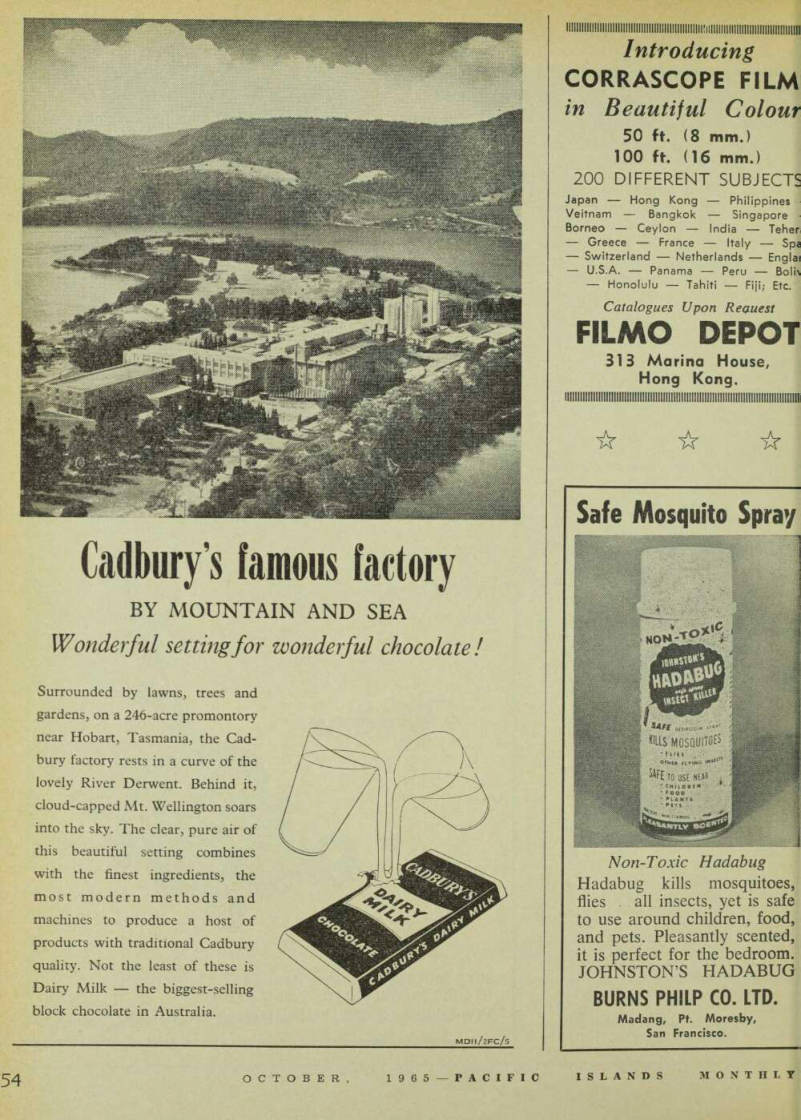 60
60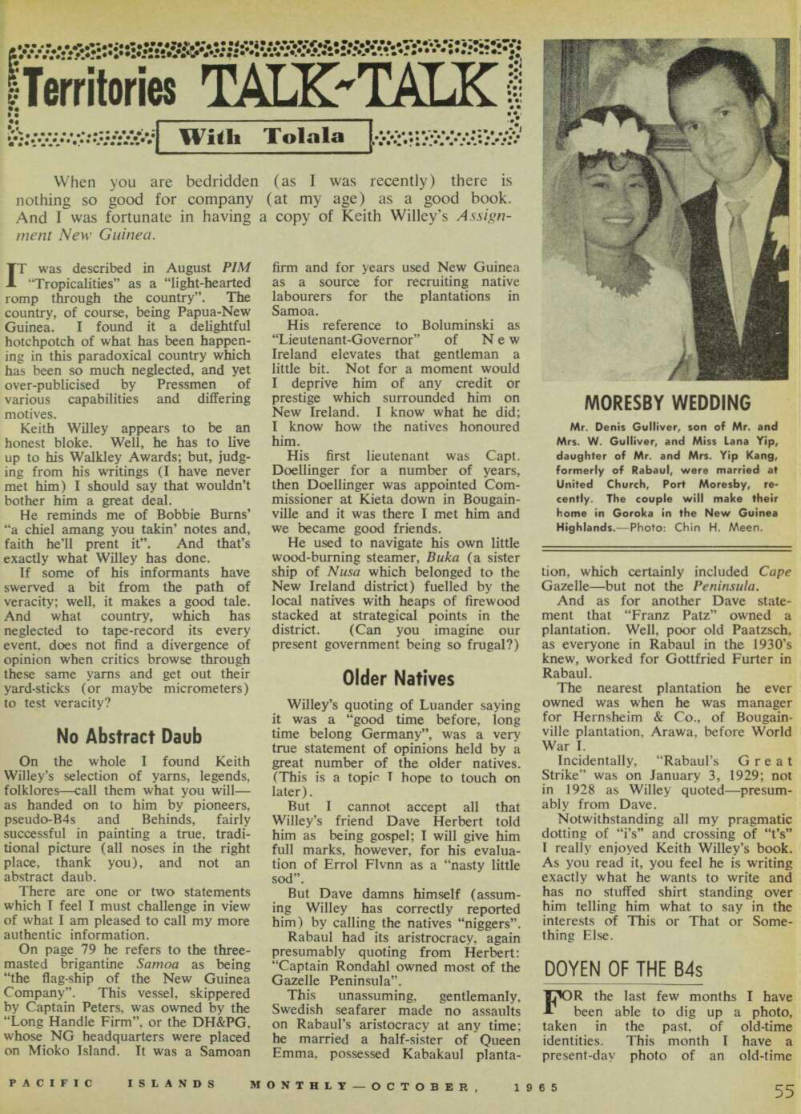 61
61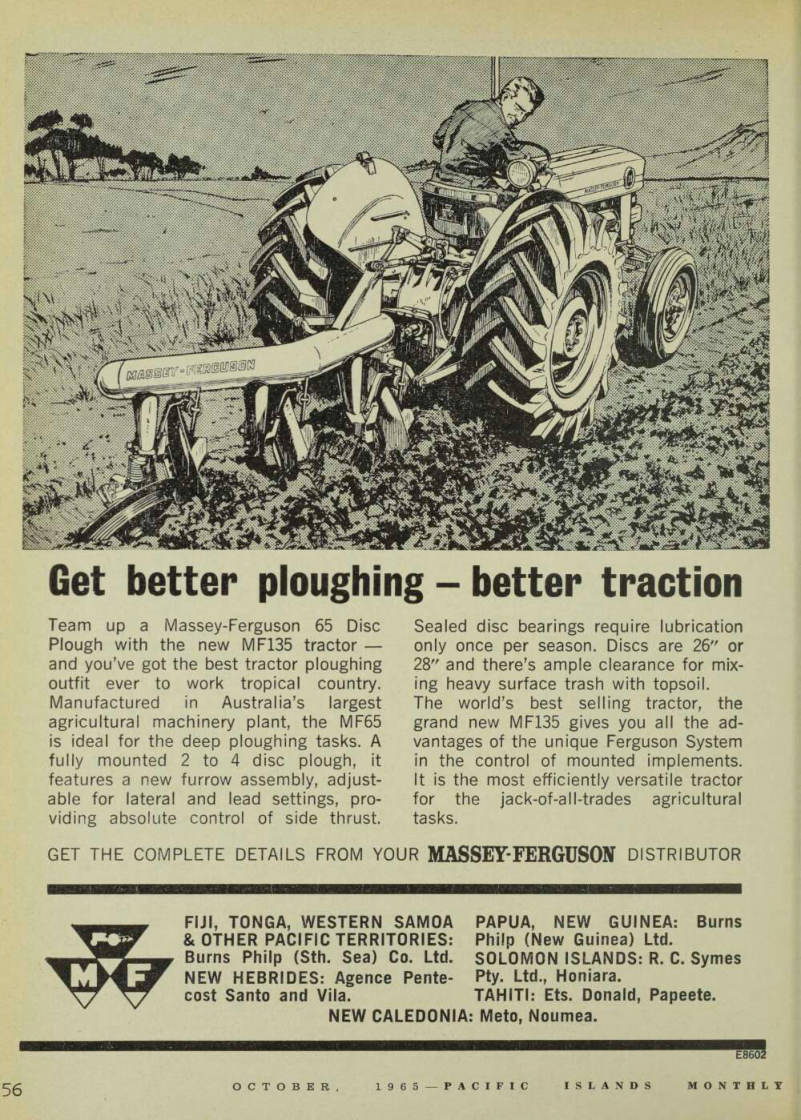 62
62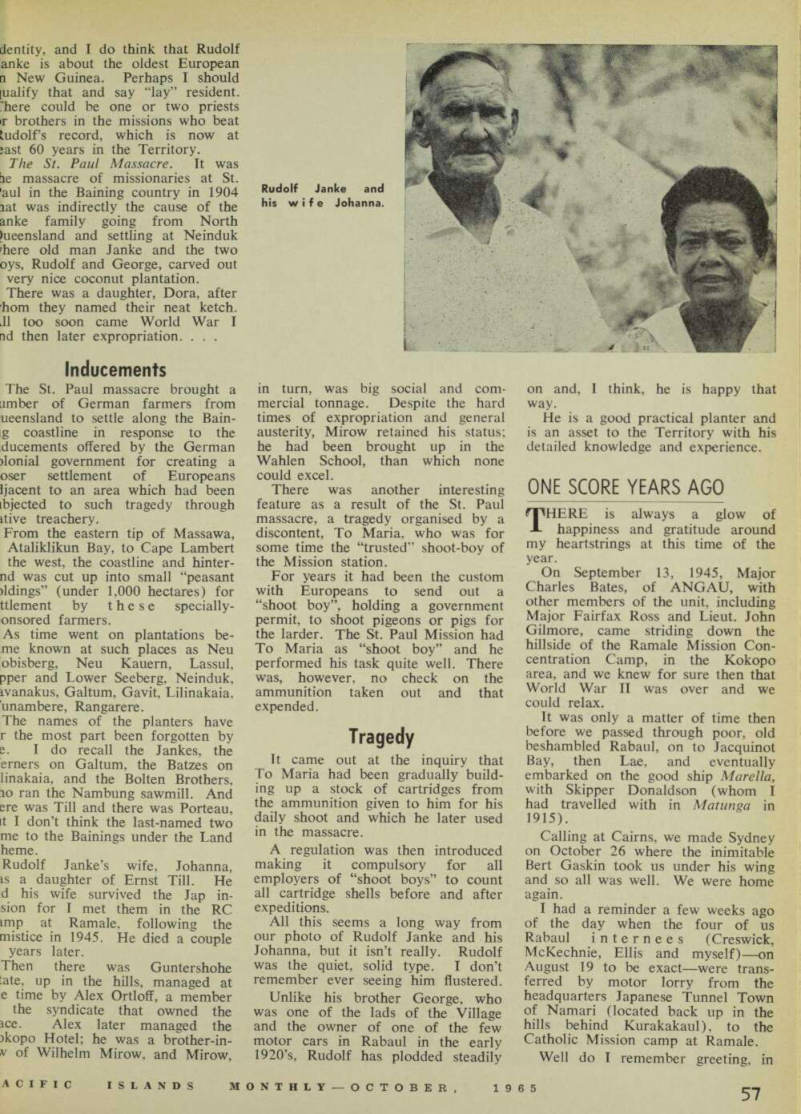 63
63 64
64 65
65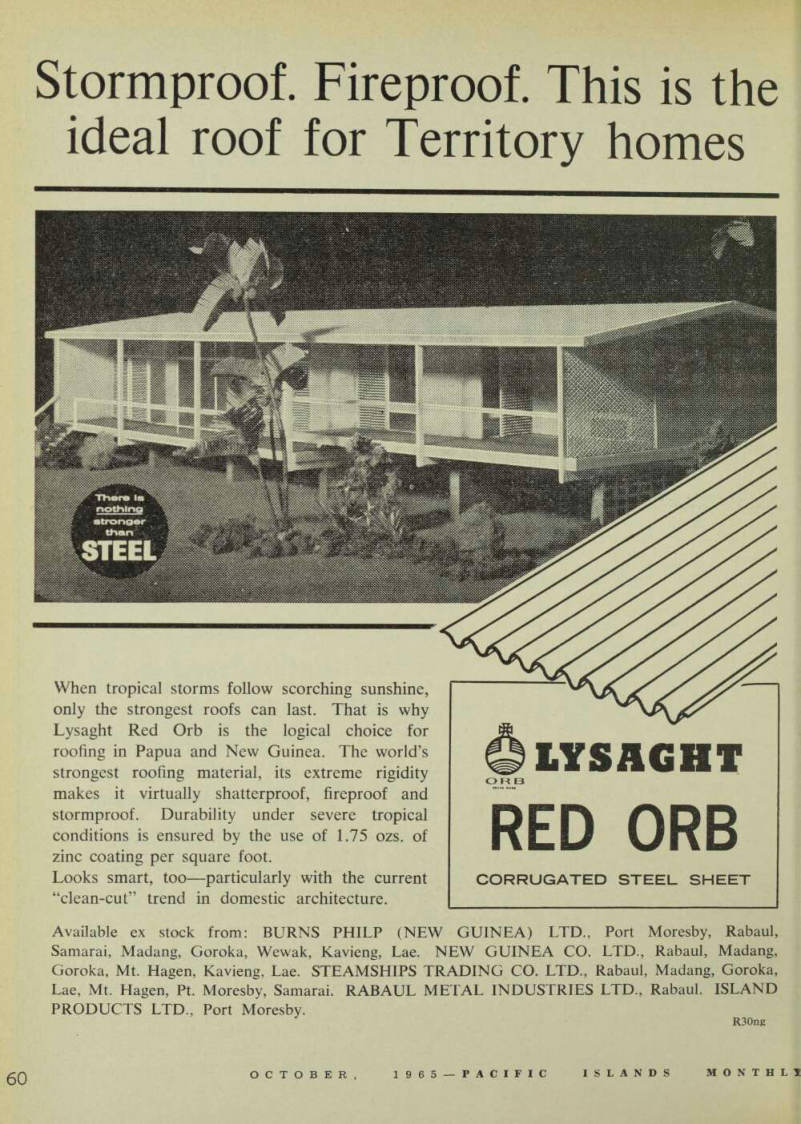 66
66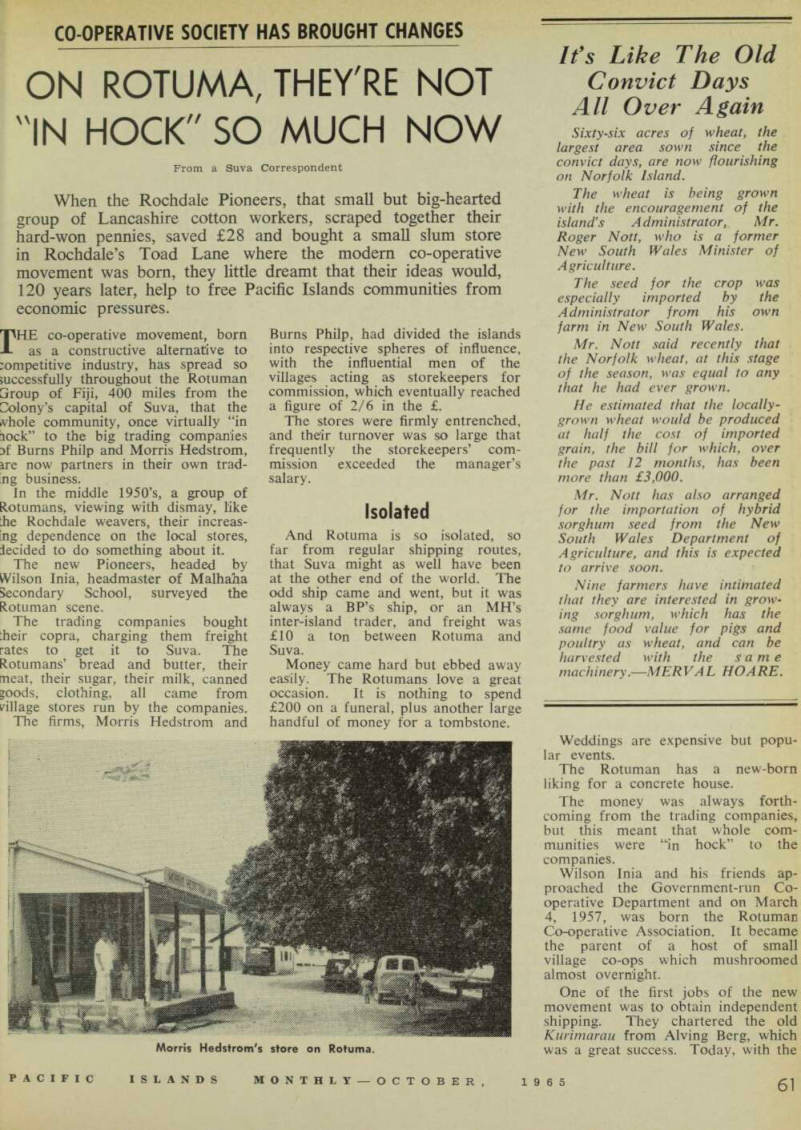 67
67 68
68 69
69 70
70 71
71 72
72 73
73 74
74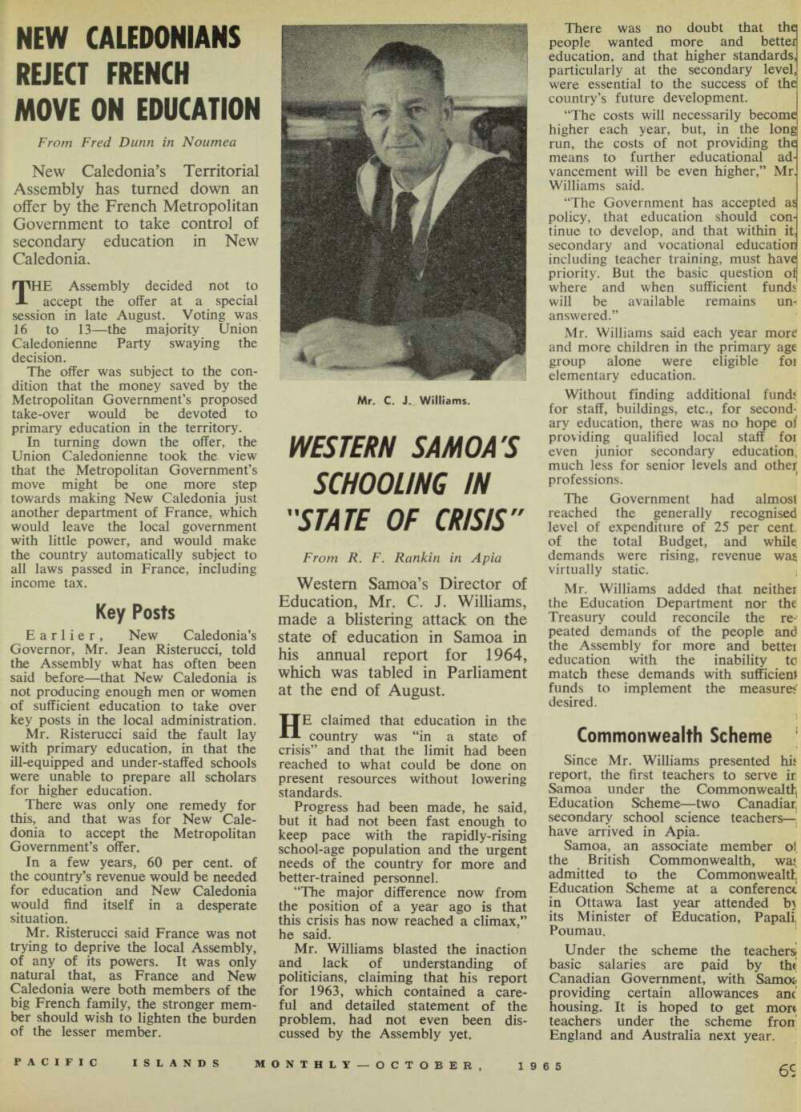 75
75 76
76 77
77 78
78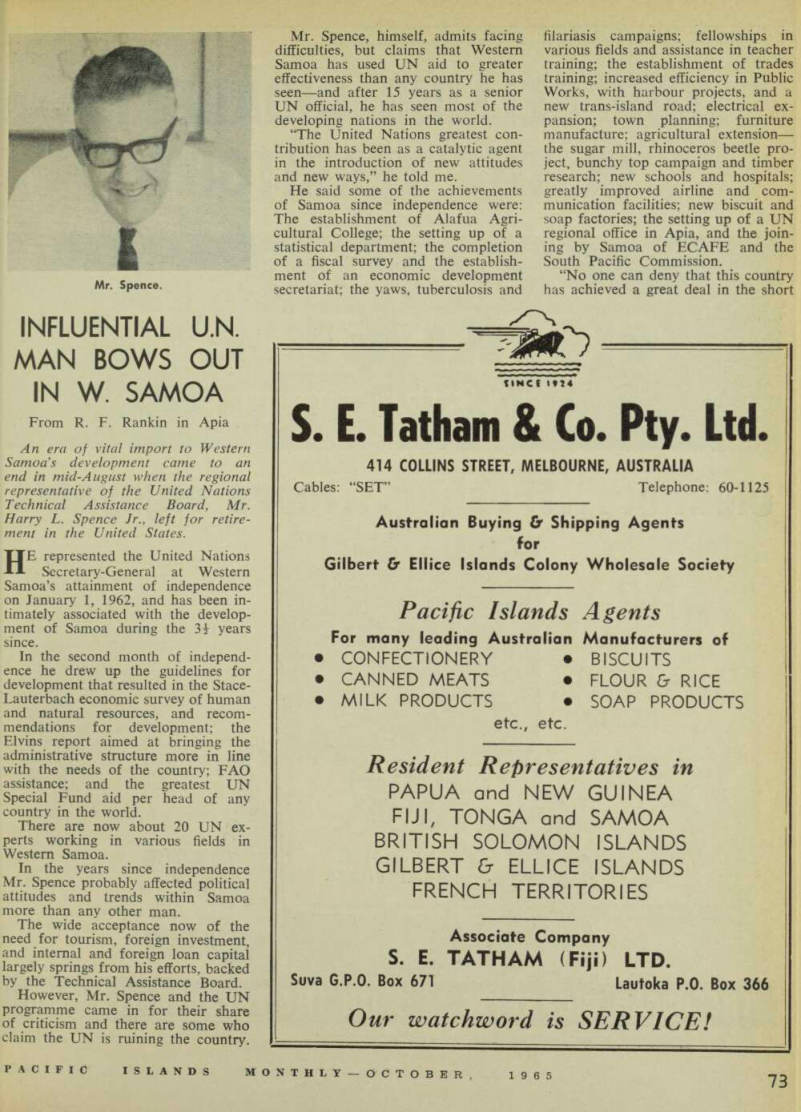 79
79 80
80 81
81 82
82 83
83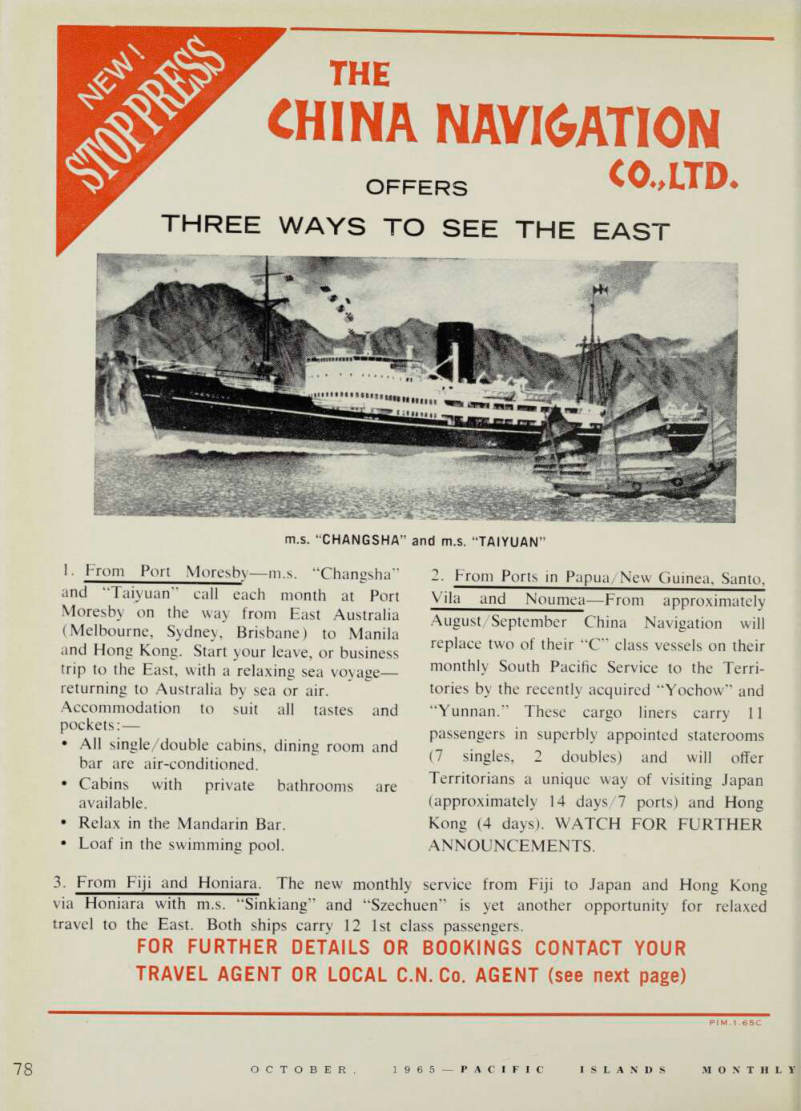 84
84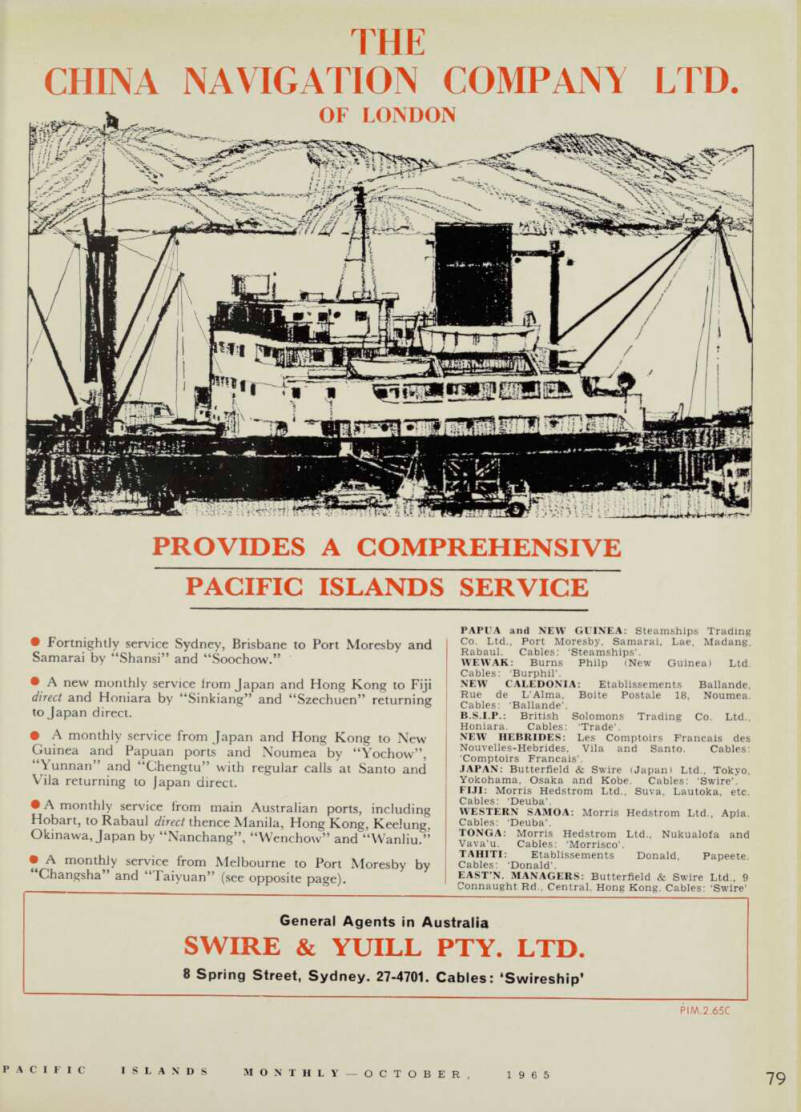 85
85 86
86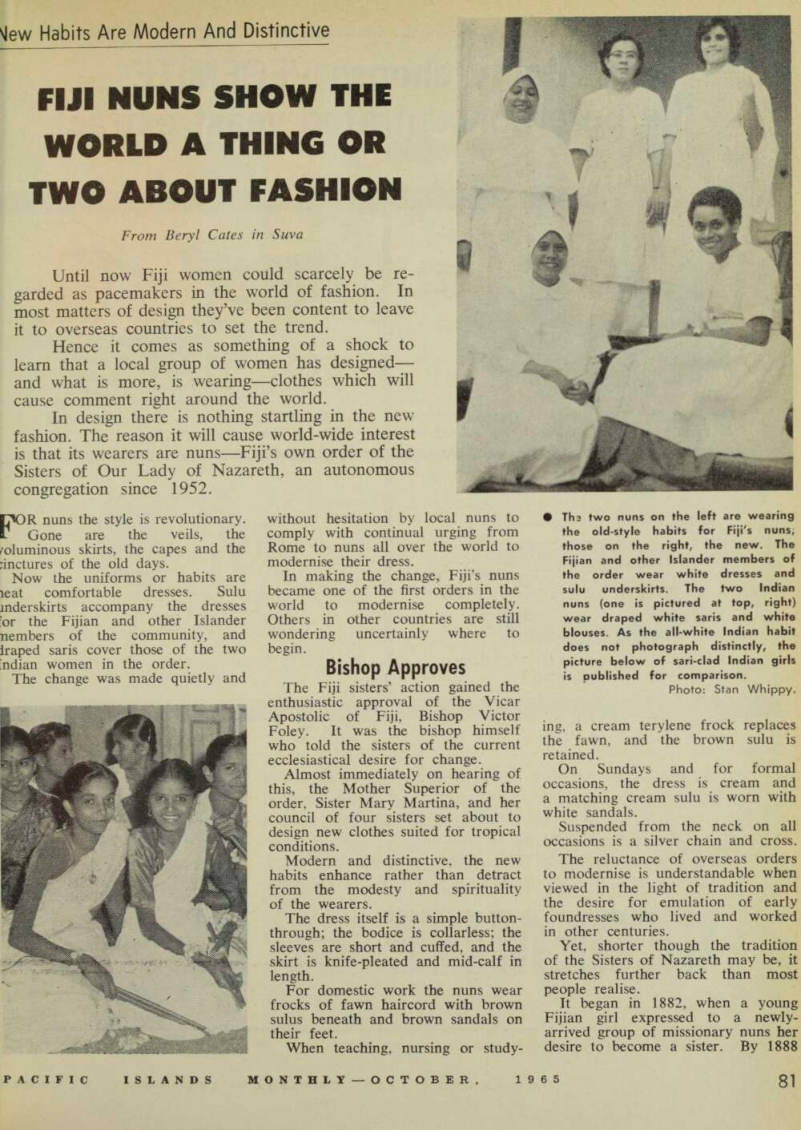 87
87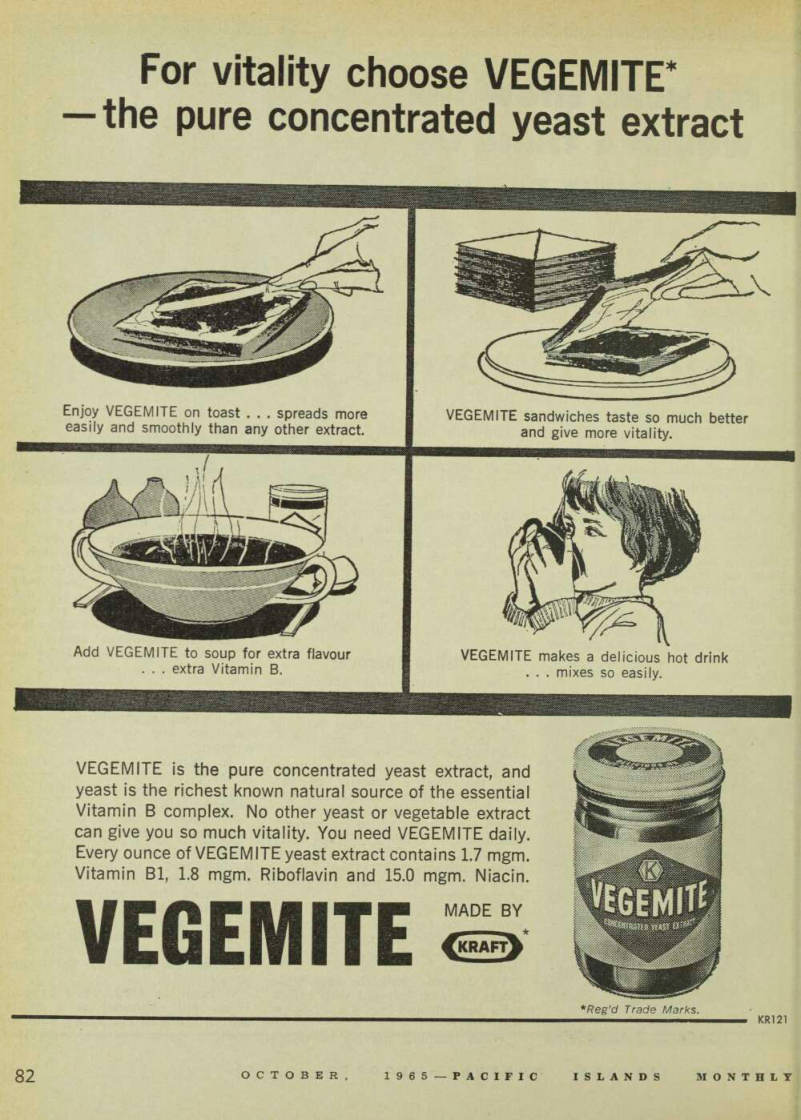 88
88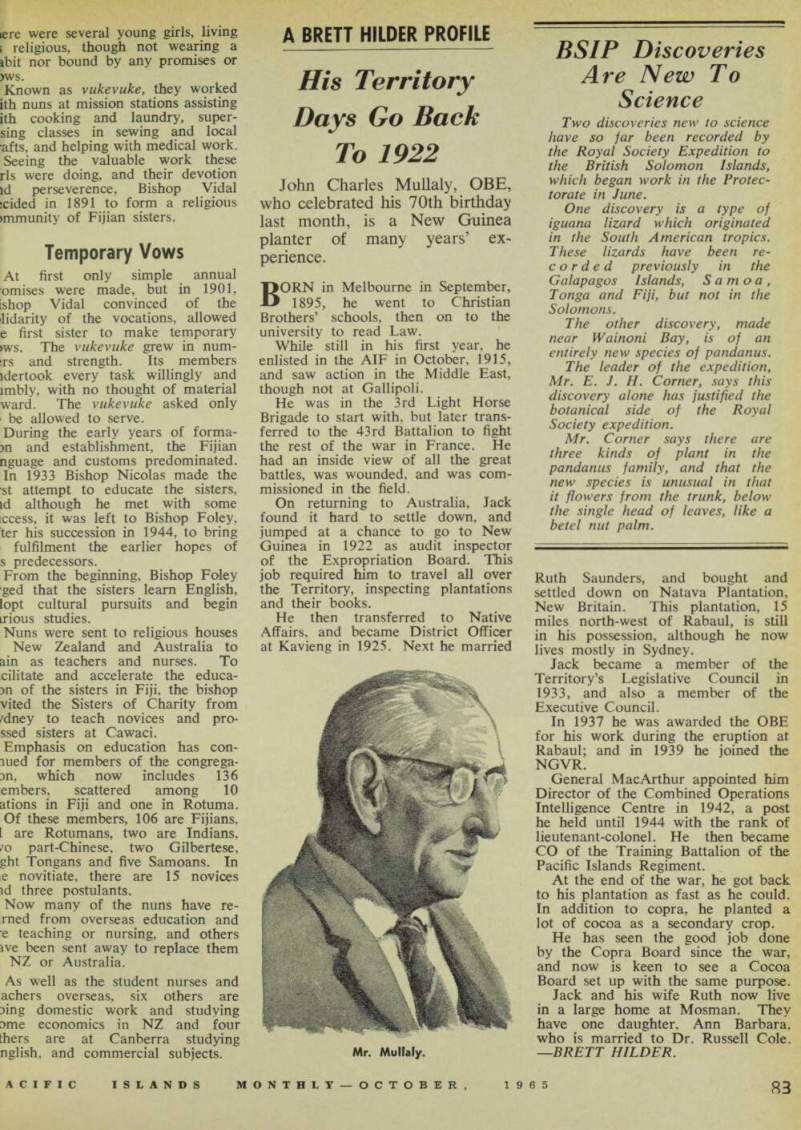 89
89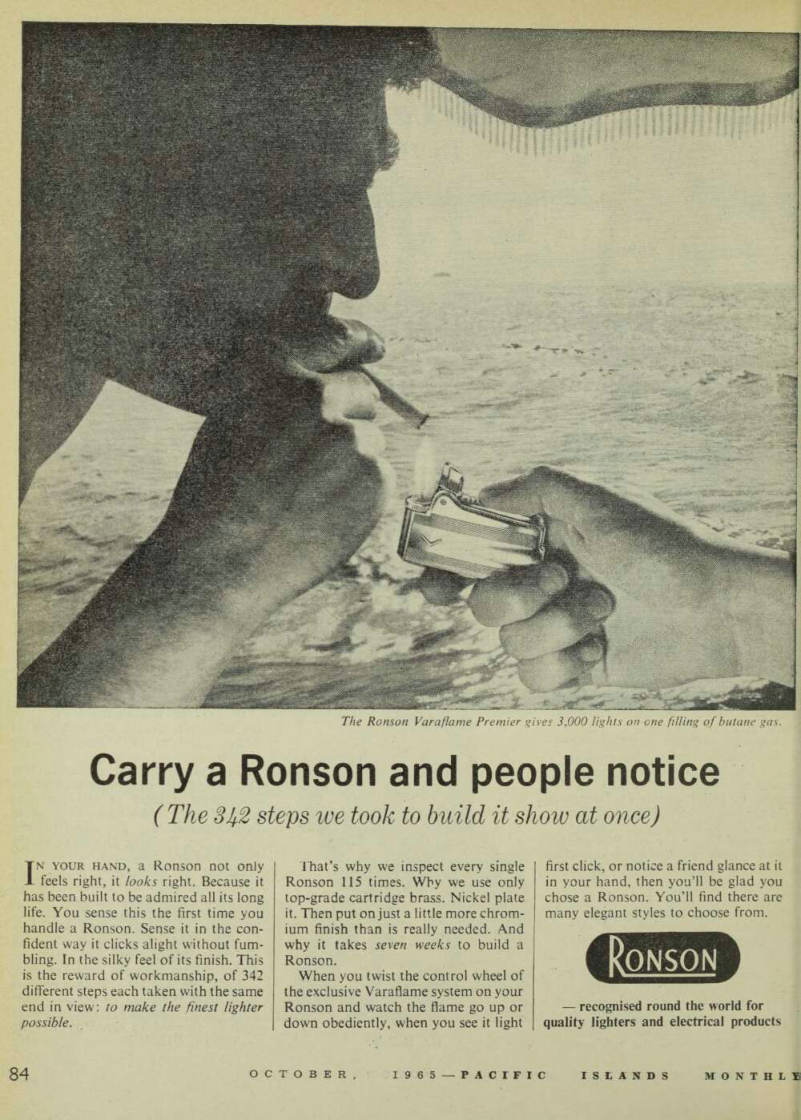 90
90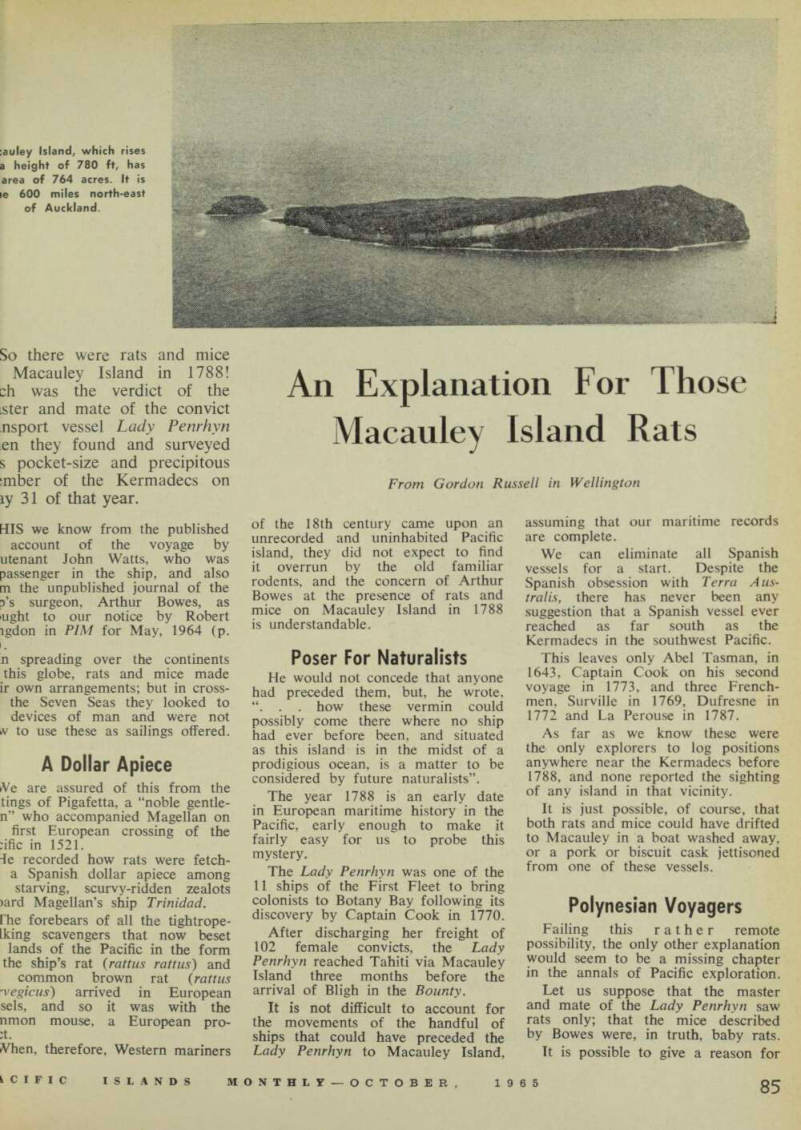 91
91 92
92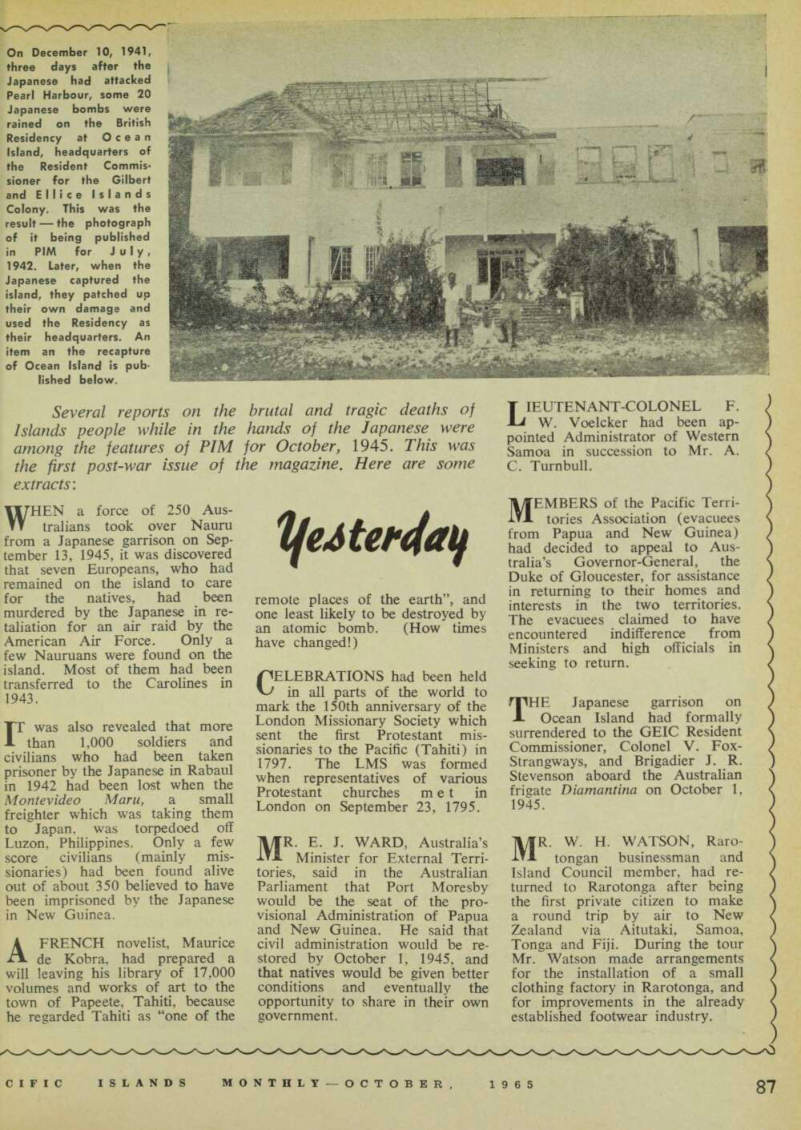 93
93 94
94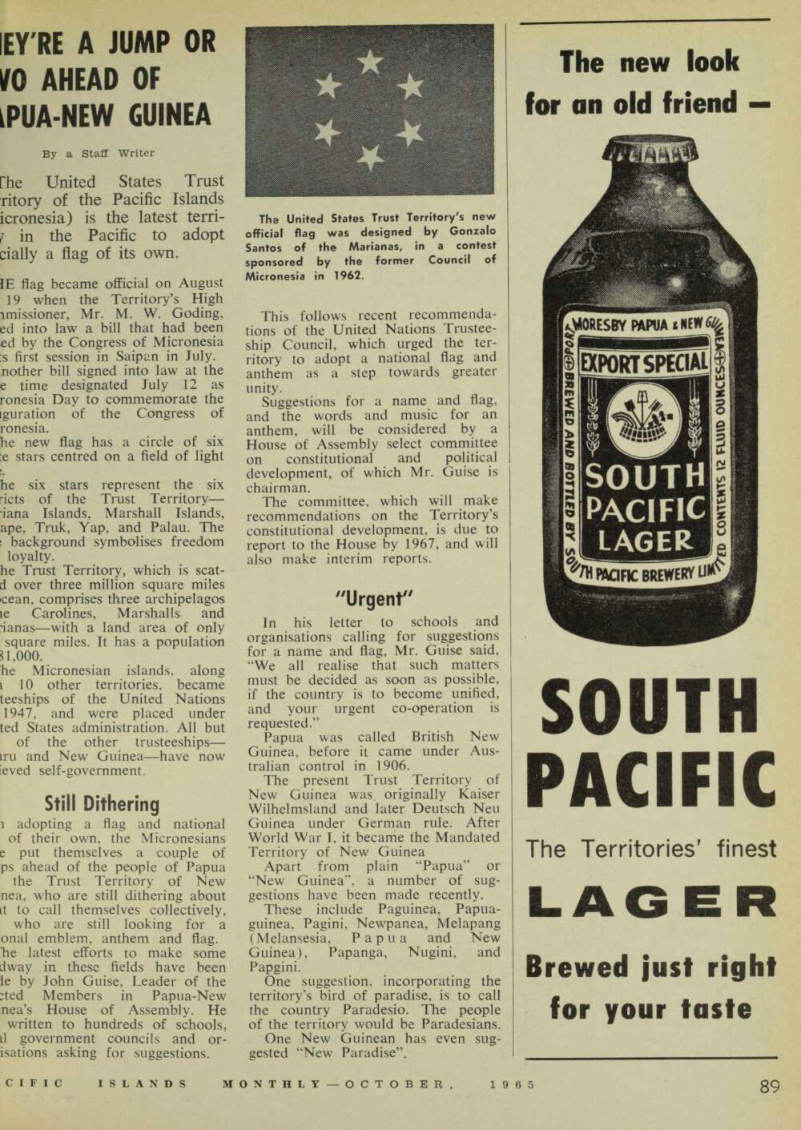 95
95 96
96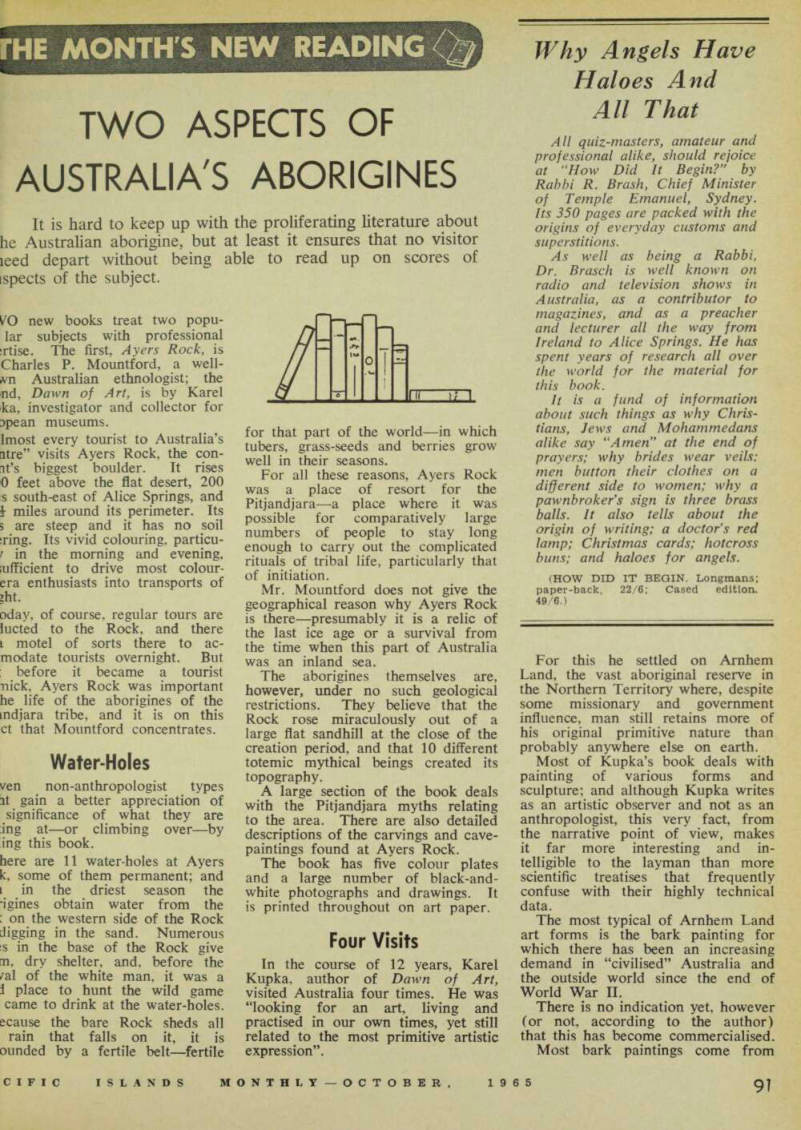 97
97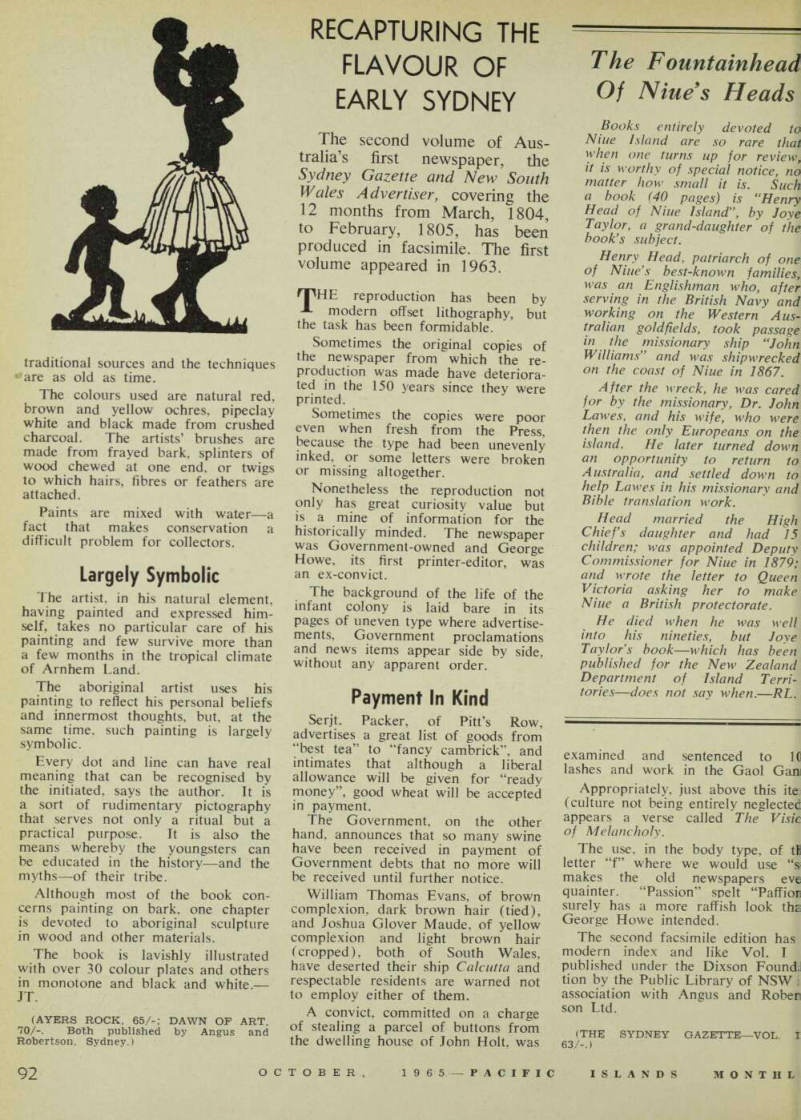 98
98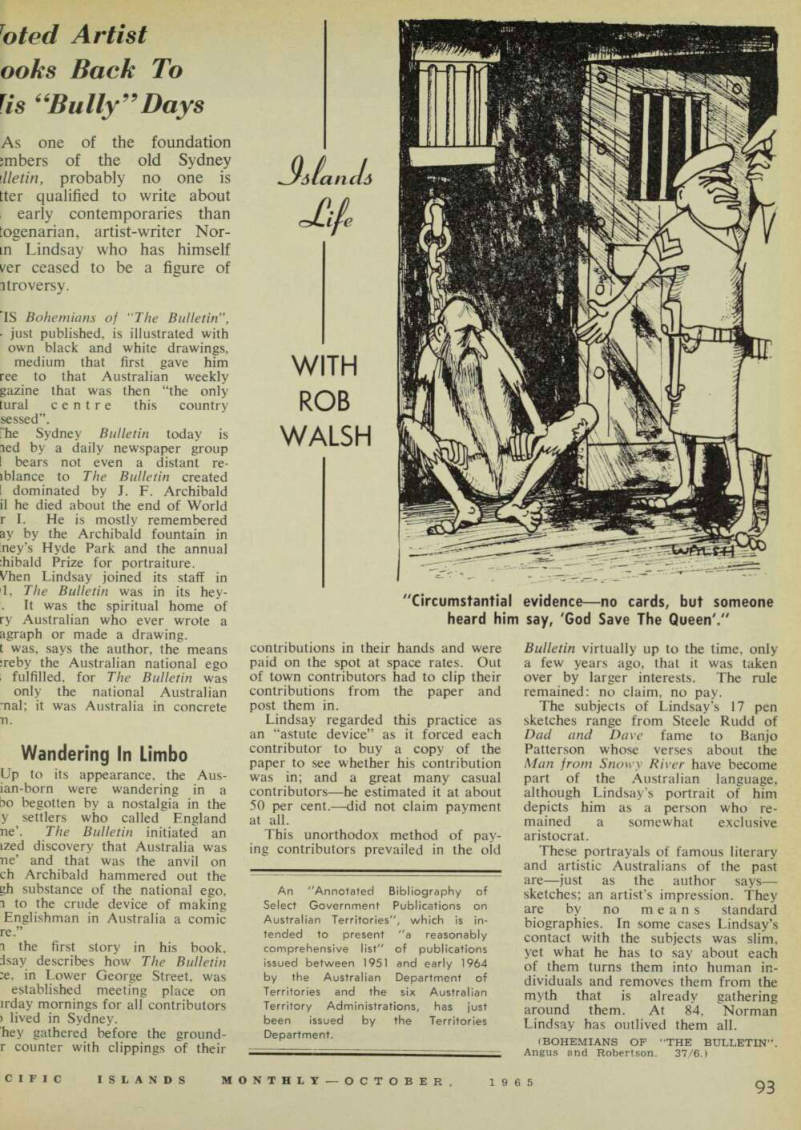 99
99 100
100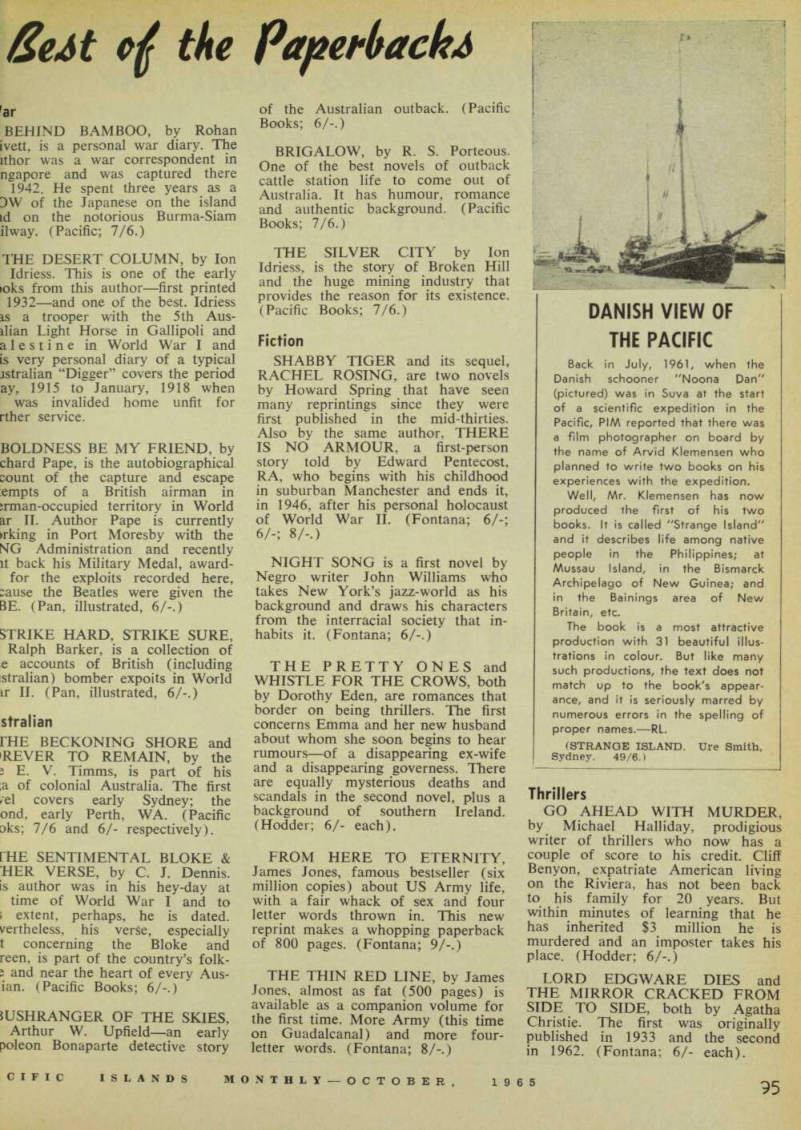 101
101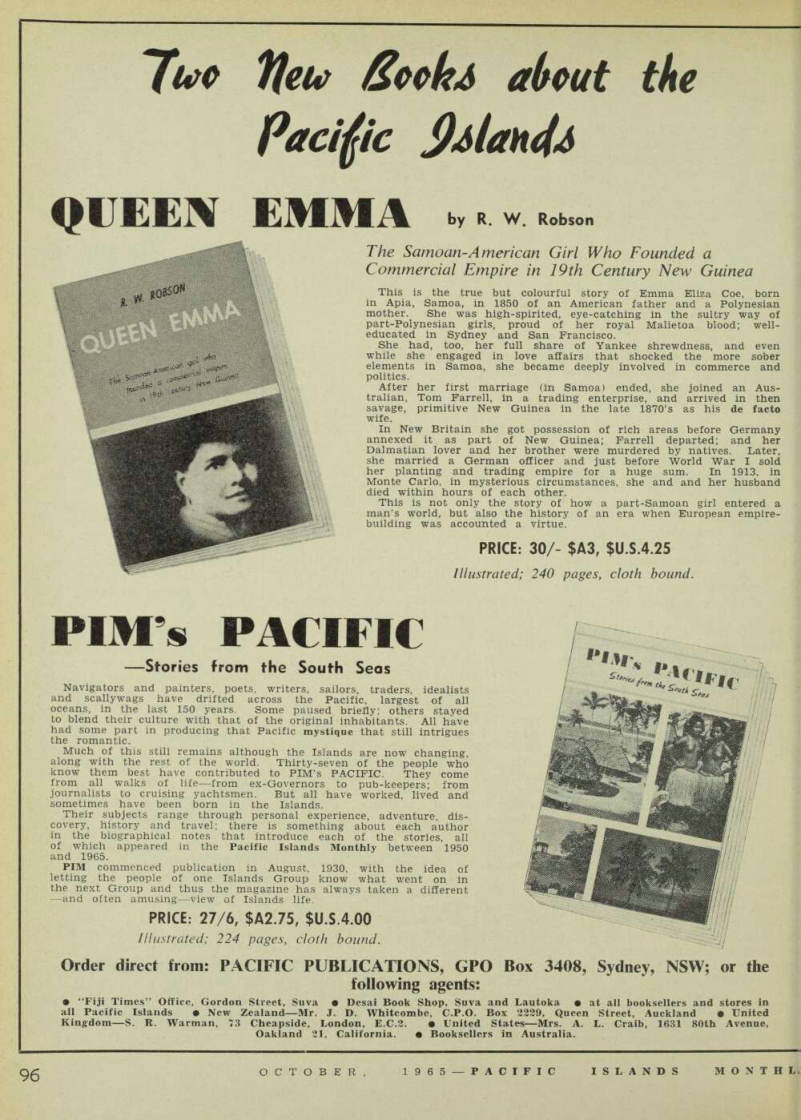 102
102 103
103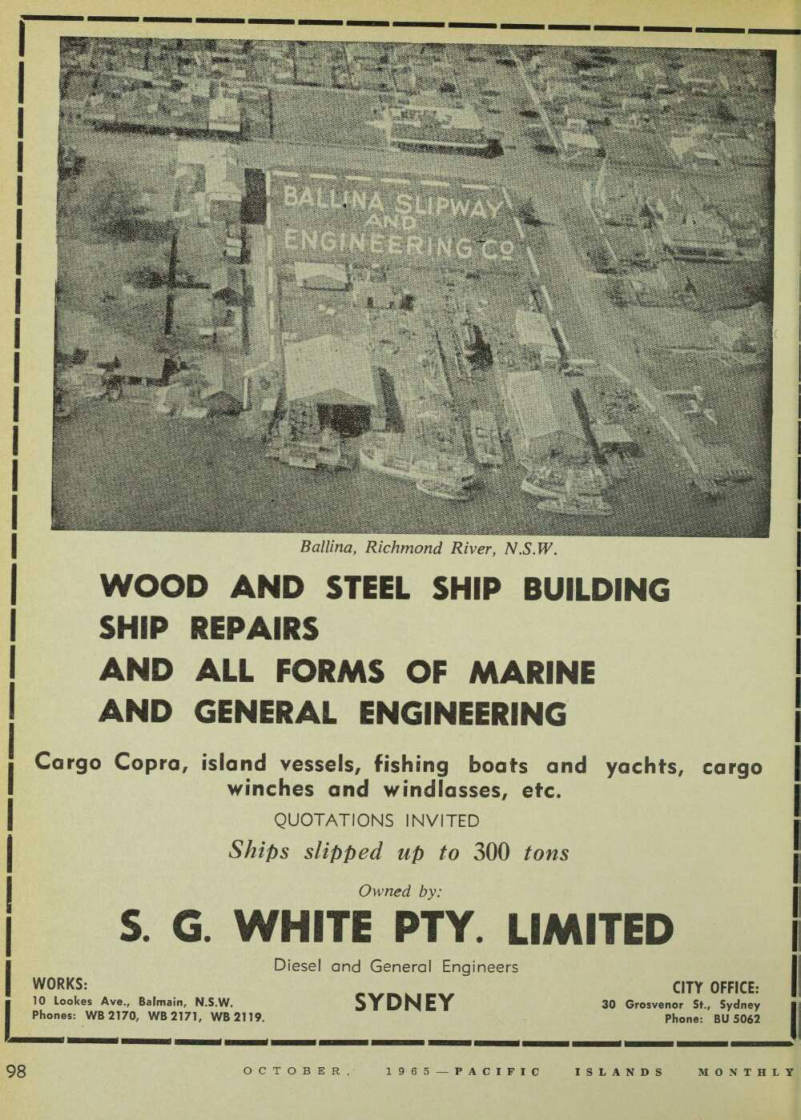 104
104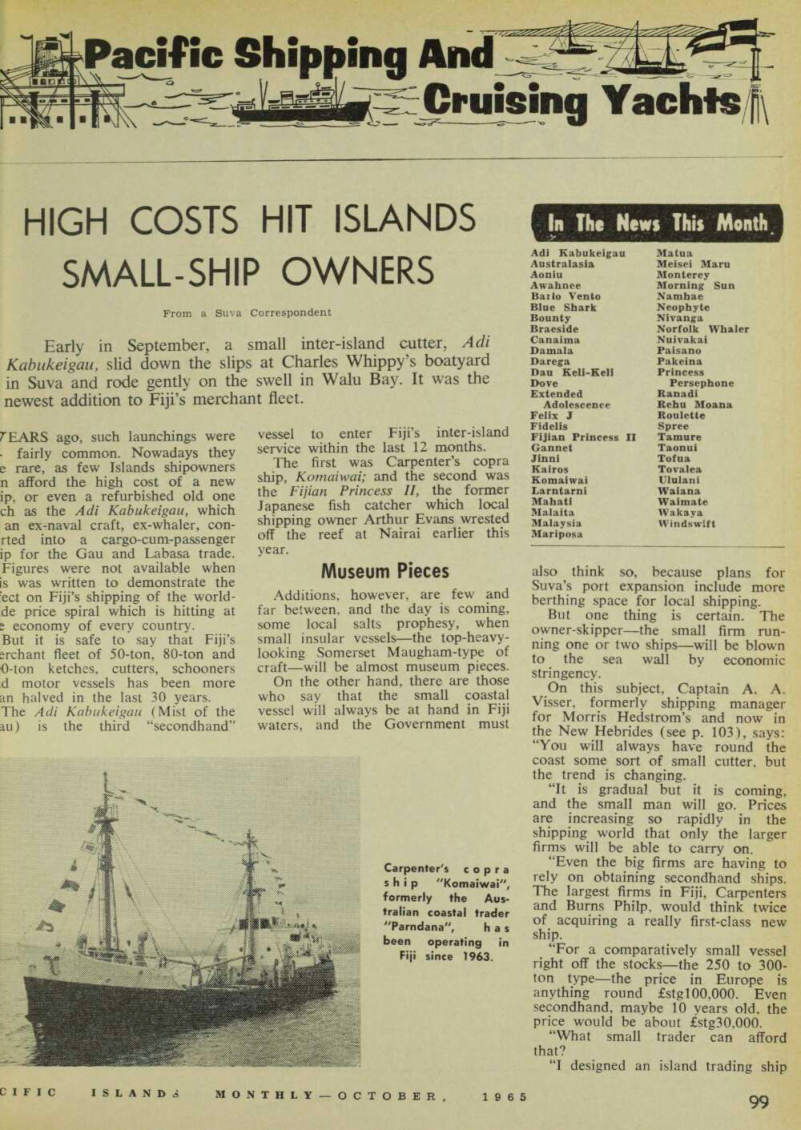 105
105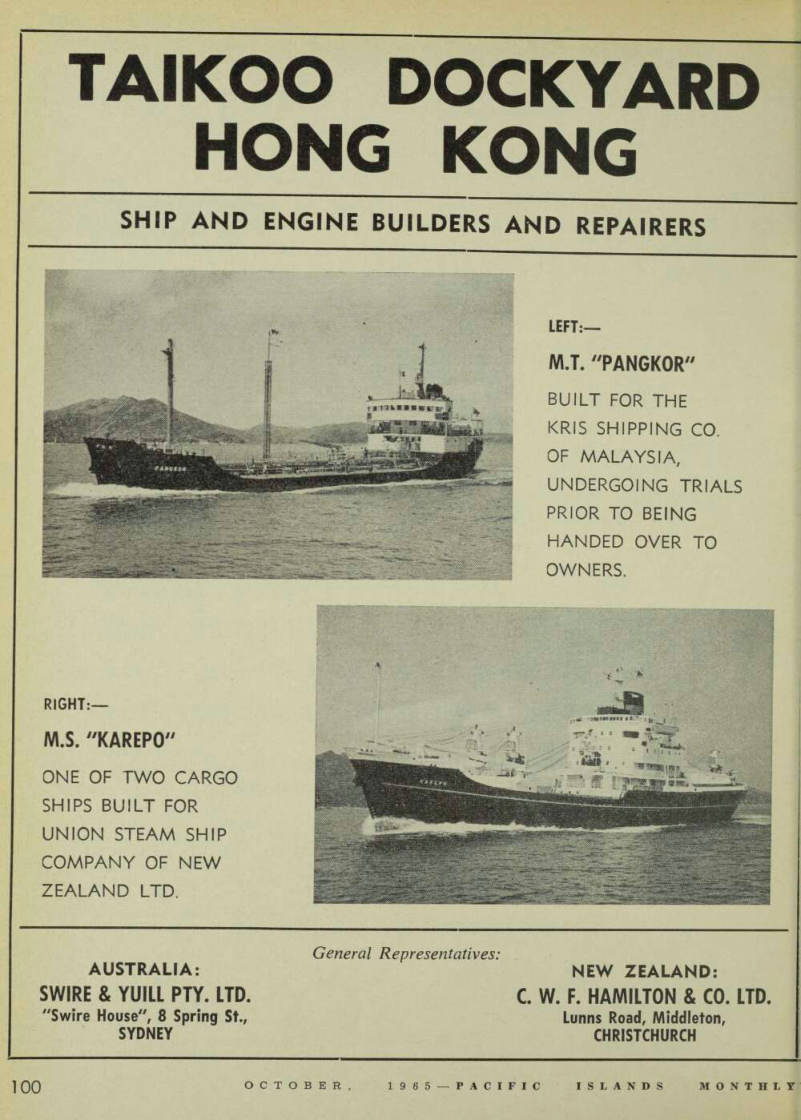 106
106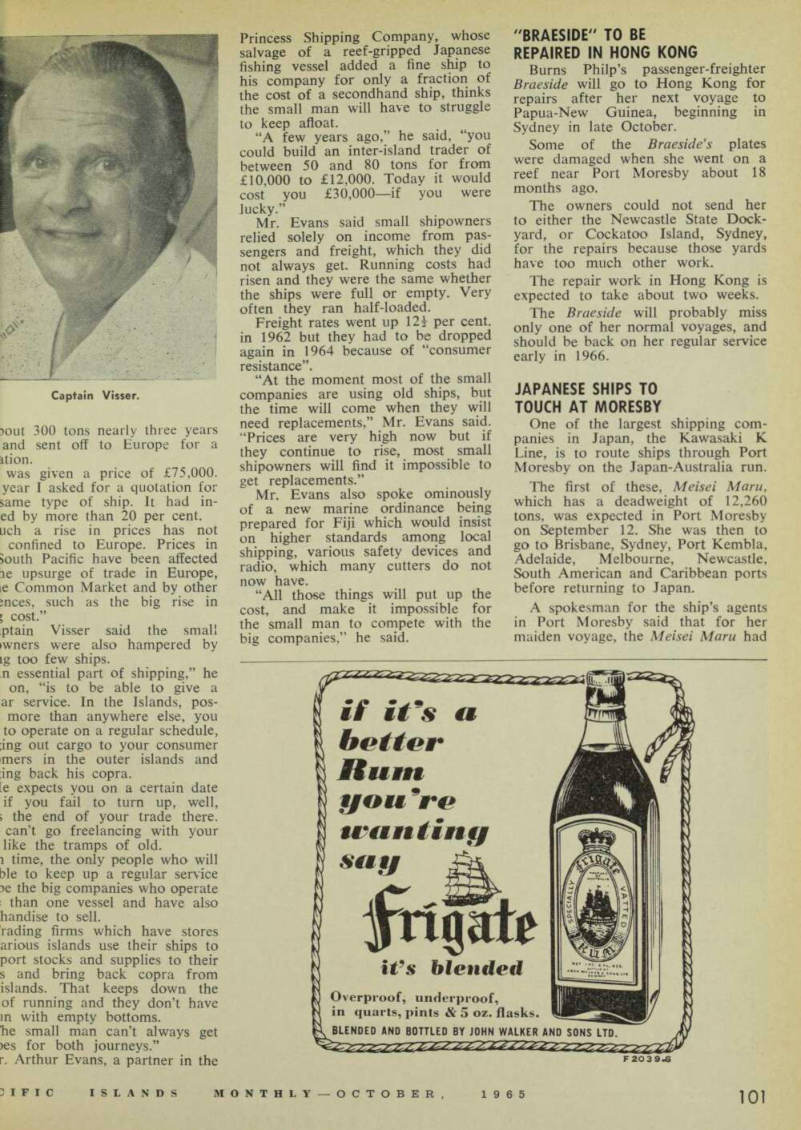 107
107 108
108 109
109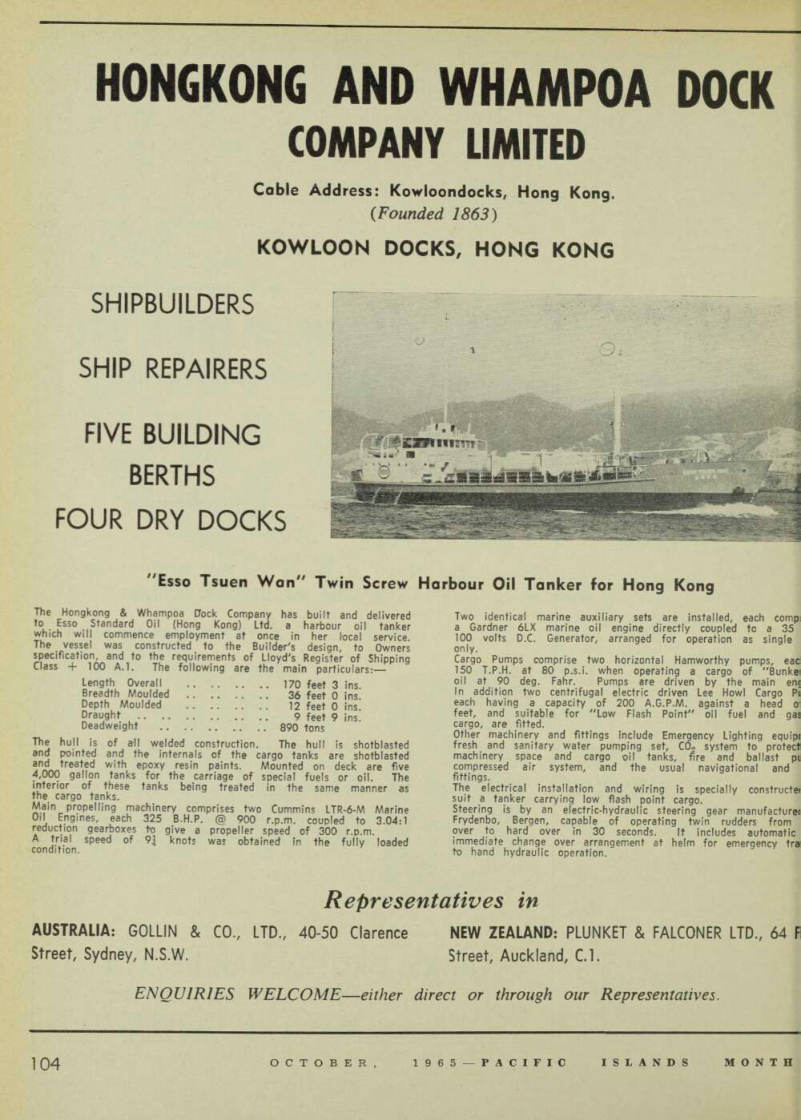 110
110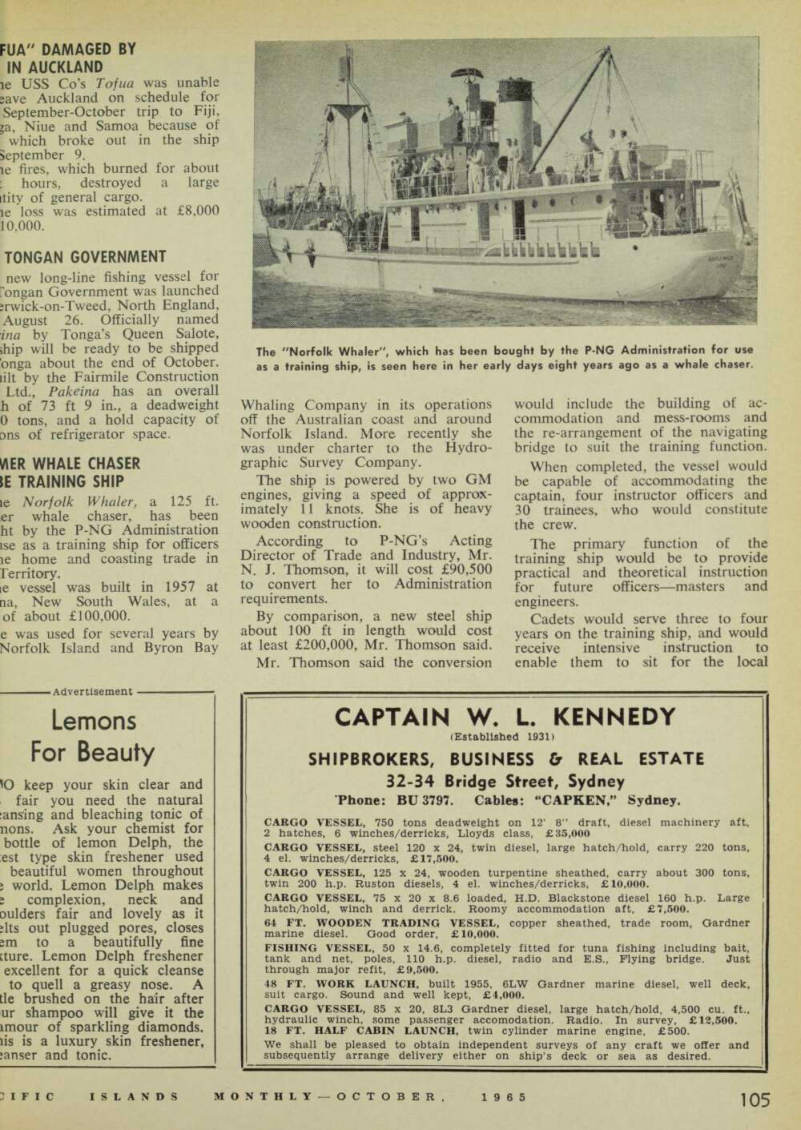 111
111 112
112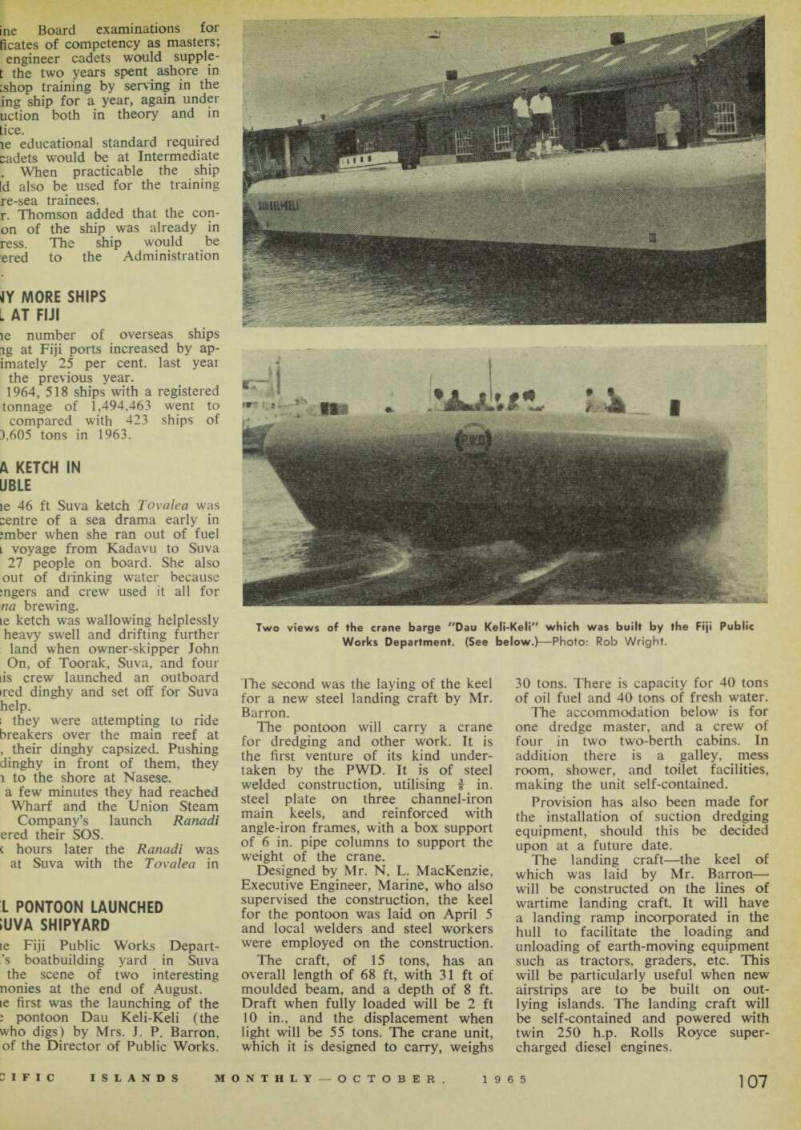 113
113 114
114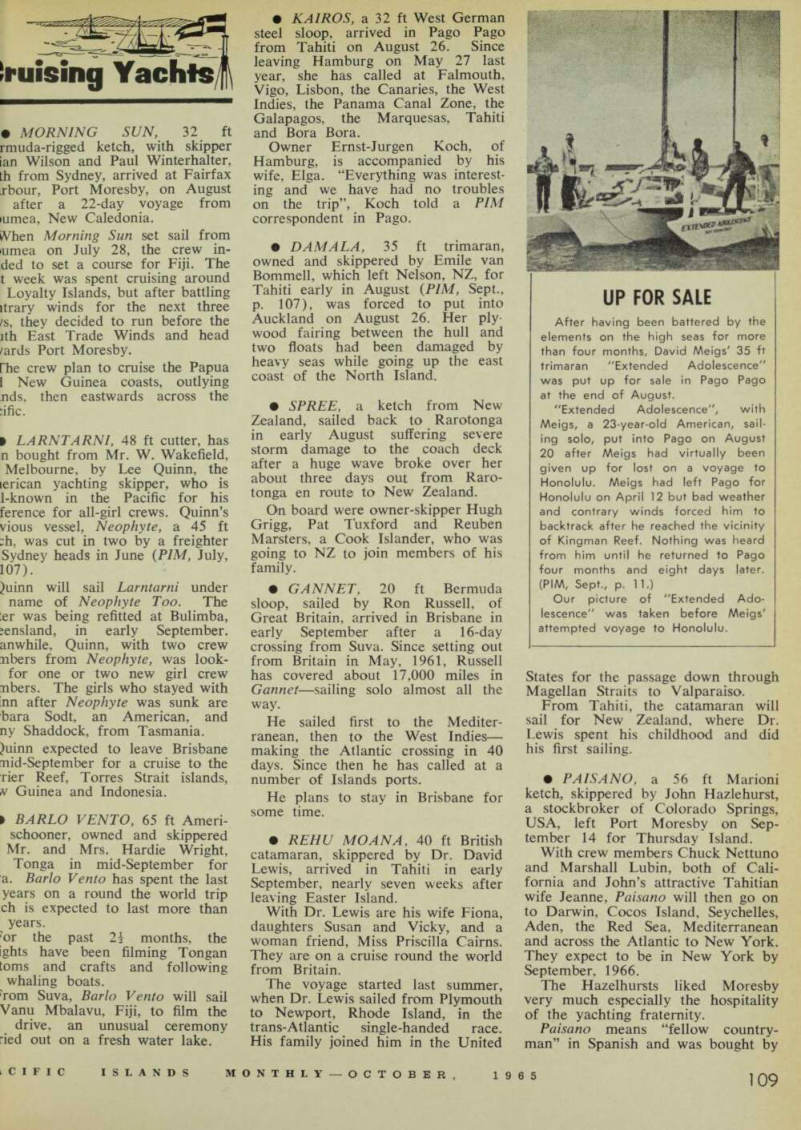 115
115 116
116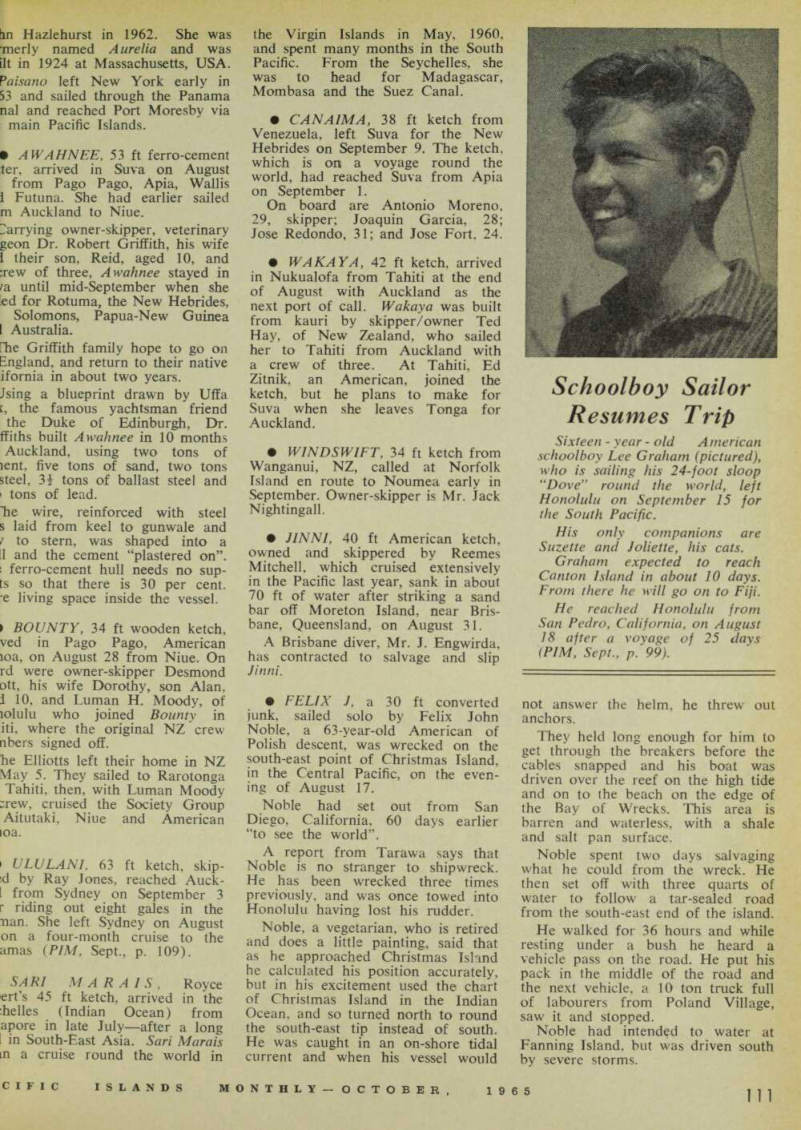 117
117 118
118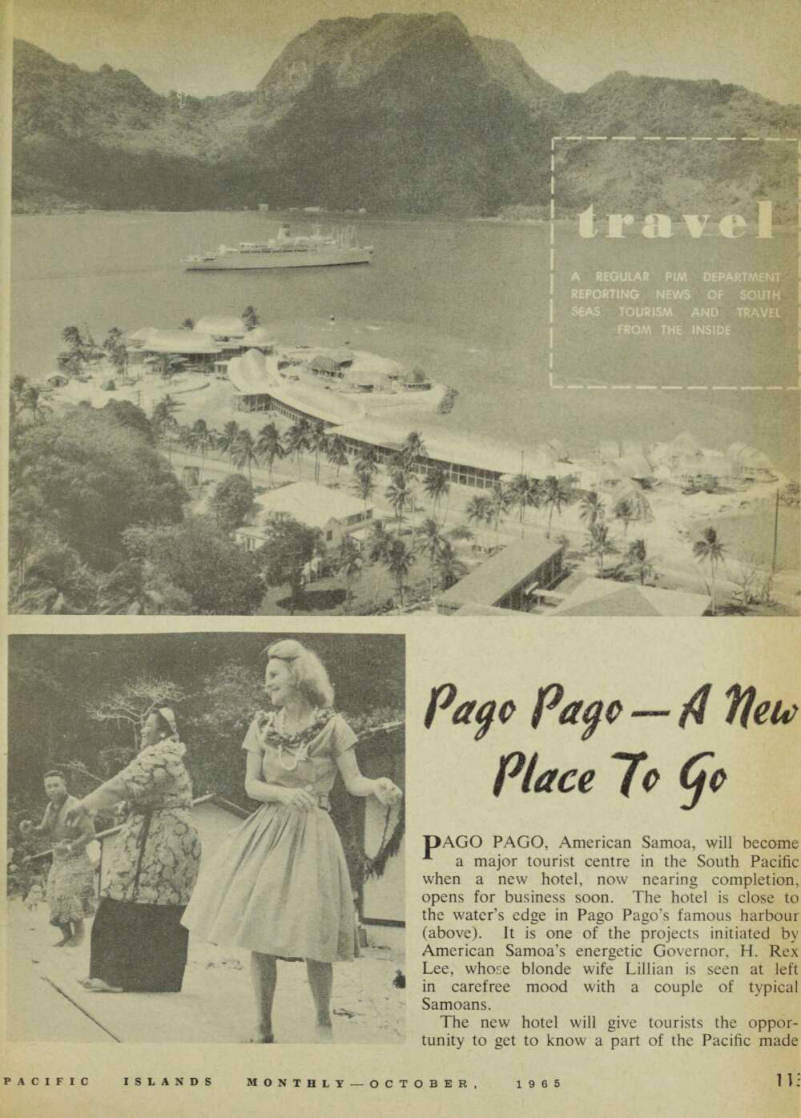 119
119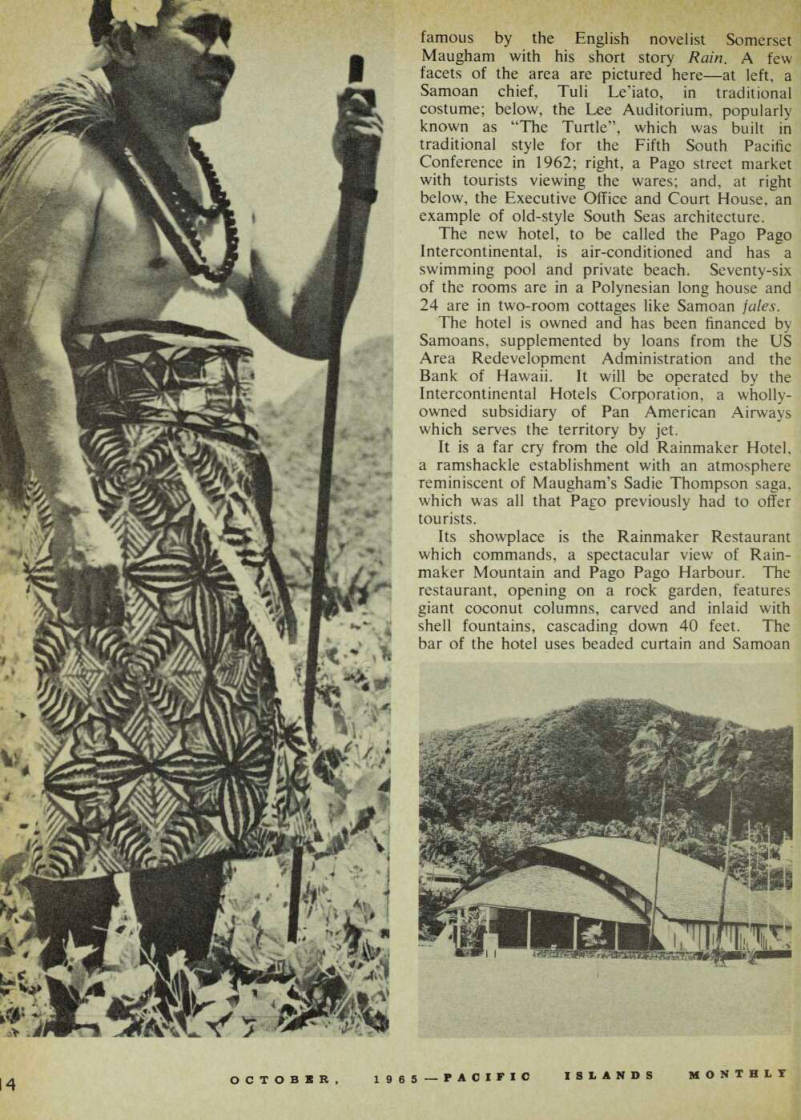 120
120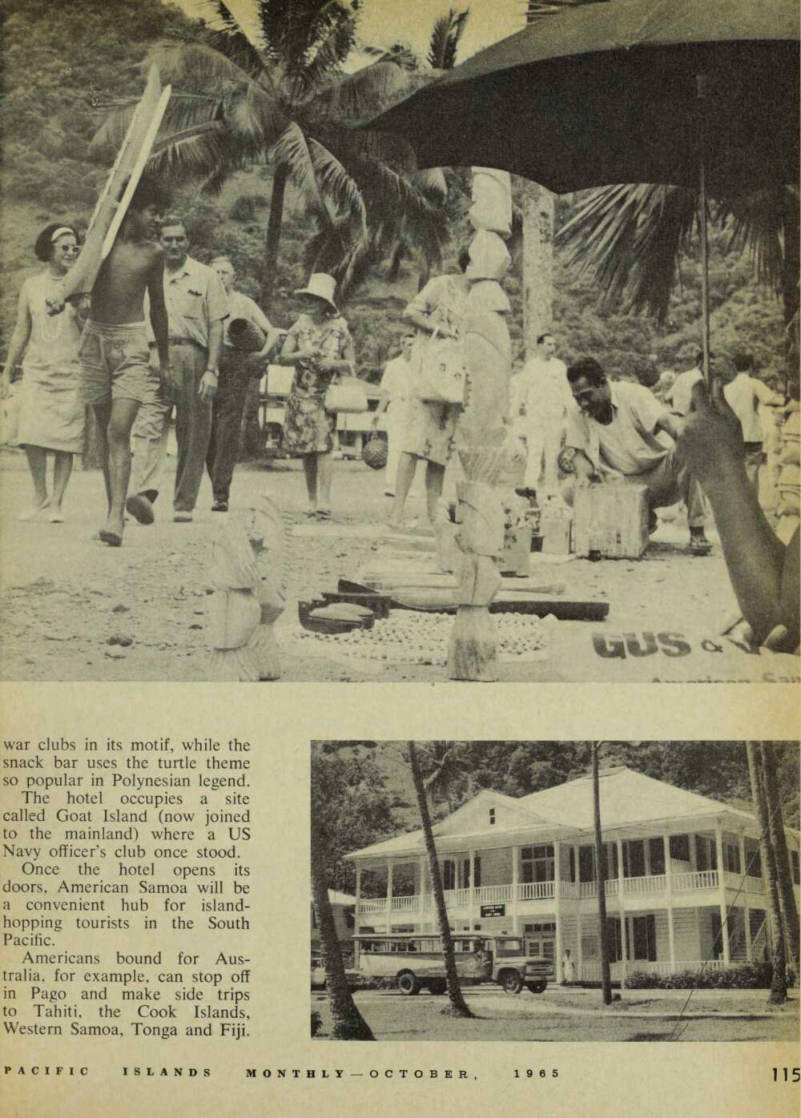 121
121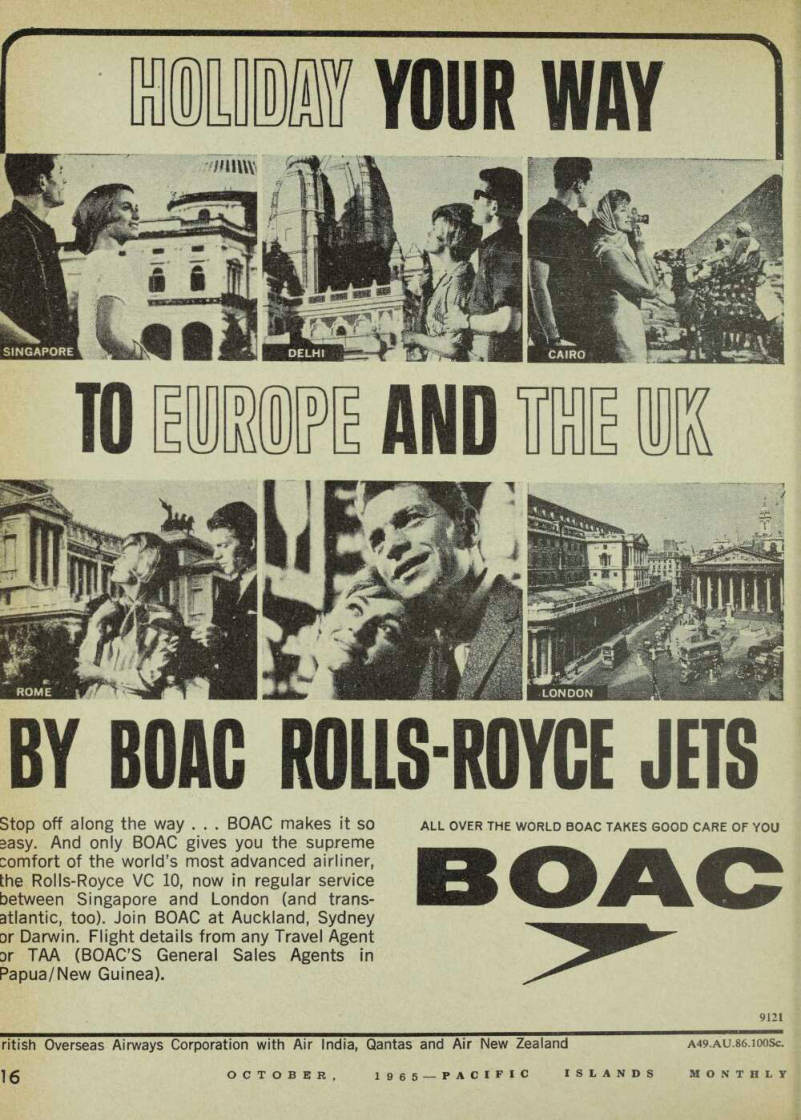 122
122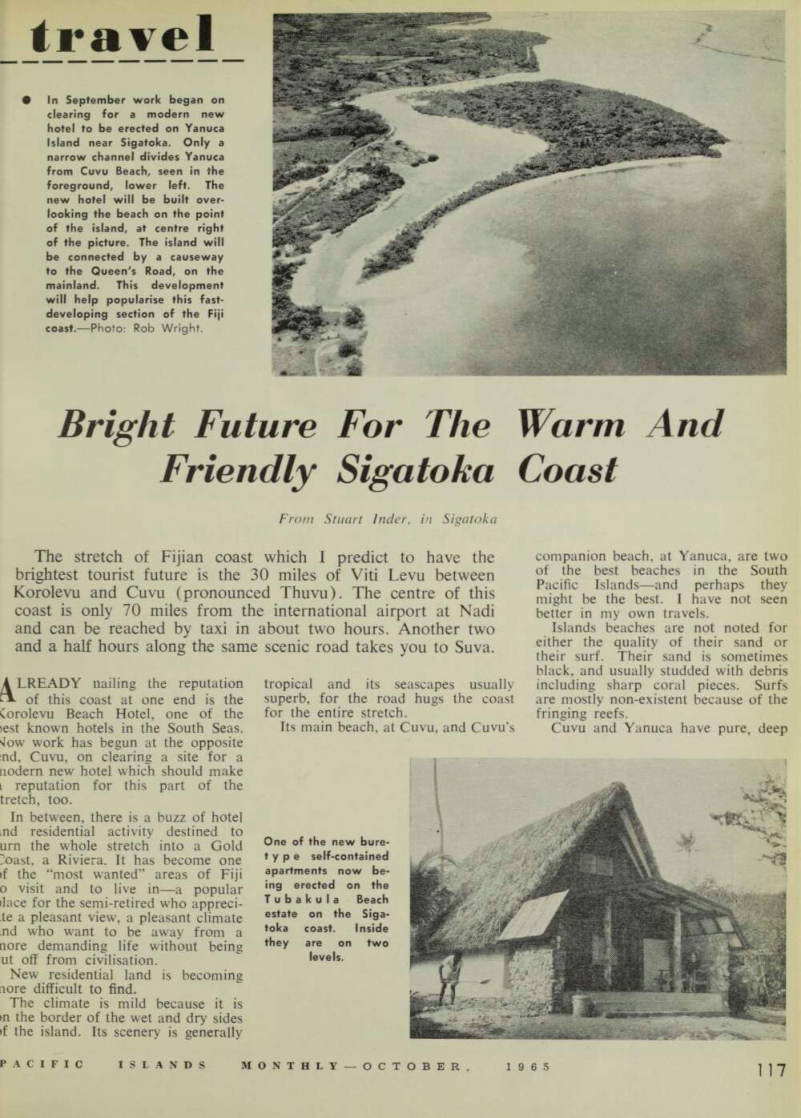 123
123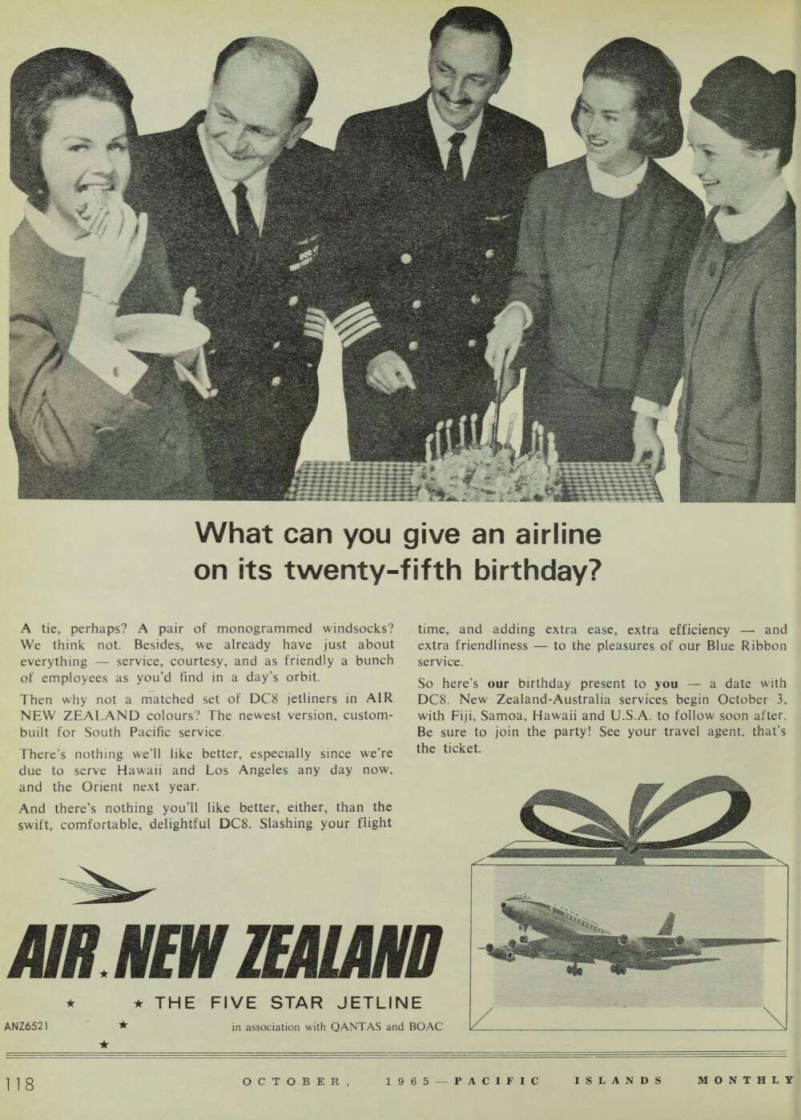 124
124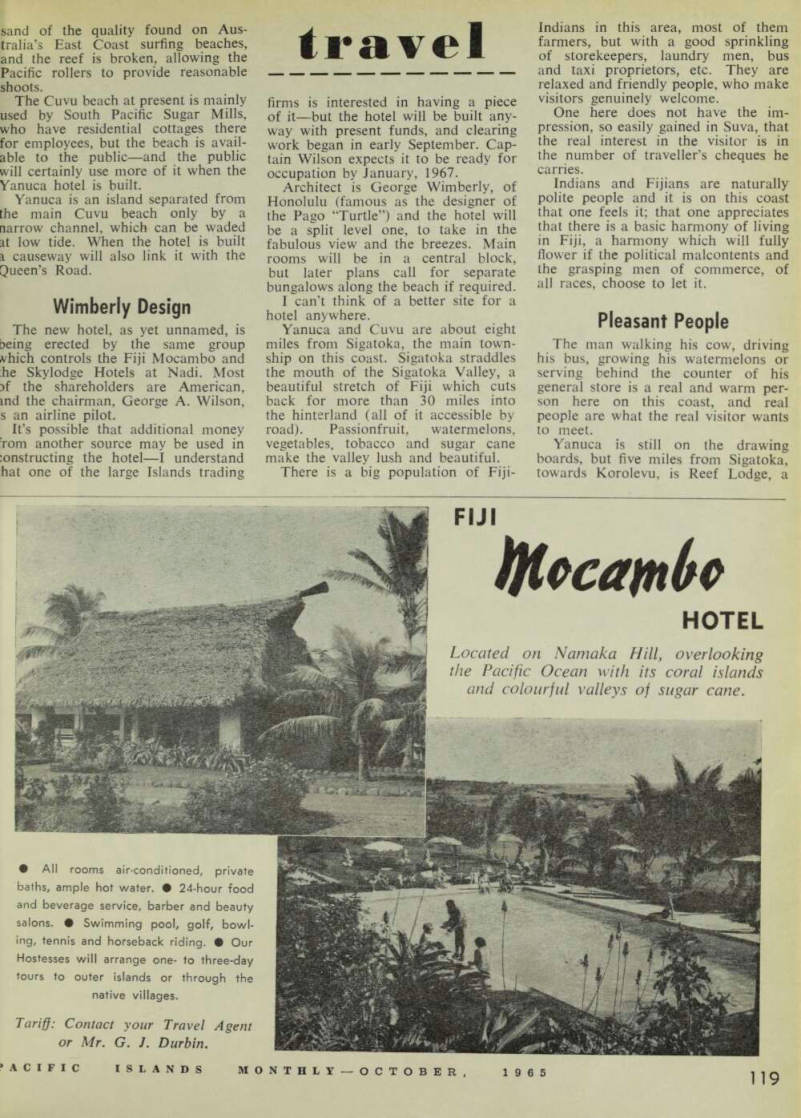 125
125 126
126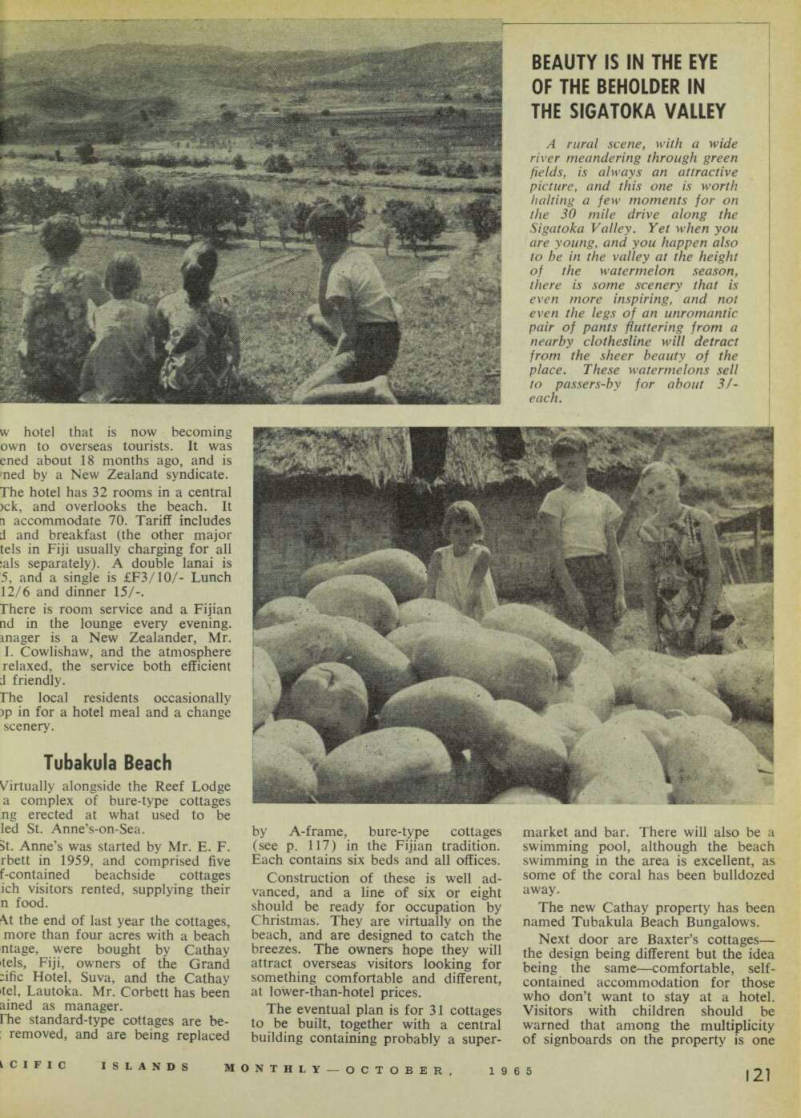 127
127 128
128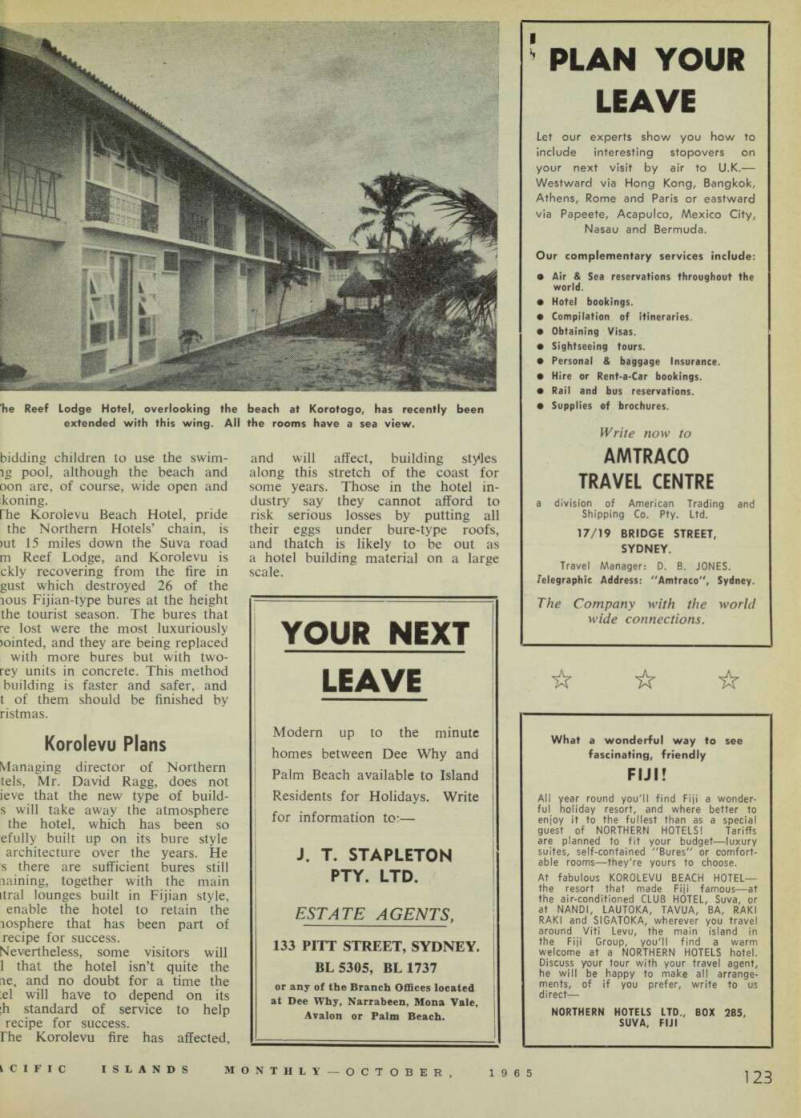 129
129 130
130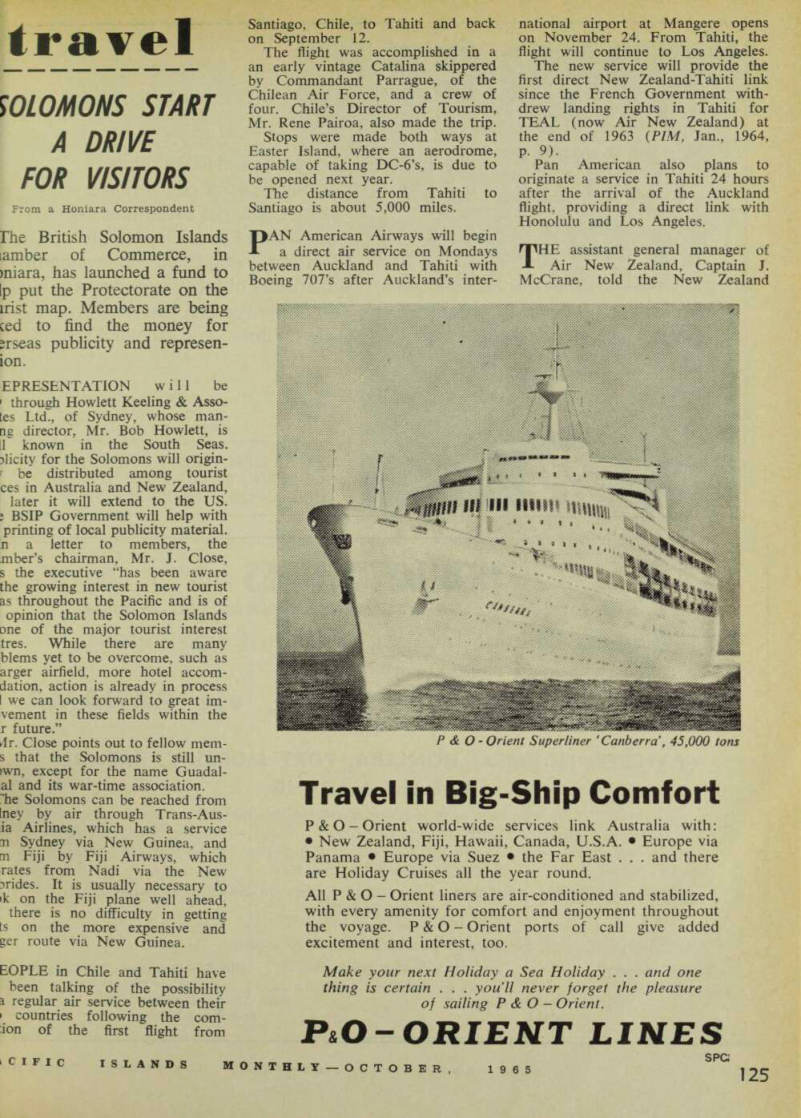 131
131 132
132 133
133 134
134 135
135 136
136 137
137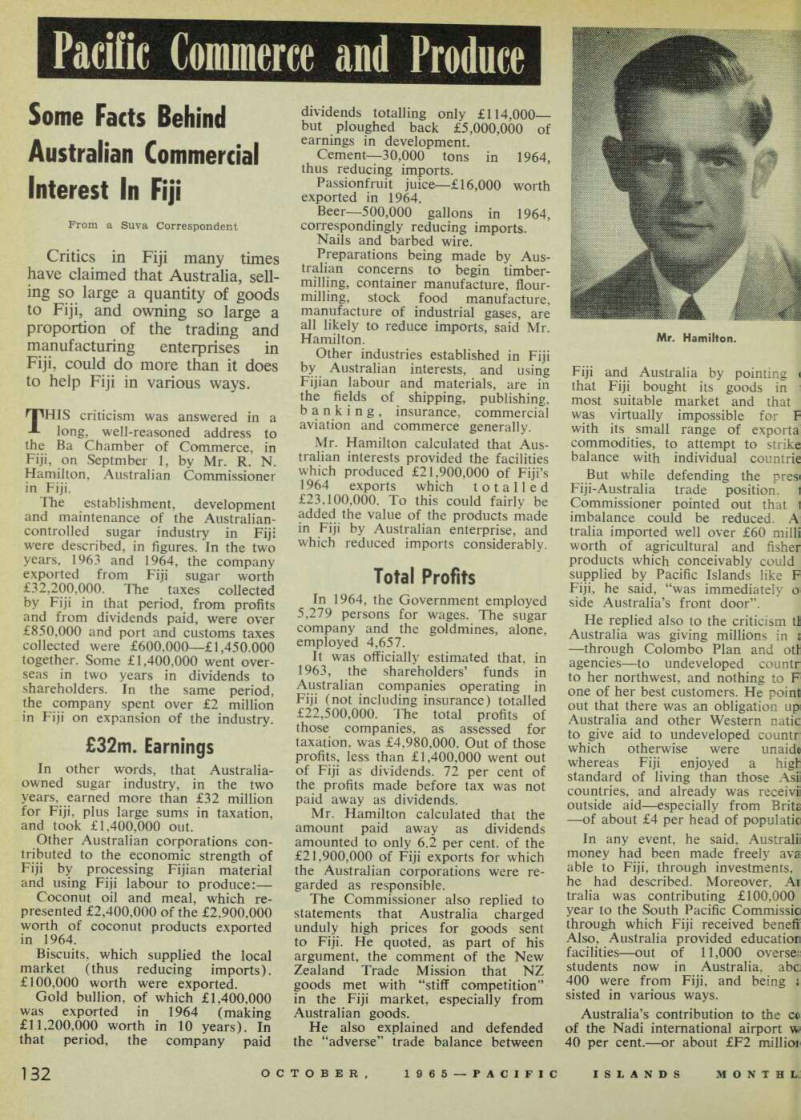 138
138 139
139 140
140 141
141 142
142 143
143 144
144 145
145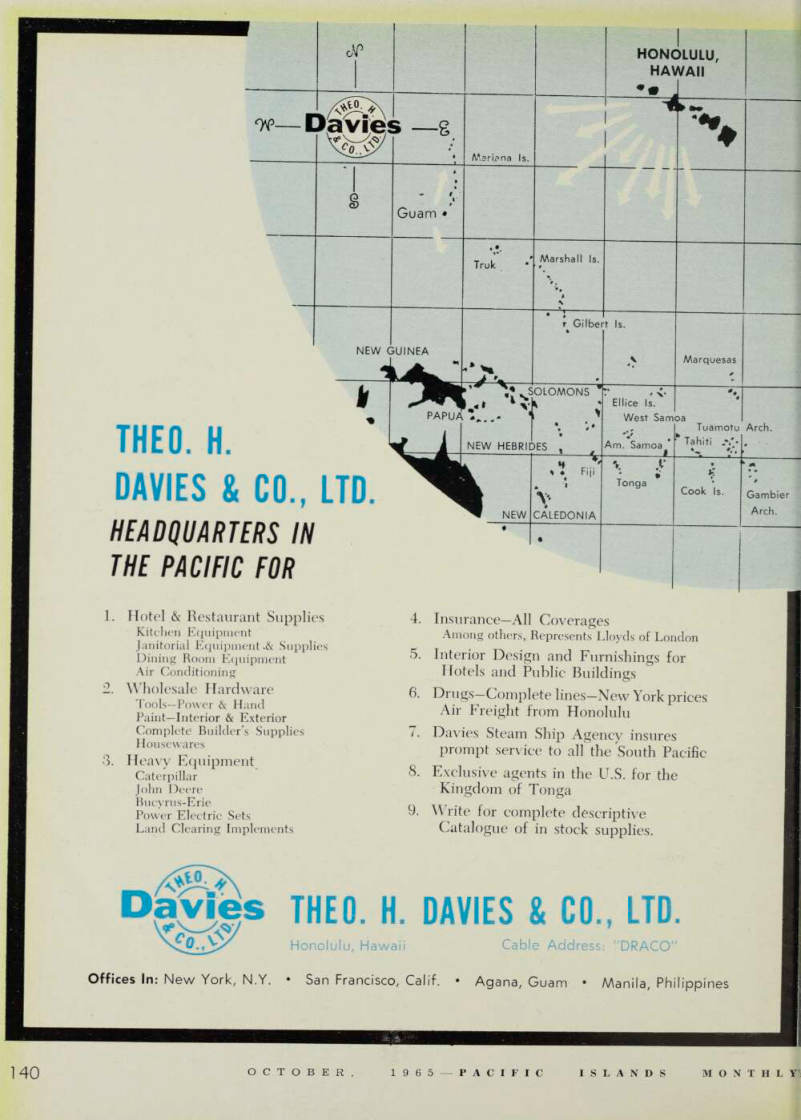 146
146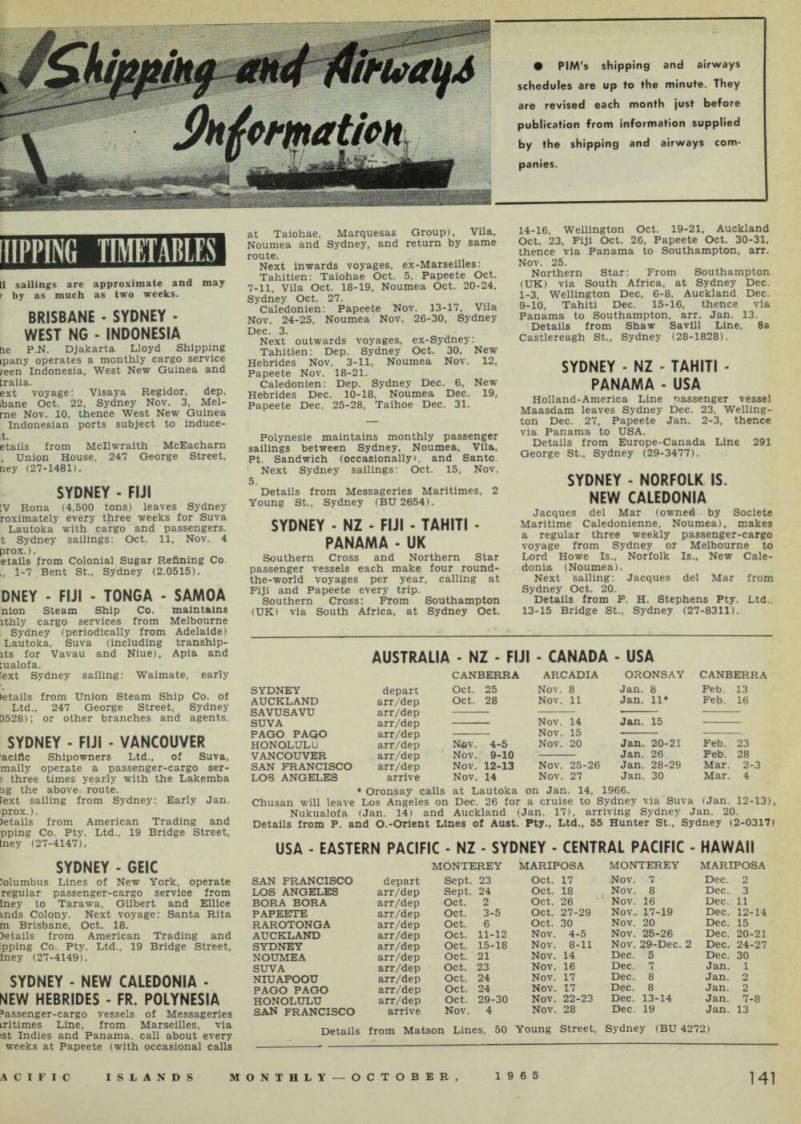 147
147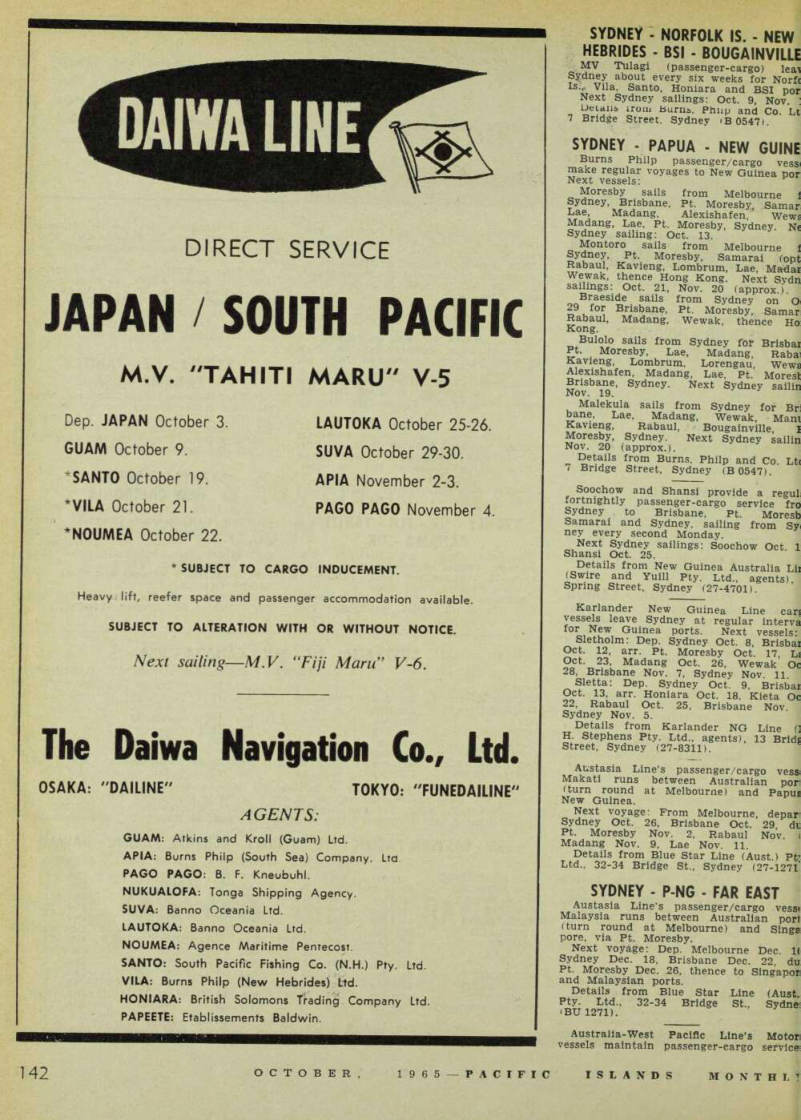 148
148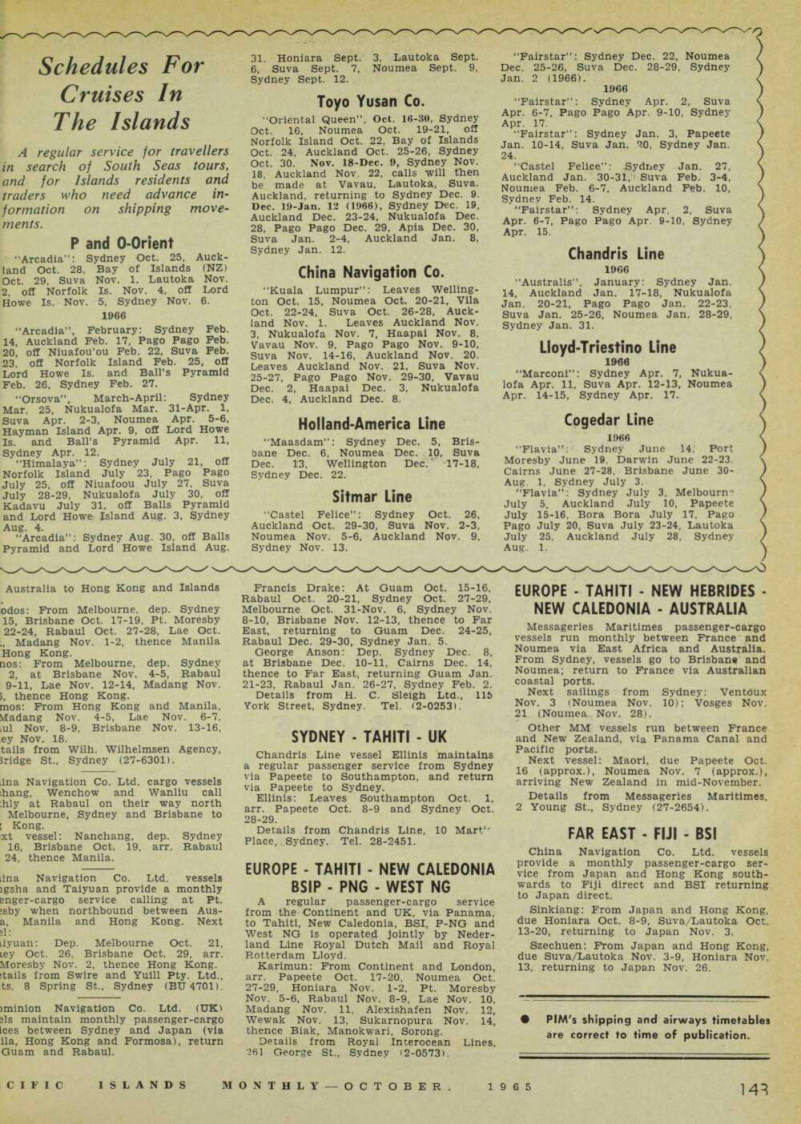 149
149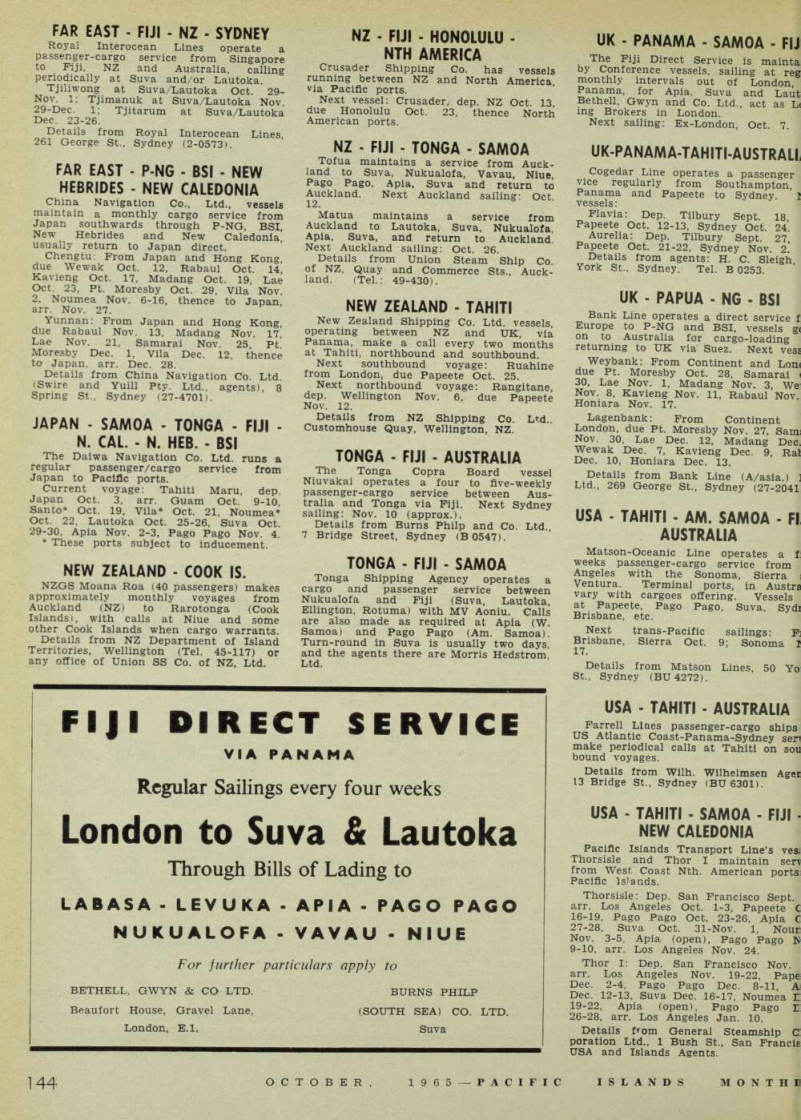 150
150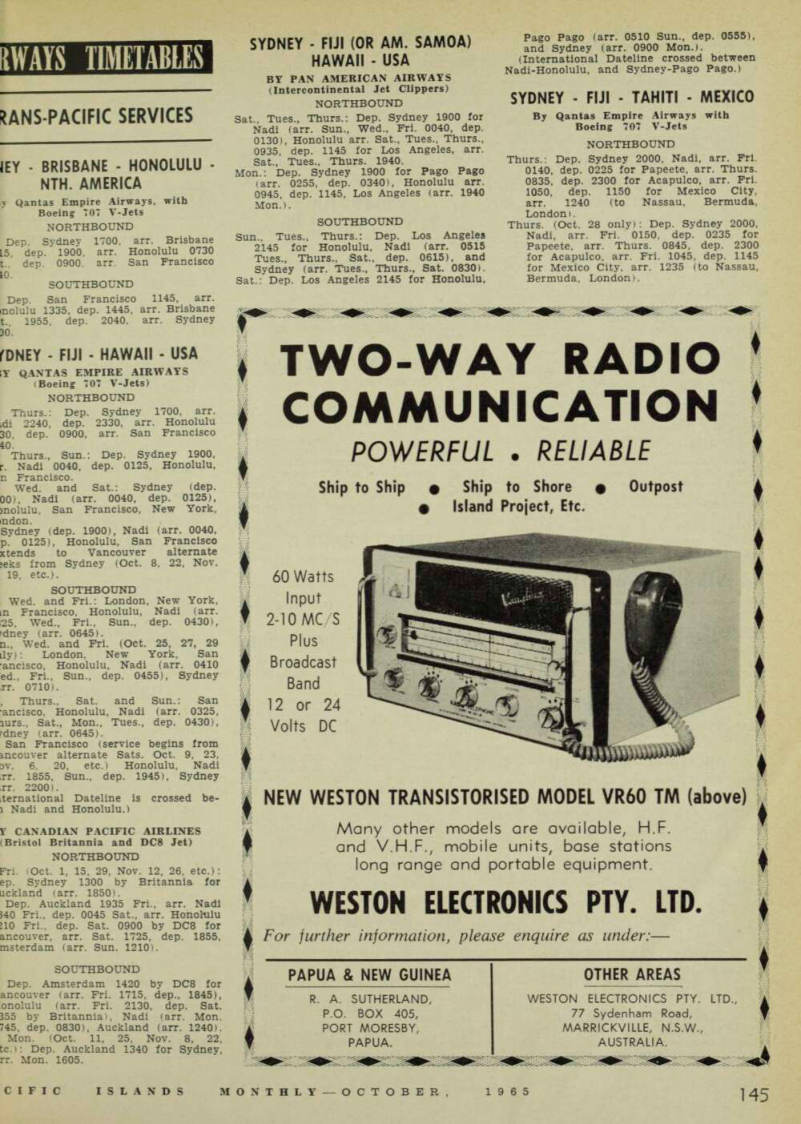 151
151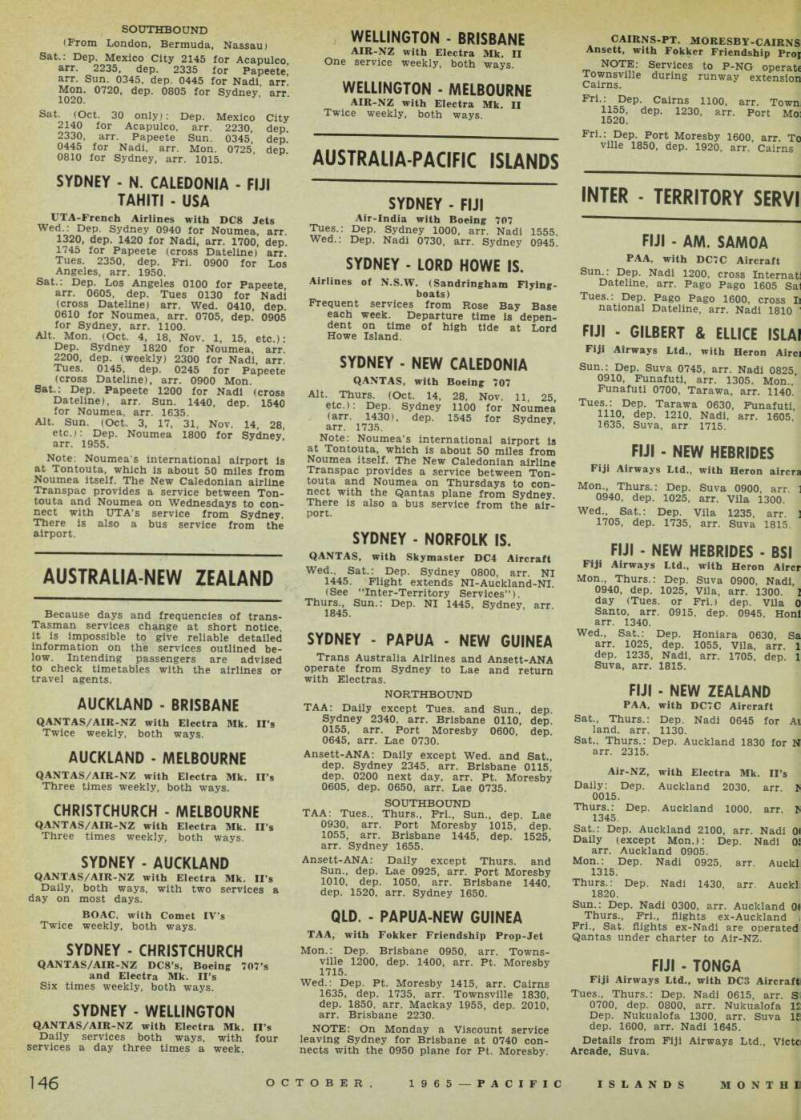 152
152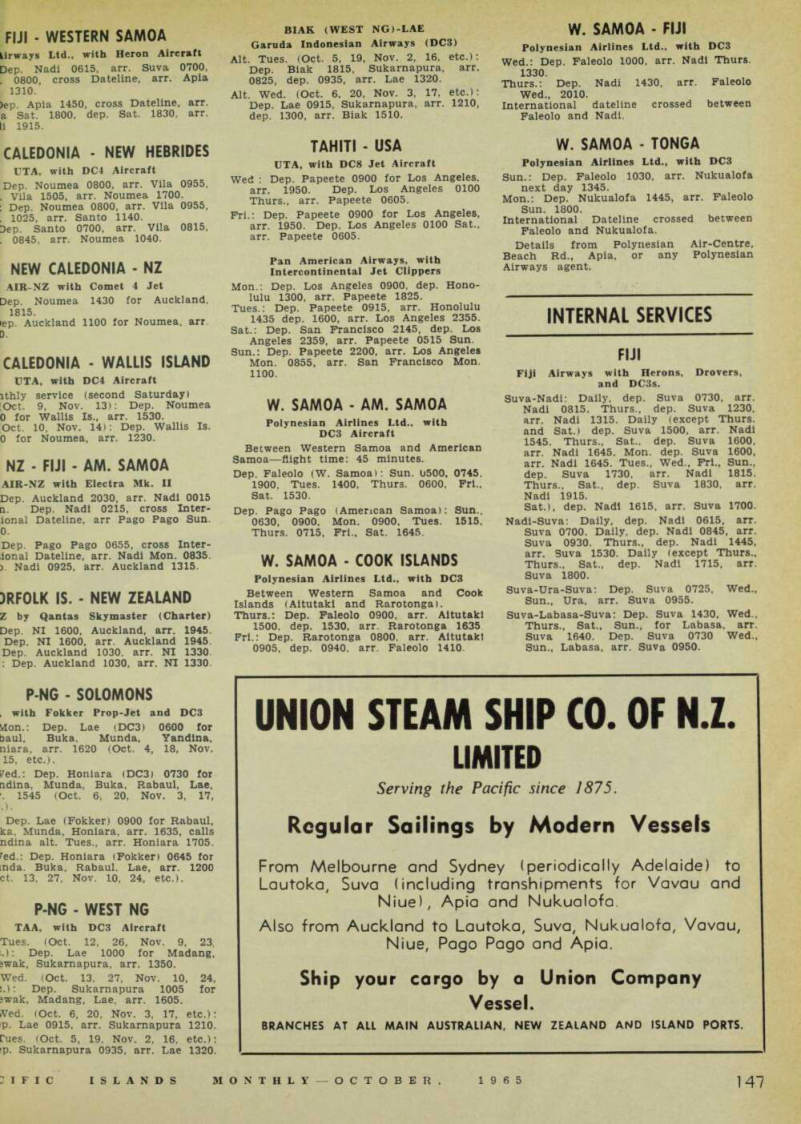 153
153 154
154 155
155 156
156 157
157 158
158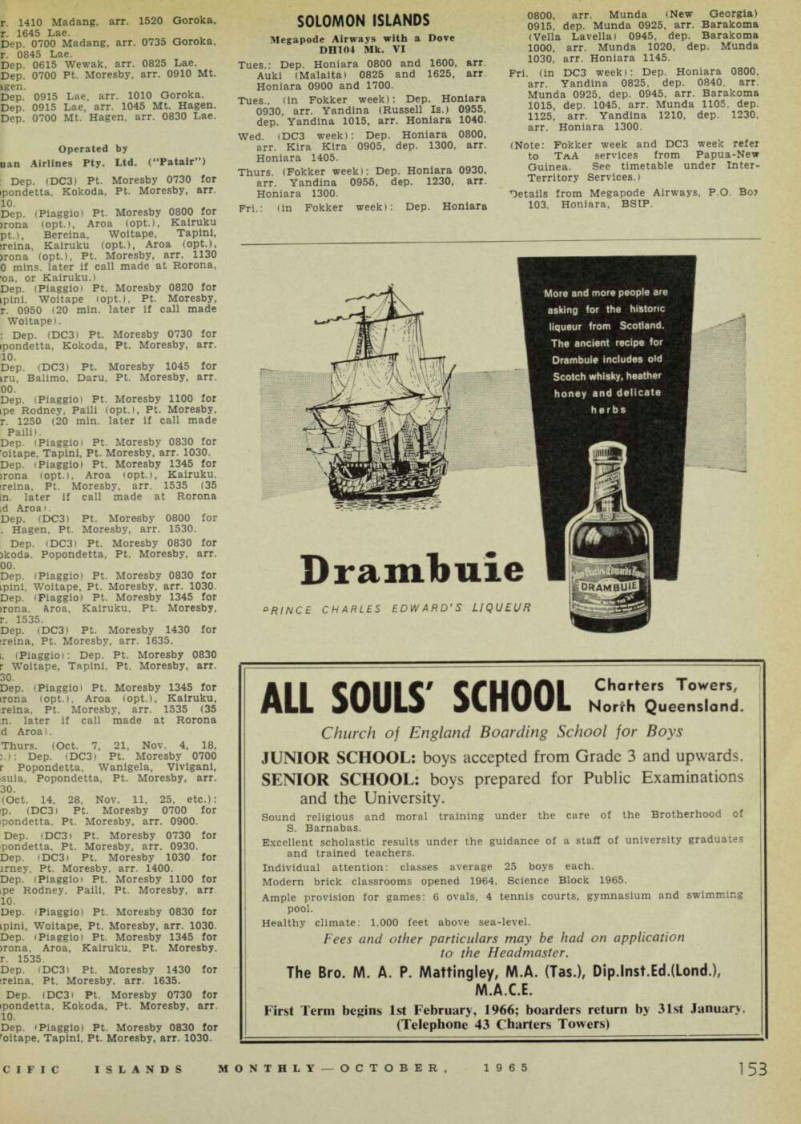 159
159 160
160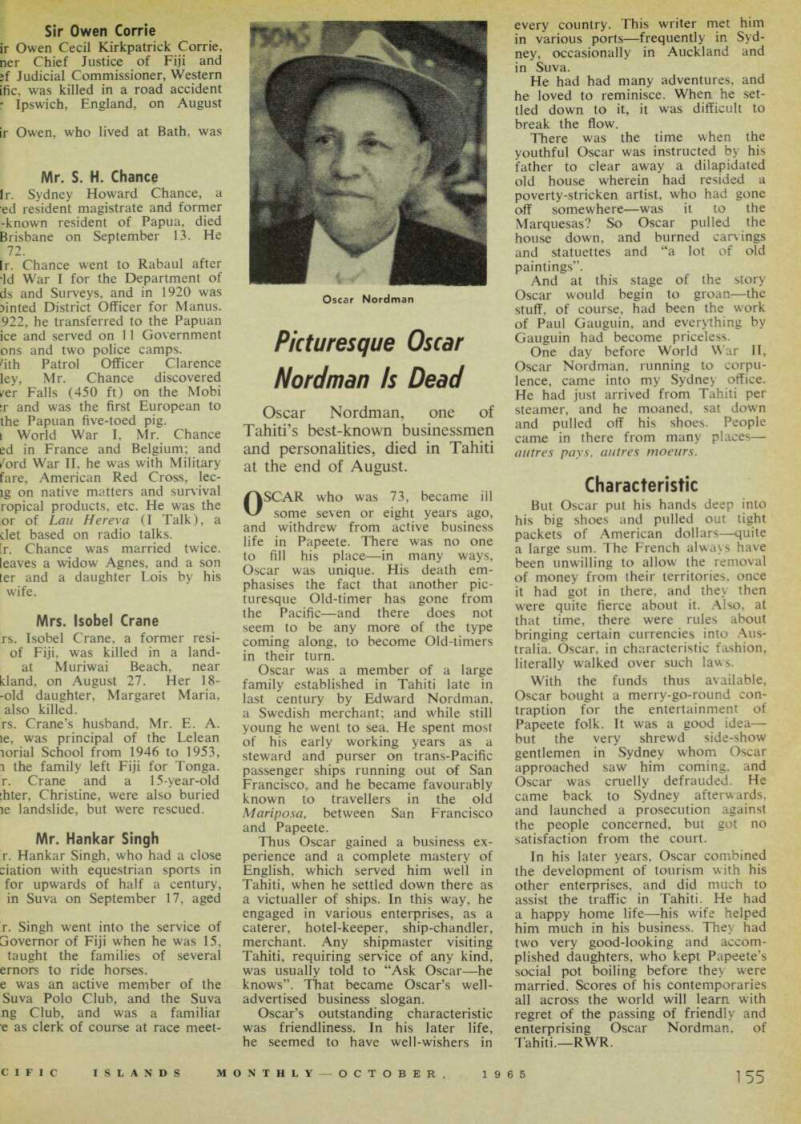 161
161 162
162 163
163 164
164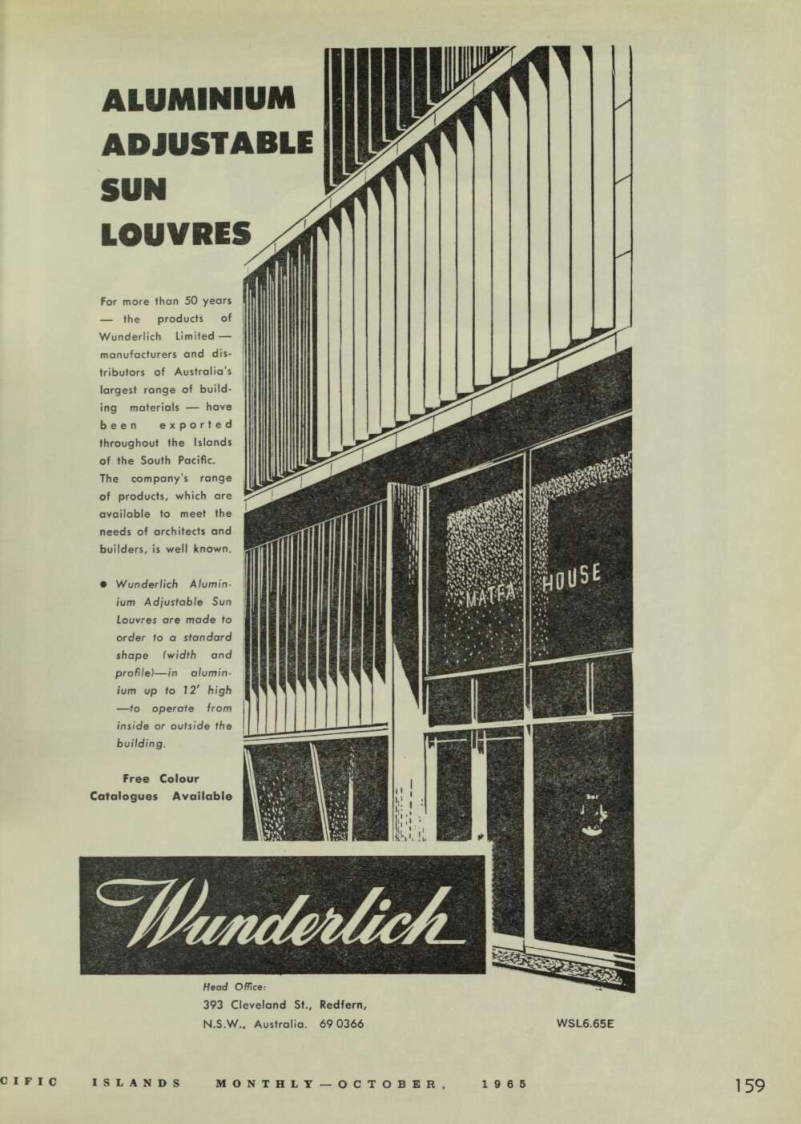 165
165 166
166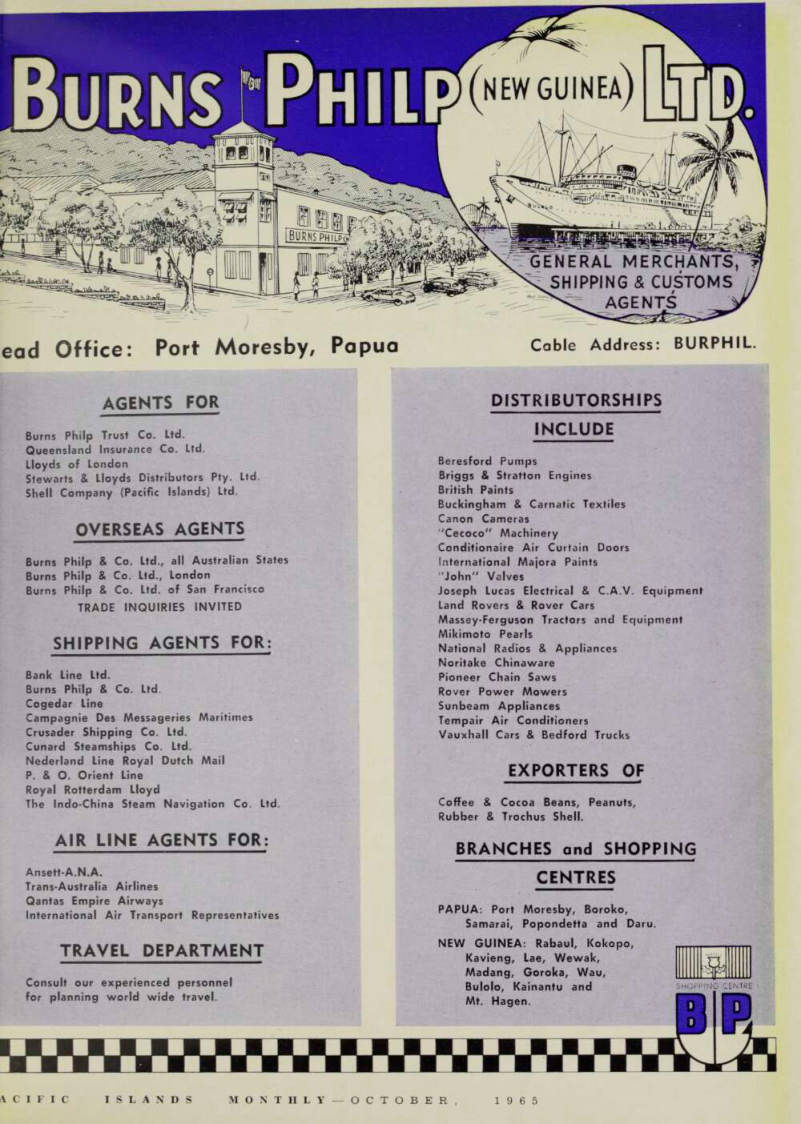 167
167 168
168