Macauley Island Rats
pp. 91-92 · Read in the full issue
An Explanation For Those Macauley Island Rats
From Gordon Russell in Wellington
So there were rats and mice Macauley Island in 1788! ch was the verdict of the ister and mate of the convict
nsport vessel Lady Penrhyn
en they found and surveyed
s pocket-size and precipitous
unber of the Kermadecs on ry 31 of that year.
HIS we know from the published account of the voyage by utenant John Watts, who was passenger in the ship, and also m the unpublished journal of the p’s surgeon, Arthur Bowes, as light to our notice by Robert igdon in PIM for May, 1964 (p. i n spreading over the continents this globe, rats and mice made ir own arrangements; but in cross the Seven Seas they looked to devices of man and were not w to use these as sailings offered.
A Dollar Apiece
•Ve are assured of this from the tings of Pigafetta, a “noble gentle n” who accompanied Magellan on first European crossing of the :ific in 1521. le recorded how rats were fetch a Spanish dollar apiece among starving, scurvy-ridden zealots >ard Magellan’s ship Trinidad. fhe forebears of all the tightrope iking scavengers that now beset lands of the Pacific in the form the ship’s rat ( rattus rattus) and common brown rat ( rattus ' vegicus ) arrived in European sels, and so it was with the nmon mouse, a European pro :t. •Vhen, therefore, Western mariners
of the 18th century came upon an unrecorded and uninhabited Pacific island, they did not expect to find it overrun by the old familiar rodents, and the concern of Arthur Bowes at the presence of rats and mice on Macauley Island in 1788 is understandable.
Poser For Naturalists
He would not concede that anyone had preceded them, but, he wrote, “. . . how these vermin could possibly come there where no ship had ever before been, and situated as this island is in the midst of a prodigious ocean, is a matter to be considered by future naturalists”.
The year 1788 is an early date in European maritime history in the Pacific, early enough to make it fairly easy for us to probe this mystery.
The Lady Penrhyn was one of the 11 ships of the First Fleet to bring colonists to Botany Bay following its discovery by Captain Cook in 1770.
After discharging her freight of 102 female convicts, the Lady Penrhyn reached Tahiti via Macauley Island three months before the arrival of Bligh in the Bounty.
It is not difficult to account for the movements of the handful of ships that could have preceded the Lady Penrhyn to Macauley Island,
assuming that our maritime records are complete.
We can eliminate all Spanish vessels for a start. Despite the Spanish obsession with Terra Aus tralis, there has never been any suggestion that a Spanish vessel ever reached as far south as the Kermadecs in the southwest Pacific.
This leaves only Abel Tasman, in 1643, Captain Cook on his second voyage in 1773, and three French men, Surville in 1769, Dufresne in 1772 and La Perouse in 1787.
As far as we know these were the only explorers to log positions anywhere near the Kermadecs before 1788, and none reported the sighting of any island in that vicinity.
It is just possible, of course, that both rats and mice could have drifted to Macauley in a boat washed away, or a pork or biscuit cask jettisoned from one of these vessels.
Polynesian Voyagers
Failing this rather remote possibility, the only other explanation would seem to be a missing chapter in the annals of Pacific exploration.
Let us suppose that the master and mate of the Lady Penrhyn saw rats only; that the mice described by Bowes were, in truth, baby rats.
It is possible to give a reason for
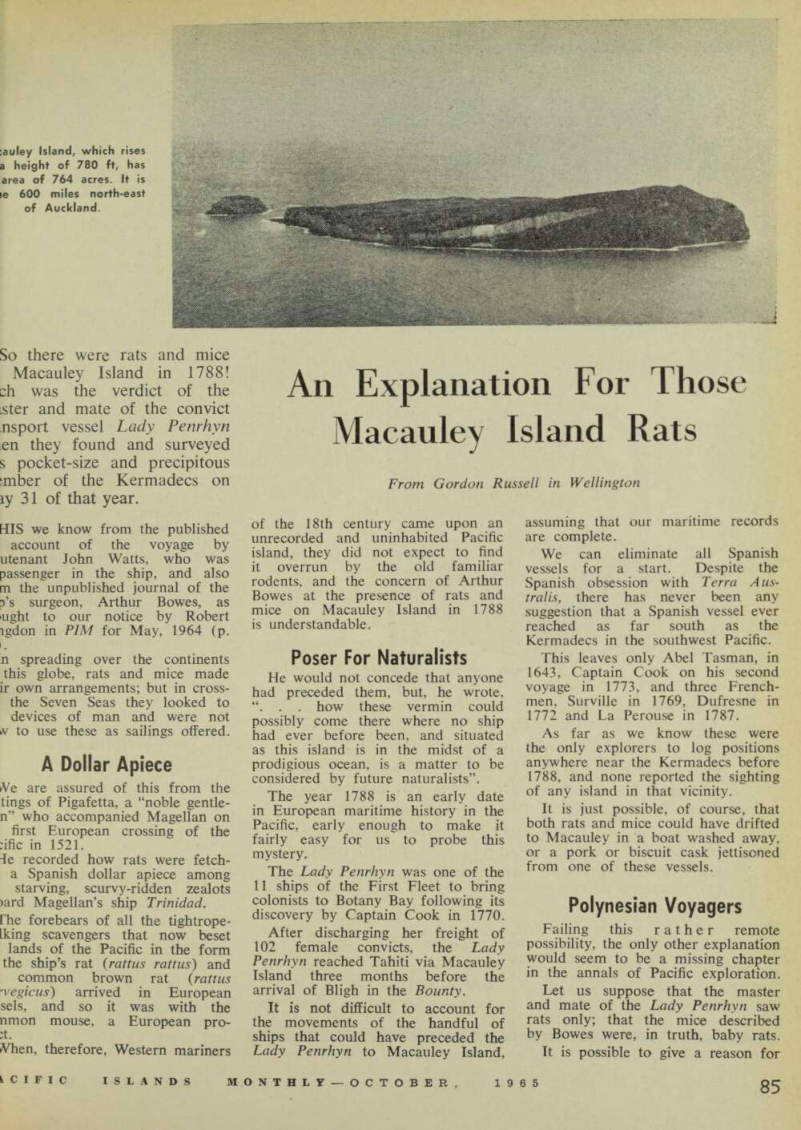
[?]auley Island, which rises a height of 780 ft, has area of 764 acres. It is e 600 miles north-east of Auckland.
the presence of one type of rat Macauley Island in 1788, in quanti No doubt Captain Sever v familiar with Captain Cook’s fi] ings on the Polynesians and his bel that they had been great voyag in their heyday.
But he would not have kno’ that the Polynesians had brought 1 little rattus exulans into the Pad many centuries before his day; tl this apparently succulent and ju; vegetarian was a staple food theirs; and that they had deliberafi conveyed it by canoe from cent: Polynesia to New Zealand.
Such is the traditional eviden It is also a recorded tradition tl the canoe Kurahaupo of the Mai “fleet” was wrecked in the Kermadt some 700 years ago, en route New Zealand.
The finding of stone adzes Raoul Island confirms the eai settlement of Polynesians in tl group.
Raoul, the main island of t Kermadecs, was sighted by D’Ent casteaux in 1793, five years after t discovery of Macauley Island, a in time it became a favourite hai of the whalers.
The Polynesian rat exulans v, common on this island up to 19* but it has since been exterminat by the European rat norvegicus.
Visitors Rare
Some day, perhaps, we may fii on this lonesome isle some clue as its first human visitors. Not mai people have scaled its precipitc shores since the master and the mz of the Lady Penrhyn made it 1788.
But last November it looked for moment as though we might lea something of interest. A party New Zealand scientists were land! that month on Raoul, and th planned to make a thorough vestigation of Macauley Islam weather and shipping permitting.
But Raoul chose to erupt violem at this intrusion, and the scientii were evacuated in a hurry.
As Robbie Burns had it, “the b»i laid schemes o’ mice and men gaj aft agley”.