Topicalities
pp. 30-33 · Read in the full issue

Two apparently unconnected events in recent months have set us wondering whether Uncle Sam’s left hand always knows what his right hand is doing when it comes to Pacific affairs.
THE first event was the publication in Washington in May of an official booklet entitled United States and Outlying Areas which outlines the “exact status within the frame work of the US Government” of “all outlying areas under US pro tection”.
The second event was the vote on August 31 by the United Nations Special Committee on Colonialism taking note of a report submitted by a team of UN observers commending the manner in which the elections were conducted in the Cook Islands in April for that territory’s first Legislative Assembly under self government.
The link (and apparent contra diction) between the booklet and the UN vote is that the booklet says that four of the islands in the Northhern Cook Group are claimed by the United States, while the vote of the UN committee (of which the US is a member) recognises the validity of the Cook Islands elections, and, in effect, cancels out the US claims.
Disputed Islands
The booklet is the fifth geographic bulletin to be compiled and released by the US State Department’s Bureau of Intelligence and Research, It has sections on Alaska, Hawaii, Puerto Rico, the Virgin Islands, Canal Zone, American Samoa, Guam, etc., and “disputed islands in the Pacific”.
In the section on disputed islands, it is stated that “in the south-central part of the Pacific Ocean lie 25 islands over which the US claim to sovereignty is disputed. The United Kingdom claims 18 of them; New Zealand 7”.
The booklet says that the islands claimed by the United States and the United Kingdom are Caroline Atoll and Christmas, Flint, Malden, Star buck and Vostok Islands in the Line Group; Funafuti, Nukufetau, Nukulaelae and Nurakita Atolls in the Ellice Group; and Birnie, Gardner,
Hull, McKean, Sydney and Phoenix Atolls, and Canton and Enderbury Islands in the Phoenix Group.
The islands claimed by the United States and New Zealand are Atafu, Fakaofu and Nukunono Atolls in the Tokelaus; and Danger (Pupapuka), Manihiki, Rakahanga and Penrhyn Atolls in the Northern Cook Group.
Although the booklet claims to assemble “information which is useful, hard to find and important for an understanding of the geography of our country”, it contains no specific statement on why the United States lays claim to the 25 islands enumerated.
Guano Act
It appears to us that the main basis for the US claims is the Guano Act, which was passed by the US Congress on August 18, 1856, to enable Americans to claim unoccupied islands in the name of the United States for the purpose of removing guano (phosphate).
But whatever the bases for the US claims are, there seems to be no evidence that the US has ever sought to take control of the four disputed islands in the Cook Group (nor, for that matter, of those in the Ellice Group and Tokelaus).
The US vote in the United Nations Committee on Colonialism on August 31 was tantamount to saying that the US has no hankering to possess any of the Cook Islands now.
So it seems to us that Uncle Sam might just as well formally renounce such claims as he once had to Puka puka, Manihiki, Rakahanga and Penrhyn.
Certainly, such a move, which would cost the United States nothing, would go down well in the Cook Islands, where the attainment of self government has given the people a sense of nationhood they did not have before.
With such people, the continuation of an ancient claim to sovereignty over some of their territory by a colossus such as the United States
could, with much justification, t interpreted as an unfriendly act.
It could, moreover, start son anti-United States sniping in the U Committee on Colonialism, wher on August 23, the Cook Islam Premier, Mr. Albert Henry sale “We may be one of the smalle distinct peoples in the world, and y you have taken an interest to s< that we as a people have a right i exist.”
Special Day For
A Friend Of Fiji
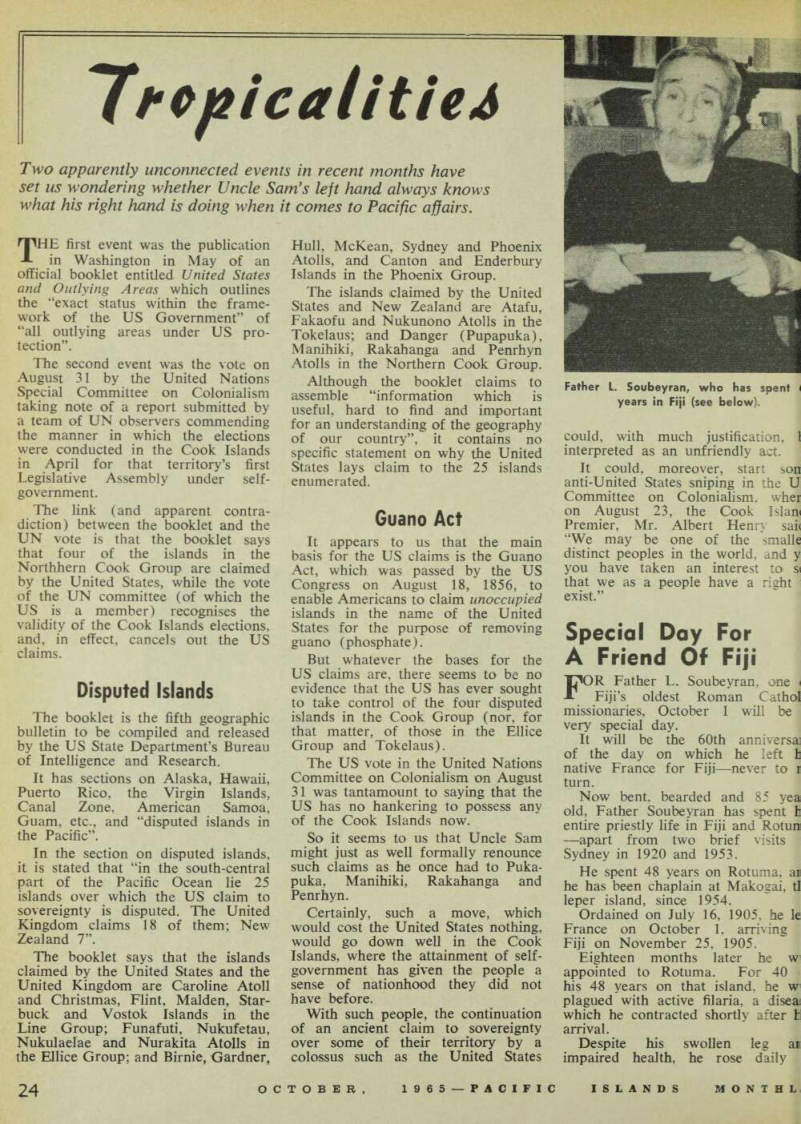
Father L. Soubeyran, one i -T Fiji’s oldest Roman Cathol missionaries, October 1 will be very special day.
It will be the 60th anniversa] of the day on which he left h native France for Fiji—never to r turn.
Now bent, bearded and 85 yea old, Father Soubeyran has spent h entire priestly life in Fiji and Rotun —apart from two brief visits Sydney in 1920 and 1953.
He spent 48 years on Rotuma, an he has been chaplain at Makogai, tl leper island, since 1954.
Ordained on July 16, 1905. he le France on October 1, arriving Fiji on November 25, 1905.
Eighteen months later he w 1 appointed to Rotuma. For 40 his 48 years on that island, he w' plagued with active filaria, a Jisea* which he contracted shortly after bl arrival.
Despite his swollen leg an impaired health, he rose daily
Father L. Soubeyran, who has spent years in Fiji (see below).
a.m. and worked until midnight mong his people. He walked— nd later rode a bicycle—all over the ►land, visiting the sick and admini tering to the needs of his large arish.
Rotumans of all ages and enominations came to love him; nd his ex-parishioners say his whole fe was directed entirely to his call ig and to the service of others.
To mark his diamond jubilee as a riest last July, Rotumans in Fiji sked to be allowed to honour the lissionary, and a celebration was eld at Samabula.
Five hundred Rotumans attended, 5 did Bishop Victor Foley, of Fiji, ad Bishop George Pearce, of Western Samoa.
There were many emotional scenes > the little, old priest moved among ic people with whom he had lived id worked for so many years.
Bishop Foley spoke in glowing rms of Father Soubeyran’s work i Rotuma.
“His work will be his memorial, id the churches and schools he has lilt, his monuments,” he said.
Father Soubeyran was cured of aria in 1948, but not before an :asperated AMO on Rotuma had oken the only known critical re ark about the gentle, old priest.
“He is foolish,” the AMO is re nted to have said. “He does not ,t enough, or sleep enough. He ould take more care of himself id his own needs.”
Father Soubeyran is now back at akogai. He has no desire to return the homeland he left so long ago. 1938 he was given the opportunity revisit it, but he rejected it,
i Backward Look At
in Old Prediction
THE outstanding part played by Ratu K. K, T. Mara, of Fiji, the Sixth South Pacific Conference Lae in July and at the subsequent ji constitutional conference in mdon made us more than ordinarily ;erested in an item in P1M for ;cember, 1952, which we happened notice the other day while trumb l through a bound volume.
The item was written by PIM’s blisher, R. W. Robson, after one his numerous forays in the Pacific, reads: — “In Fiji, they are watching with crest and pleasure the way Ratu ara is coming to the fore as a tder of the Fijians. He has great tural ability; he has been very well (Over)
Jucated; he is still only in his lirties; he is a Catholic; and he is eld in high favour by the Council f Chiefs.
“Wise old Lala Sukuna has been le leader of the Fijians for many ;ars, and most people in the Colony >pe that he may remain in that >sition for a long time yet. But ; is inevitable in nature, the years ke their toll; and a community ways is watching for oncoming aders. Mara already has taken a rong stand in some Fijian arguments, id it is predicted that his name ill be prominent in the future, in lation to native affairs.”
RWR’s prediction, it seems, has me to pass.
Vho, Me? No, No!
|UR paragraph in June (p. 14) ’ reporting that some authoritative jw Guinea circles were tipping that Tasmanian Liberal politician, Mr.
W. J. Falkinder, DSO, DFC and it, might become Administrator of pua-New Guinea after Sir Donald eland retires next year drew a nial when it was later reprinted in ; Hobart Mercury.
“I know nothing about it,” Mr.
Ikinder told the Mercury next day. fy present plans are to seek re dorsement for Franklin at the next deral election.”
Mr. Falkinder, 43, has represented anklin in the House of Repre itatives since 1946, but has taken dose interest in Papua-New Guinea airs in recent years and has made quent visits to the territory.
ole Of A New
uineo Shirt
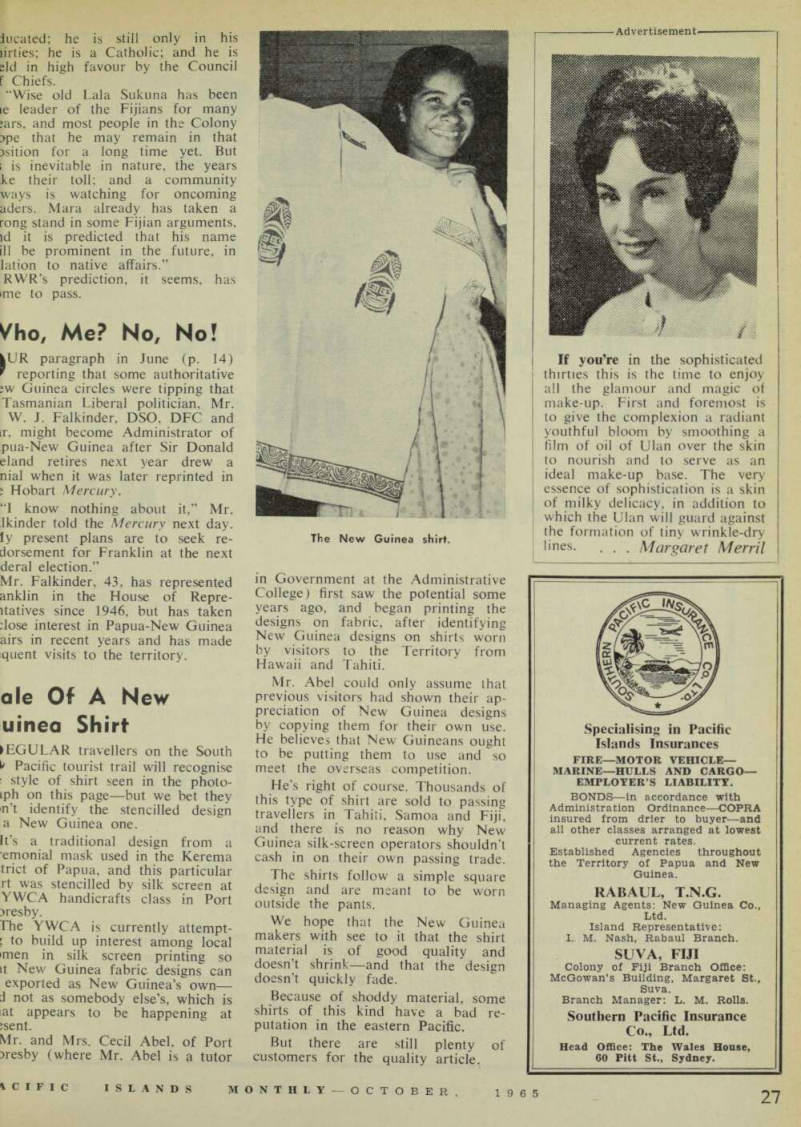
REGULAR travellers on the South Pacific tourist trail will recognise : style of shirt seen in the photo iph on this page—but we bet they n’t identify the stencilled design a New Guinea one.
It’s a traditional design from a emonial mask used in the Kerema trict of Papua, and this particular rt was stencilled by silk screen at YWCA handicrafts class in Port >resby.
The YWCA is currently attempt ; to build up interest among local •men in silk screen printing so it New Guinea fabric designs can exported as New Guinea’s own— d not as somebody else’s, which is iat appears to be happening at ;sent.
Mr. and Mrs. Cecil Abel, of Port Dresby (where Mr. Abel is a tutor
in Government at the Administrative College) first saw the potential some years ago, and began printing the designs on fabric, after identifying New Guinea designs on shirts worn by visitors to the Territory from Hawaii and Tahiti.
Mr. Abel could only assume that previous visitors had shown their ap preciation of New Guinea designs by copying them for their own use.
He believes that New Guineans ought to be putting them to use and so meet the overseas competition.
He’s right of course. Thousands of this type of shirt are sold to passing travellers in Tahiti, Samoa and Fiji, and there is no reason why New Guinea silk-screen operators shouldn't cash in on their own passing trade.
The shirts follow a simple square design and are meant to be worn outside the pants.
We hope that the New Guinea makers with see to it that the shirt material is of good quality and doesn’t shrink—and that the design doesn’t quickly fade.
Because of shoddy material, some shirts of this kind have a bad re putation in the eastern Pacific.
But there are still plenty of customers for the quality article.
The New Guinea shirt.