-By Order
p. 27 · Read in the full issue
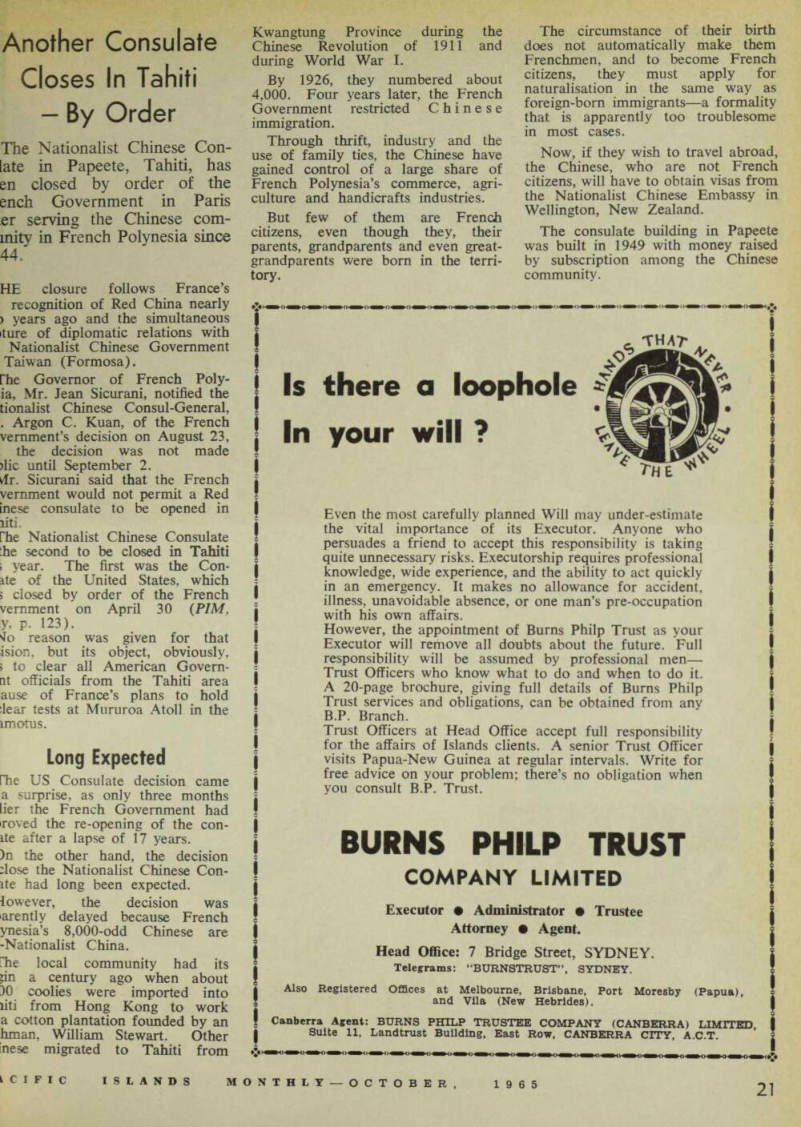
Another Consulate Closes In Tahiti -By Order
The Nationalist Chinese Con
late in Papeete, Tahiti, has
en closed by order of the ench Government in Paris er serving the Chinese com ini ty in French Polynesia since 44.
HE closure follows France’s recognition of Red China nearly ) years ago and the simultaneous iture of diplomatic relations with Nationalist Chinese Government Taiwan (Formosa), fhe Governor of French Poly ia, Mr. Jean Sicurani, notified the tionalist Chinese Consul-General, . Argon C. Kuan, of the French vernment’s decision on August 23, the decision was not made )lic until September 2. dr. Sicurani said that the French vernment would not permit a Red inese consulate to be opened in liti. fhe Nationalist Chinese Consulate :he second to be closed in Tahiti ; year. The first was the Con ite of the United States, which > closed by order of the French vernment on April 30 (P/M, y, p. 123). 4o reason was given for that ision, but its object, obviously, ; to clear all American Govern nt officials from the Tahiti area ause of France’s plans to hold :lear tests at Mururoa Atoll in the unotus.
Long Expected
fhe US Consulate decision came a surprise, as only three months lier the French Government had iroved the re-opening of the con ite after a lapse of 17 years. )n the other hand, the decision dose the Nationalist Chinese Con ite had long been expected, lowever, the decision was arently delayed because French ynesia’s 8,000-odd Chinese are -Nationalist China, fhe local community had its pn a century ago when about )0 coolies were imported into liti from Hong Kong to work a cotton plantation founded by an hman, William Stewart. Other inese migrated to Tahiti from
Kwangtung Province during the Chinese Revolution of 1911 and during World War I.
By 1926, they numbered about 4,000. Four years later, the French Government restricted Chinese immigration.
Through thrift, industry and the use of family ties, the Chinese have gained control of a large share of French Polynesia’s commerce, agri culture and handicrafts industries.
But few of them are French citizens, even though they, their parents, grandparents and even great grandparents were born in the terri tory.
The circumstance of their birth does not automatically make them Frenchmen, and to become French citizens, they must apply for naturalisation in the same way as foreign-born immigrants—a formality that is apparently too troublesome in most cases.
Now, if they wish to travel abroad, the Chinese, who are not French citizens, will have to obtain visas from the Nationalist Chinese Embassy in Wellington, New Zealand.
The consulate building in Papeete was built in 1949 with money raised by subscription among the Chinese community.