' Grave Unrest’ Among P-NG
pp. 18-19 · Read in the full issue

Officers Over Future
By J. G. Smith, L I.B., President of the Public Service Association of Papua-New Guinea.
The rapid political changes in Papua-New Guinea have caused Australian permanent public servants to ask for some thing more than generalities from Australia concerning the security of their future.
OVERSEAS officers are entitled to know, and badly want to know, under just what circumstances they will become entitled to compensation if they lose their jobs, and how that compensation will be calculated.
But although they have been asking for this information for a consider able time, so far they have been given no guarantees. Meanwhile, be cause of apprehension about the future, valuable public servants are resigning.
The Papua-New Guinea Public Service at present has 3,315 overseas officers in its emp10y—2,362 of whom are permanent. Practically every senior position in the Territory Public Service is occupied by a permanent overseas officer. But, there has been a loss of 157 permanent officers in the first five months of this year, and there was a similar drain last year.
As early as September, 1962, in answer to Public Service fears the then Minister for Territories, Mr.
Hasluck. said: The Government has authorised me to give assurances that. (a) For its part, it intends that the help of Australians should be avail able to the Territory Public Service under expatriate conditions until there are sufficient qualified people willing to work under local Territory con ditions to staff the Public Service fully. . . (b) Whatever course constitutional change in the Territory may take, the Government proposes to ensure that those expatriate public servants who are working in the Territory under arrangements made by the Government for providing help to the Territory will not have their remuneration or conditions of service changed, unless such changes are decided upon or accepted by the Australian Government, the only ex ception being any changes resulting from proceedings before the Public Service Arbitrator. {c) The Australian Government will take whatever steps are necessary to maintain remuneration and conditions of service in accordance with the
foregoing, and also to ensure that the entitlements of expatriate officers or their dependants under the existing Territory Public Service superan nuation scheme are fully honoured. (d) Any permanently appointed expatriate officers who continue to serve in the Territory in carrying out the Government’s intentions to provide the help referred to, and whose careers are terminated before normal retirement age for the sole reason that they are replaced by people serving under local conditions, will be assisted to find other employ ment or will be provided with reason able compensation for loss of em ployment.
The assurances contained in the final paragraph of this statement did not go far enough.
The Territory public servants wanted, and still want, a scheme which will compensate them for (a) loss of career, in broadly the same circumstances as those under which compensation has been paid to former officers of the British Over seas Civil Service at the time ter ritories were about to become inter nally self-governing and (b) being superseded for promotion as a con sequence of the localisation of the Public Service.
Minister Anxious
The Public Service Association asked Mr. Hasluck for such a scheme in September, 1963. In November, 1964, the PSA submitted detailed proposals for a scheme to Mr.
Hasluck’s successor, Mr. Barnes, and was told that the Minister was anxious to have a scheme in existence by the end of that year.
In a Press statement at that time, the president of the PSA said: “It is not for the Commonwealth Government simply a question of justice to the officers concerned. It is also a grave and urgent matter of practical politics.
“Very many permanent officers have now come to feel that by one
factor or another their working live; in the Territory are liable to be cui short, and that they will have t« start over again in Australia—suffer ing all the disadvantages of late comers.”
A thorough survey of employmen opportunities open to Territor public servants in Australia wa made in 1964 by one of Australia* leading firms of management con sultants, on behalf of the PSA, am this revealed that many oversea officers would find in Australii nothing like the jobs and remuners tion they received in the Territory This was mainly due to the fao that many skills developed in th Territory had no market in Au; tralia.
The Minister was told that 35: overseas officers had resigned durin 1963/4 and that resignations wen continuing.
It was, I think, becoming cles that the Territory would in a fe; years be deprived of the services o most of its permanent public servani unless something were done to assui them of their future.
The Territory would need th services of competent, skilled publi servants for many years to come.
On May 17 this year, the Ministr approved a PSA Press release whio quoted him as saying: “The Ministc stated that he was in complej agreement that an announcement o a compensation scheme was urgent: desirable. He stated that his depan ment, in collaboration with otha Commonwealth Departments, ha prepared a final scheme for Cabin©
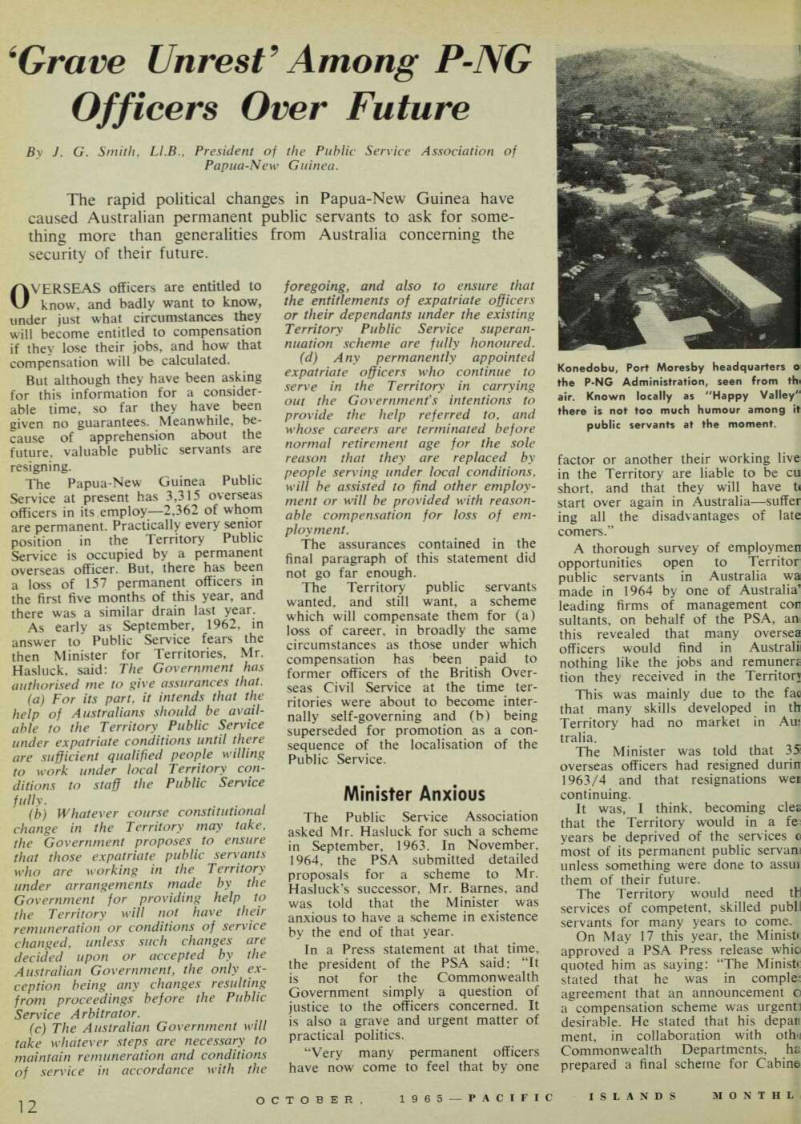
Konedobu, Port Moresby headquarters [?] the P-NG Administration, seen from the air. Known locally as "Happy Valley" there is not too much humour among it public servants at the moment.
nd that he hoped an announcement 'ould be forthcoming from Cabinet nthin three weeks ” (my italics).
On August 4 a delegation from le PSA once again saw Mr. Barnes nd reiterated that there was grave nrest in the Public Service due to lack of a decision about the com ensation scheme.
The delegation read to the Minister number of the most recent resolu ons from branches of the PSA enchantly criticising the Govern lent’s failure to announce such a :heme.
Mr. Barnes said his department ad made a submission to Cabinet, hich had considered it twice and ould consider again.
He said he regarded it as imthat the number of overseas Ticers in the Territory be increased / at least 2,000 during the next five ;ars, so that recommendations con ined in the World Bank report >uld be implemented.
Mr. Barnes added that this would ; difficult to achieve unless the •esent high rate of departures of ;rmanent overseas officers was sub antially reduced.
The Public Service Association dieves that it will be impossible to irry out even part of the World ank submissions unless the services permanent Australian public rvants in the Territory are tained.
Yet a decision on compensation still awaited. Meanwhile the Aus alian Government has refused to iplement another request by the sA that the Government legislate guarantee Australian officers their perannuation benefits—a guarantee at would see that their superan lation would be paid to them in ustralia. in Australian currency.
At present the superannuation heme is dependent on Territory gislation.
The basis of the Government’s fusal is that no further guarantees e needed in view of the assurances yen by Mr. Hasluck in 1962.
I believe this decision to be a ave error, because it won’t help e morale of the public servants or rest the high rate of resignations, le public servants are sorely afraid at such legislation may be neces ry, whether or not the Government inks so.
Since the overseas officers can see > good reason why this further rety should not be given they are •t to read a sinister implication into e fact that there has seemed to be firm determination not to give the surance. And who can blame them r reading it thus?