Some Afterthoughts On Fiji's
pp. 13-14 · Read in the full issue
Constitutional Conference
From L. G. Usher, who was in London for the Fiji Constitutional Conference
With the return, by various routes, of the delegates to the London Conference on Fiji in July, the Colony is only now beginning to hear some of the background of that meeting—which cost some £20,000 and was attended by all unofficial members of the Legislative Council.
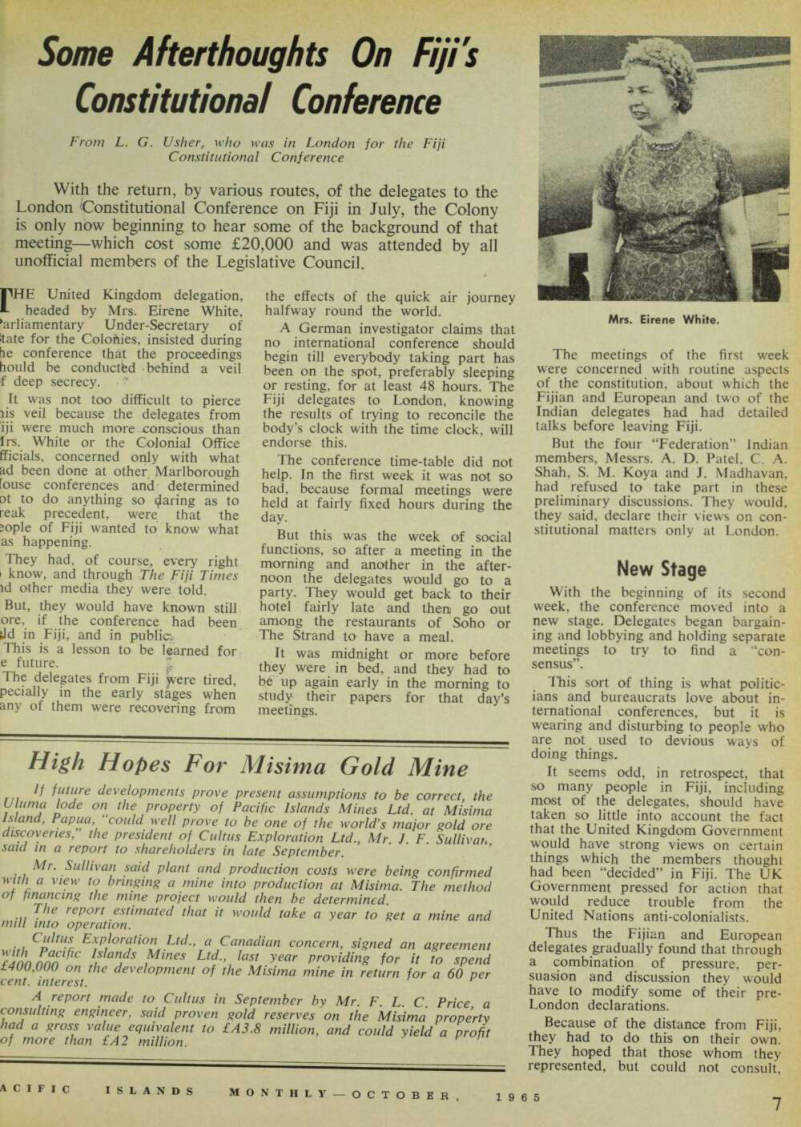
rHE United Kingdom delegation, headed by Mrs. Eirene White, parliamentary Under-Secretary of Jate for the Colofties, insisted during u , c ? n [ erence that the proceedings hould be conducted behind a veil f deep secrecy.
It was not too difficult to pierce lis veil because the delegates from iji were much more conscious than Irs. White or the Colonial Office fficials, concerned only with what ad been done at other Marlborough louse conferences and determined ot to do anything so faring as to reak precedent, were that the :ople of Fiji wanted to know what as hannpnina T , , g ' they had of course, every right i know, and through The Fiji Times id other media they were told.
But, they would have known still ore, if the conference had been lid in Fiji, and in public.
This is a lesson to be learned for Xk. Slf: ♦ r T 7... f . , The delegates from Fiji jvere tired, pecially in the early stages when any of them were recovering from
the effects of the quick air journey halfway round the world, A German investigator claims that no international conference should begin till everybody taking part has been on the spot, preferably sleeping or resting, for at least 48 hours. The Fiji delegates to London, knowing the results of trying to reconcile the body’s clock with the time clock, will endorse this.
The conference time-table did not help. In the first week it was not so bad, because formal meetings were held at fairly fixed hours during the day.
Rllf tU Q . . .
But thls was the week of social functions, so after a meeting in the morning and another in the after noon the delegates would go to a party. They would get back to their hotel fairly late and then go out among the restaurants of Soho or The Strand to have a meal.
It was midnight or more before th ey were in bed, and they had to be up again early in the morning to study their papers for that day’s meetings.
The meetings of the first week were concerned with routine aspects of the constitution, about which the Fijian and European and two of the Indian delegates had had detailed talks before leaving Fiji.
But the four “Federation” Indian members, Messrs. A. D. Patel. C. A.
Shah, S. M. Koya and J. Madhavan, had refused to take part in these preliminary discussions. They would, they said, declare their views on con stitutional matters only at London.
New Stage
With the beginning of its second week, the conference moved into a new stage. Delegates began bargain ing and lobbying and holding separate meetings to try to find a “con sensus”.
This sort of thing is what politic ians and bureaucrats love about in ternational conferences, but it is wearing and disturbing to people who are not used to devious ways of doing things.
It seems odd, in retrospect, that so many people in Fiji, including most of the delegates, should have taken so little into account the fact that the United Kingdom Government would have strong views on certain things which the members thought had been “decided” in Fiji. The UK Government pressed for action that would reduce trouble from the United Nations anti-colonialists.
Thus the Fijian and European delegates gradually found that through a combination of pressure, per suasion and discussion they would have to modify some of their pre- London declarations.
Because of the distance from Fiji, they had to do this on their own.
They hoped that those whom they represented, but could not consult,
Mrs. Eirene White.
would understand and accept the changes and the reason for them.
The UK Government strongly op posed the further electoral fragmenta tion of Fiji, which was involved in a proposal that separate Legislative Council seats should be allotted to minority groups, such as the Chinese and the Rotumans.
So the Fijians agreed that Rotu mans and other Pacific Islanders should be included in the Fijian roll, and the Europeans agreed that their community should form part of a larger group, including the Chinese and others not catered for.
This made it possible for the first time to give every adult citizen of Fiji a vote in Legislative Council elections and a chance to become a member of the council.
Special Position
It had been proposed in Fiji that the special position of the Fijian people in their own land should be recognised by the election of two additional members of the Legislative Council by the Council of Chiefs.
To gain agreement on this, the European delegates agreed that the two extra Fijian members should be balanced by a reduction of two in the number representing their own group.
This kind of give-and-take was not achieved without some misgivings. It was the result of long, often worrying discussions, at Marlborough House, in hotel bedrooms and the corners of public rooms, over meals and drinks, early in the morning and often extending far into the night.
But when agreement was reached on a particular point, the delegates concerned felt that they had done their best, and that they had at least reconciled varying views and had reached agreement through discus sion and debate.
The “Federation” group chose a different role.
Before the conference, they had suggested they had proposals, long and wisely considered, ready to be whipped out of the bag at London.
But when it came to the point, the other delegates were first surprised, and then increasingly irritated, to find that there were no such plans.
The Federation four had nothing to contribute except an inflexible in sistence that everybody else should agree to the immediate introduction of a “one-man one-vote” common roll system of election —quite regardless of the strong opposition to this re peatedly expressed by Fijian, Euro pean and a substantial section of Indian people in Fiji.
It became clear that the four had come to the conference not to discuss but to demand.
Because they had nothing to con tribute, and were unwilling to try to find common ground with the others taking part, negotiation with them
was impracticable.
The Colonial Office produced a common roll scheme on a limited scale (euphemistically camouflaged as “cross-voting”).
Logically, this should have been welcomed by the common roll advocates, as it gave them a chance to demonstrate by actual experience that their arguments were sound.
But no, the same inflexible demand remained that everybody else should give in to then.
It became increasingly clear, there fore, that the conference must end with agreement to differ, and pre paration of the final report began.
Then Mr. A. I. N. Deoki, who had aligned himselt with the Federatioc group on the common roll issue produced an alternative scheme tc the one then being embodied in the conference report.
The other delegates, who saw nc reason why they should drag pro ceedings on any longer when thej had themselves worked so hard tc reach agreement, rejected this new proposal.
The Federation group saw in thi: a face-saving opportunity.
Denounced
The Deoki scheme became an “Indian” compromise, and the Uniteo Kingdom Government (it alway;’ goes well at the United Nations to denounce an imperialist power) wai denounced for refusing to proloni the conference indefinitely to conside' the compromise, and refusing fi force the Fijian and Europeai delegations to accept it.
And this, incredible from an.i rational viewpoint, is the screen behind which the four are nov seeking to hide their sorry perfort mance at London, and to hide thi ineffectiveness of their presentation of the viewpoint and interests cr those they claimed to represent.
In the circumstances, perhaps Mi C. A. Shah was the wisest of thr group.
Throughout the whole of the formal sessions of the conference Ir said not a single word.