Three Days Of Celebrations
pp. 11-12 · Read in the full issue
Mark New Era In The
Cook Islands
From W. H. Percival on Rarotonga
Three days of celebrations to mark the attainment of in ternal self-government in the Cook Islands were held on Raro tonga in September. The celebrations began when an RNZAF Hercules aircraft touched down on Rarotonga’s airstrip from New Zealand on September 8 with a large party of official guests.
THE guests included the Governor- General of New Zealand, Sir Bernard Fergusson, and Lady Fergus son; the NZ Prime Minister, Mr.
K. J. Holyoake; the NZ Minister of Island Territories, Mr. J. R. Hanan; the Leader of the Opposition, Mr.
Nordmeyer; the chairman of the Parliamentary Committee on Island Territories, Mr. D. Riddiford, MP; representative of the Maori people of New Zealand, Mr. M. Rata, MP; and their wives.
Other guests were Professor C. C.
Aikman, of Victoria University, Wellington, and Professor J. W.
Davidson, of the Australian National University, Canberra, who helped to formulate the new constitution for the Cook Islands; and Messrs. J.
McEwan and L, J, Davis, Secretary and Assistant Secretary respectively of the NZ Islands Territories Depart ment.
It was the largest group of dignitaries ever to visit Rarotonga on a single occasion.
Islands Songs
The visitors were greeted by the NZ High Comissioner in the Cooks, Mr. A. O. Dare, the Cook Islands Premier, Mr. Albert Henry, the arikis (chiefs), Cabinet Ministers, judges, and other local leaders.
Schoolchildren formed ranks near the aircraft and welcomed the visitors with Islands songs.
Boys and girls from the Nikao Teachers’ Training College—the boys in palm frond skirts and the girls in pareus and frangipani gar lands—then entertained the visitors with drum dances.
At 8 a.m, next day, columns of Boy Scouts, Girl Guides, the Boys’
Brigade and Junior Missionary Volunteers marched through Avarua to the Administration Building in a parade of decorated floats depicting
the main stages of Cook Islands’ history—the pre-Christian era, the arrival of the missionaries, the British Protectorate established in 1888, the link with New Zealand in 1901, the first Legislative Council, and finally self-government in 1965.
Besides the official visitors from New Zealand, the parade was watched by Prime Minister Mataafa, of Western Samoa, the Australian High Commissioner to New Zealand, Dr. Donald Cameron, a representative of the Secretary-General of the United Nations, Mr. B. Claussen, and visitors from Niue.
In the afternoon the Vice-Regal party attended a feast in the grounds of Taputapuatea where their hosts were Makea Nui Ariki, CBE and her husband. Teams of dancers from Aitutaki, Mauke, and the northern atolls provided entertainment.
Some rain fell during the dancing,
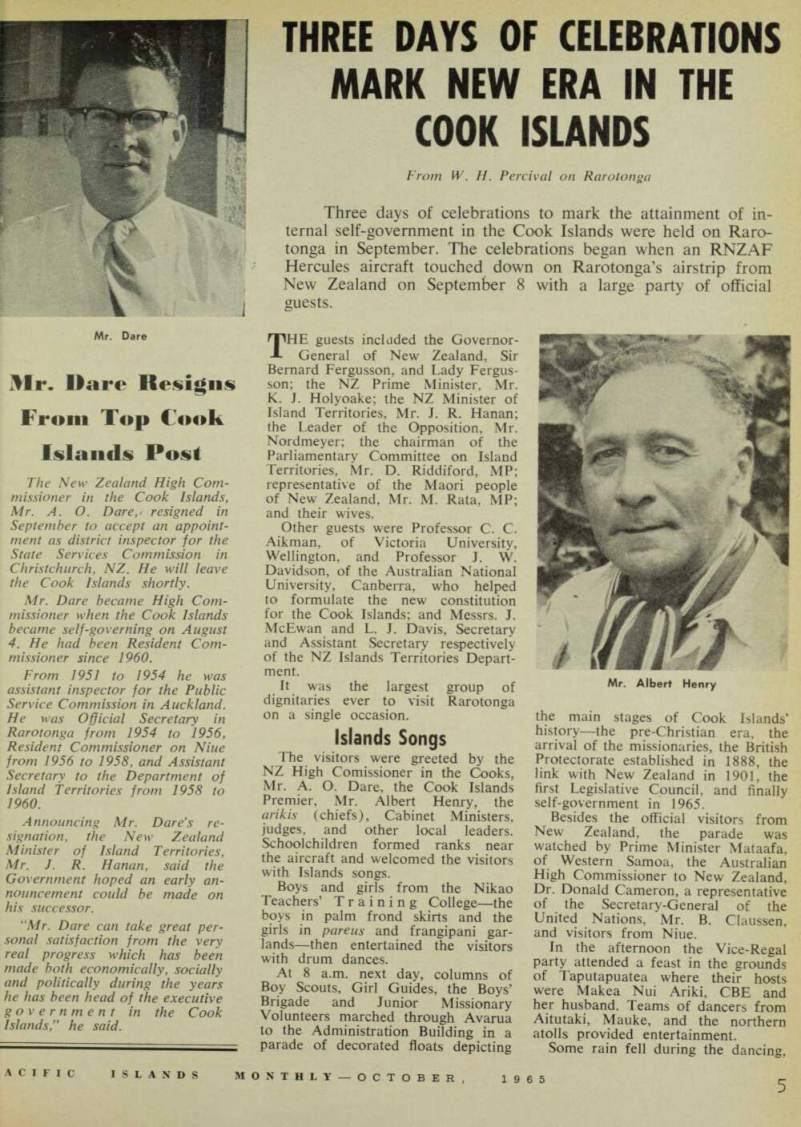
Mr. Albert Henry
which was taken as a good luck sign by the dancers. It was also welcomed from a practical viewpoint as Rarotonga had been suffering from near-drought conditions and the water supplies were dangerously low.
A Constitution Ball and an open air dance were held at Avarua in the evening.
Next morning, the Governor- General formally opened the eighth session of the Cook Islands Legislative Assembly.
The ceremony was held in the Victory Theatre so that 500 guests could be accommodated.
Red carpets covered the floor, and palm fronds and banana leaves decorating the walls gave the theatre an Islands atmosphere.
The Governor-General told the Assembly that the future of the Cook Islands was being watched with great interest by countries overseas.
Sir Bernard Fergusson read a message from the Queen, and presented a gift of dispatch boxes to the Assembly.
Partners Now
Mr. Holyoake, NZ’s Prime Minister, spoke next. He said that the people of New Zealand and the Cook Islands were now partners and, unless the Cook Islanders wished otherwise, they would continue to have the links they had enjoyed in the past.
The financial assistance given to the Cook Islands in the past would not be changed by the Constitution.
He expressed confidence that the Cook Islands’ new Government would be able to cope with its responsibi lities. “We believe we can give no more precious gift than that of self government,” he said, “which Britain gave us a century ago.”
He added that New Zealand had presented the Cook Islands with a Speaker’s chair, a table for the Legislative Assembly, and two teak chairs for the use of important visitors to the Assembly. In addition there was a special grant of £7,000 — a Constitution Day gift—for the extension of radio broadcasting to the outer islands.
Mr. Holyoake then presented the signed proclamation to the Speaker, Mrs. Marguerite Story, thus com pleting the formal opening of the Assembly.
Other speeches were made by Prime Minister Mataafa; Mr. Nord meyer: Dr. Cameron; Sir lan MacLennan, of Great Britain; Mr.
Rata; a representative of Niue; and a representative of the 6,000 Cook Islanders living in New Zealand.
Mrs. Story, replied for the House, after which Mr. Albert Henry spoke.
Mr. Henry said that the emergence of the Cook Islands as a self-govern ing state in close association with the former administering power would be watched from many quarters with an interest out of all proportion to the Cook Group’s size.
The Cook Group was a small and financially poor nation, but possessed the desire for progress. Cook Island ers had no wish to remain “a per manent charge upon the charity of another country”.
“We attach the greatest import ance to the assurances given to us that Cook Islands products will be accorded free and unrestricted entry into New Zealand,” the Premier said.
“We would go further and ask for some measure of protection com mensurate with that granted to your own primary producers.”
Referring to the controversial subject of tourism, Mr. Henry said that although it was realised that other territories had derived greatly increased revenue from tourism, his Government would not make a hasty decision which, while bringing in tourist money, might well place his people on the road to bitter dis illusionment.
Tourist money tended to disappear in a spiral of rising prices, and an inevitable deterioration of the tradi tional way of life took place—the way of life which attracted visitors in the first place.
Events in other countries had warned them that although tourism was “a potentially lucrative industry,
it was also a potentially dangerou: one”.
Concentration on tourism coulc ruin an unsophisticated people, am could further aggravate the critica labour shortage in the Cook Islands Mr. Henry said that young am able Cook Islanders continued t< leave their home islands for lack o opportunity and encouragement.
If this continued, the Cook Grouj would become “a nation of oL people and young children”, depend ing more upon remittances from thei relatives overseas than upon thi rewards of their own labour. In centives should therefore be provide* to keep the working population a home,
"Challenge"
“Despite the many problems whic: accompany any period of chang and transition, we welcome th challenge of a new era,” Mr. Henn added.
An umukai (feast) was held fc the visitors that afternoon s Arorangi, arranged by the Spor Association. Then came a spor march past, the finals of the 196 c athletics championships, and inte:; island basketball, tennis and Rugb matches.
In the evening, which was fine am moonlit, a large crowd watche boxing and Pukapuka-style wrestlin at Taputapuatea, a spectacular fir works display, and drum danc« performed by members of vario? youth clubs.
The Vice-Regal party and officii visitors left by Hercules aircraft fo New Zealand next day.
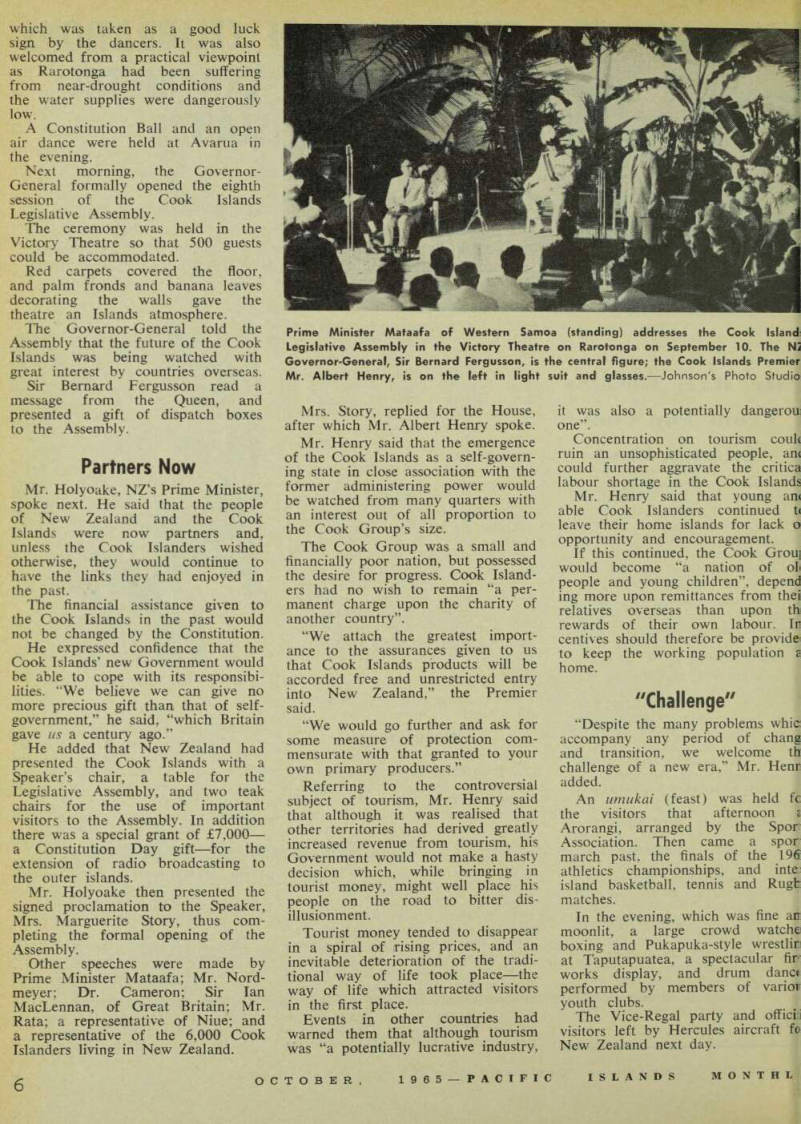
Prime Minister Mataafa of Western Samoa (standing) addresses the Cook Island; Legislative Assembly in the Victory Theatre on Rarotonga on September 10. The Mi Governor-General, Sir Bernard Fergusson, is the central figure; the Cook Islands Premier Mr. Albert Henry, is on the left in light suit and glasses.—Johnson's Photo Studioi