Yesterday
p. 89 · Read in the full issue
The capitulation of Japan on August 15, 1945, the appointment of General Mac Arthur as Supreme Allied Commander in that country, and the formal surrender of Japan to the Allies in Tokyo Bay on September 2, 1945, were among the important news items in PIM of 20 years ago. PI M’s pages for September, 1945, also recorded that :
ALONG series of “Victory V’s”, blown by the siren of an American warship in Suva harbour, gave most Suva people their first intimation that the end of the war with Japan had come.
Special coloured posters showing Allied flags and bearing the word “Victory” in English, Fijian and Hindustani, which had been pre pared by the Public Relations Office, soon began appearing on windows and walls. The Governor of Fiji, Sir Alexander Grantham, announced over the radio that Fiji would have 2 i days to celebrate.
MANY New Guinea people had been disappointed that Brigadier D. M. Cleland [now P-NG’s Administrator, Sir Donald Cleland] had failed to win the Fremantle seat in the Australian Federal Parliament, made vacant by the death of Prime Minister Curtin. “During the time that Brigadier Cleland was the active executive head of the Production Board in Papua and New Guinea, he made many friends,” PIM said. “He filled a difficult job with efficiency, tact, courage and honesty—qualities which are sadly needed in the Australian Parlia ment.”
A FORCE of 250 Australians sailed from Bougainville on September 9 to recover the phosphate island of Nauru which had been occupied by a Japanese garrison since April, 1942. Sir Albert Ellis, the New Zealand Commissioner on the British Phosphate Commission, expressed the hope that phosphate shipments would be resumed six months after Nauru and Ocean Island were reoccupied.
MEN of the Australian 11th Division landed in Rabaul on September 10. They had been preceded three days earlier by Captain Bryce Morris, RAN, who reported: “What used to be the town area
is overgrown with jungle 20 to 30 feet high. Not one building is standing, unless you include one or two shanties resembling dog kennels that the Japs have built. The wharves were com pletely demolished, and the whole foreshore is littered with wrecks, from large steamers to little boats.
Practically the whole population of Japanese and natives had gone underground against bombing, and lived in miles and miles of tunnels.”
When Captain Morris stepped ashore, he saw a group of eight white prisoners standing behind some Japanese soldiers. After the Japanese had tried to prevent him from speaking to the prisoners, he gave them cigarettes and left an officer to care for them. Later, HMAS Vendetta took them to Jacquinot Bay.
A report, then unconfirmed, said that the prisoners included Gordon Thomas (former editor of the Rabaul Times and now PlM’s ‘Tolala”), J. H. Ellis (electrician), A. D. Creswick (public works mechanic), E. Till (Bainings), two men called Rundnagel, and an engineer called McKechnie.
COLONEL J. K. Murray, Pro fessor of Agriculture at the University of Queensland since 1927, and who was acting as Chief Instructor at the School of Civil Affairs, Duntroon, had been appointed provisional Admini strator of the combined territories of Papua and New Guinea.
BAURO RATIETA, a Gilbert Islander, and Penitala Teo, an Ellice Islander, had been ap pointed Native Administrative Officers in the Gilbert and Ellice Islands Colony. They were the first local men to receive such
appointments. [Penitala Teo was one of the two GEIC delegates at the Sixth South Pacific Con ference in Lae in July. The other delegate was Buren Ratieta, Bauro Ratieta’s son].
THE offices in Sydney of the British Solomon Islands Gov ernment, which had been opened in 1942 after the Japanese in vasion of the Solomons, were closed on September 1, 1945, following the return of Treasury staff and records to the Protec torate.
THE New Caledonian Admini stration had approved a decree granting free residence, with the right to compete at a reasonable wage on the free labour market, to over 10,000 Indo-Chinese and Javanese coolies in New Caledonia.
CAPTAIN R. M. L. Gladney, Commanding Officer of the Rarotonga Maori Defence Force, had been appointed Resident Agent of Penrhyn Island.
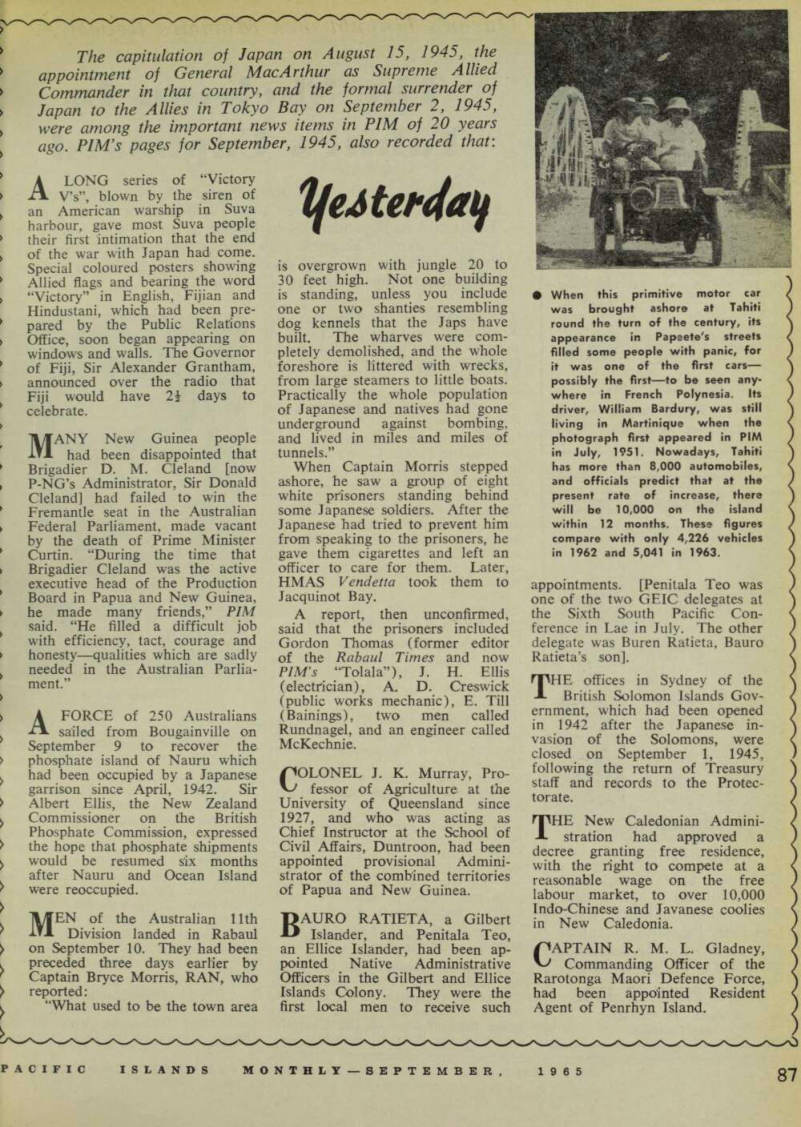
• When this primitive motor car was brought ashore at Tahiti round the turn of the century, its appearance in Papeete's streets filled some people with panic, for it was one of the first cars — possibly the first—to be seen any where in French Polynesia. Its driver, William Bardury, was still living in Martinique when the
photograph first appeared in PIM
in July, 1951. Nowadays, Tahiti
has more than 8,000 automobiles, and officials predict that at the present rate of increase, there will be 10,000 on the island within 12 months. These figures compare with only 4,226 vehicles in 1962 and 5,041 in 1963.