Least Exceptionable”
p. 87 · Read in the full issue
Norfolk Island's First Women
Their Behaviour Was "The Least Exceptionable”
By Merval Hoare, author of “Rambler’s Guide to Norfolk Island”.
Although it is well known that the first European settlers of Norfolk Island were convicts, few people probably know that the convict party included six women, one of whom was mistress to the island’s first commandant, Lieutenant Philip Gidley King.
HHE women convicts, like the L men, were chosen by King from lose brought to Sydney early in 788 by the transport vessel Lady enrhyn, one of the 11 ships in ustralia’s First Fleet.
The convicts had not then dis nbarked from the Lady Penrhyn, id King’s choices were made after insulting the ship’s surgeon, Arthur owes.
Bowes recorded that King had sleeted those of both sexes “whose
behaviour on board during the voyage had been the least exception able”.
Five of the six women recom mended by Bowes consented to go to Norfolk, but one of them, Anne Yates, preferred to stay in Sydney and was replaced by Susan Gough.
The remaining five were: Elizabeth Colley, Elizabeth Hipsley, Elizabeth Lee, Olivia Gascoyne, and Ann Innet.
King's Promise
In an address to the convict party chosen, King promised good treat ment on Norfolk Island provided they behaved well, and assured everyone that they would be sent back to Sydney for punishment if they misbehaved.
The ship chosen for the voyage to Norfolk was the brig Supply, which left Sydney on February 14, 1788, and reached Norfolk 15 days later.
But because King spent nearly a week searching for a suitable land ing place, the new settlers—a total of 23, including 15 convicts—did not disembark until March 6.
The early days of colonisation were difficult for all, including the women. As “servants of the Crown” till their sentences expired, they laboured “for the public good”, and, no matter how leniently King may have wished to treat them, there were certain privations and hard ships that just had to be endured.
Two-Thirds Allowance
The allowance of rations for the women from the Government store was only two-thirds of what the men got, though they probably fared better when fish and birds caught locally were shared out.
Domestic duties naturally fell to their lot, but, in addition, there were
other tasks not normally allotted to women.
Though not called on to fell trees, it was their job to drag away the boughs and burn the tops and branches. They helped to clear ground • for gardens and, when harvest time came, they were employed “breaking down and gathering Indian corn” and “leasing the barley”.
When plagues of caterpillars and grubs attacked the crops, it was nearly always the women who spent back-breaking hours picking insects off the vegetables and beating the ground with staves where the pests lay inches thick.
For many months the six women were the only members of their sex on the island, but in October, 1788, 11 more women, also convicts, ar rived from Sydney.
First Child
The names of five of the six pioneers have lapsed into obscurity, but that of the sixth, Ann Innet, has a place in the island’s history.
She it was who lived with King during his first term of office on Norfolk, which lasted two years.
During that time she bore him two sons. These were Norfolk King, the commandant’s first son and the first child born on the island, and his brother Sydney.
Later Ann Innet was transferred to the mainland and married a free man in good circumstances in Sydney.
Perhaps the others enjoyed similar good fortune, for, whatever their crimes might have been, life on Norfolk in 1788 could not have been a picnic for them.
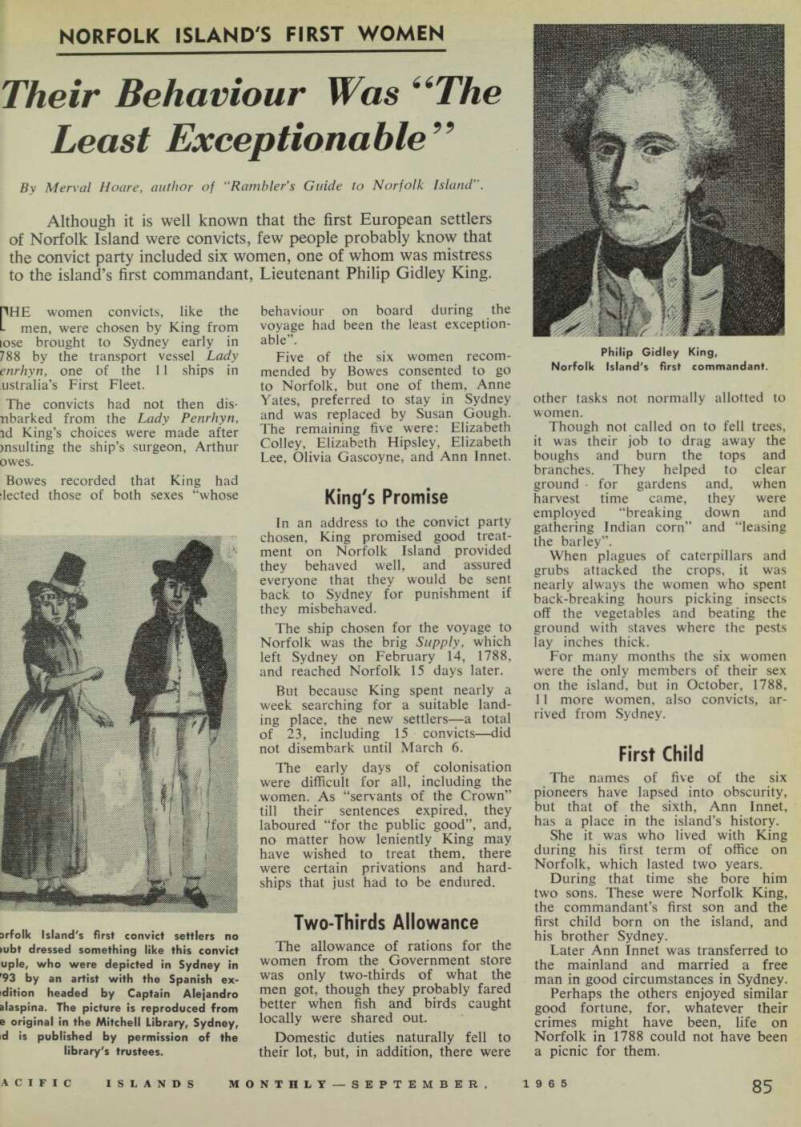
[?]rfolk Island's first convict settlers no [?]ubt dressed something like this convict [?]uple, who were depicted in Sydney in [?]93 by an artist with the Spanish ex edition headed by Captain Alejandro [?]alaspina. The picture is reproduced from [?]e original in the Mitchell Library, Sydney, [?]d is published by permission of the library's trustees.
Philip Gidley King, Norfolk Island's first commandant.