Tahiti’s Cupboard
pp. 90-91 · Read in the full issue
Queens Unpublished Memoirs Reveal . . .
The Skeleton In Tahiti’s Cupboard
Back in 1880, when King Pomare V of Tahiti and 20 chiefs of Tahiti and Moorea signed a document handing over Tahiti and its dependencies to France as an outright colony, it was the generally accepted view among well-informed observers that the French had used pressure on the Tahitians to get the signatures to the document of cession.
IT was said at the time that the French—who had held Tahiti as a protectorate since 1842—wanted undisputed control of that island and its dependencies because of their expected value as coaling stations, etc., en route to the then-projected Panama Canal.
What was not said—but has now been said in public, for the first time, as far as I know—is that, of the 20 Tahitian chiefs who signed the document of cession, only nine were “authentic chiefs” with sufficient authority to put their names to it.
Moreover, as Tahiti and Moorea actually had 22 chiefs, the document should have borne two more signatures.
Book By Queen's Son
The statement revealing this was made by Queen Marau, Tahiti’s last Queen, in a book published in France last year by the Societe des Oceanistes.
The book, Alexandre Salmon et sa femme Ariitaimai, was written by the late Ernest Salmon, a grandson of the subjects of the book, and a son of King Pomare V and Queen Marau (formerly Joanna Marau Salmon).
In his book, Ernest Salmon recalls that the documents of annexation were signed on June 29, 1880. He then quotes several passages from his mother’s as yet unpublished memoirs, which, he says, are “both curious and suggestive”.
Translated from French, Queen Marau’s statements are: — “Below the signature of the King, the first document [of annexation] carries the signatures of 20 Tahitians which, in accordance with a fore going proclamation of the Commis sioner of the [French] Republic, one
would believe to be the chiefs of Tahiti and Moorea convoked to give their consent to the annexation.
“But, besides the fact that the chiefs in question numbered 22—two more than the signatories—it appears that of the signatories, only nine are authentic chiefs, namely: Aitoa, chief of Paea; Hitoti Manua, chief of Tiarei; Tere a Patia, chief of Mataiea; Marurai a Tauhiro, chief of Teaharoa; Terai a Faaroau, chief of Afareaitu; Tarii Vehiatua, chief of Tehaupoo; Teriitapunui, brother of the King and chief of Mahina; Ariipeu, uncle of the King and chief of Arue; and Opuhara, chief of Papenoo.
“The 11 other signatures are those of two sub-chiefs and of eight unknowns (inconnus), who do not figure in any of the lists of chiefs,
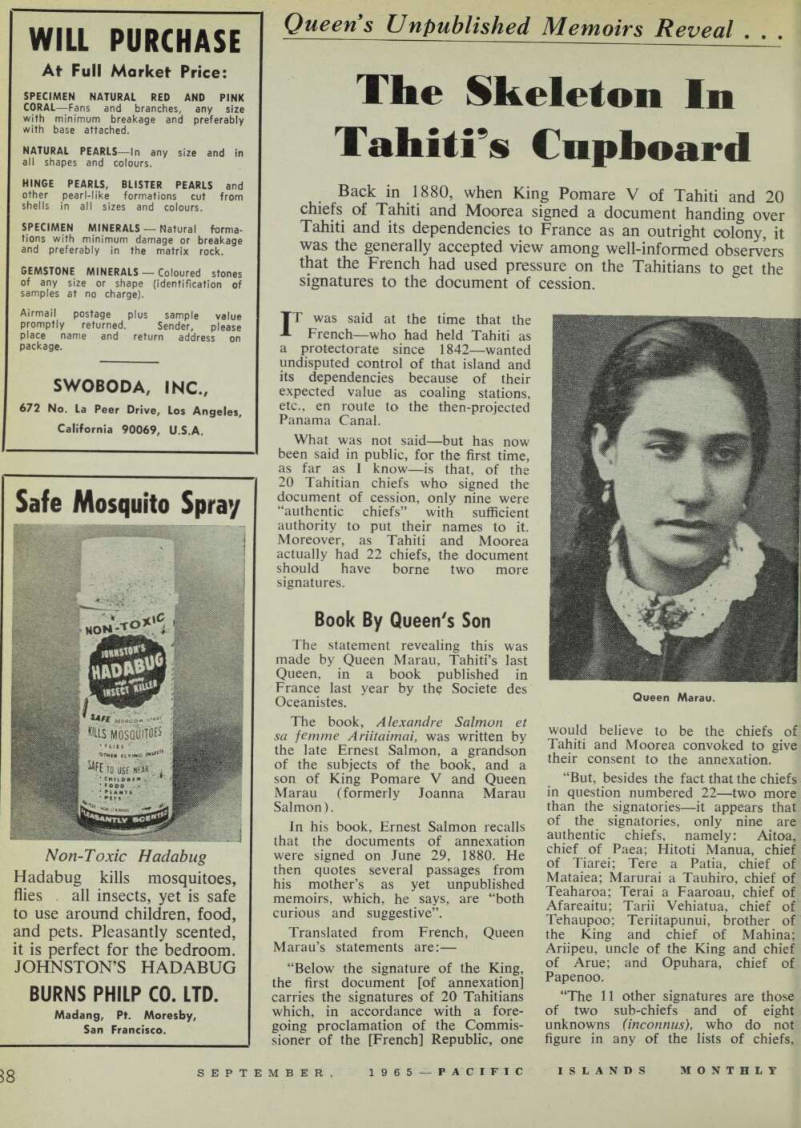
Queen Marau.
ib-chiefs or district councillors— ith the exception of one, whose lief had already signed—that are irnished us in the Annuaires de ahiti of the time.
“One is thus led to suppose that le refractory chiefs, or those who ere considered* such, like my mother, ere replaced on the spur of the oment by no matter whom, with e object of giving that capital msaction the appearance of having :en approved by the authorised presentatives of the Tahitian people.
“This astonishing state of affairs is not discovered my me, but by former naval officer while doing Jtorical research. He communicated 5 discoveries to me as matters of riosity, adding whimsically: ‘Do u perhaps doubt that the act of nexing Tahiti to France constituted kind of forgery in a public cument?’ ”
No Rancour
Ernest Salmon said in his book it, in her memoirs, his mother had ted that she did not want it to be >ught that she felt rancour or imony over the French annexation; it no one loved and venerated mce more than she did; and that ; was well aware of what France 1 done for her country. ‘But,” she added, “this is no reason not showing things un as they , for not speaking the truth— whole truth . .
According to a preface in Ernest mon’s book, written nearly three irs ago, the memoirs of Queen rau were to be published in their irely “soon” in a de luxe edition strated by Jacques Boullarie. far as I know they have not been published. >ueen Marau, by the way, died Tahiti in 1935 at the age of 75. f marriage to Pomare V, who 1 in 1891, had been dissolved 1887; but the French accorded a pension as ex-Queen until her th.
Robert Langdon