yesterday
p. 93 · Read in the full issue
The end of the Pacific War was imminent as PIM went to press 20 years ago this month. The first peace moves from Japan were made on August 10, just three days after the first atom bomb was dropped on Hiroshima.
The capitulation was on August 15, just too late for PIM to place on record that month. Here are extracts from that issue of August, 1945:
A Copra-Crushing Mill
with a nominal capacity of 7,500 tons a year, and capable of immediately doubling its capacity, was under construction at Walu Bay, Suva, for W. R.
Carpenter and Co. (Fiji) Ltd. It was intended that the first pro ducts should be, not coconut oil, but vegetable lard and stock feed.
IN Nukualofa a week of festivity marked the opening of the new church building of the Church of Tonga. Queen Salote attended the dedication service, LOCAL tree-lovers were broken hearted over the cutting-down of a circle of beautiful, healthy flambouyant trees which stood about the Protestant Church in Papeete. The trees were planted 60 years earlier by the Rev.
Vernier, and were a stately memorial of that venerated patriarch of the church in Oceania, and three of his sons who carried on his work with devotion and great honour.
A MELBOURNE company, Industrial Oils (Fiji) Ltd. nominal capital £40,000 had started to experiment in Fiji with the candle-nut. The promoters hoped to extract lumbang oil from the nuts and sell it on a world market, desperately short of paint oils.
Sir Cosmo Parkinson,
Permanent Under-Secretary
of State for the Colonies, on a Pacific tour visited Fiji, the GEIC, Jie New Hebrides, the BSIP and Eonga. He remarked during an nterview that there were no big sroblems affecting the Islands vhich had been brought about by
war conditions. He said he did not think that the way of living of the natives had been affected to any great extent through the new economic conditions created by the presence of large wartime forces, particularly in islands used by the Americans. Things would gradually go back to normal. rpHE P-NG Provisional Admini -*> stration Bill, passed by the Australian House of Representa tives, provided for amalgamation of the two territories till six months after the war. Under the bill, power was taken from the former Legislative Councils and delegated to the Government through the Governor-General.
Sweeping changes, including a 44-hour week for native labourers, a basic wage of 15/- a month, abolition of the indenture system as soon as possible, elimination of professional recruiters, and a limit of 12 months on the dura tion of native labour contracts, came into effect. tX)R four days Western Samoa celebrated the centenary of the Catholic Mission and the episcopal silver jubilee of Bishop Darnand. Several high church dignitaries from overseas attended.
Origadier D. M. Cleland
** resigned as head of the Pro duction Control Board in Papua, in March, to resume his law practice in Perth. He was the endorsed Liberal candidate for the Fremantle by-election, caused by the death of the Prime Minister, Mr. John Curtin.
Mr. W. H. Watson, Of
Rarotonga, who bought out the Cook Islands’ interests of W.
H. Grove and Sons the previous year, had sold his interests to a new company which he had formed, United Islands Traders Ltd. The first directors were Messrs. Watson and L. N. Jacka. fFHE death occurred of Fiji’s A oldest European resident, Mr. J. F. Crawford, 99. He went to Fiji in 1900, and for many years followed the trade of plumber.
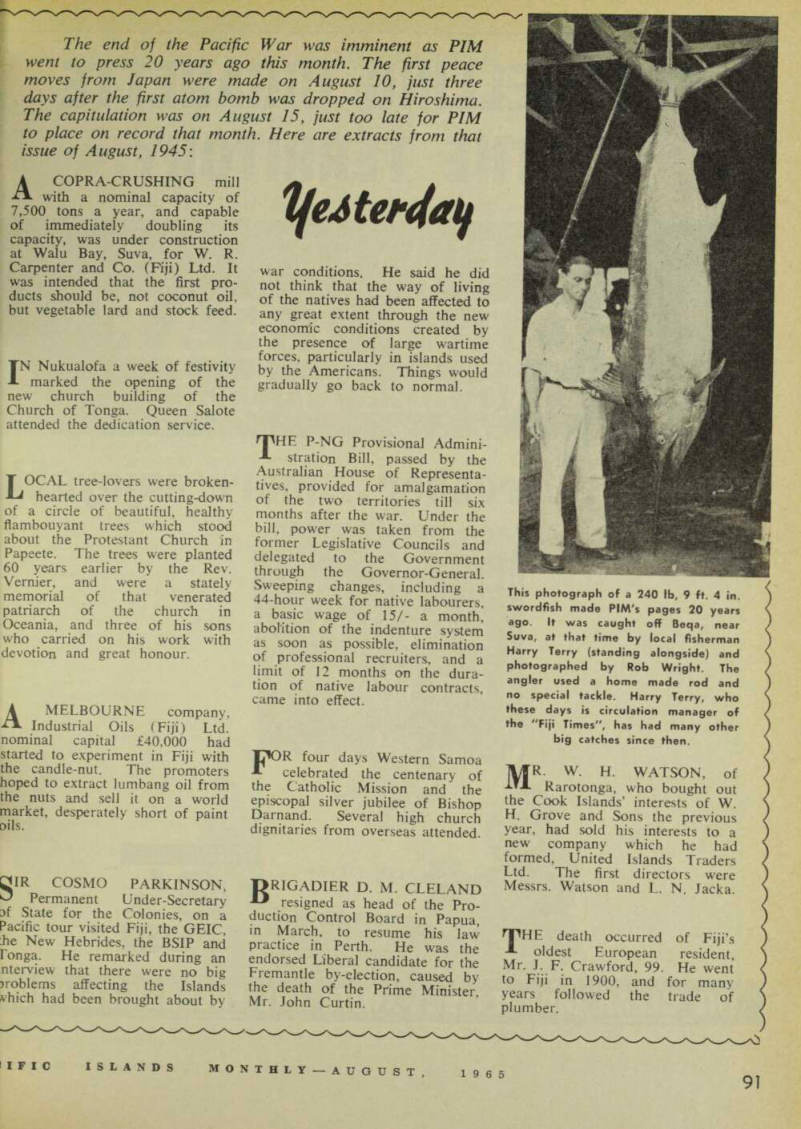
This photograph of a 240 lb, 9 ft. 4 in. swordfish made PIM's pages 20 years ago. It was caught off Beqa, near Suva, at that time by local fisherman Harry Terry (standing alongside) and photographed by Rob Wright. The angler used a home made rod and no special tackle. Harry Terry, who these days is circulation manager of the "Fiji Times", has had many other big catches since then.