Pre-War Islands
pp. 95-96 · Read in the full issue
The Month's New Reading
Memory Recalls The
Two new books on South Pacific themes —Who Stand Alone and The Happy Isles —have a common ingredient, that of nostalgia. Both authors, from the distance of England where they are now living, dip into memory to paint pictures of an atmosphere of dear dead days beyond recall.
WELYN CHEESMAN, distin * guished entomologist, needs no reduction, Who Stand Alone is r 21st book, most of her works ing on her adventures in South as backwaters during a period of years. This new book deals with ; New Hebrides and New Guinea.
D. C. Horton will be remembered a more restricted gathering as a ;-war District Officer in the Solo ms. The Happy Isles is about the lomons before the war.
Ehe remarkable Miss Cheesman’s ny Islands exploits have been ourfully and competently reported her in her previous books, and no ly who has ever come in contact h her has anything but admiration this eccentric, zealous, independent 1 fearless woman who has done so ch in the Islands in the cause of mce. Her latest collecting trip, to New Hebrides, was made not ny years ago.
Human Fauna
n Who Stand Alone, she discusses se Islands residents, expatriate and erwise, who have made an im ssion on her—the “human fauna”, she says—and as usual she shows ght and compassion. Although a nan of few words, who during her editions preferred her own com y to anybody else’s, she was an lligent observer of the players on stage of life, and in this book concentrates her studies on the ct of isolation on character, he found each individual had to e with it in his own way, accord to how he was physically and daily endowed. Those with hobbies ered less, and a man without ily responsibilities was, on the ile, the happiest.
Certainly I met few women who - able to grapple with the con ms and create something bearable
without suffering too much,” she says.
“I discovered very soon that some women were haunted by their isola tion: they resented it fiercely, daily and hourly. Such resentment is ex tremely exhausting; it became an in cubus, a vampire sucking their vitality.
When it was tinged with self-pity a crisis occurred. Keyed-up at too high a tension, something would snap.
“I came to the conclusion that the reason why so many women ended in
mental homes in Australia was the isolation.
“The stark greyness of these lonely lives can scarcely be imagined except by those who have experienced it— their own known world out of reach below the horizon, and their present life colourless. Hundreds of men and women endured this in the days be fore radio and air communications were fully developed, when only the main towns, government stations, weather stations and a few ships were equipped with wireless.”
Although Miss Cheesman is speak ing of pre-war days, many Islanders will recognise symptoms and characteristics not rare in some parts of the Pacific today, despite the in roads of civilisation.
For herself the loneliness of her bush camp never troubled Miss Cheesman and her little French coffee pot constantly was honoured by her soliloquies uttered aloud.
“It is eroneous to imagine that
when people talk aloud to themselves they are gaga,” she says. “They are quite the reverse. It is a usual habit by those who are much alone and it is a good habit when one considers it, for it is surely a sign of an orderly mind to discipline thoughts—meander ing and disjointed—and fix them by uttering aloud, even if there is no im mediate prospect of passing on these newly clarified ideas to others.”
Planters and miners made up most of her contacts in her meanderings in the New Hebrides and New Guinea. Official people she saw little, probably because these kept to the towns and her job was in the bush.
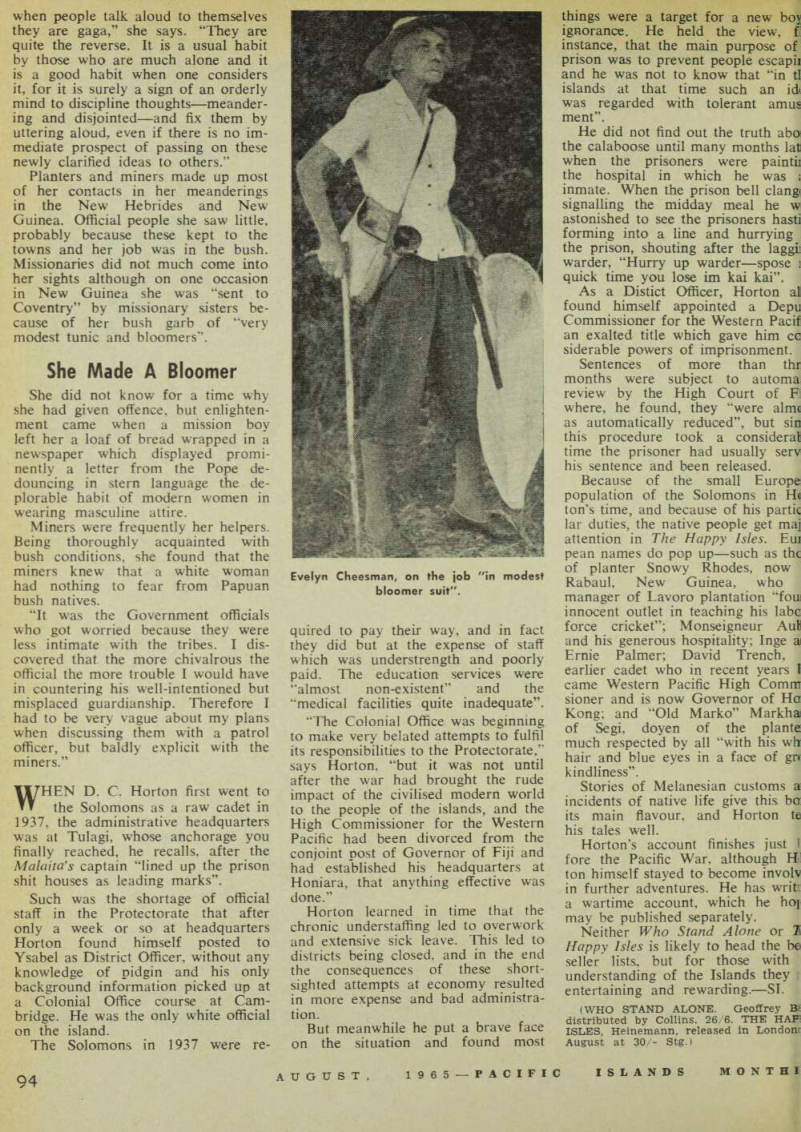
Missionaries did not much come into her sights although on one occasion in New Guinea she was “sent to Coventry” by missionary sisters be cause of her bush garb of “very modest tunic and bloomers”.
She Made A Bloomer
She did not know for a time why she had given offence, but enlighten ment came when a mission boy left her a loaf of bread wrapped in a newspaper which displayed promi nently a letter from the Pope de douncing in stern language the de plorable habit of modern women in wearing masculine attire.
Miners were frequently her helpers.
Being thoroughly acquainted with bush conditions, she found that the miners knew that a white woman had nothing to fear from Papuan bush natives.
“It was the Government officials who got worried because they were less intimate with the tribes. I dis covered that the more chivalrous the official the more trouble I would have in countering his well-intentioned but misplaced guardianship. Therefore I had to be very vague about my plans when discussing them with a patrol officer, but baldly explicit with the miners.”
WHEN D. C. Horton first went to the Solomons as a raw cadet in 1937, the administrative headquarters was at Tulagi, whose anchorage you finally reached, he recalls, after the Malaita's captain “lined up the prison shit houses as leading marks”.
Such was the shortage of official staff in the Protectorate that after only a week or so at headquarters Horton found himself posted to Ysabel as District Officer, without any knowledge of pidgin and his only background information picked up at a Colonial Office course at Cam bridge. He was the only white official on the island.
The Solomons in 1937 were re-
quired to pay their way, and in fact they did but at the expense of staff which was understrength and poorly paid. The education services were “almost non-existent” and the “medical facilities quite inadequate”.
“The Colonial Office was beginning to make very belated attempts to fulfil its responsibilities to the Protectorate,” says Horton, “but it was not until after the war had brought the rude impact of the civilised modern world to the people of the islands, and the High Commissioner for the Western Pacific had been divorced from the conjoint post of Governor of Fiji and had established his headquarters at Honiara, that anything effective was done.”
Horton learned in time that the chronic understaffing led to overwork and extensive sick leave. This led to districts being closed, and in the end the consequences of these short sighted attempts at economy resulted in more expense and bad administra tion.
But meanwhile he put a brave face on the situation and found most
things were a target for a new boj ignorance. He held the view, f: instance, that the main purpose of prison was to prevent people escapii and he was not to know that “in tl islands at that time such an id« was regarded with tolerant amus ment”.
He did not find out the truth abo the calaboose until many months lat when the prisoners were paintu the hospital in which he was ; inmate. When the prison bell clang( signalling the midday meal he w astonished to see the prisoners hasti forming into a line and hurrying the prison, shouting after the laggh warder, “Hurry up warder—spose i quick time you lose im kai kai”.
As a Distict Officer, Horton al found himself appointed a Depu Commissioner for the Western Pacif an exalted title which gave him cc siderable powers of imprisonment.
Sentences of more than thr months were subject to automa review by the High Court of F where, he found, they “were almc as automatically reduced”, but sin this procedure took a consideral time the prisoner had usually serv his sentence and been released.
Because of the small Europe population of the Solomons in He ton’s time, and because of his partic lar duties, the native people get maj attention in The Happy Isles. Eui pean names do pop up—such as the of planter Snowy Rhodes, now Rabaul, New Guinea, who manager of Lavoro plantation “foui innocent outlet in teaching his labc force cricket”; Monseigneur Aul and his generous hospitality; Inge a Ernie Palmer; David Trench, earlier cadet who in recent years I came Western Pacific High Comm sioner and is now Governor of Ho Kong; and “Old Marko” Markha of Segi, doyen of the plante much respected by all “with his wh hair and blue eyes in a face of gn kindliness”.
Stories of Melanesian customs a incidents of native life give this ba its main flavour, and Horton te his tales well.
Horton’s account finishes just 1 fore the Pacific War, although HJ ton himself stayed to become involv in further adventures. He has writ!; a wartime account, which he hoj may be published separately.
Neither Who Stand Alone or I Happy Isles is likely to head the bo seller lists, but for those with understanding of the Islands they : entertaining and rewarding.—Sl. (WHO STAND ALONE. Geoffrey BS distributed by Collins. 26/6. THE HAF ISLES, Heinemann, released in Londonr August at 30/- Stg.)
Evelyn Cheesman, on the job "in modest bloomer suit".