"Something Portentous"
p. 91 · Read in the full issue
Levuka's Drinking Bouts Were "Something Portentous"
From Frank Ryan, in Suva
The recently-established Japanese fish freezing factory at Levuka, on the island of Ovalau, has brought new life to Fiji’s fid capital. But life in Levuka is never likely to return to what t was in the days before 1874 when Fiji’s chiefs ceded their slands to Great Britain.
those days, Levuka was probably the rowdiest place in the Pacific, i wild drinking bouts and fights ost every day. ccording to The Fiji Times, which established five years in advance le British administration, Levuka’s aanent white population in 1869 about 100, with about another constantly coming and going, se who came and went were the rings from every port in the d. ost of Levuka’s shops, houses and king dens of one sort and another > built close to the water’s edge, far enough away to leave a ow strip of shingly beach, which the town’s main street.
"Rum Row" iis street, the centre of trade and p, was commonly called “The h”, but “Rum Row” would ably have been a more suitable a ’. Litton Forbes, writing in 1871, that Manton’s hotel “was at once lotel, a club and a general jzvous for all the idle, and some ic busiest men in Levuka.” ; went on: “The amount of drink hat went on there, and, indeed, «vuka generally was something :ntous. Although it had fallen to lot to see some heavy drinking mierica, in up-country villages, in gold diggings in Australia, outdid all former experiences.” the 1860’s, gin flowed freely at
1/- a bottle, but soon afterwards the chiefs of Bau imposed a duty of $3 a case, or 1/6 a bottle and, as money was badly needed by the Cakobau Government that came later, prices gradually increased.
Cheap And Potent But “moonshine whisky” and “gun barrel” rum were cheaply made and very potent. Distilling rum was a simple process. Sugarcane was boiled in a try-pot or large kettle. A wooden lid on the pot had a hole through which was inserted a bent gun barrel.
The vapour, which arose, condensed in the barrel and dripped out into a container. Because of its potency, “gun-barrel” was an appropriate name.
There was no law in Levuka ex cept that which the more moderate members of the little community im posed on themselves when things got too much out of hand.
In its issue of September 11, 1869, The Fiji Times said the town had been thrown into disorder the previ ous Sunday evening by some of its unruly members, “whose too frequent imbibings have rendered these per fect madmen as fit inmates for a lock up”.
“There were loud and fierce im precations by several men,” the paper went on, “and one individual appeared with a knife just under a foot in length. Passers-by felt anything but safe as he flourished it before their eyes.”
A little later the Times had this
to say: “We have had rows enough to satisfy anyone for two fortnights, and if broken heads, black eyes, and a narrow escape from a Japanese dis embowelling with the broadsword, or a few gentle prickings with a 14inch ham sheer, are not sufficient to make us all go about with revolvers in our belts, they should do so.
“They make us all wish either for a magistrate who would be a terror to evil-doers, or for a besom to sweep the beach of the drink maddened ruffians.”
When citizens took the law into their own hands and administered floggings, the Times referred to it as “lynching”.
“A case of lynching has occurred in Levuka”, the paper said. ‘Two American Negroes had a dispute over cards and one of them used a ‘sling shot’. ‘The bystanders pursued the man when he again attempted to use it without success. A consultation was held, and it was determined to give the man a dozen lashes, which were accordingly administered.”
Ten Lashes But The Fiii Times was not always in favour of this form of public punishment.
On November 26, 1870, it said: “Last Thursday evening a native de tected stealing money from Mr.
Cudlip’s was flogged in front of that gentleman’s house. ‘The flagellator was an unusually powerful man and used a thin piece of Manila rope. Ten lashes were ad ministered.
“Justice is a fine thing, but young children should not be allowed to look on and watch with morbid in terest the scarification of a humaff body.”
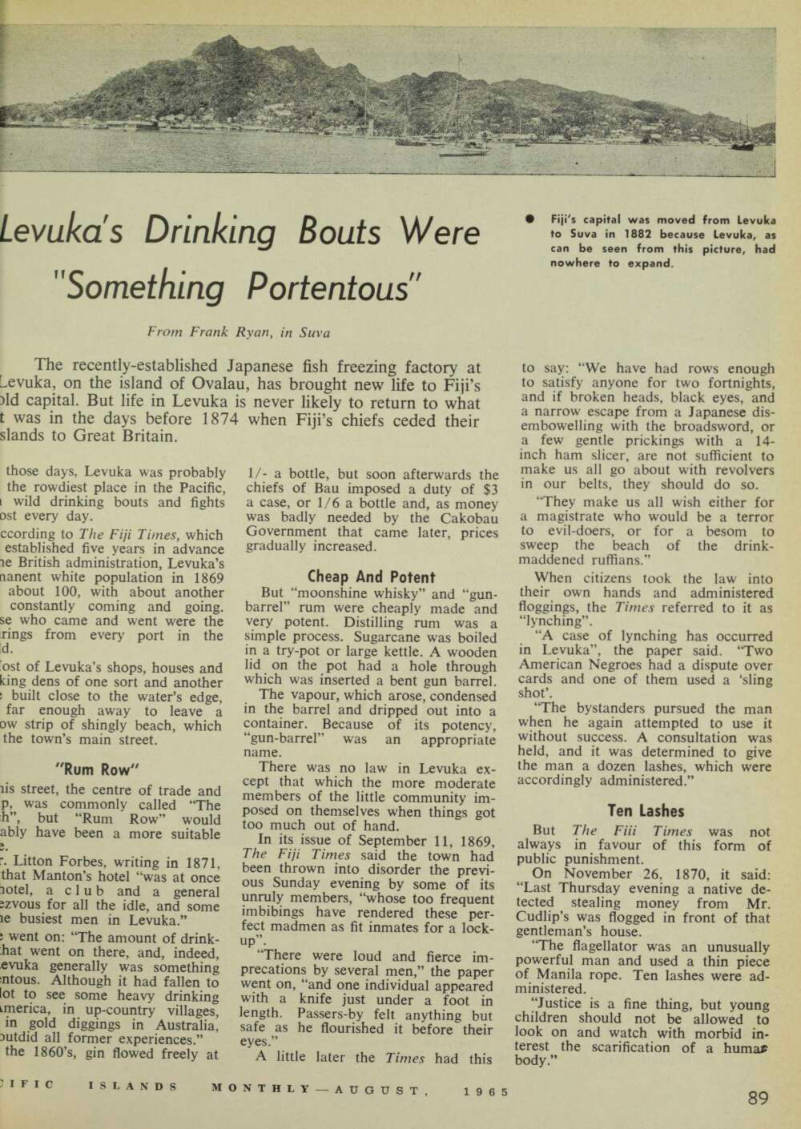
Fiji's capital was moved from Levuka to Suva in 1882 because Levuka, as can be seen from this picture, had nowhere to expand.