The True (And Wondrous) Story Of How
pp. 83-90 · Read in the full issue

Britain Got Hold Of Ocean Island
• Here, for the first time, is the fascinating story of how Ocean Island, the phosphate-producing island 160 miles east of Nauru, became a British possession. Its presentation here by PlM's Assistant Editor follows several provocative statements made in May by Mr. E. H. G.
Blacklock, a missionary, at a meeting of the Gilbert and Ellice Islands Colony's Advisory Council. Mr. Blacklock said the world would judge Britain hardly if she held the Gilbert and Ellice Islands only so long as the Ocean Island phosphates were of value to her.
He added: "One may be forgiven for thinking that British protection was being extended to the phosphates rather than the inhabitants when Britain, at the turn of the century, declared Ocean Island to form part of the Gilbert and Ellice Islands Protectorate."
By Robert Langdon
In the House of Commons between the years 1909 and 1914, the Secretary of State for the Colonies was occasionally asked irritating and awkward questions on the subject of Ocean Island, the immensely valuable phosphate-producing island, 160 miles east of Nauru.
One question that came up once or twice was: Were the Ocean Islanders being flogged and otherwise maltreated by em ployees of the Pacific Phosphate Company, which exploited the phosphate?
L MOTHER question was; In what circumstances had the company ade an agreement with the Ocean landers to exploit the phosphate, id was it true that they had been reed to part with their phosphate •oducing land for a “totally in lequate consideration”?
On the first question, the Secretary : State could reply with truth that e Ocean Islanders had never been
flogged or otherwise physically ill treated by the company’s employees.
But on the second, he could only give evasive answers, for if he had told the whole truth, and nothing but the truth, he would have had to reveal the embarrassing facts that; • The phosphate company (origi nally, the Pacific Islands Company) had negotiated an agreement with certain unlettered Ocean Islanders, which allegedly gave it the sole right to exploit the island’s phosphate for 999 (not 99) years, for an annual payment of only £5O. This was equal to about 2/- a year for each man, woman and child on the island. • The British Government had issued a licence to the phosphate company giving it “the exclusive right to occupy” Ocean Island when Ocean Island did not form part of Britain’s dominions. • The British Government had later sought to correct this anomaly by declaring Ocean Island to be pari of the Gilbert and Ellice Islands Protectorate (established in 1893).
But in preparing a proclamation to
this effect, the word “annexation” was used, and this completely confused the island’s status. • The Colonial Secretary of the time, Mr. Joseph Chamberlain, had found the confusion so embarrassing and difficult to clear up that he decided the best thing to do was to forget it—and the Foreign Office agreed with him.
The astonishing story of Ocean Island—which in this report is based mainly on Colonial Office documents now available to the public—began in the Sydney office of the British-owned Pacific Islands Company towards the end of 1899.
This company, which had grown out of one formed by John T.
Arundel, was interested in both copra and phosphates, particularly on isolated, uninhabited islands in the Central Pacific such as Baker, How land and Jarvis in the Phoenix Group,
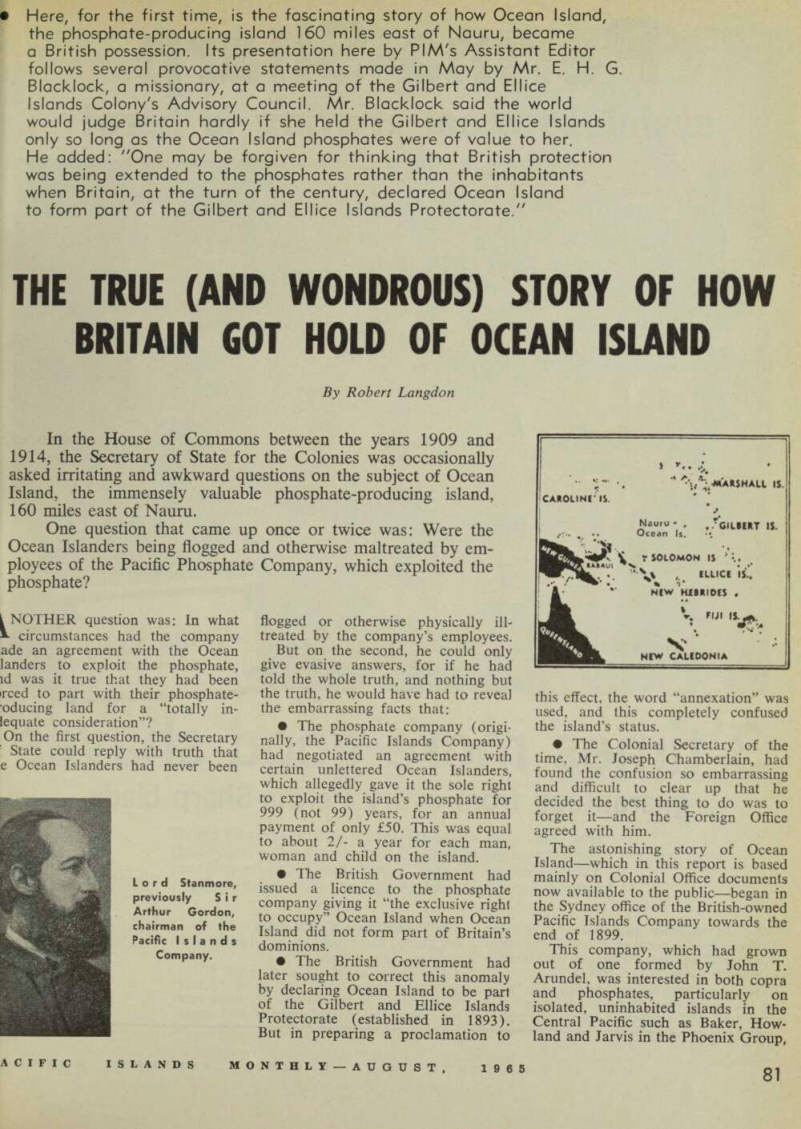
Lord Stanmore, previously Sir Arthur Gordon, chairman of the Pacific Islands Company.
and Flint, Caroline and Vostock in the eastern Pacific.
To dig phosphate (then usually called guano) or grow copra on these and other unpeopled islands, the Pacific Islands Company paid an annual fee to the British Government >f from £5 to £5O for each island.
In return, the Government gave the company its blessing and a guano icence—if not exactly a promise to arotect the company in the event of rouble with interlopers.
In 1899, the PIC was paying some hing like £350 in licence fees foi slands in the Central Pacific, and il lad a steamship called Archer which ailed at these islands and collected heir produce.
But business was so bad that on nore than one occasion the com any’s London chairman, Lord Stan tiore, asked the Colonial Office to emit various licence fees it had ontracted to pay.
Then came an event that was to ut the company on easy street for ic rest of its days. Albert F. Ellis, n employee in the company’s Sydney ffice and laboratory, was prompted > analyse part of a strange rock that le Archer had brought from Nauru bout three years earlier, and which ad long been used as a door-stop Geologists had classified the rock s fossilised wood, but Ellis thought looked like some of the hard hosphatic rock that he had helped > mine on Baker Island.
A Rich Find
Analysis of the rock showed that was, in fact, phosphate rock of the ighest quality, and Ellis could tell om its structure that it was from i old and probably extensive deposit.
But that was not all. As Nauru was lown to be of the same formation ! Ocean Island, Ellis thought it most certain that extensive phos late deposits would be found on cean Island also.
To make sure, the company asked ie supercargo of the Archer to call Ocean Island on her next visit i the Islands and collect specimens : the surface rock.
The supercargo was back with the ;sired specimens before the end of e year, and these, when analysed, •oved equally as valuable as the auru specimen. The company then id reason to believe that it had dis >vered two of the richest mining tes in history.
It wasted no time in moving to get ►ntrol of them. In London, Lord anmore began negotiating with the olonial Office to get a licence to ploit the deposits on Ocean Island,
which, at that time, was not under the control of any European power.
He also began negotiations with a German company which held mineral and other rights in German-admini stered Nauru.
The company could scarely have had a more useful chairman than Lord Stanmore to do its negotiating, for he knew everyone who mattered in the Colonial Office and most of the things that mattered about the Pacific.
As Sir Arthur Gordon, Lord Stan more had spent more than 20 years in the Colonial service, and from 1875 to 1880 he was Fiji’s first Governor. In 1877, he also became Britain’s first High Commissioner for the Western Pacific.
In the Colonial service, Lord Stan more had always opposed a com monly-held doctrine of that time that a superior race had a right to ex ploit an inferior one; and in Fiji, in particular, he always tried to put his views into practice.
Native Rights Forgotten
But in applying to the Colonial Office for a licence to exploit Ocean Island’s phosphate, Lord Stanmore seems either to have put aside his old views or to have been unaware that Ocean Island was inhabited. At any rate, his application gave no hint that native rights might be involved.
As for the Colonial Office, its officers seem to have thought that whatever they did was OK, for although they knew that Ocean Island was inhabited, they saw nothing ir regular about issuing Lord Stanmore’s
company with a guano licence—a type of licence specifically reserved for uninhabited and unclaimed islands.
Within days of receiving Lord Stanmore’s application early in January, 1900, Chamberlain, the Colonial Secretary, wired and wrote to Sir George O’Brien, the High Commissioner for the Western Pacific in Suva, that he proposed to issue the guano licence unless he (O’Brien) saw any objection.
Problems, Problems
Chamberlain’s letter went on: “Ocean Island does not, so far as I am aware, at present form part of the Gilbert and Ellice Protectorate, though it is within the British sphere, as defined by the Anglo-German Agreement of 1886, and it seems desirable that it should be brought formally into Her Majesty’s protec tion. If you concur in this view and see no objection to the issue of the proposed licence, you should take the necessary steps for its formal inclusion in the protectorate.”
Sir George O’Brien, however, did NOT agree with the Colonial Sec retary, and wrote back in clear terms to say so.
He said that as Ocean Island was difficult of access owing to the pre valence of strong currents, there ap peared to be no reason why it should be included in the Gilbert and Ellice Islands Protectorate to prevent it falling into the hands of another power.
Furthermore, if it were included, this would only add to expenditure
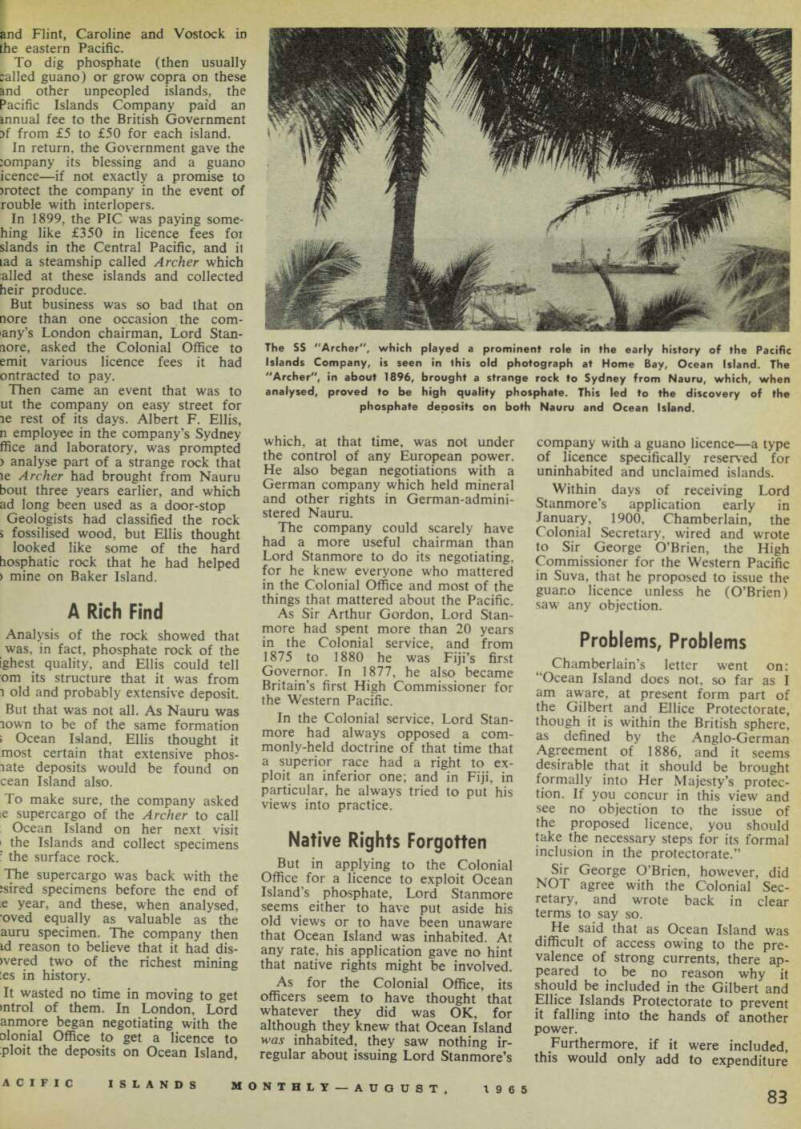
The SS "Archer", which played a prominent role in the early history of the Pacific Islands Company, is seen in this old photograph at Home Bay, Ocean Island. The "Archer", in about 1896, brought a strange rock to Sydney from Nauru, which, when analysed, proved to be high quality phosphate. This led to the discovery of the phosphate deposits on both Nauru and Ocean Island.
ithout bringing in any adequate r enue”. Therefore, the only reason y Britain should take it over was facilitate the acquisition of guano hts by the Pacific Islands Com ly.
However, Sir George failed to see y the company should not be left make “such arrangements in that pect as may be satisfactory to both ties. ‘Under the circumstances,” Sir urge went on, “I defer taking any ion until I receive your further tructions, more especially that, as as I can ascertain, no application ever been made by the inhabitants the island for British protec i . . lir George added; “I am unable to lerstand the application by the tipany for a guano licence, as h licences are issued only in the e of uninhabited and unclaimed nds, or reefs. Possibly the com iy was under the impression that Jan Island is uninhabited, but 1 informed that it is rather thickly abited.”
Advice Needed
he Colonial Office was so taken ck by this unco-operative attitude t it referred the whole matter, ;h Commissioner’s letter and all, Lord Stanmore. -ord Stanmore soon told the onial Office what it should do. It uld make Ocean Island a British session forthwith by any means its power—the means being no cern of his.
Jnless Ocean Island was declared British possession, he said in a er, it would almost certainly be lossible for his company to obtain exclusive right from the natives work the phosphate deposits, and “ss the company did have such a it, it would not pay the company vork them at all.
The commencement of opera is,” Lord Stanmore went on, >uld be the signal to adventurers
Three historic pictures of the early days at Ocean Island. At top is the first camp of Albert Ellis and L. G. Naylor in May, 1900, with the British flag fluttering from a flagpole. This was more than 12 months before the flag was hoisted officially. The centre picture shows a phosphate ship standing off the island's first primitive jetty, erected in the latter part of 1900. Below are seamen from HMS "Pylades" at the official flag-raising ceremony on Sep tember 28, 1901.
of various nationalities to try their luck in the same field , . . and dis putes and probably collisions would arise which might cause infinite trouble to the High Commissioner, and possibly even to Her Majesty’s Government.”
The Colonial Office accepted the logic of this and decided at once to give Lord Stanmore’s company the exclusive right to work the Ocean Island deposits—regardless of the fact that neither the island nor the deposits were Britain’s to give away.
But the Colonial Office still had qualms about Sir George O’Brien’s objections. This is borne out by a minute dated April 9, 1900, which reads; “As Sir G. O’Brien is slightly obstructive in this affair, we had better give the ordinary Imperial licence,”
Another minute, written two days later, says: “Yes, the licence having directed that the island belongs to Her Majesty, foreigners . , . will be sufficiently kept off, and the question of including it in any protectorate can be considered later.”
Meanwhile, Lord Stanmore’s com pany had already decided to go ahead and occupy Ocean Island.
Ocean Island Occupied
Two men were appointed for this task—Albert Ellis, the young em ployee whose Sydney laboratory tests had led to the discovery of the Ocean Island deposits, and L. G. Naylor, a young New Zealander.
Leaving Sydney in the Archer, Ellis and Naylor reached Ocean Island on May 3. 1900, via Suva, the Ellice and Gilbert Groups, and Nauru.
Thirty-five years later, Ellis wrote that this visit was officially authorised and that if phosphate was found on the island, he had authority to “treat with the natives” and “display the British flag”. But this statement, like a number of others in Ellis’ three books, is not substantiated by the evidence now available.
Ellis and Naylor went ashore with a portable laboratory, sank several holes at various parts of the island, and analysed the specimens brought up. In every case, these proved to be nothing but high-quality phosphate, and the two men soon decided that the island “contained extensive deposits of outstanding importance”.
The next thing was to make a deal with the natives to work the deposits.
This, Ellis wrote later, presented no difficulties as the natives were “eager to come into closer touch with civilisation”.
But none of Ellis’ books mentions
the fact that these uncivilised natives were persuaded to put their marks on a piece of paper which stated that the Pacific Islands Company had been given the sole right to work the rich deposits for 999 years, for only £5O a year.
Having obtained this document, Ellis and Naylor unloaded camping gear, provisions, trade goods and tools from the Archer and settled down to organise the exploitation of their great find while the Archer continued on a trading voyage to the Gilberts.
Within a day or so, the two men had erected a flagstaff, and from then until the Archer returned at the end of May, to take them back to Sydney, the British flag was hoisted daily “with its never-failing message of cheer”. Ellis and Naylor calculated that there were at least 10 million tons of phosphate on the island, and probably three times that much.
Back in Sydney in mid-year, Ellis and other members of the Pacific Islands Company made detailed plans for the large-scale exploitation of Ocean Island. And by the end of August, 1900, Ellis had returned to the island with all the plant and labour needed to do this.
Meanwhile, Lord Stanmore in London had been having a long argument with the Colonial Office over the exact wording of the licence
that the Colonial Office proposed issue to his company, and it was i until October 2, 1900, that the licei was signed.
The licence stated among otl things that: • Ocean Island belonged to I Majesty [Queen Victoria] and was : within the jurisdiction of any color government. • The licensees had “acqui from the native inhabitants all rig and interests possessed by them” the phosphate deposits. • The licensees had the “exclus right to occupy the said island” 21 years from January 1, 1901, £ could “display the British flag as casion may require in token occupation”.
On October 16, 1900, copies of licence were sent off to Sir Geo O’Brien in Suva with instructs that he was to issue a proclamat; to make Ocean Island part of Gilbert and Ellice Islands Prot torate.
Sir George duly did this, but making out his proclamation, spoke of the “annexation” of Occ Island by Great Britain, rather tl “protection”.
This, in the opinion of the Color Secretary and the Foreign Office \ a faux pas of the first water, for,, one stroke, it had turned Oc< Island not into a protectorate into an outright British colony.
Snorting with indignation, Colonial Office shot off an order Sir George O’Brien to amend offending proclamation; also to pie explain why he had muffed his li in the first place. As usual, “obstructive” Sir George was eqi to the occasion.
That Nasty Word
“I have the honour to acknowle* receipt of your despatch,” he wr back blandly, “and in reply state t; the word ‘annexation’ was used . intentionally and for the follow* reasons: (1) That a licence v issued to the Pacific Islands Comps in respect of this island, (2) that; the first clause of the said licence Ocean Island is described as certain island belonging to B Majesty”, and (3) that in Mr. Cc letter [on behalf of the Colon Office] to the Admiralty of Aug 30, 1900 ... it is stated that ** issue of a licence is equivalent annexation’.”
Sir George O’Brien added, c tingly; “In view of these consider tions, I have deferred amending proclamation pending receipt further instructions.”
Back at the Colonial Office,
This rough block of coral on Ocean Island commemorates those many Ocean Islanders who were transported by the Japanese during the Pacific War and who died in exile, and to European officials who were murdered by the Japanese.
urge’s letter caused much soul rching and buck-passing, for the jstion of whether Ocean Island was fully-fledged colony or merely a ►federate was one that transcended confines of Britain’s internal itics and entered the international lere. \n official finally came to the iclusion in an inter-office minute t “the distinction between an ;ation and the proclamation of a ►tectorate does not seem to be of r real importance in this particular e”.
But he immediately contradicted iself by presuming that unless the ,nd really had been annexed “we ild not grant an exclusive right to upy it”.
A Real Mess Now
fhe minute added that a copy was be sent to the Foreign Office with observation that the Colonial retary “did not think it necessary take any further action in this tter”. \t the Foreign Office, however, y took the view that what had n become the Ocean Island mess ild not simply be swept under the pet. n fact, his lordship the Marquess Landsdowne, who occupied the >t of Foreign Secretary, insisted ,t the word “annexation” should amended in Sir George O’Brien’s iclamation. lis lordship’s Under-Secretary said a letter that unless this were done, word “annexation” seemed calcu ;d to give rise to the supposition t the proclamation had to do with lexation, whereas this was not the
case, as the annexation of Ocean Island “had taken place years before”.
This extraordinary statement that Ocean Island had actually been an nexed “years before” threw the Colonial Office into the utmost con sternation.
One Colonial Office man, C. Y.
Dole, used up four pages of foolscap paper in an effort to convince himself and others that the Foreign Office was talking out of its hat. He wound up by suggesting to his superior, Mr.
Cox, that the Foreign Office should be asked to name its authority for its strange statement. “But as the matter is ridiculously trival,” Mr, Dole added, “I would suggest that the paper should be put by.”
However, Mr. Cox did not think the Foreign Office could be ignored, so he suggested, craftily, that Mr.
Dole should write to the Pacific Islands Company to find out when it had occupied Ocean Island and had hoisted the flag.
This inquiry revealed the highly irregular information that the com pany’s representatives had hoisted the flag on May 5, 1900, although the company’s secretary was doubtful if this could be called “occupation under licence.
The "Too Hard" Basket
“In point of fact,” he added some what guiltily, “the company occupied the island under lease from the natives some months before the licence from the Crown was obtained.”
This was good enough for Mr. Cox, who saw here enough ammunition to shoot the Foreign Office down in flames.
A letter to the Foreign Office was
thereupon composed, and at the end of all the argumentation and baffle gab, it was again stated that the Colonial Secretary thought the best way of solving the Ocean Island problem was to forget it.
“In the circumstances,” the Foreign Office agreed that this would be the best scheme; but it insisted most strongly that Sir George O’Brien should be told not to use the word “annexation” in any future proclama tions about protectorates.
Thus, in the end, no one really knew whether Ocean Island had been declared a colony or a protec torate.
But whatever it was, a British war ship, HMS Pylades, took it a step further by calling at the island on September 28, 1901, and hoisting the flag to the salute of 21 guns.
Tupper Opens His Mouth
The commander of the warship, Captain Reginald Godfrey Otway Tupper, RN, also read out a new proclamation, which he admitted later he had concocted himself, as no one had given him instructions on what he should say.
In view of the mess that everyone else had got into, Captain Tupper’s decision to open his mouth at all was daring in the extreme. But fortunately he said little apart from the fact that Ocean Island had been placed under the jurisdiction of the Resident Com missioner of the Gilbert and Ellice Islands Protectorate, and no one was upset by the wording of Captain Tupper’s proclamation.
Mr. Cox at the Colonial Office did feel the hoisting of the flag to be both “unnecessary” and “calcu
abi Island (pronounced Rambi) in the Fiji Group, is now the home of the Ocean Islanders, who were resettled there after World War II. The island was purchased with phosphate money, and the islanders still depend on royalties from Ocean Island, though there is only one Ocean Islander living there. This photograph by Rob Wright shows the main centre of population Rabi. About 1,600 islanders live a community life there, and income per head of population is low. The islanders are hopeful of economic development to improve their situation.
lated to cause doubts to the date of annexation”.
Meanwhile, Lord Stanmore had succeeded in getting the Colonial Office to cancel its licence to exploit Ocean Island’s phosphate for a term of 21 years, in favour of one for 99 years.
His company then went ahead to form a subsidiary company, Pacific Phosphate Company, to deal ex clusively with phosphate.
From then until 1909, when members began asking questions in the House of Commons, the Pacific Phosphate Company had virtually a free hand at Ocean Island.
During this period, something like two million tons of phosphate were exported.
The only financial benefit that ac crued to the Ocean Islanders was their annual fee of £5O, plus about £2O an acre for mining land bought from them and compensation for fruit-producing trees destroyed.
These ungenerous terms eventually made the Ocean Islanders so bitter that they refused to let the phosphate company have any more land. It was
this impasse that inspired some of questions in the House of Comm* The Government resolved the passe by appointing a Resident C missioner with authority to negotl a considerably better deal for Ocean Islanders.
But it ensured that a sim situation could not occur again quietly taking the necessary steps 1915 to convert the Gilbert and El Islands Protectorate into the Gill and Ellice Islands Colony.
This meant that if, at any tii the Ocean Islanders refused to al! their land to be used for phosph mining, the Government could c« pulsorily acquire it.
This is precisely what happened 1927 and again in 1931, altho the islanders were paid for the 1 at a price the Government conside reasonable.
Thus it does seem true to sa as Mr. Blacklock said at the Gl Advisory Council meeting in Ma that when Britain took Ocean Isl; under her protection at the turn the century, she was protecting phosphate rather than the inhabitai