Mystery Cannon
pp. 73-74 · Read in the full issue
New Guinea Discovery
Mystery Cannon May Be From Lost Ship Of 1595
i From a Port Moresby Correspondent A mysterious ancient cannon, ound in June at Kokopo, New juinea, may be the first clue to
he disappearance of the Spanish
hip Santa Ysabel, which was ost near the Solomons in 1595. rHE cannon, heavily encrusted with barnacles, was found by a lumber while laying new pipes out ide the police station at Kokopo, rhich is on Blanche Bay, near Labaul, at the northern end of New iritain.
The cannon was about two feet nderground and about 100 yards ■om the sea. It is just under 50 i. long; the muzzle diameter is bout 3 in.; and the breech diameter bout 10 in.
An Administration official who has iken an interest in the discovery, as written to museums in Europe, few Zealand and America in the ope of obtaining information on le cannon’s probable origin.
Two Theories
Two theories put forward in an BC news bulletin on July 1 were tat it was either a relic of the [arquis de Rays’ expedition, which itablished a short-lived settlement i nearby New Ireland in the 1880’s, a relic of a 16th century Spanish lip travelling between Spain and e Philippines.
If investigations by experts lend ipport to the second theory, then ere will be a strong likelihood at the cannon is, in fact, a relic ; the Santa Ysabel.
The Santa Ysabel is one of the w European ships known to have ■en in the South-Western Pacific ifore the end of the 17th century, id is the only one known to have sen lost there.
The ship was one of a four-ship uadron commanded by the Spanish ivigator Alvaro de Mendana, who iled from Callao, Peru, early in •95 to establish a settlement in e Solomons, which he had dis •vered 27 years earlier.
On the night of September 7, 1595,
the Santa Ysabel became separated from the other three ships off Tinakula, an actively volcanic island of the Santa Cruz group, south-east of the main Solomons chain.
Searches
The Santa Ysabel was never seen again, despite searches by Mendana in the vicinity of Tinakula; among the other islands of the Santa Cruz
group; and around San Cristobal, the southernmost island of the Solomons chain, Mendana’s subsequent attempt to found a settlement at Graciosa Bay in the Santa Cruz group proved a failure; and after his death there, his three remaining ships made for the Spanish settlements in the Philippines.
Assuming that the Santa Ysabel also made for the Philippines on
becoming separated from her cor panions, it is possible that she con have come to grief near the prese; town of Kokopo while negotiatin St. George’s Channel between Ne Britain and New Ireland.
Although St. George’s Channel about 1,000 miles from Tinakull it is on an almost direct route f» a ship sailing from that island to tB Philippines, through the seas to tB east and north of the Solomons.
Possible explanations for tB barnacles on the recently-foun cannon and its inland and unde ground location are that: • The cannon was carried asho* from a wreck by natives and burie with a dead person or during flood. • The coast line has been alter© by a volcanic upheaval so that wh< was once part of a sea-covered re; is now part of the mainland. • Professor Kalervo Rankamr Research Professor at the Universii of Helsinki, Finland, visited the BSI in June. Professor Rankama is distinguished geochemist, who n cently visited New Guinea. He Visiting Professor at the Universii of New South Wales this year.
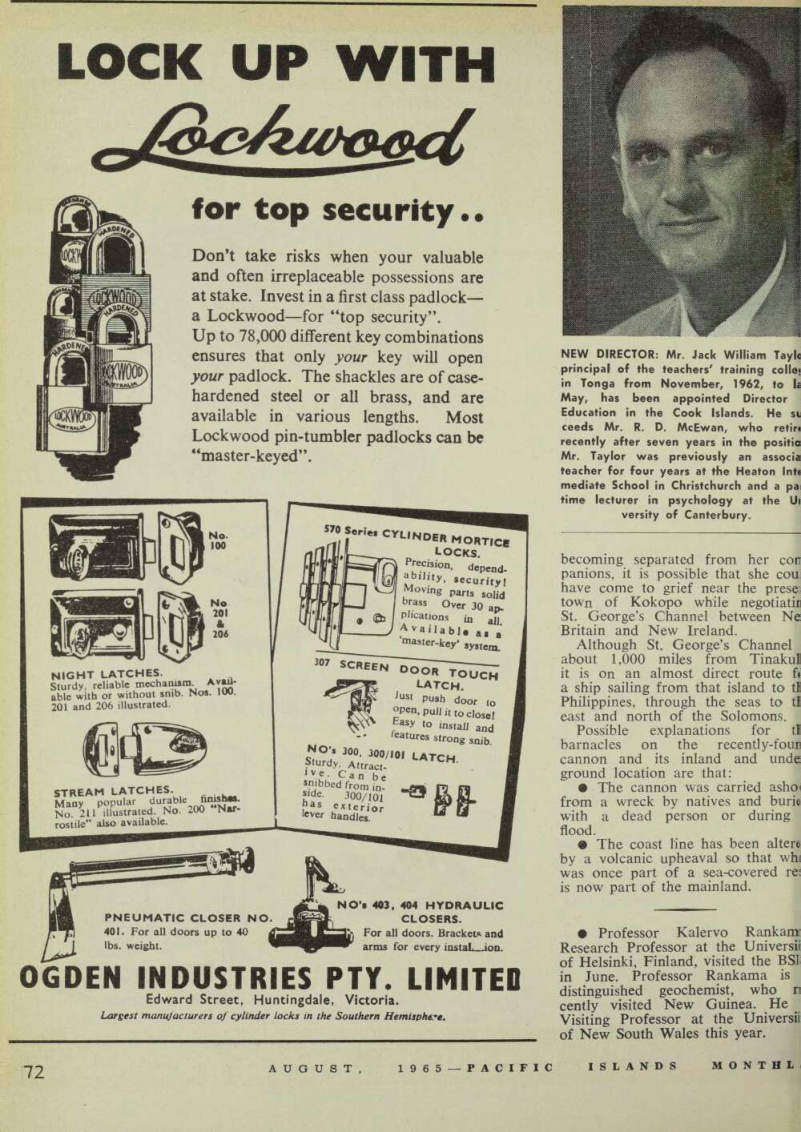
NEW DIRECTOR: Mr. Jack William Tay[?] principal of the teachers' training colie[?] in Tonga from November, 1962, to [?] May, has been appointed Director Education in the Cook Islands. He s[?] ceeds Mr. R. D. McEwan, who retin recently after seven years in the position Mr. Taylor was previously an associ[?] teacher for four years at the Heaton In[?] mediate School in Christchurch and a p[?] time lecturer in psychology at the [?] versity of Canterbury.