"Forgotten" Man
pp. 69-71 · Read in the full issue
Of Nauru Has
Done Much For
Nauruans
By a Staff Writer
Amid all the publicity over the Nauruan question, among the thou sands of words poured into the Aus tralian and New Zealand Press about the efforts of Head Chief Hammer Deßoburt to get a better deal from the Australian Government and the British Phosphate Commissioners for his people, there is one important name that is seldom mentioned. r’S that of Reginald Sylvester Leydin, OBE, Administrator of Nauru for more than seven years, and a man to whom the Nauruans owe much, whatever the outcome of the present situation.
Mr. Leydin was among the group of senior Australian Government officials who sat around the Canberra conference table with the Nauruans and their advisers in June.
His knowledge of local affairs and his goodwill towards the Nauruans are items the Nauruans are aware of, for they, anyway, know that it is merely because of a quirk of tim ing that Mr. Leydin happens to be on the opposite side of the political fence. He just happens to be the instrument of the Australian Govern ment on Nauru at a time when the mana of Canberra there is not high.
But his personal popularity has
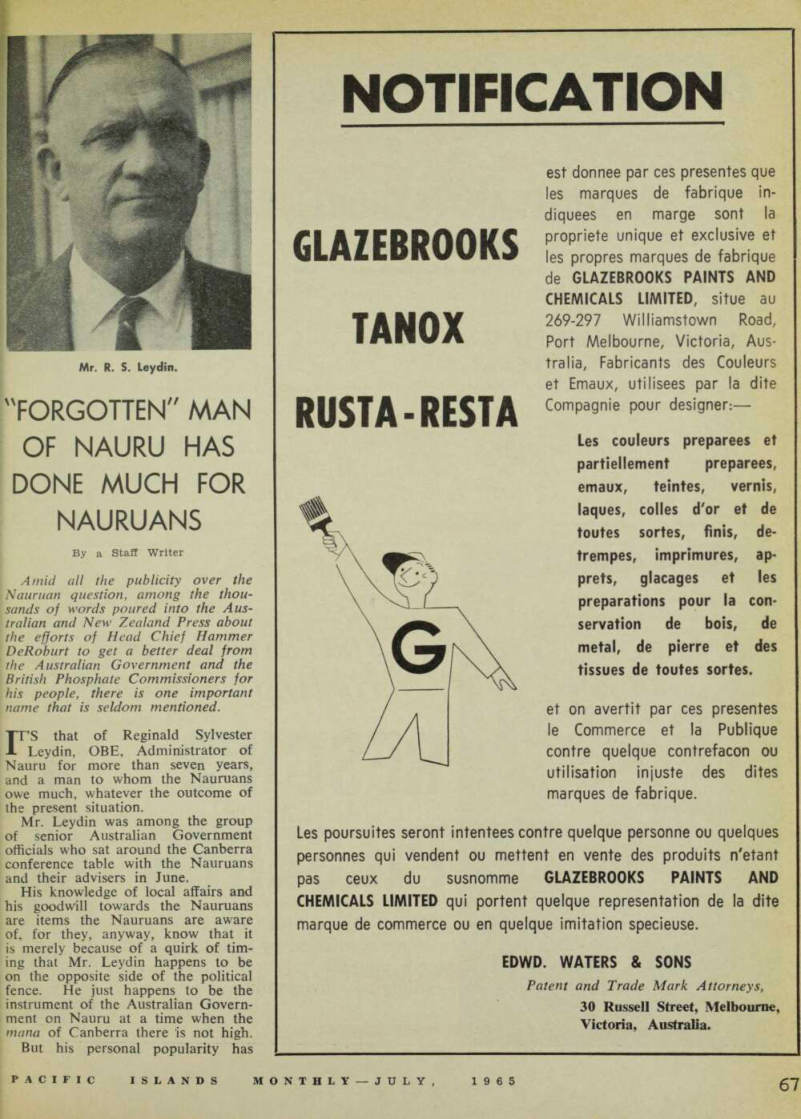
Mr. R. S. Leydin.
not waned, nor has his reputation for being an honest, efficient and dedicated Administrator. If any body else but Mr. Leydin had sat in Government House in Nauru in recent years the political situation today would probably be much Stickier than it now is.
Aged 60 last May, Mr. Leydin has been a Government man all his fife —and for all his life he has been working in Australia’s tropical terri tories (if one regards Norfolk Island, too, as being tropical). [ His longest single spell in the tropics was in Darwin, in Australia’s Northern Territory, where he was Town Clerk from 1928 to 1937.
After a four-year stint in the RAAF which he continued his tropical service, but in New Guinea!) he went back to Darwin, this time as the Territory’s Government Sec retary.
Spy Incident
I It was when he was in this position that he received unexpected plaudits as the man who prevented the wife of Russian spy Petrov from being kidnapped from the country by Russian strong-arm men.
From his Darwin post he was appointed, in 1954, as Administrator of the mid-Pacific phosphate island for the first time. He liked the Nauruans from the first and they liked him. [ At this time they had hardly re covered from the war (during which many of them were shipped by the laps to the Caroline Islands) and he worked hard to put the islanders on a better footing. He concentrated particularly on education and public service organisation.
Meanwhile, his wife put in a lot of effort to break down the social barrier between the Europeans and Nauruans, as it was virtually un beard of then for people of the two races to fraternise socially.
The good relations that the Ad ministration now enjoys with the Nauruans are no doubt due, to a large extent, to Mrs. Leydin’s friendly personality, which has brought the people together. But some of the older Nauruans apparently have not completely for gotten or forgiven the social dis crimination of the pre-Leydin era, and this may account for some of he difficulties that Mr. Leydin now bas to face.
In 1958, following a heart attack, Mr. Leydin moved to the milder climate of Norfolk Island as Admini strator—but May, 1962, found him
on Nauru again—where he has since remained.
These last few years have been a period of change on Nauru.
There has been a complete re organisation of the public service; the powers of the Nauru Council have been extended (the council now controls its own budget and elec tions, and does not need the Admini strator’s approval for many of its other actions); the percentage of Australian public servants has been reduced and the Nauruan percentage increased (with an increase in salaries); the Nauruan basic wage has been raised; a Nauruan, the late Raymond Gadabu, was appointed Official Secretary, the top official under the Administrator; and all six magistrates are now Nauruans.
All these developments, coupled with the increase in higher education for Nauruans, have been planned in Mr. Leydin’s time to help the Nauruans achieve complete control of their affairs.
Despite their current fight for higher phosphate royalties and for political independence, the Nauruans enjoy many advantages that other Islanders would give their right arms for—such as no taxation, cheap rents and transport, cheap consumer goods, and regular and fast shipping services.
No Financial Worries
They are not plagued with financial worries in the running of the Ad ministration, because the phosphate pays for it. (Out of a total 1963-64 revenue of £919,921, all but £41,000 was provided by the Phosphate Com missioners).
Mr. Leydin probably has not much longer to serve on Nauru before retirement. Although he is not likely to reveal it, the present Nauruan clamour for independence as not made him happy, because he honestly feels the people would be better off on an island of their own near the Australian mainland, or somewhere else where they could have close connections with Aus tralia.
Those who know him suspect he feels that it is his fault that they have asked for independence, because he has failed to convince them to follow a different course—a course which he honestly believes is in their best interests.
But the important fact is that his friends, the Nauruans, know him for the dedicated man he is—and in these days of swift-changing winds, no colonial administrator could ask for more than that.