Island Eclipse Watchers
pp. 73-74 · Read in the full issue

’Black Disappointmen t' For Island Eclipse Watchers
From W. H. Percival, on Rarotonga
Heavy cloud formations over Manuae and Rarotonga on May 30, the day of the solar eclipse, brought black disappoint ment to the scientists of six nations based on Manuae, and relief to parents on Rarotonga.
THE eclipse attracted the largest gathering of solar astronomers sver to observe an eclipse from a jingle site.
Manuae, their base, is an atoll of 1,524 acres, leased as a copra plantation by the Manuae Develop ment Co-Operative Society.
The atoll’s normal population is a jcore of copra labourers. On May JO, there were also 85 scientists and their assistants from the United Kingdom, New Zealand, Australia, fapan, Russia and the United States.
A post office set up on Manuae iuring the scientists’ visit issued a special 6d stamp depicting a coco aut palm and the partly eclipsed sun.
On the day of the eclipse, the skies over Manuae were clear at irst, but just before totality occurred i large cloud appeared and spoiled the scientists’ efforts. They had hoped to make records of the :hromosphere, the structure of the solar surface in relation to the tsorona, and a photographic search for faint comets near the sun.
Radio Was Successful
All that could be seen were glimpses of the corona through breaks in the cloud. This meant that only a tenth of the optical sxperiments could be carried out.
However, the radio observations, svhich were unaffected by cloud, were successful; and a few photo graphs were taken.
The Press and radio had warned Rarotongans, particularly children, of the danger of viewing the eclipse with the naked eye, or through sun glasses or film. It was therefore a relief to many parents when black Houd masses over Rarotonga obscured the phenomenon.
But the cloud cover did not mar the work of the American scientists based on Rarotonga, who fired five Nike-Tomahawk rockets to an altitude of 300.000 feet —175 miles
—into an area close to the zone of eclipse totality. Their object was to measure low energy X-rays from the sun.
The rockets were fired from a base built by the Sandia Corporation of New Mexico on the property of Captain Andy Thompson, well known Cook Islands skipper, now retired.
The rockets were the solid propellant, two-stage type. The first stages were Nike-Ajax with 40,000 lb thrust and a flight duration of 3i seconds, the second stages, Tomahawks with 10,000 lb thrust and a flight time of nine seconds.
The rockets shot into Rarotonga’s skies with the velocity of anti aircraft shells. White vapour trails marked their ascent, and a rumbling sound like distant thunder marked
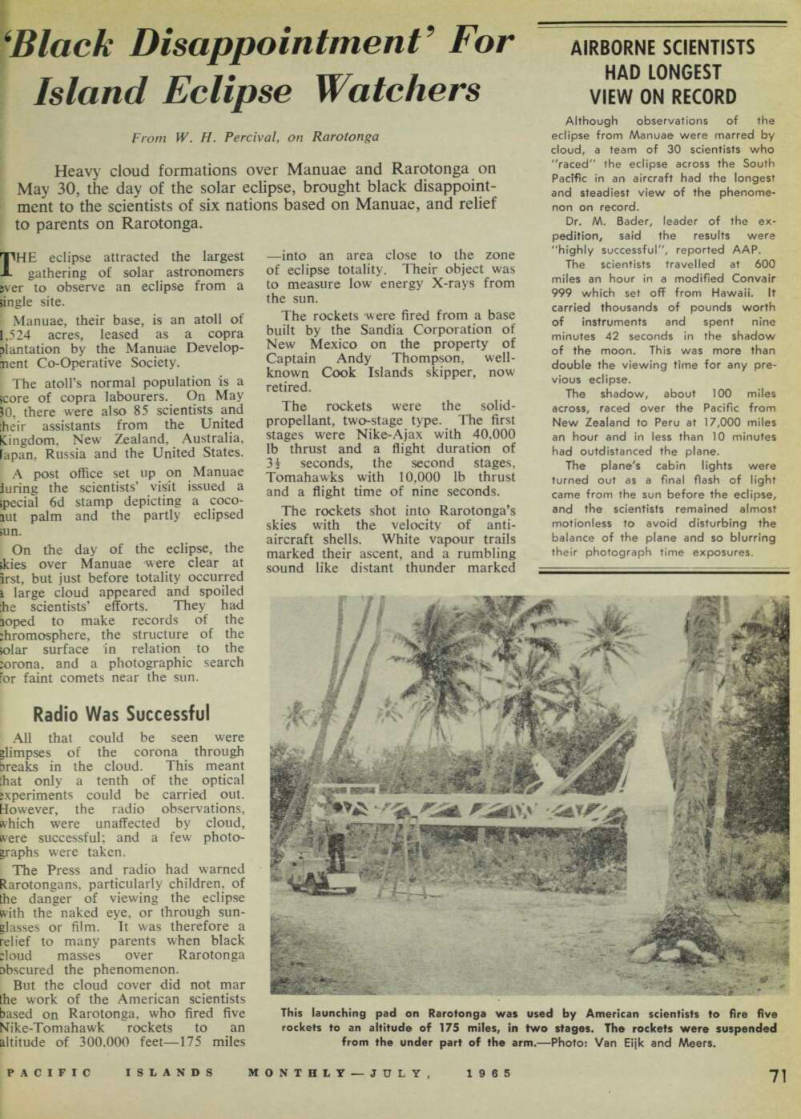
This launching pad on Rarotonga was used by American scientists to fire five rockets to an altitude of 175 miles, in two stages. The rockets were suspended from the under part of the arm. —Photo: Van Eijk and Meers.
the first breaking of the sour barrier.
The white vapour trails appear as spirals. This effect was caused I contrary winds of high velocity ; high altitudes, and it gave mar people the false impression that tl rockets were spinning off course.
When the first stages droppe towards the Pacific Ocean about tw miles out from the reef, they wei visible to the naked eye. A fe seconds later there followed anothi loud rumble as the Tomahawk ah broke the sound barrier.
The rockets had to be aimed awg from the sun so that the first ar second stages would fall well clej of the island. Then they wei directed straight at the sun b remote control. The nose com contained intricate apparatus whic transmitted information to the contn point by radio signals.
The blast-off of the rockets scare nearby livestock. Pigs jumped 01 of their enclosures and ran will As the blasts echoed round the hil dogs hurtled in all directions, tc over-awed to bark. When the eclip; brought premature night, Rarotonga chickens went to roost. Even tb noisy mynah birds were silent.
First Class Views
Although clouds obscured tb eclipse over Manuae and Ran tonga, two groups of sightseers o the Moana Roa and Tagua enjoye first class views.
The Moana Roa left Rarotong on the night before the eclipse wit a full booking of cabin and dec passengers to view the eclipsi Double-smoked glasses were pn vided for the trippers. At 8.20 a.n Sunday, the start of the eclipse ws clearly visible and there was onl three-tenths cloud. By 9 a.m. th cloud had increased to seven-tenth and hopes vanished. At 9.20 mo: of the cloud disappeared and th total eclipse was plainly seen.
Suddenly it was dark—an eeri darkness with an almost supernornu quality. Stars appeared over tb black, heaving sea and a suddenl frigid wind made the spectatoi shiver. The corona, the sun atmosphere which is usually see as a white light, appeared as blazing blue and orange halo. On star shone brightly close to the sue Three minutes later it was ligh again, and an intensely bright flas; was seen on one side of the dar circle.
Trippers on the Tagua viewed th eclipse and saw the rockets pass ove from a position 25 miles north-wef of Rarotonga.