Fascinating New Guinea
pp. 59-67 · Read in the full issue

LAE IS THE BUSY CENTRE OF A
Visitors from all over the Pacific who will be in Lae, New Guinea, for the Sixth South Pacific Conference in July, will find themselves in the heart of a fascinating Islands territory which has no equal in size or variety anywhere in the South Pacific. The island of New Guinea is the world’s largest with the exception of Australia and Greenland, and the eastern half of Papua- New Guinea has a population of more than two million. There is eternal snow on some of New Guinea’s mountain tops.
DELEGATES and visitors to the conference at Lae will in most Bses be seeing the mainland of New guinea for the first time, so it is p their advantage that Lae happens o be the most central of all New Juinea towns. [ From Lae, roads wind through he great valleys and mountain anges for hundreds of miles, and laily air services link the town with post other centres, big and small.
It is possible, and most desirable, or visitors to the area to travel to nany places by road or air and eturn the opposite way.
And in a day’s travelling visitors an see New Guineans in many stages f development; from the sophisti cates of the coastal areas to the (rimitives of the hinterland. [ Lae, the administrative centre for he progressive and fast developing rtorobe District, is also the port for me of the other quickly developing md most interesting areas, the Eastern Highlands District, with its leadquarters at Goroka, more than t,500 feet above sea level.
Goroka is a 50 minute flight from ,ae in a Douglas DC3 or a day’s Irive by car.
Before the war Lae was one of wo towns which serviced the tforobe goldfields—at Wau, Edie >eek, Bulolo and Bulwa. The other own was Salamaua, 16 miles across Juon Gulf.
Roads out of Lae in those days vere practically non-existent, and here was none to Salamaua, ilthough a possible road over the Cuper Range to Wau had been surveyed. However, it is easily seen vhen one flies over these mountains ust what a mammoth task it would lave been in pre-war days, especially, o have such a road put through. 1 Aircraft, instead, were used to supply the goldfields. Guinea Air ways, Mandated Airlines and others operated out of Salamaua, and Bulolo Gold Dredging Ltd., in
conjunction with Guinea Airways, developed Lae as a port to receive from overseas ships and dispatch, to Bulolo and later Bulwa by big three engined Junkers many thou sands of tons of goods and equip ment, including, in all, eight dis mantled dredges each weighing 2,000 tons and more. The dredges were put together on the goldfields.
Occupied By Japs
When the Japanese entered the war both Salamaua and Lae fell to the enemy, and each town was occupied for 18 months before being recaptured in September, 1943.
During those 18 months Salamaua and Lae were practically destroyed.
At Lae only two pre-war buildings were still standing, in part, when the town was won back from the Japanese.
Prior to the war Lae had been named as the future capital of the then Mandated Territory of New Guinea, following the shocking volcanic eruptions at Rabaul in 1937. But very little had been done
about the transfer before the Japanese onslaught.
Army engineers built, in 1944, a serviceable road from Sunshine, where the pre-war Wau road finished, to Labu at the mouth of the great Markham River, on the opposite bank to where Lae is situated.
Barges were used to link Lae with the Wau-Labu Road.
This road, the masses of land available for developmental purposes, and the fact that Lae had already been named as the future capital of the Mandated Territory, made Lae the logical choice for the new town.
But Lae was never to become the New Guinea capital, because the now Trust Territory of New Guinea was linked with the Australian Terri tory of Papua, to form what is now the Territory of Papua and New Guinea, with Port Moresby the chosen capital site.
Although Port Moresby has one advantage over Lae —a good harbour —many Lae residents still think Lae should have been made the capital because of its central location, its vast area of available land and good water supply.
The building up of Lae, as in all Territory centres, apart from Port Moresby where a big proportion of funds are spent each year, was slow but sure, and the town today is probably the most attractive and best looked after of all the country’s bigger settlements.
Lae is a garden town. Most main roads are tar sealed and lined with trees and beds of multi-coloured lilies. In the centre of the town is the Botanic Gardens which includes the beautiful War Cemetery where nearly 3,000 Australian and allied servicemen rest, a magnificient orchid house and lakes covered with water lilies of many colours.
The Lae Botanic Gardens, developed and cared for by the staff of the Division of Botany of the Department of Forests, covers more
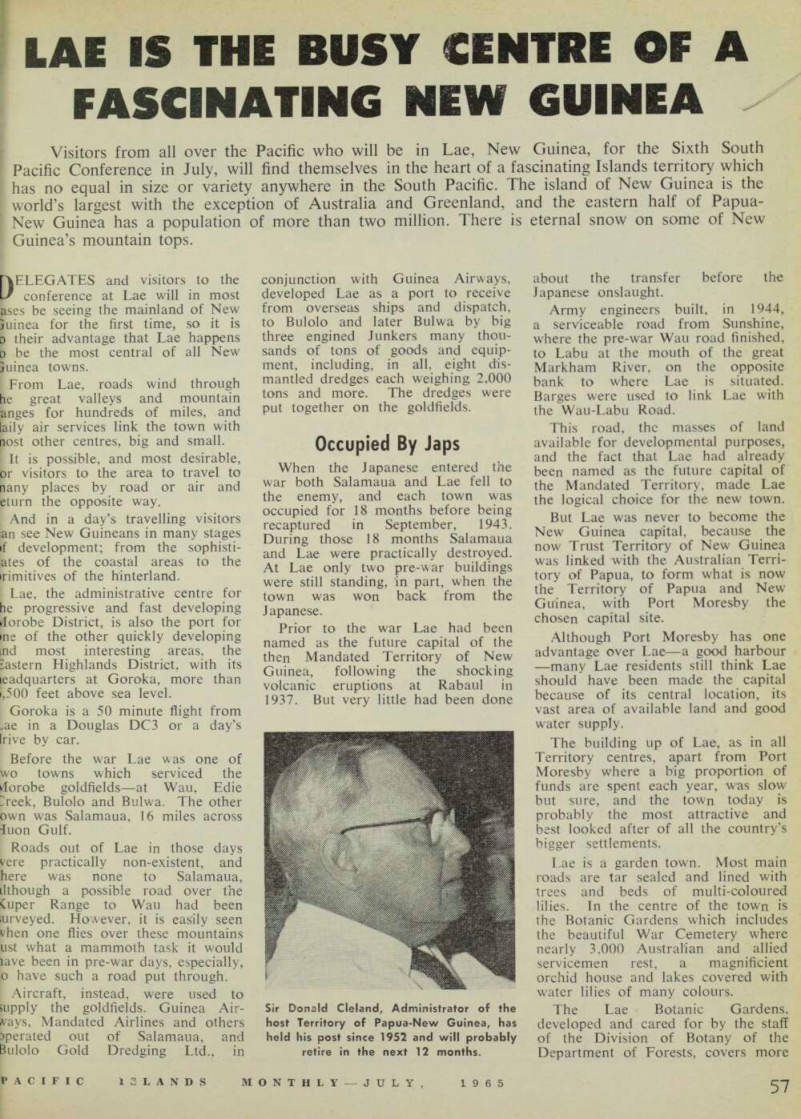
Sir Donald Cleland, Administrator of the host Territory of Papua-New Guinea, has held his post since 1952 and will probably retire in the next 12 months.
ban 100 acres, and has been [escribed by visiting botanists as the »est tropical botanic gardens in the outhern hemisphere. Only recently
j 1 herbarium, costing £lOO,OOO, was
ipened in the gardens, I Another feature of Lae is its Jrport. which runs through the own. splitting the business and bsidential sections from the in bstrial area. Lae’s airport, follow ag recent extensions and improve lents, can now take aircraft as big iS Electras, but the airlines have not et seen fit to replace the older )ouglas DC6B’s with faster and lore modern aircraft for the Sydney- Jew Guinea flights, which terminate t Lae.
Plenty Of Rain
A town with an annual rainfall ►f about 180 inches, Lae is at all imes tropical and attractive. Most inds of tropical plants grow in bundance and need very little care, "hree weeks without water could be lassified a drought and the seasons ould almost be rated as the wet eason and the wetter season. How ver, a big percentage of this rain alls at night—anything from three o six inches is not uncommon—and lost days are sunny and hot.
The wettest months are from May o July. Some miserable days are xperienced during this period.
The town, with a population of bout 3,000 Europeans and Chinese tnd about 5,000 New Guineans, has nany amenities. It can boast a ►eautiful golf course which will soon ►e the first complete 18-hole lay-out
in the whole of the Territory. And the course has a clubhouse to match the links.
Lae’s bowling club has two greens which are in use most afternoons, weekends and sometimes at night.
As yet the club has to build a permanent clubhouse.
Rugby League, Soccer and Aus tralian Rules football competitions are conducted within the town, and Lae representative teams participate in inter-town and inter-district com petitions. This also covers other sports such as cricket, tennis, golf, hockey, basketball, softball.
Lae Rugby League and Lae Amateur Basketball Associations
have developed their own grounds while there are plenty of grounds for the other sports.
Those who like to play squash are well catered for at the Lae Squash Centre where there are two courts and a filtered swimming pool which are open seven days, and most nights, each week.
Lae Aquatic Club is popular and caters for those interested in sail and motor boating, water skiing and fishing. Those interested in under water diving and fishing are catered for by the Lae Underwater Fisher men’s Club, which explores the coastline.
Visitors to Lae have the choice of the Hotel Cecil and the Transair Lodge to stay at, and within a year or so a new hotel, to be built by Steamships Trading Company at a cost of something like £330,000, will go up right in the business section of the town. A motel is also being planned.
Drinking Habits
Europeans do most of their drink ing in the various clubs, and the New Guineans prefer to drink at the Hotel Cecil and the recently completed Beeps Tavern. A few can drink at the licensed Native Ex- Servicemen’s Club.
There are three theatres at Lae.
Theatre Lae is situated right in the main business centre, in 4th Street; The Stewart, built in 1963, is situa ted in the new suburb, Bulae, about a mile from the post office, and the Star Theatre (also used for boxing and other indoor sports) is found in the industrial area. Theatre Lae
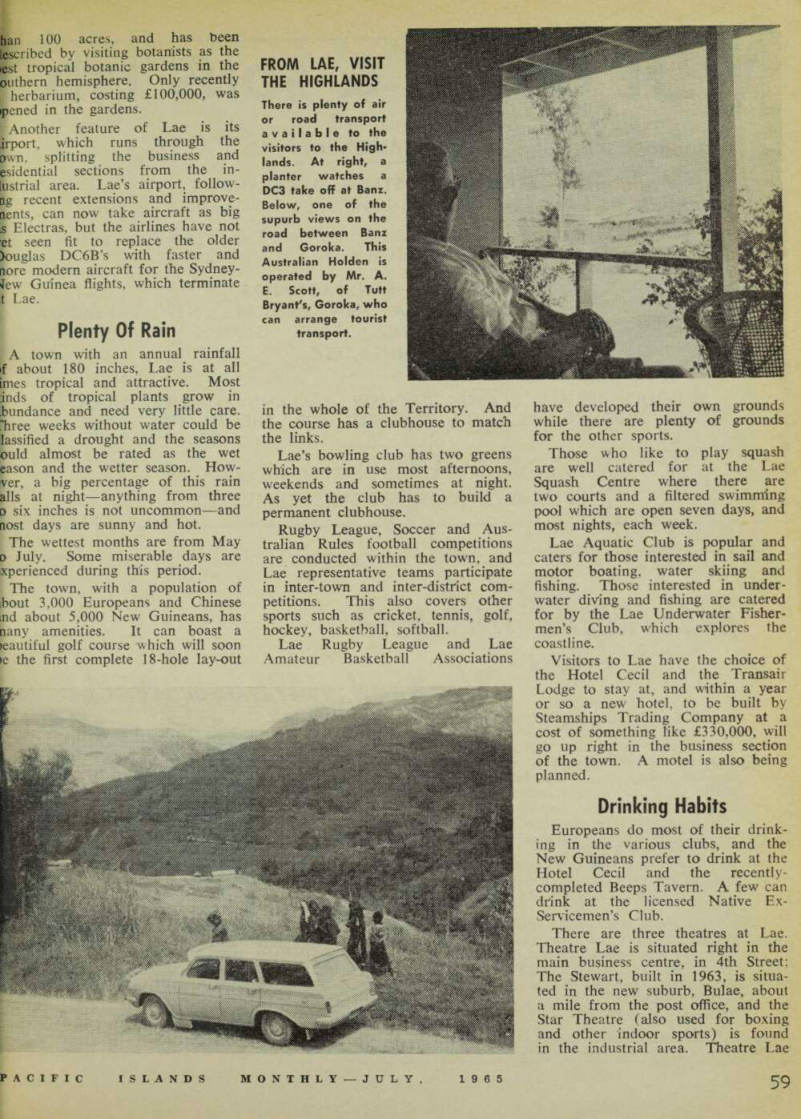
From Lae, Visit
The Highlands
There is plenty of air or road transport available to the visitors to the High lands. At right, a planter watches a DCS take off at Bam.
Below, one of the supurb views on the road between Bam and Goroka. This Australian Holden is
operated by Mr. A.
E. Scott, of Tutt Bryants, Goroka, who can arrange tourist transport.
and The Stewart cater for mixed audiences and the Star’s patrons are mostly New Guineans.
A variety of stores cater for all lastes. l Lae is also the cultural centre of the Territory. Each September a Festival of Drama is held there and in the not-too-distant future the town will be able to boast a modern Little Theatre, to cost about £20,000. [ Lae will be the outlet for a beef cattle industry which is fast develop ing in the Morobe and Eastern High lands Districts. Many thousands of acres in the Markham and Ramu Valleys are already carrying big herds, while lesser herds are being raised in the Mumeng, Wau, Lae, pinschhafen and Kainantu sub districts, The present cattle popula tion—mostly beef—of the Morobe District alone is nearing 14,000.
Wau By Road
In the Eastern Highlands, and in piany parts of the Morobe District, village cattle herds, which will play an important role in the future of the industry, are being established.
An abattoir is being built at Lae at a cost of about £40,000 and will be operative later this year. The abattoir will process an anticipated 1.000 head of cattle a year for home and export markets. The freezing section will store about 100 carcases at a time.
An interesting day for visitors to Lae is a drive to Wau and back— about 200 miles. Initially the drive takes in several miles of cocoa plantations, a dairy farm and a low land coffee plantation in the lower Markham Valley before the Mark ham River is crossed by bridge.
From then on the road winds through the hills and the odd planta tion and native village until the Zenag Plateau is reached. There, New Guinea pioneer and explorer Mr. Mick Leahy has established a mixed farm on something like 200 acres.
Mr. Leahy grows vegetables, runs about 6,000 laying hens and about 1.000 meat birds, ducks, turkeys, pigs and until recently he conducted a dairy which helped to supply Lae and Bulolo with fresh milk and cream.
But following a difference with the Administration he stopped supplying these products and is now putting his milkers to Brahman Cross bulls so that all future calves will be beef producers. ■ Across the Snake River from
Zenag, Mr. Leahy runs a herd of several hundred beef cattle on his Baiune property.
There are other farmers in the Zenag-Mumeng area, and from the surrounding district native villagers grow a great quantity of vegetables and fruit which mainly is disposed of at the Lae market, some 50 miles away.
Twenty-seven miles from Zenag
is Bulolo, where the visitor can see Bulolo Gold Dredging Company Limited’s last dredge in operation.
The dredge, on the Wau side of Bulolo, is the last of eight the company has used since 1932 to take from the beds of the Bulolo and Watut Rivers many millions of pounds worth of gold. But now there is little gold left for the dredge to remove economically and soon
the dredge’s bucket line will turn over for the last time.
Anticipating the coming of such a day, BGD in the early post-war years formed a company 'with the Commonwealth Government and established a plywood industry in the area. Thousands of acres of mature pine stands were there on the hills bordering the Bulolo Valley just waiting for someone to utilise them.
BGD and the Commonwealth formed Commonwealth New Guinea Timbers Limited, built a mill cover ing something like 3-1/3 acres and went into production. The mill, one of the most up-to-date in the world, can produce each year 35-million square feet of 3/16th inch plywood, plus quantities of various other Sizes.
To ensure that there would be a never-ending supply of pines the Department of Forests introduced a reafforestation scheme and now nurseries and plantations are being established in the Bulolo area and at Wau. An Administration Forestry School at Bulolo is training young New Guineans in all aspects of the industry.
Besides plywood, there are saw mills at Watut, Bulolo and Wau which cut timber for export, as well as help supply a very demanding local market.
Winding Roads
At Bulolo the visitor can enjoy a short respite at the picturesque Pine Lodge Hotel, built on a ridge over looking the company-owned part of the town.
From Bulolo the drive is con tinued to Wau, about 16 miles farther along the Bulolo River, and before the journey is completed the newcomer has a few worrying moments as the road winds around
the cliff face with a sheer drop of some hundreds of feet in places to the swirling boulder-dotted river below.
At Wau there are native-conducted gold claims to be seen along with the workings of New Guinea Gold fields. New Guinean miners, who are advised and assisted in their work by officers of the Department of Lands, Surveys and Mines, in the last financial year extracted gold worth £81,370 from their diggings.
In all the Wau-Bulolo area produced gold worth £648,000 in the same period.
In early 1943 at Wau there was a bloody fight. A Japanese force of about 4,000 men marched on the town after using an old miner’s track from Salamaua, a track long for-
gotten by Australia. They by-passed Australian soldiers who had just completed an unsuccessful assault on the village of Mubo, and descended on Wau where no more than 50 Australian soldiers, mostly cooks, medical people and sick and wounded remained. But for some unknown reason the Japs decided to work out a plan to take Wau, instead of just walking in and taking over.
While their plan was being put into effect, more than 370 Dakotas, carrying troops, equipment and supplies, landed on the uphill strip.
In all about 3,000 men, of the Aus tralian 17th Brigade, Commandos and Corps troops, piled in.
Soon the Japs were put on the run.
They were by this sick and sorry, and soon were also out of food.
They became easy prey for the Aus tralian 25 pounders and flights of whispering Beaufighters which cut them down from treetop level. Very few of the invaders returned to Mubo. Instead they fell to the Aus tralians, who, from then on, were in full pursuit of a soon-beaten enemy.
Kainantu
Also at Wau the visitor can call on mixed farms, and it is an ideal place to spend a night, as the climate, at more than 3,000 ft, is exhilarating and most pleasant, especially at night.
The return trip to Lae by road is also agreeable, but after having
New Guinea's Highlands towns have a charm of their own. Above is an aerial view of bustling Mt. Hagen, which is quickly challenging Goroka in size. Below is a leafy view in Kainantu, in the mountains just above the Markham Valley.
gone up, the easy way back is by feircraft, a flight of 30 minutes. This way many native villages can be seen and it is a further opportunity to have a look at New Guinea’s mighty I The trip by road from Lae to poroka by way of Kainantu is also Goroka can be reached in a day, and a lunchtime stop at the Kainantu Hotel is recommended. On this trip the visitor can see for the first seven miles or so the cocoa plantations of the lower Markham Valley. Nine miles up, the Department of Agriculture’s Lowland Experimental Station, Bubia, is worth seeing. At this station all lowland crops are experimented with and many acres of ground carry a great variety of crops. Agronomists at Bubia work in close touch with local and outside planters, and help them with their problems.
Wartime Airbase
? Further on is the famous wartime airbase at Nadzab, which in 1943/4 housed something like 100,000 servicemen and women and hundreds of aircraft. The main wartime strip is still used and at present extensions and improvements are being made to it. Neptune bombers of the Royal Australian Air Force will probably use Nadzab as an important base one day soon.
And around Nadzab many planta tions and farms have been estab lished. Peanuts, and coconuts are grown and beef cattle are being introduced to most properties. Pigs are run on some. At nearby Erap, the Administration Lowland Stock Station is located.
Further along the valley big cattle properties are now in full swing.
BGD have developed Leron Plains on the Leron River; at Gusap, R.
L. Atkinson and Sons have a big holding; and further on still at Dumpu, in the Ramu Valley, Dumpu Pastoral Company is well established.
Up over the hills at Arona another large cattle property is being built ip.
Coffee Riches
The climb from the Markham Valley into the Kainantu area is by way iof Kassam Pass, where Commonwealth Department of Works engineers are fully occupied >n a road project full of hazards ind heartbreaks. However, the job is well on its way to completion and wen now big trucks are continually hundering along this road to the highlands from Lae, and back again,
carrying stores in and produce out for shipment to overseas markets.
The Kainantu sub-district, like the neighbouring Goroka sub-district, is rich in coffee. Plantations are many.
Every village has its coffee.
In early post-war years when the Australians began to settle in the area and plant coffee the practical native people went along with them, and, besides, they helped the Admini stration in every possible way to build roads to make sure that their produce could make its way to a market.
These roads also permitted agri
cultural extension officers to travel to the villages with the know-how on bigger and better crops. Last financial year 3,578 tons of coffee were produced in the Eastern High lands District. Of this 2,053 tons came from the efforts of New Guinean planters. Many of these natives are members of the High land Farmers and Settlers’ Associa tion, a body which has also en couraged and helped the villagers in many ways.
The visitor to the Eastern High lands will also see other projects which have done well, for here he is in a rich and busy district.