When Tonga's Treasury
pp. 93-94 · Read in the full issue
Was Stony Broke
• The Kingdom of Tonga is currently passing through a period of financial troubles, which has resulted in strict exchange controls being im posed. But as gloomy as the picture might appear, it's just nothing to the time . . .
The Hon. and Rev. Shirley Waldemar Baker, Premier of Tonga, Minister of Foreign Affairs, President of the Court of Appeal, Auditor-General, Minister of Lands, Judge of the Lands Court, Minister of Education, Agent-General, and Medical Attendant to King George I, had at last fallen from office.
HE was aboard the mail steamer Wainui, bound for Auckland, with a deportation order signed by the Western Pacific High Com missioner, Sir John Thurston, pro hibiting him from remaining in Tonga for two years because he was con sidered a danger to good order and peace.
But now that he had at last been got rid of, who was to straighten out the ship of state on her wobbly course, and —more particularly—who was to solve the kingdom’s grave financial situation?
Sir John Thurston got his first in dication of the state of the Treasury following a conversation with Tonga’s Minister of Finance, elderly Junia Mafileo, the King’s nephew, which went like this: “What is your office?”
“I’m Minister of Finance.”
“What is the revenue of Tonga?”
“I don’t know.”
“But what is your office?”
“Minister of Finance” (warmly).
“Well, who knows what is the revenue of Tonga?”
“Misa Beika.” [Mr. Baker].
“Who takes care of the money?”
“I do.”
“How much have you got in the Treasury?”
“I don’t know.”
“But you are Minister of Finance?”
“Yes; I have told you that I am.”
“Well, where’s the money?”
“In the safe.”
“Who knows how much there is?”
“Misa Beika.”
“Yes, but he’s gone. Can’t you go and count it?”
“No; I haven’t got the key.”
“Why, who keeps the key of the Treasury?”
“Misa Beika.”
The answer to the need for a man to straighten it all out came in the person of 29-year-old Basil Thomson, a wide-awake Colonial Office official, whom Sir John sent to Tonga un hampered with detailed letters of in struction, but with a general outline of policy and a free hand to carry it out.
Thomson was later to make his name through a variety of exploits, and to be knighted, but he never more enjoyed anything than he did on the occasion, in 1890, when he became virtual Premier of Tonga.
Delightful Reading
His book on that exploit, The Diversions of a Prime Minister, pub lished in 1894, is required reading and delightful reading, for those fascin ated by Tonga’s chequered history.
The history of the Rev. Shirley Baker’s control of the financial and political strings of Tonga had really started in 1845 when King George Tubou came to the Tongan throne.
His people were in the white-heat of conversion to Christianity, and when Mr. Baker, a London-born Methodist missionary, appeared on the Tongan scene in 1860 it was not difficult for him to win a place as a royal adviser and finally to become the King’s favourite.
Unfortunately his zeal was so ex cessive that he became a tyrant, with many enemies, and the Tongans gave
up paying their taxes in disgust. It was at this stage, in 1890, that Sir John Thurston deported him.
When Thomson finally opened the safe it was found to contain £2,000.
But the claims against the Govern ment amounted to more than £6,000 and there was another £B,OOO owing in arrears of pay to public servants —many of whom, including Euro peans, had been waiting nine months.
Tonga was broke!
Just where the money had gone was difficult to say, thanks to the Rev.
Baker’s odd financial system.
Money collected by the sub- Treasury offices was personally carried off by the former Premier and put in the safe. Customs duties and rents paid by Europeans by cheques upon Australian and New Zealand banks were deposited by Mr. Baker in an account in an Auckland bank of which he had the absolute control.
Mr. Baker made frequent trips to Auckland and his expenses were borne by the Treasury.
In his accounts as turned up by Basil Thomson items such as “police uniforms, hardware, parliamentary expenses, tanks, medicine, building materials, lime, etc., £769/6/2”, were all flung together incongruously. They invited speculation.
In this particular account, Thomson tracked down the “et-ceteras” and found they consisted of vouchers for groceries (£35/19/-), Mr. Baker’s sub scription to the Northern Club, Auck land, his son’s cab, tram and boat hire (£46) and boots and shoes (£2/9/9). (over)
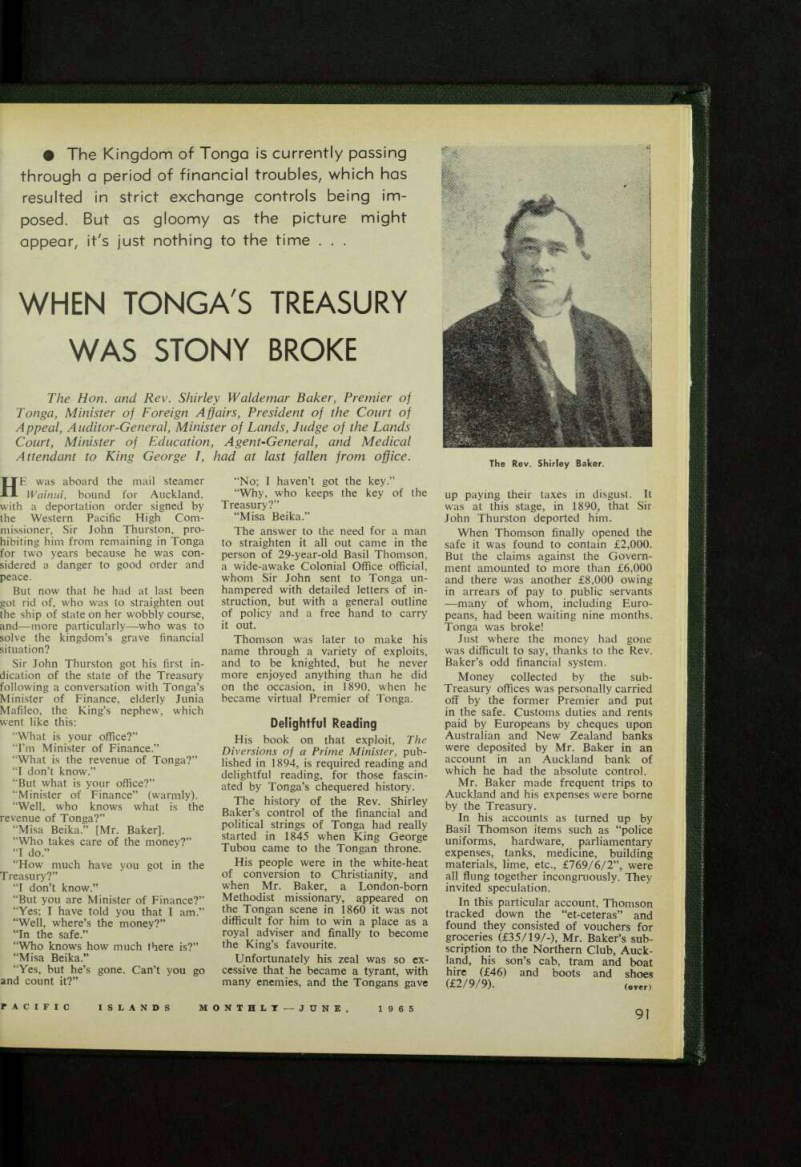
The Rev. Shirley Baker.
A wicked curiosity prompted Thomson to write to the fallen Minister to inquire whether his club subscription had not been charged to the Government in error. But Mr.
Baker, unabashed, “had the honour to inform” Thomson that payment had been approved by His Majesty in Council. But the minute book was silent on the point and the King and the Ministers disclaimed knowledge.
Thomson’s hand trembled as he un folded another voucher, marked “Assassination, £45/16/9”. Had the ex-missionary reverted to the methods of medieval Italy to choke opposi tion, and then flaunted the price of it in a Treasury voucher?
The amount turned out to be for the complete renovation, by an Auck land coachbuilder, of the Premier’s private carriage, which three years before had been damaged, in one place only, by a bullet fired at Mr.
Baker by a party of disgruntled Tongans.
Mr. Baker always subsequently re ferred to this attempt on his life as “the assassination” (and the fact that he had four Tongans summarily shot for the exploit was one of the things that helped bring about his down fall).
I
Missing Statue
Then there was the case of the missing statue.
In a burst of loyalty to his master, the ex-Premier had, during the closing months of 1886, inaugurated a sub scription for a statue of King George, to be executed by an Italian artist, and erected in the centre of the Malaekula, the public square of Nukualofa.
Money flowed in rapidly, with the High Commissioner heading the list.
Scarcely a European or Tongan had failed to give according to his means.
The Paymaster, Sateki, as trustee, took charge of the money and the Premier was commissioned to order the statue. Four years passed, dur ing which the curious learned that the artist in Italy was carving the marble at the very moment of inquiry.
But this picture of the Italian artist failed to satisfy the subscribers and Thomson decided to track the sealed bag of silver.
Sateki remembered giving the bag to the Treasury clerk for safekeep ing in the safe—the last clerk but one, he who was dismissed for embezzlement. Thomson waded through the Treasury book until he found “Revenue from Paymaster— £l,299/13/6”, the exact amount of the subscription. It had been used for general expenditure.
To retain the wavering loyalty of the civil servants Thomson now paid them a month’s salary, and used the slender balance of the national in come to pay off enough of the country’s overseas creditors to restore credit abroad.
He then set about getting the Tongans to pay their taxes and in stituted a better system of accounting than the one that had been followed by the ex-Premier.
During one particular lean period Thomson decided to change the de sign of the Tongan stamps—which he found could be done for £40 —so that the old stamps would have an enhanced value for overseas col lectors. He then had the old stamps sold for a much-needed £2OO.
Thomson recalled later: “I have since heard that a year later the Gov ernment of Costa Rica descended to the same disreputable expedient, but I believe I may fairly take to myself the discredit of being the first to de vise the scheme.”
The clean-up in the Treasury was successful, and Tonga’s greatest financial crisis was over within 12 months. When Thomson left in 1891 there was £B,OOO in the Treasury and all debts had been discharged.
But it was many years yet before the Kingdom recovered from the activities of Misa Beika.
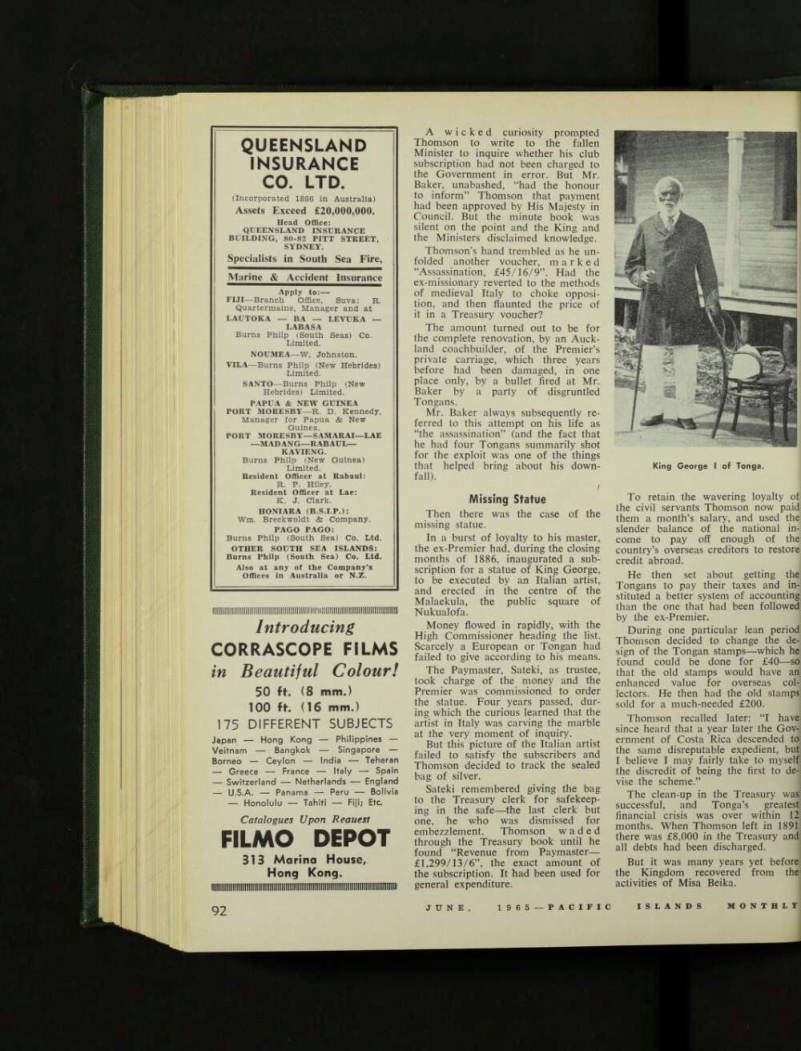
King George I of Tonga.