yesterday
p. 95 · Read in the full issue
World War II did not have far to run in June, 1945.
The issue of PIM for that month reported that, following the Allied victory in Europe, the Allies were pressing on relent lessly towards the home islands of Japan. Air attacks on Japan were an almost daily occurrence, and Tokyo Radio reported that five cities — Tokyo, Yokohama, Nagoya, Osaka and Kobe—had almost ceased to exist.
MEANWHILE, Australian
troops had sealed off about 12,000 Japanese troops in the rugged inland country between Wewak and Maprik, NG; and Australian troops had landed at various points on the north-west coast of British North Borneo. * * * An oilfield, capable of develop ment on a large and profitable scale, was reported to have been discovered in Dutch New Guinea in 1940, but because of the war it had been kept a secret. The location of the field was not stated, but American companies, including Texaco, were said to be interested in it. * ♦ * The Fiji Government announced that the main structure of war time control measures would con tinue “for the present”, but it was
intended to relax regulations as soon as circumstances allowed. * * * Tahiti was having a “remote control” curio boom. It was send ing a steady supply of articles fashioned from pearl-shell, pupu (small sea shells), and the like to Noumea for sale to the armed forces. * * * Keen competition was expected between British and American air lines when trans-Pacific air ser vices were resumed. Pan American Airways, which started a flying boat service to the South Pacific in 1940, was expected to be one of the first airlines in the field. * * * Australia’s Acting Prime Min ister, Mr. J. B. Chifley, told the House of Representatives that Aus tralia had made strong representa tions to Great Britain to send a
military force to Ocean Island and Nauru to liberate them from the Japanese. * * ♦ The death had occurred in the New Hebrides of Mr. Ewan Corlette, of Bushman’s Bay, Male kula, who had been a planter there for many years. He was 70. * ♦ ♦ The illegal possession of military rifles and ammunition in north west Viti Levu was causing con cern to authorities in Fiji. A num ber of shooting incidents and murders in the area were reported. * ♦ ♦ After a brilliant career at the Central Medical School in Suva, the Tongan Government had de cided to send Sione Siosiomalohi to New Zealand to do a full medical course in the hope that he would eventually return and set up a practice in Tonga. The Gov ernment felt he was too gifted to be limited to the work of native medical practitioner. * * * Captain Viggo Rasmussen, well known in the Central Pacific as a trader, schooner captain and Resident Agent on Penrhyn Island, in the Cook Group, had been flown to New Zealand for treat ment following a stroke which had caused partial paralysis. * * * Noumea’s black market liquor trade had fallen off following the opening of many more legalised bars. * * * The motor vessel Margaret, the first of five such ships ordered by the Western Pacific High Com mission for service in the GEIC and BSIP, arrived in Suva from Auckland. * * * The death was reported of one of Tahiti’s leading citizens, Mr.
Edouard Ahnne, a schoolteacher, who closely identified himself with the political and cultural life of the group. He was 77.
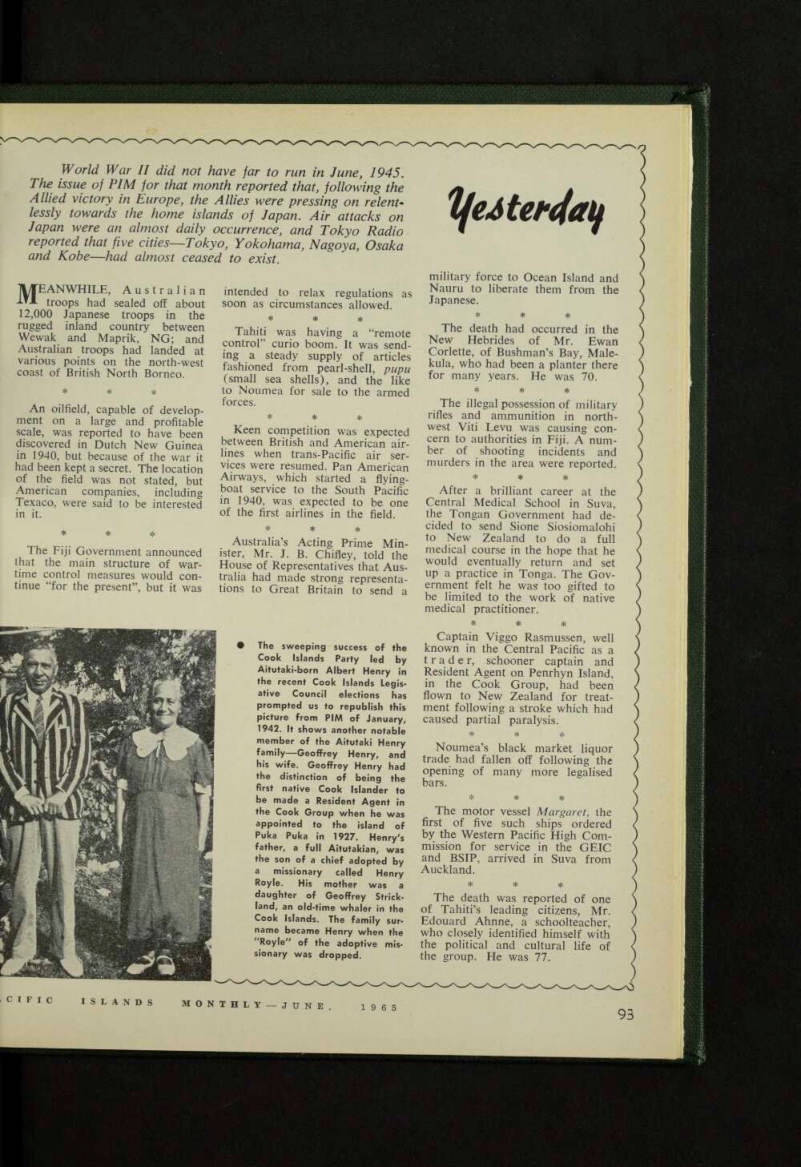
The sweeping success of the Cook Islands Party led by Aitutaki-born Albert Henry in the recent Cook Islands Legis atilve Council elections has prompted us to republish this picture from PIM of January, 1942. It shows another notable member of the Aitutaki Henry family—Geoffrey Henry, and his wife. Geoffrey Henry had the distinction of being the first native Cook Islander to be made a Resident Agent in the Cook Group when he was appointed to the island of Puka Puka in 1927. Henry's father, a full Aitutakian, was the son of a chief adopted by a missionary called Henry Royle. His mother was a daughter of Geoffrey Strick land, an old-time whaler in the Cook Islands. The family sur name became Henry when the "Royle" of the adoptive mis sionary was dropped.