For Historic
pp. 91-92 · Read in the full issue

End Of An Era For Historic Harbour Islet
By Robert Langdon
Motu Uta, the tiny islet in Papeete Harbour, halfway between the entrance through the reef and the waterfront, has come to the end of another era in its colourful history.
A FTER having been the site of a quarantine station for more han 60 years, the islet has been ibandoned for this purpose and a lew quarantine station is being built t Faaa Airport, some five miles iway.
The new arrangement has been nade necessary by the fact that, as ►art of a £2s million plan to in rease berthing facilities in Papeete, dotu Uta is to disappear soon under l mass of concrete and steel and be oined to the mainland to form part »f a new wharf.
Plague Scare
But even if this plan were not in he offing, the shifting of the luarantine station from Motu Uta o Faaa would still be desirable as nore and more people are arriving n Tahiti by plane these days rather han by ship.
Motu Uta first became a luarantine station round the turn of he century when there was a plague care in San Francisco’s Chinatown.
Before that it had served as a lible translation centre, as a get iway-from-it-all venue of prodigious Irinking bouts and revels, as a site or political talks, as a leper station ind as a fortress. But Motu Uta’s ;hief claim to fame is as the site >n which the French flag first flew n the islands of the Pacific.
Except, perhaps, as an abode for
fishermen, the history of Motu Uta began in the first decade of the 19th century when the whalers calling at Tahiti for repairs and “refreshments” forsook the open roadstead of Matavai Bay—which the early ex plorers had used as an anchorage— for the security of Papeete Harbour.
Motu Uta in those days was part of the Pomare family’s property, and when King Pomare II moved to Papeete from the family seat in Pare (nearer Matavai Bay) to be on hand to receive the valuable gifts that the whalers brought, he built a house on Motu Uta so that he could be even handier to them than on the mainland.
Later, after Pomare had been baptised by the LMS missionaries, he also used his home there as the headquarters for his work of helping the Rev. Henry Nott translate the Bible into Tahitian.
Queen's Revels Pomare had become a formidable boozer by this time—thanks to the easy liquor he got from the whalers —and he liked to live on Motu Uta because it was the one place in Tahiti where he could drink hard without being surprised by the missionaries.
He died there in 1821.
After Pomare’s death, his daughter Aimata, who became Queen Pomare IV in 1827, used Motu Uta for some of her girlish revels.
A visitor in 1833 said two or three old carronades had been mounted on the island and the Queen’s residence, besides being a pleasure house, was “often used to discuss matters of political business in”.
Priests Expelled
In 1838, after Queen Pomare had incurred the wrath of the French Government for forcibly expelling two French Roman Catholic priests from Tahiti, Motu Uta was the scene of one of the strangest and most ludicrous events in South Pacific history.
When a French naval officer arrived in Tahiti with instructions to obtain suitable reparations for the “insults” against the French priests, he decided to ask the Queen for a letter of apology in Tahitian and French, an idemnity of 2,000 Spanish dollars, and a salute of 21 guns to the French flag which was to be raised on Motu Uta.
The Queen protested that she could not pay the indemnity because she didn’t have 2,000 Spanish dollars, and that she could not salute the flag because she had neither the flag nor the powder.
But the French commander’s demands were eventually met—the French flag being saluted on Motu Uta after he, himself, had provided both the flag and the powder.
The American novelist Herman
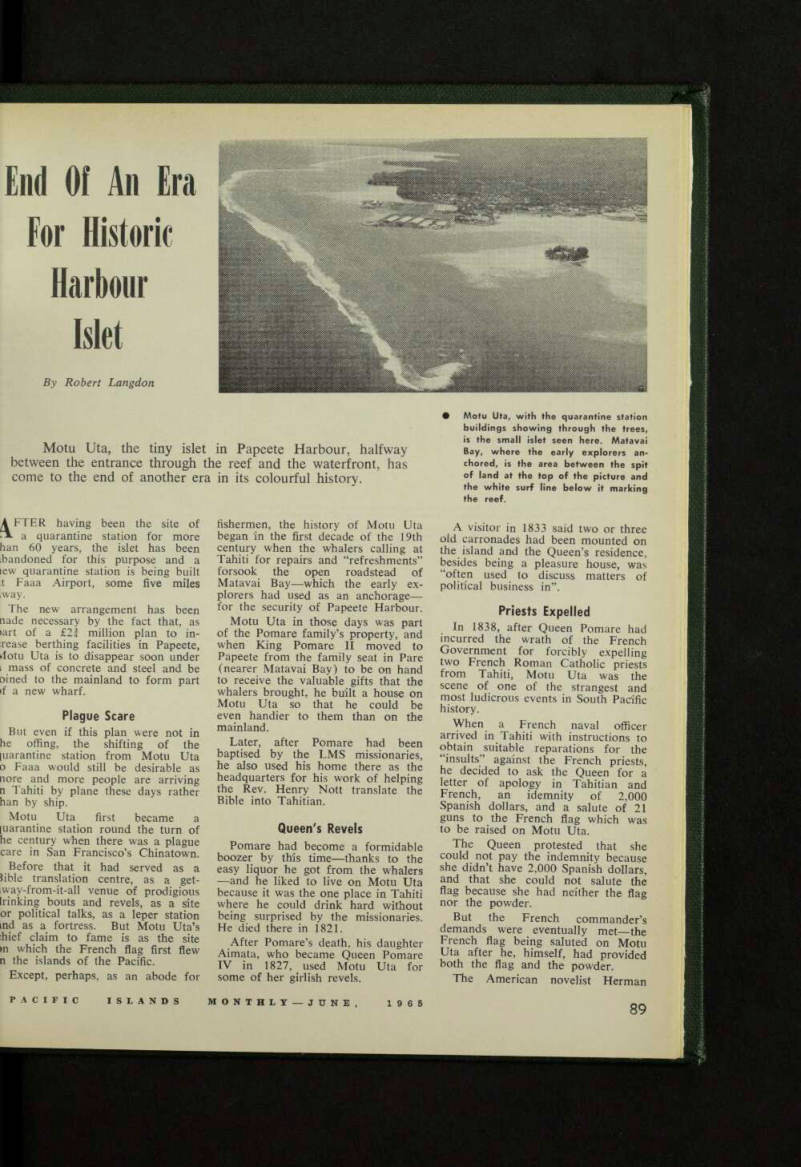
Motu Ufa, with the quarantine station buildings showing through the trees, is the small islet seen here. Matavai Bay, where the early explorers an chored, is the area between the spit of land at the top of the picture and the white surf line below it marking the reef.
Melville, who visited Tahiti four years later, just after the French had established a protectorate, found that Queen Pomare had “done all she could to make a fortress of the island”, and that her residence there —“a melancholy-looking range of bamboo houses”—was falling into decay.
Behind a parapet which had been built with hewn blocks of coral were “a number of rusty old cannon, of all fashions and calibres” which were mounted on “lame, decrepit looking carriages”.
Six years later, another American, Lieutenant H. A. Wise, USN, found that Motu Uta had 12 French cannon on it to support other armament that the French had installed on the mainland. The French were still “busy with pick and barrow” building other fortifications.
Wise thought Queen Pomare showed good taste in choosing Motu Uta for residence, as it was “a most charming retreat beneath the droop ing foliage”.
However, because of the French activity, she had given up going there. It seems that Royal visits to the island were never resumed.
Just Opened
An English visitor to Papeete at the turn of the century in the schooner Tropic Bird, wrote that Motu Uta had just been opened as a quarantine station after having been used as a leper station.
However, there was no resident doctor, and the Tropic Bird had to wait alongside the islet for two or three hours before the Government doctor came out in a boat to give the schooner a medical clearance.
Since then, Motu Uta’s history has been unspectacular—except that about 12 months ago workmen drill ing on the island in connection with the harbour project struck abundant fresh water, much to their surprise, at a depth of 350 ft.